Compose yourself

Wet Autumn Night - final photo

Apologies, this will be obvious to some, but I have seen enough so-so images on social media to convince me there are others who could post much better pictures if they took just a little bit more care. Smartphone cameras are so good these days that everyone is a photographer. But clearly, everyone isn’t a photographer.

So I thought I’d explain how I created the photo above, taken and edited on an iPhone 13 Pro (apart from one final modification, which we’ll get to t the end). I won’t go into massive detail, but assume people have at least looked at the editing functions available on the iPhone. They’re surprisingly powerful.

I was walking out of Senate House in London on a wet October night when I noticed a large pile of fallen leaves, a street made shiny by the falling rain, and the occasional pedestrian with an umbrella. I pulled out my camera and snapped the image below. I did this quite quickly, just waiting a few moments for someone with an umbrella to walk into the shot.

Wet Autumn Night - take 1
I held the iPhone close to the ground so that the pile of leaves would provide a foreground that screamed Autumn and frame the bottom of the shot. The railings on the right framed the picture on that side.

There’s quite a lot of empty, uninteresting space on the left side of the image, so I cropped closer. This also allowed me to position the pedestrian – the subject of the photo – close to the one-third lines that, for reasons that remain largely mysterious to me, helps to achieve a more balanced shot. It gives the subject room within the image and an interesting position.  Placing the subject at the edge of the frame tends to make for a less harmonious composition.

Wet Autumn Night take 3

The initial photo was also dark but the editing tools allow you to lighten dark areas in ways that are subtle enough to not seem unrealistic. There’s a lot of information captured on the sensor that isn’t necessarily displayed via the camera’s albeit pretty smart automatic settings. On the ‘Adjust’ tab of the editing suite, I hit the ‘Auto’ button (the one with the magic wand). This helped to lighten the shadows, and altered a few other settings. But you can go in and tweak further any of the settings available here. The main ones that I adjusted were to lighten the shadows even more (to about 82 out of 100) and to a a bit of vignetting, which darkens the edge of the image.

On the Filters tab, I selected ‘Vivid Warm’ to enhance the orange-brown tones of the fallen leaves.

Wet Autumn Night - take 2

The image achieved at that stage looked pretty good and I posted it on Bluesky, where it was warmly received (40 likes).

However, The presence of the black car driving past the pedestrian bothered me – it was a distraction. If I’d thought about it at the time, I could have waited a few seconds more for it to disappear into the distance. But I was in a rush.

Instead, I turned to the erase tools that are available within Adobe Lightroom (for which I pay £10 a month to have on my laptop and iPhone). These are AI-powered so all you need to do is roughly mark out the bit of the image that you want to remove and it will do a decent job of figuring out what should have been visible if the car wasn’t there. As you can see from the final image, shown at the top of this most, it remarkably good at this. This clever erase function is the best use of AI that I’ve come across!

And that’s  all there is to it! Except of course, it isn’t. It takes practice to see in your mind’s eye the image that you might be able to make of the scene in front of you. You need to think about where you put the camera so as to create the most interesting composition. Sometimes that also means waiting – for someone to walk into or out of shot (look out especially for clutter in the background), or for the sun to come out. You can correct or even erase a multitude of errors with the editing software, but it is more satisfying to start by capturing something close to the picture you intend.

Posted in Science | Comments Off on Compose yourself

Leaving Imperial

Today is my last day at Imperial College London. It marks the completion of exactly 29 years as a member of staff.

Two pictures separated by about 30 years. On the left, young Stephen presented results at the IUCr conference in Beijing in 1993; on the right, older Stephen talking about research assessment reform to funder and university leaders in Tokyo in 2023.

Two talks, about 30 years apart.

I joined Imperial as a young lecturer in Physics on 1st November 1995 and have travelled a long road since then, moving to the Department of Life Sciences a few years later, reaching the rank of professor in 2007, and shifting from structural biology research to work on the management (and culture!) of universities and science when I began writing my Reciprocal Space blog in 2008. I took on new roles at the university: Director of Undergraduate Studies in my department from 2011-15; the university’s first Associate Provost for EDI from 2017-2023; and latterly a College Consul. Outside Imperial I helped to co-found the campaign group Science is Vital and served as vice-chair from 2010-18, joined the board of CaSE from 2012-18, and was chair of DORA from 2017-23.

Such skeletal lists reveal little of the story of my last 29 years. Nor do they have anything to say of the great number of friends and colleagues who provided such depth and colour to the tale.

One day perhaps I will be in the mood to add more meat to my story, but right now I can’t quite grasp how I feel. I’ve said my goodbyes and told people I am relaxed about the next chapter (which will be devoted to caring responsibilities and my part-time role at RoRI), but I in truth I don’t really know what it will be like to no longer be an integral part of an institution that has been such an integral part of my life.

All I know today is that I wanted to mark the occasion.


Posted in Science, Scientific Life | 10 Comments

Abandon the REF?

Screenshot of the UKDayOne report on their website

On Tuesday evening I was asked by Research Professional News for my views on a new report from think tank UKDayOne, which is calling for the abolition of the Research Excellence Framework, unlovingly known as the REF.

The report is provocative and interesting. It has won loud support from one Dominic Cummings. It’s standfirst promises that a lighter-touch alternative will have multiple benefits for the universities and the UK:

“The Research Excellence Framework is too bureaucratic and unaffordable. An alternative system would lead to similar funding allocations whilst supporting university finances and promoting technological diffusion, driving regional productivity growth.”

The entire report isn’t very long so I would encourage fellow academics and policy wonks to read the whole thing. There is bound to be a range of reactions.

Research Professional News’s Fiona McIntyre pulled a few lines from my remarks for her piece (£), but in the interests of stimulating further discussion, here below is the full comment that I sent her. It doesn’t capture everything that needs to be said – there are some complicated issues to unpack here – but I don’t have time right now to dig deeper:

“The REF is an easy target because few would mourn its passing, but I found this provocative report thin and disappointing. Two stars. It cherry-picks from the evidence base and provides relatively little meat on the bones of its main recommendations. It elides research quality with citation performance, a problematically narrow perspective which contrasts with the REF’s much richer view of the outputs, environment and impact of UK research. It claims that Australia and New Zealand have abandoned similar exercises, whereas both countries are currently figuring out how to replace them. The report omits to mention the announcement of a new Canadian Research Excellence Framework.

There are some superficially appealing recommendations for reducing bureaucracy, but these don’t seem to have been thought through properly and leave many questions hanging. The authors propose that QR funding should be allocated in proportion of external research income from private, public and philanthropic sectors and argue this would stimulate collaboration with local industry. Universities already leverage funds from these sectors, but there is no discussion of how much extra stimulus would be provided by this change. Nor is there any attention paid to how this would play out within different STEM disciplines or how to manage the enormous (over 10-fold according to their data) shifts in QR funding that some institutions would experience.

The authors argue that longer term funding for “people, not projects”, targeted at “the most promising individual researchers and research groups” would stimulate blue-skies research, reduce precarity and support equality, diversity and inclusion. But how would this work? How would those researchers not funded this way survive in institutions that need them to teach undergraduates? How does this solve precarity for them? How exactly does it improve EDI? On these questions the report is silent. This rather naive approach to policy formulation is underscored by the quaint notion that grass-roots movements like the UK Reproducibility Network can, on their own, drive much needed culture change. UKRN does important work but in my experience drivers of culture change need incentives that bite.

All of which is not to say that we should not be taking aim at the high cost and bureaucratic burden of the REF. This report should certainly stimulate some fresh thinking but that thinking needs to go much deeper than the arguments presented by the authors.”

Posted in Science | Comments Off on Abandon the REF?

Can scientific productivity be optimized?


This is a repost of an article that was originally published on the Research on Research Institute website. Comments welcome! 

Black and white image of three people silhouetted on a mountain slope

It is a truth universally acknowledged that scientists who take greater risks are more likely to make important discoveries.

Actually, I’m not sure it is a truth, and I don’t know if it is universally acknowledged – I haven’t looked closely enough at the evidence – but it is a long standing and widely held assumption. However, research funders struggle to operationalise this assumption and the question of why that is the case is the focus of a stimulating recent paper in PLoS Biology from Kevin Gross and Carl Bergstrom on “Rationalizing risk aversion in science: Why incentives to work hard clash with incentives to take risks”.

Gross and Bergstrom bring an economic perspective to the question that provides an insightful framing for some of the wider issues that it raises. Here’s their abstract (with my emphasis and annotations):

Scientific research requires taking risks, as the most cautious approaches are unlikely to lead to the most rapid progress. Yet, much funded scientific research plays it safe and funding agencies bemoan the difficulty of attracting high-risk, high-return research projects. Why don’t the incentives for scientific discovery adequately impel researchers toward such projects? Here, we adapt an economic contracting model to explore how the unobservability of risk and effort discourages risky research. The model considers a hidden-action problem, in which the scientific community must reward discoveries in a way that encourages effort and risk-taking while simultaneously protecting researchers’ livelihoods against the vicissitudes of scientific chance. Its challenge when doing so is that incentives to motivate effort clash with incentives to motivate risk-taking, because a failed project may be evidence of a risky undertaking but could also be the result of simple sloth (I would add “or incompetence”). As a result, the incentives needed to encourage effort actively discourage risk-taking. Scientists respond by working on safe projects that generate evidence of effort but that don’t move science forward as rapidly as riskier projects would. A social planner who prizes scientific productivity above researchers’ well-being could remedy the problem by rewarding major discoveries richly enough to induce high-risk research, but in doing so would expose scientists to a degree of livelihood risk that ultimately leaves them worse off. Because the scientific community is approximately self-governing and constructs its own reward schedule, the incentives that researchers are willing to impose on themselves are inadequate to motivate the scientific risks that would best expedite scientific progress.

The authors’ analysis relies on a mathematical model which I confess I did not completely understand*, so I’ll spare you the details; (those who are more mathematically challenged will still get a lot from the paper if they confine themselves to the Introduction, the box on Hidden-action models and the Discussion).  What I did understand of the model in terms of the codification of risk, reward, scientific value, effort, resources and utility and the explanations of simplifying assumptions seemed reasonable and, notwithstanding the obvious risks of confirmation bias, the two key conclusions that emerged from it resonated with my sense of how research decision-making works:

“[…] scientists seem either unable or unwilling to devise institutions that motivate investigators to embrace the scientific risks that would lead to the most rapid progress. Our analysis here suggests that this state of affairs can be explained at least in part by the interaction between two key structural elements in science: the unobservability of risk and effort on the one hand, and the self-organized nature of science on the other.” 

The “unobservability of risk and effort” is more or less self-explanatory and accounts for the reliance on outputs such as publications as markers of achievement, which are to some degree beyond the control of the researcher. Demand for these outputs in the absence of an assessable record of the intelligence and invention brought to any research effort, is what leads many researchers to opt for safer, less-risky projects that are more likely to result in a paper, albeit one that reports a more incremental finding**.

The role of “the self-organized nature of science” needs a little more unpacking for those who haven’t read the whole paper. What Gross and Bergstrom mean here, I think, is that because the highly specialised nature of scientific endeavours relies so heavily on peer reviewers in the assessment of funding proposals, the key decision-makers have a strong internal sense of the risks attending project failure. They are therefore less willing than a hypothetical social planner charged with maximising scientific productivity to subject applicants to a reward regime that more punitively disfavours incrementalist approaches. The authors argue further that such hypothetical social planners cannot emerge in the first place because they would have to depend on researchers to determine how to value outcomes and would effectively morph into conduits for the collective view of the scientific community.

Several thoughts and questions occurred to me in the immediate wake of the paper’s findings. They are not fully formed, so I offer them only in the interest of provoking further discussion.

Any researcher who has been on the receiving end of a paper or grant rejection – which is pretty much every researcher – would be forgiven for asking themselves how much more punishment they deserve at the hands of Gross and Bergstrom’s social planner. Could it be that the current balance of risk and reward achieves the maximal level of scientific productivity that is commensurate with the desire to accord researchers a reasonable work-life balance? Personally, I don’t think I ever achieved any kind of balance during my time as a jobbing academic trying to carve out a career in research. Current efforts to incorporate research culture and the quality of the lived research process as part of assessment exercises spring from long-standing concerns about the risks and stresses imposed on researchers. One cost not discussed in any detail in Gross and Bergstrom’s analysis is the human cost (though I appreciate they deliberately narrowed the parameters of their model to answer a specific technical question and the human cost factors into the appetite for risk).

Also, is it so difficult to uncover hidden effort? Better line management within research performing organisations could track effort, and perhaps even reward it directly if sufficient intramural funds were available. Researchers would also feel less of a sting from failed grant applications if funders were more open about the uncertainties in decision-making processes that ultimately rely on human judgement; feedback that clearly flags applications assessed as of fundable quality but for which funds were not available could provide some measure of career protection for researchers back at their home institution.

Although Gross and Bergstrom dismissed their hypothetical social planner, Daniel Sarewitz has argued powerfully and provocatively for a more managerial approach to the organization of research, in part to tackle what he sees as the perverse inefficiencies arising because science is permitted undue freedoms to self-organize.

Elsewhere, Michael Nielsen and Kannjun Qiu’s long but very worthwhile essay “A Vision for Metascience” casts Gross and Bergstrom’s social planners as risk-taking “metascience entrepreneurs” empowered to achieve “scalable change in the social process of science. Their ideas for incentivising risk include (among many other interesting but as yet untested suggestions) funding by variance, where grant applications are funded not by being high scoring among reviewers but by polarizing opinion; or failure audits, where grant programme managers are fired if the failure rate of their funded projects drops (yes, drops) below 50%.

Conceivably, the UK’s recently established Advanced Research and Innovation Agency (ARIA) also embodies an alternative form of the social planner. Modelled on similar Advanced Research Project Agencies in the US (e.g. DARPA, ARPA-E, ARPA-H), ARIA is essentially run by programme directors in a range of topic areas who have the authority to select and fund projects they believe will result in the most significant breakthroughs. I’m not aware of any study that has quantified the scientific productivity of the longer-established American agencies in comparison to more traditional mode of research funding, but their anecdotal (?) reputation was sufficient to persuade the UK government to bet on ARIA. I share the view that this a reasonable bet for the UK to take, even if the funding agency has yet to develop robust criteria to demonstrate its own worth.

A last thought on productivity to throw into the mix: a hidden assumption of the Gross-Bergstrom model is that all research funding is awarded competitively. But what would be the impact on productivity of an ecosystem where researchers were provided with a basic or background level of funding, enough for a single postdoc or research technician, guaranteed for 10 years, in recognition of their hard work? As I’ve argued elsewhere (and some time ago), such a regime could boost the productivity of the research funding ecosystem by reducing the wasted effort of submitting grant applications to funding systems  that have chronically low success rates. Ghent University’s introduction of a form of universal basic research funding is a tentative, small-scale step in this direction.

There are further, broader questions raised by Gross and Bergstrom’s paper. For example, is an analysis centred on individual economic actors weighing the balance of risk and reward in deciding which research projects to undertake the best way to explore questions of scientific productivity? What does it have to say about the impact of different institutional models, which not include not only the APRA/ARIA approaches mentioned above but also experiments in Focused Research Organisations (FROs), innovative academic-industrial fusions such as Altos Labs, or new types of research institution, such as Arcadia Science or Astera?

Finally, I’m not sure how useful it is to talk about maximising or optimising the productivity of science, given the immense diversity and complexity of its processes, outputs and impacts. That’s not to say that discussions of how to improve scientific productivity should figure out optimisation before any policy decisions can be made. Dare I suggest that more incrementalist approaches to improvement represent a more realistic and promising approach? We need to start somewhere – some already have! – and policy makers, no less than scientists, should be prepared to take risks. We will just have to work out the evaluation methods as we go.

I am grateful to James Wilsdon for a critical reading of a first draft of this blogpost.


Footnotes

*Although reasonably mathematically literate, I would have benefitted from a fuller description of the equations feeding into the model and suspect many other PLoS Biology readers would too. The Box on Hidden-action Models was useful though!
**One of the simplifying assumptions of the model that did trouble me was that studies resulting in “unpublishable outcomes”, presumably null or negative results, were assigned a scientific value of zero. This is not altogether unreasonable given that null results are rarely written up for publication because they are not rewarded. Journals in search of citations to buttress their impact factors strongly prefer positive results and researchers in search of jobs, promotion and funding, are strongly incentivised to publish in ‘top journals’. But in truth null or negative results are not valueless and their absence from the published research record impacts productivity because the lessons learned from such studies are not logged, leading potentially to unnecessary duplication of effort. If we are interested in understanding the productivity of scientific research, we need better measures of the value of null results, not just a deeper understanding of the tensions between risks and incentives.
Posted in Science | 1 Comment

On the Freedom of Misunderstanding of Speech

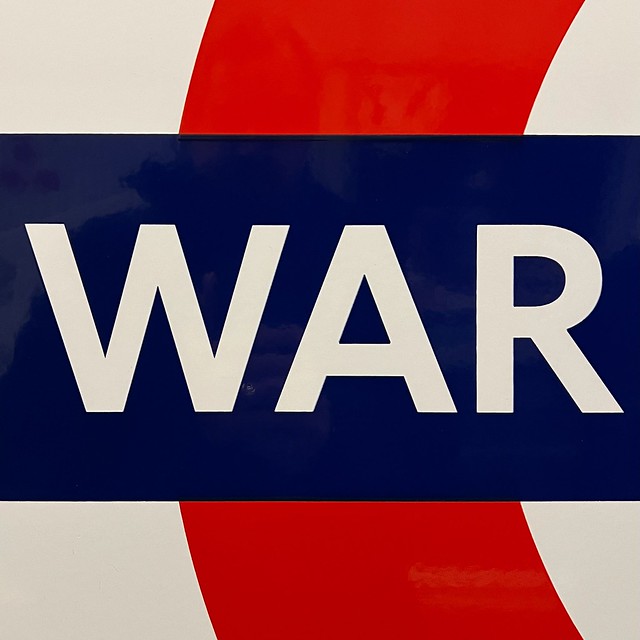
Close up of the Tube sign at Warren Street station showing just the letters W-A-R

Misreading on the tube leads to WAR

“The Ruffian” is great title for Ian Leslie’s Substack given his predilection for roughing up lazy thinking. I first came across him as the author of “Conflicted”, an excellent book about how to disagree constructively, a practice he frequently deploys in his Ruffian pieces. I sometimes disagree with Leslie, but not often enough to stop me paying the £4 monthly subscription to his Substack. He’s a sharp-eyed and sharp-tongued observer of contemporary life and there’s a substance to his writing that can’t easily be dismissed.

A couple of weeks back Leslie’s sharp eye was directed towards the critical reception of the recent Netflix specials from Ricky Gervais and Dave Chapelle, both of which have been branded as “anti-woke” by commentators who dismissed the performers as lazy and out of touch. In characteristic hang-on-a-minute mode, Leslie observes that both shows are among the most popular currently on the streaming service and mounts a pretty cogent defence that in his show Armageddon, Gervais (whose work he is most familiar with) is laughing not at minorities but at the po-faced strictures of the members of the ‘wokerati’ who have set themselves up as censors.

I think he has a point, even if the piece did raise a couple of uneasy thoughts that I wanted to chase down. I agree with him that comedy doesn’t have to have a moral purpose – it’s about the laughs. And like him, I want to live in a society where comedians are free to push at boundaries and to play with the hypocrisies and discomfort of their audiences. Indeed, I think that comedians have a licence to transgress. Those watching have made a choice to do so and there’s an understanding that what’s being watched is a performance, even if some performers work hard to disguise their artistry.

Even so is there any collateral damage? The comedian’s licence to transgress isn’t easily transferred to the workplace or other social environments. Gervais can’t reasonably be held responsible for the retelling of his material, but it is nevertheless absorbed into broader discourse.

As others have said elsewhere, Gervais’s show is a bit lazy in its content and construction. He’s done smarter work and I’ve seen edgier and better crafted shows challenging social mores from the likes of Stewart Lee, James Acaster, and Hannah Gadsby. Armageddon lacks their fire and sophistication, though admittedly Lee, Acaster and Gadsby were approaching transgressive boundaries from different angles in their work (I am probably revealing my tastes and biases here). Gervais leans too heavily on simplistic caricatures of some of his targets such as critical race theory or statue protests (though he had a good joke about cultural appropriation). These things are fair game for comedic attack but do jokes that operate at a Daily Mail level of critique of the underlying ideas erode the foundations of efforts to create a fairer and more tolerant society (efforts which Gervais admits at the end of the show he supports)?

On balance, I suspect not. I felt I could take what I liked from Ricky Gervais’s show and discard the rest and my guess is that many other audience members are probably doing the same. Is it a problem that not all are – that some are clapping and nodding along without seeing the artifice in Gervais’s act? I find it hard to believe that the political divisions over the merits and demerits of ‘wokeness’ depend much on any one comedian, however popular.

I’m very likely over-thinking this, but I still think there’s a broader point here about the impact of misunderstanding in public discourse. Misunderstanding is the raw material of comedy, which is part of the justification for its license to transgress. Jokes often play on people’s misperception of the set up: “By my age, my parents had a house and a family, and to be fair to me, so do I, but it is the same house and it is the same family” – you can see why Hannah Fairweather’s was judged one of the funniest jokes at the 2022 Edinburgh Fringe Festival. However, in discussions that aim to critique one viewpoint or another, misunderstanding is more problematic, whether it’s intentional or not.

The intentional part is obvious in the rhetoric of political posturing. But there’s another aspect of the problem that seems to be more common in the age of quickfire social media and was highlighted in Helen Lewis’s Substack on the reaction to the Gervais and Chapelle shows on Netflix: the politicisation of arts criticism. Lewis writes “Many people are making political judgements, rather than artistic ones, and using these cultural avatars to signal their political beliefs,” and suggests this is happening both because “it’s easier to write about the ideological content of an artwork […] than it is to appraise its technical details” and because controversies over ideology, particularly ones stoked by half-truths and superficial analyses, attract readers and clicks. The problem extends to those of us who engage in social or political debates on Twitter/X, Instagram, and in blogs or Substacks, where the primary purpose is to attack or defend a given position, because we are on show in a technologically enlarged public square. It’s human nature to fall back on snap judgements and assume that any given statement defines a person or the full contours of their political viewpoint. We’re all prone to this sort of kneejerk or system 1 thinking, which is most likely to be unleashed in the heat of partisan politics or – to return to my starting point – the woke and anti-woke enmities that inflame the current culture wars.

The temptation to react without thinking more deeply might be augmented by the rapid-fire format of much of social media but is not confined to it. Even in longer form writing it can be difficult to convey the totality – dare I say complexity? – of what we want to say. Even as I write this post, already festooned with mid-branching qualifications, I aware of the compromises between the clarity and conciseness. Ideas spill and meander in branching lines of thought and can be hard to shape into concrete forms. This is why Pinker argues it’s so much easier to explain yourself in conversation than in writing, where you cannot react to your audience and have instead to anticipate their needs.

I write all this as someone who has given in to the laziness of system 1 thinking on occasion (mostly on Twitter) and who has in turn, as a result of working in matters of EDI and research culture in a university setting over the past several years, found myself misunderstood. I have been variously accused in the press and on social media of being a stifler of academic freedom, a remover of statues and, on one particularly memorable occasion, “a witchfinder general”. As far as I am concerned, each of these accusations was based on misunderstanding or misreporting, but maybe part of the fault was mine for not expressing myself clearly enough. While each accusation was an irritant, I mostly opted not to respond. This was because although I was being criticised personally, as a member of the senior leadership team of the university, I risked any reaction being seen – misunderstood? – as an institutional pronouncement. I no longer hold that position, so it is now easier for me to write about these incidents, but I don’t feel completely free of the constraint of institutional association.

Still, the lack of response still feels like a failure. I am well aware that contested matters of EDI present no easy solutions, which is why I made openness to challenge and dialogue the seventh of seven pillars in our university EDI strategy and have striven to live up to that commitment in responding to concerns raised by colleagues and students. But it’s hard to know how much faith people have in that commitment (both internally and externally) and it certainly remains the case that universities struggle to engage meaningfully in public-facing discussions about what they are doing.

The facile answer to this challenge is that everyone should read and absorb the lessons of Ian Leslie’s book about how to have a productive argument. That’s easier said than done, alas, even at universities which, of all our public institutions, are supposed to be the places where ideas can be tested rigorously – to destruction if need be. The places where thinking should be the least lazy.

However, it doesn’t always work like that. As we have seen last week with the Employment Tribunal judgement that Professor Jo Phoenix was subjected to victimisation and harassment at the Open University for her gender critical beliefs. The lesson to draw here is not that such behaviours are to be found at all UK universities. In my experience of leading on EDI at my own institution and through talking to my opposite numbers across universities in the UK and Europe, there is serious engagement with the myriad intersecting issues (including academic freedom and freedom of speech) that affect efforts to create environments that more equal, more diverse and more inclusive. Although some might accuse universities of mindlessly quaffing the Kool-Aid of wokeism and identity politics, what I have mostly seen is recognition that we are grappling with complex and shifting debates and that dialogue to find a way forward has to embrace the full range of views that are advanced in good faith.

Perhaps these internal discussions are too internal. It remains true that creating a space within universities for critique of difficult issues – the appropriate balance between trans rights and women’s rights, the Israel-Gaza conflict, the frictions between sexuality and some religious beliefs – remains, well, difficult. There is nervousness about internal and external reactions that crowd out efforts to have a more informed and nuanced discussion between different perspectives. But if universities aren’t prepared to shoulder that risk, who will? They are not helped by the fact that these issues are now grouped under the simplistic and misleading term, ‘culture war’. Different perspectives on our aspirations as a society or a culture aren’t going away, so why condemn ourselves to endless bitter conflict? As a first step, wouldn’t it be better to stop warring and have a conversation? Who’s brave enough to go first?


Posted in Equality Diversity & Inclusion, Science & Art, Science culture, Scientific Life | 4 Comments

Books of 2023

A combination of life’s distractions, ill discipline and slow reading mean that I have only managed to finish 11 books this year. I am almost embarrassed to admit to such a paltry tally. There are people who can rip through that many titles in less than a month. I envy them their capacity. But it is what it is. Eleven.

As is now my habit, there is a tweet thread of brief reviews of each book – summarised in the image below. Click on the image for a higher resolution version.

Multi-panel image of the tweet thread of reviews of the 11 books I read in 2023.

Tweeted reviews of the books read in 2023.

My favourites would have to be the first two books that I read this year: Andrea Wulf’s Magnificent Rebels and Kenan Malik’s Not so Black and White.

I had previously enjoyed Wulf’s biography of Alexander von Humboldt (The Invention of Nature) and he reappears here, albeit as a minor character, in her stupendous and rollicking tale of the writers, philosophers and thinkers who coalesced around the polymath Goethe in the small university town of Jena in the last decade of the 18th Century. Their lives, deaths, loves, rivalries and collective creativity make for a riveting story.

Not so Black and White is a more sober tome but no less vital. It provides a deeply informed analysis of the history of racism and the ways that identity politics, while seeking to enact the higher aspirations of the Enlightenment, have led to a fracturing of social solidarity. Malik is another author I’ve read before – his The Quest for a Moral Compass is a magisterial exploration of the development of moral philosophy – and I was once again hugely impressed by the depth and clarity of his writing.

Most of the other non-fiction titles I got through this year were also important and compelling reads, especially Sarah Churchwell’s The Wrath to Come, an exploration of the persistent legacy of slavery and white supremacy in the USA; Angela Saini’s deconstruction of the presumption of male power in The Patriarchs; Matthew Cobb’s The Genetic Age, a thoroughly researched account of the societal implications of gene and genome engineering; Gaia Vince’s terrific and terrifying analysis in Nomad Century of the likely impact of climate change on human migration; and Peter Frankopan’s massive and massively impressive The Earth Transformed – world history as you have never read it before.

I reserve special mention for Why don’t things fall up?, my friend Alom Shaha’s brilliantly lucid account for non-specialists of how science helps us to understand the world.

Sadly, the two novels that I read this year – Amor Towles’ A Gentleman in Moscow and Anthony Doerr’s All the Light We Cannot See – were both disappointments, neither conjuring for me the feeling of the worlds they sought to convey. Better luck next year on that front, I hope.

Posted in Book Review | Comments Off on Books of 2023

Photos of 2023

I took over 2800 photos in 2023. Actually, I took a lot more because we went on safari in the summer and I have worked hard to cull as many shots that I could from that trip. Even so, that left me with nearly 1000 pictures of wildlife that I want to keep.

Facade of a building in Bologna onto which is projected paintings of the dissected human body

Building and body beautiful (Bologna)

My selected favourites bear witness to the fact that this has very much been a year of travel – mostly to cities and mostly for work. I started and finished the year with trips to Germany. Sharped-eyed viewers will see that over the course of the last 12 months I have visited Berlin, Ballymena, Vienna, Cambridge, Brussels, Barcelona, Geneva, Auschwitz, Valencia, Kenya, Leiden, Killyleagh, Bologna, Tokyo, and Hannover – not forgetting, of course, my home town of London.

Orange and grey concert hall, reflected in damp concrete.

Concert Hall (Berlin)

There are cityscapes and pictures of whole buildings but I do like to try to pick out details, fragments that will give some sense of what it was like to wander the city streets. I retain also a fascination with the shapes and colours that our manufactured environment presents to the eye.

Angular block of flats abuts two chimneys from the restored Battersea Power Station (London)

Battersea Power Station (London)

Metal statue of man in a frock coat and top hat beside a bell - seen on the roof of a building in Brussels

Bell ringer (Brussels)

Woman walking alone down a narrow lane in Barcelona. It is evening time - the street lamps are lit.

Barcelona walker

A crown of hippos in a natural pool; glistening with water, many of them appear to eye the camera

A crowd of hippos (Masai Mara, Kenya)

Nighttime cityscape in Tokyo under grey skies – lights are on in many tower blocks.

Los Angeles 2019? No, Tokyo at night.
Yellow and red illuminated girders of the Tokyo tower make for an angular and abstract composition

Tokyo tower in red, yellow and blue

In the foreground stone steps lead down to a path that meanders into the distance over the hills and mountains of Co. Down

County Down (N. Ireland)

All 90 of this year’s selection can be found on Flickr.

Posted in Photography | 2 Comments

An open letter on EDI matters to the Secretary of State for the Department of Science, Innovation and Technology (DSIT)

The letter below started out as a ‘closed’ communication sent to DSIT on 11th October but in the absence of any response, despite two reminders, and the revelation in the meantime that the Secretary of State herself sometimes has  occasion to write open letters, I have decided to publish it.

Although my letter precedes the furore ignited by Michelle Donelan’s missive to UKRI raising her concerns about tweets by members of Research England’s Equality, Diversity and Inclusion (EDI) Advisory Group, it touches on a related issue: the use and interpretation of evidence in political discourse on matters that are central to research and higher education.

Donelan’s UKRI letter put a very particular spin on a small number of words in a few tweets and proceeded to call for the disbandment of an EDI committee that has yet to meet. It seems to me that greater diligence was needed to ascertain whether or not the individuals involved are actually biased in a way that would compromise their role as advisors on EDI before any challenge was made regarding their participation in the committee. It would also have been more rigorous of the Secretary of State to have provided a rationale for her call to disband the committee completely.

The issues involved here (attitudes to the Israeli-Hamas conflict) and in my letter (a request for clarification of claims made by Michelle Donelan with regard to questions of sex and gender) are complex and important. They deserve serious attention. That means that any and all discussions should pay particular attention to the totality of evidence, rather than being selective with the facts.

Of course, the difference between scholarly and political discourse is very often located in the way that facts are used. The best scholarship will embrace all relevant information, including that which might contradict an argument that is being advanced. By contrast, it is in the nature of the rough and tumble of politics for people to play a faster, looser game.

In reality, the differences are not always so marked. We all – scholars and politicians alike – cling to our predilections and worldviews. Our minds are not changed so easily. But none of us has a monopoly on the whole truth, which is why it is so important to try to be open-minded and curious about what people we disagree with are really thinking.

I still hope therefore to get an answer to my letter and a clearer insight into the mind of the Secretary of State. On the face of it, she and I see the facts differently and have different views on the importance of work to promote equality, diversity and inclusion within our universities and research institutions. But I am curious to know if there is scope to explore what commonalities there might be between our perspectives.

11 October 2023

Dear Secretary of State

I write in a personal capacity as a scientist who has spent their entire professional life working in academia and been closely involved in addressing a range of issues related to research culture. These include the impact of incentive structures, and efforts to create a more diverse, inclusive, and productive academy. As I’m sure you are aware, these are knotty subjects.

I was pleased to read of your commitment to facts and evidence in your speech to the Conservative Party Conference last week, but troubled by some of the vaguer claims made about the ‘slow creep of wokeism’. I realise party conferences are occasions for rallying the troops, but you touched on complex issues that require serious deliberation, not least because of the impact they can have on the people most affected by them.

Therefore, there are two points in your speech on which I would be grateful for a clarification of the facts.

First, you said that Scotland’s Chief Statistician had issued guidance to the effect that “data on sex can only be collected in exceptional circumstances”. I have had a look at the guidance document but did not get a sense that that was his intention. Please could you or someone in your team point me to the sections where your claim is substantiated?

Second, you said that scientists are being told “by university bureaucrats that they cannot ask legitimate research questions about biological sex”. Could you please list the instances where this has happened that you had in mind? If there are very many, perhaps just mention four or five that you consider the most disturbing. I’m bound to say I have not come across such direct interference in my own work in science or in the EDI space. I am fully aware that questions of sex and gender are discussed, often in an uninformed and ill-tempered manner in the media and social media, but in my experience universities grapple very carefully with these questions.

There is of course a rapidly evolving discourse around sex and gender, and one that is important for our society. That is why it is crucial for us to create space for constructive dialogue. Perhaps this is your aim with the investigation to be led by Prof Alice Sullivan? I hope that will provide an opportunity for an informed discussion that is broad enough to embrace not just academic and policy research, but the women and LGBT+ communities closest to these matters.

Yours faithfully,

Professor Stephen Curry


Posted in Equality Diversity & Inclusion, Science & Politics | Comments Off on An open letter on EDI matters to the Secretary of State for the Department of Science, Innovation and Technology (DSIT)

Kenya: Where the Wild Things Are

Everyone we knew who had been on safari told us they’d had such an amazing experience that I was worried our expectations for our trip to Kenya were being set too high.

Elephants near and far walking in the Kenyan sunshine from right to left over beaten grassland

Elephants trekking across Amboseli National Park

I needn’t have been concerned. For six days we bounced and rattled in a Toyota Landcruiser driven by our knowledgeable and sharp-eyed guide, Senei, and each game drive seemed to be better than the last.

Black rhino in the Serengeti grassland with an Oxpecker hovering above

Black rhino in the grassland at the Masai Mara

I took hundreds of photographs. I had a harness that would allow me to carry two cameras, one on each side, so that I could quickly switch between their different lenses. I looked and felt a bit weird in this get-up but in the end was pleased with the flexibility it gave me.

Flamingoes at the edge of the water and in flight.

Flamingoes at Lake Nakuru

I won’t post all my picture here, though I am sorely tempted. The wonder of it all. We saw lions, elephants, giraffes, hippos, hyenas, vultures, wildebeast, water buffalo, antelope, a leopard, a serval, flamingoes, pelicans and a huge variety of other birds.

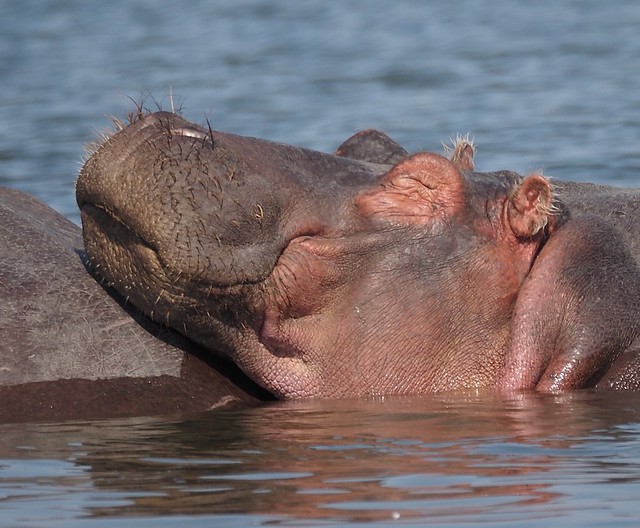
Close-up of the head of a hippopotamus in the water, resting on a friend and apparently smiling in his dreams

Happy hippo in Lake Naivasha

If I have any regrets it’s that we didn’t have more time to stand and stare. The experience of seeing so many wild animals in their native habitats made me realise how rare it is to see large, undomesticated animals in the UK. If you do, it is in ones or twos, usually darting across the road. I guess you can still see herds of wild deer in Scotland, but I never have.

Male lion with severe facial scarring looking directly at the camera.

A lion who’s been in the wars (Amboseli National Park)

The pictures here are just a taster. If you would like to see more, I have selected my top 78 and created an album on Flickr. If you are interested in seeing more than that, I have assembled a larger set that is essentially a photo-journal of our trip.

A black and orange bee hovering over the centre of a bright purple and yellow flower.

Busy bee

Enjoy!

Posted in Photography | Comments Off on Kenya: Where the Wild Things Are

Why Succession failed me – just

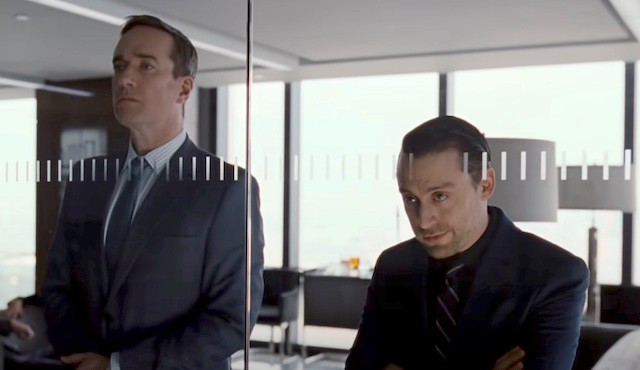
Tom and Roman gaze out through the glass wall of a corporate office

Tom and Roman – trapped by farce?

I have been trying to put my finger on why I have found Succession — HBO’s must-see series about fictional US media mogul Logan Roy and his dysfunctional family — to be at once utterly compelling and annoyingly dissatisfying.

The show has an excellent pedigree. It was created by Jesse Armstrong (Peep Show, The Thick of It, Fresh Meat), and has a stellar cast featuring career-highlight performances by Brian Cox as the ferocious patriarch and Matthew Macfadyen, playing brilliantly against type as the hollow but calculating hanger-on Tom Wambsgans; these two shine just a little bit more brightly than the portrayals of the fractious Roy children by Alan Ruck (Con),  Jeremy Strong (Kendall), Sarah Snook (Shiv), and Kieran Culkin (Roman).

Succession is commonly mentioned in the same breath as other stand-out television series from the last two decades, such as The Sopranos, Mad Men, and The Wire, but I wouldn’t put it in the same category at those dramas. Technically, nor would the creators, since Succession is a comedy-drama, and one that that some perceptive critics have even compared to superior situation comedies, because of the recursive plotting, which loops from season to season around the children’s struggles to grab the reins of Waystar-Royco from their ailing father.

I think there’s something to that designation. But even though the series has some scenes that are blisteringly dramatic – not least from season 4, Logan’s sorrowful dismissal of his kids in the karaoke bar (“I love you, but you are not serious people.”), their hate-love inflected attempts to say a last farewell to him over the phone, and Shiv and Tom tearing truth and chunks out of each other on the balcony at the pre-election party – its comedic instincts pull the show more towards farce than a work that has something new to say about modern life.

This, ultimately, is the source of my dissatisfaction with Succession. Because so much of the plotting and characterisation is rooted in farce, they end up being flattened in a cartoonish way that you don’t find in more serious drama. There are moments of self-awareness for many of the characters but little in the way of any kind of growth. That would be OK – who says that people have to grow or learn lessons in fiction? – but the main dramatic weakness is that you almost never get to see any of the characters doing their jobs. They mostly sit around bickering, albeit in superbly caustic terms, but that wasn’t enough for me. Logan’s charge of unseriousness therefore applies not just to the characters of his children but to the narrative, which lacks the procedural depth found in shows like The Sopranos or, my recent favourite, Better Call Saul. There’s no real sense that Kendall, Shiv, or Roman have the wherewithal to run the company. To my mind, nowhere near enough groundwork had been laid to make Tom’s transformation into the all-powerful CEO believable.

Realising that Succession is more farcical, than dramatic makes this omission more forgivable but I still can’t really understand it, given the enormous amounts of talent involved in creating the show. But what do I know – a mere armchair critic? Maybe an injection of reality would have nixed the comedy? I’ve got my suspicions.

Whatever. Succession remains an outstanding achievement – horrifically compulsive viewing. And who would have guessed that Roman would ultimately emerge as the most relatable human of the bickering Roys?

For better and more in-depth critiques, see these pieces by Hannah Mackay (BFI) and Isabel Berwick (FT).

Posted in TV review | Comments Off on Why Succession failed me – just

A day in Auschwitz

Entrance to Auschwitz I with the 'Arbeit Mach Frei' iron gate

Entrance to Auschwitz I

Last week I visited Auschwitz. I find myself hesitating to write or say anything because I can’t find the words to convey the horror of the place and, in any case, so much has already been written and said far more powerfully by the Jewish survivors of the evil that was the Holocaust.

The trip was organised by the Holocaust Educational Trust as part of their Lessons from Auschwitz project, which aims to raise awareness of antisemitism among school and university students and teachers. It was preceded by a workshop that included an eyewitness account of the savagery of the Nazi death camps by Holocaust survivor Renee Salt. I was already familiar with the accounts written by Primo Levi and Viktor Frankl, but these could not compare to hearing the testimony first hand.

Renee’s horrific story made the trip to Auschwitz all the more human because the camps themselves lie empty, bearing only silent witness to the unspeakable events that took place there.

Crutches and artificial limbs taken from disabled people who were sent to the gas chamber on arrival

Crutches and artificial limbs taken from disabled people who were sent to the gas chamber on arrival

I learned that Auschwitz is composed of three separate camps, two of which we visited. Much of Auschwitz I, a converted army barracks which has the infamous ‘Arbeit Macht Frei’ gate, is now a museum containing many artefacts and records of the people who perished there: shoes, luggage, pots and pans, crutches, hair (taken for the German textile industry), and photographs. It also, chillingly, retains an intact gas chamber and crematorium.

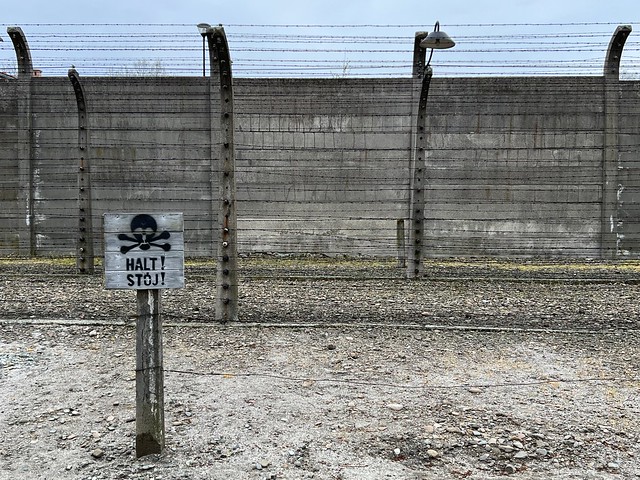
A 'Halt!' sign with skull and crossbones stand in front of barbed wire fences and a high concrete wall.

No way out

Empty canisters of Zyklon B

Empty canisters of Zyklon B

Gas chamber

Gas chamber

Crematorium oven - with trolleys for loading corpses

Crematorium oven – with trolleys for loading corpses

Sign saying "Danger! High voltage will cause death" in front of fences and barrack buildings

“Danger! High voltage will cause death.”

Barbed wire - close-up

Barbed wire


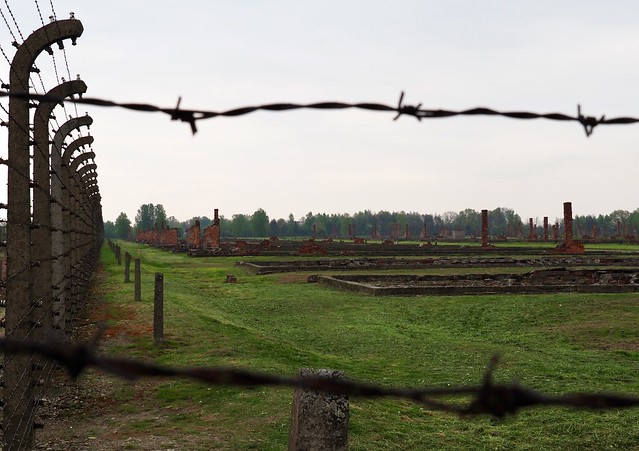
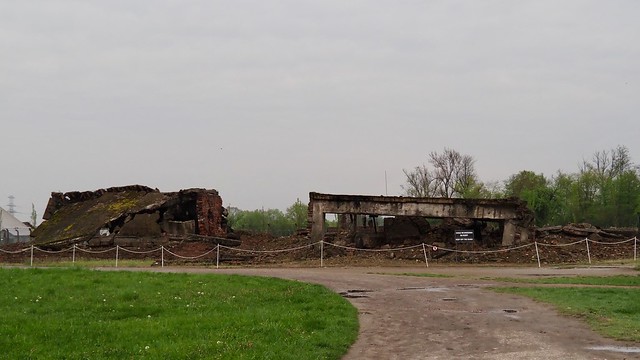
Auschitz II, or Auschwitz-Birkenau, was purpose built for murder and the sheer scale of the place is hard to comprehend. Row upon row of huts almost as far as the eye can see and, at the rear, the remains of the four gas chambers and crematoria, which were ineptly dynamited at the end of the war as the Nazis sought in vain to destroy the evidence of their crimes. The photographs I took struggle to convey the size of the camp, or the grimness of the visit.

Entrance to Auschwitz-Birkenau

Entrance to Auschwitz-Birkenau

Guard towers at Auschwitz-Birkenau

Guard towers at Auschwitz-Birkenau

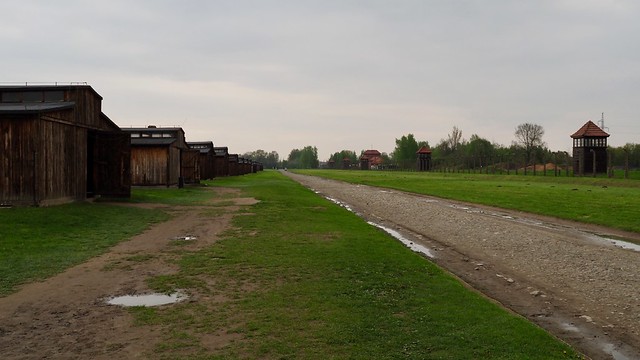
Prisoner huts at Auschwitz-Birkenau

Prisoner huts at Auschwitz-Birkenau

Bunk beds inside a hut at Auschwitz-Birkenau

Bunk beds inside a hut at Auschwitz-Birkenau

Remains of huts at Auschwitz-Birkenau

Remains of huts at Auschwitz-Birkenau

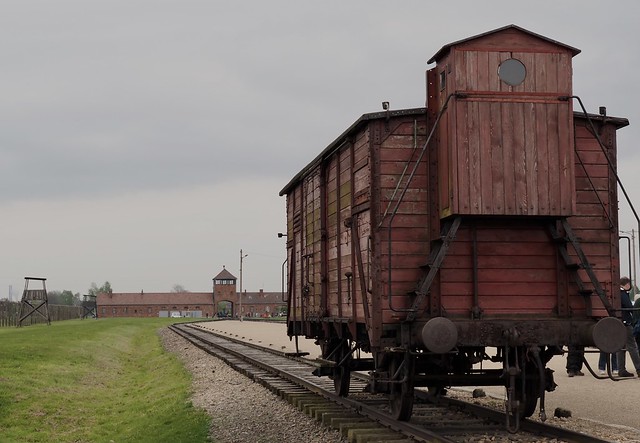
Modified cattle truck

Modified cattle truck

Remains of the crematorium

Remains of the crematorium

Finally, because the photographs bear only insipid witness, perhaps the wordless video below will give a better sense of what it was like to be there. It was impossible to absorb the full extent of the horror but will be impossible to forget.


Posted in History of Science | 1 Comment

The separation of life and death

Dad on the beach - Sept 2014

Who is that stranger in my father’s bed?
Those sunken eyes
The concave cheeks
Salted with stubble
The thinned grey hair
Plastered to a narrow skull.
I have lost the man I loved.

In truth it had been a long journey
To this resting place.
A slow stepping backwards
As memory stuttered and stalled
And confusion dampened
The flares of anger
That made strangers of us both.

You used to fill a room with smiles
(Or suck the air out of it).
How did we become so
Disconnected?
Before the question is fully formed
The answer blurts out:
This is not death
It is life.


(My father died in February and I am still coming to terms with the loss. I don’t know what to make of it. Ours was at times an uneasy relationship; we were close and not close. I don’t want to dishonour his memory, but neither do I want to gloss over. I suspect I am not yet ready to look at it – or my own feelings – too closely.)

Posted in Philosophy | 3 Comments