Staffing Matters

How good are Universities as places of employment? The THE ran a couple of stories last week, headed ‘higher education staffing’, looking at the age distribution of academic staff, and the gender pay gap. I don’t think either of these stories are particularly new for this year, but they are a constant, depressing reminder, that as a sector we don’t appear always to value individuals as we should. The stories arose from the publication of HEFCE’s Annual Report on Staff employed at Hefce-funded HEI’s.

The report shows that the proportion of academics over the age of 60 has increased from 5 to 9% in the years since 1995, and the older staff are especially concentrated in humanities, languages and social, political and economic studies – so less of a problem for scientists apparently (maybe we burn out earlier). As things stand, this drift in age (there are now only 8% of academic staff under 30 compared with 14% in 1995) is only likely to get worse with the removal of a default retiring age. Most universities have simply accepted this position; in the future academics can choose when to retire past 65 and, if US universities are a guide, a significant number will choose to work on well into their 70s (according to a 2006 report, for instance, at Harvard there were more tenured faculty over 70 than under 40). This is not going to improve the situation for those up and coming youngsters, the postdocs  and research fellows seeking to step up into permanent faculty positions, whose fate has featured previously on these pages (here and here, for instance)  as well as those of OT blogger Jenny Rohn (here and here).

My own university saw these problems looming. We looked at the turnover for different grades of staff: academic, academic-related and support staff. What was very clear was that we had less turnover of academics than many HEIs, with around 50% of all new academic openings arising from retirement. These statistics meant, if we just accepted the removal of the default retirement age (which anyhow is 67 for academics at Cambridge), we would have even more limited opportunity for recruiting new blood and, as a secondary point, this would also make it even harder to improve the gender distribution amongst our academics. So, we argued the case – through a vote – to maintain an Employment Justified Retirement Age for academics, although not for other grades of staff where turnover was not an issue. (I say ‘we’ because, through my role on University Council and as the Gender Equality Champion, I was quite active in producing the arguments in favour of this action, as can be seen in the flysheets we produced.) It wasn’t obvious the majority of academics would vote in favour of limiting their own tenure, but they did by a very sizeable majority (greater than 4:1 of those voting). So, we are one of the few universities that have actively sought to do something about the ‘greying’ of the academic workforce (Oxford has also introduced an Employer Justified Default Retirement Age) and, although my own retirement seems to be approaching remarkably fast, I am proud that we have taken that stand for intergenerational justice. It would be nice to think other universities would wake up and do something similar to counter the ageing population the HEFCE report identifies.

The second story the THE ran looked at the gender pay gap, which showed that at the very least the pay gap for permanent academic staff has not diminished over the past 7 years; the raw numbers show that it has increased from £5,690 to £6,680 but I don’t have enough numbers at my finger tips to know what that means after adjustment for inflation.  Here the sciences do do very badly, with a differential of more than £8,000 in physical sciences and maths. The size of this gap probably in large part reflects the fact that there are so few women professors in these subjects so we shouldn’t be very surprised. However, the lead on the story was the anxiety expressed by Geraldine Healy from QMUL (which is having its own problems about gender issues, with criticism of ‘clear gender discrimination’ arising from a metrics exercise to see who should be made redundant in the School of Biological and Chemical Sciences, according to Rachel Ashworth from the School) about the lack of transparency surrounding pay in academia. She called for academics to be able to see what their colleagues earn.

Now, it is not the case in my University that individuals can see exactly how much Professor W or Dr J is being paid, but we do at least publish an Equal Pay Review , something that doesn’t seem to be common in universities, particularly those in the Russell Group. So we can see the mean value in each grade, and the differences by gender. Because we have the data – and publish it – we can start to act on obvious shortcomings if they show up. I chair the committee (the so-called Gender Equality Group or GEG) set up by Council to oversee the findings and to make recommendations. In fact, what we have seen so far is that there is a massive pay differential if you simply look at the average pay across the university which is, if you like, the headline figure, but this for the unremarkable reason that there is grade segregation: women are more likely to be found in the lowest grades (cleaners etc) and men in the professoriat. This is hardly ideal, but we know what the problem is and, as the first part of this post illustrates, we are mindful of it and are doing what we can to increase the number of women in the academic grades (doing far more, I should add, than simply sticking with a default retirement age). We still fall far short of where we’d like to be, but it’s a start. What we would be much more concerned about would be if there were significant differences within grades. In fact, aside from at the most senior professorial levels,  where we, just as almost every other UK university, have problems because of the lack of senior female professors, the pay gap is rather small. Not zero, but small and tending to diminish over the years.

So, whereas the THE bad news stories represent a bad state of play across the sector, I feel Cambridge is doing better, and actively pushing to do better yet, than many other institutions. Add in the fact that we are the highest ranking HEI on the Stonewall Workplace Equality Index http://www.stonewall.org.uk/at_work/stonewall_top_100_employers/default.asp  and that we won this year’s Employee Inclusion Award http://news.admin.cam.ac.uk/news/2012/07/23/cambridge-wins-employer-inclusion-award/  from the Employers Network for Equality and Inclusion and it can be seen we do believe ‘Staffing Matters’ and that we are striving to improve. There’s a long way to go, but there is a will here that makes it a pleasure to be part of the effort. Not before I retire (at 67 of course) will we see the gender pay gap vanish, I fear, but we will be monitoring it; nor do I expect to see the professoriat suddenly become 50% women, but again, we’re on the case and monitoring it. I do at least feel discrimination of the kind alleged at QMUL is unlikely to feature, although unconscious bias undoubtedly persists here as elsewhere.

Posted in Equality | Tagged , , , | 3 Comments

Uncertainty is Not Terminal….

…it applies to life and it applies to tackling science. It was the phrase picked out by one tweeter from the speech I gave at the University of Exeter a couple of weeks ago when receiving, with some nervousness, an honorary ScD. It was a phrase I used to describe the fact that many of them, as new graduates, might be heading off into a future of great uncertainty, without a job and probably with substantial debts weighing down on them. But the fact that they didn’t necessarily know what the future meant now, didn’t mean that the future was therefore bleak. I was trying to reassure them that even successful people had often been uncertain about both short and long term goals, and almost invariably things would have turned out differently for them from their aspirations at some, possibly many, points along the way. But, the lack of definite knowledge about how things would pan out shouldn’t paralyse any of the new graduates them with fear; in other words the future still was, at least potentially, their oyster. I have no idea whether that was how they interpreted that phrase, but with luck something of the spirit was conveyed to them at least.

However, when it comes to tackling scientific research, it seems to me that ‘uncertainty is not terminal’ is just as applicable and a phrase worth bearing in mind. Moreover, anyone who doesn’t feel comfortable coping with uncertainty is almost certainly going to have a hard time of coping with research. That transition between being fed ‘facts’ to digest and regurgitate for exams and going off and chasing the unknown is a key transition point in the development of a young researcher. If it doesn’t happen, then there will be a problem.

Liking – or at least being prepared to live with – uncertainty is perhaps just another way of saying one is insatiably curious. And that of course is the hallmark of a scientist (although not uniquely so; a recent conversation with a portrait artist indicated that she too believed curiosity was intrinsic to her discipline because she always needed to be experimenting and observing in order to capture her subject accurately. Sounds a very familiar skillset to a scientist). If you don’t want to explore the unknown, and if you can’t do it with confidence, then a scientific research career may not be the right thing for you.

But scientists have to start somewhere, and that somewhere is inevitably going to be at a tender age. One of the most important things to ensure, as the Primary School National Curriculum Review proceeds, is that we do not squeeze out space in the curriculum to allow the natural curiosity in the young to be developed.  As the draft curriculum stands, there are encouraging signs that this is recognized, with an emphasis given to the idea of ‘working scientifically’ as something to be centrally embodied in the early years programme of work, this to include:

    • Observing closely using simple equipment
    • Performing simple tests
    • Identifying and classifying
    • Recording findings in various formats.

These are good basic skills that are so central to later development, and yet can be done in straightforward ways with minimum equipment: the school  grounds provide ample opportunity to carry out basic explorations on what would once have been called nature studies, but now probably rejoices in the name of bug (or creepy-crawly)-counting. Of course this could also be done using plant studies, but somehow children seem more attracted to things that can squirm and squelch. It can also be done comparing objects that sink or float; or considering which materials break under a given load or dissolve in water. There are so many simple experiments to be done which a teacher can devise, as long as they also have the confidence to set such things up and then handle excited children’s queries.

Confidence is key.  One of the current problems in primary schools is how few teachers have scientific qualifications (not necessarily a degree, as there are subject knowledge enhancement courses which can be taken to provide the necessary background knowledge for those without a scientific degree). As yet, there is no formal definition of a primary school science specialist, though there is a push to produce such a definition. However, looking simply at the percentage of those who go into primary school teaching with a STEM degree as a crude estimate, it turns out to be only a dismal ~ 3% of those going into teacher training, according to data from the Royal Society. The concern is that if teachers themselves aren’t comfortable with enquiry of an open-ended sort, they may turn children off science very early on. This problem will then perpetuate through the system, providing (as has been the case for many years) an inadequate supply of the teachers of tomorrow who have a STEM background creating a vicious circle.

So, having an overall education system that facilitates, indeed encourages, curiosity, inquiry and careful observation all the way through school is vital for the health of science. The curious thing is that even for those students who have been fired up, chosen to pursue science at degree level and beyond, uncertainty in their experiments can still seem very scary. I have seen this both with undergraduates attempting final year projects and once, rather unnervingly (for me, never mind for them), with a PhD student, who came to me with excellent credentials. However, when they’d got past the first few months of learning the techniques and methodologies, they seemed floored. How could they construct a set of experiments without knowing for sure what answer they should be expecting? This particular student felt unable to design any experiment because the answer was not a foregone conclusion. This was a problem I absolutely had not seen coming: a bright student who simply couldn’t cope with the unknown, but was smart and capable of seeing their way through tricky paper problems of the kind found in exam papers. Nevertheless, with hard work on both our sides, this student satisfactorily got through their PhD, and then stayed in science, but working for a scientific consultancy where, I assume, they found the questions asked much less open-ended.

So, for this year’s batch of fresh graduates from any discipline facing an uncertain job market and career prospects, as well as the scientists setting out on their own voyages of discovery, I would say again that simply because you can’t stare into a crystal ball and know for sure what’s coming next is no reason to be paralysed by fear.

Posted in Uncategorized | 9 Comments

Work-Life Balance for Whom?

Can women ‘have it all’ (i.e. have a family as well as a career) is a question frequently asked, and one Sally Feldman referred to in her article in last week’s Times Higher Education. Although the sub-title for her article said ‘despair not’ – despite the growth of presenteeism, the high-profile women who have dropped out of pressured jobs because of the call of family and the growth of out-of-hours communication via Blackberry and their look-alikes – despair not, she says, because ….well to be honest I’m not sure why she feels that way. It wasn’t at all clear to me from what she wrote. At the end of the article she referred to various utopian solutions and tossed out a final solution, she attributed to Sheryl Sandberg, namely ‘find a supportive husband’; but she wrote as if she lacked conviction. I certainly felt despairing reading her article, because it started from the implicit old, familiar premise that looking after family life is all down to the woman, and hence her final remark merely looked like an attempt at a little amelioration, rather than a solution.

Many years ago the norm was the model of male breadwinner and female stay-at-home wife. Society has moved on to the position where women are in principle able to succeed just about everywhere – no more medical school quotas, or rules forbidding a wife to occupy a more senior position in an organisation than the husband (as was historically the case in my own university), so the formal obstacles are reduced. But society has not yet really got to grips with the fundamental problem which is that, where family matters matter, someone has to deal with them. But that doesn’t mean that it has to be – by default – the woman’s problem. It just usually turns out that way.

It is disappointing not to see a wider recognition that it takes two to beget a child and, except for those unfortunate individuals whose partner is not still around once the baby comes along, therefore there are two parents to deal with most of the child-rearing issues. Maybe the mother feels the stronger bond, maybe even there are biological reasons which make that the case, but – once days of breastfeeding are over – there really aren’t significant tasks a man can’t tackle given the will. Yet, still, it remains the case that the standard societal expectation is that it will be the mother who does the lion’s share of the childcare (or be the one who seeks out alternative solutions) and women – in academia and elsewhere – will continue to be held back as long as that’s the case.

What works for any given family will be very personal, determined by a multitude of factors. I am hardly trying to suggest that women should simply look automatically for role reversal, but I found it disappointing that Sally Feldman’s sights were set so low. I was fantastically fortunate. I most certainly had a more-than-supportive husband and my success undoubtedly came at his expense . He gave up his own career aspirations so I could pursue mine and he bore the brunt of meeting children from school and being the one at home to allow me to travel (albeit I certainly did meet the children quite frequently and I severely restricted the travel). That ‘worked’, in so far as giving up career aspirations can ever be said to work, given our own situation. It was an action almost unheard of at the time all those years ago.  But it strikes me as not unreasonable that, before a child is born or even conceived, a serious conversation about how the childcare is to be sorted out/apportioned should be had between the parents, and that this should be regarded as the norm rather than anything exceptional. (Almost certainly the conversation will need to be had again in the months after birth, once reality has hit.) For many families, traditional patterns may well be best, but where a woman is making great strides in her career, let it not be assumed that it will automatically be her’s that then slows down.

I am pleased to say I do know academic couples where both opt to work part-time (probably just for a limited period), or at least both expect to slow down, cut back on travel or – at the very least – devise staggered patterns of working so that both can put in approximately a full day but perhaps at slightly unusual hours. The men involved welcome this shift in emphasis and recognize it as appropriate in an equal relationship, rather than see it as an imposition. Far from seeing the constant accessibility of email as a problem in this context (as Sally Feldman appears to), it seems to me it confers flexibility so that, if working late at night fits in with your schedule (and you can keep your eyes open), you can fit in lots of the drudgery of clearing up your inbox from the convenience of your own home once the children are safely tucked up in bed, having spent those crucial hours between end of school/nursery and bedtime with them.

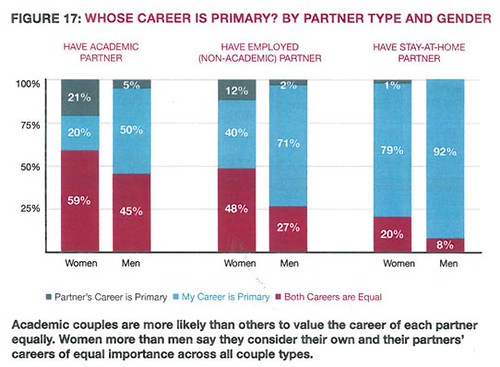
At the meeting for postdocs at IC I wrote about recently, I was asked by one pregnant individual how she should set about things after the birth. She seemed surprised I raised the fact that, if her partner was still around, that meant there were two of them to find a solution. Why don’t we talk about this question more? The problem is probably more acute for women in academic science than in some other professions because – certainly in the field of physics – it is so common for women to be married to other (physics) graduates. The statistics on this (summarised here) show overall that more than sixty percent of women with PhDs in science have husbands with PhDs in science and that women in the sciences are much more likely to have spouses with science PhDs than is the case in reverse.  This can mean two people both with constrained choices for location of work and suffering a place of work with a long-hours culture.

At a recent meeting of the Russell Group Equality Forum I attended, one speaker pointed out that the change in paternity law, allowing the time off (maternity leave as was) to be shared between parents, was already having a discernible effect in their institution, where they had been proactive in distributing information about what the change in law meant. I would wish that people like Sally Feldman would move on from thinking a ‘supportive husband’ is sufficient – which sounds to me like one who is willing to go down to the supermarket with the children occasionally, or sometimes put them to bed, rather than one who is completely stuck in to shared parenting – to seeing childcare as a joint enterprise with neither parent automatically shouldering a significantly heavier load.

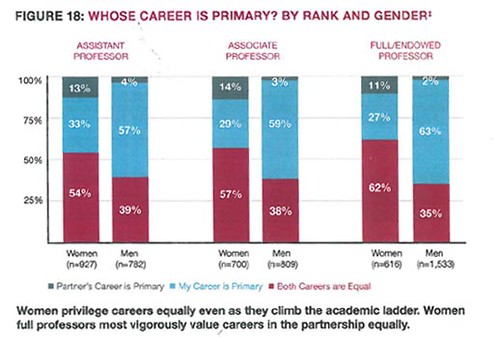
We – women and men – need, collectively, societally, to talk about the change in law and the consequent changes in practice it facilitates. The Scandinavians have been doing this for a while, to some effect although not complete success. This piece is not intended to be a feminist rant – for many couples the traditional model is likely to remain best, be it for financial, emotional or simply pragmatic reasons. But, unless we widen the debate and make it increasingly the norm that men assume practical responsibility for tasks still seen by default as the woman’s, we cannot expect to see the significant improvement in women reaching the senior ranks that might be expected, given the quality and number of women with their feet on the bottom rung of the professional ladder.


Posted in Women in Science | Tagged , | 21 Comments

By Degrees

I’m reminded of the words of the Joni Mitchell song stating “I’ve looked at life from both sides now” as I consider my feelings regarding degree ceremonies. I think I have by now looked at graduation from just about every conceivable direction (certainly more than two). It is, to my horror, nearly 40 years since I first donned a hood and gown to receive my own BA – in typical Cambridge fashion that was the degree I got, since the University does not award BSc degrees. I chose to go with the flow and receive the degree in person, but I don’t remember a huge lot about it. The rabbit fur (no idea if it was still genuine, or had already been transmuted into nylon) was hot on a warm late June day; the black ankle-length skirt (praelectors were very strict about what we wore back then; no jewellery, everything had to be strictly black and white) too long to kneel down in and then spring up again conveniently; the recently sprained ankle that made things even harder; and of course the Latin – those are the things I remember. I didn’t see it as a rite of passage, merely a chance to say farewell to my friends on the Senate House lawn afterwards and go to Grantchester for a cream tea with my family.

Neither my MA nor my PhD did I take in person, having already left the UK for the US, but I did attend my then fiancé’s graduation, at which he took advantage of the University’s ruling that – beyond black and white – national costume could be worn, looking resplendent in a multi-coloured kilt.  I also attended a very different sort of ceremony at which my (by then) husband got his PhD at Cornell, with a huge open air gathering and a hood that was a great deal more complicated than a Cambridge one to get to sit correctly so that its many colours were appropriately visible. As I recall it took his mother-in-law and a lot of safety pins to get it to sit right. Still, I didn’t really see these ceremonies as hugely significant; they were just what happened at the end of a lot of work, and possibly were an excuse for a celebration.

Then, after a gap of many years, there were the occasions where I went as a proud mother to watch my offspring graduate. I saw different universities do things very differently – for instance the appearance of an honorary graduand (Cambridge has a separate ceremony entirely for its chosen few, not mixing with the hoi polloi of the regular graduates), and the ‘capping’ of each new graduate with the hat allegedly made from John Knox’s breeches that Edinburgh runs to.

But recently I’ve started to see things differently again, as I’ve learnt to see things through the eyes of students who are clearly a lot less blasé than I ever was about my own degrees.  I have in the last couple of years attained the stature of a Deputy Vice Chancellor in Cambridge. This is not in itself an executive role (as it is in some Universities) so much as ceremonial. My previous VC, Alison Richard, offered me the role to ‘increase my convening power’ for my work around women in science, and my current VC has maintained the offer. With it comes the opportunity to confer degrees, and so I have been at the opposite end of the graduation ceremony from where I started. I am afraid my first response to doing this was probably not entirely appropriate, as it provoked a hastily suppressed fit of the giggles. Wearing what is clearly a Santa Claus look-alike costume of a red mantle trimmed with (synthetic) fur, I found my first procession behind the mace hard to take seriously; with the officials bowing to me it felt completely surreal (although one can rapidly get used to this), and anyhow I was trying not to get too nervous about speaking Latin publicly or messing up which degree I conferred on whom.

But as I have got more relaxed about my own role, I have begun to appreciate what the ceremony means for many of the students. The procedure is very formal – none of the hugging at Exeter (more on this below), none of the freedom to choose whatever fashion takes the student’s fancy – and, at least to a first approximation, unchanged in the time since I took my own degree (and probably a lot longer than that).  Some of the students approach me with shaking hands, nervous and all but overwhelmed, some mumble an expression of thanks, or bow /curtsey (this tends to occur with certain colleges more than others), some get very confused about how to place their hands (I am supposed to clasp their hands as I pronounce my Latin sentences), or where to kneel. But what is absolutely clear as I make eye contact with many of the students – some can’t nerve themselves to look me in the eye –  is that they are moved and taking this ceremony very seriously in a way I cannot recall doing myself. It makes me feel very differently about the whole process. This really is a pinnacle of achievement for so many, a moment to stand proud in front of one’s peers, friends and family, to celebrate perseverance and success, as well as the start of the rest of their lives. I can no longer regard my own role as a mere formality, but as something much more personal and meaningful, and of significance to those who endure my Latin pronouncements (so far, as far as I’m aware, always the correct degree conferred on each individual).

Last week I participated in graduation ceremonies in what, I suspect, must be my last possible role. I was  honoured to find myself being awarded honorary ScD’s from both Exeter and UEA a couple of days apart. Now my participatory role was different again, dressed in brightly coloured bicoloured robes (I mentioned it would be good to warn the honorary graduand of the relevant colour scheme, so that women can choose an appropriate dress that won’t clash horribly when, like me, they eschew plain black) and a floppy hat not a mortarboard, plus a seat on the platform looking down on the serried ranks of graduands. This location provided a chance to contemplate the teetering steps of women wearing heels of a height I suspect they’d never ventured on before (though none fell over, several of us had fears for some of them) and admire their varied hues of toenail varnish. At UEA it was a moment to shake hands with the presiding officer and, at Exeter, to be hugged warmly by their extrovert Chancellor Floella Benjamin, who hugs each granduand in turn. And finally, a chance to speak – in English – to wish the new graduates well on their future paths, and to try to dredge up tales to tell from my own experiences that were at least somewhat relevant and vaguely witty. But since in both cases my speech came right at the end, also a chance – not only to squirm as kind words were addressed to me by the universities’ orators – but to get increasingly nervous as that moment of my own brief speech approached and to reflect, with that never-absent feeling of being an impostor, that I had no business even being there let alone pontificating to others.


Posted in Education, Universities | Tagged , , , | 3 Comments

More Than Just Gender

Last week I attended an evening at the Royal Society, badged as a discussion between Vince Cable and the RS President Paul Nurse on ‘UK Research: building bridges, building prosperity’. In fact it wasn’t really a discussion at all, so much as set speeches which contained no new policies just well chosen words. It also involved an introduction  by Adam Roberts, the British Academy President, and a third panellist Roland Aurich from Siemens (you can see the video of the event here). It was chaired by Robert Tooke, President of the Academy of Medical Sciences, and for the Q+A they were joined by Adrian Smith on the platform. In other words, all the key players were men, as a tweet from Evan Harris towards the end of the meeting (apparently instigated by Martin Rees, the former President of the RS) made plain. Fellow OT blogger Jenny Rohn has written up her own thoughts on this here (with various comments from me too);  I won’t attempt to cover the same ground but to open up the debate a bit more.

I must confess I hadn’t noticed that the speakers were all male. I don’t know if this proves I am inured to such things, because physics meetings are so often male-dominated, or whether implicitly I just accepted the situation because people were speaking ‘ex officio’ as it were. However, when the tweet circulated, I still felt this was no big deal, partly because of this ex officio aspect, but also because the attendees were, by and large, established individuals rather than those setting out on a scientific career path who are still looking for inspiration and role models. Jenny disagrees with me about the importance of the male dominance here, and says others felt the same way as her, but if we are to worry about the diversity of speakers I feel there are other sorts of meetings where a white male slate would worry me far more. Conferences, for instance, where graduate students are much more likely to be present and who may gain negative impressions about how welcome they are.

However, there are two additional threads I want to draw out, one stemming from a broader meaning of diversity, one dealing with what, in general, may be done to improve the breadth of diversity at meetings etc. As I say, all the speakers were male, as were the 3 people who asked questions (time was very limited, so it was only 3). One of these questions came from Imran Khan, who doesn’t fit the ‘white male’ label. So, finally, a little diversity entered the debate, albeit in terms of ethnicity not gender. It was clear Imran had prepared his question in advance, and so one could ask if people like Jenny would have been more satisfied if he’d passed his question over to his deputy at CaSE, Beck Smith, who was also present. It would have ‘solved’ one problem, but reinforced the ‘science is for whites’ message instead. In other words, it wouldn’t have been a solution regarding diversity at all. Diversity is not simply about gender, although it’s perhaps too easy to forget that because the numbers of women setting out in science are large, and the leakage so manifest.  The numbers overall of those who don’t fit the ‘white male’ bill are depressingly low, as this incident makes very clear.

Last summer I participated in a panel debate organised by CaSE on Higher Education, at which the panel was challenged that science was too much a white, middle class affair and that problem started at school. Recognizing this huge problem, BIS has recently given money to the Royal Society to implement a programme of work to increase diversity in the scientific workforce. The programme focuses on the different diversity strands: gender, ethnicity, disability, and socio-economic status, and will be looking at the issues both within academia and industry.  I have heard the Shadow Innovation Minister, Chi Onwurah, publicly state she doesn’t feel the RS should be trusted with this when their record on diversity is bad. I disagree with her because my experience within Cambridge shows me that where the problems are less acute (for instance around gender in the Humanities) there is a tendency for complacency to set in and less rather than more is likely to be done. The RS is totally committed to doing what it can, because it knows there is a problem, but what it can do may be limited within this fairly short-lived programme with its very modest funds. Certainly when it comes to the socio-economic aspect, the problems start at a very early stage, with the dangers of poor schooling and possible lack of support for a would-be scientist from within the home. That sort of embedded, cultural problem cannot be solved by looking at the workforce, nor within a very modest programme, but it is hoped that at least some of the biggest barriers may be identified during the BIS-funded work, along with  possible interventions, even if the shortish timescale will not make it possible to pilot actions in practice. This may, one hopes, just be the start of an onging process to improve access to support, good teachers and good careers advice for those who are currently not getting it.  It’s unlikely to be sufficient in itself to transform the scientific workforce, but it should at least nudge things in the right direction and perhaps kickstart more substantial actions in the future. But we have to recognize that improving diversity within science means far more than worrying about the gender make-up of a panel, important though that is.

Which brings me to my second point. I believe growing out of the recent ESOF meeting in Dublin, a database  has been set up of women scientists within Europe (although a quick glance suggests this is a very incomplete list, heavily biased towards Germans, presumably due to the knowledge of those who have constructed it). I saw a tweet about this, and was asked to retweet it, which I did. And duly got hammered by a male physicist (who can identify himself if he wants) who said:

now that is truly appalling: why would anyone query such a database if not engaging in the worst kind of tokenism?

I proceeded to have a long twitter conversation with him – which is a tricky thing to do when covering subtle points in 140 characters – because I cannot agree. My arguments tie in with Jenny’s initial objection to the RS Panel discussion, but are much more fundamental than that. Tokenism is tiresome, often unpleasant for the token (probably female) concerned, but sometimes may be necessary in certain situations where a field may be still overwhelmingly uniform. In a comment on a previous post of mine, Curt Rice said targets on e.g committees, panels, conference speaker lists etc, was a better way of expressing it than in terms of quotas, and I would agree.  A long time ago I wrote a blogpost about Remembering the Women, itself sparked by an article by Yasmin Alibhai-Brown. groaning over how easy it still was to ‘forget’ women, as if they were invisible. She was discussing the problem in the context of the media rather than science, but the same thing applies. Having a database of women scientists, to facilitate making sure that conference organisers can’t use the excuse of ‘not being able to think of a woman’ as a reason for not including women on the programme, strikes me as a good idea. I am just as much in favour of having databases covering individuals who are within 10 years of their PhD, or listed by geographical region, or identifying those who work at the boundaries between disciplines. Anything that makes life easier to be broad-minded when seeking out individuals for some task or other seems to me a good idea. I cannot see that such databases are ‘appalling’, and am surprised that others would. The ideas about tokenism are, however, much more subtle than that and need much lengthier discussion. Another day, another blogpost…..


Posted in Equality, Women in Science | Tagged , , , , | 8 Comments