Obnoxious Physicists?

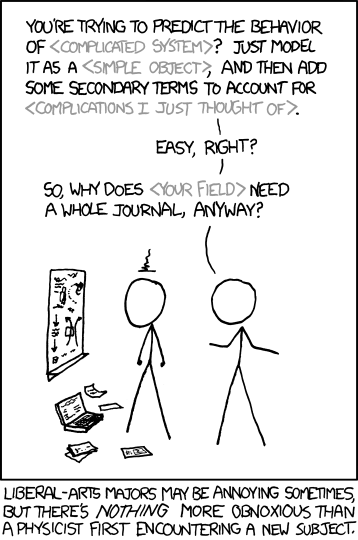
xkcd takes a sardonic view of interdisciplinary science

I am sure readers of this blog do not tackle their science in this way, or think about their pet biological system as a ‘spherical cow’!  Thanks to Matthew and Owen for forwarding me the link to xkcd so I could decorate my blog, and in the process learn how to insert an image without a ‘glitch’.

Posted in Biological Physics | Tagged | Comments Off on Obnoxious Physicists?

Athena Swan – Celebrating the Changing Culture

Today I attended the lunch for winners of Athena Swan awards. I was there wearing my hat as Chair of the Athena Forum (whose predecessor, the Athena Project, had been the progenitor of the Athena Swan awards), but I was particularly delighted to be there since my own department became the first at Cambridge to win a Silver Award.  The awards are given both to universities as a whole, and to individual departments.  They have become an excellent mechanism for institutions to reflect on how well they are performing for all staff, but particularly if they have practices that might disadvantage women. And by monitoring numbers of women at different stages along the pipeline it is easier to identify where particular obstacles may be occurring and to come up with an action plan to remedy any problems identified.

Cambridge University has been an Athena Swan Charter member for a number of years, with the application spearheaded by WiSETI, but Physics is the first to get an individual departmental award. This success is largely due to the hard work of my professorial colleague Val Gibson, and our departmental Administrative Secretary David Peet, who together have put a huge amount of work and passion into assembling the departmental case.  It is not a trivial task, but one absolutely worth doing in terms of gauging and changing the atmosphere in which we all work. Some years ago the IOP came on a site visit to look at the situation for women, part of an extensive series of such visits they made. A variety of issues were identified then which were very helpful to us in moving forward. On the back of that visit we set up a Personnel Committee for the department. This committee deals with a huge range of issues, going well beyond those of gender and covering the workforce as a whole including support staff (but not undergraduates). During the period I chaired it, much of our focus was on the assimilation of staff onto the single pay-scale. I think the very existence of the committee provides reassurance to the department how seriously we collectively (and from the head of department down) view our working environment.

Val Gibson now chairs the committee, and one of her recent initiatives has been to set up a postdoc committee to provide a forum where postdocs can raise the issues that bother them.  I fear few departments have Personnel committees, but it seems to me to be an excellent route to tease out things that may not be going quite right.  Other steps that have been taken over the past few years that have contributed to the Silver award include: changing the time of our departmental seminar to 4pm to make things a little easier for parents (either sex) with young children; introducing exit questionnaires for people when they leave (although clearly most people leave because their contract ends, just sometimes it is because something has gone wrong, and we need to know); and on return from maternity leave, female academics are relieved from lectures in the first term back and no new courses are assigned in the 12 months following return.
Now that we have achieved the Silver award, we hope to be able to ‘spread the word’, and in my role as University Gender Equality Champion I will be looking to distill some of the key actions and processes we have in place to help other departments improve their own cultures and working practices to be able to achieve similar success. I hope to discover just how many already do lots of good things, but I fear there are some that are less than shining examples as yet.  The key thing is for departments to sit down and work out what they are doing already, and what they might do better; and for the departmental senior management to be committed to improving the atmosphere for all.   As David Ruebain, head of ECU, said today at the Awards lunch, actions that may be initiated to help women, actually help everyone.  Sharing best practice is the name of the game, and trying to eradicate the not-so-good that no doubt lurks in some places is certainly on my own agenda within Cambridge.  I would urge readers of this blog to check whether their own university has signed up to the Athena Swan Charter. If not they should try to put pressure on the relevant individuals or committees to commit; and if they are, then perhaps their own departments can aim to achieve a Silver or Gold award.  This ‘brand’ is receiving international attention as a very positive initiative to improve the situation for women in STEM departments.

By the way, I am delighted to see the Guardian publishing a list of female science bloggers, with 86 on the original list and more being submitted through the comments.  Clearly this is an active community I have just joined, and I look forward to exploring some more of these blogs myself.

Posted in Equality, Women in Science | Tagged , , , | Comments Off on Athena Swan – Celebrating the Changing Culture

Whither (or possibly even wither) BBSRC’s Committee C?

I am now heading off to a hotel near Heathrow for a BBSRC committee meeting. These are always held in such delightful locations because of the need for a large enough hotel to fit all 4 committees plus the associated BBSRC staff in simultaneously.  I hope I have done my preparation carefully enough – and that my committee have done so likewise. Committee C (likewise B) only has about half the number of grants of committees A and D, yet it is still a mammoth stretch of concentration.  At the start of the last meeting, not having yet got into my stride, I made a classic mistake as I turned to one of my committee members. Let us say her name was Athene Donald (clearly it wasn’t, but my name serves equally well as an illustration of what I did wrong). I looked down my list of who the introducing members were, saw ‘Donald’ as a plausible name and so said ‘”Donald, would you kick off please”.   Deeply embarrassing, and all goes to show that – despite the tenor of my last post – I am equally capable of getting things wrong as a chair.

What strikes me about the grants we are currently seeing coming through our committee is the high proportion that are based around modelling/computational/e-science/bioinformatics approaches. Gone are the days when biologists did not cope well with such matters; the standard line of ‘I’m a biologist because I couldn’t do maths at school’ clearly is no longer valid, if it ever was. Even if they have a computer scientist as a collaborator (and many of them do not) they have obviously wholeheartedly swallowed the more mathematical and if you like systems biology approaches, pushed by both the past and present CEO’s of BBSRC, and made them their own. It is only 6 years since I chaired a Panel specifically on Bioinformatics and E-science for the BBSRC, arising from a focussed call with ring-fenced money which had to be spent in a single round. This had been felt necessary because there was perceived to be a lack of much serious work in that area.  Now, around 25% of the grants Committee C sees fall into this general category, with even more that have an element of this included in an overall experimental programme.

I think this observation demonstrates just how much a field can be kickstarted by pump-priming money coupled with a strongly held view by those at the top of a research council.  Sunsetting areas – deciding they aren’t priorities – is harder to do, and often happens by inanition rather than formal policy as far as I can tell.  But, with Cable’s depressing and misleading speech last week, and a not obviously more encouraging – though perhaps more accurate – one  from Willets yesterday it looks like drastic things are bound to happen to UK research funding so that potentially large and fertile areas will be effectively closed off.  It’s far too early to know where the axe will fall, but logically either some mechanism will be established to restrict the number and/or subject area of grant applications allowed to be submitted, or success rates will tumble from the not-too-disastrous level of ~20% the BBSRC has achieved over recent rounds.  It is not a happy or sensible place for UK science to find itself, as many others  have cogently discussed, neatly summarised in a series of reports by William Cullerne Brown . No doubt nothing official or drastic will yet be happening at a grant-awarding committee like mine today, but I’m sure there will be plenty of rumbles in the bar.

Posted in Biological Physics, Interdisciplinary Science, Research, Science Funding | Tagged , , , , | Comments Off on Whither (or possibly even wither) BBSRC’s Committee C?

Committee Etiquette

Now I am back from my holiday, one of my first tasks is to get on top of the committee work for this week’s BBSRC Research Committee C, which I now chair.  Times have changed substantially from the first such research grant committee I ever participated in many years ago.  This was the Food Grants Committee of the AFRC (the Agricultural and Food Research Council), one of BBSRC’s antecedents.  I attended this meeting with some trepidation, not least because it necessitated leaving my 8 month old child for longer than I was happy to do at a time when I was still feeding him (my husband brought him to London to minimise the time of separation), but also because I had no idea what to expect. These were the days before any training was offered by the research councils for young academics. I was therefore very dismayed and taken aback on this occasion to be greeted by an indignant grey-suited gentleman –I had no idea who he was, and members weren’t dignified with name badges or anything similar then – complaining at how late the papers for the meeting had turned up. It took me a while to work out that he had naturally assumed I was part of the office staff, and far too long to come up with any suitable rejoinder.

These days the BBSRC – as no doubt all the research councils do – work very hard at ensuring a good distribution in both gender and geographical location.  I believe currently 4 out of the 8 chairs and deputy chairs of the committees are women, and there will typically be several more serving on each of them.  However that is not to say that all is necessarily plain-sailing for women on committees such as these, even now.  In the last 10 years I have served on two totally separate committees, run by two distinct parent organisations, where the chairman (and most definitely a chairman in each case, not a chair) addressed the committee as ‘Gentlemen…’. It is worth stressing that in the more recent case (a mere couple of years ago) there were actually 3 female committee members present, plus 2 women from the secretariat.  In both these cases individuals were under consideration, so a chairman blind to the make-up of his committee could be considered potentially dangerous in ensuring women candidates were treated equitably; such behaviour therefore cannot and should not be allowed to go on unchecked.

So what is the correct response to such crassness, assuming it wasn’t done deliberately to annoy? It is so boring that one still has to ask this question. It forms part of the “perpetual grinding down by seemingly innocent but slightly derogatory comments” female experience that was described to me by a (female, fairly obviously) correspondent today about her own experiences.  I have always felt that making an open fuss tends simply to be counterproductive; to do nothing just ensures such petty behaviour continues with the added danger of a negative bias in evaluating any female candidates under consideration.  So, for what it is worth, here was how I dealt with the situation in case a similar situation befalls any of the readers of this blog.

After the meeting I emailed the chair, let’s call him X, saying I felt that his use of the word ‘gentlemen’ was inappropriate, the more so as the committee was particularly and explicitly charged with being sensitive to diversity issues in our discussions.  I copied this email to all the women present, to the male members whom I thought would be sympathetic (i.e. to those who had privately expressed shock/outrage to me about X’s behaviour), and to the chair of the committee above, who happened to be a woman herself.  I received a suitably apologetic response from X. Oh he hadn’t meant anything by it, he was just too used to chairing all-male committees. Next meeting……..exactly the same thing happens.  While I was still working out what to do, I was delighted to hear one of the ‘sympathetic males’ I had copied in to my email say ‘X, this really won’t do’. And, pleased to say, X never did it again.

Now lest it be thought this is just me male-bashing, let me hold up my hand and admit that I can also be guilty of making stereotyped assumptions in my committee work. A few years back, on a Board of Electors for a Chair in Medical Physics, I walked into the room to see one more woman than I expected – I knew who all the other electors were – and fell into the trap of assuming she must be an administrator there to see fair play. It transpired she was a senior NHS observer, and I was immensely relieved to find I had said and done nothing to offend her by my assumption – but only because I hadn’t talked to her at all.  I believe we all suffer from unconscious bias and, if the reader really thinks they are exempt, I recommend they try one of the Implicit Association Tests or read some of Virginia Valian’s work on gender equity. It is disturbing to realise what baggage we carry with us.  We all, male and female, have to be constantly on our guard to ensure our roles on committees are appropriately gender blind.

Posted in Equality, Science Culture, Women in Science | Tagged , , | 1 Comment

The Advantages of Maturity

A final post on the Oxford meeting, before I go on holiday for the next week (no laptop, no emails and no posts).  This topic is provoked by some comments made to me by a mature PhD student attending the meeting.

These days we are much more organised about training PhD students than when I set out. However, what this woman remarked on were the advantages of advancing years in coping with interdisciplinary research.  This woman had recently come back to do a PhD in physics, although she is slightly older than me. Her take was that she would have struggled to cope with the need to interact with people in the different disciplines, challenge the less than ideal supervision she had – shared as she has been between 3 supervisors separated by geography and discipline – and generally take control of the project if she hadn’t had 30+ years of ‘real life’ to equip her to do it.  Certainly, at 21, our students have not yet had the opportunity to develop the sort of confidence in themselves and their interpersonal skills at a professional level that this woman was implying.  That is not to say some students will not arrive equipped with exactly these skills by virtue of their schooling, families or other background input, but most will lack the requisite experience, personal insight and confidence.

Standard PhD student training (at least in the UK) is likely to incorporate some elements of transferable skills training.  This might include presentation skills, scientific writing, maybe information on how to prepare your CV and interviewing skills, but almost certainly nothing about the lifeskills that this woman identified: dealing with difficult people, team working, knowing how to negotiate and having the confidence to ask awkward questions – and then keep asking them.  These skills are important in ensuring a successful outcome of research, and maturity does give the opportunity to develop them as well as the confidence to know that the sky will not fall in if you dare to challenge, if you misread a situation and put your foot in it or otherwise get it wrong.

More often than one would like, research students find themselves in unsatisfactory situations and for a variety of reasons. These might include having difficult peers and/or supervisors who go AWOL, make unreasonable demands on them or simply do not interact with their students or teach them anything. Increasingly universities and funders set up systems to try to ensure things don’t go awry, but since so often they go wrong for non-systemic reasons, life skills are also needed.  For example one practice that appalls me, although I have only heard of it occurring in the US, was that of a professor who set two students on essentially identical projects to see which came out on top. What a waste of time, and probably one student’s career, since the ‘failure’ was implicitly going to be dispensed with.  The trouble is that I am not convinced a university’s policies would necessarily pick it up as an example of bad practice.

Interdisciplinary research poses even more problems because you may have to deal with two lab cultures, two research teams and conflicting expectations and demands. Training for students maybe should be extended to cover these other ‘soft’ skills of confidence building (something locally  WiSETI tries to do through workshops for early career women researchers), conflict management and team working skills. As an example of lateral thinking to cure a people problem, I would cite a previous postdoc of mine who found a very effective way to speed up instrument making in the workshop – bake them a cake! Using whatever skills and native wit you have to make progress is what it takes to get on, after all, and thinking about how to make her requests literally more palatable clearly came naturally to her. These abilities may be more important than learning how to jazz up Powerpoint presentations, which most students will have learnt years before anyhow (though the same may not be true of the ability to construct a grammatically correct sentence). And of course, remembering my post on the deficit model, we should recognize it is not just the students who need training and by implication are at fault, but supervisors and their own line managers may also need such training.

Posted in Biological Physics, Education | Tagged , , | Comments Off on The Advantages of Maturity