‘I do like kissing games’

After Harvey Weinstein there have been suggestions that we’ve reached a ‘tipping point’, that the genie can’t be put back into the bottle and that our society will clean itself up with respect to sexual harassment. I wish. In the meantime, the low level denigration of women continues, from wolf whistles in the street to offensive casual remarks, as illustrated by the Virgin tweet enquiring if someone who had objected to being called ‘honey’ by one person, would prefer ‘love’ or ‘pet’ instead. Some people simply don’t get it. The recipient of this tweet, Emily Cole, wrote a very well-argued piece in the Guardian about what this episode demonstrates about ‘toxic masculinity’ and how it impacts on everyone, whatever their gender. I would like to think Virgin trains will be running some training sessions for staff, both those on trains and those who are in charge of their social media, so that similar embarrassing and offensive remarks do not recur.

What can the community do? To begin with it behoves all of us not to tolerate disdain and belittling behaviour, whether addressed to you or directed at someone else in your hearing or sight. Remind people that the world has changed and what might have been regarded as OK in your parents’ or grandparents’ generation is simply not OK anymore, be it in words or actions. In order to achieve this, all of us in a strong enough/senior enough position to do something need to be mentally prepared to act and to follow up after the event where required. I am not particularly optimistic that collectively society will change, but it certainly won’t if pressure is not put upon it. I, like many another woman I’m sure, has tended just to grin and bear the tediously common low level misogyny I’ve faced, from teenage years on: I used to think there was something odd about my face which meant people shouted ‘cheer up love, it may never happen’ at me repeatedly. Being wolf-whistled at on the way to school was just a fact of life (and it happened despite our not particularly fetching dark green school uniform and knee high socks; even, for a couple of years, being required to wear a beret).

However, from now on, I will be less tolerant of taxi-drivers calling me darling in a sneering kind of way, as illustrated by my recent explosion – and complaint to the firm – under these very circumstances. I will speak up about people’s inappropriate behaviour when directed at me. If people are prepared to do this to me, they almost certainly will also have been doing it to much more vulnerable, less senior people. So, if I’ve been touched inappropriately I will let people know, politely but in no uncertain terms when they have crossed a line that is likely to cause some people offence. Since such behaviour may also land them in hot water, you could be saying I’m doing them a favour! Not so long ago I was even kissed by a very senior, even elderly, someone who told me ‘I do like kissing games’, I quote, before they acted. This was in the not so distant past, but I did not complain let alone stamp on their foot. I regret that.

During my career the senior male who patted me on the arm has been all too common. In most cases it was a case of old-fashioned patronage that surely was not meant to cause offence. Probably, these older generation folk thought they were just being friendly and supportive, although plenty of people – for instance, my one-time mentor Sir Sam Edwards – could be both without ever getting close to arm, shoulder or any other part of my anatomy. Nevertheless 20 years ago, let alone 40 years ago, I thought little of it other than ‘here we go again, I wish he’d desist’. But, this particular worm has turned; I’m not going to shut up any longer.

Before Christmas I was at a dinner when my host and neighbour at the dinner table repeatedly patted me patronisingly on the arm. It happened to be in the presence of the University’s new Vice Chancellor and it did not feel the moment to make a fuss or slap the guy, however irritating he was. Instead, I decided to mention his behaviour in my note of thanks, being very conscious the guy in question would be likely to interact with many students from all round the world; some of them might justifiably be not at all happy about such unwanted and unwarranted light touching, and/or might well feel they were being inappropriately condescended to.

I wanted to keep this low key and, rereading what I wrote, I still think my email was to the point and hardly abrasive:

In today’s rather febrile atmosphere, and with changing attitudes, you might find that some people – from different cultures, gender and degrees of seniority – might find your friendly pats on the arm unacceptable. It doesn’t particularly bother me, but younger folk may feel differently. Hope you take that in the spirit intended!

I got no reply, but subsequently saw the email appeared still to be sitting in my drafts. Feeling embarrassed that the thanks which had started off the email was going to turn up awfully late, I decided nevertheless to send the email. To which the curt reply came

I got your message the first time. Thank you

That was it. An inadequate response if ever there was one. I have to hope that, despite the unforthcoming tone, my message had got through. If it happens again, with him or anyone else, I think it is incumbent on me to do the same again.

I am glad to say the men with whom I work on a daily basis are not of this inclination. The men with whom I’d choose to go out for a drink do not casually dismiss women as post-menopausal or hot totty or a bit of all right. Their conversations demonstrate their acute sensitivity to unconscious bias and I’m sure they would be the first to highlight a letter of reference as being inappropriate when describing a woman as feisty or that they’d only got as far as they had because there were so few women in the field. But it is impossible not to know that there are plenty of men in labs and offices around the university who simply don’t realise that they are being inappropriate, insensitive or worse.

So, although we all know new year’s resolutions are made only to be broken, perhaps this year I really will be motivated to stick with mine: not to let such behaviour pass by without some comment, be it at the time or privately later. If more of us (senior) folk not only felt empowered to act this out but actually did so, perhaps academics and taxi-drivers alike might shower fewer unwanted pats, darlings and worse on women. One can only hope.
Posted in Equality, Women in Science | Tagged , , , | 6 Comments

How the Financial Sector Hinders Manufacturing

As 2018 approaches, the UK’s economic future seems as uncertain as ever. I think we can conclude with conviction that our country is anything but ‘strong and stable’ and the mantra that Brexit means Brexit has been shown up for what it is: a cover up for complete uncertainty over any future plans whatsoever. However, tempting though it is to make this end of year post a tirade about our political masters, I will refrain, and focus instead on matters that are, possibly, less political. Industry.

November saw the launch of the Industrial Strategy White Paper, preceded by the somewhat punchier Industrial Strategy Commission Final Report. I wrote about educational aspirations in the White Paper before. Here I want to focus on underpinning aspects of UK’s industrial manufacturing base in the context of our long decline on this front. This decline is well-described in demoralising detail in a recent book by Tom Brown, an industrialist who has worked in and run many engineering companies over the past 50 years. Tragedy and Challenge: An inside view of UK engineer’s decline and the challenge of the Brexit economy records his despairing thoughts about what has gone wrong with the engineering sector. I don’t usually buy books on the recommendation of the Evening Standard – indeed I cannot remember ever reading any book review previously in that paper, but then I only pick it up occasionally as I rush through Kings Cross of an evening after some long day in London. However, having read this review my interest was sufficiently piqued to buy the book, and the Christmas break has provided me enough time to finish reading it.

It makes gloomy reading, particularly in the light of the aspirations of the Industrial Strategy White Paper. Brown – most recently CEO for Cambridge solar energy spin-outs (from Cavendish Professor Richard Friend’s lab) of Eight19 and Azuri Technologies – delineates exactly why the greed and short-termism of the city financiers has driven many once-proud UK engineering companies into the ground. If you want to understand better the way fund-managers operate; or why (corporate) tax incentives introduced by successive UK governments since the Big Bang of the Thatcher years, massively damage our manufacturing base you cannot do better than this book by way of a simple introduction. It is eye-opening and jaw-droppingly worrying if you haven’t had to consider these matters before.

I first became aware of the damage financial instruments could do to blue chip companies back in the 1990’s. ICI, a company I worked with and was funded by over a number of years to study various aspects of polymers, had to fight off a hostile bid from the well-known asset stripping company Hanson. ICI survived that, but in order to be able to defend itself from future attempts by similar companies it sold off parts of its business. Further, it divested itself (‘demerged’) of its more biological businesses: notably pharmaceuticals, agrochemicals and seeds, forming a new company Zeneca. This new company thrived, in turn merging to form the highly successful company AstraZeneca, now in the process of moving its main research labs to Cambridge. But in doing all this, ICI became a ‘rump’ of a company. It still possessed some commodity plastic businesses based in Middlesbrough and its paint businesses (Dulux and Crown paints mainly based in Slough), plus a few other smaller businesses. In attempting to move away simply from bulk chemicals it bought National Starch from Unilever at an inflated and completely unaffordable price. All these moves, which had more to do with share-holder value than materials development or any sort of ‘industrial strategy’, ultimately led to its complete demise. ICI as a company no longer exists, its last (paint) businesses subsumed within AkzoNobel. For 30 odd years I had worked with different parts of the company and it was tragic to watch measures that were all done to satisfy the financial markets and not to produce genuine manufacturing ‘value’, innovation – let alone disruptive technologies or any of the other encouraging words you can find in the White Paper – kill the company off, business by business.

Being no economist I always attributed this decease to ‘short-termism’ without really exactly knowing what this meant in strict accounting terms. The Tom Brown book is excellent in explaining exactly why companies felt they needed to behave this way in order to keep share-holders, including big fund-managers, happy. Also he spells out exactly why things are so different in German manufacturing, a sector he also had worked in. In Germany, where many companies remain family-owned, owners see themselves as in it for the long term. In turn this means they are more willing to invest in the necessary capital equipment to keep businesses cutting edge plus in training for their workers. It is hard not to see these measures as feeding into their much higher overall productivity than the UK manages.

It wasn’t at all clear to me after reading the White Paper, and after reading the book it is even less clear to me, that anything the Government is proposing will really alter the fundamental control the financiers have over our present and future manufacturing industries. Investment in sectors is excellent as a concept, but…unless there are changes to the financial incentives that drive mergers and acquisitions or the bonuses fund managers receive for doing not very much then nothing substantive is likely to change in most manufacturing industries. Brown has nothing good to say about fund managers and their (lack of) skills. Take the sentence

‘institutional fund managers [do] not understand the companies in which they invest and frequently put them under pressure to behave against the companies’ long term interests…’

as indicative of his views.

Although the book could have done with substantial editing, and its prose is not particularly beautiful, I would thoroughly recommend this book for an eye-opening description of UK practice (not least contrasted with Germany) to accompany the aspirations of the White Paper. It would be reassuring to think Brown’s book is also on our Prime Minister’s and Chancellor’s Christmas reading list (never mind those beings inhabiting DExEU).

(As an aside, being as I say no economist, let me take this opportunity not only to welcome the well-respected economist Diane Coyle to Churchill College and POLIS in Cambridge in March when she joins us as the Bennett Professor of Public Policy, but also to congratulate her on her CBE in the New Year’s Honours. Diane co-authored the Industrial Strategy Commission Final Report. One of her co-authors, my friend the physicist Richard Jones, has written extensively on his own blog about some of the flaws in current government approaches to industrial policy, including analysing why the Life Sciences isn’t a sector, despite receiving a sector deal, and about why the Government has need to refocus on an industrial strategy after all these years of actively being laissez faire on this front.)

Posted in Science Culture | Tagged , , | 1 Comment

Is the THE aiming for clickbait?

Just before Christmas on Twitter I came across a survey being run by the THE asking

THE is running a survey about whether women should champion other women in academic careers. What do you think?

I duly went to this and answered the questions, but I did this with rising frustration. And clearly I was not alone. When I retweeted the original THE request others complained about this.  Sarah Kendrew complained ‘I want to fill out this survey but there are so many questions whose phrasing I object to’ and Liz Gloyn said ‘Oh, for the love of… enough with the faux-engineered gender competition!’ To which Sarah Kendrew came back with ‘yes it’s like they engineered the survey questions to be able to publish a clickbait-y headline about the results: “women don’t care that their sisterhood is unfair to men!”’ I tend to agree with these sentiments, although other people (perhaps who hadn’t yet looked at the questions) seemed keener. The list of questions appeared to be loaded to get certain types of answer. I doubt it was prepared with the care social scientists probably like to put into their questionnaires.

By trying to seek information on a reasonable subject, their survey actually makes it very hard to be nuanced: I did try in my replies but the presumption seems to be that women only support women – and of course men only support men. What rubbish! A survey which enquired about support in general and with gender as a minor component would be more interesting and more realistic.

It is true many women like talking to other women in academia. In a field like mine, which is so male-dominated, in part that is because another woman is (still) a relative rarity. But, if I like talking to fellow female physicists, that does not equate to not liking to talk to male physicists. Gender is going to be less relevant than whether they have something interesting to say and are pleasant to be with. I like to think, and I hope I live by this, that I treat people as people. I do not go out of my way to help another scientist by virtue of their gender alone. That isn’t to say I don’t think women deserve support, because of course they do. As do many men. The reason women need ‘more’ support is solely that so often they actually receive less than their male peers. This sad fact can be for many reasons ranging from the senior staff in a department feeling uncomfortable talking to early career women, to the fact that to some people women may not be as visible as men.

Both those reasons indicate why it is easy to fall into the trap of thinking there has to be a female sisterhood looking after young women, to promote their interests and to mentor them. In the abstract it is harder to imagine a senior woman being uncomfortable talking to a female postdoc in the way some male professors might – but it could certainly still happen. It is also rather naïve to think that it is only men who fail to see the early career researchers about them when they happen to be female.  In practice there are people of both sexes who are supportive of both sexes. There are also men and women who, having risen up the system, couldn’t give a toss about those behind them. If women are more likely than men to be aware of the challenges facing early career researchers it is probably because they themselves noticed the lack of support as they tried to progress and want the next generation to have it easier. In reality, and way beyond academia (Maggie Thatcher used to be cited as a key example of a queen bee of this sort), some women who made it despite suffering from an absence of concrete mentorship or sponsorship are of the kind to think ‘I made it without anyone taking care of me, so why shouldn’t the next generation?’.

So, although I filled in the survey, I tried to temper my answers where I could (which wasn’t often) to point out that we all should support all young researchers. I wonder if that message will come through when the results are written up.

Let’s not put the onus on women to support women – the few women there are in the professorial ranks have plenty else to be getting on with anyhow, as they get stuck on innumerable committees by virtue of being the only plausible woman who can tick the quota box – and recognize that everyone has a responsibility in this area. Otherwise, we are continuing to propagate a view that men and women really aren’t equal; that women are delicate objects who need cherishing by the kind hand of the nurturing women around them. But men are real men, tough and can only be  handled by the greybeards around them, male of course. Never the twain shall meet. Such a view, such a course of action, would be a disaster for young and old, men and women. Come on THE, you can do better than that!

Posted in Equality, Uncategorized, Women in Science | Tagged , , | 1 Comment

Taking the Chair

Robert Macintosh recently wrote an article in the THE about how to chair a meeting. This is a topic that I have dealt with before on my blog in light-hearted vein – describing those chairs you really hope you never have to serve under, beautifully illustrated in cartoon form on the Upturned Microscope blog – but it is a topic I feel strongly about. And, in part, I disagree with what Macintosh writes. So, let me revisit the issue in a more serious vein than my earlier post. (Apologies, I know it’s meant to be the festive season but, despite what Jo Johnson and Lord Adonis may think, most of us academics have serious things to do even after the students depart).

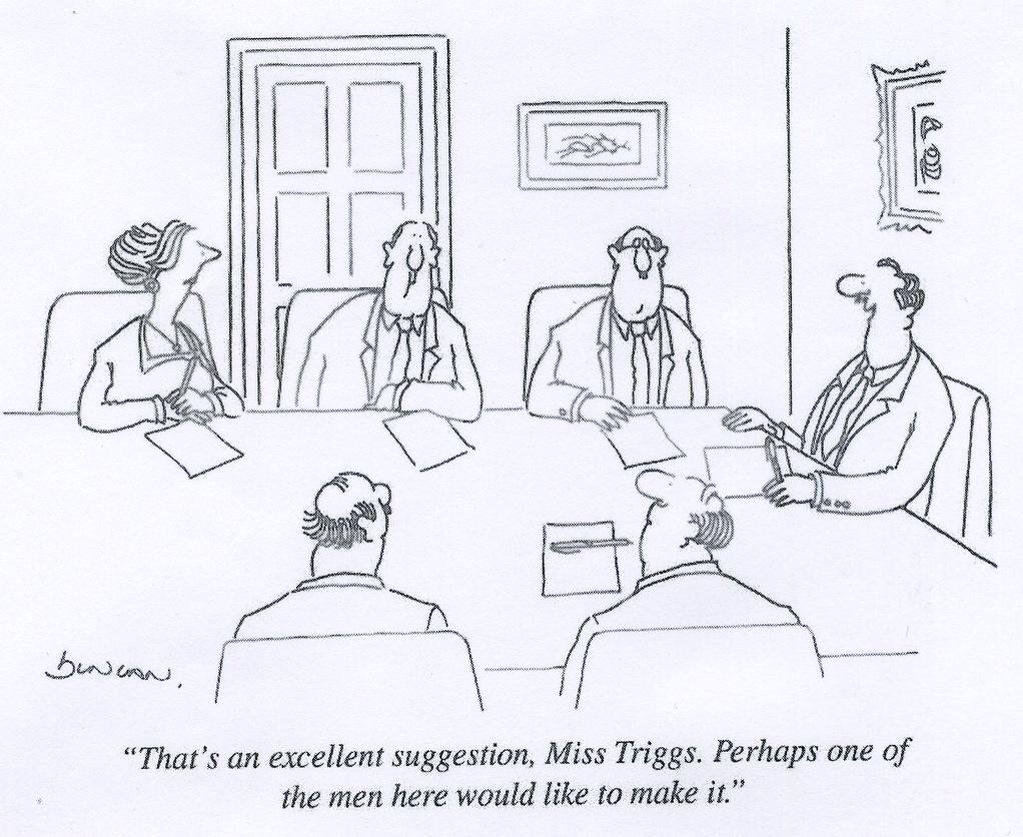
Image result for miss triggs

This Punch cartoon from 1988 is an excellent example of how not to run an inclusive committee meeting.

When I wrote my previous post, I really had grant-giving or promotions panels in mind, since those are the sorts of committees with which I had had most prior experience.  Since then the sorts of committees I’ve had responsibility for have diversified. It is clear that ‘judging’ panels have certain characteristics that don’t apply so much to, say, the sorts of local departmental committees I think the Macintosh piece refers to. Nevertheless, there will always be common strands. So let me counter Macintosh’s article with my own set of recommendations for the novice chair.

Timing and Logistics

Most important I think is the issue about timing. Whether the meeting is scheduled for 1 hour or 8 (or even more than one day, as grant panels often are), knowing where you should be on the agenda at each stage is crucial if the business is to be completed effectively. That also means you can factor in ‘comfort breaks’ at convenient – and regular – intervals. A committee member whose legs are crossed will not be at their best. For those who need caffeine to stay awake, regular coffee breaks are often of assistance. Biscuits may also be constructive, bearing in mind the study that said people were less prone to unconscious bias if they were topped up with sugar. It may be bad for the teeth and waistline, but if good for minority interests and fair play I’m all in favour.

In advance of any meeting I’m chairing likely to take over a couple of hours, I ask the secretary to give an indication to me of approximate anticipated times on my briefing paper. In particular this can be vital if the chair of some subsidiary committee, or any other external member, is expected to turn up to some specific item on the agenda. It is rude to ask them to turn up at 1530, only to find you don’t get near their point on the agenda until 1645. But it happens, the more so without due planning.

Secretariat

Where I strongly disagree with Mackintosh is in his recommendation ‘sack the minute taker’. I think this is unwise. If the chair is to make notes throughout the meeting, they are less able to concentrate on making sure all voices are heard. The chair should be watching body language as well as listening to verbal language. If they are concentrating on scribbling they will miss many of the nuances, such as the slight twitch of body or eyebrows which indicates someone silent is wishing to make a contribution; or the clenched fist or jaw hinting at strong disagreement; or, perhaps most common, the tapping pencil highlighting impatience and boredom. Sometimes it is necessary not just to have a one line summary of the conclusions reached, but a careful record of who said what. Not all committees require that, but in many cases – particularly if the committee in question feeds in to another one, for instance helping a higher level one  understand the strength of feelings on some topic and how these vary from faculty to faculty – these sorts of details are required.

Even if that is not the case, a chair who writes the record of the meeting is much more likely to impose their own slant on to the wording in ways that may not reflect what actually happened, but be hard to correct by circulation after the event. Such a person may amount to the Benevolent Dictator Chair I described before, or could be someone much more Machiavellian. In any case they could be perceived as drafting the record in ways that did not do justice to the subtlety of the discussion.  So, I would say, give me a neutral secretary every time to take the minutes. In any case, this paradigm of efficiency and excellence is the person I expect to prepare me a briefing, remind me of previous decisions or papers, make sure we have dates for meetings going forward….all the crucial details that I am prone to forget.

Membership

Mackintosh uses the curious phrase ‘avoid room meat’ as one of his instructions. I have not heard committee members referred to in this way, but I know what he means. Members who turn up and never speak are a concern. Sometimes people are there because they represent a particular constituency, for instance the student body. As such, it is important their views are heard and a chair should be trying to draw them out to make certain this happens if at all possible. Sometimes nerves may overwhelm a person, particularly if they feel out of their depth or outclassed by the seniority of others. All the more important, then, to try to get them to speak in those situations, but if this still doesn’t work it may be sensible to talk to them outside the meeting so that you know if their silence means acquiescence, indifference or strongly-held views they don’t know how to express in front of others.

A chair may or may not have responsibility for selecting committee members. Often not, although they may have input into the sorts of people needed to cover the breadth of topics. Either as a new chair, taking over an existing committee, or when the entire committee is new, it is important for the chair to have some sense of the membership. It isn’t always possible to know in advance that two members loathe each other and will oppose each other come what may; or that one member is the ex-partner of another. But if you can get any sense of where people are coming from in advance that can be helpful, although not always possible. By the end of the first meeting or two it should be possible to tell where friction is lurking or who is going to attempt to dominate any conversation (and needs to be politely told to shut up). After that, in my experience chairing is likely to get easier once you are no longer operating in the dark.

Learn from Others

Since the Macintosh article was clearly written to help those aspiring to fill the chair’s role at a later date, I will take that stance too. I believe the most important way of learning is by watching others. When first invited onto a committee, any committee, observe your colleagues. Observe the chair, what they do right and what they do wrong. Often it is the latter that is most important to pick up so as to avoid it in the future. My previous blogpost identified some ways in which chairs can get it wrong. Previously I have also written about the bad habits of committee members themselves, of which dominating the debate or waffling indefinitely are the two I consider most egregious for the well-being and success of the committee’s work. Finding ways to prevent such behaviour tactfully is never easy, but is a crucial skill for the chair to learn. I was touched to receive a Christmas card this year from a student member of a committee I chair saying how much they had learned from watching me. They could, of course, have meant about how not to do things, but I chose to take it as a compliment.

Chairing a committee is undoubtedly a skill that needs work; one never gets it entirely right. Anyhow, every committee has its own dynamic so that what works in one situation – light humour, for instance, or rigid time-keeping – may be disastrous in another. Macintosh’s advice seems directed towards efficiency, which is not necessarily the same as effectiveness.  I feel there are other skills required to get the most out of a given bunch of well-intentioned if inexperienced colleagues. This post should be read in tandem with his advice. And then, when that moment comes when first you adopt the Chair’s chair, you need to find what works for you with your own particular committee membership and brief. Good luck!

Correction: Apologies for consistently mis-spelling Rob Macintosh’s name when first posted: now corrected


Posted in Science Culture | Tagged , , | 2 Comments

Assertively Asking Questions

Different sources pointed me towards a paper appearing on the Arχiv this week discussing when and why men and women ask questions after a seminar presentation. A brief write up even appeared in The Economist, a sure indicator that a piece of academic research has resonated way beyond its home turf. Asking questions at the end of a public talk (seminar, conference and so on) is bread and butter in academia. For some people it seems to come naturally, be it the elderly professor who looks like he’s slept through the entire talk and then asks a killer question, or the confident new hire who asks a question at every seminar all term whether it is appropriate (or pleasant) or not. However, other people – myself included – don’t find it so easy.

I’ve said this before: asking questions at the end of talks is one of the activities that (still) makes me most nervous. However, I have also noticed that if I am chairing a seminar or conference talk, so that it is incumbent on me to be ready to fire off a question or two if there is silence from the floor, I have no qualms. At one level this makes no sense: a question is a question is a question. But my physical reaction does not indicate my body or brain think this is true. Internally I feel I have carte blanche to be challenging when I’m in the chair, but not otherwise apparently. As the Arχiv paper makes clear, we all will have internalised gender role stereotypes including about what constitutes an appropriate level of assertiveness. If asking questions carries the implication that one is stepping beyond an acceptable level of this for one’s gender, then the inference would seem to be that one shuts up.  Whatever anyone may think when they meet me about how assertive my behaviour is, it would seem that I too have internalised this gender stereotype when it comes to asking seminar questions.

The lead author of the paper I’m referring to, Alecia Carter, is a former Junior Research Fellow at Churchill College, and the last time I heard her talk was in the College and it was about primates; specifically it was about foraging and the dissemination of social information amongst baboons based on work in the field in Africa. It could be argued she is still working hard on primates, even though you may not consider a seminar audience in that light. Indeed, as was said to me, her work continues to be about ‘display behaviour in male primates’.

Her research, along with her three international co-workers, studied what the pattern of questions at the end of a talk was. They used observations ‘in the field’ at seminars in Cambridge and elsewhere, across 10 countries and 35 institutions in total. What they found was that by and large men asked proportionally more questions (i.e. after allowing for the percentage of men and women in the audience) than women. However, perhaps most interestingly, she also found that if a woman asked the first question then other women were far more likely to join in. Again, this looks like a case of ‘permission given’, the title I gave to my earlier post. A role model of a woman asking the first question appeared to make it easier for other women to chip in and ask additional ones. Indeed, if a woman asked the first question then essentially the questions distributed according to the gender split in the audience; if a man asked first, the questions were skewed strongly in favour of men. The team also explored the reasons given for not asking questions. Women, far more than men, were likely to say they couldn’t ‘work up the nerve’ or that they weren’t ‘clever enough’. Men suffered from these anxieties much less, demonstrating why they felt much more confident to ask.

It is clear that the authors were hoping to come up with not only insight into what was going on, but what might help to turn things around. They postulated that allowing longer question time might give women more time to get their courage together to open their mouth. The two occasions when they tried to manipulate the situation to provide this extra time, though, this didn’t seem to happen. The crucial thing seems to be, the clear message that session chairs should bear in mind, is that giving the woman the microphone first may make all the difference to the women in the audience. And if those women find they can ask a question and the floor doesn’t open up and swallow them, it can only aid their development as researchers.

It is interesting that a single lead-off female role model makes such a difference. In careers more generally, the evidence supporting the importance of role models is actually quite sparse, whatever anecdote may suggest and however much younger women swear that meeting or seeing Dr Jane Doe was really important in providing inspiration to them to keep on keeping on. But in this specific, carefully studied example it seems clear that a real difference was being made by a woman kicking question time off as a role model. Will seminar organisers and hosts take note? It would be a very interesting turn-around if they did, but it will still require that first woman to pluck up her courage and stick up her hand.


Posted in Women in Science | Tagged , , | 2 Comments