Getting the Most out of Panel Discussions

When I set out as a young researcher, conferences had a pretty monolithic structure. There were longer talks and there were shorter talks, but that was it. I don’t even think the first conferences I attended had poster sessions. Talks were usually delivered either with an overhead projector(usually with prepared overheads, but occasionally written on the fly; and, as a speaker, the acetates were tediously heavy for travelling by train let alone plane) or with slides – or even with a mixture of both.

Slides were great for people like me who wanted to use electron or optical micrographs, but had their own downsides. The glass (yes, glass) cracked frequently and it was only too easy to put the slides in the wrong way up (which actually meant they had to put into the slide projector upside down so they projected correctly). On a bad day the whole set could come out wrong. There were other things that could go sadly astray. I once attended a talk where the projector decided to spit out each slide as it advanced round the carousel. There were flying slides in the room, but none made it to projection. Or there was the time a Japanese speaker, who had carefully put his slides in Western order in the pockets used for travel (i.e. left to right in rows, not in vertical columns as would have been the Japanese way) but was ‘helped’ by his Japanese colleague who had assumed the speaker would have loaded the slides as would have been done in Japan; he therefore re-sorted them as he inserted them into the projector. Clearly the slides weren’t random, because one could have worked out an algorithm for where slide X would have appeared, but equally they made a nonsense of the talk.

All this is a digression. I want to discuss a relatively new entrant (at least in my experience) into the field of formats at conference: the panel discussion. I have been on both sides of the podium for such sessions and I have yet to feel that I have attended/participated in any such session that really worked. The list of pitfalls is fairly numerous, but I am not sure that it would ever be possible to avoid them completely. Have other readers had better experiences and come away satisfied? It seems to me that, on the surface, they look like a brilliant idea: a mixture of brief introductions from experts in the field, a chance for some cut and thrust discussion between the panellists and finally questioning from the floor. What could go wrong? Unfortunately, quite a lot it turns out.

The first issue is how many panellists are ideal? I have seen any number from 3-6. Less than 3 and you just have a conversation (which actually I think works rather well, but the format doesn’t tend to be favoured: perhaps it’s viewed as too ‘intimate’). Each speaker is meant to introduce their view of a specific topic, let’s say ‘Are we producing too many postdocs, given the number of faculty positions available?’, or ‘How should the government make decisions about research infrastructure?’ to give an idea of the sort of questions that might be asked (although I haven’t actually seen these specific questions discussed). Conference organisers optimistically suggest each speaker might talk for 5 minutes; in practice, given a brief like that, few will manage to restrict their remarks to less than 10. You can immediately see the problem with a panel of 6: the time is likely to be used up (an hour would be a typical timeslot) before anything other than the opening remarks have been made. It isn’t likely to have been a very constructive session, particularly if everyone’s position is well-known in advance as is all too often the case.

A panel of three, however, should mean that only half the allotted time is used up, so let’s work on that optimistic assumption. Maybe the person chairing the session now decides to kick-start the discussion by asking a question or two that they’ve laboriously prepared in advance. If they allow each panellist to respond to each question, another slug of time vanishes. This is a disaster as too often the same ground is repeatedly covered.

I once attended a meeting where the chair had assiduously prepared a whole list of questions and was working through them one by one, with each panellist likely to respond to each question, and yet again it was obvious that the audience – on this occasion very obviously champing at the bit to be allowed to ask questions – wasn’t going to get much of a look-in. Some brave member of the panel spoke up, suggesting to the chair that perhaps others might like to pose some questions and the situation was semi-rescued.

My own view of what would be ideal would involve:

  • Strict time-keeping in the opening remarks (see my previous post for a fuller discussion of the importance of always keeping an eye on the clock).
  • Having a maximum of 4 panellists, enough to give a breadth of views and experience, but not so many as to absorb all the time without thought.
  • Ensuring that the audience are allowed at least half the time to ask questions and to make sure that each questioner makes clear which panellist they want a response from.
  • The chair should have a list of questions only to be used in extremis if the audience are silent and no one seems to have any burning issues to raise; otherwise their role should merely be to keep things moving on and not allow anyone to hog the floor.
  • Part of the act of ‘moving things on’ must, however, be to allow exchanges/disagreements between the panellists to be aired if it becomes clear this is appropriate.
  • At the end, sufficient time should be allowed for each panellist to make one or two (not more) closing remarks.

Unfortunately I don’t think I have ever attended a discussion that got anywhere near this list. I usually come away frustrated that no real debate has occurred and often that I could have predicted what was likely to be said. As a panellist I am usually equally frustrated because too often I sense there has been no opportunity for in-depth probing of the issues, and too often one ill-behaved panellist has monopolised the entire discussion. (You will note from that that I, possibly incorrectly, do not associate myself with such indiscretions.)

I can see why conference organisers believe panel sessions may, not only break up the formal presentations but also provide a chance for audience participation. However they will only work if plans about timing are clearly laid out in advance and all the (limited number of) panellists are adequately briefed to know how to perform. Plus there needs to be a strong chair who is content to exercise a whip hand if things go awry.

Has anyone had better experiences of such sessions than I have observed through my own rather jaundiced eyes?


Posted in Science Culture | Tagged , , , | 4 Comments

Is the Royal Society Treating Women Fairly?

This year’s announcement regarding successful applicants for Royal Society University Research Fellowships (URFs) has been hailed with deep suspicion by many. Out of 43 awards only 2 went to women and there is no getting around the fact that this is a dismal result. Paul Nurse, the President has published a statement spelling out, not only his disappointment at this outcome, but also giving the statistics since 2010 (see below). There are many ways of trying to unpick the data and the Society will be considering why this year women have been so spectacularly unsuccessful: Paul has called for an internal investigation and I will be very interested to see what the outcome is. As a Council member I have asked Paul that Council discuss this situation, and I am not alone in making this request, although it may be wise to wait to discuss the results once the investigation has been completed.

URF figures

As the table shows, in previous years the percentage of women appointed has been essentially in line with the percentage applying; indeed in 2010 women did rather better than that and had a significantly higher success rate than the men. In succeeding years the success rates for men and women have been broadly similar, that is until this year. I would like to think this is just a fluctuation, but it certainly warrants examination.

However, while that internal investigation is being carried out, and while the community is lambasting the Royal Society, it is perhaps worth pointing out a few points for reflection by all. Firstly, as previous years’ data show, I don’t think the Royal Society can be said to be permanently showing deep prejudice towards women applicants. I have in the past been accused essentially of being an apologist for the Royal Society. I don’t think I am. I think it is simply the case that being a female fellow I have a better idea of what is going on than many outside, who tend to assume something as venerable as the Royal Society is likely to be so ‘Establishment’ it must be full (as its portraiture is) of bewigged old men who want to treat it as a gentleman’s club. Not so. I have always found it welcoming and it has offered me many interesting opportunities (see here and here) to participate and contribute to its work, not tried to exclude me from its ‘corridors of power’, as it were. I have encountered many more hostile atmospheres in which to work than Carlton House Terrace! I should also point out that I was myself one of the very first tranche of URF’s appointed back in 1983. I have no idea how many women were appointed that year, but I don’t recall being the only woman (although I do recall my fellow URF’s including a lot of men).

So what is going wrong? And where in the system?

If we break down the application process into its component parts we can identify the different stages where things may be going wrong. All that follows can only be speculation, but I hope quite well-informed speculation. Firstly, do women apply in proportion to their numbers in the pool? It’s hard to tell, because of course the numbers cover all disciplines and physics, for instance, will have a very different percentage from zoology (biomedical scientists are likely to apply to the Henry Dale Fellowship competition, which is why both numbers overall and the percentage of women has dropped since their introduction in 2012). My suspicion is that not all the talented women out there are given enough encouragement to apply and, lacking such encouragement they may feel that they aren’t good enough. So my first recommendation (which, like all of my recommendations, is highly personal) to the whole community is:

  • Look at the smart female postdocs working around you and be sure to encourage them if you feel they ought to be applying. Don’t assume someone else will do it. Do it yourself be you a VC, a Dean or PVC, a head of department, supervisor or simply a colleague or friend. Encourage them at the very least to seek advice from more experienced heads or those who may carry out a preliminary sift within an organisation. Stereotypically, all the evidence is women are not keen on putting themselves forward without encouragement. At the very least this may mean women wait longer before ‘daring’ to submit an application.

If a young researcher does apply, then those around them should also take responsibility for looking at their applications. It is tough when first setting out to know how best to write up one’s CV and proposal to make the best of what you have. If no one reads the application, is the case being undersold? Again, this should be a responsibility of all those around the young researcher but I fear too often women may hold back from asking for such help for all kinds of reasons. This is something outwith the Royal Society’s control: it lies, again, with the community, so my second recommendation is:

  • People should take responsibility for reading applications and giving advice. I would be far from confident that men and women receive equal support and advice at this stage, not because anyone intends it to be so, but just from cultural patterns of behaviour.

One thing I hope the Royal Society will do is consider whether the way the application form is structured might in some way disadvantage certain groups of applicants. The ERC decided to modify its forms to try to ensure that everyone wrote up their CV/track records in the same sort of way, to reduce the blagging and the differences in customary style between different parts of the EU. It hasn’t solved the gender difference (see here) but it probably reduced it somewhat. For the Royal Society, I would recommend:

  • An examination of the application form and guidance notes should be carried out to check that no implicit biases are obviously being introduced at this stage.

Whether it is possible to carry out blind reviewing at this stage, I’m not sure. I’ve never sat on any of the panels or observed them in action at long- or short-listing stage. Applications, I believe, could not be anonymous because of the need to demonstrate track record through publication lists etc, but possibly first names could deliberately not be requested to be written out in full. However, as we proceed through the different stages of the selection process to interviewing there are some other places where problems may arise as much from community behaviour as the Royal Society’s.

Letters of reference, for instance, are too often full of subtly gendered words. If you don’t believe me, look at this article or read my previous writings (here and here) on the subject. If you write letters of reference for an applicant, are you prone to describe a woman as a good team player and excellent at looking after the project students but a man (with exactly the same characteristics) as original and innovative? Too many of us use different sets of words to describe men and women quite unconsciously, but it can have a devastating effect on the women’s chances. It is all very well to give unconscious bias training to panels – and it should definitely  be done – but it is very difficult to override a negative impression given by a letter of reference because of the careless use of words, even if there may be a suspicion that this is has occurred. Hence my recommendation four is:

  • Anyone asked to write a letter of reference, for the URF competition or anything else, should think carefully about the words they use to describe the person concerned.

Women are also known to be less likely to be cited, a fact that HEFCE should bear in mind as it goes through its current discussions about the possible use of metrics when it comes to funding decisions. I have no real idea of why women should be less cited, but the evidence is there that this is the case. It would seem unnatural to suggest to the community that they should consciously go out of their way to cite work by someone simply because they are a woman, but perhaps this is what it would take to level this particular bit of the playing field. At the very least, panels should be very aware of the problem and not use metrics slavishly and without thought.  This is probably particularly important at long- and short-listing meetings.

In 2010, when interviews were introduced in the URF process, we had a bumper year for women. I naively thought that maybe all these cumulative unconscious microinequities were being overruled by their articulacy and ability to put their ideas across at interview. I saw that year’s data as demonstrating that all was well, but sadly this is clearly not the case. So I guess the Royal Society should look again at the interview process. Are all candidates being treated equally or were some panels prone to put individuals on the spot rather than genuinely find out their abilities? It will be hard to look at this retrospectively but it is something that needs to be thought about for future years.

I’m not aware there are observers at the panels in the way that Council members attend committees looking at fellowship elections; perhaps that could provide some way of normalising procedures between panels for the future and to check that nothing untoward is happening. That would be my personal next recommendation, along with unconscious bias training for the panels in advance.

  • The Royal Society should nominate observers to watch all the panels and comment on what they see and everyone involved should be required to have unconscious bias training.

In addition, if there were a group of observers they could be used to facilitate interweaving lists from different panels, because they would have seen what the relative strengths of the field are between mathematics and ecology, geophysics and developmental biology and so on. This would be a huge ask of some people but perhaps it is what is needed. In fact, such a group of observers might be asked to draw up the final list of names, given the rank-ordered list each panel produces.

I personally do not believe there are large, systematic problems, let alone collective ill-will direcgted at women, but clearly there are problems of some sort. I am sure I have failed to identify many possible issues that could be playing a role, because I haven’t spent enough time doing this. Some require more action outside the Society, some processess must be improved internally. At the end of the day we mustn’t think there is a fixed percentage of women that is ‘right’. It will fluctuate year by year and introducing some sort of quota would be anathema to candidates and the Society alike, I imagine. But equally we mustn’t assume that because nothing is grotesquely going astray (and even that is a dubious statement this year), there is nothing that can be done. Something could, should, indeed must be done.

There are no doubt many other suggestions people will want to make, and those who have either been through the process (particularly those interviewed) or sat on panels may have much useful hard evidence to adduce. My thoughts here are quick personal reflections and should not be taken as representing anyone other than myself. I hope that this year will, in the future, be seen to have been merely simply a statistical blip (although see this interesting post for how ‘blips’ can occur). If it is more than that even more soul-searching will be required.

Update October 6th 2014: An analysis by Rebecca Roisin considers different scenarios using simulations which provides some interesting context. Additionally, Julia Higgins discusses the issue on BBC Radio 4’s  Inside Science, suggesting that women may be seeking URF’s slightly earlier in their research career than men (directly after the Dorothy Hodgkin Fellowships they may have held, for instance) which could have the effect of making them look less strong if this factor isn’t properly accounted for. No doubt such possibilities will be looked at in depth by the internal investigation.


Posted in Equality, Science Funding, Uncategorized, Women in Science | Tagged , , | 12 Comments

What’s Wrong with Conferences?

September is customarily a busy month for conferences, often with too many interesting ones that clash. What makes for a good meeting? Exciting talks, which you haven’t heard before (so not just lazy wheeling out of the usual suspects by the organisers); lively discussion; comfortable beds, quiet corridors and good food; poster sessions with enough space to permit circulation as well as in depth conversations around the ones that catch your fancy; and a friendly atmosphere in the bar. If the beds are lumpy it will mar the meeting due to a general feeling of drowsiness (it’s curious how too little sleep arising from late nights in the bar don’t have the same negative effect). If the crowd is the same one you met last month on the other side of the world you may wonder why you bothered to come. But one particular thing that always infuriates me is when the timing of sessions goes awry.

This poor time-keeping can be due to a range of different reasons, one of which can be the trivial one that there is no clock in the lecture theatre, or at least not one that’s visible to the speaker. The problem is most acute if the clock is actually located immediately behind the speaker, so that the audience is constantly reminded of the overrun, but the speaker may be blithely unaware. Good chairing of course can obviate this problem. A good chair will give clear signals as the clock ticks down – though sometimes this can require some almost literal gymnastics to draw the speaker’s attention – and step in to cut the speaker short in extreme circumstances. But not all chairs are good, and often they are too timid to challenge a keynote speaker who’s been droning on way past their allotted slot. It is of course rude to step in and say, in essence, shut up. But it should equally be remembered that it is rude to the audience and later speakers in the programme not to do so. For a graphic illustration of what the mood can be in a lecture theatre when no one intervenes to shut up an over-running speaker, I’d refer you to the world of LegoAcademics here.

Speakers who over-run also defeat the purpose of time scheduled for discussion. Not all talks lend themselves to real discussion, as opposed to some snotty intervention about nit-picking detail best left to be done in private, but in most conferences there will be one or two presentations that get the arguments going. Sometimes this may be a long-running debate between two camps. Unfortunately, if arguments get too polarised, such debated can simply seem like a rehash of the unresolved issues of a previous conference. But, on all-too-rare occasions there can be lively clashes of opinion or disagreements about the interpretation of results and something new and exciting can emerge in front of the onlookers’ eyes. This can never happen if someone has rambled on previously in the session, eating up all the allocated time. Learning to keep to time should be a critical part of one’s training as a researcher. It is something that practice makes perfect. It should not be achieved by talking extensively about context and preliminary data and then visibly skipping 25 slides towards the end which, as they whizz past, the audience realises is where the interesting and novel stuff actually was to be found.

For students and early-stage postdocs, often their turn to shine comes in the poster sessions. A novelty when I set out, in a well-run conference they can be more satisfactory than a brief 10-15 minute oral presentation. Nevertheless they tend to be the less sought-after slots. They are valuable because you get to engage with people who are genuinely interested in your work (or those who are on the panel to judge the poster prize of course). There may be only a couple of people, although hopefully many more, in this category but you get plenty of time to talk to them, take down their contact details so that you can follow up later and/or continue the dialogue in the bar. But you need a well-run and well-planned conference if this is to happen. Too often the sessions are held in rooms of inadequate capacity or, at the very least, the wrong shape so that perambulation is difficult. If you can’t get near the poster you want to see because the gangways between the boards are too narrow or you simply can’t find it, then the opportunity for interaction is lost. Not all locations lend themselves to success on this front as too often posters are crammed into unsuitable corners of a venue.

I am reminded of all these issues, not only because it has been the conference season but because, by pure chance, I associate Churchill College with two series of conferences I was heavily involved with. The first occasion I came to a meeting here must have been around 30 years ago shortly after I returned from the USA as a young researcher. I presented my work (on mechanisms of crazing in polymers) to the big international conference in the field which met triennially at the college. The meeting, formally known as Deformation, Yield and Fracture of Polymers, was always colloquially known as the Churchill conference because of its close association with the college.

My work was well-received, to the extent that I found myself invited onto ‘high table’ at the conference dinner, the first time that had happened. In time I joined the organising committee – I distinctly remember the call inviting me to take up what felt like a big honour came when I was on maternity leave, so that I panicked wondering how I was going to get to a committee meeting in London given a baby in tow. Many years later I took myself off the committee again when I felt my interests had diverged too far from its theme and that anyhow the big questions in the field had mainly been resolved. Nevertheless, I have many happy memories of a conference that saw much lively debate and much progress in the field.

Later, when I came to organise a multidisciplinary conference on Starch in 1996, Churchill became the location of choice because of its excellent facilities (with a second in the series also held there four years later). This conference was when I became aware of the problems a lack of visible clock can cause, to the extent that when, a couple of weeks ago I was walking around my new home, when I got to the lecture theatre my first reaction was to check if they had a clock now, visible to the speaker. They do.

I hope you’ve had a fruitful and satisfying conference season. If you haven’t, what are the faults you’ve identified in speakers and venues?


Posted in Communicating Science, Science Culture | Tagged , , | 8 Comments

Who Isn’t an Impostor?

Last week I attended the last day of the British Science Association‘s Festival in Birmingham. There was a real buzz about the place and it had clearly been an extremely successful few days. I enjoyed hearing Ineke de Moortel – the Rosalind Franklin Lecture Award winner – talk about solar flares and sunspots in lucid and accessible terms as part of the lunchtime x-change conversation event, in which I also participated along with several others. Each of us were interviewed for about 10 minutes, one following the other in quick succession. I had hoped to talk about my science; I was firmly told I had to talk about gender issues. Robin Ince was another of the speakers, talking about why he has become so committed to covering science in his stand-up comedy routines. Robin and I seem to be stalking each other, having only met for the first time in London last week (see here for why, as we were honoured with honorary fellowship/ degree respectively) yet so quickly doing another sort of double act.

During the afternoon I watched Alice Roberts do her best to grill a very polished Greg Clarke, the new Minister of State for Universities, Science and Cities. It’s a curious combination portfolio, although Clarke did his best to defend its logic in the face of the questions. I also listened to Paul Nurse give his Presidential address explaining why science is the most truly revolutionary activity in the world and pointing out why it always has been so. And then we trooped off to dinner.

I found myself seated not only next to Robin Ince, but with another comedian on my other side, Steve Cross from UCL. His day job may be Head of Public Engagement at UCL, but he is also the founder of Bright Club and has just been named one of the 50 New Radicals by Nesta for his work setting up Science Showoff. Between this pair of witty gentleman I felt myself somewhat out of my depth – but then I think each of us did. And this is where I get to weave in ideas about impostor syndrome.

The three of us were cosily packed together at the dinner because we were each being awarded Honorary Fellowship of the British Science Association. Each of us admitted sotto voce to the others that we had forgotten we were supposed to be saying ‘a few words’ as we were presented with our certificates by Paul Nurse. Those words turned out to be going to be suitably amplified for the large company present at the dinner. Robin and Steve both got busy with pens, scribbling on the back of their hands (Steve borrowing my pen), but I eschewed such prompts, knowing full well without putting my glasses on I couldn’t have read anything anyhow.

Steve was summoned first – before the starters – and snuck in the fact that he felt like an impostor almost as soon as he started speaking. I felt that my thunder had been stolen: at UCL the week before, the orator at the honorary degree ceremony had singled out my early post about impostor syndrome as he talked about my writing. Certainly a suitable topic to talk about to graduands about to set out for the murky world of life beyond university, and one that encouraged a couple of people to come up to talk about it with me afterwards. But Steve had got there first and, as I munched my way through my starters, fielding comedic interventions from right and left, I tried to find a new angle. Twitter tells me I said ‘I want to make sure that academics understand that talking about their science is something that everybody must do’. I’m sure that’s correct, but the trouble with not having written a speech in advance is I only have vague memories of what I came up with on the spur of the moment.

Robin drew the short straw, in that he had to sit there with whatever impostor-like feelings he was suffering from and restraining himself from knocking back the wine until we got to the third course. Robin is of course famed for his double act with Brian Cox on the Infinite Monkey Cage, to which Paul Nurse referred in his words of introduction. And perhaps the most illuminating manifestation of impostor syndrome of the evening was contained in those words. Paul, with just about every accolade to his name from the Nobel Prize down, expressed anxiety about his appearance on the programme. Paul, who always seems so fluent, obviously didn’t fancy his chances as a comedian.

The reality is, and this was something responses to my original post showed so very clearly, most people feel like an impostor at least some of the time. If you end up being President of the Royal Society (and, on this particular night, President of the British Science Association as well) it means that, at the very least, you’ve learned how to cope with such feelings and not to let them get in the way. But it doesn’t mean that you’re somehow exempt. The more the topic is talked about, at least to my ears, the more it seems that those who don’t suffer from impostor syndrome are the rarities. This is why I think talking about it at a graduation ceremony is so appropriate (although you could argue this is already 3-4 years too late). People should not be left to suffer in silence thinking they are the only ones who felt when they get admitted to university/get an honorary degree – or even, for all I know, when they get rung up about a Nobel Prize – this must be a mistake; they didn’t mean me; they’ve got me confused with someone else and this is just a clerical error.

This week in Birmingham, the belief that the three of us Honorary Fellows shared was – why us, what am I doing here? It didn’t paralyse us so that we couldn’t say our few words to the assembled masses, it didn’t mean we weren’t delighted to accept the honour, but I believe for most people much of the time, that sneaky internal voice will continue to pop up and say ‘there’s a mistake here’. The advantage of advancing years is that you have a better chance of being able to say to that voice ‘shut up‘ and so get on with life.

Posted in Communicating Science, Science Culture | Tagged , , , , | 4 Comments

Fresh Start, Fresh Anxieties

This is the time of year when anxious students-to-be – and their parents – are contemplating their future. Having established that they have got into University X once A level results are known, they have to work out what the shape of their future life will be. Where will they live? What will their accommodation be like? What will be provided by the institution/landlord and what must they rush out and buy? Maybe it’s mugs, cutlery, duvet, towels and a new laptop, but it may also require some furniture purchases too. Until you know where you’re living these questions can’t begin to be answered.

Other sources of anxiety will be focussed on finding the way around a new campus or town; establishing the precise set of lecture courses that need to be attended, or which the student wishes to select out of a smörgåsbord of choices available; and dealing with the harsh realities of living away from home, such as doing one’s own laundry. But, for many students, there is the additional fear of the unknown when it comes to people. The need to establish a friendship group is often paramount in terms of a support system and contributing to well-being, but fear of failing to do so, or of not ‘fitting in’ may feature high up the list of anxieties at this time. I well remember, as a fresher, feeling that sense that all around me there were these fascinating people but I had no idea how to find the ones with whom I could have a wonderful interaction in the months ahead, and not just get lumbered with bores.

Many of the fears mentioned in the last paragraph – though not the ones about lectures or laundry – feel very close to home for me right now. As I move into my new role as Master of Churchill College (formally I start next month), I am facing similar challenges of a new home, a new dramatis personae list of characters in my life who are going to feature significantly, I hope for a good long while. Additionally, since there is a large fellowship and staff I face the challenge of rapidly needing to remember names and faces. I must master, as it were, the routes around the college and know which room is which. I have been working hard reading biographies of Churchill himself so the names Jock Colville, Cockcroft and Tizard are familiar to me as well as the roles they played in his life, but it doesn’t mean I know where the rooms associated with the names are located.

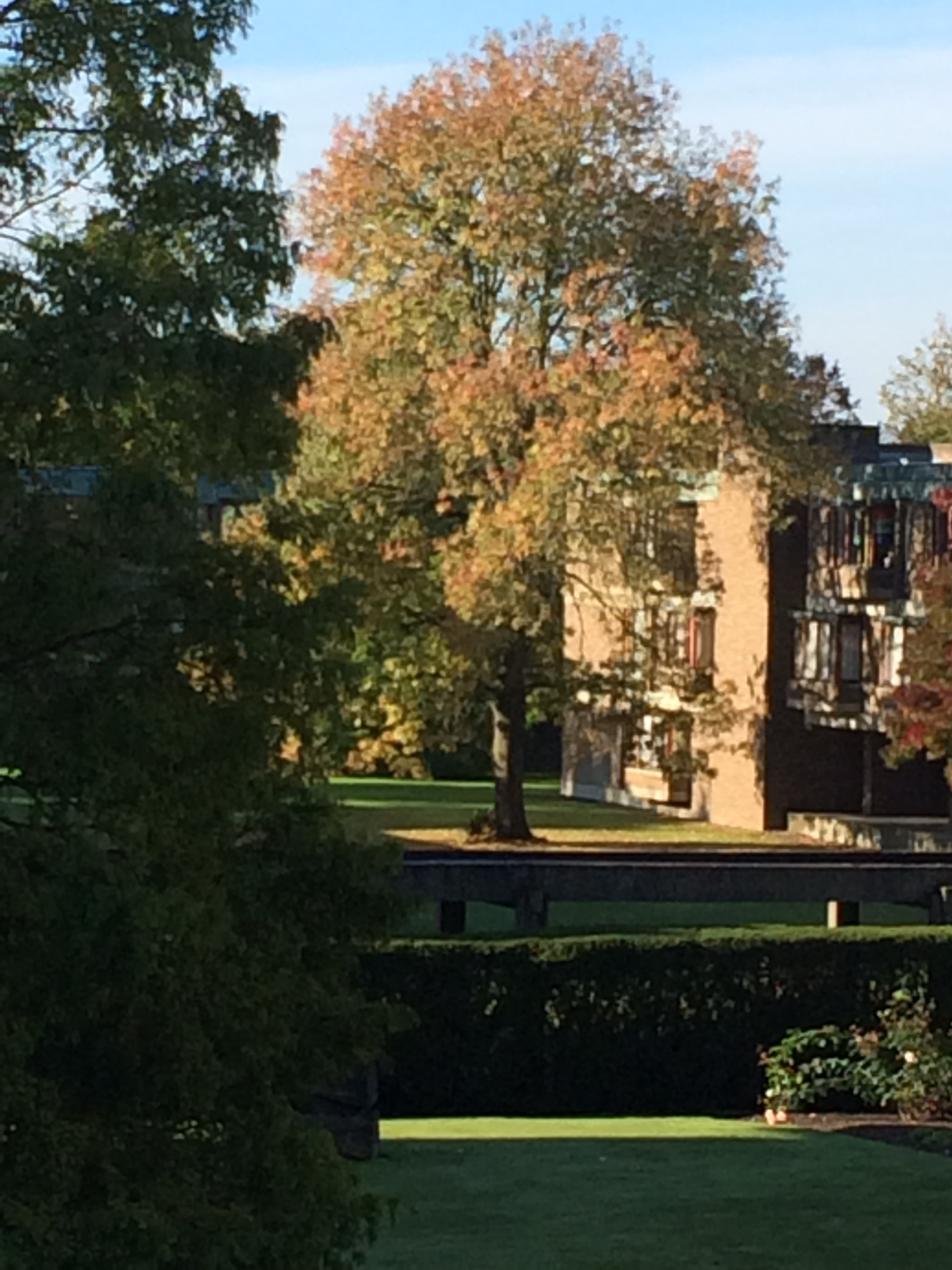
However, in the immediate short term, my preoccupation is working out where I’ve put things in the Lodge. It is a gorgeous house, refurbished for us by the college and newly released by the contractors so still with a few minor tweaks needed (no blind in one of the bathrooms, for instance, and my keys seem annoyingly temperamental probably because they are new). My study has a wonderful view over the greenery of the Fellows garden and if I peek across the corridor there is what we are terming the ‘bamboo garden’, though sadly lacking a panda. Unlike most students’ accommodation, the Lodge is extensive in size, but equally I have had a lifetime to accumulate stuff that I have to fit in. We are adopting the motto you cannot possibly have enough bookshelves and, with many books still to move across from our old home, we are doing a fine job of filling those provided for us.

New term, new life: for students and for me. The anxieties may have similarities, but one thing that undoubtedly gets easier with age/time is having confidence that you’ve survived difficult situations before and the likelihood is that you’ll survive them again. Not for me the angst that I will use the wrong implements at some fancy meal because, even if in a temporary lapse of concentration (or due to a poor upbringing) I do, I’ll just laugh it off. Ditto (she says hopefully) if I pour a glass of red wine down my white shirt or commit some other social faux pas. My poor memory for names and faces worries me more. I have already introduced myself to at least two people who have pointed out that we’ve met previously during the last week, and that’s before I’ve got to grips with more than a handful of the people who work and live in the college. However understandable my mistakes may be – after all they only have to remember me and my husband, whereas I have well over a hundred, perhaps nearer two hundred, unfamiliar people to get to grips with without even starting on the student population – I still feel it is a sad failing of mine.

Once term starts I am very much looking forward to meeting all the students, undergraduate and postgraduate. It will be the former whom I expect will be the ones who come up to Cambridge full of life, expectation, hopes and fears. It isn’t so hard to remember the excitement I felt when I first arrived at Girton College an unbelievable number of years ago; the feeling that wonderful things might be just around the corner and you never knew when you were going to make a friend for life. And that feeling that you were entering the world of grown-ups and your education was going to make you wise.

Not all of these hopes were of course realised, and wisdom is perhaps relative, but Cambridge has remained close to my heart ever since. To what extent I can keep up with this blog it’s too early to say. I do know that I am greatly looking forward to my new adventure

Posted in Science Culture | Tagged , , | 1 Comment