Is (or was) your PhD an Ordeal?

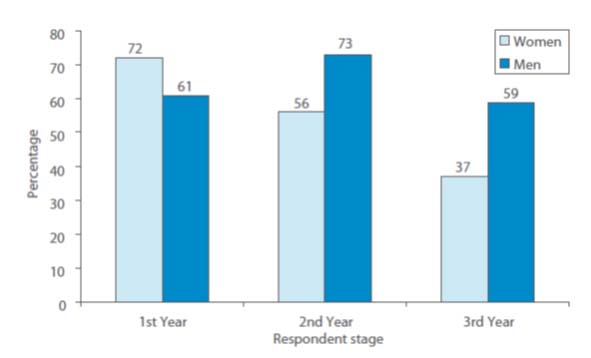
If you answered yes to the question in the title, a recent report suggests you may be a chemist, and more specifically a female chemist.  A study carried out by the UKRC for the RSC about the PhD experience for chemists reveals some fairly unattractive facts that should give heads of chemistry departments serious pause for thought. In particular it can be seen from the figure reproduced here just how precipitous is the fall off in women who intend to continue in research during the 3 years of their PhD, with the figure approximately halving. In contrast, the number of men who agreed they wanted to continue in research, whilst it started off at a lower initial figure, was almost unchanged between years 1 and 3 and actually peaked in the second year. Here is food for thought for people who care about the loss of talent from the pool, and who look at the leaky pipeline in dismay. What makes the chemistry PhD experience such a particular turn-off for women?


Proportion of respondents intending to pursue research on completing doctoral study by year and gender

This report builds on earlier work, dating back to 1999  (a report entitled Factors affecting the career choices of graduate chemists), and a later report (which I cannot find on the web) in 2008 explicitly looking at career choices by gender. The leaky pipeline seems worse in chemistry than other subjects, something that was reinforced by last year’s study about postdoctoral experiences  in physics and chemistry which I wrote about here where, once again, female chemists were much less happy and much less sure they wanted to continue in research/academia than their male counterparts. A 2008 report comparing chemistry and biochemistry PHd student experiences likewise demonstrated that chemistry students (female) were less satisfied overall.  The discipline of chemistry seems out of line with other subjects when it comes to how women experience it.

The current report is based on interviews with men and women during their (chemistry) PhD’s, both as individuals and in small groups, and the results are pretty dispiriting. Even though the numbers involved in these interviews are quite small, the results amply back  up prevous findings involving much larger numbers. I will only highlight a few points here, but I would urge the concerned reader to read the report in full – it is fairly short, at least if you don’t read the annex which has many of the actual quotes included. Broadly speaking it is clear that the women were much more likely to be got down by poor supervision, by feelings of isolation and by the slow progress of their research than their male colleagues. But they also seem to have been more likely to feel uncomfortable with the culture ‘especially where the culture was particularly macho’ and not infrequently to feel poorly integrated or even excluded and bullied within their research group.

Now, the more macho supervisors out there may immediately feel that this is due to weakness in the women, that they lack something that makes them suitable for a research career and the sooner they are weeded out the better. That would be to approach the problem via the so-called deficit model which implies that the failing is in women who can’t manage to fit in, integrate and be like the boys.  However, perhaps the macho culture weeds out a certain kind of person – who may be male as well as female  – and that as a result a reinforcing pattern of unpleasant behaviour, rather than an optimised way of doing research, ensues.  It seems to me that a culture within research is deeply flawed which leads to the following statement:

During doctoral study, a larger proportion of female than male participants had formed the impression that the doctoral research process is an ordeal filled with frustration, pressure and stress, which a career in research would only prolong; rather than short-term pain for long-term gain.

Of course this macho culture is not the only thing that women find discouraging. It is inevitable that, for many of them as they look ahead to the uncertainties of short–term contracts if they opt to stay in academic research, they worry about the implications for family life. As a result they

Come to believe they would need to make sacrifices  (about femininity and motherhood  ) in order to succeed in academia;

and

Been advised in negative terms of the challenge they  would face (by virtue of their gender).

On the former front there should be far more effort put into highlighting those women chemists who have succeeded in combining motherhood (and even femininity) with successful careers. This is something we try to do in Cambridge in various ways, but notably this past week we had a wonderful  talk by Carol Robinson,  who has undoubtedly succeeded on all these fronts. Here is a woman, an FRS, winner of many prizes, who not only had 3 children (now adult) but took 8 years out of research when they were small.  She came to give Cambridge’s Annual WiSETI lecture last week, to a packed audience. This is the sort of life-history that should give hope to all those wavering female chemists who simply believe ‘it can’t be done’. It can.

There are many recommendations made in the report. I single out just a few here:

Training supervisors better, particularly about equality issues but more generally about providing support and encouragement to those starting out on their research careers;

Setting up networks to prevent feelings of isolation and discouragement, and better mentoring perhaps via a buddy system;

Acknowledging the role postdocs may play in PhD student supervision, but also ensuring they too receive training and also recognition of this important role;

Assessing departments on the basis of the quality of their students’ training and the quality of their experience, for instance through Athena Swan awards.

Which brings me full circle.  This report was originally coordinated by Sean McWhinnie and Sarah Dickinson, when they were employed at the RSC.  They both left several years ago. Sarah at that point joined us in Cambridge as the WiSETI project officer, a role she fulfilled admirably and with her last main task being the WiSETI lecture I mentioned above. She has now moved on again and will be heading up the Athena Swan team at ECU  and so, in principle, could move to include the PhD experience in assessment criteria. However, it is very clear that Athena Swan is going to have its work cut out for the foreseeable future, with a flood of new departmental applications anticipated in the months ahead.  This is a direct result of Dame Sally Davies’ requirement of Clinical Schools that they have Athena Swan Silver awards in order to be likely to receive further funding (as I described here), accompanied by other funders making noises that they may follow suit in some shape or form. Consequently, I suspect that Athena Swan may not make such changes fast.

However, let us hope that chemistry department heads read this report and reflect about what they can locally do.This and previous reports suggest there is something peculiar about chemistry as a discipline that makes things seem so particularly tough for women. Indeed, as some of the comments in the annex to the report make clear, synthetic chemistry seems even worse than other sub-disciplines. If asked to speculate, I would suggest this may be because groups in synthetic chemistry tend to be very large, with PhD students being seen simply as a useful pair of hands. It is all too easy for the individual’s needs to get lost in such a synthesis factory. Nevertheless, for the good of future research I hope that something will be done to improve the working atmosphere for everyone, and not just perpetuate a certain type of machismo.


Posted in Research, Science Culture, Women in Science | Tagged , , , | 9 Comments

Taking Precautions

I have been reading the biography of Barbara Wootton by Ann Oakley. Baroness Wootton was a remarkable woman  (or, as the title of the book says, A Critical Woman), with an astonishing number of firsts to her name. Born in 1897, her field of activity was social policy, and at the start of her career she was particularly involved with education –  within universities, but more importantly for those without traditional qualifications at Morley College and the Workers’ Extension Association (WEA). She was the product of a Cambridge academic family (classicists) and went to Girton College where she started off reading Classics herself, which she hated. Having failed to get a 1st at the end of Part I, by virtue of developing acute tonsillitis and so failing to take the exams, she finally was allowed (by her mother it would seem) to take Part II in Economics. She excelled in this, and left Girton with its main prize, the Theresa Montefiore Prize (an honour both Sandy Toskvig and I share with her).

After a brief spell in London she returned to Girton to become Director of Studies in Economics. She was so highly regarded she was invited to give lectures to all the undergraduates, and so became the first woman to lecture to men in Cambridge.  Unlike any of the male lecturers she couldn’t wear a gown to lecture because, as a woman, she hadn’t been admitted to her degree  (no women were until 1948) and so was not eligible to flaunt this garment; indeed the lectures had to be advertised in the Reporter  (the University’s official organ) under someone else’s name, since officially she couldn’t be recognized! Her thoughts on what to wear, or perhaps how to wear it, show just how nervous she was when she started lecturing. She wore a green suit she had made herself, but in her own autobiography she owns

The skirt had an elastic band round the waist and I was so worried it might break, that I made two skirts and wore one on top of the other.

Many of us get nervous lecturing, particularly when doing it for the first time. For Baroness Wootton, like myself, there was clearly no training for the job provided. When I lectured for the first time, all the help I got was being given the notes from the lecturer who had left and whose course  I was taking over (I was still a University Research Fellow at the time).  The notes were very familiar; they seemed unchanged from the ones I had myself taken,  in longhand (and which I still possess), during my  own  undergraduate days. Having worked out (I wasn’t told) where the lectures were to be given, all I had to do was nerve myself to turn up.  I used to get up very early and essentially speak these lectures out loud, word for word, to check I knew what I was trying to say before I gave them that first year. Nevertheless, before the very first one I can distinctly remember thinking “how am I going to walk out in front of the 200 or so students and speak”. It was a terrifying prospect, but one I felt able to share with no one. I don’t recall worrying about my state of dress, other things featured far more largely in my mind, but it hasn’t stopped those students with a vicious streak commenting on my attire as they return their end of course questionnaires then –  or at any  time since.

Since that first, terrifying year, inevitably I have got more relaxed about my lectures, not always with justification.  One really should, like Baroness Wootton, make sure one has a metaphorical belt and braces. Some years further on from my first experience I still lectured sans computer but with hand-written notes which I transcribed onto overheads as I lectured (a style I would probably still favour if students could tolerate it).  I had 3 identical green files of notes covering the course and one year I managed to pick up the wrong file as I cycled off to work. I arrived in a full lecture theatre, opened it, only to find this was a file of material I had already  covered. Now what to do? Familiar though I was with the material (it was indeed a course on Materials and I really did feel very familiar with it), I still felt if I tried to extemporise without my notes to remind me exactly what I was trying to cover, things could go very badly wrong. So, I confessed and cancelled the lecture.

As with seminars that bomb, the dynamics of a lecture course can vary massively from year to year, even when teaching exactly the same material. That particular year –  it was a final year option course, so the students were very much self-selected for interest –  I had the students eating out of my hand (one of the rare occasions I could say that that has been the case). They were good-humoured about my idiocy, and cheerfully turned up for an extra lecture at the end of term. One of them even was kind enough to say on those dreaded questionnaires that it really hadn’t mattered at all.

So, turning to this year, my precautions failed me again, and I sailed very close to the wind although I also survived the experience (as did the students). Teaching a course for the third time, this time to 400+ 1st years, I was nevertheless making some not insusbstantial changes to alter the balance between different sections. After all, as one respondent said last year, how could anyone make geometric optics interesting? ( I suspect one could, but that’s another story; clearly I hadn’t). So, I had a modified set of powerpoint slides to use. Did I back them up? Did I hell!  I kept thinking,  I really must make a copy onto a  USB stick  (the notes lived on my laptop), but somehow I never quite got around to it. You can see what’s coming. Disaster struck my laptop in the form of A Worm, early on a Thursday morning. Or at least, at that point, I didn’t know what had struck I merely knew I had a dead computer. But it was a Thursday, a full 24 hours before the next lecture. Not a problem,  I thought, my wonderful  computer officer will sort me out. But, as I soon discovered, he was having a day off. Panic. L uckily we have a central IT section too in my large department and a temporary solution was found by a kind soul there to get my laptop back on its feet sufficiently that the Friday lecture could pass off without more than its usual glitches.

The moral of the story is: put two skirts on, or at least back up all your work. Work on my laptop was only backed up if I remembered to transfer the file I was working on to my  office computer. Incredibly stupid. Furthermore, due to the way I work it didn’t even have updated virus protection. Sheer idiocy. I hope I have learnt my lesson. One cannot take too many precautions about things like this. Every student who is writing their thesis, just as much as every lecturer who is teaching, should have multiple back–ups and not rely on ‘it won’t happen to me’. Not many department buildings burn down incinerating all one’s data, though it happened to Biochemistry when I was a student.  Not many people have all their results destroyed by protestors, mistakenly thinking that the work had involved animal testing, but precisely that has happened in the past to two people I knew –  and several years apart. Not many skirt elastics fail (and I assume Barbara Wootton’s didn’t or she might have mentioned it ). But computers most certainly go wrong with monotonous regularity and it would have been totally unforgiveable if my lack of foresight had meant I had to turn up to say to 400 1st years, I’m sorry , I can’t give you this lecture because the worm eat my computer. I shudder to think what the student questionnaires would have said in that case.

Afternote: Mac users need not point out that this wouldn’t have happened to me if I didn’t use a PC. I am aware!


Posted in Science Culture | Tagged , , | 2 Comments

Apple(s), Tomatoes, Willetts and Public Engagement

It’s National Science and Engineering Week in the UK, or at least it is for most places. In Cambridge we celebrate it with a fortnight, and call it a Festival because there is just so much to squeeze in.  Many of us get involved, from students to emeritus professors, and the audience is drawn from far and wide – both in terms of background and location.  It is a wonderful opportunity for people to hone their outreach skills, and for students to get into the thick of explaining their science to everyone from toddlers upwards, thereby discovering what ‘works’ and what doesn’t.

This year we kicked off with a slightly sotto voce speech by David Willetts. I call it that because it was to a ‘select’ (ie extremely small) audience carefully drawn from those of us doing our bit during the festival. I think this was deliberately done in view of the unedifying spectacle that was meant to be his last speech in Cambridge, when hecklers prevented him delivering it. This disruption caused widespread annoyance, on the grounds of freedom of speech, and led to the immediate publication of a University Council statement reinforcing our belief in the importance of this freedom.  This statement  was signed by all the student members who were, I believe, as disgusted as the academics that we were prevented from hearing what this senior politician had to say, even though many might have been going to disagree with him in practice.

Anyhow, I was one of the few to get an invitation to listen to the Minister this time. He (or at least his team) had done his homework and he began his speech with some impressive statistics reflecting the Cambridge Festival’s strengths: the largest free scientific festival in the UK with over 35,000 visitors last year. He also expressed his tactful belief that the Cambridge Science Festival has had (almost) as much effect on public engagement and awareness as “Brian Cox being photogenic”. Clearly he understands the message that we need to work in an environment in which science is appreciated by the public, but of course all of us must do our bit to ensure this happens; it isn’t simply a case of the politicians waving a magic wand (though waving a bit of money is good, as he demonstrated by announcing BIS’s continued support for Sciencewise and the Cambridge Centre for Science and Policy).

We were all curious to know what a speech we were told was entitled ‘Apples, tomatoes and our scientific future’ might embrace. In fact, this was an error in communication. Apples, speculated to be represented by our very own Isaac Newton, were not to be touched on; it was a speech comparing the apparently hi-tech science and technology underpinning  Apple and the iPhone, with the presumed-to-be much lower tech associated with the food industry. Willetts produced facts and figures to show that food manufacturing actually contributes very substantially to the UK economy, but that it also rests heavily on much basic science including, notably, genetics. Personally I’d have been delighted if he’d used starch/ polysaccharides as his example, given my own prior interest in the subject, but the arguments would have been very similar. Likewise the dreaded term GM raises its head here, whether tomatoes or starch are the focus. I asked Willetts at the end, if the government was going to reignite the GM debate. This was a challenge that has been raised very recently by Paul Nurse  in his Dimbleby Lecture, thrown out to an audience which included Willetts (the transcript can be found here). I got a politician’s answer. I think this event could be best described as a muted beginning to our two weeks of action-packed science.

As for my own part in the Festival, attending that speech was the passive bit. I have so far taken part in a lively debate on ‘Visions of Future Healthcare’ in front of a packed audience. The debate was only part of the fun though. Science magazine hosted a reception afterwards at which I was metaphorically pinned to the floor by some very engaged attendees. I felt somewhat handicapped by high quality eclairs which oozed cream and chocolate in inappropriate ways when trying to hold an intelligent conversation. It was a good evening. Even that is probably the easy bit for me, though I’d put a lot of thought into my 10 minute presentation (not least because I was being challenged to dream about what the future might hold). On the second Saturday I have the honour of giving my department’s main lecture to an audience which I anticipate (from my own prior experience as an attendee) will have a huge age range. This is the moment when I must manage to engage the 10 year olds, whilst simultaneously not boring the accompanying well-informed adults or worse, coming across as inaccurate and sloppy by trying to simplify things just that smidgeon too far.  I am still working up my lecture-demonstrations, with a long shopping list ranging from shaving foam to epoxy resins. I fear I cannot serve meringues (my dessert of choice in this case rather than eclairs) to all the audience, but they will feature prominently in the talk.

Many years ago, way back in 1995, I was part of a team that gave the IOP Schools’ Lectures, a team of 4 (consisting of then Cambridge colleagues Richard Jones, Ruth Cameron, Adrian Rennie and myself) that toured the whole of the UK. My colleagues were very kind to me back then: knowing I had young children – and none of the others did at the time – they took all the hard work of travelling to the further reaches of the country and left me the comfort of day trips within the south-east. So I got the pleasure of talking at both the Royal Institution (before its seats were purple, but still the original wooden benches) and the Science Museum. The talk we prepared back then, Building with Snakes, discussed many of the properties of polymers. Some of the ideas we perfected then – and with around 30 performances between us, we really had plenty of opportunity to perfect our spiel – will also find their way into next week’s talk; even some of the props have survived, but not many. My talk this time focusses on Goo, a topic I hope will go down well with the youthfulness of the audience.  If I had entitled the talk Viscosity and Soft Matter I think I would have had an audience in single figures. So now a week in which to get my demos working, and remind myself of how not to turn off a lay audience.

National Science and Engineering Week is a wonderful thing. I am delighted to be getting my hands dirty and trying to inspire the scientists of tomorrow.  But we all know the old adage If it doesn’t work it’s physics­- and that will be much in my  mind as I take to the floor with a benchful of (potentially) recalcitrant demonstrations in front of me.

Posted in Communicating Science, Science Funding | Tagged , , , | 4 Comments

Dangerous Assumptions

Last week I was put in touch with a reporter from my local newspaper, the Cambridge News, who was writing a story about the University’s Annual Report. They seemed concerned about the lack of women academic staff (and ethnic minorities) – as we all are – but they also seemed rather more surprised than perhaps they should have been,given that it’s data that has always been in the public domain. In fact, they initially contacted my classicist colleague Professor Mary Beard by email, but she was travelling and passed the query on to me. So I sent them a carefully worded reply, to the effect the numbers were low but we were working hard to improve the situation and stating that I was the university’s gender equality champion. When the article came out I was very pleased to see they had used my quote accurately and in an appropriate context. But then I looked more carefully at what had been written and felt a lot less happy (as far as I can see the story didn’t make it onto their website, so you can’t check it).

They used quotes from two Cambridge professors in the story, my colleague Malcolm Longair (ex-head of the Physics Department) and myself, both of us saying very much the same thing. But the difference was that he was referred to as Professor Malcolm Longair, and I was merely Athene Donald, with no title at all. Did the journalist – a woman herself – realise that she had done this or was it, as so often, completely unconscious? As a woman, indeed as the university’s gender equality champion, maybe she simply assumed I couldn’t be a serious academic, couldn’t be a professor and she hadn’t checked any further. But I had sent my comments by email so she had no excuse. My email signature spells out quite clearly that I am a professor. Indeed I had, most unusually for me, actually changed the signature to add in the fact I was a Dame – something I usually try to gloss over. So, it would appear she had simply made the assumption

woman= insignificant,

and hence no title required (at least she hadn’t called me Miss; I suppose I should be grateful for small mercies).

This kind of unconscious putting-down is, I fear, prevalent in our society. It is deeply troubling to see it in action, and yet it is difficult to overcome for the very reason that it is unconscious. In this particular journalistic instance, it is of no consequence except as an illustration of how these things crop up all over the place.  Other similarly irritating occasions will be familiar to many a professional woman who turns up somewhere unfamiliar only to be first cut dead and then be greeted with ‘oh I was expecting a man’ (this frequently happens to me when drivers pick me up from airports or stations waving their placards saying Professor Donald). Boring but unimportant.

Other instances of unconsciously ignoring or marking down an individual simply because they are female can be much more serious. The 1997 study of Swedish fellowship applications by Wenneras and Wold is frequently cited on this front. Examining how male and female applicants for postdoctoral fellowships were judged, it demonstrated that the playing field was anything but level. Other well known papers demonstrating similar subtle (or not-so-subtle) effects include a 1999 study of reviews of CV’s, when either a male or a female name was attached to the same CV. This study showed that both men and women scored the ‘male’ CVs more highly than the ‘female.’   In a totally different context it was shown that when auditions for orchestras were carried out blind, by placing the players behind a screen so that the judging panel couldn’t see if they were male or female, suddenly more women were successful in the auditions. This was also published in 1999.

However, it is possible that things have improved substantially since these papers were published at the end of the last century. As I cited previously, the Royal Society’s recent statistics actually show a marginally higher success rate for women fellowship applicants than for men. Recent work from the US by Ceci and Williams also suggests that the outcomes of the Swedish study may no longer apply. This same paper suggested that examination of studies about hiring processes, grant reviewing and journal refereeing all failed to show significant differences by gender. Is it possible that we have actually progressed beyond the obvious problems associated with unconscious bias? I am afraid I am not convinced that the world is quite that rosy.

It may indeed be the case that interview panels are much more aware of the issues, but it is still the case that judgements may be formed very fast, and be remarkably hard to overturn. A chilling, although I suspect statistically flawed study (the numbers were tiny) of mock job interviews showed just how much first impressions count: this might be anything from firmness of handshake, to body posture on the interview chair to – well, I suppose, is this what the interviewer thinks a new research fellow/professor or whatever should look like? Having been told in the not-so-distant past by a male colleague that my ‘turn would come’ when I applied to take on some role, despite the fact I was more senior (in age and status) than the alternative male applicant, signified to me I did not meet with his superficial expectations; it had nothing to do with my actual skills and experience.  That is the danger if thought is not applied. And that is exactly the sort of thing my recent experience with the Cambridge News demonstrates. In that case it didn’t matter. Many times it may make the difference between career progression and stagnation, or even failure and dropping out.

Posted in Equality, Women in Science | Tagged , , , | 27 Comments

That Dratted Tenure Clock

Almost exactly a year ago I posted a blogpost on the back of wading through papers for a promotion panel. I’m buried in the paperwork again this year, but I’d like to put a very different emphasis on what I have learned from the experience this time around. First of all, hallelujah, the documentation is on a USB stick and NOT delivered to me in 3 large cardboard boxes. It actually feels like less work when it is so tidily packaged into something occupying a volume of approximately 1.5 cc as opposed to tens of litres of ‘stuff’’.  The information content is of course identical.  Last year I bemoaned the inability of applicants to provide the information requested. This year I’d like to salute the fairness and intrinsic sense of equality about the process, particularly in comparison with everything I hear about the US system (I hope, although I don’t know, that other UK universities may be equally far-sighted in their approach). There is still much that can be done to ensure fairness; indeed, there will – I believe – locally be further changes in the coming year regarding the weights with which different aspects are valued.

The instructions for the various panels involved in the exercise are given in a thick (virtual) tome about the process; the applicants get exactly the same information. I want to concentrate on the question about how an individual’s circumstances are taken into account, and contrast that with what goes on in the US, as far as I understand it. Let me start with pointing out the legal differences about maternity leave in the US and here. I find it incredible that in the US there is still no legal entitlement to paid leave.  I wanted to check I really did have my facts straight on this, so I did a bit of searching on the web. On the BabyCenter website I found the following unequivocal statement:

Maternity leave, now often called parental or family leave, is the time a mother (or father) takes off from work for the birth or adoption of a child. Actual paid “maternity leave” — while the norm in almost all countries — is unusual in the United States, although some enlightened companies do offer new parents paid time off, up to six weeks in some cases.

Goodness, enlightened companies offer a whole 6 weeks of paid leave! Even when I had my own children 25 years ago I was entitled to 16 weeks of paid leave in the UK, although I think (if I recall correctly) I had to have been in employment with the same employer for 2 years in order to qualify for this.  Seeing this, it makes much more sense of why ‘stopping the tenure clock’ is such an important issue for women in the US who have a child (or more than one) during their tenure track years. They may come back to work very fast, while still recovering from childbirth, breastfeeding and generally feeling under the weather. And yet they are expected to be working at the same rate as those individuals who are doing none of the above and, unless they put their hands up explicitly to ask for that dratted clock to be stopped, they need to get equivalent numbers of grants, write the same number of papers and deliver the same number of contact teaching hours. And they are probably doing this on very little sleep. It sounds horrendous. So their alternative is to sound like Oliver and say ‘please committee can I have some more (time)?. Compare that with even the much-disliked REF, with its revised requirements that each woman can (if she and her department want) automatically reduce the number of outputs submitted by one for each period of maternity leave, no questions asked; revised, it has to be said, in the face of strong voice of criticism, but at least they did do so, and quickly.

Turning now to the guidance about promotion within my University, I find the following – covering much more than just maternity leave.

Consideration should be given to any personal circumstances which may have had a negative impact on an applicant’s or group of applicants’ teaching, research or general contribution e.g. disability and time away from work because of family responsibilities for bringing up children or caring for relatives or for illness. The quality and impact of an applicant’s performance should be assessed objectively and on the same basis as other applicants but promotions committees should take into account any reduction in working time of the candidate due to additional considerations when judging the quality of their work or output; for example, by assessing the volume of output pro-rata. Advice should be sought at the earliest opportunity from the relevant HR Business Manager.

In the case of a member of staff who has taken leave from their usual duties, e.g. maternity or sick leave, assessment of their contribution should focus on the period when they were at work, with allowance made for quantity of work/output, as appropriate, as set out in paragraph XX.

So, as a member of one of the relevant committees I am told to factor in any reduction of hours worked at any point during the preceding years since appointment or last promotion as long as I’m told about it. Specifically, there is a form about Additional Circumstances where applicants can write down any relevant facts. Individuals should be being encouraged to say things like:

  • I was invited to give a plenary in the US but I’m restricting my travel due to my family commitments and so declined;
  • I am only working 4 days a week (hence by implication the publications record can be expected to be accordingly reduced);
  • I was on maternity leave for the whole of one academic year, during which time I applied for no grants and paper-writing stalled;
  • I was involved in a car-crash and my recuperation knocked me back over a period of 6 months (in this case a statement from Occupational Health is likely to be required, so that the magnitude of the health issues can be objectively assessed).

Hence what matters is the quality of what is submitted, not simply the volume. This seems to me an altogether more humane way of handling the realities of life and, as you can see, is likely to benefit men as well as women. Indeed, it is frequently the men we see declaring these sort of circumstances (other than, obviously, maternity leave; as paternity leave is more commonly adopted this will be increasingly likely to appear too).  But it does mean, for instance, we have women promoted to professor who are working part-time. I am not sure how many universities can boast that, or how many people would expect that to be true of Cambridge.

I am sometimes told that the culture for women in the US is better than here. I find it hard to believe that this can be true on these sort of objective grounds, even if in some places the inherent culture may appear to be more friendly. A recent article in the American Scientist has highlighted just how much motherhood impacts on career progression and the leaky pipeline in the sciences in the US. The reality is, any system which implicitly penalises women for daring to disappear from their place of work to have a baby, let alone takes time off to bond with it during the early months; or that penalises anyone for being involved in an accident or suffering from long-term ill health without due allowance being made when it comes to promotion/tenure decisions seems to me to be a pretty inimical place to work. I am so pleased my own University has adopted some pretty people-friendly policies; I doubt they yet match some Scandinavian policies, but they do at least mean that one’s brilliance may be temporarily dimmed by being human, with a consequent hiccough in publications, grants or invited talks but, assuming the brilliance is nevertheless present, it can still be evaluated fairly and objectively.

Posted in Equality | Tagged , , , | 12 Comments