The Royal Society and Diversity

It is very easy to pillory long-established organisations for being insufficiently diverse. As a member of Cambridge University and a Fellow of the Royal Society, I see it all the time. It is assumed these venerable institutions are ‘bad’. It is true that in both cases only the last 60 years or so have seen these entities fully admit women out of their total lives of 801 and 351 years respectively. However, working closely with both on gender issues, and diversity more generally, it strikes me that actually both are very conscious of the impact of their history on their current membership and performance and are actively working hard to change things. But, accomplishing this will take time. Indeed I think that, because they are very conscious of the baggage of history, they are probably much more concerned and active than many younger organisations. This post is about the Royal Society, but I will just say in passing and in defence of my university’s activities that to the best of my knowledge Cambridge is the only Russell Group University that both carries out and openly publishes its Equal Pay Review. It may not be a perfect performance, but we are willing to share it in the interests of transparency. (In a similar vein, as the THE pointed out only last week, Cambridge has been transparently publishing its ethical guidelines regarding donations for the last 10 years, but that’s a different story.)

This post is prompted by a talk I am giving at an Inside Government meeting later this week on Widening Participation for Women in STEM, representing the Royal Society. I sit on the Royal Society’s Equality and Diversity Advisory Network, EDAN for short, and each year they gather statistics on the Society’s performance. I think these are considerably better than most of you might imagine.  You may be familiar with the Royal Society’s motto Nullius in Verba, roughly translated as ‘Don’t take anyone’s word for it’. In other words, for 350 years it has been looking at the evidence, and this applies just as much to its own performance as to the activities of its individual members in science. So, it has been scrutinising its performance against benchmarks of the population and looking at the progression in time. I’ll just pick out a few headline figures.
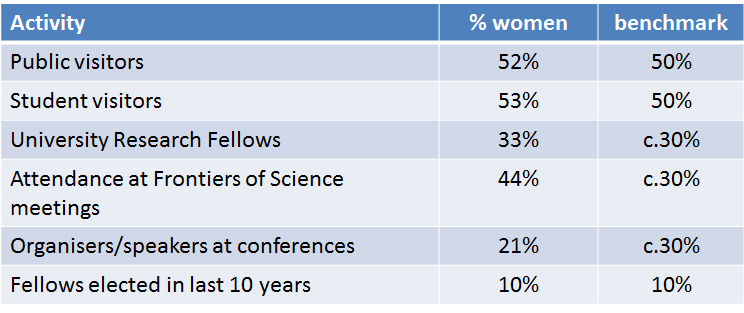
Statistics for 2010 from the Royal Society

The first challenge is to identify what the appropriate benchmark figures are for different stages of the ‘academic career’. This is hard enough to do for gender, even harder for ethnic minorities or the disabled; suffice it to say these last two are something the RS also has its eye on, probably increasingly so, but I won’t discuss them here. (A fairly recent study in the US shows just how bad the situation is there for black scientists. ) It is obvious that in the general public the percentage of women is essentially 50%.  As the first chart shows this benchmark is being met and, for student visitors, even slightly exceeded. For the scientific community overall an average figure of 30% is used for the gender benchmark, based on the average of figures for female postdocs and lecturers across the scientific disciplines (not including engineering, which one might argue one should, but also excluding medicine which would shift things in the opposite direction).  One can argue about the precise value this benchmark should take, but as the chart shows the figures again are healthy using two different measures: attendance at meetings and successful University Research Fellows.  From the second chart (note the ‘A side’ means the physical sciences and the ‘B side’ the Biological in the terminology of the RS) it can be seen that for 2010 – the year this data was collected – women actually have a higher success rate than men in the URF competion. Should we worry about this? Probably not yet, but in due course, if this imbalance persists, one might want to explore the reasons for this further. Nevertheless, the situation from the perspective of the pipeline of women moving through the system is encouraging. The one figure where the numbers fall below the benchmark is in terms of speakers/organisers for meetings held at the Royal Society. There is a policy that when outline proposals are considered by the relevant internal committee, if there is a dearth of women speakers in the programme the organisers are asked to consider whether this is appropriate (for the particular topic) and if they can’t justify their slate of candidates they will be asked to reconsider. Clearly, this is not yet having a significant enough effect. Again, this is something to keep an eye on.
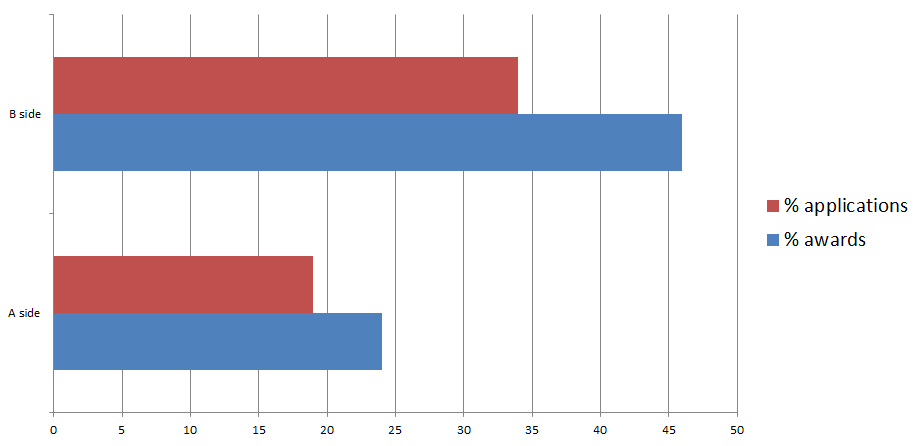
2010 statistics for women applying for University Research Fellowships

The final statistics in the first chart relate to the ‘established’ or senior section of the community. With around 10% of all science professors being women, this is the benchmark figure being used. Elections to the fellowship are in line with this, although there is a marked difference between the biological and physical sciences side; it won’t take much thought to work out on which side there are more women fellows elected. It’s not yet good enough, and with a figure of only 5.6% women amongst the fellowship as a whole there is a way to go, but just because of the historical imbalance don’t assume no one worries about this.

For election to the fellowship, in other words to become an FRS, or indeed to win any of the medals and awards, you – rather obviously – have to be nominated. So, if there is to continue to be an increase in the number of women in the ranks, people must continue to nominate them.  As I have written previously, it seems remarkably easy to not to ‘remember the women’. The leadership in the Royal Society are so worried about this, and have been since the days when Lord May was the President in 2000-2005, that they have taken a number of steps to draw attention to the issue. So, heads of departments and Vice Chancellors are encouraged to consider putting names forward, and some of the Officers have gone to meetings at the various professional bodies to remind people that it is to some extent up to them to propose names. Even people who aren’t FRS’s themselves, and so cannot formally nominate anyone, can make suggestions of high flyers to the Officers. Historically this is also relevant to people from smaller less well-known institutions as well as minorities of any kind.

Finally, I should say not only is the RS really aware of the issues and trying to do what it can to improve the situation, since I was elected I have always found the place friendly and welcoming, probably not what people might expect.

So, historically bad though the Royal Society may have been, I do get rather fed up with the constant sniping about how unrepresentative it is. Election to the fellowship only happens rather late in life, with the average age upon election probably being mid-50s, though that is a guess (and does appear to vary from field to field); of course it won’t be transformed overnight. But I am not a believer in quotas, and I am not a believer in lowering the bar just to speed up that transformation. It will only weaken the position of women who might be elected under such systems.  Before people snipe they should be very sure their own organisation is spotless, and doing everything it can to facilitate women’s progression.

Finally, it is worth noting something that hasn’t yet received much coverage, although David Willetts announced it formally in a speech a few weeks ago: BIS is giving £200k pa for the next four years to the Royal Society to address some of the diversity issues, paralleling money given to the Royal Academy of Engineering. In the case of the Royal Society exactly what the money will be used for is still very much under discussion, and it is also clear that it is to cover diversity in all its facets – socio-economic, ethnic and gender – but further progress and action can be expected.  Monitoring statistics is all very well, it is a step in the right direction and indicates where action is most needed, but new concrete and broad-ranging activities should help to spread the word: diversity matters and the Royal Society is set to play a key role in improving the landscape. I hope it will – as some have said it should – take a more prominent leadership role in diversity across all the sciences and continue to disseminate best practice. But it’s not all bad news and, as the statistics show, its own house is in moderately good shape.


Posted in Equality, Women in Science | Tagged , , , , , | Comments Off on The Royal Society and Diversity

Leadership from the Top

What will it take for true equality to occur, not just in academic science but in employment anywhere? One key aspect is that people at the top not just ‘talk the talk’ but ‘walk the walk’. So, when talking about family friendly policies it is important that leaders show they mean it. Some years ago I attended an event at the House of Lords where various people spoke about what their own company was doing. Examples included flexible working, teleworking, job shares and many obvious examples of this sort. But what struck me was the story of the CEO of some large company – at this distance in time I cannot remember which – who left work early each Friday so he could go and meet his children from school. I am not applauding him because as a man he did this. I am applauding him because as a CEO he was making a very positive statement that this was an activity he valued and that he recognized others in his company would value it too. In other words, that it was OK to care about your family, and make arrangements – with your line manager, perhaps, about hours of work – to ensure that (within reason) caring responsibilities could be catered for. If the boss does this it carries a very powerful message.

Having recently attended a meeting with my own VC with the Daphne Jackson Trust about returner fellowships, I know how much he cares about these matters. Here is a man who is prepared to lead from the top and make a cash commitment if that is what it takes. This week, at his termly meetings with heads of departments he invited me to come to talk about how important it is for departments to be proactive about equality issues and, when I had finished my brief overview last night, reinforced it with his own hard-hitting words.  Both the upcoming REF, with apparently stringent requirements going to be imposed on those making decisions about entries on the equality front, plus the potential moves by a variety of funders to ask departments and universities (see here and here for my exhortations on this front; there are interesting and interested noises coming from several funders)  to show their commitment to equality through Athena Swan, it is no longer sufficient for departments to look the other way. Nor is it sufficient for the person at the top simply to say they care about these things: they must demonstrate this commitment too.

There are many ways that leadership of an organisation can make a difference by quite small actions. That is why the Athena Swan Charter is so important by requiring this commitment from the senior management; the actions it requires for individual departments to take can have significant impact on women and men too, by creating a more inclusive culture. Timing of meetings, for instance, can shift the balance for some from attending these under duress and fretting about whether someone else has remembered to pick up the children from school, to making accomplishing both activities straightforward. Monitoring whether there is a greater drop-out of women than men at each stage from first year undergraduates to professorial appointments and promotions can highlight where the system is causing problems.

Finding out what people feel was at the heart of the ASSET survey, whose report is celebrated with an event at the Royal Society today.  Those universities and departments who had significant numbers of responses completed can use the responses to evaluate what is going right and wrong locally. More targeted questionnaires and monitoring can then be used to inform what policy and practice changes are needed, because every insititution will have its own culture and its own successes and failures. But, no longer can people bury their heads and say this doesn’t matter; if funding does indeed become pervasively dependent on a minimum sort of demonstration of ‘best practice’ it will force the issue. About time one might say.  There are too many examples I come across of less than ideal procedures, sometimes one suspects deliberately so, more often just due to a lack of awareness.

At the Heads of Department meeting I attended, I referred to the poor advice some women receive about how to handle career breaks. A particular case history was put forward by someone else of a case for promotion he had seen where everyone was very enthusiastic about some woman, and yet her publication record was surprisingly thin. By pressing the department it was possible to extract the fact that she had actually had more than one child during the past few years and yet this nowhere appeared explicitly. It makes a nonsense of judging people if all the facts are not present; and extended time away from the job doing something as natural and important as having a baby should not be obscured. No one is being served well if heads of departments (or others) give the advice – as they obviously still frequently do – that it’s best not to mention the inconvenient production of a baby rather than a Nature paper or two. These messages need to be said over and over again until our culture changes to recognize that 24/7 working is neither ultimately productive nor beneficial and that life beyond the lab is also of importance. (I will have more to say about this in the context of the REF in a couple of weeks).

Families matter and, despite the pressure cooker life that is academia, work-life balance matters too. Recently I was encouraging a senior male member from the Management Committee of another university not to feel embarrassed that he couldn’t give a talk on a Saturday because he had a prior commitment to his young son. The more men feel able to say this, the more women will too. The more academic life is full of people who believe other people matter, the more smart people will not want to leave science for the wrong reasons, driven out by an inimical culture. This will benefit women, but it will benefit many men too.


Posted in Equality, Science Culture, Women in Science | Tagged , , , | 12 Comments

Tea and Tradition

And the votes are in. The University of Cambridge Senate has just voted for its new Chancellor. Senate rarely votes about anything, and the last time a Chancellor’s nomination was put to such a vote was in 1847 when Prince Albert beat off a challenge from the Earl of Powis, a graduate of St Johns who was nominated by others from that college. At that time things got somewhat mired, not only in college politics, but politics more broadly. I suspect the processes have got much more formalised through Statutes and Ordinances in recent years.

As a University Council member I was also automatically a member of the Nomination Committee who nominated David Sainsbury  earlier this year  as their candidate of choice. But this time there were 3 opposing candidates:  the actor Brian Blessed, Michael Mansfield QC and a local shopkeeper Abdul Arain.  So, over Friday and Saturday the centre of Cambridge was unusually busy with throngs of voters turning up.

It was a strangely moving experience, because of its rarity and because of the great sense of ceremony that was attached to it. I had not expected this at all. I first noticed it as I cycled at high speed past the Senate House on Friday afternoon (having missed the train from London I needed to catch to get back in good time for the beginning of term welcome to our new PhD students due to the vagaries of the Piccadilly line).  The road outside Great St Mary’s was peopled with large numbers of gown-wearing alumni and alumnae many, it has to be said, leaning stiffly on walking sticks. The University Senate consists of anyone with a higher degree from the university and, since graduates of the university automatically qualify for an MA 7 years after matriculation, this means all but the most recent graduates are members, as are many of the senior staff with degrees from other universities who can also apply to be granted an MA.  Friday afternoon was obviously the time when MA’s who matriculated many years ago were inclined to return.

I returned myself to vote rather later, at which point I was pleased to see there were no queues. I was able to dump my bike against a railing, don my gown and quickly cast my own vote. But even though I was glad to do it fast, I couldn’t help but be impressed by the way the whole operation was organised. No queues for me, and it was a bright sunny afternoon, but it seemed that everything had been thought through. There were many officials clad in cloaks and top hats, ushering the voters along under an awning – factoring in the possibility of rain –  where there were chairs placed to assist the elderly if forced to queue. There was a convenient place where I could leave that rucksack I was hauling around with my luggage from my London trip, and there was the sense of an immense and efficient polling station as the ‘Regents’ were separated from the ‘Non-Regents’ (ie those who are currently members of the Regent House, broadly speaking current employees of the University, as opposed to those who were simply graduates), and rows of desks to deal with us alphabetically.  Hot drinks were available too, I think in the recently re-opened University Combination Room. It was a very smooth operation, overseen by everyone from the Registry down as far as I could see: the Esquire Bedells, the Constables, the Proctors and the Vice-Proctors (such wonderful names these people have), and probably others whose titles I’ve never learnt, though they are equally efficient at every Congregation – degree awarding ceremony – I have presided over. Whatever one may think about this country, we do ‘do’ ceremonies rather well!  Everyone was smiling and there was a strong sense of occasion. As I say, I found it surprisingly moving.

On the Saturday I returned again, when my husband went to vote in the afternoon. By this time the crowds were back (I believe when the poll had first opened on the Friday morning this had been the same, with queues described as winding all round the Senate House), but the average age was much lower than those I’d seen on the Friday afternoon. These were on the whole rather recent graduates. But, since most of them did not have gowns with them – gowns were of course available to borrow – I think many of them had probably come from outside Cambridge. The crowds did not quite match those seen back in 1897, shown in the photographs, when special trains were laid on from London to make sure voters could get back to oppose the admission of women. This time, a mere 5,558 valid votes were cast.

The scene outside the Senate House in 1897

Effigy of a bicycling woman suspended across from the Senate House in 1897


I am no fan of gowns, of paraphernalia or anachronisms, but somehow this sense of ceremony seemed fitting. I was really glad when Universal Council decided, shortly after I was elected to it nearly 3 years ago, that gowns no longer were really a necessary prerequisite for attendance. I would like to think my moans on the subject of having to stick my gown into my bicycle basket as I dashed across Cambridge for Council meetings (not for me the luxury of being able to walk to the Council Room from my college or department, since Physics is situated 1 1/2 miles from the centre of Cambridge), contributed to the swift change of mood about their necessity. One of the key arguments for retaining them was that the Council Room is so cold in winter that they were very desirable, an argument that I must admit has some force but which really can be dealt with in other less archaic ways.

So, now we have our new Chancellor, duly elected by a historic procedure.  Lord Sainsbury was gracious throughout, saying perfectly reasonably

‘This is no longer the age of deference. An election is a good thing.’

I’m sure he will serve us well now the Nomination Committee’s nomination has been formally approved, and by a simple majority. Maybe next time we vote for a Chancellor of the University of Cambridge we will have moved on from such a cumbersome approach. If it is another 150+ years hence who knows what procedures might have taken over; there seems little point in thinking about whether it might involve dimpled chads or even online voting, Surprisingly I find myself hoping that actually, once every century or so, Senate will get a chance to don its gown (or someone else’s) and turn up to vote – and then have a cup of tea.


If you’re interested in a slightly different take on this, read Mary Beard’s account here.

Posted in Education | Tagged , , , , | 9 Comments

Is this an Insoluble Problem?

Previous posts by fellow OT blogger Jenny Rohn (here and here) and me (here) about fellowship funding have sparked a lot of debate and interest. With the report that Science is Vital has just produced for David Willetts described in another of her posts, plus the round table that Jenny and I will both be participating in later in the month with Willetts, Paul Nurse and others at the Royal Society, it seems timely to revisit this issue. More specifically, I’d like to revisit the topic building on the post that Tom Hartley wrote as a follow up to our original ones, about what might represent ‘fairness’.

Let me start out by saying that I have every sympathy with those early career researchers who feel immensely frustrated, not to mention depressed, by the current system. There are a huge number who end up being disappointed, many of whom no doubt could have thrived if only they had been given the right opportunity, and who would have given much back to the taxpayer who will have contributed to their education and training up to that point. But I still don’t like the use of the word ‘waste’ when these people are discussed, because education is (in my view) a public good, and these people – as long as they don’t end up so embittered they give up any attempt to use the skills they have learned along the way by opting out completely – are likely to continue to contribute massively to the economy in many different ways. Becoming a school teacher, a festival organiser or a freelance writer (just to name some random roles they might assume) may not equate to their dream of continuing as a bench scientist let alone a PI, but I don’t believe it amounts to a waste of their education and training.  Furthermore, if the funding system made it possible to create more permanent postdoc positions I would be absolutely delighted. These roles are invaluable for the individual and for their PI (and do exist, as far as I can see, in some STFC funded programmes). But such positions cannot solve the fundamental problem because there simply wouldn’t be money to create sufficient posts to fulfil the aspirations of all.

Tom Hartley felt that the funders – from whose point of view my earlier post was in essence written – are not really “doing the best that can be done with the money available”, or at least that he didn’t feel at all confident that this was so. He is intending to do some modelling to check this out, but I am not aware he has yet put the results out on the web. In offline comments to me he indicated that it might be much ‘fairer’ for instance, if the money was spread more widely and more thinly, so that luck played a less important role in people’s careers. So let me tackle that point of view, by raising the question of fairness for whom? This I think gets to the heart of why modelling may be so hard to make meaningful.

Suppose a fellowship competition changes its processes, so that instead of awarding 20 x 4 year fellowships it offers 40 x 2 year fellowships, will this make things fairer and more popular? No doubt it will feel so to the 20 who get a fellowship now who wouldn’t have under the earlier rules. But actually it means not one of these people will be able to take on a PhD student, or apply for most grants. The time is too short. I am aware that people currently with 3 or even 4 year fellowships worry about this shortness. Everyone wants fellowships to run for 5 years so that they have time to demonstrate that they can supervise students and win grants. So I am not convinced Tom’s suggestion on this front would actually make the postdoc population at large feel more content. Of course none of the 40 putative fellows would know whether they would have been in the 20 who would otherwise have got 4 year fellowships and so ought to feel aggrieved, or in the additional 20 who have now got something they would otherwise not have had and ought to rejoice the system had changed.

So it seems to me there are 3 measures of fairness of outcome which are likely to be incompatible. Fairness to the pool in general – which is no doubt what Jenny and Tom focus on; fairness to those who succeed in one fellowship competition and want to demonstrate how much they can go on to build on this success and generate more fantastic results; and fairness to the taxpayers who want to know their money is being wisely spent on top-notch candidates without massive associated overheads due to having an impossibly large number of applicants (with the concomitant nightmare of  heavy administration and multiple selection panels), if all eligibility criteria were removed.  The latter scenario, I will stress again as I did in my first post, would not lead to the removal of luck, it would just manifest itself in different ways.

An alternative suggestion to spread the money more evenly would be to say, if you were nearly successful in one round you were given bonus points for the next, whereas if you were successful you were totally excluded  – this is an approach that seems to be implicit in Tom’s post as a way of levelling the playing field. What this means is the truly excellent – those who do have the skills and not just luck – will be hampered to make way for others who may be less good. The bone of contention is that these others may in fact not be less good, merely less fortunate or less well-positioned.  Funders need to go on the evidence put before them, as scientists surely should. And if the evidence is made up of a mixture of luck and skill any selection panel can only go so far in disentangling the two. This is in essence the same challenge that universities have in widening access: go to the ‘right’ school, have the ‘right’ parents or happen to be lucky enough to have a brilliant teacher and life is much easier than if these things aren’t present in your life. My university works really hard to try to distinguish applicants who have been well coached but are merely solid from those who haven’t had the advantages of such preparation but are inherently smarter.  It is not such a very different problem and is equally hard to resolve.  Contextual data, as with university admissions, may or may not be readily available or usefully interpreted by selection panels trying to work out just how ‘lucky’ someone may have been.

Science is Vital have made the point to David Willetts in their submission that losing so many postdocs after many years’ experience gained because they haven’t made PI is like throwing out all teachers who don’t get to be Heads by 40. The analogy is not perfect, though, because there is far more turnover in head teachers than in Lecturers and far fewer people chasing the positions. So the supply and demand pattern is totally different. Indeed in science teaching there is a serious shortage in many subjects, such as my own of physics, so the parallel is not at all close. As long as we have a huge number of aspiring PI’s who are willing to take the risk of there being no opening of a permanent position for them in the end, the problem of the system ‘rejecting’ large numbers is bound to continue. The simple supply and demand solution would be to have fewer entering at the bottom as lowly postdocs. If there were fewer of these, there would also be more money to create permanent senior postdoc positions. Perhaps that is the logical solution to this problem, rather than homing in on the specifics of a particular fellowship scheme’s eligibility criteria. However, it isn’t clear to me that that is any fairer, since the rejection process will just occur much earlier in one’s career, where the evidence is bound to be even less concrete: how can you judge someone’s innate brilliance infallibly at the end of a PhD? That is a time when there will have been extremely limited scope to demonstrate independence of thought, leadership, originality or any of the other qualities that ultimately matter for a successful career.

So, reforming the postdoc career structure is clearly something that needs to be thought carefully about. Undoubtedly PI’s should do a better job of informing those starting out of the risks inherent in taking on a postdoc position and ensure that the skills learnt include many generic/transferable ones which the postdoc can usefully (and enjoyably) take if they leave the laboratory.  But, with finite money and far more researchers dreaming of running their own teams than positions available, it is inevitable there will be disappointments. Shaking up eligibility criteria for fellowships will never solve the fundamental problem. Nor can creating a few permanent positions, desirable though that may be; it will only create a different kind of lucky elite.

After I drafted this, I came across a  post about the pros of  multiple short-term contracts, written by Tom Webb, a postdoc who has had 4 successive 1 year positions. It provides an interesting contrast to the usual unhappiness with that aspect of the system, but it would take my own post  too far in a different direction for me to be able to address that question here.

Posted in Careers, Science Culture, Science Funding | Tagged , , , , | 36 Comments

To Whom I Give My Vote of Thanks

Today is Ada Lovelace Day, a day when we are asked to celebrate the women who have inspired us in our scientific lives.  I have to admit that ‘famous’ women such as Marie Curie or Rosalind Franklin have no part in my mythology and the woman from history I wrote about recently, Mary Somerville, I am ashamed to say I had never heard of until quite late in life despite being very familiar with the name of Somerville College. I also had no female scientific forebears or close relatives to inspire me.  But I would single out two women from my early years who each played a large part in the fact that I am where I am now.  The first probably fits appropriately into the category of those in the psalm we used to sing at my school’s Founder’s Day ‘But some there be who have no memorial, who are perished as though they have never been’ (a verse I sing to myself as I type) although she may in fact still be living. The other has a name which will be familiar to many generations of Cambridge NatSci’s who will be well-acquainted with a textbook she wrote with her husband.  They both provided me with immense support in very different ways as I grew from a gangly and shy 13 year-old first encountering physics, into a graduate of Cambridge University.

Ruth How was my Physics teacher when I was at Camden School for Girls. She was herself a graduate of Oxford. To my teenage eyes she was already ‘old’ when I knew her, with her thick grey hair. I have little idea of what her real age was, perhaps only 20 years older than me. Most importantly, she was not only my physics teacher, she was a physics graduate. She knew her stuff; she could teach me what I needed to know and she always appeared to be able to answer my questions. At the time I had no idea how lucky I was to be at a (girls’)  school which was able to provide teachers for the sciences who were all qualified in the particular subject (one of the chemistry teachers even had a doctorate). I never questioned that. But now, of course, we know just how many schools lack such teachers. Or rather we don’t know, because there are no formal definitions of what a ‘specialist’ science teacher is, something that is deeply worrying because if we don’t know that, we don’t know who is being provided with what kind of education. We do know (from the Royal Society’s recent report) that 17% of schools in England did not enter a single pupil for Physics A level. Without knowing the reason for this in each and every school, it is a reasonable assumption that a significant number did not enter pupils because they had no teacher qualified to teach the subject.

In retrospect I can see I was amazingly fortunate to be blessed with a teacher who was so qualified and who so obviously loved physics.  I was the only girl to proceed to university to read physics in my year, indeed my A level class only had about 7 students most of whom were aspiring medics, so she had the breathing space to give me a lot of individual attention.  But she had the enthusiasm to enter us into the pilot scheme for a new A level which must have caused her lots of those headaches still familiar to teachers today: no textbooks, a syllabus I suspect that was largely unknown territory, coupled with a requirement to let us loose doing experimental projects. It was fun and challenging for us. It must have been terrifying and challenging for her. Being young, I knew none of that. She simply acted professionally and answered every question I threw at her with confidence and encouragement. How many children are able to get that sort of support now in our state schools (and I should stress, this was and is a state school, even if in my day a selective Grammar school).  So, luck was with me and she was able to stimulate my love of physics, without me having a clue at the time of where it was going to lead me.

Where it led me next was to Christine Mackie at Girton College (also known as Dr Kelsey, her maiden name, to distinguish her from her husband Duncan Mackie who worked in the same field of crystallography in the Mineralogy and Petrology Department and with whom she wrote the standard text for the first year course). Christine was a wonderful mentor in her capacity as my Director of Studies. She was always calm in the face of my panic and confusion as I struggled to come to terms with Cambridge. I moved from the single sex environment of my school to the single sex college that was Girton at that time in the early 70’s.  I am sure being in such a supportive environment was immensely important to me. There were only 8 girls in the midst of over 100 men in my final year physics class, and knowing that I had a bunch of female friends and tutors back home in college was a real boon to me at the time.

Christine watched over all of us with a quasi-maternal eye. At the start and end of each term we each met with her individually to discuss our progress (or lack thereof), but there were also sherry parties where we got to know her a bit more at a personal level.  I recall her saying how, when she got her lectureship (relying on my rather dodgy memory I would say that would have been in the late 50’s) how everyone had said how impossible it would be for her because there were no academic jobs, and yet she had succeeded. Some things never change; although the absolute numbers involved in chasing academic jobs are clearly much larger now than then, the difficulties for the individual and the proportion of jobs to applicants may not have been so different from the situation fellow blogger Jenny Rohn describes today.

Christine was not a friend, the professional distance felt too great, but a bunch of us gave her a dinner party when we graduated because we wanted to express the gratitude we all felt for her encouragement. She was the kind of person with whom we continued to swap Christmas cards for years. On each of my promotions she was quick to send me a warm note of congratulation. I was absolutely delighted when she came to a prize lecture I gave in London 5 years ago, but I haven’t seen her since. For me, she was a prop at a time when I needed all the support I could get. Having managed to get about 30% in my mock first year exams she merely said I should take the weekend off and stop worrying.  Wise words which I took at face value and went on a long cycle ride. Since I passed my exams this was clearly the right thing to do.

Both these women must have gone through degree courses in the physical sciences when the numbers of women were (even more) miserably low than now, must have had interesting life stories about their own battles and tribulations I never thought to find out – and now never will. Both of them gave of their best in selfless ways. I have no idea if they were satisfied with their lot in life. But to each of them I offer my heartfelt thanks. Without their encouragement, I would never have been able to progress to where I am, without their teaching, encouragement and inspiration I would have faltered at a very early hurdle.

Posted in Education, Women in Science | Tagged , , , , | 3 Comments