Come Fly with Me!

This week the Guardian ran a story which reeked of the Everyday Sexism Laura Bates has charted so excellently. The story referred to the airline TUI which had printed out badges to give to children boarding its flights. On one flight they took great care, apparently, to segregate the badges. Those reading ‘future pilot’ were handed out to the boys; the girls got ones labelled ‘future cabin crew’. The article did not relate whether the badges were also neatly colour coded. I’m guessing not because TUI’s response was that usually they were handed out randomly, but no explanation of why they had fallen into such an obvious gendered trap this week. Clearly there was someone left over from the 1950s handing out the badges that day. Even Japan, a traditionally strongly paternalistic society, has managed to appoint its first female fighter pilot this week.

I put out a tweet reading

How nice, children given stickers saying ‘future pilot’ – but only if they were boys. Girls got ‘future cabin crew’ stickers instead. Ugh! #everydaysexism

Unsurprisingly, given the mindset of many of my followers, most related tweets were as appalled as I was, but surprisingly there were quite a lot of angry folk out there who decided to take a pot shot at me, although by the standards of trolls, they did this quite mildly. Given that I regularly tweet about gender issues I wasn’t sure why this one had trodden on so many folks’ corns. Some were of course just abusive:

How nice that you are a total knobhead.

Others seemed to think I objected to men aiming to be cabin crew (although I don’t think that’s what my tweet implied, it is simply their reading of it), as in

Get a damn life, who cares if a boy got a captain sticker and the girls get a crew member. Do we have to make an issue out of every little thing? It’s sexist for boys to get captain, maybe they want to be a crew member? #getalife

I’ve written about those folk who say ‘get a life’ before because, on the whole, I quite like the life I have got and I suspect that is more than can be said for some of these twitterati who object to my tweets. I fear it is the very fact they feel life has treated them unfairly that causes them to strike out randomly at strangers across the ether. This would seem reinforced by the following tweet

with the airline stickers… if u don’t like them or u r offended, then don’t take a sticker or don’t fly them. Stop complaining to the world that it’s not fair. Newsflash*** The world is not fair, get used to it & grow thick skin

One could write many words about why the world is not fair and why equally it isn’t always appropriate to grow a thick skin but I’m not sure that was why I put my original tweet out. (Just for the record, I have never flown TUI so perhaps that means I’ve already taken the other handy piece of advice proffered).

And then there was the helpful voice who referred to my ‘milenial [sic] opinions’:

I’m so tired of you sick people and your milenial opinions. If I ask 100 girls what do they want between captain and cabin crew, 90% will say crew. Or is cabin crew in your opinion a bad career to have?or an insult? What is wrong with all of you?

Curious to assume I’m a millennial, wrong by a few decades, but clearly this respondent hadn’t noticed that not everyone even of their own generation shares their views.

Then there was the tweeter I wanted to encourage to read Angela Saini’s excellent book Inferior to correct their view about women drivers (or pilots) and many other stereotypical myths that I suspect this person probably implicitly believes:

To be fair have you ever seen a woman reverse a car? Sound policy from TUI if you ask me

However, following the policy of not feeding the trolls, again I refrained. I don’t suppose they would have followed my advice anyhow. I think the writer of

Your all insane, face the fact the most women cannot, I repeat cannot do what a man can do, there is a difference

is probably also guilty, not just of poor English but of believing many of the same myths but as the words are so non-specific it is hard to know what I am not supposed to be able to do (although I will admit I cannot fly a plane).

As I say, I’m mystified why my original tweet provoked so much ire (there were others too, but you get the point) when links to stories about gender inequalities in business or science provoke fewer in general. Perhaps it is because it involved children and they don’t want their own children bucking the stereotypes? Maybe they want their daughters to grow up aspiring to be docile and handy pouring orange juice under turbulent conditions because that’s all they want in the women in their life. I am assuming that the respondents were all male but, as Trump supporters have made clear, many women don’t seem particularly enthusiastic about women’s rights so I may be wrong.

In the grand scheme of things, handing out stickers segregated by gender is not important. It is simply a symptom of a lazy and unhelpful way of thinking. However, it is clear that we will never reach any true sort of equality unless we take a stand against even the minor things. I know some people may think these things are funny. I remember the occasion when I sat down at a committee meeting in my assigned place – there were name plates on the table to indicate where we should all sit – and discovered that I had a branded notebook in my place, a pink notebook no less. Looking round the room it was clear that yes, someone really had put pink notebooks in every woman’s place and blue ones for the blokes. Red faces on the part of the organisers ensued, but someone must have thought that one through carefully and I am far from convinced they were being ironic.

Everyday sexism of this sort does not matter in and of itself. It does matter as a message, as a constant reminder that women are different from the default male who is expected to rule the roost. Any woman who tries to speak up runs the risk of being told ‘can’t you take a joke?’ or something much, much worse. Or to be marked down as a trouble maker. Or just occasionally, to be marked down as the person who dared to speak up.

To end on a positive relating to that last point, I was rather pleased to be accosted by a woman at a recent committee meeting who introduced herself as someone who had been part of the administration servicing a committee I had served on about 10 years ago. She was not surprised I did not remember her but pointed out that I had been the one who had challenged the Chair when he referred to us collectively as ‘gentlemen’ (despite there being a number of women present on the committee and in the secretariat). I wrote about that sad episode early on in the history of this blog (which has just passed its 8th birthday), when I had mobilised some of the men to challenge the chair the next time he transgressed. As a tactic it had worked well. And I am pleased that as an awkward cuss who made the chair change his tactics I had stuck in this woman’s mind all these years. Those of us in a position to do something should never shy away from doing so, to help eradicate outdated ideas about women’s roles and how we should be addressed and treated.


Posted in Uncategorized | Comments Off on Come Fly with Me!

The Typical Image

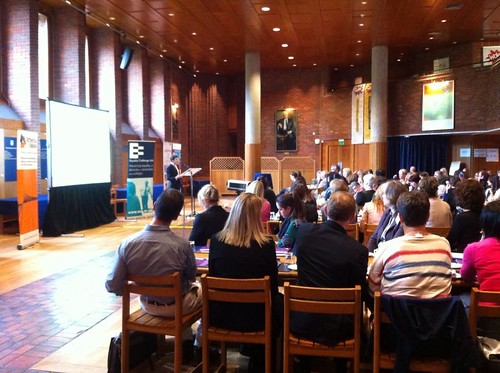
In any bit of publicity, imagery is hugely important. What should you choose to illustrate your story?
B1wbyNqIAAE-p06_002

What does a typical audience look like?

As a microscopist, I know all about the challenges of finding a ‘typical image’. If you are trying to demonstrate some interesting structure or correlate some feature which you’ve imaged in different modes, then making sure you find an image that makes your point clearly is obviously going to be crucial. However, then you are faced with the challenge of deciding whether what you are getting so excited about is actually an artefact and you should be moving swiftly on. How many times do microscopists chase the ephemeral not-really-there feature that is simply due to poor sample preparation, contamination or (speaking as an electron microscopist) resulting from that pernicious danger of electron beam damage which changes the image literally as one watches, often before the focus is ever got right?

As an illustration of the challenges in electron microscopy, when I was a young research fellow I was studying a now (largely obsolete) class of polymers known as thermotropic liquid crystalline polymers. Optically, when the molten samples were smeared out to produce a thin film, a characteristic structure was seen – almost independent of the polymer’s chemical details – which we termed the banded structure. Trying to get more sense out of what the underlying molecular packing was I turned to transmission electron microscopy. The trouble was the structure could only be seen using so-called dark field techniques, which require quite a lot of setting-up to achieve as the image is formed from only a small part of the diffraction pattern, which anyhow does not consist of sharp spots since this isn’t a crystalline material.

I used to go into the department at weekends, when no one else was around (safety issues were less considered back then), so I could get uninterrupted access to one of the older microscopes, and shoot a hundred or more images. I wanted to get pairs of images taken using different parts of the diffraction pattern along with the standard ‘bright field’ image. And I had to work incredibly fast because the polymer degraded under the electron beam and any sort of orientation in the diffraction pattern vanished rapidly. Out of 100 images only a handful would be usable, either because of damage before I’d manage to capture all the images, or because of the difficulty of acquiring good matching sets of three images with the right exposure on each of the photographic films (no digital recording back then, and getting the exposure right was an inexact science). So, what was the ‘typical’ image, since so many of them were failures? Publishing artefacts is unwise, so I needed to be absolutely sure I’d nailed this before writing a manuscript.

This week I was amused to see some other ‘typical’ images. Not so long ago, when A Level results came out, the various media outlets always managed to publish pictures of ecstatic blond girls jumping in the air while clutching bits of paper which were allegedly their exam results. This means of illustrating the A Level story has fallen from favour, I’m glad to say. People now recognize that many of the students who do well are neither female nor blond. But what struck me this year, looking at the images accompanying the various write-ups, was how, not only were there no blond girls on show, there were practically no white students of either gender visible. This year (and maybe in previous years too), the images seemed to be dominated by BMEs of various kinds.

Diversity if of course excellent and I’m delighted to see BME students thriving. However, how typical are they of the A Level cohort? The statistics will be out there telling us what proportion of students taking A levels are of which ethnicity and I am pretty sure the images were over-compensating for the years of blond girls. So what is typical and what should be published by way of illustration?

Of course as regards this story it doesn’t matter at all if the images are non-representative. It is good to remind the reader that not everyone in this country is white. But in other situations the message given by publicity material, for instance, does matter in conveying an accurate message. About 15 years ago my department – note, this is a Department of Physics, so you can work out roughly what proportion of students and staff are women – produced a draft document which I was sent to comment on. I think the head of department was slightly startled when I objected to the imagery. Looking at the photographs on page after page – of seminars, lectures and laboratory classes – you might have been forgiven for thinking that men really don’t like Physics. It was absurdly out of kilter with the reality on the ground. Indeed, they must have tried quite hard in the lecture theatres to find some angle in which so few male students were visible – or else had stage-managed the whole thing. I felt this was deeply misleading and totally unconvincing, but it certainly had not occurred to those who had put this draft document together that it would be unwise to fake things this badly. (They did, I’m pleased to say, amend the document before publication.)

So, when producing publicity for a department like physics, where women are in the minority, or for a Cambridge college (such as my own) where there are BME students but they are not as thick on the ground as at, say, QMUL, Leicester or Brunel, what should we be producing? In this case we are not trying to produce ‘evidence’, as in a scientific paper, but to demonstrate the possibility of all genders and races being welcome. Diversity is so many-facetted that in a single document of only a few pages it is unlikely to be possible to be statistically (or slightly optimistically) representative, but one has to try.

The ‘typical image’ is as misleading a concept in publicity material as it is in a scholarly paper populated with micrographs. In both cases one is trying to make the best job one can out of imperfect information and statistical limits. It is an effort that is constantly worth making.

Posted in Equality | Tagged , , | 1 Comment

Getting the Balance Right

Without much fanfare, the allocations across the different research councils have just been announced until the end of the current spending round.  What processes went into making decisions about the distribution between the different research councils is not obvious, or whose decisions these were. Maybe some reader can tell me whether the decision about the split between the research councils was made simply within BEIS or by the UKRI Board itself.  The original Nurse Review – which led to the creation of UKRI – stated, as part of the recommendations that such an organisation should permit ‘when necessary reallocation of budget between Research Council portfolios’ and maybe that is what has been done. The UKRI Board itself has set out its direction of travel in the Strategic Prospectus, but – although there is much said about transparency and the production of a multi-year operational plan – I cannot see it spelling out how the distribution of funds is to be made. Maybe it is not under its control. Does any reader know, as it is easy to miss such things in the small print?

Whoever made those decisions, when I looked at the allocations what struck me was that the AHRC sees almost a 50% increase (admittedly from the lowest baseline by a significant margin) over the next two years but NERC sees an approximately 10% decrease* (but see clarification below).  I found this latter troubling as we have been struggling through a heatwave across essentially the whole of the northern hemisphere; is environmental research really that unimportant? Most of the other budgets are not significantly changed, with EPSRC remaining the largest by some substantial margin. InnovateUK also sees a substantial increase by around 25%.

Interestingly, a few days before these allocations were announced the Commons Science and Technology Select Committee itself announced an inquiry into the balance and effectiveness of research and innovation. They are clearly wanting to check that all appropriate questions are being asked regarding the large sums of money going into science, broadly defined. The playing field is made all the muddier as, in line with the Government’s stated goal of moving towards 2.4% GDP being spent on research and innovation by 2027 there are many pots of government money not under UKRI’s control (or only partially so in some cases). This is obviously the case with the new money just announced for Catapults, amounting to £780M to add to a previous £180M announced in July for the North East of England.

Catapult Centres are described as designed ‘to remove barriers to innovation, help new entrants to increase competition and innovation in the economy by levelling the field for disruptors to challenge incumbent.’ according to the Government website. The recently announced money is overwhelmingly not going to go to the Golden Triangle, but to areas which are often seen as (variously) cash-starved or underperforming. Given their locations, it is to be hoped their activities will facilitate spillovers into the local economy. The evidence is building that such investment does indeed stimulate other investment, as demonstrated already by the Rotherham-based Advanced Manufacturing Research Centre/Nuclear Manufacturing Advanced Centre (attached to the University of Sheffield) which have recently attracted new manufacturing centres for both Boeing and Maclaren to the region and which, through the recent Catapult awards, will receive an additional £126.7k in funding.

This effect of spillover ties in with the evidence from a recent study looking at what happened in the wake of relocating the UK Synchrotron light source from the North West to a site not far from Oxford, as Diamond was built. Research outputs – those directly utilising the synchrotron and, perhaps more surprisingly, those which had no connection at all with Diamond – blossomed. The conclusion is, I’m afraid, another manifestation of the Matthew effect (paraphrased as to him that hath shall be given) whereas, it seems only too likely, the area around the original source at Daresbury (near Warrington, an already depressed part of England unlike the thriving Oxfordshire countryside) suffered significantly as a consequence of the move.

When it comes to this issue of location, the UKRI has a new fund to try to drive a ‘place-based approach to research and innovation funding, to support significant regional growth’. The Strength in Places Fund is a relatively small fund, but it is to be hoped it might work constructively in tandem with the Catapults when it comes to stimulation of the local economy. It is too early to know what the impact of it will be, but it is reassuring to see a specific fund set up labelled with this ‘place’ banner as opposed to a statement that was once made to me by someone who should really have known better that there were ‘two kinds of excellence’ – the quality of the science itself and the place it was being done. Both are important but they are not two faces of the same coin. The distinction should be recognized, as this new fund seems set to do.

So, for the Science Select Committee as it takes its evidence, there will be many issues to consider; there are a variety of different balancing acts to take into account (and I haven’t even mentioned in this post the challenge of getting truly interdisciplinary research going so that it does not need to be squeezed into individual research council funding, a point I discussed at some length recently and one which is close to my heart). The landscape is complex as is its organisation and governance, but it is certainly one many will be scrutinising, particularly those who set out sceptical of the need for ever setting UKRI up in the first place.

One issue I am sure the Select Committee will wish to consider is that discussed in the recent report by Sheffield professors Richard Jones (a physicist) and James Wilsdon (a specialist in research policy), both of whom previously were involved in the production of the Metrics Tide, a report James chaired. Entitled ‘The Biomedical Bubble’ and published by Nesta, this new report has set the cat amongst the MRC pigeons, as tweets and ripostes make clear. To put it at its simplest, the Jones/Wilsdon report argues that too much money has gone into basic biomedical research, lulled into a belief of its winning ways by the Nobel Prizes and high returns on research investment in the pharmaceutical industry in the past, but not reflecting what might make most difference to health outcomes in the UK today. Public health is poorly funded, for instance, and future health improvements may be driven as much by developments in social care or IT issues as finding new drugs that extend life for cancer sufferers by a few months (however harsh that may sound to those whose life might end up so extended). I felt the case was made convincingly.

Despite the authors’ conclusions being backed up by substantial hard data in the report, from the ONS and other sources, the MRC have nevertheless chosen to take exception without really engaging with the broad but fundamental questions being asked. Fiona Watt, the MRC’s relatively new Executive Chair, has written rejecting the central thesis of the Nesta report that a bubble exists saying ‘It is essential for the health and wealth of the UK that investment in biomedical research is not a bubble, but subject to sustained growth.’ This is a conclusion which could be unkindly paraphrased as ‘keep giving us the money’.  Wilsdon has responded by saying that she is missing the point by looking parochially at the MRC’s own position when the report was ‘not about the MRC but a much broader set of issues’ including funds from public and charity investment as well as the role of the pharmaceutical industry. I have been invited to the Nesta discussion next month on the report and I look forward to hearing the arguments pro and con, but it will be very important not to get mired in inter-Research Council warfare but to remember the bigger picture the report’s authors were considering. At this juncture of rapid funding change, stopping to consider whether the status quo is correct seems to me well worth doing and not something to shy away from.

For the Select Committee members, as they sit down and try to sift through the evidence, I hope they can make sense of all the different strands of the increasingly complicated funding landscape. The Government’s commitment to increasing funding on science and innovation in the years ahead is welcome, challenging though it may be in the face of Brexit and its concomitant consequences for industry and academics alike. Putting money into different funds has a certain logic to it but makes establishing ‘balance’ and the decision-making processes much harder to get to grips with. (Cynically I would say we should remember that, give an academic a hoop to jump through and they are remarkably good at doing so; consequently we should expect to see the same proposals badged around place or industry or global challenge according to the day of the month and upcoming deadline.)

Keeping track of the balance between the strands and funding streams (as well as working out who controls which) will be no mean feat for the committee, or indeed for the rest of us. How do you balance the need to cope with food security in the face of global warming alongside the issues of an ageing population with increasing incidence of dementia? How do you decide if funding should go to the coastal towns or the old mining communities if you are going to spark regeneration? Who should be making which decisions. The questions are vast, the societal needs are enormous and yet we must never lose sight of the importance of the underpinning science. Plus, running as a constant thread through this is the importance of training/education of those who can drive innovation and be the brains and hands of the future. But that, of course, is the other half of science and education minister Sam Gyimah’s brief – split as it is between BEIS and DfE – and a topic for another post!

* Correction 13-8-18 I am informed by NERC that this drop in its allocation simply reflects the completion of the research ship RRS Sir David Attenborough. This vessel will be operational in 2019 and funding for it was channelled via NERC’s budget. I am relieved to know that the explanation does not indicate a meaningful reduction in research income, but it just reinforces how hard it is to make sense of the numbers with so little context given. In the past (Graeme Reid tells me in 2010 but not 2016) there was more explanation given, including the method of allocation. That this is missing does not help the research community.


Posted in Research, Science Funding | Tagged , , , , , | 2 Comments

What makes for a Toxic Environment?

Toxic atmospheres have been in the news recently in the wake of an NHS report on a low-performing cardiac unit in London. All the articles I’ve read on this are short on detail of what actually happened. ‘Dark forces’ are mentioned, reminiscent of a Tolkien nove,l but they don’t actually give much insight into what – beyond rivalry between two teams – was actually going on. Toxic atmospheres are, however, not simply restricted to polluted cities (literally) or the NHS. They turn up in many workplaces, whether academic or not. The only way round them is good and strong leadership which is willing to bite the bullet, either by reassigning roles or banging heads together.  In universities actually sacking anyone is remarkably difficult, short of criminal behaviour or (I assume this still counts) what used to be referred to as ‘gross moral turpitude’.

Toxic atmospheres can arise in many different ways, unfortunately, and human nature being what it is competition often is at the root of it, as it seems to be in this recent NHS case. But such rivalry, probably arising near the top, will affect everyone and quite possibly the most lowly (or, in the NHS case, the patients) suffer the worst. In other words, PhD students or technicians may be the ones who get sucked into other people’s damaging feuds, not to mention the administrators who are often left to pick up the pieces.

What follows are examples I have seen in departments across my own university and others, with all identifying indicators I hope removed! This is not meant to be a name-and-shame post, so much as one for reflection.

One classic example arose in a fairly small department which had, if you like, two philosophies about how their discipline should be handled. Should it be all about the underlying science or the applications thereof? Because it was a small department it was possible for it to be essentially riven in two and, as the head of department of the time shifted from one side of that divide to the other, the balance of power also shifted. It was not healthy because, inevitably in such an unwholesome situation, the folk lower down the food chain were jostling for position. My guess is that students and postdocs were only too aware of what was happening and felt anxious about proving their ‘loyalty’ to their own side.  That is not going to create an atmosphere where the best research will get done, if you are always looking over your shoulder or nervous that the space for your equipment might be removed and given to ‘the other side’.

Laboratory space is, unfortunately, only too often a symbol of who has the power or the ear of the powers that be. Back in 1998, when female faculty at MIT first raised the issue of whether there was parity of treatment with their male colleagues and an investigation was initiated, the report made clear that on average women were indeed allocated less space as well as were paid lower salaries.  This was a key moment in the discussion about gender equality in academic science, when hard evidence demonstrated that there was a systematic bias against women. (It was also when I first realised perhaps some of my own struggles derived not from my incompetence but from my gender.)

But allocating less space to those least likely to shout loudly persists to this day, whether on the basis of gender or any other indicator of apparent lower status. You might argue that less grant income requires less space, so those who are awarded fewer grants deserve less, but there is always the danger that this becomes a vicious circle. Those with less space, if assuming appropriate responsibility, may feel that they should not take on too many students and are hence less able to get new results to feed into the next grant application. It is a classic case of the Matthew effect and most certainly is not always justified. In my own experience, it is unfortunately those who shout loudest who win out – on space or other resources – not those who are most deserving by a range of figures of merit, often including those concerning service to a department.

I once watched a head of department concede a lectureship slot to a powerful professor (who left the relevant department shortly afterwards because he still didn’t feel he was appreciated enough), when the scientific and strategic case for the position to go in that direction was, shall we say, extremely weak. Another area – allegedly a growth area in the department – was overlooked because the head of the group was clearly not seen as obnoxious enough to be a threat. What sort of message does that give to the department as a whole? A weak head of department who can be bullied by he (and it was a he) who shouts loudest is immensely damaging to the overall atmosphere.

Indeed, any sense of there being an ‘in-crowd’ who can put pressure on a leader, or who has some hold over them (if you don’t give me what I want I’ll leave before the next REF would be an obvious example) is likely to lead to all kinds of underlying grievances. A head who does not handle wrong-doing of whatever sort in an effective way will lose respect and facilitate dissension lower down; once again this is liable to promote a toxic work atmosphere for the many. I would suggest that complaints of bullying or harassment (for instance sexual or racial in origin) that are not dealt with swiftly would come into this category, as well as favouritism over who gets space or posts and, unfortunately, also who gets promoted.

It is interesting to note that historically in Cambridge, in a bid to overcome personal prejudice in a head of department – which was known to be occurring – the process around promotion was changed so that applications came from the individual and not from the head. Some time later it was spotted this meant that those who were putting themselves forward were not always the most deserving candidates and many departments internally changed things again so that the head of department talked to all potential candidates to give them what one hopes was a fair assessment of their chances. An individual could still act unilaterally; in some cases I know some did go against the advice of their head – and still found themselves promoted, to their joy. I merely use this anecdote to demonstrate that what looks like a fix may in itself create other problems which require different fixes.

The bottom line is it is my belief that any head of department who sits back and presides over an atmosphere where junior, and indeed not-so-junior staff, feel they have little desire to come into work every day should be feeling very worried. Toxic atmospheres invariably have a root cause and looking the other way is unlikely to be a long term solution. The REF will come and bite you, or the financial system of a university which examines how much grant income is being won or how many PhD students wish to come and work there. There are many figures of merit (whatever I may feel about metrics overall) which should be seen as worrying indicators a department has sunk below an acceptable level of ease in which to work. Heads of department take note.

Posted in Equality, Science Culture | Tagged , , , | Comments Off on What makes for a Toxic Environment?

Diversity in the HE Sector

When I was a harried mother, trying to maintain some sort of work-life balance while running a research group and keeping family fed and watered alongside my husband, I had no energy left for reading. Aga sagas, chick-lit and general lightweight airport reading was all I could summon the energy to tuck into.  Now my children have long since left home and ‘all’ I have to do is my day-job, my reading has got a bit more serious. This is not necessarily a good thing; it frequently leaves me depressed, or simply aware of the great gaps in my knowledge.

One of those gaps is definitely economics, and I’ve been trying to apply myself to the subject more recently, with books ranging from Inequality by the Churchill alum and Honorary Fellow  the late Tony Atkinson, via Capitalism without Capital (Jonathan Haskel and Stian Westlake) to GDP: A brief but affectionate history by my colleague at Churchill and new Bennett Professor of Public Policy Diane Coyle. I hope I have absorbed a tiny fraction of these books (although I must confess I have not yet finished the first, although it was also the first I started). Our times definitely call for all of us to have some inkling of what the government thinks it’s doing with our futures – economic and otherwise – where the productivity paradox is heading (and why we have it worse than other nations) and, more local to the HE Sector, what pensions valuations are all about as we head for another apparent show-down in the autumn about USS.

Coupled with this diet of economics I also read David Willett’s book A University Education. Parts of this are excellent, but I found the middle session on his ideological drive towards student loans did not chime with my views and that his attitude towards why tertiary education was more important than first years smacked of cherry-picking evidence. He seemed to amalgamate all degrees as equivalent – a dangerous position for the sector, the individual and the economy – and imply that everyone can benefit if we just open up the sector enough. The trouble with this approach is that a kid who starts primary school at a disadvantage because of family circumstances, or who consistently resists authority – and therefore learning – in the classroom perhaps because they have suffered a lifetime of abuse, is not going to be in a position to benefit from tertiary education of any sort. Potentially they might have been able to if their reading level had ever got beyond that of a 10 year old, but without that security in early years’ learning it is futile to think going to university is suddenly going to change their own life chances; or indeed to analyse what they might be able to offer the economy.

I am quite sure there are still 18 year olds in this country who could benefit from tertiary education, but it does not make sense to expect them all to want to go to the same kind of university. The sector is not homogeneous, nor should we want it to be. And for some kids, aspiring to any sort of university is meaningless without a sure foundation started in early years’ schooling (and quite possibly earlier than that).

However, where I think Willetts is compelling is in asking us – as many have before, including Cardinal Newman and, much more recently, Stefan Collini with many in between – what do we want of our universities: who should they be educating in what under which financial model? Which takes me back to economics. If more tertiary education is what will solve the productivity paradox, then we should be saying bring it on. The evidence of the difference it makes to growing and developing economies and nations is convincing, as Willetts indicates. But in an economy with already nearly half its 18 year olds going to university it isn’t so clear what the added value is. Maybe it is more kids staying on post-16 and gaining strong but basic numeracy and IT skills and applying them with confidence. Maybe FE is as important for a productive economy as HE and investment there may be more beneficial pound for pound currently than directed towards some of the newer universities currently struggling financially.

And ‘value for money’ is a phrase popular with the (relatively) new HE minister Sam Gyimah. It is a phrase that makes me wince. How does one put a (financial) value on education? Having read around a bit more about economics, I am now more familiar with Baumol’s cost disease on productivity. This was originally posed in the context of a string quartet. Such musicians cannot get more productive by playing twice as many Mozart quartets by playing them twice as fast, so that their ‘service’ outputs will not be able to increase in the way that Asda or Amazon might expect its own operatives to manage.  So, for a university lecturer, what would amount to increased productivity? I’m afraid the simple answer is ‘bums on seats’ that well-worn phrase for piling students into the lecture theatre. But, if the students don’t manage to learn anything, or never appreciate how to structure an argument because little of their written work gets marked, is that ‘value for money’? I think not.

Judging whether students learn by what they earn six months after graduation is a meaningless measure as are –as is widely accepted now – student satisfaction surveys. But graduate income seems alarmingly close to being accepted as a good proxy for value and is part of the deplorable direction of travel about marketization of the sector. To be fair to Gyimah’s predecessor but one in the ministerial role, he does not suggest this solution in his book, but I am one of the hordes of academics worried that universities are going to be judged by daft criteria. In Cambridge I am told by the Careers Service that (at least for women) the most popular sector to seek a first job in is the charity sector, not renowned for being able to pay massive salaries. It does not mean their education did not provide value for money because that is their predilection for a career.

All of us in the sector need to be engaging with this debate about what we are ‘for’, who we should be educating and for what purpose. But does it make sense to measure every university in the same way when our goals may be very different? This is not simply a Cambridge academic trying to do a bit of special pleading for our own distinctive system, it is a reflection of the fact that some universities have very different goals in what they are trying to achieve and we should celebrate that.

Posted in Education | Tagged , , , | 2 Comments