In which I tend a strange garden

My loyal readers may have noticed that Mind the Gap was silent on the topic of Darwin this year. I have nothing against the man, and admire his work as much as the next girl. I suspect, however, that there is some stubborn kernel inside of me that resists the deification of one individual when scientific advancement is so clearly the product of many people working in concert over a long period of time – and the concept of evolution is no exception. I have also traditionally been adverse to bandwagons, and in this country at least, and especially in the blogosphere, the brass section surrounding the Ascent of Charles was getting a little loud. Still, I think about evolution with silent wonder every day in my line of work. And now that the parade has largely passed by, the street cleaners busy sweeping away the colorful remnants of merriment, it’s been more on my mind than ever.


Strange fruit Not so much a Blind Watchman as a gardener with 20/20

As with any endeavor, there are tasks in science that I enjoy and tasks that I don’t; there is also a strong correlation, for me, between enjoying a task and being good at it. I happen to be a whiz at making stable cell lines: coaxing bits of foreign DNA into immortalized cancer cell lines and selecting out a new strain derived from a single mutant cell. In this procedure, which is more like horticulture than molecular biology, I can induce the evolution of practically any trait that is not lethal to a cell by using a particularly nasty form of artificial selection and letting nature take its red-toothed and clawed course.

A few days before my ski holiday, I transfected two different DNA constructs into a single plate of cancer cells, one encoding a histone protein fused to a fluorescent red tag and the other encoding a newly published actin-binding domain I was eager to try out, fused with a green fluorescent tag. The first construct also encoded a gene conferring resistance to the deadly drug puromycin, while the second construct would allow cells to escape the effects of the equally iniquitous chemical G418. One the second day, I diluted the transfected cells across a series of plates so that the modified clones would not be too crowded to isolate once they began to grow. While I was off on the slopes, one of my lovely colleagues obligingly nuked my Petri dish with several doses of the drugs and watched while hundreds of thousands of cells died off, filling the medium with light-refractive clumps of unhappy corpses. When I got back, the carpet-like monolayer of cells I’d left behind had almost completely vanished, but when I held the plates up to the light and examined their undersides, I could see the faintly glowing, pale spots of resistant colonies scattered across the plastic.

Isolation is satisfying: you wash off the medium, pluck up a sterile glass cloning cylinder with a forceps, dip one end in high vacuum grease and press it down around one of the colonies to form a water-tight seal. A tiny amount of the enzyme trypsin will loosen the colony (consisting of anywhere from twenty to a thousand cells) and the cells can be replated into a small-welled vessel to begin the laborious process of nurturing, expansion and validation. I usually take about twelve colonies to ensure that I get at least one cell line that is healthy and that expresses both markers to sufficient levels, but for the next week or so I’ll have my hands full transferring my new babies to increasingly larger vessels, freezing down samples as back-ups and running tests to decide which will be ultimately be chosen — and which will be flushed.

It’s a jungle out there.

Posted in Uncategorized | 41 Comments

In which life goes on

Momentous things always happen when I’m not looking. While I was off gliding through waist-high powder and suffering death by fondue in Les Menuires last week,


Above the clouds

Wendy Richard died of cancer,


The end of an Eastenders era

Richard packed up to leave Australia,


A big country just got a bit smaller

and Bora midwifed the final production of The Open Laboratory 2008, which is now up for sale.


A book of blogs, buffed and polished to a high gloss

Please support the cause and buy a copy of this book: a number of your lovely colleagues are featured in it, Richard and I lost several weeks of our lives editing it, and all proceeds go to two excellent causes: bigging up the concept of science blogs in general, and giving a wee financial boost to next year’s ScienceOnline blogging conference.

You know you want to.

Posted in Uncategorized | 53 Comments

In which I haven’t lost my touch

Thank goodness for synthetic rubber. (And yes, it’s Friday in many parts of the world.)

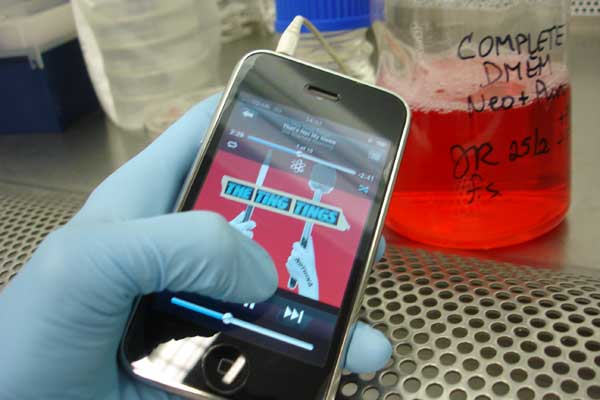
My iPod Shuffle ran out of juice yesterday just as the deepest, darkest, most tedious phase of cell culture was about to commence. And it was then I made the happy discovery that the iPhone touch screen still functions with a nitrile-clad finger:

This was by no means a given. During the recent cold snap, I’d found that it was impossible to operate an iPhone wearing woolly gloves. Hence, I encouraged a little snag that appeared in the right index finger to develop into a full-fledged hole:

I’ve since experimented with other objects and textures, and it’s amazing how they’ve managed to design the iPhone’s screen so that it is responsive only to the touch of humans.

And scientists.

Posted in Uncategorized | 77 Comments

In which I continue to suspend disbelief

I don’t know about you, but when I have a hypothesis that bodes particularly well for fame, glory and high-profile publication, I am far less likely to believe in it. Somehow, it’s always the mundane that seems the most plausible. This is not, I suspect, down to the lofty notion that extraordinary claims require extraordinary evidence. Rather, it’s more like a superstition. In other words, some things are just too good to be true.


Spot the difference Polka-dots are all the rage in my hypothesis

I’ve been fiddling around with this interesting hypothesis since Christmas, reading a lot of background literature, making a few new molecular tools, running some pilots and gradually ramping up the experiments to test it. And today, I settled down in front of the microscope to look over the results of my first really big experiment. Human cancer cells, genetically manipulated and then frozen forever by formaldehyde into a snapshot of their seething, immortalized life, stained midnight blue, cherry red, emerald green and that elusive fluorochrome Cy5, which, with a maximal emission at 670 nm, is nearly impossible to see with the naked eye, so you have to let the computer do the honors and take on faith that the signal is real. (Somehow, I don’t tend to trust signals unless I can see them under the oculars; CCD cameras can make light of even the most dim background staining if you are not careful, but the eye is seldom fooled.)

Even after all these years, I still get very excited just before the results of a major experiment. This afternoon, I slowly nudged the electronic stage from well to well, forcing myself to take it slowly, peeling away each variable in my carefully crafted test. All was silent and dark in the little room, just the opening and closing of the shutter and the purr of the filter cubes rotating from channel to channel. My labmates have a running joke about which is better to look at first, the boring controls or the bottom line – I’m afraid I always force myself to start with the housekeeping and save the pleasure (or more likely, pain) for last. So there is that delicious anticipation as the stage whirrs towards the verdict, as the bright colourful shapes swim into focus in their sea of velvet black – anticipation, and the bracing yourself for that crushing disappointment.

Today, Dear Reader, the news was…good. Everything is consistent. No assumptions have crashed and burned. I am not convinced yet, not by a long shot – but I am one step closer to belief.

Posted in Uncategorized | 27 Comments

In which I ponder economies of scale

Writing about science is a hobby for some, and puts dinner on the table for others; yet others, like me, fall somewhere in between. People enamored of the idea of so-called “citizen journalism” (a nice way of describing the mechanism whereby professional media outlets fill their pages with content that they either pay nothing for, or a token far underneath standard union rates, while giving the public that warm fuzzy sense that they are “interacting” with the outlet in question) frequently take people to task for fearing it’s a conspiracy to do freelancers out of a few quid.

I’m sure it’s not a conspiracy, but it is a real problem for some of my friends who subsist entirely on freelance science writing earnings. It’s not as easy to pitch a story now, when there seems to be legions of people – presumably in well-paid day jobs – willing to “interact” for free. There is, simply, less paid copy required. Nature Network, for example, used to pay freelancers like me to write news stories; I assume this was discontinued because they realized it wasn’t economical when there was so much engaging reporting going on about local events amongst their own bloggers, for absolutely free. It makes perfect business sense, and it gives a voice to people who before had none, but I do wonder at the long-term implications for professional writers. Traditional ‘Letters to the Editor’ pages typically made up a minute fraction of a media outlet, but user-generated content is expanding far beyond this.

There is another issue. Amateurs may be engaging, but they might not be conversant with the basic tenants of journalism. A few years back a particular blogger “broke” a story about some perceived evil that a big publishing company had apparently perpetrated, and it made a huge stink, but (as it turns out), she had failed to perform the basic, Journalism 101 task of simply checking her facts with a second source. In the end, her story was based on a faulty assumption and contained patent untruths – oh, and she also managed to commit libel at the same time. Because she was an amateur, no one bothered to correct her (and she was lucky she wasn’t sued). There are probably still people out there who believe her story because there was no self-correction, and no editorial desk to act as a safety net.

But that’s not what I want to talk about. I want to talk about cold, hard cash. Science writing is surprisingly lucrative – and I didn’t really internalize how lucrative until I received the first royalty statement for my novel Experimental Heart. Now, the book is doing very well; after launching in November, my publisher recently ran out of the first edition and had to do a second printing – and now I hear a third printing is just about to commence. Is seems really promising, financially, until you do the sums. If I sell a thousand books, I receive…about five hundred US dollars.

To put this into perspective, I’ve called up one of my invoices for a London science trade magazine I occasionally write for and have done a comparison. To earn the same amount, I would have had to have written three science news pieces for them at 300 words each.

To put this into even more perspective, those 900 words would have taken me about six hours: two to research, two to find and ring up experts for quotes, and two to write the pieces (and respond to the subeditor’s queries after submitting my copy). In contrast, my novel is 140,000 words; it took two months to write the first draft and three years to edit it into shape.

Somehow, this just doesn’t seem right. Are book authors getting a bad deal? And how does any author survive without an additional income? I suppose that in the absence of doing a J.K. or a Da Vinci, full-time book writers must supplement their earnings with honoraria from personal appearances – and possibly, by writing for magazines at an exponentially higher per-word rate.

That is, if there is anyone left willing to pay for professionals in the future.

Posted in Uncategorized | 94 Comments

In which I ramp up

bq. My friend Richard and I are moving in perfect reciprocity at the moment, so we thought it would be entertaining to plot our opposing curves simultaneously. I left science publishing to return to the bench, and he’s leaving the bench for a job in the same publishing company where I had my first editorial job. As he winds down in the lab, I find myself ramping up. You can read his side of the story over there, and here is mine:

It all started on the day I formulated my first real hypothesis last December. Up until that point, I’d been working full-time on a large-scale RNAi screen, hoping that some interesting gene would slip through the filter like a fragment of fossilized bone in a sieve of endless sand. It is absorbing work up to a point, but only in the way that hoovering is: there is satisfaction in making each square meter tidy, replacing chaos with order, but your heart doesn’t exactly pound at the thought of finishing the living room and moving on to the kitchen.

But on that December afternoon, darkness falling around four o’clock and a fierce rain battering the windows of the lab, I saw something amazing in the pattern of green, blue and red in my cells. A few threads clicked into place: my first major hit was starting to look promising. Suddenly a dozen ideas for experiments were tumbling out of my brain, and something very strange began to happen: I felt myself trying to metamorphose into my former self.

What did I used to be like? My previous work ethic has been memorialized in the character of Andy in my first novel, who spends nearly every waking hour in the lab. When I was a PhD student I subjected myself to regular eighty-hour weeks and never once lost that sense of excitement and enthusiasm about being there. But those are the excesses of youth. Since returning to the bench eighteen months ago, a little wiser and a lot older, I have been very strict about my time, arriving just before ten on the weekdays and leaving by six, and never coming in on weekends. I arranged my manipulations so that they’d run over the weekends and if that didn’t work out, I’d postpone things until Monday. And I did all that without a shred of guilt, and with full support of my boss: I am very efficient when I am in, and do not waste my day with excessive tea or lunch breaks. It all worked really well, and it gave me the time I needed at home to write my novels, edit LabLit and do the freelance writing, broadcasting and engagement gigs that needed feeding on the side.

But ever since my hypothesis, I feel the tidal tug of obsession threatening to shatter my carefully balanced life. Because now, you see, I am doing actual experiments: I am perturbing signal transduction pathways to see how they respond; I am knocking down some genes and over-expressing others to see whether and how my pet protein is involved. I have made an antibody to this protein, and I am probably the first person in the world to see where it is localized in cells – despite the bioinformaticist’s prediction of nuclear localization and nucleic acid binding, I instead see it packing into discrete globules in the advancing, ruffling front of spreading cells – exactly where my hypothesis would predict it should be. Now the experiments that I perform answer questions, and lead to more questions, and – before I know it, six o’clock has arrived and I don’t actually want to leave. In fact, I’ve stayed until seven a few nights recently, and even then I’ve had to force myself to stop.

When I first returned to the bench I found it hard to do more than one experiment at a time; now, like Andy in the novel, I am piling them one atop another to see how high the tower can get before it topples. The inevitable failures, which before were just part of the hoovering (like having to pause to empty the filters), in this environment become more frustrating because they keep away the truth for one day longer. Yes, the essence of it is that now, I am starting to care.

Somewhere under all the excitement and anticipation is a sense of danger. As much as this feeling reminds me of my youth, and reinforces my decision to return to the lab, I know I will to fight to the death to prevent myself from being sucked under once again.

Posted in Uncategorized | 41 Comments

In which the data back up our habitual suspicions

We’re not actually paranoid: everyone really is out to get us.

Last week at Science and Shopping, the UCL-based women in science networking group, we had a special guest presentation from Virginia Valian, Distinguished Professor of Psychology and Linguistics, Hunter College and CUNY Graduate Center, and a visiting Fellow at UCL.

Professor Valian might be familiar to some of you as the author, a few years back, of a shocker of a book entitled Why So Slow? The Advancement of Women. Our host, Professor Uta Frith FRS, had invited her to present the highlights of her book as they pertained specifically to women in science, along with more recent results from the literature.

After our usual lunch in the Royal Society canteen, we all climbed the grand marble staircase to the Library (past the names of all the Presidents of the Royal Society since its inception – not a female among them) and – with a few self-conscious chuckles – pulled the masculine rows of chairs into a nurturing circle on the plush carpets. And then Valian gave us the lowdown.

None of it came as a great surprise, but we felt a little stunned nonetheless. The general idea is that we all hold gender “schemas” (perceptions or stereotypes) that lead to subtle overvaluations of men and undervaluations of women – by both men and women, even those who want to be egalitarian and meritocratic. These small imbalances eventually accumulate until men tend to have the advantage. This isn’t just in science, but according to Valian, the scientific profession harbors an inbuilt exacerbation of this problem, as the schema for a scientist (“capable”, “independent”, “can-do”) overlaps much better with the schema we hold for men than for women (“communal”, “nurturing”).

I’ll give you some of Valian’s examples of how these schemas play out (see her book for the references). When lacking sufficient information about competence, say when viewing a fictional CV with a man’s or woman’s name on top, both men and women tend to rate the male as more competent. This tendency would obviously put women at a disadvantage during hiring and other competitive situations.

The good news is that when given enough information that both are stellar, both men and women do believe that the pair are equally competent; the bad news is that in the absence of any information about their personalities, both genders rate the woman as “less likeable” – a penalty with proven concrete disadvantages when it comes to advancing in one’s career. So women have to overcome two hurdles if they want to succeed. Women with children have a third disadvantage, as studies show that this state definitely counts against you: interestingly, the more children you have, the higher the penalties. Valian presented a number of really fascinating studies – the one that made us laugh the most was the suggestion that women could offset their inherent “unlikeable” tag by conceding on small things, such as making the tea. (Valian, however, confessed that this was one indignity to which she herself could never submit.) There isn’t space here to do her metastudies justice, but if you live in or near London, I would highly recommend going to her upcoming talk on 24 February at UCL’s Senate House

It wasn’t all doom and gloom: Uta also presented us with complimentary copies of a wonderful booklet produced by the York University plant geneticist Ottoline Leyser with the support of a prestigious Rosalind Franklin Award from Royal Society: Mothers in Science: 64 Ways to Have It All (cover pictured below). Within its pages are dozens of case stories about successful female scientists including a timeline of their scientific as well a familial successes. As I understand it, it’s not yet available for general release. But I suspect that in the face of the uphill battle that many women still face in the lab, it could be very inspiring.

Posted in Uncategorized | 327 Comments

In which London simply cannot do snow

Stephen narrowly beat me to the mark, but I am honored to be published back-to-back with such an august professor.

Enjoy your commute, one and all!

Posted in Uncategorized | 61 Comments

In which I wade through the fringes of textbook fact

I’ve recently turned in a commissioned review article about the role of the actin cytoskeleton in cell shape. I’m an old hand at reviews, but this was something special: a ‘Cell Science at a Glance’ poster for the Journal of Cell Science. In this nifty piece of front matter, the words are secondary: what authors are asked is to conceptualize their topic in the form of a large poster of visual art (four times the size of a journal page) which will be redrawn by a professional artist into a full-color piece, folded as an inset into the print issue and available as a PowerPoint slide online. And it must stand alone, with the accompanying 1,500 or so words of text serving as a mere bonus.


A room with a mess The edges of truth are seldom tidy

Now, I am a wordsmith primarily, and after so many years of practice, there are very few gigs that cause me undue trouble. I’ve never suffered from writer’s block, and the 1,500 words were duly researched, executed, polished and EndNoted in about seven days.

But the sketch was another story. I was raised by artists, so I’ve always done a bit of drawing; when I was an undergraduate on financial aid, I even helped bankroll my education by doing graphic design for the college. But how can you actually draw the role of actin in cell shape? And then, once you decide on your conceptual framework, what goes in and what goes out? Biology, after all, is a nightmare of reductionism, its various elements going on relentlessly in all directions; every protein is touched by dozens of others, and so on, ad infinitum. One has to somehow incorporate three dimensions, and a dynamic temporal aspect too. I also wanted to compare yeast to higher metazoans, so there was that facet to depict as well.

But there is an even more interesting problem here, as I was soon to find out. In words, you can deal fairly easily with controversial or unknown elements of a topic. You can present caveats and conflicting viewpoints, and attempt to synthesize some sort of consensus. But a drawing is absolute: something is either depicted, or it isn’t. And as I started to flesh out all the details of my drawing, I kept finding myself stumbling into grey areas. Were these particular filaments catalyzed by formins or Arps? Scouring the literature, I could see that one vociferous camp claimed the former, and another, the latter. No sooner had I dispatched one ambiguity that the next would arise: which signalling cascade was truly upstream of this particular protrusion? Looking into it, I found that the jury is still out, and entire review articles had been written about something that I was trying to reduce to a one-centimeter squiggle of graphite.

In the end, I just did my best. It turned out to be very soothing, sitting in a quiet room with a pile of colored pencils and a very large eraser – a far cry from normal lab life. And now, I am hoping that the chosen peer reviewers are not so embroiled in such a fervent battle over the genesis of bulge X or protrusion Y that they fail to appreciate what it takes to generalize in art.

Posted in Uncategorized | 57 Comments

In which you are invited to expose yourselves

Now, let’s see: where can I find a bunch of extroverted science fanatics?

My friend Alom Shaha, in addition to being a talented science filmmaker, producer, ex-politician and part-time physics teacher, is in the midst of a wonderful blogging/film hybrid project at the moment. And he needs your help.

The premise is simple. There is one question, “Why is science important”? There are probably as many answers as people, and Alom would like to hear as many as possible so he has asked me to spread the word. If you’d like to answer the question on the project site, you can rub virtual elbows with the likes of Susan Blackmore, Adam Hart-Davis, Roger Highfield, Simon Singh and other luminaries – as well as the odd Nature Networked riff-raffy sorts.

With just a few pithy paragraphs, you’d be helping Alom to do some good in the world. As we speak, he’s making a film funded by The Wellcome Trust, and bits from the blog will appear in the film and bits of the film will appear on the blog, so you might even get your two minutes of fame as well. The end result, he hopes, will be to reach people who don’t think science is important and convince them otherwise. He wants to show, as he puts it, that science is “absolutely crucial to the future wellbeing of our world, that its contribution to culture is as significant as that of music, art or literature and, most important of all, that a sound appreciation of science is vital to realising your potential as a human being.”

If you think science is important and want to spread the word, follow the instructions here. Just tell him that I sent you.

p.s. Alom welcomes contributors of all species, but notes a worrying lack of female representation on the blog. So come on, ladies – let’s raise the tone a bit!

Posted in Uncategorized | 28 Comments