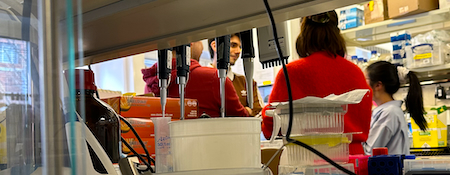
The lab family: a snapshot in time
Labs are such a patchwork: as the head, you cobble together a shifting-sand group of people who start and stop at different times, overlapping with one another sometimes for years, other times, just a few weeks. Every person under your care is the product of a grant you have agonised over, often for months, submitted into a pool that can be as competitive as tankful of sharks scrabbling over a single piece of meat.
Once you welcome that person into your lab family, the clock is already ticking: 18 months, two years, maybe three if you’ve been lucky. As soon as they start, you are already worrying about the next grant, as you’ll need to put in multiple grants to ensure that one will succeed.
It’s not just the lab head feeling the strain; it’s much worse for the individual researchers, whose continuity in the system absolutely depends on that next position. Unlike me, they have no buffer system. While I can function for a while with a smaller team, even on life support, there is no such safety net for the individual team of one.
Which is why the news that a number of UK Research Council grant schemes were being temporarily paused, ahead of a reshuffle in priorities, came as such a shock to the research community. One of my own grants in progress was labelled “rejected” on the system just days before Christmas (even though it wasn’t due until March). Hundreds of other grants suffered similar fates, most tragically those that had already successfully passed a stage-one application with positive reviews.
We are all of us on edge, as we have to wait a few more months until we find out exactly when we can apply for grants again, and what those grants will look like. On edge, and in limbo.
For me, it could be a lot worse. I have a team of seven, a few of whom are funded through to 2027. We have four papers under review and even more than that number nearly ready to submit, so any grants I do submit are likely to be well-bolstered with evidence. In my field, there are a few funding charities with whom I have had success in the past, and which remain available. The Almighty Wellcome, too, is still up and running – although much as a road closure diverts all the traffic to somewhere else, people assume that these alternative sources will only become overwhelmed.
But the people I really worry about are the early-career researchers (ECR), the ‘teams of one’, who need to find their next post-doc, fellowship or faculty position. Anecdotally, I understand that the bleak scientific news from the United States has already driven an increase in overseas applicants to the UK and Europe – themselves saturated job markets that can ill-afford yet more contenders. A common way of taking on post-docs in my field, for example, is via the ‘project grant’ route: one of the paused schemes.
Even if I am able to submit a project grant in the summer, such is the protracted nature of the process that any associated position will take another year to become available. What happens to all the ECR who are ready to move on now, or in the next few months? There is the very real possibility that this strategic pause will actively drive young researchers out of academia – perhaps forever. It is a tragedy, all the worse for seeming wholly avoidable. Surely this pause could have been worked into the system seamlessly? Surely live grants could have been grandfathered in? None of it makes any sense.
For now, I try not to worry, and I’m busy making strategic plans which will allow me and my collaborators to move in any number of possible directions once the way is finally signposted. While I am no stranger to imposter syndrome, I also know, objectively, that my grant success rate has been high of late and that my area has been remarkably fashionable. I can weather this, from the lab perspective. And I will do all I can to support my team to cling onto their academic dreams despite the odds – heaven knows I could write a master class on that particular subject.
But for now, I can only watch and wait along with everybody else.