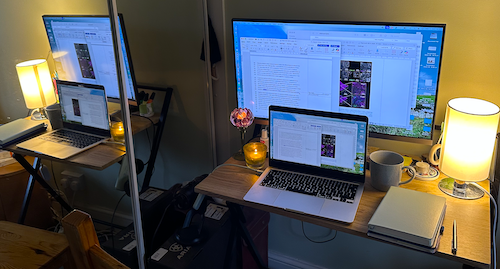
The work universe bubble at home
A senior colleague once likened the transition from the former to the latter as “escape velocity”: the difference between milling around on the launchpad with too much fuel (ambition/ideas) and not enough hardware (the rocket ship and crew that will actual propel you into a stable orbit). It’s a brilliant metaphor, which he presented to me after the disappointing news that my major fellowship interview had not been successful.
At that moment, more than a decade ago now, I was despondent, on temporary contracts and about to enter into a massive teaching commitment to earn my keep at the university – a teaching commitment that I still bear. Although it was a long time ago, I still recall the mix of emotions: relieved that at least I could carry on taking home an academic salary and trying to grow my lab, but wondering how on earth I would manage to succeed with such little protected research time – research time I had to actively buy out from my multiple grants, all stitched together to create a day or two a week.
Fast forward to now, and the good news is that everything turned out for me. Against the odds, I managed to craft enough competitive grant funding to secure my salary and to hire a sizeable team long-term. I’ve maintained a group of between 5-7 people ever since, alongside my own salary buyout, through a combination of very hard work and not a little luck. Collaborations turned out to be key: when I stopped acting like a lone wolf and started seeking out like-minded individuals, more opportunities opened up. Today, I operate within a small but close-knit group of collaborators who share my values, interests and (unexpectedly importantly) sense of humour and fun*, and who also embody a Venn diagram of complementary and unique skill sets.
(*One of my colleagues, who I consider especially wise, once told me that they had long ago resolved never to work with people who did not bring them joy or could not share a laugh. I promptly adopted this as my new mantra and have never looked back. Life is, frankly, too short to work with assholes. These I have shed with the utmost relish.)
I am now privileged to act as a mentor to more junior scientists who are where I was a decade or so ago. They, too, often feel despondent and pessimistic about their chances. Sometimes, like I did, they think about bailing out of the profession altogether.
I, personally, have done the experiment. It’s rather inferior to a randomised control trial, as there is no “control me” who took alternative paths. Instead the study design is what is known as a longitudinal “crossover”: I have been a scientist, and left research for publishing, and returned. It is not perfect, but I know that when I clipped my wings and tried to bow out of science, I had a more stable life, but I was ultimately unhappy. And I quite soon realised that I had made a grave mistake. Returning to research made my life more difficult in some ways, but also, overwhelmingly, more fulfilling and happy.
Revisiting the original question, what does it takes to raise an independent scientist? I think the most important thing has less to do with intellect and resilience, and more to do with home environment. Succeeding at academia is very difficult if you do not have a supportive home life and good work-life balance. I have been blessed with a family who understands my need to travel and to work hard. Although I sometimes feel guilty when I have to fly away, work late or spend time on my computer on the weekends, this guilt is entirely self-inflicted: nobody ever makes me feel that I am not doing enough, and we have wonderful experiences working around my constraints. I even have time to pursue my hobbies, albeit on a rather restricted schedule: making music, learning languages, writing, sketching, ham radio, gardening. As a result, my home life is grounded and fulfilling, yet I still manage to get everything done.
But it’s not just about a permissive and supportive home life. None of this would be possible without the lab team behind me. The more senior members look after the more junior members, and all of them keep the lab running effortlessly without me needing to intervene much, or sometimes even to think about it. The older members hand over to the newer ones to ensure continuity. For this, I am eternally grateful: a village, indeed.
There is, of course, a gap between the “team of one” and the fully functional team that even the most supportive family or home life cannot bridge. For this, only the luck of a few successful grants can really fill that gap, rewarding you with the team who will shoulder the quotidian load and free yourself for more advanced tasks like publishing papers and dreaming up more grants.
Escape velocity.
And the secret formula? Engaging with collaborators and submitting as many grants as humanly possible – meaning that for a time (months? years?) your own work-life balance will invariably suffer.
Whether it is ultimately worth it depends on the outcome, and the temperament of the individual in the midst of their own particular career experiment. For me, it was: for others, it may not.
Sometimes you just have to do the experiment.