In which I look ahead

Wishing something will not make it real. But its opposite is a very powerful force: if you decide something is out of your reach, it’s never going to happen. I am not ascribing some New-Age prophecy or supernatural barrier here: I simply believe that once you surrender, you start disregarding all the small opportunities that collectively could help you achieve your goal. You become blind to your strengths and sink into the morass of your weaknesses. You begin to believe what is not true, and doubt what actually is.

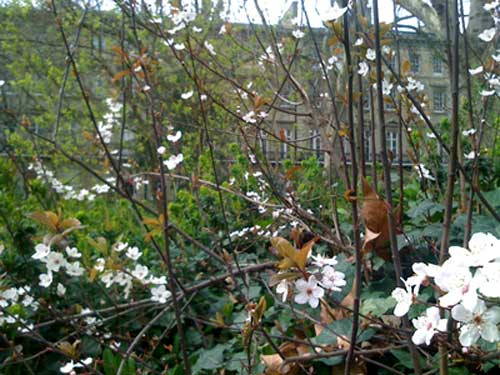
Spring has come to campus: exotic cherry trees have unfurled rosettes of pink petals; undergraduates are wearing shorts and T-shirts; even the lecturers on industrial action last week couldn’t help smiling on the picket line as they basked in the warm sunshine. The final stage of publishing my paper – the culmination of four years’ work on a massive screening project – has been punctuated by periods of waiting: waiting for a collaborator to finish up and send his loose ends, waiting for co-authors to return their final comments, waiting for my boss to read the manuscript. During these spells, I’ve been preparing for my scheduled lab meeting, using it as an opportunity to set out and present my final exit plan. When I submit the paper in a few days’ time, I want to shoot out of the starting gate at full speed.

Nine months. Long enough to gestate a baby with relative ease, but a very short period in which to concoct a future research plan, assemble preliminary data and write a successful grant or fellowship about it. Nevertheless, this is exactly what I intend to do.

It has been very satisfying, poring over my lab notebooks and extracting useful data. I always save everything and carefully document what I’ve done, so it’s possible to extract new information from old slides, images and even homogenized lysates stored in the freezer. I haven’t initiated a new experiment for months now, but I managed to follow an interesting thread and accumulate enough new evidence to make a convincing case about the way I want to go forward. Yesterday I presented it to the group – despite my new resolve, I was still pleasantly surprised at how positively everyone else reacted to my plan.

It’s not going to be easy, and I still may not succeed. But despite the temptation to stabilize my life by jumping before I’m pushed – and despite a couple of intriguing feelers from employers outside of research – I’ve decided not to blink until the final hour.

Posted in Careers | 21 Comments

In which we rev up again

It’s been a long, cold winter. Science Is Vital has been in hibernation, but now we’re back.

After half a year since the government’s Autumn Spending Review, the implications of the science budget’s cash freeze are starting to kick in. Inspired by a recent Campaign for Science and Engineering blog, Stephen Curry proposed that we lend a hand to the Parliamentary Science and Technology Committee who are seeking evidence about how the proposed cuts are affecting scientists at the coal face. We want to make sure that all voices, including those of early-stage researchers, are heard – not just eminent scientists or scholarly societies.

So we’ve organized a helpful page on our website about how to prepare and submit your evidence, and a questionnaire that will help us keep track of the cuts geographically. And we’ve just contacted everyone who helped out with the campaign to let them know – that’s the more than 37,000 people who supported us last time around.

We’d be grateful if you could help spread the word: the hashtag, as always, is #scienceisvital, along with the specific campaign tag, #CSRimpact.

Posted in Uncategorized | 5 Comments

In which I go native

We scientists are an itinerant bunch, wafting from job to job, city to city and – frequently – country to country, in search of that elusive permanent position. Because of that, our sense of ‘home’ – a place where we feel rooted – can be even harder to grasp.

I will never forget the first time I touched down in the UK in 1994, on an ultimately ill-fated romantic mission. My first port of entry was Glasgow Airport and, after waiting for a bus on the wrong side of the road, I eventually worked out how to get to Edinburgh. The sensation of being in Scotland was simultaneously foreign and yet intensely familiar, as if it were a place I’d known from long ago. This rightness was so strong that I felt a sharp pang when I landed back home in Seattle: the babble of my native tongue was somehow disconcerting. I wrote in my journal, I know I’ll find a way to return.

I left the US in 1997 for a post-doctoral position in London and never looked back. Aside from my four years in Amsterdam, London has been my home ever since, so much so that when I was homesick in the Netherlands, it was London that I missed, not America.

There are two sorts of long-term ex-pats: those that seem to retain a bubble of their birth place about them, and those that essentially go native. Unlike some of my compatriots in London, I didn’t fight the change in accent: the volume diminished, I rediscovered my t’s and my a’s started to lengthen. In scientific talks, I found myself saying “beeta” and “zed”. British words began creeping into my everyday language, and more problematic American constructions (such as khaki pants – ask your nearest Brit why this doesn’t work) slipped away. Collective nouns became plural. I began putting the word ‘do’ after conditional expressions, saying “as if” instead of “like”, and “quarter past two” instead of “quarter after”. At conferences, Americans regularly mistook me for a foreigner. (In fact, at the American Society for Cell Biology meeting last year, I felt like a total alien.)

Although I finally gained permanent resident status, I still felt it wasn’t enough. I hated not being able to vote, even in my local borough, especially after becoming politically active, and I was sick to death of languishing in the long ‘other’ line in British and European airports. And the current government’s stance on non-EU immigrants made me uneasy; strictly speaking I was safe with my “indefinite leave” status, but who knew where possible future xenophobia might one day lead? In short, the word “indefinite” did not feel quite definite enough.

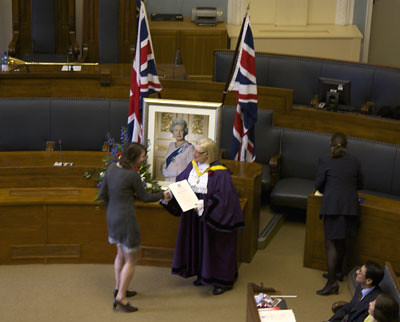
So this year, I set off on my journey to citizenship. For me, after filling out all the forms, paying my £750 to the Home Office and waiting a few nail-biting weeks (would they reject me for having ‘fessed up to that fender bender when I was 17?), that journey ended in Peckham. On the way to its Town Hall this morning, the signs seemed auspicious.

JennysCaff

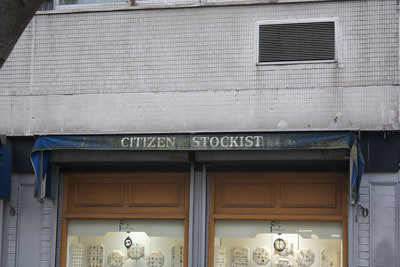
I even wondered if there might have been an easier, and cheaper, way to become naturalized over-the-counter:

CitizenStockist

Southwark Council do a lovely ceremony (note the plural collective noun – sort of sexy once you get used to it, isn’t it?).

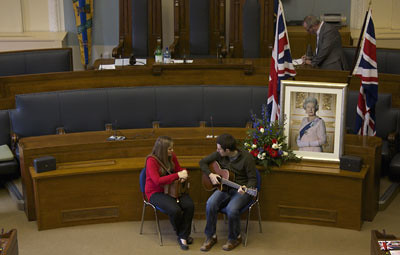
Musicians

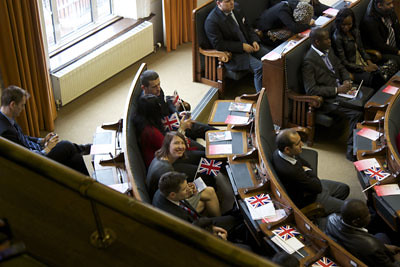
The deputy major had a purple robe, a reassuring amount of bling and a golden mace that could probably fell an antelope with one swing, and the room was full of about sixty people from all over the world, dressed in their finest.

WaitingMyTurn

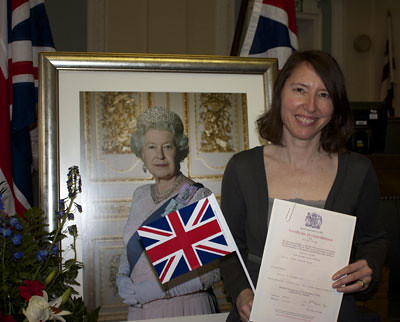
Two local musicians played Irish jigs, reels and airs for us, in celebration of St Pat’s tomorrow. Ironically, Irish music always makes me feel homesick, in a good way – not because I have more than your average mongrel American’s amount of Irish blood, but because everywhere I’ve lived on this planet, I’ve always found a proxy home in Irish pubs, which specialize in taking in strays and consoling them with their music, sad and joyful all at the same time, in a way that makes being far from home seem bearable. I was genuinely moved by how welcoming the officials made us feel – even the Queen, surveying us all from within her gilt portrait frame, seemed to have a cheeky glint in her eye.

Then it was my turn at last.

TheMoment

Afterward, lesson one: we all queued (politely) to get our photo snapped next to her.

MeAndLiz

I thought becoming a citizen was just a way to make my life more convenient. But I was not prepared for the deeper impact. Now, back at home in the flat that I own, safe with my family in a neighborhood I have grown to love, I feel a sense of home that I haven’t experienced for as long as I can remember. Maybe laying down roots will become problematic when I start looking for the next lab job, but I don’t care: I feel as if I’ve finally got my priorities straight.

[all photos by Richard P. Grant]

Posted in Nostalgia, The profession of science | 44 Comments

In which I lose my temper

Late last year I blogged about the new health and safety rule handed down on high from the research council that funds our institute: all staff must wear safety glasses at all times while in the laboratory – regardless of what they are doing. I won’t rehash my objections here, except to summarize that about 95% of what I do involves transferring non-toxic liquids from one tube to another, and when I do perform something hazardous, like poking around a liquid nitrogen tank or dealing with concentrated sulphuric acid, I wear the appropriate safety gear.

I’ve worked in a number of labs the world over, and I’ve never encountered such a draconian eyewear policy. What, I wondered, could be its impetus? One of my fearless and intrepid colleagues, Ian the Microscope Guy, dug a little deeper and found out:

I looked up the research council’s policy and it explained that there were 12 injuries in 2009 relating to the eye. The breakdown is as follows:

7 Chemical splashes
1 Chemical vapour (formaldehyde)
1 liquid nitrogen

Then it gets a bit silly….

1 Ice from freezer
1 plastic fragment (freezer tray)

Then it gets REALLY silly…

1 soap

Now, every lab in our building was forced to spend an inordinate amount of time writing up detailed risk assessments for every conceivable manipulation we do in the lab, including what safety gear is required (although handwashing with soap, I’m afraid to say, is not on our lab’s list). And we are all charged by regulations to be familiar with these procedures. It has not escaped my notice that the first nine, non-silly items on the list would have been prevented if people had simply been following the pre-existing rules about wearing goggles at the appropriate time. Actually, make that eight: strictly speaking, glasses would not prevent formaldehyde vapor from contacting the eye, so that person should have been working in a fume hood – another requirement clearly indicated in the risk assessments that seems to have been flouted.

So will the new rules lead to a reduction in eye injuries? I’m not convinced: risk assessments covering the scenarios that led to these injuries already dictated that care should be taken (either by the manipulators themselves, or nearby bystanders), and it clearly wasn’t – so wouldn’t these sorts be just as likely to disregard a more wide-sweeping rule? Meanwhile, what sort of havoc could be caused by perpetually restricted peripheral vision?

One of the most astonishing things about the policy is that the funding body, in order to implement its rule, had to pay for prescription safety specs for every single bespectacled researcher working in one of its funded institutes – I don’t know the numbers, but I can imagine there must be many hundreds of us. In these times of drastic cutbacks, I really shudder to imagine the final bill, and how many antibodies and enzymes we could have bought with that cash instead.

But there’s no use complaining about it now; the rule has kicked in. This past Friday, after putting it off as long as humanly possible, my benchmate Helen and I trundled down to High Holborn to order our special specs. We were optimistic – surely these days, the design of such items must have become more fashionable. Maybe we would actually be pleasantly surprised.

But our hearts sank when the clerk pulled out the box of samples, about a dozen models in all and each of them utterly hideous. Matters got worse when it became clear that most of the models were off-limits to people as myopic as me (R:-13.00/-0.75×2°; L:-11.00/-1.00×5°, since you ask) or my colleague (slightly less bad but still over the limit). Matters got a bit more worse when the clerk warned us the lenses might be an inch thick for people like us. When I finally had chosen the least hideous of the two possible pairs on offer, I was then informed that as my prescription was more than a year old, I’d need to be retested.

Dear reader, I lost my temper. For starters, I can assure you that anyone with a prescription of R:-13.00/-0.75×2°; L:-11.00/-1.00×5° is never going to get a decent assessment from a high street optician. After about two decades of being unable to see and not knowing why, I’d finally sucked it in and paid £300/hour to a Harley Street consultant ophthalmic surgeon with a posh accent and a natty bow-tie who, after two sessions, was finally able to prescribe glasses through which I can actually see. I was not about to spend the research council’s hard-earned, taxpayer’s cash on safety specs that I couldn’t focus through, and I certainly wasn’t going to go back to Harley Street until I felt I needed a change. It didn’t matter how hard I tried to convince the clerk that my current glasses prescription gives me 20/20 vision. The bottom line was that it’s against the optician’s health and safety regulations to fill spectacle prescriptions more than twelve months old – no matter what the customer wants. The final scores? That’s Lab Health and Safety 1, Optician Health and Safety 1, Jenny, nil.

So if you ever visit my lab in the afternoons, which is when I usually have to remove my contact lenses out of fatigue, I’ll be the one with the glasses over glasses, messing up my experiments because every time I look down, the outer safely specs slip off my nose and fall all over my rack, splashing solutions everywhere.

But don’t worry about my skin – I’ll be wearing the white coat.

Posted in Health and safety gone mad | 76 Comments

In which I assert my right of interpretation

In doing research for my previous World View piece for Nature about the lack of female science pundits, I came across the notion that women might be discouraged from expressing their views in public in part because they didn’t want to deal with nasty responses. I can sympathize with this perspective. Even though I don’t let it stop me from speaking my mind, I am naturally conflict-adverse and can often feel physically sick in the midst of it. But I strongly believe it’s more important to speak your mind than allow fear of reprisal (or ridicule) to stop you.

Last week, I published a second World View piece in Nature, about post-doctoral career problems in the life sciences. There was a very robust response in the comment thread, by email and in the blogosphere. Overall, I received hundreds of responses from all over the world, the vast majority of them supportive.

I am not going to discuss the post-doc topic further here; the point I want to make is a lot more meta. In a few of these responses, I encountered a recurring trope: irritation that I was writing something similar to something that someone else, somewhere, had once mentioned. The implication seemed to be that in matters of opinion – even something as often discussed as post-doc careers – particular ideas could somehow be owned.

Is there any justification for this view? First and foremost, there is a big difference between an op-ed and a scholarly article. And it would be very difficult, in a 700-word piece, to enumerate all the hundreds of influences that led to my ultimate argument. I am writing from the perspective of someone who has been in the academic system for more than two decades: in that time, I have absorbed thousands of conversations from colleagues in coffee rooms, in pubs, and in the banter of the laboratory. I am also writing as someone who is precariously close to being squeezed out of the system herself: indeed, in the past few months I have thought of little else, and bored my readers here with some of that angst. More recently, as I’ve got more into politics, I’ve started having conversations with various stakeholders about the issues, canvassing as wide an opinion as I can. For the piece, I needed to frame the argument for an international readership, and I needed to propose a solution (of arguably many), and for this I chatted to many different people, including a number of esteemed scientists. All of this was distilled, in a quite painful process, to fit on one page of a magazine – and was then further cut and refined by an editor, a subeditor and a copyeditor, some of this out of my direct control.

The internet is a big place. There are millions of voices, spinning out words into the void. And I am extremely time-poor, unable to take in more than a few blogs from time to time. An infinite number of monkeys would probably reproduce my Nature piece in full, while a sub-infinite number of bloggers collectively have probably said every part of it at one time or another.

But does this mean I didn’t have a right to say what I said, to put my own spin and stamp on the well-known tide of post-doctoral angst, to propose a solution – not the solution, but one possible one – to get a discussion going? Is the protestation “But I wrote about this last year” really a good reason to expect others not to? If we all think an issue is worth discussing, and none of us can read everything, surely the best thing to do is just to embrace all the various versions that struggle to the surface in the messy scrum of the online world. Implying that people have stolen ideas when they are probably just unaware of them is counter-productive. Convergent evolution is bound to happen whenever enough people are thinking along similar lines, and collectively, many overlapping voices will be more powerful than one. Indeed, the day after my piece went live, I opened up EMBO Reports and saw a piece by Howy Jones about women scientists that echoed a few points in both my recent Nature pieces. I was happy, not upset, that the arguments would get even more exposure.

If there had been infinite space for citations, and had an infinite amount of time to read every blog on earth, who would I have chosen? I am a big fan of Michael Teitelbaum, and have blogged about his views before. I was taken to task for not acknowledging Beryl Lieff Benderly, whose work I honestly have never come across before – but I’m glad I have now, because her stuff looks well worth a serious read. I’m sure I’m unaware of hundreds of other key voices. But I’m not going to apologize for saying what I needed to say, in my own words, in my own particular corner of space-time. Because sometimes you just have to speak out.

Posted in Careers, The profession of science | 19 Comments

In which I do my bit

For me, one of the highlights of Science Online 2011 was meeting @HistoryGeek – Holly Tucker, an Associate Professor at Vanderbilt University who teaches French and the history of medicine, and whose upcoming book Blood Work, a tale of murder and medicine in the Scientific Revolution, is coming out imminently from WW Norton. In fact, I’m not ashamed to admit I have a bit of a girl crush on Holly. Which is why, when she invited me to take part in Writers for the Red Cross, I leapt at the chance.

Holly and her friend Beth Dunn organized Writers for the Red Cross (#write4red) to celebrate Red Cross Month, which kicks off today. Intended to raise funds and awareness for the American Red Cross, this online event will be auctioning off publishing-related items and services donated by publicists, agents, editors and authors – including yours truly.

The American Red Cross has more than half a million volunteers and 35,000 employees who work together through nearly 700 locally supported chapters to help out during worldwide disasters. It’s a great cause, and you can take part in the auction to win a wide variety of swag bags put together by the various participants – you don’t have to be American to show your support. Week One’s auction is now open!

My own goody bag will be available for bidding next week. In addition to signed copies of both my novels, Experimental Heart and The Honest Look, you can win a fabulous Science Is Sexy T-shirt and mug (see the picture above for the design) and also a lovely full-color micrograph of one of my cell biology experiments, suitable for framing. (We are also considering selling these mugs and T-shirts on LabLit.com if they prove popular.) Do take a look at all of what’s on offer throughout the month.

Post-script: For those of you interested in how The Honest Look is doing, it sold out quite quickly in the US, necessitating a second print run. So I am pleased to report that after a long hiatus, the book is finally available again on US Amazon. Grab your copies while they last! The journal Cell thought it was pretty groovy, as did Grrl Scientist, writing in the Guardian. If you’ve already read it, please consider writing a review on Amazon – every little helps. The more books I sell, the more likely that my third novel – a light-hearted tale about a feminist virologist in a sexist institute – will be taken up for publication when the time is right.

Posted in LabLit, Writing | 6 Comments

In which I ask my due

When has good writing become such a cheap commodity that people seem reluctant to pay for it?

I still remember the first piece of proper science writing I ever did. The year was 2003, the place was Amsterdam, and my situation was bewildering: on the dole in the aftermath of an imploded start-up biotech company, I suddenly found myself with so many hours in the day that I wasn’t entirely sure what to do with them. I worked on my second novel. I wandered the streets and canals and surveyed the houseboats moored along the River Amstel, each with its own tidy garden on the adjacent embankment. I frequented cafés and tea rooms, stared at sunflowers, starry nights and nightwatches in various museums, searched for jobs in several countries. As spring turned into summer with no appropriate situation appearing, I saw an advertisement for a free conference in Utrecht about the dire situation of women scientists in the Netherlands. Bored and acting on a whim, I contacted the editor of the Dutch edition of Science’s careers website (the now defunct Next Wave) and asked if he’d consider a brief wrap-up of the event – no charge. He enthusiastically agreed, and a few weeks later asked me to report on something else. The third time he wrote to commission a piece, he said with typical Dutch diffidence that as I wrote better than most of his freelancers, he’d better start paying me. I was thrilled with the idea that I had progressed so far, and soon began to seek out further paid work – nothing prestigious or fancy, just solid bread-and-butter wordsmithing.

This low-key state of affairs went on for a few years, but escalated when I started working for a scholarly society in London. Although my job was to oversee their four peer-reviewed journals, the organization also had a respectable trade magazine whose editor was happy to train me in bona fide journalism and eventually accepted regular news pieces from me. Of course I didn’t get paid, because I was on salary with the society, but I didn’t mind because I was learning a new skill from a very experienced team. It was stimulating to work to such short deadlines, to scan press releases, to interview scientists, to learn the fine art of teasing out the opposing view. One of my investigative pieces got picked up by the Telegraph and from there trickled into the Metro and a few other outlets, which made me enormously proud. Meanwhile, on the non-news front, I was writing for serious money for other clients in my spare time. I didn’t need the cash, but it felt good to be earning on the side, even though I had to pay an accountant to help me discharge my now rather complicated tax obligations.

This was around 2006, when blogging was just starting to take off – or, at least, to filter into my late-adapting consciousness. I started blogging myself in 2007; although my free time was gradually getting swamped with paid extracurricular activities, I was happy to blog for free because, frankly, it was a blazing relief to be able to produce copy without the well-meaning interference of editors and subeditors. (I don’t wish to denigrate the profession, as I’ve been an editor myself, but there are times when you want to cry when your perfectly crafted paragraph is butchered into a stream of simple sentences forced together with no thought to logic, orderly transition, rhythm or – god forbid – beauty.)

Somewhere between then and now, amateur writing and citizen journalism became a thing that professional news outsets suddenly seemed to desperate want a piece of – although not, of course, at the going rate. Some ask for free copy; some pay a token. Fair enough, if you consider that amateurs are not professionals – but what if they’re as good or better as those on retainer? The lines have definitely started to blur. I myself am a strange hybrid mixture – the part-time journalist who’s been jobbing for money for the past eight years. Only now, my financial situation has become such that this extra income is actually necessary; in parallel, requests for my writing and appearances have steadily increased, meaning that the time that I have to write for money (including my own novels) has dwindled alongside.

I was inspired to ponder all of this last week when a prominent, high-profile, healthily-for-profit journal asked me to write a piece of front matter. When I asked if there would any remuneration – a fairly reasonable request, I would have thought – he informed me that there wasn’t (fair enough), but that none of their other scientist authors had had an “issue” with it (not quite so fair). Perhaps the jibe wasn’t intentional, but between the lines I read You, unlike all the other suckers we’ve roped into writing this column for free in a sphere traditionally populated by well-paid freelancers, are unbelievably greedy even to have inquired. Who do you think you are? Don’t you know you’re lucky to even have been asked to sacrifice your academic time in this way to increase the value of our journal so much that we can raise subscriptions even further? How, I wondered privately, would that editor respond if I asked him to do a half day’s worth of editing for free?

Yes, I was angry by this sense of entitlement, even if the comment was entirely innocent, and yes, I turned him down (although on the entirely true grounds of over-commitment). Of course scientists have always been asked to contribute to journals gratis – the primary articles themselves, as well as scholarly reviews, perspectives and refereeing. And this, I think, is not so bad, because such activities can be cited in our CVs and enhance our professional standing. But asking for unremunerated front matter is starting to stray into the territory of taking the piss. Not all journals get this wrong – Nature, for example, pays the freelance rate for news and comment, no matter who has authored it, and the broadsheets too are very aware of what good writing is worth. Writing for free to develop a portfolio and reputation is a great way to start out, which I highly recommend, but after a certain point, you need to start demanding your due.

This problem, I suspect, is a reflection of a society-wide reluctance to pay for certain types of creative content. A friend of mine who wouldn’t think twice about paying £12.50 to see a movie once asked if she could borrow a copy of my novel (£8.99) instead of buying her own – when I declined, she asked if it was available at the library. Others feel they don’t want to pay for films and music and instead obtain pirate copies. It is the same psychological reason why at the scientific society where I used to work, the journalists with PhDs were paid about half the salary of people in PR, marketing and business development who possessed only an undergraduate degree and years’ less experience. The subtext? Science and writing are for dabbling and “fun”; Human Resources is a serious profession worth paying for.

—–
*Clarification added: I should have stressed that there are still times when I write for free – when it’s a good cause or non-profit organization; when the company in question has done something nice for me in the past; when the gig will help me reach a brand-new audience. And sometimes, it’s just when someone has asked very nicely and hasn’t made me feel like I have no right to say no.

Posted in Nostalgia, Writing | 59 Comments

In which I wait for spring to come

Dusk was already falling, along with a light drizzle, earlier this afternoon as I pushed brown ovoid objects repeatedly into heavy wet earth. Carelessly dressed against the cold, my muddy fingertips going numb, I worked the trowel and hoped I wouldn’t slice open any previously planted spring bulbs. The truth is I’ve completely lost track of how many I’ve actually deposited under our row of dwarf fruit trees over the past six months, let alone their precise coordinates. Some have come up already – snowdrops and crocuses in bloom, and the first signs of daffodils, tulips and hyacinths. Others may yet emerge, if they haven’t been stolen by squirrels or blighted by parasites. In short, the space is fully booked with standing room only.

But I’ve been longing for Convallaria (lily-of-the-valley) ever since I saw them growing wild in the forests around the European Molecular Biology Laboratory in Heidelberg during my sabbatical last year – which in turn conjured up the neat row of nodding ivory bells that my mother tended along the front path of our old house in Ohio. Their fragrance has always invoked new beginnings, but also sad endings. Richard brought some home for me yesterday, because I was blue and he always seems to know exactly what is needed when I’m lost at sea.

The orchard isn’t the only thing that’s fully booked in our back garden. We have overly ambitions plans for the limited space in the rest of the lawn, and I fear my most recent Thompson and Morgan order went a bit over the top (the spuds in particular – do I really need 2.5 kg each of first earlies, second earlies and a maincrop?).

You're chitting me

But I can’t resist potatoes, the way they taste dug straight from the ground on a sultry summer evening, boiled until their skins are just flaking off and tossed with mayonnaise, salt, pepper and chives, with barbecued meat, a glass of cold Pinot Grigio and the scent of citronella candles.

The potatoes, bulbs, herbs and climbing nasturtiums are my domain, and Richard does the vegetable beds, the tomato greenhouse, the sunflowers and sweetpeas – and the heavy digging. We got a late start last year because we didn’t move in until March, with some of our tomatoes withering on the vine in November, but now we’re fully prepared for a long and prosperous harvest.

Post-script: It was only today that we dug out the last of the carrots and leeks.

Posted in Domestic bliss, Gardening | 32 Comments

In which the truth hurts – or does it?

As crocuses push through muddy earth, the air softens on campus and the undergraduates wake up from hibernation to resume clogging up the pizza queue in the refectory, I feel the weight, yet again, of the swift passage of days and months.

It’s that time of year again: our annual staff appraisals. Being subjected to this exercise is, for me, a surreal experience. Before I returned to academic research, I was leading a team of eight scientists in biotech and, after that, a group of six editors, giving me many years’ experience on the other side of this process. Appraisals now, in my status as lowly post-doc, administered by a boss several years my junior, only underscore how far back I have slipped in my career progression. And progress is never as quick as you’d like, especially when you’re flying solo again after years of achieving things as a team. Looking back at last year’s appraisal document, I saw with discomfort that my main goal – submitting the big screen paper for publication – remained unfinished (albeit lurking only a few weeks off, if all goes well).

The chat was informal and went well, but with only eleven months of funding remaining, there was no avoiding the serious discussion about My Future. And the boss made no secret of the fact that he didn’t think I was cut out for the cut and thrust of lab head existence. It was not framed in a particularly negative way: I am, I was told, a woman of many talents, and I probably would not find focusing solely on research to be an adequate outlet for my interests and passions. Obtaining an independent fellowship might be tricky with my track record in the current climate. Attempting a bridging, three-year project grant would be a gamble on success. Yet if I went the way of a lectureship position, I’d probably end up frustrated by a situation that didn’t even allow, these days, a fair shot at performing any significant research at all.

Over the past few months, I’ve noticed that my boss is not alone in the assumption that I would not like leading a group. Last week in the common room, a colleague told me about a particular Oxbridge artist/writer-in-residence programme, and several professors we were drinking coffee with thought it would be the perfect thing for me – not seeming to realize the double-edged implications of their hearty praise or how it might make me feel. I know I am fully capable of leading a group and writing novels at the same time – after all, I’d done it before, quite effectively, for a number of years. But although one of the professors always urging me to leave science “for writing and that sort of thing” probably spends as much time playing tennis and watching the cricket as I do working on the side, her hobbies are somehow not considered to be incompatible with science – neither do they impinge on her serious reputation. (I’ll leave for another time the fascinating topic of why physical activities, like sport, or passive entertainment such as TV, are fair game for scientists, but intellectual activities that may take up no more time are viewed as best, an odd quirk, or worse, a fatal distraction from research that taints the purveyor as “less than serious”.)

So, do I want to be a lab head?

Yes – and no.

Would I be capable of pulling it off and still keep up my writing and other science communication endeavors?

Absolutely. I can do anything I want, and I always have done.

Would it be the best course of action for me?

Your guess is as good as mine.

Posted in Careers, Staring into the abyss, The profession of science | 28 Comments

In which we fail to meet expectations

Sometimes you find yourself in a crowd, experiencing the unreal sense that you’re wearing a disguise, or acting out a part in a play, or watching yourself in a web-cam feed. Last week I attended the biennial meeting of Wellcome Trust Fellows, a gathering designed to allow chances to network, learn about each others’ work and discuss future funding opportunities. The majority of participants were Career Development Fellows (CDF), but also in attendance were all ten Career Re-Entry Fellows (CRF), including me. I gave a talk about my research, which was very well received, but I in no way felt like a peer to all the confident, impressive CDFs in the room.

For those of you who aren’t familiar with the Trust’s schemes, the CDF is a highly competitive, prestigious five-year fellowship which allows a talented post-doc to take on people and become a new group leader. The Re-entry Fellowship, on the other hand, is a rather amorphous beast: it is also advertised as being prestigious and competitive, but as it’s for people returning to research after a break, this notion is subtly undermined by the implications of the relatively small selection pool. The CRF lasts only four years, and though the person is designated as the Principal Investigator and is, according to the Trust, meant to be an independent researcher in their “sponsor’s” lab, she can’t start a group. In other words, we really are just post-docs with our own consumables budget.

Or so I’d thought. But during one of the informational lectures from Trust staff, we heard the surprising news that we Re-entry fellows were meant to be entirely independent, and as such, really ought to be senior authors on our papers. At the moment I’m putting the finishing touches on what may be the only major manuscript I get out of this stint, and my name appears co-first with a former PhD student in my boss’s lab. But maybe this was unusual? During the next break, I sought out as many of my counterparts as I could find to see what they thought. Like me, the others were bemused and a little bit alarmed to hear this news. “There’s no way in hell my boss would ever let me be senior author,” one woman told me, with a bitter laugh, which seemed to be the prevailing view. Another said that, in fact, most of her papers were turning out to be second-author because her specialized technique was being used as a coveted “service” by the rest of her department – or “collaborations”, as they preferred to call it.

The psychology of the Re-entry fellow is tricky. For starters, we’re typically women, which already can affect how we feel about being on a non-traditional, start-again path. It is difficult to describe what it’s like to be out of research for a time, especially if you really didn’t want to leave in the first place. There are decades of dreams, hopes, ambitious and expectations built into a scientific career, dreams which for me started when I was a small child. And when you are already a very mature post-doc, coming back into the game is not so easy. How do you find someone willing to give you a chance? And when they do give you the chance, you are in an unavoidable position of submission: they did you a favor, and you are sincerely grateful. This is not a situation that makes you want to rock the boat, especially when you are already feeling insecure and rusty, surrounded by brilliant seminar speakers and new group leaders ten years your junior. Nobody in your lab or department treats you with what would be afforded a prestigious CDF: you are just an odd-ball mature post-doc. A Re-entry fellow may be asked to do lab chores, management, admin: the fellow is just happy to be there, happy to make life easier for the person who made it possible. The fellow may be asked to help out on other projects, for minor authorships – again, it may seem like the right thing to do at the time. And above all, the Re-entry fellow acts like any other post-doc – she is expected to attend lab meetings and one-on-ones with the boss, to heed project guidance – which means that, no matter how independent you are, you can’t say that you “own” your project – it’s just too closely circumscribed by the lab head. The bottom line is that none of us really feel in a position to insist that senior authorship, in this environment, would be appropriate – no matter what the Trust expected.

In retrospect, I am not sure the CRF scheme will achieve the aims that most of its awardees might want. The younger ones may bounce back, but for those of us a decade or more from our PhD and aged beyond most funding sell-by dates, what can we realistically hope for? Unless we are very lucky, four years with no technical assistance is not enough time to create a track record and line of research that would make us competitive for the next step, especially when it can take more than a year just to get back into the swing of things. I’ve heard that at least one CRF became a lecturer, but we don’t have access to the stats and fates of our predecessors – and it’s a relatively new scheme, so the sample size is probably too small to draw conclusions anyway. I am grateful to the Trust for the opportunity – of course I am – , but I can’t escape the feeling that when it’s all over in a years’ time, I will have let them down, that their generous support was too little, too late, and might better have been spent on backing a more convincing, younger winner. I wonder, sometimes, if I would have been better off not coming back to research in the first place, instead putting my energy into establishing myself in a career where I had a more realistic chance at future success.

I’ll never know, now. And only time will tell what will happen to me next.

Posted in Careers, Staring into the abyss, The profession of science | 35 Comments