In which we fast-forward

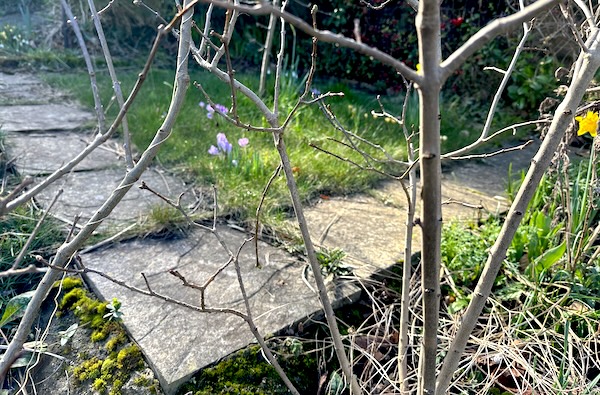
A grassy lawn with spring flowers

Once more, with feeling

The phrase bleak midwinter was first coined by the English poet Christina Rossetti in 1872 and went viral when composer Gustav Holst incorporated her text into a carol a few decades later. Although the words are clearly meant to evoke the “hard as iron” feel of Christmas, I have always associated bleak midwinterism with January and February, the period after the festivities have ended but before the first spring bulbs begin to bloom. In this dormant, liminal period, the world is gripped in darkness and all hope seems very far away.

I used to struggle quite a bit during the bleak midwinter, but it’s been increasingly less problematic; this year, the period has lost its bite altogether. In fact, it doesn’t seem to have happened at all. Maybe it’s because of the mild winters we’ve been having, which keep the roses blooming into late December, coaxing up freakishly early snowdrops at the same time. The cow parsley sent up green fronds in January, alongside the rusty-red quince blossoms and lemon-yellow false oxlips; February has brought the crocuses and daffodils, hyacinths and hellebores, all compressed into one wave and heedless of the proper unfolding order of things. We may yet get a cold snap or even a dusting of snow, but to all intents and purposes, some celestial force has zapped us straight from New Year’s Day to spring.

I am not complaining. But at the same time I am hardly sure what to do with this sense of peace and contentment which normally needs to be awaited, longed for, somehow earned.

Posted in Domestic bliss, Gardening | Comments Off on In which we fast-forward

In which we celebrate

ornaments

Overlapping festive traditions: new (left) and old (right) baubles

Christmas, I argue, is a space-time continuum where the past and present layer up like sediments on the Jurassic coast. At the appointed time, old traditions are unearthed out of storage to mingle with those spontaneously invented as you go along. The result is slightly different every year, yet grounded with a hefty sense of nostalgic familiarity, the past shoring up the present as if they have always been together.

This time was especially intense because we received my late parents’ possessions over the summer in an overseas container shipment, most of which have yet to be explored. (It is so emotionally difficult to process, I can only do a box at a time.) But when we were putting up our tree last week, I was ready to tackle the one marked “Christmas” that Richard found among the stack in the loft. Feeling that tingly sensation like the moment before the big reveal of a scientific experiment, I slit through the tape and began to delve through the dusty contents within, stirring up the scent of a Victorian farmhouse halfway across the planet.

I found what I was looking for: several cardboard boxes containing the ancient glass family ornaments in faded tissue paper, each nested into a cardboard cell. Some were instantly recognizable, and others, utterly unknown. In the familiar category were all the baubles that I’d forgotten until the moment I saw them, the seeing somehow reconnecting the memory as decisively as a light switch. Some were broken, others intact but with colors faded almost to greyscale, while a few looked nearly brand-new, like the brace of red and green peacocks with their real tail feathers that I used to adore, and which must be close to a century old. The unfamiliar ones included a pretty, gilt-trimmed scarlet sphere in its own special box, with a gaping hole on one side and a little note in the hand of my mother (also a relentless chronicler) stating simply: “Poland, 2002”. (Darling Richard managed to fill the perilously fragile shell with expandable foam, and it now hangs with all the others on the tree, foam-side back.) Did my parents manage to travel to Poland on the same trip when they visited me in Amsterdam? I have no memory of this, but it may be so. So many mysteries, which now will remain forever unanswered.

I wasn’t expecting to find the metal Christmas tree candle-holders, complete with half-burned silver candles still in situ. Dad used to take hours attaching the holders in unproblematic areas of the live tree, then changing his mind and moving them repeatedly, before making us all sit down and not move for half an hour after he lit them, lest we accidentally burn down the house. Just seeing them gave me a shiver of fear, but also an injection of the old Christmas wonder, from back when I was as small as my son, and everything seemed not just metaphorically magical, but actually magical.

My maternal family’s cookie recipe, converted from American to British

Back in the present, the longest night of the year has come and gone and the moon is swelling towards full. We have been baking non-stop – the usual Julpepparkakor cookies, and my recent adaption of Martha Stewart’s sugar cookies, both cut into shapes using the metal cutters that I happily discovered in the overseas Box of Christmas. I like the idea that when Joshua is pressing them into the dough to make stars and hearts and trees, he is handling the same tools that his grandmother used to use, and his mother, when I was his age. Richard has been knocking out stollen, mince pies and sausage rolls with his usual aplomb, all handmade from scratch including the candied peel, mincemeat and marzipan. He’s got a Christmas cake and pudding in the wings, and a magnificent feast for tomorrow night. I am not sure what sort of cosmic lottery I won, but I’m just going to try to enjoy it without pinching myself every two seconds, or convincing myself that I don’t deserve it.

musical notation

How did this abomination slip past the editors?

Joshua and I have been practicing festive duets daily for the past month, which we finally got to showcase last night at our annual cocktail party, with everyone gathered around the piano singing. It’s hard to find decent arrangements of the old favourites, and I usually have to annotate them to set them to rights. But it is wonderful that Joshua is turning into a proficient player, and that I have someone to play with. It’s been nearly half a century since I use to enjoy duets with my father’s best friend Chester, a concert pianist who would indulge my childish enthusiasm, and whose Secondo would include thrilling improvisational flourishes and trills that turned our songs into gold. But now I’m the Secondo, spicing up the bass parts, and Joshua is playing a serviceable melody snuggled next to me.

It’s Christmas Eve, and everything is ready. The lights are up, the mistletoe is hung, I’ve made a wreathe of fir offcuts, holly, ivy flowers and pyrocanthus berries. The larders are full, the older offspring are home and sleeping for 15 hours. The presents are wrapped, and the weather is typical mild English green-and-grey gloom. I am humbled by my excessive good fortune, and strive only not to take it for granted.

Posted in Domestic bliss, Joshua, Music, Nostalgia | 2 Comments

In which I age backwards

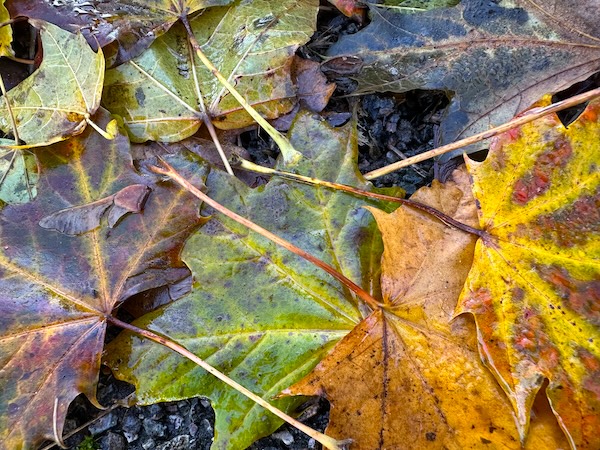
Autumn leaves

I don’t know if it’s just me, but for the last few years, I’ve forgotten how old I am. Because I spend so much of the year pessimistically rounding up, I’m rendered unsure by the present state of affairs. When the inevitable question comes, from a doctor or someone else official, a few embarrassing seconds tick by while I’m forced to do the math. This morning, I woke up to realize that, despite it being my birthday, I’ve actually lost a year of age. Not a bad present, that.

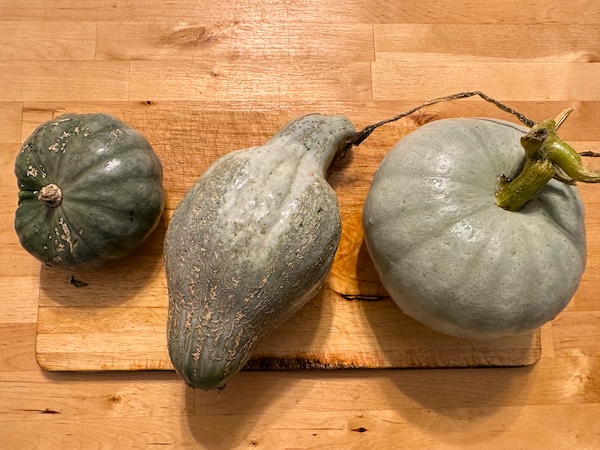
Blue pumpkins

Headed for a pie

The latter half of November is always my favorite time of year. My birthday and Thanksgiving fall in the same week, giving a glimmer of excitement and occasion to my life against a backdrop of autumn color, dark mornings and nights, the snap of cold against my skin. From the garden, we harvest pumpkins and squash, withered apples, sweet potato, kale, quince, crabapple, the last of the bolting autumn lettuces. A crop of Christmas potatoes and parsnips awaits in the damp earth, and we cloche the over-wintering patch of cauliflower, broccoli, kalette, broadbeans and peas (but leave the garlic to fend for itself). I snip the final few roses to unfurl indoors, find unoccupied space in the ground for yet more tulips and daffodils (violating some arcane law of physics in the process), and force narcissus bulbs in the garage.

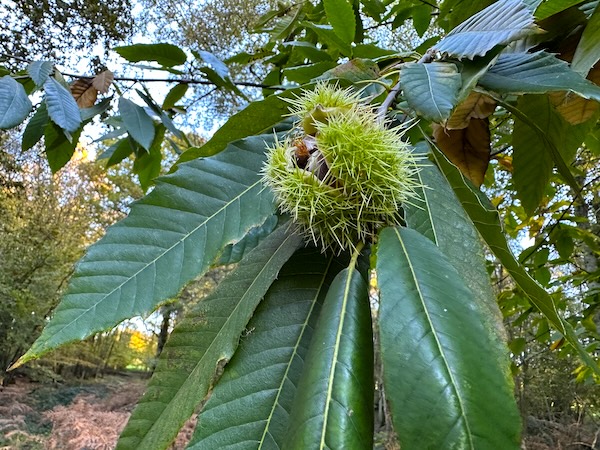
In dripping local woods smelling of moss and loam, we gather fallen sweet chestnuts, carefully extracted with a boot toe from their lethal acid-green cases, and roast them over the fire. The solar panels no longer produce surplus energy, the hens lay fewer eggs, and our bees slumber in their hive, much missed. Richard’s amazing homemade eggnog develops in the fridge, soon ready to be served with freshly grated nutmeg.

chestnut on a branch

Headed for an open fire

Out and about, London has long since succumbed to premature festivitis and is decked in Christmas lights, with boughs and wreathes up in St Pancras International station. The commuting capital teems with life, as if the pandemic were a long-ago nightmare, and at night, as we go to the theatre or dine out, the joy of life is almost overwhelming. My lost youth is out there in the revelling crowds, just around a corner, shivering in the queue of some club in heels and inappropriate clothing. Truth be told, I’m far happier at home, on the sofa under a blanket with candles as the rain and wind pound against the bay window glass. The joys of middle age are definitely underrated.

Posted in Domestic bliss, Gardening, Nostalgia, The ageing process | Comments Off on In which I age backwards

In which the wheel turns

Time is a wheel, speeding me along in ever quicker circuits. As individual moments rush towards me, flare into immediacy and then blur past, most are soon forgotten save for those captured as digital images, or in some dashed lines of ink in my journal. While the tune is largely the same each year, certain themes progress irrevocably: the height of my son, once a helpless baby and now a ten-year-old whirlwind of humour, intelligence and stubborn self-sufficiency. The consistency of my skin, gathering millions of tiny wrinkles and spots, making me stare sadly at my ankles and think, girlfriend, you are old. Aging, my own and my family’s, is a fiducial marker by which I can gauge the eventual end of this crazy road trip. Still a good ways out of sight, I hope, but no longer an infinity away, as it seemed when I was my son’s age.

Bowl of garden produce

The beginning of the end

There are multiple annual cycle start points in my life. Of course there is the first of January, when the calendar year resets and I think about personal changes I might want to make in my life, both physical and mental. The garden cycle starts in February, when I begin propagating the earliest seeds, a months-long and arduous process that will fill our plots and greenhouses – and weekends – for the year. And then there is the end of September, when the academic year kicks off and the new students arrive, emitting youthful enthusiasm and anxiety in equal measure, when I dust off my lectures and gear up for months of pretty heavy stress until the Christmas wind-down.

The lab has its own internal cycles that are far more chaotic than the annual circuits framing my individual life. Team members come and go on a random timescale, meaning that the group dynamics are always fluctuating in terms of personality, experience and some unquantifiable aspect I might unscientifically call “vibe”. Our recent move to the new building has added an additional dimension: the camaraderie of working together to find out where things are, how things work, how we fit into the ecosystem – and whether we can really trust the “decontaminated” lab fridge in the kitchen to store our lunches.

There’s no point in getting too comfortable with a current vibe, as soon another new postdoc will be joining our team (hooray!), alongside the small phalanx of annual undergrad and master’s project students who will brighten up the atmosphere even further in their brief tenures with, one hopes, a minimum of broken glassware and yeast-infested cultures. But the vibe is great now, making coming into work something I anticipate. There is also the welcome excitement of accepted papers, invited lectures, press interviews, public engagement activities and new collaborations to keep things lively. It’s a weird job by any measure, and often challenging, but one that still keeps me interested, more than thirty years since that timid PhD student first ventured into a real lab to start her own scientific journey.

Posted in Academia, Careers, Domestic bliss, Gardening, Joshua, Research, The ageing process | Comments Off on In which the wheel turns

In which we land

Our migration is complete: my lab now has a new home. And for me, a new office space.

An office desk with computer

The secret to my scientific success?

Numerous studies have scrutinised the effect of environment on work productivity. Anecdotally, I know that my own focus and output are greatly enhanced by my surroundings. Until my workspace is tidy, I cannot seem to muster the mental intensity needed to sink into my work, especially creative tasks such as writing a grant or paper, or planning a long-term research strategy.

Albert Einstein once famously quipped “If a cluttered desk is a sign of a cluttered mind, of what, then, is an empty desk?” I would argue that everyone has her own work style, and in a digital age, there is no need for the perilous stacks of scientific papers that used to be the mainstay of professorial desks (and still are, among the older set. I’m looking at you, new office-mate). These rectangular columns – stalagmites of pure knowledge, precipitated into paper and toner – used to sprout from every available surface of all “serious” desks, with bonus points for colonising most of the floor as well. Additional specimens were captured into heavy ring-binders and lined up on dusty shelves, never to be consulted again. The more obsessive would further encase each individual article into a plastic envelope, which makes recycling a nightmare. And I should know, having spent many hours last week disposing of dozens of these binders when we were clearing out the new space – the most recent articles dating from the mid-Nineties.

But these desk stacks loom large in my memory. Whenever I’d sit in the office of an established scientist, the sheer mass of their scholarly learning would engender a sense of awe and respect in my much-younger self. As a PhD and postdoc I devoured an awful lot of papers, but would I ever reach this particular boss level? Now I know, from experience, that many never bother to actually read the papers they print out. Rather like a well-stocked vegetable drawer rotting by the end of each week, the accumulation alone already seems to tick some sort of box.

I do, very occasionally, print out an article so that I can scribble on it and, in doing so, organise my thoughts. (Online annotations don’t seem to have the same cognitive effect). And even more rarely, I store them for future reference. But once the paper/grant is out the door, the article is off my desk and into the recycle bin. The older I get, the less tolerance for clutter I can muster. So after the big office purge last week, I was surprised to find that I wasn’t able to fill even a small fraction of the modest shelf space above my new desk. I even lined up notebooks and protocols from my postdoc days just to make the place look a bit more lived-in. But the spareness suits me well, and I’ve already shepherded a revised a manuscript and a grant rebuttal out the door, and made good inroads into my next grant application.

Laboratory space

A lab with a view

The lab is also looking great. But I need more grants to keep up the momentum. I’m fine for people (we’ll have a total of five come autumn), but when I’m lacking is funding that buys out my research time from teaching. If none of the four outstanding bids come through by the end of the year, I’m hopeful they’ll let me bridge the gap with a period of full-time teaching. Of course, my research would be relegated to evenings and weekends (putting my work-life balance on hold for while), but in the absence of a permanent position, I’ve been gambling with this sort of jeopardy for decades. It no longer has the power to frighten me. Things will work out – or they won’t, and I will do something else. Meanwhile, I’m whooping in the front car of that downward roller-coaster, waving my arms in the air and enjoying the ride while it lasts.

Posted in Academia, Nostalgia, Research, science funding, Scientific papers, Staring into the abyss, The profession of science, Work/life balance | 1 Comment

In which we migrate

After about eight years in residence at the Royal Free Hospital, my itinerant scientific journey is about to embark on its next exciting leg.

lab space with researchers

Some of my team, hard at work in our current home

In a few weeks’ time, my lab is uprooting itself and moving to a new home in the same department, from leafy Belsize Park to the thrumming centre of the university campus in Bloomsbury. I’m looking forward to it, but if you’ve ever moved labs before, you’ll know how overwhelming it can all seem. Most scientists are pack rats, and each trainee accumulates things – chemicals, reagents, plasticware, small pieces of kit – that are inevitably left behind for their successors. After a few such “generations”, the provenance of these items starts to get a bit blurry, especially when there is no one left who knew the original owners. Of course there is me, the sole constant, but even I struggle when confronted with the bold initials of a long-ago undergraduate project student who laid claim to a box, a rack, a bottle with a scribble of Sharpie, who came and went in a brief flurry of newbie zeal, ideally without blowing anything up.

In a communal lab space like the one we currently inhabit, the problem is compounded because there are multiple groups all leaving behind their stuff. The shadowy corners and recesses of less accessible benching – like that scary space behind the fume cupboard – are no-man’s lands of dusty piles of what is tactfully known in the business as “crap”. Broken gel electrophoresis electrodes, boxes of microscope slides smeared with decades-old dried purple goo, expired DNA extraction kits, pipette tips that are no longer compatible with the current sets of instruments, broken microwaves, rusty water baths that haven’t been filled for decades. Someone recently found a bottle of powdered chemical that had expired in 1972. And then there are the towers of reusable rainbow-coloured plastic boxes that fit a standard 10 by 10 grid of Eppendorf tubes, emptied of their contents but still marked territorially with their original owner’s name and purpose. IMPORTANT SAMPLES!, one declares. THE VERY LAST EXPERIMENT! promises another. Once these were prized treasure chests, carefully guarded – now they are spent empty shells, waiting for the next researcher to fill them with purpose.

So we’re using the opportunity to get rid of stuff that we no longer need, once and for all. It’s agonising, but as with most moves, we’re getting increasingly ruthless the further into the process we go. That little bottle of buffer from five years ago? It may still work, but do you really want to risk your experiment finding out? And so we recycle and donate what we can, and fill up the rubbish bags with the rest. Meanwhile, across town, members of my team have been clearing out the abandoned detritus occupying the space earmarked for us. I’m pleased to report it’s now empty and gleaming and ready for the onslaught of our crates.

If you ask us what we’re looking forward to the most, it’s probably having windows in the lab and office spaces. Yes, we’ve been enduring a fluorescent-lit cave for far too long. But University Street is lined with trees and sky and we’ll emerge into our next stage of the life cycle, blinking in the sunlight.

I am so looking forward to a fresh start – decluttered, scrubbed clean and optimistic. We have two new people joining the team soon, and so many grants outstanding that I’m confident of even more before long. I’ll be closer to key collaborators, and to the heart of university life. Endings and beginnings punctuate academic life, so let’s see what’s around the horizon. I’m ready.

Posted in Academia, Research, The profession of science | 2 Comments

In which I am pummelled into viral submission

I am only happy to write about this today because I suspect it is finally almost over. I’m no longer so superstitious that I think I’m tempting fate by doing so now.

In short, I’ve been ill for a long time. It all started off in mid-April, probably about the same time that I finally stopped wearing a mask on public transport. It was only a tickly cough, but when it ambushed me out of the blue, I’d hack uncontrollably for a minute or two, then find myself utterly voiceless for the next five, until it would all be fine again, sometimes for hours. When it happened during meetings with collaborators or doing tutorials with my students, it was embarrassing and debilitating, but I learned to always carry a pack of Ricola lozenges with me, which could usually get the coughing under control fairly quickly.

After a conference in Rome, I flew home with a sore throat, which developed into cold symptoms to keep the pesky cough company. In the first week of May, I tested positive for COVID – a deep red line that developed as soon as the sample flowed over the zone. It hit me pretty hard, sort of halfway between a cold and influenza, but after a few weeks my cough was fading and I was starting to feel better.

Enter another sore throat, which waned after a few days, and then a much sharper one, alongside acute conjunctivitis in both eyes, and the return of the stupid cough. For exactly 24 hours, I lost all sense of smell, restored the next day like a switch flipping. The pain and swelling in my throat became so bad that for a week, I could hardly swallow and certainly couldn’t sleep, so I ended up binge-watching, in small insomniac chunks, the 2016 version of War and Peace (essentially Jane Austen but with furry hats and amputations) between two and four in the morning. The moon transformed night by night outside my window from a slim crescent abutting Venus to a fat waxing half, leaving the more steady planet far behind. Sometimes, the sound of a neighbour coughing uncontrollably would float across the dark gardens, and it was strangely comforting to know I wasn’t alone. Solidarity, my comrade-in-arms.

Last night, for the first time in ages, I managed a full night sleep, and today, the ache in my throat has dwindled to a faint pain (though my friend the stupid cough lingers). This weekend, I took pleasure in the warm breezy weather, attacking the jungle in our back garden, hacking away at vines and shrubbery and pulling long, satisfying strings of goosegrass and bindweed from the beds. There are so many lovely things blooming now: delicate beauty bush, mock orange, red conker candles, lilac, anemones, irises, thyme, and of course the roses. A vase of them sits by my computer now, leaching sweet scent. It’s been pretty outside for weeks, but when you’re ill, it’s hard to feel the love.

I’m not writing this because it’s original or even unusual, but it comes after a long illness, with some similarities, I suffered for two months at the end of last year. The throat pain is in exactly the same place – but fortunately this time I didn’t have to go to hospital. There is still so much we don’t understand about viral infections, how they play out and how they linger. How many separate fresh infections have washed over me, ebbing and flowing, and how many were relapses of what was already there? Am I getting so ill because I wasn’t properly exposed for the past few years due to Covid precautions? Or is it just the inevitable consequence of “immunosenescence” – my defences deteriorating with age? (This is a topic I regularly teach undergraduates and medical students, but it’s never before felt real. Until now. I can almost feel my responder cells dawdling inappropriatately and secreting all the wrong signals.)

Perhaps one day we will have lateral flow tests for all the respiratory viruses, and we can monitor these strange battles raging in our bodies in real time. Or better yet, maybe someone can use RNA vaccine technology to finally target all the cold viruses, all together. One handy annual seasonal jab to take away this pesky misery once and for all. Back in 1946, the Common Cold Unit was established to try to cure us of these first-world-problem scourges, but despite a lot of interesting knowledge generated while it was active, we still don’t have a cure. One could of course argue that colds aren’t important enough to try to seriously tackle, but they certainly blunt our productivity significantly. Personally I think it would be research money well spent – but then, I would say that: I’ve been under the cosh since what feels like the Jurassic era.

Posted in Gardening, Illness, Research, The ageing process | 1 Comment

In which I head into the wind

Tulips in the garden

Heart-breaking ephemera

Sometimes joy and sadness are hard to tease apart – there should be a word for the heavy lightness, or light heaviness, of springtime. This time of year always carries ambivalence: a scrum of flowers unfurl, scenting the air, but the winds are bitter-cold with that “not so fast” April scold, night temperatures not far off zero.

We are not finished with winter yet, not really, even though my garden is doing a pretty decent Koekenhof impression at the moment. Aside from the too-many tulips I keep layering in each autumn, accidentally unearthing old bulbs to make room for the new, the first (evil) Spanish bluebells are out, rushing ahead of their lazier but more true-hearted English cousins. Wild garlic blooms in the shady little woodland along our back garden wall, jostling with wild celery and the first cow parsley bunches. In my morning walk along the hedgerows, I see purple archangel, dead-nettle, green alkanet, dove’s-foot crane’s bill, all the pretty little weeds that don’t clamor to be noticed. I’ve been plagued with headaches and migraine auras recently, and it feels as if the icy air could anaesthetize my brain if only I could inhale enough of it.

I’m aware of significant stress at work, even though things are going as well as they ever have in terms of papers, grants, invited lectures and exciting collaborations, and my team is engaged and brilliant. Sometimes when I wake at 3 AM (why is it always exactly 3 AM? There’s a PhD thesis in there somewhere), my academic worries chase each other around in the dark, stripping the willow with my imposter syndrome. By light of day, I conquer them, and just get on with things. Science is such a strange profession, the sort of strangeness to which you become immune after long exposure. It tries so hard to spit you out once it swallows you, but if you are stubborn, you can cling on in there and try to achieve all the good things you’ve devoted your life to attempting. You do sometimes wonder what it would be like to work with a tailwind for a change – how much more would you accomplish? Or, perhaps the headwind is what sculpts the community into the sort of hive being that gets the best overall result, regardless of the fate of individual bees.

Posted in Careers, Gardening, Research, The profession of science | 1 Comment

In which I capture the present, but forget why

Ancient history (1997): does anyone map plasmids anymore?

I have always been a compulsive chronicler, ever since I was a small child starting off my first journal. I still write an entry nearly every day, taking a few months to fill in all the pages with my increasingly illegible scrawl, then adding the bound notebook carefully to the stack of hundreds of others fading in cupboards in my study – decades of events, sucked irrevocably into the past and largely forgotten.

This habit suited me well over the three decades that I worked at the lab bench, writing down every last experimental detail alongside taped photographs, x-ray films, plasmid maps, nucleotide sequence outputs. I captured not just the process, but analyses, conclusions, next steps – even a few unscientific expressions of joy or misery. These entries contain smudges of chemicals, coffee stains, and even what I suspect were tears. For all I know, some of the pages might even be faintly radioactive.

In more recent years, I have felt a strong compulsion to chronicle my home life beyond just what I write in my journals. It was actually Richard’s idea to start a family almanac when we moved to our ‘forever home’ back in 2015. Near the end of our fifth volume now, we both record weather observations, gardening activities, adventures in home-brewing and produce preservation, and any other domestic event that might be worth remembering: pandemic lowlights, comets and meteor showers, hen memorabilia (acquisition, laying habits and deaths), significant illnesses. After a few years we started to see patterns, certain events happening very close to the same time each year: the flight of ant queens, the first appearance of particular butterflies, the flowering of the first snowdrops, crocuses, ornamental cherries, daffodils, tulips, the onset of powdery mildew infection in our courgette patch.

Around the same time, we started a cookbook too – just an A4 notebook where we scribbled down our favourite food experiments or taped in printouts from online recipes or cuttings from magazines. These two volumes are encrusted in batters, grease, fruit stains and God knows what else. I like to think that a thousand years from now, scientists might be able to bring back some extinct forms of life with it.

In the past year, I’ve developed an urge to re-discover some of the more creative areas of my life that I haven’t fed in many years. I’ve started playing the piano again regularly, which I haven’t done since I all but abandoned the instrument at about Grade 8 proficiency when I went off to university. And following a bout of severe laryngitis that largely obliterated my singing voice in 2018, I recently decided to start taking weekly lessons to see if I could rehabilitate my vocal cords. A few months in and I am not only nearly back to where I used to be, but I am learning techniques that should make me sing even better, with a larger range.

Colored pencil sketches of flowers

Last weekend’s entry (Clockwise from top left: Magnolia, hyacinth, crocus, evening primrose, wild garlic)

But the most exciting development has been resuming regular sketching. I’ve always loved to draw, especially botanical subjects, but do it only rarely. Inspired in part by Emma Mitchell’s flower sketches on Twitter, and Katherine May’s excellent book “Wintering”, I decided to start a botanical journal, capturing emerging flowers and plants in our garden every Sunday, not only practicing my technique but also documenting the changing of the seasons. After I spent quite a bit of money on a 72-piece set of Lyra coloured pencils and a hardbound book of fine vellum from Strathmore, I was worried that I might abandon it after the first entry. But the project has taken on a life of its own, and it’s satisfying to watch the pages fill up week after week, blossoming like a garden in springtime.

Last weekend, however, I did have a little wobble, wondering why I am so compelled to get all of this stuff down on paper. In the past, when my life stretched out forever, I assumed that the chronicles would come in handy, a reference to consult whoever I wanted to remember a forgotten aspect of my journey on this planet. But now I’m not so sure. Why go to all the trouble? Who is it for? I can’t imagine anyone being interested, even my own family tree once I am gone; unlike a laboratory notebook, it’s not even useful: nobody will need to see how I did it, or reproduce the result. All these hours, days, years of active chronicling, sometimes at a considerable cost (for it takes time and energy that I sometimes feel I cannot spare): what is the point? The experience of doing it, living through it more intensely by recording it? But no – if it was only for the process, I wouldn’t save anything: I’d discharge my heart and soul onto the pages and then throw them away. It seems the saving is part of it, but I no longer know why.

It’s a sobering feeling: in the past, there was only the evangelical certainty that I must gather and accumulate this diverse evidence. Now the stacks of dusty journals seem to look at me and say, “Well?”

Posted in Academia, Art, Domestic bliss, Gardening, Music, Nostalgia, The ageing process, Work/life balance, Writing | 3 Comments

In which my lab is a garden

purple crocuses

It’s a grey afternoon, the light already fading. R. and I have just done a circuit of the back garden – ‘inspecting the troops’, we call it.

The entire space is dishevelled, as it always is this time of year: the brown skeletal remains of last year’s growth tangled in with the green perennials, most of which are in dire need of a prune. The lawn is more mud than grass, and everywhere the bulbs are pushing upwards. Hellebore already blooms in the train-wreck of our unweeded herb garden, along with the snowdrops, rosemary, winter jasmine and the first crocuses. There are even a few of last autumn’s roses unfurling, having powered through several weeks of hard frost to put on their last-gasp performance. Magnolia trees display furry pods that you can’t resist stroking, and the bird cherry in the back hedgerow – always the first to kick off – is studded with hundreds of tiny white buds. Wild onions – the bane of R.’s existence – seem to reproduce in real time, spewing out ten clumps for every one he yanks up. I’m sure our well-meaning predecessors (largely sensible in most of their other horticultural choices) had no idea what a cursed epidemic they were unleashing.

Our overwintering shallots, garlic and broad beans are doing well, but our greenhouse needs a good clear-out, to prepare for the dozens of seedlings that are already germinating indoors in heated propagators under industrial LED light panels. After last year’s aphid infestation, it probably needs a good fumigation too.

Earlier today after J’s rugby practice, we skulked into the local park and dug up a few lush cow parsley crowns, taproots squirming with fat earthworms, from the weedy verge, which I transplanted along the back garden wall. Our hedgerow has turned into a little woodland, and I think every woodland needs cow parsley on its sunny edges. If I try hard enough, I can almost smell the shimmering springtime haze of a field of cow parsley in bloom.

As if on cue, R. has just put a cocktail into my hand made from rum and pulverised blackberries picked last August and stored in the chest freezer since. A little bit of summer in an ice-cold glass.

Things are going well at work – which sometimes resembles an untidy garden of its own, old and new all entwined, everything coming and going. We published a paper in the first week of January, have another with minor revisions which should soon see the light of day, a second one close to submission, and several more taking shape. I’ve nearly finished the second of two major grant applications already submitted this year. Meanwhile, three grants are pending with outcomes expected soon. I’m advertising for a PhD student, just in time for one of my existing ones to take his viva. A postdoc has joined to start a project, while another has just moved to a new position abroad. All the various strands of what are euphemistically known as “output”, but are really human beings and their amazing achievements, bits of the cycle shooting here, blooming there, or blowing away like feathery seeds to take root somewhere else. And me in the middle, a smudge of mud on my forehead, reading glasses shoved onto the top of my head, wielding a spade and secateurs, half proud, half bemused as it all takes shape.

Posted in Academia, Domestic bliss, Gardening, Research, The profession of science, Work/life balance | Comments Off on In which my lab is a garden