In which I step over the edge

Trees reflected in a pond

Another first of January, and I find myself in that fuzzy transition between old and new, between holiday and the resumption of real life. The Christmas tree and its associated trappings give me that look, seeming to realise they they belong to another era and are living on borrowed time. Their glimmer has an air of tragedy. You really want them gone — the decorations, the festive table settings, the fairy lights, the deformed candle-ends, the last few days of going through the motions. The coup de grâce. You want to rearrange the furniture back to normal, restore the boxes of ornaments and relics to the loft, hoover up all the needles on the carpet. But it’s not quite time: tomorrow, perhaps.

I’ve been ill for so long that this Christmas could never have been normal. Only in the last few days have I started to feel somewhat like myself. The best I can say is that I caught up on my sleep, read a few good books and gained back three of the twelve pounds I precipitously shed in the acute November throes. I’ve started to learn the accordion (again), and have resumed my fitness regimen, months behind where I used to be, but you have to start somewhere. I’ve enjoyed the walks we’ve taken, fresh mild air in the lungs, stands of old oak and holly and mud beneath my boots, crunching on spent chestnut casings and acorns and sodden leaf.

I’ve thought about the future: what would I want to see different this year? As usual, I already feel happier and more secure than I probably have any right to. If it ain’t broke… But nevertheless, I’d like to up my game. Some of this I can control: writing more, doom-scrolling less. But some of it is out of my hands, and none of it is urgent.

In the meantime, 2023: welcome. Let’s see how we get on.

Posted in Uncategorized | 3 Comments

In which we fall

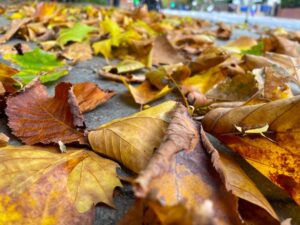
autumn leaves

Fireworks crackle in the darkness: yesterday’s Bonfire Night stretching to fill the entire weekend. The torrential rains have given way to an almost full moon, glowing cold-silver in the eastern sky. November is always a positive month, with the cosiness of a warm home as nights close in, various celebrations to anticipate and the frenzy of Term 1 lecturing having somewhat peaked as we start our downhill crash towards Christmas.

I have not written in a long time because work has been ruthless and all-encompassing, filling up every hour, even when I rise too early and retire too late in a vain attempt to wrest back control. Burning at both ends, my middle feels exhausted and sometimes only partially present. I scribble in my journal when I get a spare moment – a few swaying stops on the Underground, or a decadent five-minute break over coffee – but there is time for little else. A couple of snatched chapters of a novel, cuddles with my son, the 30 minutes of cardio exercise I prioritise over sleep each morning, my daily Duolingo lessons, half-hearted attempts to tame the feral garden before winter sets in. This weekend I managed to cook a hearty stew, bake a pie, play a Chopin Nocturne for fifteen minutes at the piano and put some narcissus bulbs into containers for forcing, but I worked many hours on various academic chores and face a soberingly long list come tomorrow morning. The clamour for my time never ceases; I just grimly slice off heads as ten more sprout back to take their places.

But things are exciting in the lab: I’ve recently got a few new grants, with some others submitted; we also have a number of papers in press, in revision, pending or in the final throes of preparation. Many people are asking to collaborate with us, from great labs all over the world, and that opens up new intriguing possibilities for the research. It’s stimulating and it propels everything forward. On the other side of my portfolio, the small cohort of medical students I’m teaching this year on my course are honestly a joy, and I feel very privileged to be able to work with such bright young people. So life is good, even if sometimes it borders on unbearably stressful.

I just have to keep going.

Posted in Academia, Domestic bliss, Gardening, Joshua, Research, Staring into the abyss, Students, Teaching, The profession of science, Work/life balance | 2 Comments

In which I cherish useless facts

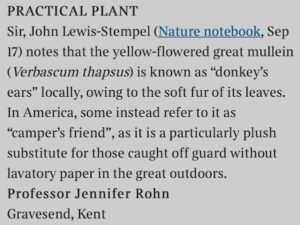
I’ve just had my first letter to the editor published in the Times (of London, that is, not of New York). It wasn’t an urgent missive about science policy or politics or the state of the world or the Queen’s death – just a little musing about a pretty weed that was one of hundreds of Ohio native plants and trees I studied in a botany class as an undergraduate at Oberlin College.

People sometimes ask me what good my Liberal Arts education did – especially as a scientist. It’s a particularly interesting question in the UK, where science graduates start specializing as children in school; after this, most undergo a heavily restricted three-year BSc degree consisting solely of modules about that science. As a result, they are taught little about anything else. Even normal high schools and undergraduate degrees in the US allow students to take a broad range of topics, so to a typical Brit, my even more expansive liberal arts degree seems completely bonkers. How have they benefited me, my years of Ancient Greek and Spanish, my modules in Ethnomusicology, Linguistics, Cultural Anthropology and the dozens of other modules I was required to take outside of my Biology major? I even got credits on my transcript for playing in the steel drum band and the Javanese gamelan ensemble and being part of the Ultimate Frisbee team.

I’m not sure it made me a better scientist, but I’m sure it made me a better person. The botany class where I learned about “camper’s friend” was run co-run by Dr David Benzing, an expert in epiphytes, and George Jones, a 90-year-old alumnus who led us around the local woods and fields collecting specimens and telling us stories about which plants had medicinal or edible properties. You had to keep on your toes – he was quick as a flash and would start talking as soon as he reached the specimen of interest, whether or not the gaggle of students had caught up with him. The class began in the depths of winter, when it was so bitter cold that we had to use pencils to take notes because the ink in our ballpoint pens would freeze. Our first exam was a series of one hundred different winter tree twigs, laid out on the lab benches, which we had to identify by genus and species only by inspecting the color, texture and bud-scar pattern. Much of university life has faded, but I can still see those twigs laid out on the scuffed black epoxy resin, and various still-frames of happily collecting leaves and blooms as winter finally morphed into spring. On one occasion, an angry farmer charged over on his tractor, gun aimed squarely at us. Dr Benzing blanched, but the girls of the party looked up at him with big imploring eyes, flowers in our hair, and the man finally cracked a smile and lowered his weapon.

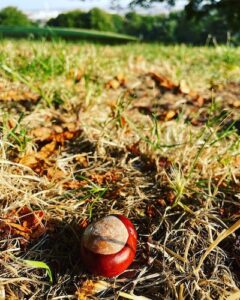
I have long since forgotten how to identify those one hundred Ohio trees, and am immersed in a different country with a different spectrum of flora. But as autumn deepens under golden sunshine and indigo-blue skies, I’m comforted by the familiar species of my youth: great mullein, yarrow, asters, the scatterings of horse chestnuts on the faded grass.

horse chestnut

Posted in Nostalgia | 3 Comments

In which climate apocalypse feels inevitable

Cover for the Ministry For the Future

A dystopian future is already mostly here

Here in England, we are braced for an historic heat wave. The Met Office has issued its first ever ‘Red Warning of Extreme Heat‘ for much of the UK, with temperatures set to reach a new record of 40 degrees C today. It hasn’t rained here for many weeks, and the grass is baked brown and tinder-dry. On the Met Office map, a sinister blob of scarlet spreads over otherwise orange terrain, and if you zoom out to the rest of the continent, it’s the same in many other countries. Wildfires burn in Spain, Portugal and France, and a number of people have already died.

Some of my America friends seem bemused that the Brits are panicking about mere 104 degrees F temperatures, but you have to keep in mind that we aren’t equipped for this. Even in slightly less intense heat waves, people die here. The vast majority of homes, and many offices, do not have air conditioning or decent insulation. A number of people commute by trains, whose tracks start to warp in extreme heat.

It’s a big deal because it’s not normal – though of course, sadly, it’s part of our coming new normal. A new normal that feels inevitable now. I consider my last trip to the beach in a car burning fossil fuel, and think: how strange/reckless/crazy/amazing will this activity seem to someone twenty years from now, a hundred, five hundred? When I write in my journal about my lush green garden, where I can wander out and pluck an apricot from a tree, will this seem like some sort of paradise lost?

Climate change, and how on earth we are going to fix it, is the subject of Kim Stanley Robinson’s latest novel The Ministry for the Future – a story that starts with a deadly heatwave in India and goes downhill from there for its characters. It’s one of those books that has lingered long after I tucked it away on a shelf. A strange sort of novel, it focuses on a governmental policy team in the very near future – 2025 – trying to turn around the planet-sized oil tanker of climate change using a series of incentives and punishments both small and large, ranging from global to intensely local. Being in uncharted territory, the team just throws whatever they have at the problem and sees what sticks. Nothing is off the table, not even government-sanctioned black ops and guerrilla manoeuvres. Although it’s like trying to fight a forest fire with a squirt gun, momentum gathers in interesting ways as the drama plays out over many decades. The main storyline is intercut with hundreds of vignettes, first-hand accounts of what the dying planet is doing to individual people all over the world. The picture slowly builds, blinding-bright sunlight splintered through a glass shard of narrative.

By the end, all you can think is: we might just be able to pull this off. But how to convince everyone else that we need to? Persuading others to read this book might be a good first step – a droplet against an inferno, perhaps, but someplace to start.

Posted in Policy, Science fiction, Staring into the abyss | 2 Comments

In which ‘Lab Lit’ escapes its little box

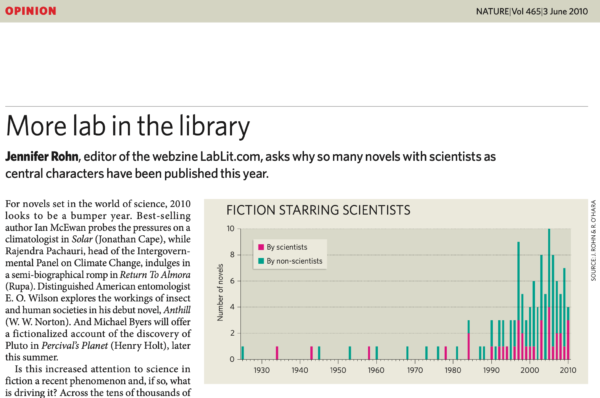
It’s been many moons since I published an article in Nature featuring my graph illustrating the apparent year-on-year increase in frequency of novels with scientists as central characters – or ‘lab lit‘. The trend had looked compelling, but coming from such sparse beginnings it was difficult to be sure, as the only way was up.

Increase in lab lit novels

The only way is up?

Twelve years on, is the trend holding up? You bet. Due to my hectic academic existence, I’m sadly more than a year behind in updating the database on LabLit.com, but I don’t need to run the numbers to tell you that this once-rare genre is rare no more. Years ago, my Royal Institution book group struggled to find titles to read each month; now we are spoilt for choice, with suitable novels coming out all the time. In due course I will update the graph, and I confidently expect it to show exponential growth.

Part of the trend has seen science transcend its ‘normal’ intellectual/arty/historical boundaries and invade territories that delight me. Case in point is the increasing frequency of the glorious mash-up of “chick lit” and “lab lit” – spawning deliciously awful back-cover blurbs such as, Jess Davis is a numbers genius, but when it comes to love she’s had to accept there is no magic formula (Christina Lauren, The Soulmate Equation).

two romance lab lit novels

Chick lit meets lab lit

And why not have a bit of romance in the lab? A lot of published lab lit has been, for want of a better description, terribly worthy and too esoteric to interest a wider swathe of people. But once your story has made you a Tik Tok sensation (as for Ali Hazelwood and The Love Hypothesis), you know your geeky cult classic fringe element is going mainstream.

And that’s all I’ve ever wanted.

Posted in LabLit, Writing | 3 Comments

In which I see the light

Viburnum

Viburnum x bodnantense, a winter-flowering shrub

I’m happy, and I don’t know why.

Usually I dread this time of year, the period between demobbing the Christmas tree and the daffodil-studded benevolence of mid-March. It stretches on endlessly, the dreary coldness, the frosts interspersed with rain that pools on pavements and hardly ever coalesces into snow, and above all the afternoon darkness, which on overcast days might as well be twilight.

Last year, my diary reminds me that I was resorting to ordering from flower catalogues to take the edge off – huddled in a chair with candles lit on a mid-winter evening, daydreaming about dahlias whose future blooms felt almost mythical. During this period, probably in late January, I was walking Joshua to school when I registered a deep, hyacinth-like spring scent. Looking up, I discovered a shrub I had never noticed before, spilling over the garden fence of one of the grand Georgian listed houses, its woody branches lush with pink bunches.

What seasonal misfiring could have coaxed such delicate flowers out into a world encased in a hard frost? This singular oddness made it easy to identify online: Viburnum x bodnantense, which blooms from November until March on purpose, not as an accidental aberration of climate change. (Apparently bees and other pollinators can over-winter in gardens, at least in this climate.) Of course I had to order one for my own garden in the hopes that it might cheer me up during midwinters to come, but that just added something more to the long list of things I was waiting for.

Well, that ‘mental health viburnum’ has been flowering for weeks out back this year, but for some reason, I don’t need it. I have been happy, more or less non-stop, since I hoovered up the brittle fir needles from the carpet on New Year’s Day.

It’s so out-of-character to have dodged the winter blues that I’ve been trying to work out why.  The weather is probably part of it – it’s been remarkably fair these past few months. I had a dig around the Met Office pages but couldn’t easily find the sunshine data I wanted. Fortunately Richard’s weather station, its shiny cups spinning tidily on the summerhouse roof like some steampunk NASA apparatus, could at least tell me about the rainfall. Sure enough, this January and February have been drier than any year since he started collecting data in 2018. It’s been so dry, in fact, that I’ve stopped checking the forecast before heading off to London, and have yet to be caught without an umbrella. What little rain we’ve had has tended to be overnight.

A graph of rainfall

But this is just quantitative data, dead numbers on a chart. They cannot conjure up the astonishing beauty of the mornings we’ve had. From the bedroom window, the dawn sky glows a million different shades, each morning subtly different from the last. Venus is tangled in the great sycamore tree lurking over the nearby park, as bright as an incoming aircraft against peachy or coral or golden streaks of cloud. To the left, there are a few minutes each day when the ships on the Thames far below glow like molten lava, until their moment in the sun is gone and they reclaim their drab grey.

Faraway ships on the Thames, set fire by sunrise

Atop Windmill Hill where I walk after dropping the boy at school, the sky changes further, so unique and lovely that my phone has filled up with portraits of the same horse chestnut trees over and over: the silhouettes never change, but each image is infinitesimally different in the colour and texture of its backdrop. I do my normal brisk circuit, puffing at the crest of the climb, crunching frost under my feet, sucking icy air into my lungs, greeting the same dog walkers, taking in the same maritime views of the flat silver ribbon of estuary below, yet it never once feels tired or overly familiar. I understand now that this formerly dreaded period is not a rigid stasis, but a subtly developing season-scape that you only notice if you are amidst it every day. Green shoots push up from the muddy earth, tree buds start to swell, the tenor of the songbirds eases and lifts, dog cherries bloom in the otherwise barren hedgerows.

photos of trees

The same trees, from different angles and days, January and February 2022

And there is light – acres and acres of light, so bright that it dazzles and spangles, colluding with the frigid air to make a tiny joyful headache deep behind the eyes.

I consider my pre-pandemic routine at this time of year. I would leave the house just after 6 AM, in darkness, work all day in a lab and office with no windows, slip out of the hospital around 5 or 6 PM into darkness again. The only time I could ever see the sun was on the weekends – when it was more often than not raining. Last year I didn’t have these routines, because of lockdown, but hadn’t started my morning walk routine, and in January, it was raining almost constantly. So maybe that is the simple answer: I’ve been starved of light.

Now Spring is nearly here: our garden blooms with hellebore, snowdrops, and the first crocuses and daffodils. It’s good to see them, but they slipped in without me realising they weren’t there. Because somehow, I’m not waiting for anything anymore.

Crocus

Joshua presents his first crocus of the year

Posted in Domestic bliss, Gardening, Nostalgia, Work/life balance | Comments Off on In which I see the light

In which I imagine a dystopian future

Book cover: Vital Signals

Despite my dedication to promoting the Lab Lit genre, I’ve always been an avid science fiction fan too. I admire how a good dystopian tale can transport you into a terrifying alternative future so convincingly that when you emerge from the spell, the relief of having escaped this fate (so far) can linger for days.

I felt a little bit like that after seeing the film “Don’t Look Up” (spoilers follow). It had its flaws, but the agonising run-up to the loss of our beautiful world – and then its terrifying execution – were so well portrayed that, weeks later, I’m still wandering around on my morning walks giving quiet thanks for the sky, the trees, the birds, and everything else we humans haven’t quite managed to ruin.

(As an aside, “Don’t Look Up” also had some nice lab lit qualities at the beginning. We see the world-weary astronomy PhD student clock into her telescope session, headphones on and utterly blasé – until she discovers the new comet. Then she claps her hands together and gasps with joy like a child. I think all scientists have been there.)

I’ve got a lot to learn about mastering the art of dystopian fiction, but I had the chance to practice when I was invited to take part in the anthology Vital Signals, from NewCon Press. Out on 25 February and available for preorder now, the collection offers visions of our potential future and draws attention to how science and technology might alter us as a species. There are lots of great authors in the collection and it’s been beautifully produced and edited.

I contributed to the “Disease” section of the anthology with a new story called “The Needs of The Few” (my early geeky childhood TV viewing showing through there). This short fiction imagines one possible extreme consequence of antibiotic stewardship, which is our current policy of not over-using the antibiotics that still work because we are running out of alternatives. The global antimicrobial resistance (AMR) crisis, predicted by Alexander Fleming back in the 1940s, is still a serious issue to this day and growing worse. The crisis was caused by flagrant abuse of these miracle drugs over many generations – taking antibiotics for non-bacterial illnesses, not finishing the full course of an antibiotic prescription, dosing livestock wholesale to prevent infection. Each inappropriate dose selects bacteria that are naturally resistant to the drug, and allows them to thrive and take over until inevitably, the drugs we have no longer work. Add to this the stalled pipeline of antibiotic discovery and the sheer difficulty of devising new ones, and you can see why stewardship is deemed necessary. This tenant means that all antibiotics, and especially any newly discovered ones, must be used sparingly and only when absolutely essential.

Stewardship is a very sensible policy in principle, and badly needed, but a rigorous, one-size-fits-all interpretation may deny people antibiotics who genuinely need them. I’m thinking in particular of people who suffer from chronic urinary tract infections that don’t register on the old-fashioned diagnostic tests, either because they are low-grade or because the tests themselves can be very insensitive. Many such people with genuine symptoms of infection are sent home from clinical consultations without a prescription, and continue to suffer, some so terribly that they cannot work, cannot leave their houses, cannot sustain a relationship – or, in some tragic extreme cases, cannot face living any longer. In this unfortunate situation, a disease with suboptimal diagnostics has collided with the idealogical force of a stewardship policy that is sometimes, in my view, too rigorously enforced.

But what, I wondered, would happen if the need for rigid stewardship suddenly became species-imperative? What if a deadly bacterial pandemic swept the world (I wrote this story before COVID19 came on the scene), and only one newly-discovered antibiotic could cure it? And what if you were a scientist who had dedicated her life to curing diseases, and had the means to break the law to help people with infections that weren’t “important enough” enough to risk treatment?

If you want to find out more, do pick up a copy.

Posted in LabLit, Science fiction, Writing | Comments Off on In which I imagine a dystopian future

In which I break through

Sometimes the things you fear the most aren’t as bad as the fear itself.

About two years ago, I gave my first media interview on what was then generally referred to as “the Wuhan coronavirus”. It was still three days before a case would be confirmed in the UK, so most people were thinking of it as a Chinese problem, remote and unthreatening, even the occasional punchline of British gallows humour. I’d already turned down a few approaches from Sky News when the press office twisted my arm, saying it couldn’t find anyone willing to speak out. We didn’t have any coronavirus experts on staff (that’s all changed now, of course, after diverse scientists from multiple disciplines rolled up their sleeves to expand their research questions), but they’d used me in the past for other infectious disease news items and were keen to get the university front and centre in what was shaping up to be a very large story. As I had a PhD in virology and a broad background, it seemed harmless enough as a one-off favour.

Jenny on TV

First coronavirus media appearance – before I invested in better AV equipment!

But within a week, I’d given a dozen interviews and was rejecting scores more – they flooded in by email, text, landline, FaceBook and Twitter, until I eventually switched off my phone in despair. It would stop eventually, right? Soon, however it became clear that, unlike all the other topics on which I’d commented, the answer was no.

Fast forward to today, hundreds of interviews later, and I look back on it all from this unusual perspective: the meta-COVID perspective. Whenever I prepare for an interview, I do a lot of research, filling up a few plain A4 sheets with scribbles that I try to memorise before going on air. Every once in a while I stumble over these sheets in the scrap paper pile, or find Joshua drawing on one. They are ephemeral time capsules about a quickly moving target, and I marvel at how obsolete the information is. All those pressing questions, long since answered, even though at the time they seemed so raw and perilous. Will the epidemic reach Britain? Will the epidemic, now arrived, get out of control in Britain? Will many people die? Will coronavirus come back in the winter? Will we need to go into a second lockdown? Will any of the vaccine candidates work? Will the vaccines we’ve bought be enough to end the pandemic in 2021? Will omicron send us back to square one, or herald the beginning of the end? I now wish I’d saved all these notes in chronological order, just so I could remember what we knew when. But of course you never realise you are living through history until you are looking back.

Despite my highly detailed knowledge about the twists and turns in the pandemic story, it was all still rather abstract back in December. But this was soon to change. A few days after my last stint in the lab before the Christmas holidays, I was congratulating myself on having avoided omicron, even though it was already cresting over the capital during my last few commutes on the crowded, largely mask-less Underground. I was quite worried about it, in a way that hadn’t really gripped me before. In this particular snapshot in history, all we knew was that omicron spread like the clappers, but its severity was still an open question. We did know that even people with a booster vaccine dose, like me, could still be re-infected, but we still didn’t know whether it would protect against severe disease. So I traveled around for over two weeks in this knowledge limbo, trading in my cloth mask for an FFP2 and hoping for the best.

A few days before Christmas, I developed a scratchy throat and eventually some congestion, sneezing and fatigue. None of my symptoms were on the allowable list for a PCR test, but I knew from my media research that omicron had a different spectrum and was more or less indistinguishable from the common cold. (One of my time capsules sheets from that period states “one in two cold-like illness in London is actually omicron”). Still, the lateral flow tests, based on a nasal swab, kept coming up negative. By Day 4 of my “cold”, I’d seen a lot of social media chatter about omicron coming up more easily, or earlier, when a throat swab was taken. As the first LFD kits had been combined tonsil/nasal swab-based before the nasal-only ones were phased in, I knew the correct way to sample the tonsils, so I tried it out in the spirit of scientific research, alongside a test swabbing the approved way (nostrils only). The throat sample came positive straight away, an alarming red line that coalesced as soon as the fluid flowed over the test area, while the nasal swab came back negative. A PCR test taken later that day confirmed the positive result.

Two years after those first Wuhan reports, I was SARS-CoV-2 positive. I wasn’t talking about the news: I was the news – especially when my tweet about throat vs. nasal swabbing went viral. (I’m relieved to see that this anecdotal report, one of thousands, is now backed up by actual data.)

How did I feel about joining the COVID club at last? The oddest thing was the overwhelming sense of relief. Although it was always possible that my illness could take a turn for the worst, my time capsules started recording reassuring data about omicron’s severity, first from Ground Zero in South Africa, and then in the UK. Risk of hospitalisation was slashed. The T-cells were mobilising even thought the antibodies were failing. The virus itself was intrinsically less able to replicate in the lungs, preferring the loftier expanse of the bronchi and the nasal passages, where it was better at transmission but less able to cause bodily havoc. I felt terrible, but my cough didn’t get worse; my oxygen saturation levels remained at 96 or above. I was one of millions of people in the UK (up to one in ten in London alone, says Wednesday’s time capsule) with prior immunity coming to the realisation that this particular variant of SARS-CoV-2 was manifesting as a bad cold. I was going to make it. I’m still concerned about how the already struggling National Health Service will survive the coming weeks and months of onslaught, and about potential longer-term effects of infection, but – at least for the moment – I don’t need to worry about catching COVID again myself.

Is this really the beginning of the end for the pandemic? Many people think it is. Others aren’t so sure. With so much of the world unvaccinated, new variants still have the space to breed and ferment. In line with my usual meta-COVID stance, I’m waiting for more data before I form an opinion worth sharing. But my own little COVID story feels like it’s reached a happy ending of sorts – at least for now.

Posted in Epidemics, Media | Comments Off on In which I break through

In which pandemic storm clouds gather – again

A hillside with trees

A number of months have slipped past since I last wrote here, two seasons under the bridge as my ramped-up academic life has consumed most of my free time. Then, it was the height of optimistic summer; now, the year trundles toward its endgame, short days of chill air and bright sunshine, followed by long nights under an icy-sharp moon. And all of it has been overseen by the ongoing pandemic, waxing and waning in neatly printed daily oscillations on infographic charts, lulling us into a sense of false vaccinated security over the warm months and now, poised to rain down on us all like poison from the heavens, blind and unrelenting.

We can’t cope with another year like this,” the journalist Janice Turner lamented in yesterday’s Times, chafing against further restrictions. But the virus neither knows nor cares what we think: it simply gets on with the job: surviving long enough to reproduce, just like everything else on our planet that harbours greedy genetic information. It was the same in the lightning-struck, acrid primordial soup of 3.6 billion years past as it is today. We, the alpha species, can send people into space, but we can’t (yet) fight evolution.

And maybe it’s not us who are the alpha species after all; perhaps it is the microbes who inhabited this world billions of years before we swaggered onto the scene. Behold the mighty, big-brained humans with their smartphones and over-engineered cars, felled like harvest grain by a microscopic entity with only a dozen genes. When the host species conveniently failed to care enough to vaccinate the entire world effectively, the virus did what all the scientists predicted: it exploited pockets of neglect to mutate into the magic combination that now appears can evade even fully vaccinated people’s immunity. It turns out that sometimes doom and gloom scaremongering is not just a recreational pastime, a performance piece by ‘experts’ designed to ‘curtail our liberties’ – it is simply speaking the truth. And now we are almost back to square one in developed nations (and even worse off everywhere else).

Living through history is difficult: sometimes I can see the forest, and other times it’s all trees. On days that I don’t commute into the lab, I take the long way home after dropping off my son at school, trudging up to the top of Windmill Hill with its spectacular view of the Estuary Thames as it winds past the Port of London Authority, flanked by Tilbury Docks. Great seagoing vessels pause there awhile on their journeys, dwarfing the warehouses, rooftops and church spires while themselves dwarfed by the giant wind turbines dotting this serpentine zone of grey industrialisation. The morning skies have been streaked with lilac and coral, setting off the skeletal reticulated silhouettes of the horse chestnut trees. With breath fogging and fingers numb inside gloves, frosted grass crunching underfoot, the raw air reminds me of the fact that I am alive, that neither me nor my family has been rendered seriously ill, that I still have a job and plenty of money to live comfortably.

I think how the pandemic has reshaped some of the patterns of my life. In the Before Times I would never have dared to spare fifteen minutes out of my busy morning to clear my head and remind myself that there is a world outside of my work. I wouldn’t be so in shape if lockdown hadn’t encouraged me to get more serious about keeping fit, a habit that I now carve out time to maintain. And I’m eating healthier food, and trying to spend more time with my family, and I live in an almost perpetual state of thankfulness for all that I have.

Small boy with Xmas tree

Leading an undergraduate intercalated BSc course and revamping it almost from scratch has been challenging and rewarding, but it killed my summer and turned my autumn into a blur of stressful deadlines, one after the other in a relentless assault. Yet because of my enhanced pandemic perspective, all I can be is grateful. This will pass, and Britain may lock down once again, but Christmas will come and my family will be together.

This weekend, we bought a Danish fir tree and have taken down all the old boxes from the loft – more tape than cardboard by now and lined with newspapers bearing decades-old headlines (in both English and Dutch) – containing the precious family ornaments and relics. These, and the annual rituals, give us continuity, binding together our history with that of our families past. Richard ferments the eggnog and makes homemade mince pies and sausage rolls; Joshua and I bake the julpepparkakor and play four-handed carol duets on the piano. I fashion wreathes from fir offcuts and sprigs of holly and ivy from the garden, and bring out the narcissus bulbs I’ve been forcing in the garage. We light candles against the darkness and hope for better days – but the days we have together already are almost too good to be true.

Posted in Academia, Domestic bliss, Epidemics, Teaching, The profession of science, Work/life balance | 1 Comment

In which academic dreams come true: a belated professorship

Lab scene

I have wanted to be a scientist since before I can remember.

I did all the right things: I studied hard, finished my homework, raised my hand in class, failed to hide the fact that I loved learning, even though the other children teased me for it – and worse. (Those Hollywood movies about the cruelty of the American school system? It’s all true.) I didn’t care. I was going to become a scientist one day, even though no one in my family had ever earned a PhD, and even though I had never met any scientists, let alone a female one. I’d only encountered them on the page, in the novels I devoured, teetering-library-stackfuls at a time. These characters were heroic and colorful, leading the sort of exciting lives that seemed so far away from suburban existence in small-town Ohio.

I was going to be a scientist one day, even though I constantly received pushback: the well-meaning high school guidance counsellor who suggested that nursing might be more “appropriate”. The male senior researcher in a summer lab internship at the National Institutes of Health who sneered that women made terrible scientists, and convinced the boss to redirect me from experiments to photocopying journal articles for him. Years later as a postdoc, the lab heads who told me I wasn’t cut out for academia because I had outside interests in writing, public engagement and activism. I’m sure they thought they were being kind, doing me a favor. Tough love.

Every time I hit setbacks, or I was told I couldn’t do it, I tried harder. At university, when I couldn’t get a lab job, I got a part-time position scrubbing shit from mouse cages, just so I could wear a white coat and be closer to action. In senior year when I didn’t get into any of the biomedical research labs for my Honors project, I persuaded a new group leader to let me work on plant genetics. Even that NIH internship didn’t happen straightaway; the summer before I’d papered my CV all over the Bethesda campus, but the only job offer I received was in the Health and Safety department. I took it anyway (and had a blast, teaching myself C from Kernighan and Ritchie and doing all sorts of bizarre odd jobs with my newfound programming skills).

The very worst set-back of all was after such a promising start – a PhD from the University of Washington, a postdoc in a prestigious London lab and a group leader position in biotech – it all unravelled in just a few months. The biotech bubble burst, I was made redundant and was on the dole in Amsterdam. The few interview offers I did receive dried up after my unemployment was official, and I was forced to go into scientific publishing to put food on the table. I don’t regret this now, as I learned a tremendous amount during those times. I wrote novels, I started a freelance writing career that continues to this day, I helped launch new journals, I found out what I was made of. But at the time it was devastating, and for several years afterwards I suffered from depression and a complete lack of self-confidence. Being a scientist had become my identity; now that had been stripped away, what was left?

Of course you all know how the story ends. I made it back into academia eventually, even though it took years to find my true calling. Re-starting a scientific career with no prior line of research to build on, in a new discipline where you don’t know anyone and no one knows you, is a very lonely business. For me, the worst was the sensation of having been left behind. First it was seeing postdocs with whom I’d shared a lab become professors. Then it was PhD students I’d supervised. I knew I was swirling in the dust when the PhD student of a PhD student I’d supervised became a professor too. When I ran into such former colleagues at conferences, I always felt awkward and embarrassed, even though I was sure they weren’t aware of how lowly I felt, and wouldn’t have dreamt of judging me. To them, I was that interesting person who’d published novels and organized a memorable political demonstration. But inside, I was the failed scientist who didn’t even have a permanent position, who was surfing, hard and desperate, on a wave of rolling short-term contracts, who was kidding herself, who wasn’t doing justice to the second chance she’d been given. I even allowed myself to be bullied on several occasions because deep down, I thought I deserved it.

Fast forward to today, a full fifteen years after re-starting my academic career. It is only now that I finally feel like I belong, and deserve, to be running a lab. I lead with a light but steady hand, confident in my choices; I have a clear scientific vision; I am respected in my new field. I play a pivotal role in the university. It hasn’t always been smooth sailing – a shocking and protracted incidence of collegial abuse a few years ago nearly threw me back into that roiling surf. But I got through it, and kept my head above water, and now I know that such terrible things happen all the time, but the trick is not to let those incidents define you or undermine your confidence or sense of self. The perpetrators are to be pitied, not feared or hated, and one day they will undoubtedly reap what they sow. Meanwhile, it strengthens my resolve to never be the sort of person who seeks to advance themselves by treading on others; to break the cycle of abuse by refusing to be bitter or changed; to encourage my trainees to shine brightly, to become their best possible selves.

Earlier this month, I found out that my promotion bid had been successful, and that from October I will officially be known as Professor Rohn. After all the heartache, obstruction and deviation, it seems almost unbelievable. I think this is why it took me so long to process the information enough to write about it. Somewhere inside me, a young girl is still scrubbing rodent poo from hundreds of cages; as she walks the corridors on her way out, tired and back-sore, she is peering into the brightly lit labs to the left and right and wondering what it would feel like to belong to one of them. But the long-dreamt-of moment has finally arrived. I survived. I made it.

The other day, on a whim, I looked up the sneering senior scientist online and found that he’d vanished without a trace from PubMed within ten years of our encounter.

Yet I am still here. In fact, I’m only just getting started.

Posted in Academia, Careers, Nostalgia, Research, Staring into the abyss, The ageing process, The profession of science, Women in science | 5 Comments