Science in your pyjamas: bliss
What’s the youngest a person can be exposed to science in a meaningful way? Loyal readers will know that I’ve pondered this question before, especially since becoming a mother.
The other day a colleague told me that his four-year-old grand-daughter had expressed firm interest in “being a microbiologist when she grew up”, and could she and her mum come and visit me in my lab some day soon? Of course I agreed, though I wasn’t really expecting much. I duly arranged a risk assessment and permissions, and then asked one of my students to prepare some pretty slides that were at least visually striking, even if what they showed might be beyond the capacity of a four-year-old to grasp.
When the day arrived, I was confronted with a firebrand of a little girl, eyes fiercely inquisitive. In lieu of a teddy, she was clutching two soft Giant Microbe toys, which she shyly held out to me for approval: a smallpox virion and a T4 bacteriophage. I revised my expectations considerably right there and then.
My student was brilliant, explaining everything in a friendly and simple way as the girl was hoisted up onto the tall stool. It has to be said that at first that our pint-sized guest seemed a lot more interested in the swivelling mechanism of the stool, but eventually we managed to engage her with what was happening down the oculars: bright green bladder epithelial cells coated with a liberal sprinkle of neon-blue bacteria, and the wonky looking leukocytes that were coming to the rescue. As she and her mother took turns ooh-ing and ah-ing at the various slides, I got the impression that she was grasping at least the basic idea of cells under attack.
When we’d finished with the scope demonstration, her mother produced a hand-written list of questions that her daughter wanted answers to:

I was quite surprised at the complexity of some of these, which I answered as best I could in a way that she was likely to understand. I didn’t ask, but I wondered what sort of content and education she had been exposed to elicit this list.

My own son, a year older, knows all about “mama’s germs”, but is very interested in the physical world and how it all works. I’ve told him about the water cycle on Earth, in which liquid from the seas evaporates into the air, forms clouds and eventually rains back down to start the cycle anew. The other day he asked me whether rain was salty like seawater.
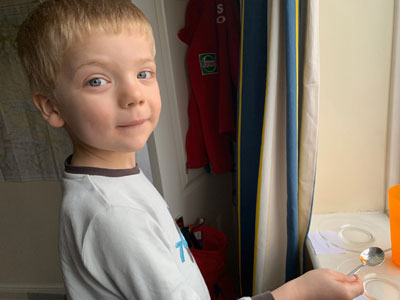
It was a good and understandable hypothesis, but I explained that salt was simply too heavy to float up into the clouds along with the water vapor. He seemed skeptical, so I decided that a little experiment was in order. I asked Joshua to dissolve a large amount of table salt into a cup of water. He then spooned the clear liquid onto a glass plate, which we put on the sunny windowsill of his bedroom.
“But mama,” he said. “Aren’t we supposed to have the second thing…the thing that is the different thing?”
The control! How embarrassing to have to be reminded. And it made sense, as our tap water probably has some mineral content that might – literally – cloud the analysis. So we set up a second glass plate with plain water, labelled them, and left them for a few days. I warned him that it might not work – the most valuable science lesson of all, in my view.

Fortunately, the experiment went off beautifully. Once dry, there were a few grainy smudges on the control plate, but the experimental plate was loaded with fat salt crystals, left behind for the big journey to the sky.

Joshua was entranced. This experiment was dead easy to perform and understand, but I don’t think activities like this are being put on at school at his level. They’ve already done the vinegar and baking soda volcano, and have been asked to draw the solar system, but I wonder why they don’t get exposed to the art of posing a question and working out how to answer it. Because what could be a more effective lesson about science at this age, when asking how and why are so imperative?