The Young Atheist’s Handbook by Alom Shaha

Don’t be misled by the title: this is a book about love. Love for life, love for family and love for curiosity, which leads — circularly — to a love affair with books.

Don’t be misled by the title: this is not a handbook. At least not in the sense of being a manual or guidebook for atheists. Rather Alom Shaha, a physics teacher who was born in Bangladesh and raised as a muslim in south-east London, has written a completely candid account of his life and his journey from religion to atheism. He bares his soul to reveal that he has not found one within himself.

The Young Atheist's Handbook

The Young Atheist’s Handbook is moving and insightful. At times Alom’s story is raw. With an unflinching eye he examines how his experiences, especially in his early life — the untimely death of his devoted mother, the brutal punishment at the hands and belt of his neglectful father, the inspiration of his teachers and his own encounters with students in his physics classes — have shaped his world view. As he recounts the story of his journey away from Islam, a religion that he entered through an accident of birth, he reflects on the profound questions that occur time and again to young people who amass the courage to question their faith, the questions of free-will, of motive and morality, of evil, of heaven and hell, of life after death.

These questions are explored with a determination that is at the same time respectful and firm. The author strikes a modest tone that I am sure will draw readers in, even if, as people of faith, they find the text uncomfortable.

The book leans on extensive reading. It feels solid but is not trying to be scholarly. Theologians and professional apologists for religion may take issue here and there but that would, in a way, miss the point. This is the story of someone who is on a personal journey and makes no claim to have all the answers. As he writes towards the end of the book:

If you’ve noticed the occasional bouts of confusion, contradictions, flawed logic, or misinterpreted ideas, well, they’re there because I am a flawed individual, confused and contradictory. I put these shortcomings forward unashamedly because my final thought is this: none of us is perfectly rational, none of us is in possession of all the possible facts, and none of us is free of beliefs based on irrational foundations.

The Young Atheist’s Handbook is truly a gem of a book; it’s lucid prose shines with feeling and wisdom. It has the substance to endure.

Don’t be misled by the title: the book was written for young people but it also deserves to be read by young people who have grown up.

Alom Shaha's book launch

Robin Ince (right) interviews Alom Shaha at the launch of his book.

Declaration: I am a friend of Alom Shaha and was delighted to be able to attend his book launch on 10th July with my teenage children.

Posted in Book Review | Tagged , , , | 6 Comments

The Entrepreneurial State by Mariana Mazzucato

This is not new since Mariana Mazzucato’s breezy pamphlet, The Entrepreneurial State, was published a year ago, but it was new to me. I’ve just finishing reading it, having snagged one of the copies that she brought to June’s fascinating Science Question Time on economic growth.

The Entrepreneurial State

The Entrepreneurial State is a welcome addition to the debate on the value of public investment in science as a factor in economic growth because it opens up what was for this reader at least a relatively uncharted dimension of the argument.

The case for public spending on basic R&D is taken as read. Rather what Mazzucato is keen to address is the role of the state in enabling research discoveries to be developed into new products and even, in the most influential cases, new markets. Rather than simply charting the well-known anecdotes of blue-skies research leading to successful businesses (admirably covered in the 2010 Royal Society Report, The Scientific Century), this short book aims to dissect how that process happens most effectively.

In particular, drawing largely on examples from the US, it addresses head-on the claim that the vitality of private companies and venture capitalists is largely responsible for the successful commercialisation of scientific research. Instead, contends Mazzucato, it takes a visionary, risk-taking state to make the long-term investments needed to join up science with enterprise.

I won’t rehearse the arguments; it is easier and quicker to quote the conclusion:

A core lesson of this pamphlet is the need to develop a new industrial policy which learns from the past experiences in which the state has played a leading, entrepreneurial, role in achieving innovation-led growth. State-funded organisations (mainly decentralised ones such as DARPA*, SBIR* and so on) have been fundamentally involved in generating radically new products and processes, which have changed the way that businesses operate and citizens live—transforming economies forever, from the internet revolution to the biotech revolution to what (it is hoped) will be the greentech revolution. It has also been argued that a core way to tackle smart and inclusive growth together is to ensure that the gains from innovation are just as collective as the risk-taking underlying it is.

In seeking innovation-led growth, it is fundamental to understand the important roles that both the public and private sector can play. This requires not only understanding the different ecologies between the public and private sector, but especially rethinking what it is that the public is bringing to that ecology. The assumption that the public sector can at best incentivise private sector led innovation (through subsidies, tax reductions, carbon pricing, green investment banks and so on) — a claim being propagated heavily in the UK, especially but not only in the face of the recent crisis and ensuing deficits — fails to account for the many examples in which the leading entrepreneurial force came from the state rather than from the private sector.

Or you can read a synopsis that Mazzucato wrote for the New Statesman.

I found it an engaging read, but the thesis advanced in The Entrepreneurial State may be uncomfortable for some scientists since it emphasises the role of mission-oriented direction of funding (albeit in a decentralised form via agencies at arms length from government). Science Minister David Willetts has clearly read the pamphlet because he referred to it in his policy speech from Jan 2012. At the time — without realising its source — I noted a shift in thinking towards a more directed policy where government would target technologies for investment.

That may sound a bit too much like the impact agenda writ large. For now, it is not clear whether the message has really been taken on board; it still seems as if Osborne’s austerity plan trumps any grander vision for the future (a view shared by the Science Question Time panel). But the scientific community has to be smart enough to engage with the technicalities of this debate, especially in the run-up to the next Comprehensive Spending Review when the case will have to be made once again for the science budget.

In preparation for that, you could do worse than read The Entrepreneurial State, which you can download it as a free PDF. You might also want to consider coming along to the Science is Vital AGM in September, where the funding challenges that lie ahead will be discussed.


*DARPA – Defense Advanced Research Projects Agency; SBIR – Small Business Innovation Research. Both are US government agencies with broad remits to foster the development and commercialisation of new technologies.

Also well worth reading on the topic of innovation and government policy is Richard Jones’ Soft Machines blog.

Posted in Science & Politics | Tagged , , | 6 Comments

Open Access by Peter Suber

There has been a fairly torrid debate over open access over the last six months (even longer for aficionados). For people who look in only occasionally it must seem like a storm that swirls around the same arguments time and again. This jargon can be problematic — open access is variously green, gold, gratis or libre — and is wrapped around a complex tangle of issues of freedoms, responsibilities, costs and opportunities that are debated passionately by advocates on both sides*.

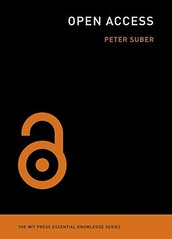
Open Access by Peter Suber (cover)

Cutting through this noisy argument is Peter Suber’s short book on the topic, which has just been published by MIT Press. In the ten brief chapters of Open Access he works his way through the definitions, the history, the economics and the implications of changes to the landscape of research publishing. The text is thorough, clear and measured.

Suber has deliberately kept things brief. He is a man with a mission:

“I want busy people to read this book. OA benefits literally everyone, for the same reasons that research itself benefits literally everyone. OA performs this service by facilitating research and making the results more widely available and useful. It benefits researchers as readers by helping them find and retrieve the information they need, and it benefits researchers as authors by helping them reach readers who can apply, cite, and build on their work. OA benefits nonresearchers by accelerating research and all the goods that depend on research, such as new medicines, useful technologies, solved problems, informed decisions, improved policies, and beautiful understanding.

But OA only does this good work insofar as we actually implement it, and the people in a position to implement it tend to be busy. I’m thinking about researchers themselves and policymakers at stakeholder institutions such as universities, libraries, publishers, scholarly societies, funding agencies, and governments.”

I downloaded the Kindle version and worked through it in a couple of days’ commuting. I’d like to recommend that you do the same. Suber does a wholly admirable job of unpicking the complexities of open access and we’ll get there sooner if more of us are able to engage properly with the matter.

 *Update (5-7-12; 10:57 pm): Some interesting recent contributions to the debate have come from Keith Jeffrey (STFC), Stevan Harnad, and the Wellcome Trust.

Update (18-6-13): And now, true to his principles, Suber has made the book open access you you can download it for free.

Posted in Book Review, Open Access | Tagged , | 20 Comments

Open Access: Who Pays the Copy-editor?

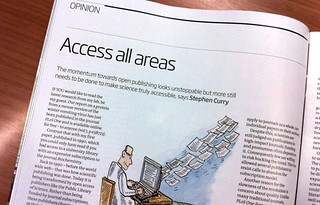
My article on open access in the New Scientist provoked an email from copy-editor Miranda Potter. Starting from the article’s mention of my recent paper in PLoS ONE, she raises the question of who is going to pay for copy-editing services if the drive to OA is accompanied by downward pressure on price (the $1350 fee I paid to the journal did not include any provision for copy-editing).

This re-ignites some of the arguments about quality that were discussed in my post on PLoS ONE, but it is an important topic so I was glad that she agreed to allow me to post her email here. Please feel free to respond in the comments.

From: Miranda Potter
Subject: Open access publishing

“Did part of the fee that you paid to the open access journal go to a scientific copy-editor, so that you received a high-quality proof for comment and correction? Regardless of whether papers go through the review process, I have yet to see a paper that could not be improved upon by the services of a native English-speaking, highly qualified copy-editor.

The reviewers have many tasks and cannot possibly be expected to copy-edit every poorly written article. These roles are very different; the reviewer is a specialist in the subject area, whereas the copy-editor is a generalist who spends their time reading many scientific manuscripts, sometimes in very different fields. The reviewer should have sufficient in-depth knowledge to be able to provide constructive critcism of the scientific issues presented and help the authors to ensure that their article is high quality.

In contrast, the copy-editor ensures that the final article conforms to journal style, which is a more mundane, technical role. More importantly, the copy-editor reads every word of each manuscript and helps the authors by ensuring that any little glitches that the reviewers don’t have time to spot are picked up before the article appears in press, thereby preventing embarassing errata. You will find that for the journals with higher impact factors, the copy-editors will check that every panel of every figure matches its description both in the main text and in the figure legends, right down to the last asterisk. In fact, you would be amazed at how many meritorious authors cannot even manage to spell the names and addresses of their colleagues correctly.

I’m sure you’re aware that a paper written by a native Spanish speaker is likely to use a very different English linguistic style from one written by a native Polish or a Japanese speaker. If left without copy-editing, such papers might be very difficult for the worldwide readership to understand. I’m afraid there is a reason why scientific writing tends to be rather dry and structured in a certain way; it facilitates general comprehension. Isn’t that the most important thing?

If journals/authors opt out of paying for copy-editing services, I fear that science published directly on the Internet may degenerate into international gobbledegook and lose credibility. Who will stand up for the scientific copy-editors of the world?”


Posted in Open Access | Tagged , , | 20 Comments

An Eye for an Eye

I have the feeling that there have been too many words on this blog of late. I need a break and wonder if the beleaguered reader does too.

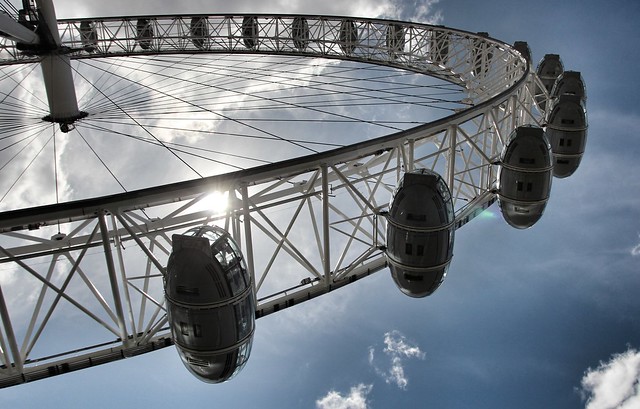
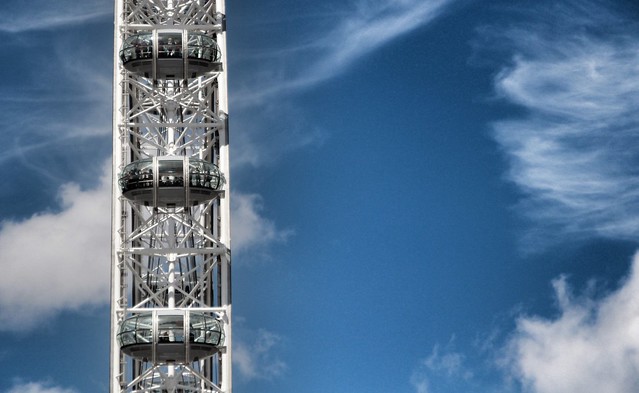
Since I happened to be in the sunshine on London’s South Bank yesterday and have a soft spot for the London Eye, rather than torment you with yet more words, I thought I’d give you an Eye-ful.

London Eye 3

London Eye 4

London Eye 2

Posted in Fun | Tagged | 4 Comments

Finch Report: the question of costs

Last week, having quickly digested the executive summary of the Finch Report on open access (OA), I told you it was complicated. I’ve now read the report in its entirety, along with a large swathes of blogospheric commentary. I’m still decidedly of the view that it’s complicated but I wanted to think through some of the initial responses. In particular, I’d like to try to address the vexed issue of costs.

There are positive elements in the report, as I have already noted. It was warmly welcomed by science minister David Willetts and the Publishers Association, but elsewhere the reactions have been cooler. For a sampler, have a look at Cameron Neylon’s thoughtful commentaryStevan Harnad‘s trenchant critique, and accounts of the concerns of repository managers, RLUK and universities such as UCL.

In the main, there are two features of the report’s recommendations that have caused most disappointment.

The first is the lack of clear support for subject or institutional repositories as a vehicle for green OA. By this route papers published in subscription journals can be made freely available. It’s a compromise because the version of the paper that is placed in the repository lacks the professional formatting provided by the journal and typically can only be deposited 6-12 months after publication; these conditions are designed to allow the publisher to recover costs.

The green route is popular among advocates of open access because it is inexpensive to authors and has been taken up by many more of them than gold OA. In the UK about 35% of papers are published by green open access, while only 5% go down the more expensive gold route, where payment of an author processing charge (APC) of $1000-$5000 enables the paper to be made freely available upon publication. However, rather than promoting this access model, the Finch working group suggests that repositories should be developed more as places to archive research data and to grey literature (reports, working papers, PhD theses etc.).

The second disappointment is the high estimated additional costs that the report judges may be required to manage the transition to full open access by the gold route. Commentary has fixated on the recommendation that an extra £50-60m per year be found from public monies to cover transitional costs. This looks like an extraordinarily heavy price, especially when you consider that the total annual cost of OA charges and subscriptions to academic institutions in the UK currently runs to about £175m. The problem is exacerbated because the working group can give no clear indication of how long the transition might last.

These are serious difficulties and have been raised by serious people. But I don’t see them as insurmountable.

While green OA may be cheaper to authors, it is far from perfect. In its current form, green OA does not necessarily guarantee text and data mining rights. Moreover, some publishers resist deposition in subject-based rather than institutional repositories, a barrier that tends to fragment the literature and thereby creates its own barriers to access. But in the long term there is an even bigger problem with green open access: it is likely to become the victim of its own success.

Green OA is sustainable at present because repositories aren’t good enough to pose a significant threat to publishers’ subscription revenues. Institutional repositories are relatively hard to find because their collections are not indexed by PubMed (though Google Scholar can help) and their contents are patchy, in no small part because of unreliable support from authors unaware of the facilities for deposition that their institutions provide.

My guess is that publishers like it that way; it’s better for business. But if with proper development repositories were to emerge as the go-to place for the research literature, they would soon start to hit sales of subscriptions and thereby undermine the journals on which they rely for the organisation of peer review.

This is a conundrum from which there is no easy escape, at least not by the green OA route alone, which to my mind explains why the Finch working group has opted for Gold OA as the primary route for enhancing access.

Such a strategy can only work if the price is right. The working group’s estimate of a £50-60m surcharge every year during the transition includes £38m to cover APCs, which they suggest should come from higher education and research budgets. This level of excess cost hasn’t gone down well at a time when budgets are already under severe strain; Harnad sees the Finch figures as a wanton gift publishers.

But the preoccupation with the headline figure has obscured the real issue with these costs: they are stunningly imprecise.

Let’s look at how they were worked out. The £38m estimate is derived from a projection that is midway between optimistic and pessimistic forecasts for how the move to OA will pan out; the projections take account of possible variations in APCs and in the relative speed of adoption of OA in the UK and the rest of the world. The optimistic scenario (lower APCs and faster uptake in the rest of the world) has a predicted transitional cost of £0 (yes, zero — there might even be savings), whereas a pessimistic assessment suggests the costs may be closer to £70m (see paragraphs 7.22, 7.23 of the report).

That’s quite a span. It may be larger still since working group has made no assessment of whether the subscriptions currently charged by publishers represent value for money. As has been made clear here and elsewhere, the 35% profit margins earned from research publishing by the likes of Elsevier are indicative of a market that is insufficiently exposed to the heat of competition. (Nor do they sit well with a business model that relies to a large extent on authors and reviewers providing their work for free).

Within that combined imprecision it seems to me there is scope for the government to make gold OA work cost effectively as it looks to formulate its policy from Finch’s recommendations.

Although Harnad has expressed the hope that the UK might ignore the report, I see in it an opportunity that might well chime with the government’s natural inclination to apply market forces to extract value for money. It is already clear that the disruption of academic publishing caused by internet-propelled moves to open access has yet to play out completely. As the Finch report itself acknowledges, the transfer of costs from subscriptions to APCs should create a more transparent, more efficient market.

The government has to pick up on this. Dare I suggest that it could influence the market by deliberately limiting any funds made available to cover transition expenses? Further downward pressure on costs can be made if the government reiterates that the Research Excellence Framework should be blind to impact factors, which are expensive and increasingly of questionable value, and by demanding that future REFs will only consider papers that are open access. The government, and the scientific community, will also have to work hard to roll out OA across the world; there are encouraging signs that this is already happening.

David Willetts has my sympathy as he grapples with the tortuous detail of the Finch report. It is complicated. But I hope he knows that it offers him the chance to make a real difference to the accessibility of the research literature, and the value that can be extracted from it.

Posted in Open Access, Science & Politics | Tagged , , , | 31 Comments

Rubicon

This is a big deal for me: my first ever article in New Scientist – a magazine that I read in the library in Ballymena as a teenager. Pardon me for preening a little.

New Scientist Jun2012

What’s it about? You guessed it: open access.

My thanks to Simon Singh for suggesting that I pitch it to them.


Posted in Blogging, Open Access, Science & Media | Tagged , | 13 Comments

The Finch Report on open access: it’s complicated

A committee set up by government was never going to foment a revolution. And so it has proved to be. The recommendations of the Finch Report released today mark a cautious, measured step in the right direction, but it is nevertheless a significant one.

The Finch committee was set up by science minister David Willetts at the end of 2011 and charged with examining “how to expand access to the peer-reviewed publications that arise from research undertaken both in the UK and in the rest of the world; and to propose a programme of action to that end.”

I have had sight of the report for the past few hours on a busy day and so have only been able to quickly digest the executive summary. It may give you some idea of the complexity of the issues considered if I tell you that the summary runs to nine closely typed pages.

It starts out promisingly, recognising that although established modes of publishing have served science well for a long time, “the internet has brought profound change across all sectors of society and the economy, transforming interactions and relationships, reducing costs, sparking innovation, and overturning established modes of business.” This, the committee recognises, has wrought a cultural change in scientist’s relationship with information. Simply put, we want better and faster access. And the public deserves better access too. Perhaps the most important statement in the summary enshrines the key to the ongoing debate:

“The principle that the results of research that has been publicly funded should be freely accessible in the public domain is a compelling one, and fundamentally unanswerable.”

That sounds like an excellent starting point. But the committee has had to grapple with the complexities of the associated issues, which have been rehearsed here and elsewhere in recent months. Their summary is worth quoting in full (with my emphases in bold):

First, there are tensions between the interests of key stakeholders in the research communications system. Publishers, whether commercial or not-for-profit, wish to sustain high-quality services, and the revenues that enable them to do so. Funders wish to secure maximum impact for the research they fund, plus value for money. Universities wish to maximise their research income and performance, while bearing down on costs. Researchers themselves wish to see speedy and effective publication and dissemination of research results, but also to secure high impact and credit for the work they have done.

Second, there are potential risks to each of the key groups of players in the transition to open access: rising costs or shrinking revenues, and inability to sustain high-quality services to authors and readers. Most important, there are risks to the intricate ecology of research and communication, and the support that is provided to researchers, enabling them to perform to best standards, under established publishing regimes. Concern about these risks may restrain the development of wider access if it is not managed in a measured way.

Third, research and its communication is a global endeavour. Measures to promote open access need to be similarly international in scope if they are to deliver their full potential. The UK has played a leading role in promoting open access, but there are limits to what the UK can achieve alone. Although researchers in the UK are among the best and most productive in the world, they produce only 6% of the research papers published in journals each year.

Fourth, is the question of cost. Current funding regimes focus on providing access to research literature through libraries, via payments for subscription-based journals. Arrangements to meet the costs of APCs for open access publishing tend to be ad hoc and unsystematic. In the period of transition there are bound to be additional costs as both systems exist side by side.

Some of these points may rankle with those in the vanguard of open access but they seem to me to reflect important concerns of the wider scientific community, especially those embedded in scientific societies.  I remain hopeful that some of the difficulties on the issue of cost can be be addressed by the advent of innovative and nimble publishing solutions, but we shall see.

The committee’s understanding of the nature of the problem has clearly informed its recommendations. They are a mixed bag (see below for commentary):

i. a clear policy direction should be set towards support for publication in open access or hybrid journals, funded by APCs, as the main vehicle for the publication of research, especially when it is publicly funded;

ii. the Research Councils and other public sector bodies funding research in the UK should – following the Wellcome Trust’s initiative in this area but recognizing the specific natures of different funding streams – establish more effective and flexible arrangements to meet the costs of publishing in open access and hybrid journals;

iii. support for open access publication should be accompanied by policies to minimise restrictions on the rights of use and re-use, especially for non- commercial purposes, and on the ability to use the latest tools and services to organise and manipulate text and other content;

iv. during the period of transition to open access publishing worldwide, in order to maximise access in the HE and health sectors to journals and articles produced by authors in the UK and from across the world that are not accessible on open access terms, funds should be found to extend and rationalise current licences to cover all the institutions in those sectors;

v. the current discussions on how to implement the proposal for walk-in access to the majority of journals to be provided in public libraries across the UK should be pursued with vigour, along with an effective publicity and marketing campaign;

vi. representative bodies for key sectors including central and local Government, voluntary organisations, and businesses, should work together with publishers, learned societies, libraries and others with relevant expertise to consider the terms and costs of licences to provide access to a broad range of relevant content for the benefit of consortia of organisations within their sectors; and how such licences might be funded;

vii. future discussions and negotiations between universities and publishers (including learned societies) on the pricing of big deals and other subscriptions should take into account the financial implications of the shift to publication in open access and hybrid journals, of extensions to licensing, and the resultant changes in revenues provided to publishers;

viii. universities, funders, publishers, and learned societies should continue to work together to promote further experimentation in open access publishing for scholarly monographs;

ix. the infrastructure of subject and institutional repositories should be developed so that they play a valuable role complementary to formal publishing, particularly in providing access to research data and to grey literature, and in digital preservation;.

x. funders’ limitations on the length of embargo periods, and on any other restrictions on access to content not published on open access terms, should be considered carefully, to avoid undue risk to valuable journals that are not funded in the main by APCs. Rules should be kept under review in the light of the available evidence as to their likely impact on such journals.

Points i-iii look good: clear support for gold open access with proper funding mechanisms (following the Wellcome model) via — if I have understood correctly — modes that permit text-mining.

Point v, on walk-in access journals in libraries for the general public continues to make no sense to me in the age of the internet (now concurrent with an age of austerity that is seeing the closure of libraries across the UK).

Point ix on institutional repositories will represent a significant advance only if they can be properly linked and indexed via the web. It remains to be seen if publishers will comply with this; at present they resist such added value.

And finally, point x appears to suggest that the committee has shied away from laying down a recommendation on the embargo period for papers published via green open access (where no Author Processing Charge is paid). The committee expand on this in a later paragraph where they state that institutional repositories should:

“Consider carefully the balance between the aims of, on the one hand, increasing access, and on the other of avoiding undue risks to the sustainability of subscription-based journals during what is likely to be a lengthy transition to open access. Particular care should be taken about rules relating to embargo periods. Where an appropriate level of dedicated funding is not provided to meet the costs of open access publishing, we believe that it would be unreasonable to require embargo periods of less than twelve months.

Is this a sop to publishers or a reasonable compromise? I think the key will be how research councils respond to the report and what conditions they will lay down on their funded scientists. There is no mention in the summary of ‘mandates’ but I wonder if the committee is banking that its report, while lacking in some specifics, nevertheless marks an important cultural shift.

I think — and hope it is not wishful thinking — that the committee has been wily enough to read the runes and push just hard enough at a door that is opening. I was struck by their analysis of the cost implications:

“…one of the advantages of open access publishing is that it brings greater transparency about the costs, and the price, of publication and dissemination. The measures we recommend will bring greater competition on price as well as the status of the journals in which researchers wish to publish. We therefore expect market competition to intensify, and that universities and funders should be able to use their power as purchasers to bear down on the costs to them both of APCs and of subscriptions.”

These are arguments that have appeared more than once on this blog so it was heartening to see them echoed in the report.

The step forward is smaller than many might have hoped for but all in all the report represents a positive move towards the goal of full open access. There is the realistic appreciation that a shift to open access will not happen overnight, even now. But it is coming:

“Implementation of the balanced programme we recommend will mean that more people and organisations in the UK have access to more of the published findings of research than ever before. More research will be accessible immediately upon publication, and free at the point of use. Our recommended programme will accelerate the progress towards a fully open access environment in the UK, and we hope that it will contribute to similar acceleration in the rest of the world.”




Posted in Open Access | Tagged | 15 Comments

PeerJ – a brave new world?

For me, one of the more appealing aspects of open access publishing is that by making costs transparent it could stimulate competition between publishers and generate innovative solutions to drive down prices.

Today sees the launch of one such innovation: a new open access platform for life and medical sciences called PeerJ.

PeerJ Logo

It is a fascinating gamble that may well pay off. According to the minimal information that has been available until now, PeerJ offers open access publishing at ‘$99 for life’, a price point that has intrigued onlookers. It seemed too good to be true, never mind economically viable. But in Peter Binfield, formerly of PLoS ONE, and Jason Hoyt, until recently a VP of R&D at Mendeley, the venture has co-founders who are deeply rooted in internet publishing and give every appearance of knowing what they are doing.

PeerJ Co-Founders (Binfield and Hoyt)

PeerJ Co-Founders (Binfield and Hoyt)

The details published today reveal that the reality of pricing is more complex and, in most cases, will work out to be more expensive than the trailed $99 figure. Nevertheless PeerJ is shaping up to be a highly competitive entrant in the burgeoning field of open access publishers.

The catches are three-fold. First, for your $99 you get lifetime membership that entitles you to publish just one paper per year. $169 gets you two papers per year but if you can stump up $259, then there will be no limit on the number of papers you can publish in PeerJ. It will only depend on how hard you work.

The second catch is that all authors (up to 12) need to be paid-up members for any paper that is accepted by PeerJ. So to begin with, the cost of publishing a paper with 10 or so authors won’t be significantly cheaper than going for PLoS ONE, which currently charges $1350. However, if you stick with the system — and I guess this is what Binfield and Hoyt are counting on — the longer-term costs will be minimal.

Sticking with the system is the way to avoid the third catch, which is that your membership will lapse if you don’t contribute at least one review per year. This can be a full peer review of a submitted manuscript or simply an informal comment on a paper in PeerJ (or one deposited with their planned preprint server). To my mind this condition isn’t much of a catch and is in fact a nice way of encouraging authors to participate in pre- and post-publication review. It gives PIs an incentive to get their students and postdocs involved in reviewing the literature.

For sustainability, PeerJ is looking to capture some of the megajournal market; clearly modelled along the lines of PLoS ONE, it will judge papers only on “scientific and methodological soundness”.

Will it work? I, for one, certainly won’t bet against them. Too many things are shifting in the publishing world right now for anyone to be sure about what lies ahead but it looks like Binfield and Hoyt have thought through many of the likely pitfalls.

There is perhaps a question mark about the capacity of the scientific community to support the volume of peer reviewing engendered by new open access journals — a strain that PLoS ONE already seems to be experiencing — but that is a difficulty that we will have to face together. For now I salute the innovation represented by PeerJ. The academic publishing industry just got more interesting.

Posted in Open Access | Tagged | 15 Comments

Passing By

I was determined not to miss the transit of Venus today. Life’s too short. But this week I have relocated to St Raphael in the south of France for a conference on picornaviruses and had to leave my telescope behind.

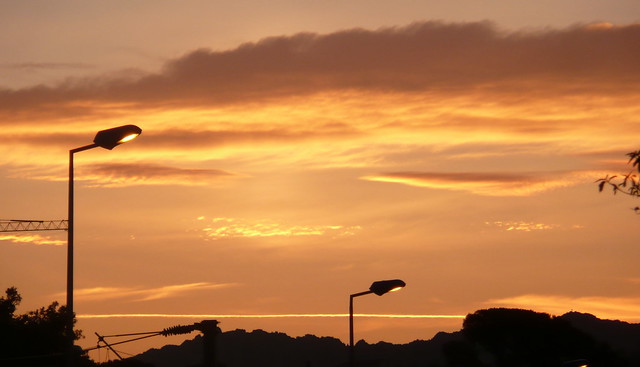
Despite this lack of equipment I roused myself from bed at 5:20 and went in search of the sunrise, hoping to be able to catch the tail end of the transit. I installed myself at the top of an avenue that descended towards the east and waited and watched as the rays from the sun gilded the wispy clouds clinging to the horizon.

Horizon, just before the transit of Venus

I waited and waited. The light, a living thing almost, shifted and changed among the scattering of clouds. Slowly the brightness of the horizon increased.

And then suddenly there was a blaze of light above the horizon that quickly formed itself into a globe.

With no telescope and no solar glasses to protect my eyes, I was planning to use a small pair of binoculars to project an image of the sun onto the back of the program booklet from the conference. This was tricky. My hands unsteady, the image of the sun danced and wobbled across my cardboard screen. I had to play with the distance to try to bring the image into focus.

But then there it was — wasn’t it? I could see a black speck near the bottom edge of the sun: the shadow of Venus blocking the light from our star. The image dipped and defocused. I steadied my hand and tried again. Yes, for sure there was a speck. I smiled. With my camera in my other hand I snapped this image:

Transit of Venus 1

The planet Venus has moved between the Earth and the Sun. The motion is simply a part of the Solar System, the collection of planets that is our home. The conjunction has happened before and will happen again, countless times. But the next occasion will not be until 2117; not in my lifetime.

Why did I drag myself from bed to see this? It is just that, since we were both passing through the neighbourhood at the same time, I wanted to be there.


Posted in Astronomy, Scientific Life | Tagged , , , | 15 Comments

Open Access: Money and Data talk and say the same thing?

One of these days — I promise — I will get back to writing about science. But a conjunction of tweets today brought to me three articles on open access that were interesting in different ways but curiously all seemed to point in a similar direction.

First, a post on the Scholarly Kitchen blog (h/t Alicia Wise) from Rick Anderson, who is the Associate Dean for Scholarly Resources & Collection at the University of Utah. His post was a critique of the ‘Big Deals’, bundled or grouped  journal subscriptions that large publishers sell to university libraries. They may have low ‘per article’ costs but inevitably mean that libraries have to subscribe to journal titles they don’t want. Big deals consume very large fractions of library budgets and restrict flexibility for changing subscriptions.

But the more interesting point was that the ‘big deal’ was a larger version of a long-standing practice of ‘Medium Deals’ by which he meant ‘journals’. To get access to an article of interest you have to subscribe to the whole journal. Anderson argues that this made sense when the literature had to be printed to be distributed; but this is no longer the case now that distribution is online. He doesn’t quite come out and say it, but are we on a trajectory that leads to the abandonment of the journal form?

There seems no immediate danger; even relatively new and online-only journals, such as PLoS ONE, have a journal identity. But what does that mean in the absence of a physical object that looks like a printed journal? I suspect the dissociation of the concept from the thing itself may weaken people’s habituation to the form.

There is some evidence for this from the second interesting article I came across today, a recent preprint in the ArXiv (h/t @figshare) that claims to detect a “weakening relationship” between journal Impact Factors and individual papers’ citations. To quote the abstract:

Historically, papers have been physically bound to the journal in which they were published but in the electronic age papers are available individually, no longer tied to their respective journals. Hence, papers now can be read and cited based on their own merits, independently of the journal’s physical availability, reputation, or Impact Factor. We compare the strength of the relationship between journals’ Impact Factors and the actual citations received by their respective papers from 1902 to 2009. Throughout most of the 20th century, papers’ citation rates were increasingly linked to their respective journals’ Impact Factors. However, since 1990, the advent of the digital age, the strength of the relation between Impact Factors and paper citations has been decreasing. This decrease began sooner in physics, a field that was quicker to make the transition into the electronic domain. Furthermore, since 1990, the proportion of highly cited papers coming from highly cited journals has been decreasing, and accordingly, the proportion of highly cited papers not coming from highly cited journals has also been increasing. Should this pattern continue, it might bring an end to the use of the Impact Factor as a way to evaluate the quality of journals, papers and researchers.

This doesn’t amount to a prediction of the end of the journal, (though there is some prospect of reducing the disturbing hold of the Impact Factor over academic careers). But it does suggest that it is the paper and not the journal that may be the focus of interest in future.

Traditions, like familiar coastlines, are slowly being eroded. The standard journal faces new competition from the disruptive impact of the web. And it is not just the advocates of open access who are saying that. The third piece flagged up to me on Twitter today (h/t @GaviaLib) is a sober analysis by Jared Woodard, a financial analyst, of how the rise of viable open access options is presenting real challenges to Elsevier.

His analysis is worth reading in full but to pick out just a few quotations:

Elsevier’s upside potential looks capped, since there is no room for top-line expansion given tight university library budgets, and no room for cost-cutting in an industry where the labor of academic researchers, editors, and peer reviewers is provided, literally, for free.

Social media and improving technology have allowed opposition to rent-seeking by publishers to become more coordinated and widespread. The public relations disaster and boycott triggered by the Research Works Act (RWA) provides an excellent example.

The best argument that the company has put forward to defend their business model is that, in exchange for all of the free labor that makes the business so profitable, Elsevier provides academics with the “high-impact” journal brands that committees want to see on the CVs of tenure applicants. Until recently, the only response from the open access movement was to point out that rentier capitalism is unjust. Today, the best response is that high-impact open access journals exist as a viable alternative to the old model.

These are uncertain times for publishers — and academics. Change is coming, and perhaps more than any of us is bargaining for.

And to help push things along, I have signed the White House petition on open access. Come on in; the water’s intriguing.

Posted in Open Access | Tagged | 33 Comments

Petitioning the President on Open Access

It has been quite a year so far for open access. And the momentum is still building.

First came the Elsevier Boycott, triggered by an angry reaction to the publisher’s support for the US Research Works Act, which would have undermined the open access policy of the National Institutes of Health.

The Act has been withdrawn but the debate stirred up by the boycott continues to play out in the blogosphere and the press.

Then, at the beginning of this month, David Willetts declared that the UK government is committed to the “principle of public access to publicly-funded research results”. We await the report of the Finch committee which is has been charged with figuring out how this is to be achieved.

Willetts acknowledged that the UK cannot go it alone on open access so it was heartening to read last week that the European Union is likely to require researchers that it funds in future to make their results freely available.

Please Sign the Petition

And today sees the launch of a new campaign that is petitioning the Obama administration to extend open access mandates beyond the NIH to all large federal funders of research.

The petition reads:

WE PETITION THE OBAMA ADMINISTRATION TO:

Require free, timely access over the Internet to journal articles arising from taxpayer-funded research.

We believe in the power of the Internet to foster innovation, research, and education. Requiring the published results of taxpayer-funded research to be posted on the Internet in human and machine readable form would provide access to patients and caregivers, students and their teachers, researchers, entrepreneurs, and other taxpayers who paid for the research. Expanding access would speed the research process and increase the return on our investment in scientific research.

The highly successful Public Access Policy of the National Institutes of Health proves that this can be done without disrupting the research process, and we urge President Obama to act now to implement open access policies for all federal agencies that fund scientific research.

This could make a real difference. If the campaign gets 25,000 signatures in 30 days, the Administration has to issue an official response. The campaign organisers are keen to surpass this target quickly because they sense they may be pushing at an open door.

And you can help. It is hoped that most signatories will be US citizens (those are the political realities) but foreigners can also sign.

Please do. It is only by concerted world-wide action that open access can be made to work.

Please note: to sign the petition, you much first create an account, click on the link in the verification email that you will receive (which contains your password), and then sign in to the web-site to finally add your signature to the petition. (I missed the last step first time round.) When you’re done, you will see your first name and the initial of your surname appear in one of the signatory boxes.

For more information please consult the access2research website or the campaign Facebook page. If you would like to tweet support, please use the #OAMonday hashtag.


Posted in Open Access | Tagged | 6 Comments