A Bill to Amend the Law of Defamation

The libel reform campaign has yielded a spring crop: a bill to amend the law of defamation was introduced to parliament in the Queen’s Speech on May 10th.

This means that legislation to amend the lax libel laws of England and Wales, which have caused a plethora of problems for scientists and science writers in recent years (not to mention many other worthy individuals and groups), will be debated in the Commons and the Lords. With luck, it will finally make its way onto the statute book. There is no guarantee that this will happen, even though libel reform has cross-party support, so it remains to be seen if the spring crop will be successfully harvested.
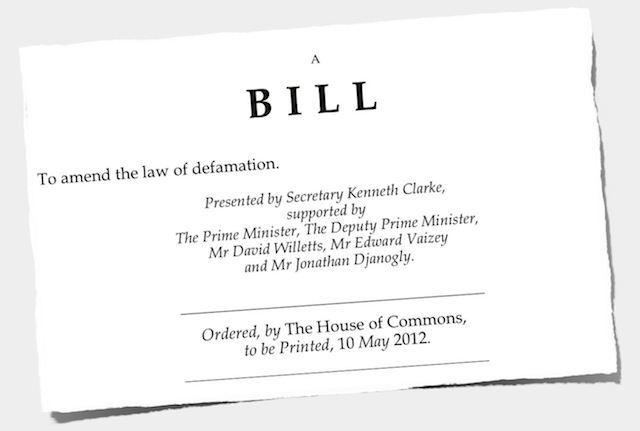
The Defamation Bill 2012

The passage through parliament is also likely to result in amendments to the proposed legislation. This is a good thing because, although the new bill represents a huge advance on current legislation, it falls short in some respects from the measures demanded by the libel reform campaign.

You can download the bill as a PDF to have a look for yourself. It’s not a long document but is written in a legalese that I confess I struggled to comprehend, even though I have written a fair few posts about the campaign in recent years. Nevertheless I wanted to highlight what seemed to me to be the more salient points.

The bill starts in section 1 with a definition of defamation:

A statement is not defamatory unless its publication has caused or is likely to cause serious harm to the reputation of the claimant. 

The key phrase here is ‘serious harm’. I am not entirely sure if that phrase has a legal definition but right at the beginning the test of whether a case can be brought for defamation appears to be less than ideal. The reform campaign would like to have a stronger test of harm “that strikes out claims unless the claimant can demonstrate serious and substantial harm and they have a real prospect of vindication”. This would serve to eliminate the muzzling that occurs presently from the mere threat of legal action by wealthy claimants who know that the potential high costs of defending a libel suit, even if successful, are a deterrent for many.

Section 2 establishes that you cannot be sued for libel if you are telling the truth:

It is a defence to an action for defamation for the defendant to show that the imputation conveyed by the statement complained of is substantially true. 

Nor, according to section 3, can you be sued for your opinions, as long as they are honestly held. This removes the trap that the British Chiropractic Association tried to use to snare Simon Singh when he wrote that their organisation “happily promotes bogus treatments” for which there was “not a jot of evidence”. Effectively it enshrines in law the ruling handed down by the High Court who upheld Singh’s argument what he had written was “honest opinion”.

Singh’s case was arguably also a matter of public interest since the claims of the BCA for the efficacy of chiropractic would undoubtedly influence choices made about healthcare. Under present legislation, the public interest defence in libel cases is unsatisfactory; it was established by legal precedent in the Reynolds defence, which allows potentially libellous statements to be published if they are in the public interest. But such a position usually has to be tested through the expensive business of court procedures, which puts it out of reach for many.

In section 4 the new bill explicitly asserts the right to a public interest defence to replace Reynolds:

It is a defence to an action for defamation for the defendant to show that—

  1. (a)  the statement complained of was, or formed part of, a statement on a matter of public interest; and
  2. (b)  the defendant acted responsibly in publishing the statement complained of. 

There are a number of caveats to this position, which attempt to define the seriousness of the statement complained of and the importance of the matter of public interest, and test whether the author has made any attempt to seek the claimant’s views or to verify the truth of the statement before publication. To me this seems like a big step forward but the campaign would like to go further to strengthen the public interest defence; they would like the law to require the claimant to show that the author had been “malicious or reckless” in their writing.

There’s a legal subtlety here that escapes me (legal experts should feel free to wade in with clarification) but I suppose that the campaign’s aim is to minimise the chilling effect of any room for manoeuvre that the new law might allow.

Section 6 is of particular interest to scientists since it establishes protection for the peer-reviewed literature. This is a measure that many scientific publishers had been keen to see incorporated. Thus, academic publications on scientific or academic matters are considered “privileged”; they are immune to libel suits, provided that:

before the statement was published in the journal an independent review of the statement’s scientific or academic merit was carried out by—

  1. (a)  the editor of the journal, and
  2. (b)  one or more persons with expertise in the scientific or academic matter concerned.

However, scientists still have to be careful: statements made with malice will lose this privileged protection. So by all means be critical in your papers, but make sure to stick to reasonable standards of academic rigour!

The bill also attempts to bring the law into the age of the internet. Section 5 offers protection for website operators, or ISPs (Internet Service Providers), who have been targeted in the past because of content written by bloggers that they host (though bloggers themselves still need to be mindful of the legislation). And section 8 eliminates the risk of repeated libel action through repeated posting of the same claims on the internet by establishing that it is only the first publication that is actionable.

Finally, the dreaded curse of libel tourism is to be nixed. Notoriously, current provisions have given free rein to foreign claimant to sue in the courts of England and Wales for statements that were primarily published in other jurisdictions. This is the weakness that caused Dr Peter Wilmshurst so much trouble; the British cardiologist was sued by American company NMT for remarks made in the USA that were reported on a Canadian website. Unable to sue in the US, where freedom of speech has much greater protection, NMT were able to bring proceedings in London simply because the Canadian website was accessible from there.

No more. The defamation bill states that, for foreign claimants, no case can be brought:

unless the court is satisfied that, of all the places in which the statement complained of has been published, England and Wales is clearly the most appropriate place in which to bring an action in respect of the statement. 

That is not quite everything in the bill but it is everything that I could understand. It is an immense step forward and a great achievement for all those involved in the campaign, one that is rightly celebrated in Mark Henderson’s new book, The Geek Manifesto, which I reviewed last week.

However, unless this bill passes, no law will change. The campaign may have garnered a few laurels but it is not yet time to rest on them.


For more informed opinion on the Defamation Bill, try the Without Prejudice podcast, where the legal brains of  @JackofKent and @CharonQC discuss it in detail. For more background on the libel law, go for Nick Cohen’s You Can’t Read This Book.

 

Posted in Libel Reform, Science & Politics | Tagged | 4 Comments

Finch Committee: Update

I reported before on the notes from earlier meetings of the Finch Committee, which was set up by Science Minister David WIlletts to formulate proposals for making publicly-funded research more accessible. The notes of their latest meeting, held on 27th April, are now available so I wanted to add an update. I’ve uploaded a highlighted PDF for anyone who wants to read all four pages.

The more recent discussions bring out some of the tensions between the academic and publishing members of the committee. The circulation of a revised draft policy on open access by RCUK was a point of contention. According to the notes, Mark Thorley (RCUK):

stressed that the draft policy, as it stands, does not constitute a formal RCUK position. Disquiet had been expressed about circulating it widely in anticipation of the conclusions of the Working Group, and it was argued that this had been premature. RCUK stressed that the issuing of the document at this stage was essentially a means of testing out ideas. 

He added that there had been much positive feedback. That was certainly the tenor of my submission to RCUK (see here for my reaction to the draft proposals).

Publishers were dismayed with the RCUK’s proposal for a maximum 6 month embargo on scientific papers following the green route to open access:

Publisher members of the Working Group were unhappy about this, and were perplexed about the rationale specifically for a six-month period, which did not appear to be based on any analysis of the half-life of articles. RCUK’s view, however, was that the six-month span had been suggested because it was deemed right and appropriate.

It looks like RCUK wants to stick to its guns. To facilitate this, the organisation seems to be moving to a more flexible position on payment of author processing charges (APCs) — the so-called gold open access route which provides immediate availability:

Mark Thorley reported on the new RCUK position on meeting costs of APCs. Under this, researchers would be allowed to include APCs in directly-incurred costs for research grants; the payments could be placed in an institution’s publication fund. Research Councils would show flexibility when matching payments to publications. This stance was welcomed by all around the table. 

I’m not certain yet whether this proposal quite matches the Wellcome Trust’s easy mechanism but it looks to be a move in the right direction.

There was also tension over text-mining:

Publishers were also apprehensive about the proposals relating to text mining. RCUK’s view is that it wishes to see all research outputs from its funding placed in the public domain, and feels that the suggested approach to text mining addresses this need.

Again – good to see RCUK holding its ground.

The discussion then moved on to look at cost implications. There are some details given but the analysis remains to be completed. Nevertheless, at the time of the meeting, the committee agreed the following principles as it now moves to finalise its report:

  • Maximum access at the point of use should be set out at the outset as a fundamental principle, with APCs presented as a key vehicle for this, but not the only vehicle.
  • The recommendations of the Working Group will relate to all research, not just publicly-funded activity – but clearly it will have less influence over the policies and practices outside the public sector.
  • There is a need for clarity about what licences should cover, given the distinction between read-only and re-use rights. Here too, sustainability is an important factor. Nonetheless, the Group felt that the policy should stress that there should be as few restrictions as possible for use and re-use, including text and data mining. 
  • An emphasis on the need for sustainability and competitiveness should replace references to distribution to publishers’ shareholders.

What does that last point mean exactly? Not sure, it does at least point to the potential for competition between publishers to drive some cost savings. It is to be hoped that a new market in publishing might generate some hungry and innovative new entrants.

These meeting notes are now a few weeks old (the committee met again today for the last time). But it is good to read that they were also planning have meetings with the “Nr 10 Policy Unit and with representatives from the European Commission”, before finalising their report. That latter get-together is particularly significant in the light of today’s news that the Commission will be expecting any researchers funded under the EU’s massive €80bn Horizon 2020 program (which will run from 2014 to 2020) to publish under the open access model.

This tanker is slowly turning.

Posted in Open Access | Tagged | 4 Comments

Manifest Sense

Mark Henderson’s The Geek Manifesto is a remarkable book. Though many of its themes are not new, it is difficult to imagine such a book being published as recently as five years ago.

The Geek Manifesto provides a timely analysis of the power that different groups of geeks have levered from the growing sophistication of the of the internet. It examines several recent campaigns that have had notable influence in the UK, including battles to prevent science from being stifled by the libel laws and to stave off the threat of cuts to the science budget. Henderson draws out the reasons for their success but is careful also to point to the challenges that lie ahead.

The Geek Manifesto

Henderson’s aim is not simply to encourage geeks —web-savvy skeptics drawn from many walks of life — to form a pro-science lobby. Rather, The Geek Manifesto is a rousing call for the scientific method to become more enmeshed within the political process. Henderson ranges across healthcare, education, justice, environmental policy and the media, examining the opportunities for infusing greater rationality and respect for evidence into policy formulation. He builds a compelling case.

It is an optimistic program but the author fixes a critical eye on the problems that it faces. Among them are the lack of synchronisation of the electoral cycle with the timescales needed to submit new policies to more rigorous testing, and the residual reluctance or incapacity of scientific professionals to get down and dirty with the bruising realities of social and political life.

If it can be made to work, the rewards will be palpable. The libel reform and Science is Vital campaigns, for example, have already borne fruit. I’ve had the opportunity to be involved in both of these but my favourite story in the book is the one about the maxillofacial surgeon who applied science to tackle the problem of bar brawling in Cardiff (the wonderful details of which I will leave you to discover for yourself).

The Geek Manifesto is a impassioned book. It is a political tract, written with a sense of urgency. It might run the risk of irritating those too ready to accuse science of over-reaching itself but Henderson lives by example, showing a healthy respect for standards of evidence and critique that he advocates for all of public policy.

A central message is that geeks and politicos need to better understand one another. For too long they have occupied sets with little overlap and that needs to change if society is to make a better fist of solving its problems. I would like to see a copy of The Geek Manifesto on the desk of every minister, every MP and every local councillor in the country; and, speaking of my own constituency, one in every laboratory too.


Posted in Science & Politics | Tagged , , | 6 Comments

Access to the Finch Committee on Open Access

The Finch Committee, set up last year by David Willetts to examine how UK-funded research findings can be made more accessible — and mentioned by the minister in his speech on the subject earlier this week — has been meeting regularly and is due to report within weeks.

If you would like to find out more about the committee’s deliberations, you can. The notes of their meetings are published on the website of the Research information Network (RIN).

Chaired by Dame Janet Finch DBE (Professor of Sociology at Manchester University) the Working Group on Expanding Access to Published Research Findings (WG), to give the committee its long and proper name, is made up of representatives of researchers, universities, librarians, publishers, funders (Wellcome Trust, RCUK, HEFCE), learned societies and RIN. It has met three times to date and has a fourth and final meeting scheduled for later this month.

The decision to make the meeting notes available was taken at their 2nd meeting in December 2011 to foster “two-way communication” between members of the working group and their constituencies. I’m not sure how much of that has gone on. Oddly for a process that is considering open access, the consultation process seems to have been rather muted; the same was true of the consultation on the RCUK’s draft policy on open access which didn’t appear to have been officially announced. Nevertheless it is evident from the notes that the working group has been consulting widely. Anyone who would like to communicate with the committee, even at this late stage, can do so: the membership and email details of its members are available via RIN (Excel file).

I’ve had a look at the meeting notes and have uploaded PDF versions to a public dropbox folder in which I have highlighted what appeared to me to be the key points. Anyone wanting a fuller picture should read the full documents (links below) — they’re not very long.

To summarise a few highlights, in the first meeting (Oct 2011) the working group agreed what were the key issues to be tackled. These included (my emphasis in bold throughout):

It is important to focus both on the savings and the benefits that can be achieved through moving to open access, and on the means by which the costs of such a move can be most effectively met. The costs of the scholarly communications system are currently driven largely by the volume of published output. Research funders can be legitimately concerned about this, and the UK needs to move towards a system that incentivises quality rather than quantity.

…open access also presents interesting business opportunities in the longer term, for instance by helping to encourage the spread of machine-readability of published outputs; these need to be factored in.

Greater adoption of open access is nevertheless not risk free: For research-intensive countries such as the UK, Gold OA could result in greater costs, while the benefit accrues to other countries – particularly since assumptions about moves to Gold in other parts of the world (e.g. in the USA and China) may be optimistic.

The variety of views aired around the table suggested that the model that will be elaborated by the WG will draw from several perspectives, and will reflect a mixed economy for the foreseeable future… Inevitably, the model will therefore be complex.

Key points raised in the second meeting (Dec 2011) included considerations of how to fund author-processing charges (paid by authors in lieu of subscriptions) and the workings of repositories:

(The) OA journal market is clearly developing – albeit from a relatively small base. Members reflected on the challenges inherent in moving further down this road:

Effective ways have to be found of funding APCs through institutional mechanisms, using perhaps such models as those deployed by the Wellcome Trust, or by universities such as Nottingham. This implies the need for a large-scale transfer of funding, in a controlled manner, of funding from library budgets preferably to fund researchers directly. Funders have a major role to play in helping such a transition.

During a transition period conceivably lasting several years, subscription costs will not necessarily go down at a rate that would balance increased costs associated with payment of APCs – particularly if the hybrid model is adopted, or the transition to OA is slower in other parts of the world. This would create a ‘hump’ since the UK HE sector would still need to pay for subscription access to the large proportion of global output that is not (yet) OA – so there could, in effect, be a UK subsidy to the rest of the world. The question is whether that is a price worth paying to achieve beneficial change in the landscape.

The WG noted that, although there is a significant number of repositories in the UK, most remain under populated and sub-optimally used.

It was agreed that meeting minimum standards and ensuring quality of metadata relating to all research outputs (not just journal articles), would go a long way to addressing the issue of interoperability. Metadata standards for both published and unpublished material, it was suggested, would drive technical standards in repository operation. However, progress would depend crucially on the openness and searchability of the metadata.

I was impressed to learn of the proactive stance adopted by Nottingham University, which has set up a fund to allow all its staff to follow open access options in publishing their research. This is a model of support for OA publishing that was considered in greater detail at the following meeting (Feb 2012):

The sub-group had also agreed that author-side payments should bring with them full rights of re-use.

A key set of issues related to the costs of APCs and how they could be met, especially in the HE sector. Steve Hall tabled a set of spreadsheets that sought to estimate the additional costs that would arise if UK authors were to publish increasing proportions of their articles as OA and funded through APCs, with different rates of increase modelled over a six-year period. He noted that the additional costs appeared to be substantial, which was a concern in a context where BIS had indicated that no new money would be available. Other members noted, however, that the funds required were modest in relation to total UK expenditure on research. Moreover, the costs as well as the benefits were highly sensitive to the pace of change in the rest of the world; and the entry of new publishers and journals into the market could have a significant impact on the levels of APCs.

The sub-group had considered how funding arrangements would need to be changed to provide a simple, accountable and equitable system to meet the costs of APCs; and noted the difficulties in any system that depended significantly on the use of research funds supplied to meet indirect costs. The Chair suggested that a standard percentage addition to project grants from the Research Councils and other major funders might allow universities to build up a publication fund, perhaps with a contribution also from QR and other funding streams. Use of such a fund would not be restricted to publications arising from specific projects, and would therefore give greater flexibility to the institution to support publications beyond the life of a specific grant and from a wider range of researchers. It could potentially be extended to researchers in the humanities and other subject areas where much research did not benefit from project grants. The Group noted that a publication fund of that kind would give universities a degree of control over what was published, which might be helpful in incentivising quality over quantity. It was agreed that the feasibility of such an arrangement should be explored by RCUK and HEFCE.

Those in the arts and humanities may derive some reassurance from that last paragraph,

Overall the deliberations appear to have been detailed and informed — and have obviously influenced Willetts’ speech. Nevertheless it was curious to see that, although Springer is represented on the WG, its executive vice president for corporate communications, Eric Merkel-Sobotta, reacted to the speech by complaining that “We’re not as well represented or as loud as the other side”. Perhaps the published notes do not fully reflect the heat of the debate at meetings but in my view the balance of membership is representative of the weight of interest of the parties involved.

I look forward with a keen interest to the published report.

The notes of the meeting held on 27th April are not yet available. I’ll try to post an update here when they are.

Update (17-5-2012): Notes from the 27th April meeting have now been published. Commentary here.


Posted in Open Access, Science, Science & Politics | Tagged , , | 6 Comments

Willetts’ Speech on Open Access: Analysis

David Willetts, Britain’s minister for science and universities, trailed the announcements made in his speech on open access to the UK Publishers’ Association yesterday as a ‘seismic shift’. One learns to be wary of the more hyperbolic statements of government ministers but I was at least left wondering whether the earth had moved for the publishers in the room.

This is not new territory for Willetts, who has already declared himself and his government in favour of greater access to the academic literature, but it was by some margin his boldest statement yet on the topic. The speech fell short of providing all of the answers on how things will move forward – the government will wait for the Finch Committee to report on mechanisms for putting OA into practice before deciding on a plan of action. Nevertheless it laid down some important markers for publishers and academics and showed a firm grasp of the residual complexities of the issue, both of which I take to be good indicators of seriousness of intent.

Willetts started out with warm words on the high quality of UK science and the government’s commitment to it, manifest through a cash-protected budget and reform of university funding. These points are arguable but we shall leave them aside for another day because the minister was keen to make the broader point that our research base is not just an important economic asset but a cultural one as well.

“It enriches our cultural life to have such a range of intellectual activity here. … This is an extraordinary privilege that we enjoy and which we should not take for granted. It contributes immeasurably to the quality of our national life.”

Having declared the economic and cultural value of research the minister went on to acknowledge that, as is now a commonplace, the web changes everything, and in particular our ideas about access to information. Relying no longer on libraries and printed matter, the web has created a massive interlinked store of knowledge that we are only beginning to tap. This sets the scene for what he has to say next to the publishers in his audience. His choice of words is telling (my emphases in bold throughout):

“We need to have far more research material freely available, and we need to be better at editing and sorting it. The challenge is to discharge both of these crucial functions better. This is the challenge facing your industry but you are not on your own. It is one that we share, since Government has responsibilities for intellectual property, copyright and, of course, funding much research. We can work on this in partnership. Let me now set out our approach.”

Willetts acknowledges the challenge facing publishers but leaves them in little doubt about the government’s strong hand in this because, simply, it holds the purse strings. Then comes the declaration of the principle that is guiding government thinking and that publishers are going to have to find a way to live with;

“Our starting point is very simple. The Coalition is committed to the principle of public access to publicly-funded research results. That is where both technology and contemporary culture are taking us. It is how we can maximise the value and impact generated by our excellent research base. As taxpayers put their money towards intellectual enquiry, they cannot be barred from then accessing it. They should not be kept outside with their noses pressed to the window – whilst, inside, the academic community produces research in an exclusive space. The Government believes that published research material which has been publicly financed should be publicly accessible – and that principle goes well beyond the academic community.

This is as clear an articulation of the cultural shift in academic publishing as you are likely to hear. Willetts backs up his stance with figures, citing the $141 generated in the US economy for every dollar of public money spent on the Human Genome project (which shared its sequence data freely and almost immediately upon acquisition) and the 250% increase in readership of articles that are taken out from behind paywalls.

He expressed some sympathy for the publishing industry as it faces the future, but the bottom line is clear:

“I realise this move to open access presents a challenge and opportunity for your industry, as you have historically received funding by charging for access to a publication. Nevertheless that funding model is surely going to have to change even beyond the welcome transition to open access and hybrid journals that’s already underway. To try to preserve the old model is the wrong battle to fight.

With a paint pot and broad brush, Willetts was writing on the wall in large letters.

But we’re not there yet. There are plenty of details to be figured out and it is to be hoped that when push comes to shove the minister’s nerve will not fail him.

He does at least seem to have a good grasp of the trickier details of implementing a workable open access policy. For one thing, the UK publishing industry is a successful business (albeit one containing companies that extract excessive profits from a largely publicly funded activity). Around 5000 of the 23000 peer-reviewed journals are published in Britain and, currently, 80% of the subscription revenue comes from overseas, making the industry a significant exporter, not something the UK government can readily ignore. Clearly the publishers have to be part of the solution, but only so long as they willing to work towards the inevitable transition:

Provided we all recognise that open access is on its way, we can then work together to ensure that the valuable functions you carry out continue to be properly funded – and that the publishing industry remains a significant contributor to the UK economy.”

How this plays out remains to be seen. Willetts can still parry questions about detail while the Finch committee is deliberating, though its report should be out “in the next few weeks”. Important components of the economic argument about how open access is paid for are both the international dimension and the impact on learned societies, many of which rely heavily on subscription income from journals. Here it is clear, as was signalled in his trail, the minister has been thinking some interesting thoughts.

“Let me put this very crudely. At the moment, American and Chinese libraries have to pay for journals containing the results of our scientists’ research. In future we could be giving our research articles to the world for free via open access. But will we still have to pay for foreign journals and research carried out abroad? If so, would we not only have undermined a business model but an export industry too? And there could be collateral damage for our learned societies, a very important part of our research ecosystem, as they rely on international journal subscriptions for much of their income.”

The UK cannot act alone in this arena. Open access can only succeed as an international endeavour and it is encouraging to hear that Willetts is aiming to take a lead.

“I am pleased to report therefore that representatives of the European Commission will be coming to BIS very soon to discuss open access. We share common objectives with the Commission and want to ensure that a sustainable strategy is developed for Europe as a whole. I will also be discussing the whole issue with colleagues beyond the EU. Fortunately there is already a lively debate on these issues in the US, and we hope they will be implementing similar initiatives. The US Committee on Economic Development, for example, advocates building on open access initiatives taken by the National Institute of Health, arguing that the costs involved are well outweighed by the economic benefits derived from greater utilisation of research.”

He even has time to consider scholars outside the mainstream academic community (perhaps reflecting on his own experience as author of The Pinch) and areas — such as the arts and humanities — that do not enjoy the funding levels awarded to most of the sciences and seem likely to suffer under author-pays open access systems. There are no concrete proposals here but rather aspirations:

“I know some publishers already respond flexibly to this issue, for example through fee waivers for lone scholars, and I am keen to know if this might offer a sustainable way forwards.”

I gather the learned societies are also keen to know this.

Text and data mining of the literature — which require unfettered access to the literature and the underlying data to be maximally valuable — are also considered and are clearly part of future plans. Willetts’ comments here are telling:

“I know that publishers share an appreciation of the potential of these technologies, and that some of you are supporting developers in creating new applications. We are considering how to advance UK capability in data mining in the light of the recommendations from Hargreaves, and I would like to thank the publishers who have engaged with this process. The Government wants to see an environment which enables researchers to use datasets from a number of different publishers without undue costs or obstacles – and without undermining research publishing. 

Is there a subtle message here that only some publishers have realised the significance of permitting researchers access to text and data mining? I think there might be.

Finally, the minister turns his attention more directly to the academic community, who have an important role in shifting the culture of research publishing. Specifically he appears to recognise the drag effect that adherence to traditional publishing venues — and the associated hypnotism of impact factors — has had on the transition to open access. He suggests that future Research Excellent Frameworks, the mechanism whereby research in UK institutions is assessed for the purposes of allocating a large tranche of public funding, might only admit open access papers as legitimate outputs from researchers:

“The debate on open access will inform HEFCE’s planning for the research excellence process that succeeds the current one which concludes in 2014. There may well be another assessment exercise around 2020 and it is quite possible that, by then, open access could be among the excellence criteria for qualifying articles.

This isn’t as strong a statement as I would like because there is little doubt that imposition of such a criterion would be an extremely powerful driver of academic behaviour. It would be a further powerful addition to the message from Harvard recently to researchers to “move prestige to open access” by publishing their beset work in OA journals.

All in all a fascinating speech and in many places a bold one. This business is far from over. As Willetts’ notes in his closing comments:

Government, the Research Councils and HEFCE have all been working towards a common policy, and we have tried to maintain an open dialogue with the publishing industry throughout. There is a lot going on.”

Yes minister, there certainly is.


Posted in Open Access, Science, Science & Politics | Tagged , , | 12 Comments

UK Government to lead the world to open access?

The open access buzz around the internet last week was all due to the announcement by senior faculty at Harvard that journal subscription prices were rising at an unsustainable rate and the call to colleagues to devote their publishing energies to open access titles.

This week Michael Eisen has written a strongly worded reality check that pours some cold water on the potential significance of the move by Harvard academics, noting in particular that it has not been adopted as official policy by the university.

Nevertheless I think that it marks an important symbolic shift that adds to the impetus for action. And now, according to the Guardian, the move to open access is about to get a further push from no less an institution than the British Government. At the annual meeting of the Publisher’s Association tomorrow UK Minister for Science and Universities David Willetts will announce a government plan to “make publicly funded research accessible free of charge to readers.”

It will be interesting to see what an audience of publishers makes of that.

The timing of the announcement is surprising since it seems to pre-empt the report of the Finch Committee, which was charged by Willetts last year to figure out practical steps for the implementation of open access publication of publicly funded UK research.

Details are still rather sketchy although it has already emerged that Willetts has recruited Jimmy Wales of Wikipedia to advise on the project (including helping to define new open standards for papers and data). The plan appears to be to set up a government-backed “Gateway to Research” which would provide links to UK-funded research. It should be up and running within 2 years.

The project is backed by £2m funding and so seems relatively modest in its ambition. Questions abound. Is this just a better organised network of institutional repositories? How much latitude might publishers have for restricting authors rights to making work available via the Gateway?

We shall have to see. But it seems clear that Willetts still has the big picture in view and has at least considered some of the more difficult questions that attend a move to full open access. He writes (in the Guardian):

Moving from an era in which taxpayer-funded academic articles are stuck behind paywalls for much of their life to one in which they are available free of charge will not be easy. There are clear trade-offs. If those funding research pay open-access journals in advance, where will this leave individual researchers who can’t cover the cost? If we improve the world’s access to British research, what might we get in response? Does a preference for open access mean different incentives for different disciplines?

These are good questions. What I find particularly encouraging is the implicit signal that the UK is opening up the international dimension of this problem. If we are to reach a workable system in which the academic literature of the world is freely available, the internationalism that is such an organic part science has to inspire politicians around the globe.

I applaud Willetts’ declared aspirations. I will applaud all the more loudly when I see a successful implementation.

Posted in Open Access, Science, Science & Politics | Tagged , , | 7 Comments

Harvard: we have a problem

This is astonishing. Harvard is one of the best and one of the wealthiest universities in the world but last week its Faculty Advisory Council* announced that it can no longer afford to maintain its subscriptions to academic journals.

The announcement was made online by the Council as a message to the academic staff at the university. I have taken the liberty of quoting it in full below.

The message is notable since it bears out many of the factors — in terms of costs — that have been highlighted by the Elsevier boycott (though no particular publisher is mentioned in the communiqué).

Perhaps this announcement is simply part of a negotiating strategy (one would expect Harvard librarians to be a clever bunch). But, be that as it may, what is particularly striking is the advice offered to staff regarding what they can do to help the situation, which chimes with what I and many others have been arguing for as ways to bolster open access publishing (and was writing about only yesterday). To pick out just two key phrases (with my emphases in bold):

Consider submitting articles to open-access journals, or to ones that have reasonable, sustainable subscription costs; move prestige to open access.

If on the editorial board of a journal involved, determine if it can be published as open access material, or independently from publishers that practice pricing described above. If not, consider resigning.

This sends an important message (one is tempted to the hyperbole that it may even be a ‘shot heard round the world’): if one of the most prestigious and richest institutions in the world cannot afford its journal subscriptions, then there is a serious problem in academic publishing.

Well done to Harvard’s Faculty Advisory Council for coming up with concrete proposals for what academics should be doing to improve matters.


The announcement:

To: Faculty Members in all Schools, Faculties, and Units
From: The Faculty Advisory Council
Date: April 17, 2012
RE: Periodical Subscriptions

We write to communicate an untenable situation facing the Harvard Library. Many large journal publishers have made the scholarly communication environment fiscally unsustainable and academically restrictive. This situation is exacerbated by efforts of certain publishers (called “providers”) to acquire, bundle, and increase the pricing on journals.

Harvard’s annual cost for journals from these providers now approaches $3.75M. In 2010, the comparable amount accounted for more than 20% of all periodical subscription costs and just under 10% of all collection costs for everything the Library acquires. Some journals cost as much as $40,000 per year, others in the tens of thousands. Prices for online content from two providers have increased by about 145% over the past six years, which far exceeds not only the consumer price index, but also the higher education and the library price indices. These journals therefore claim an ever-increasing share of our overall collection budget. Even though scholarly output continues to grow and publishing can be expensive, profit margins of 35% and more suggest that the prices we must pay do not solely result from an increasing supply of new articles.

The Library has never received anything close to full reimbursement for these expenditures from overhead collected by the University on grant and research funds.

The Faculty Advisory Council to the Library, representing university faculty in all schools and in consultation with the Harvard Library leadership, reached this conclusion: major periodical subscriptions, especially to electronic journals published by historically key providers, cannot be sustained: continuing these subscriptions on their current footing is financially untenable. Doing so would seriously erode collection efforts in many other areas, already compromised.

It is untenable for contracts with at least two major providers to continue on the basis identical with past agreements. Costs are now prohibitive. Moreover, some providers bundle many journals as one subscription, with major, high-use journals bundled in with journals consulted far less frequently. Since the Library now must change its subscriptions and since faculty and graduate students are chief users, please consider the following options open to faculty and students (F) and the Library (L), state other options you think viable, and communicate your views:

1. Make sure that all of your own papers are accessible by submitting them to DASH in accordance with the faculty-initiated open-access policies (F).

2. Consider submitting articles to open-access journals, or to ones that have reasonable, sustainable subscription costs; move prestige to open access (F).

3. If on the editorial board of a journal involved, determine if it can be published as open access material, or independently from publishers that practice pricing described above. If not, consider resigning (F).

4. Contact professional organizations to raise these issues (F).

5. Encourage professional associations to take control of scholarly literature in their field or shift the management of their e-journals to library-friendly organizations (F).

6. Encourage colleagues to consider and to discuss these or other options (F).

7. Sign contracts that unbundle subscriptions and concentrate on higher-use journals (L).

8. Move journals to a sustainable pay per use system, (L).

9. Insist on subscription contracts in which the terms can be made public (L).


*Update (23-4-12 23:35): The original version of this post may have given the impression that the announcement was made by Harvard University. I am grateful to @Medicalskeptic for clarifying that the memorandum comes from the Faculty Advisory Council. Nevertheless, it is worth noting that the council membership is drawn from senior academics, most at professorial level, from all the schools of the university and is likely to be influential.

Posted in Open Access, Science, Scientific Life | Tagged , , | 50 Comments

Eyes on the prize are blind to reality

Scientists’ quest for publication in journals with high impact factors is widely perceived as one of the more refractory barriers to the fuller adoption of open access, which I believe to be in the best interests of science.

But the barrier problem is complicated. Some of its dimensions were teased out in a debate on ‘Open Science and the Future of Publishing’ held at Oxford at the end of February this year that involved publishers, funders and proponents of open access. The video of the debate is well worth watching (especially the first 45 min – though there’s a nice summary over at F1000). I was particularly struck by the comments made by Alison Mitchell of the Nature Publishing Group (NPG) (from 10:50 – 19:12) which started a train of thought about their gold-standard publication, Nature. See if you think I’m going off the rails.

The problem

Publication in Nature is a highly coveted prize. Many labs will literally pop champagne corks if their paper is accepted by one of the most prestigious scientific journals in the world. I shared in this wonderful feeling once, though it was back in 1993 and the memory, alas, is fading.

Nature’s prestige is hard-earned. The journal’s editorial staff and volunteer peer reviewers sift through thousands of submissions and select fewer than 10% for the privilege of occupying a few pages in the weekly publication. This rigorous filtration, argues the publisher, ensures that the journal serves up a quality product to the scientific community.

The success of the journal — and its authors — is one reason cited for their resistance to open access modes of publishing. Although NPG offers several open access options through the group’s various titles and permits deposition of author-formatted manuscripts in PubMed Central 6 months after publication in Nature, it does not offer Gold open access options for the vast majority of its Nature branded journals (the notable exceptions being Nature Communications and Scientific Reports*).

Alison Mitchell defends this stance by arguing that Nature’s reader/author ratio is so high — considerably higher than ‘normal’ scientific journals — that it does not make sense to charge the journal running costs to authors, which they estimate would work out at up to £30,000 per paper if a switch to full open access were to be made.

This is a reasoned position, but I would still like to pick it apart because some of it doesn’t make sense to me.

For a start, part of that £30k fee would presumably be needed to cover the costs of the very good front matter that appears in Nature and occupies about a third of the journal. The front matter includes news, commentary, feature articles (analysing scientific trends and matters arising in science policy and education) and summaries or highlights of the papers appearing in that week’s issue). These items are mostly written by Nature staffers or commissioned from academics. There is no case for charging the costs of writing them to the authors of Nature’s scientific papers, although I would be loathe to see the front matter disappear from the journal. I suspect these are the pages that most people read. Let’s face it, although Nature is a general science journal, few these days have the learning to be able to profit from all its articles. The spread is too great and the divisions between specialisms, unfortunately, are too deep (a point I will return to later).

Part of Nature’s predicted high open access charges also reflects the very high rejection ratio — above 90% — which means that the journal processes many more articles than are eventually published. Nature relies on skilled editorial staff — at PhD level or above — and the selectivity imposed by them and their reviewers to ensure quality and maintain the prestige of the Nature brand. The careful sifting is reflected in its impact factor which, at 36.101, is one of the highest in the business.

This latter point bears closer inspection, particularly if one has the bigger picture of science in mind.

First, most, if not all of the papers rejected by Nature will be eventually published elsewhere, though only after the delay caused by cycles of rejection and resubmission as authors chasing impact factors work their way down the journal rankings. The chase retards the dissemination of scientific information — and can be exhausting and demoralising for authors.

Second, despite all the careful sifting, Nature’s system is incapable of picking winners reliably, a problem that was highlighted in the past week in BBC4’s Beautiful Minds documentary on Andre Geim, who shared the 2010 Physics Nobel prize with Konstantin Novoselov for the discovery of grapheme (catch it if you can — wonderful). As revealed in the program, Nature rejected Geim’s and Novoselov’s initial paper** on graphene — twice.

Nature’s failure in this case is not the particular fault of anyone at the journal; it simply represents the intrinsic difficulty of forecasting from a slew of submissions which ones will go on to spark the greatest interest in the scientific community. The problem is not simply anecdotal; it is widespread. Nature’s impact factor is dominated by a minority of the papers that it publishes, as the journal itself has acknowledged. A 2005 editorial revealed that fully 89% of the citations to work published in the journal in 2004 derived from just 25% of papers; at the other end of the citations distribution, over half the Nature papers from that year had fewer than 20 citations.

It is genuinely difficult to pick winners: the skewed distribution is in fact typical of most journals, whatever their ranking, as shown by Per Seglen in a fascinating analysis performed back in 1992. Despite its rigorous selection procedures, Nature appears statistically no better at determining the relative quality of its submissions than other journals; it wins at the impact factor game because the brand ensures that the average quality of the submissions is higher.

What this means — and this has long been recognised — is that the journal impact factor is not a reliable indicator to the quality or influence of a particular paper. Nature knows this, and publicly bemoans the mis-use of journal impact factors in the assessment of individuals. And yet it cannot help itself from trumpeting its success in a full page advert whenever the latest impact factor calculation is published, or from dangling the statistic in the faces of prospective authors.

But the journal is not particularly to blame for this. Their stance is all of a piece with a scientific culture that has grown to over-value journal rankings. Everyone in the business knows what publication in Nature means. It is an accolade that we seek out because the system — largely devised and run by scientists — recognises and rewards winners of this prize with funding and promotion. We might wish that it were otherwise but wishing only works in fairy tales.

Playing the game makes fools of us all. We chase prizes that our critical faculties and our mathematical analyses have long demonstrated to be awarded prematurely and inaccurately. Worse still, running after these prizes slows us down.

Surely we can do better?

A proposal

We certainly still need to weigh and judge the scientific output of our peers. This is necessary to determine distribution of funds and preferment. But rather than relying on the inaccurate shorthand of impact factors, we need to reserve judgement until after publication. I am not suggesting that we abandon pre-publication peer review, which I think serves a useful function in filtering and improving the published literature. But it would be better to fast-track publication and then to arrive at a more considered judgement of their quality by assessing how well they had been put to use — downloaded, cited, commented on, criticised or lauded — by the scientific community. Adoption of full open access would facilitate this by allowing the whole community to be involved. There is a burgeoning industry of post-publication assessment that can better harness the wisdom of the community and which, done well, could provide more accurate judgements than a handful of peer reviewers.

We could even buttress this system by a more formal and more extensive procedure of prize-giving — prizes are important to us — which would do a better job of recognising achievement than publication in a high-ranking journal. Such prizes could replace the incentivising function of the glamour publications in stimulating the productivity of research groups. Again, if they were judged by the wider community, by the people who actually make use of the published literature, such awards would have the merit of being a fairer and more thorough assessment of scientific work.

This is a radical proposal but it has many advantages. It is more equitable; it clears the way for open access; it speeds up the process of peer-review and publication; it accelerates science.

The proposal may threaten the business model of Nature and break with the journal’s long and venerable tradition of publishing ground-breaking work. But I think there is still a place for truly multi-disciplinary journals in this new landscape. As I mentioned already, no-one can properly read and profit from the breadth of papers that Nature currently publishes; the constraints of the abbreviated format of Nature papers and the deep specialisation that characterises modern science make this impossible. That is unfortunate for science since new discoveries are often made at the intersections between fields: Geim exemplifies this with his field-hopping success.

I would like suggest therefore that Nature re-models itself as a platform for scientists to write a separate version of their ground-breaking research (published in long form elsewhere) that is intelligible to scientists outside their field. In doing so they would need to include the broad context of the work and to unshackle the text from excessive jargon. I can see the grimaces already but this would be a good exercise for authors — obliged to think large — and provide a valuable stimulus for interdisciplinary research to the scientific community. One might take this even further and include at least a lay summary that could be appreciated by a non-scientist readership. Nature might then rediscover its original mission.

I don’t for a moment suppose that this proposal will be taken seriously at NPG. But I thought it was worth thinking about.


*Thanks to Graham Steel for pointing out my omission of these titles in the original post.

**Geim’s and Novoselov’s paper was eventually accepted by Science. It currently has over 8000 citations according to Google scholar.

My thanks to the various people who sent me a copy of Seglen’s paper which I could not access from my institution.

Posted in Open Access, Scientific Life | Tagged , , , , | 56 Comments

What’s your favourite colour?

What’s your favourite colour? Anyone who has socialised with small children will have been confronted with this serious-faced interrogation at some point. It’s the sort of question that erupts as soon as young kids learn to verbalise the jumble of perceptions filling up minds that are untidier than bedrooms. It’s the sort of question that is too often discarded in the mis-named process of growing up.

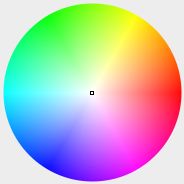
Colour wheel

So what do you answer? Blue? Green? Girls aren’t encouraged to say pink these days, though the same answer from boys may be applauded.

Do you try to be smart and say something like ochre? Or puce? Clever. You get to show off and educate the child at the same time.

But if you really want to twist their brains until you hear that bubble-wrap popping noise, you’ll use the answer that I would give: X-ray.

X-ray is a colour. It is. We can’t see it because our eyes are only tuned to visible light. But X-ray is definitely a colour. Red light is an electromagnetic wave with a wavelength — the distance between successive crests — of about 700 nanometers (nm). That’s just under one thousandth of a millimetre. And the only difference between red light and blue light is that the wavelength of blue light is smaller, at only 400 nm. The wavelength of an X-ray is over a thousand times smaller still, so small it is hard to imagine. It’s only about one ten millionth of a millimetre (0.1 nm).

X-ray is my favourite colour because it allows us to see inside things. We can’t say what colour X-rays look like — we don’t have the experience or the words — but because they will darken photographic film (or, these days, a CCD chip), we can still use them to make images. And since they penetrate matter and objects rather than bouncing off the surface like regular colours, those images can be literally extraordinary.

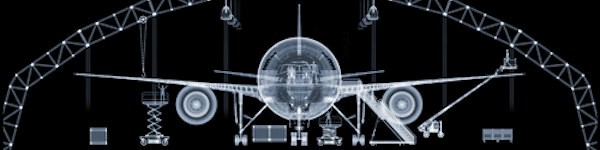
If you have ever been lucky enough to break a bone, you will have had a picture taken with X-rays that reveals the details of the injury. The X-rays go right through you but are absorbed differently by muscle and bone and so cast spooky but informative shadows. The photographer Nick Veasey uses X-rays to take pictures of the insides of lots of different things. Here’s one he took of a plane. Yes, a plane

From Nick Veasey's Plane

X-ray of a plane by Nick Veasey

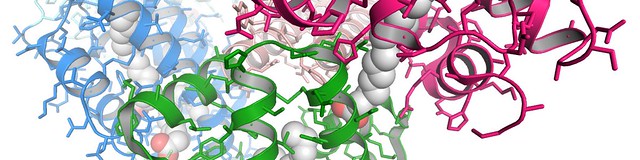
The other great thing about X-rays is that you can use them to see atoms and molecules. Since the X-ray wavelength is so small, the size of a typical atom in fact, it’s penetrating power can reveal the unseen structure of matter. You have to trick that matter into forming crystals (a story for another day) but anything that can be induced to crystallise — and that includes salt, proteins and even viruses — will yield up its inner secrets. With the colour X-ray you can paint a picture of a landscape that few people ever see.

Human Serum Albumin with bound fatty acids

X-ray structure of albumin, which carries fat molecules around the body

Which is a great shame, because all of the atomic interactions that make the world and all of the interactions between molecules that make you you happen in this unfamiliar territory. If more people — they don’t have to be children — knew even a little bit more about what happens in the universe of the molecule, they would ask all sorts of interesting questions.

Posted in Protein Crystallography, Science | Tagged , , | 54 Comments

Hawking with Dinosaurs

Here is a ‘paper‘ that I think would not be accepted by PLoS ONE and yet it was the subject of a report on the Today programme on BBC Radio 4 this morning, arguably the nation’s premier morning news show.

Please have a listen. It’s 3 minutes and 51 seconds long. And it’s unbelievable.

The radio report describes findings in a new paper by Professor Brian J Ford that call into question the ability of large dinosaurs to move around on land. They were too heavy to support their own weight, argues Ford, and so they must instead have spent most of their time immersed in water.

Now, to his credit, the BBC reporter Tom Feilden took this paper to Dr Paul Barrett of the Natural History Museum who is described as “one of the world’s leading experts on non-avian dinosaurs”. Barrett is unlikely to have come across Ford’s paper because it was published in a little known palaeontology journal called Laboratory News.

Although Feilden makes clear that Ford is not himself a palaeontologist – he describes him variously as a “cell biologist” and “polymath”, he doesn’t deign to tell us where he holds his professorship. Nor does he bother to inform the listener that Ford’s paper has not, repeat not, been peer reviewed. This was confirmed to me in a quick email exchange with Phil Prime, the editor of Laboratory News, who cheerfully also described his publication as a magazine, not a journal.

Barrett was polite but gave the paper short shrift. There will no re-writing of the dinosaur textbooks this year. Feilden could have made this assessment for himself with a quick glance at the paper — it’s a provocative piece that relies as much on rhetoric as on ‘evidence’, none of which Ford troubles the reader with through the tedious (albeit scientific) practice of citation.

I don’t know what Ford is hawking or whether he intends to submit his new theory for peer review, but I do wonder at his ability to enchant the Today program.

Such was his hold over the BBC journalist that, in signing off his report, Feilden could not help wondering whether Ford will have the last laugh: “As another famous scientific dissenter was reported to have muttered under his breath when forced to deny that the earth revolved around the sun ‘Eppur si Muove’ — ‘And yet it moves’.

Dear God, this was pitiful stuff. And it has moved me to formulate the Galileo Rule: anyone comparing a random maverick scientist with Galileo loses their science reporter’s badge.


Update (4-4-12, 12:11): I have since come across several other blog responses (i.e. demolitions) to Ford’s article and the BBC coverage of it. They range from the short and snappy (by Dave Hone), the longer but no less pithy (by Mike Taylor — no stranger to these parts) and all the way to a lengthly and clearly argued disquisition by Brian Switek. Frustrated I may have been, but on the upside, thanks to these bloggers I now know a bit more about how dinosaurs lived and walked.


Posted in Science & Media | Tagged , , | 24 Comments

PLoS ONE: from the Public Library of Sloppiness?

I had an argument with my colleague in the tea-room the other day. Gratifyingly, I learned he had been reading my blogposts on the subject of open access, but it soon became clear he did not entirely share my enthusiasm for the topic. Specifically, he criticised open access journals such as PLoS ONE both for their lack of sub-editorial services and for creating a home for poor quality science.

This got my goat, not least because I had made my first submission to PLoS ONE just the day before. We spent some time arguing back and forth and my colleague was kind enough agree to let me lay out the dispute in a blog post. I want to do so because, despite the evident variety of opinion within the blogosphere, it can be easy for the like-minded to coalesce into groups where positions are not so rigorously tested. So please see what you think of my case (since amplified by further reading) and feel free to take issue.

The first charge sticks only partially. There is no copy-editing of articles in PLoS ONE — this is one of the factors that keeps the OA charge to $1350 — but it is nevertheless the case that the articles accepted by the journal are formatted and certainly look like the real thing. Here is an example, selected at random. It may well be that authors miss corrections that a sub-editor would catch but authors can mitigate the worst offences simply by asking co-workers unfamiliar with the paper to proof-read for them. My colleague was prepared to pay a couple of thousand dollars in page charges for formatting and copy-editing (not including open access fee). Perhaps I am a cheap-skate but to me this seems ridiculously expensive.

(As I side-issue I think one of the important advantages of open access is that, by moving all the charges to authors, the real cost of organising and disseminating the scientific literature becomes visible.  Authors at universities rarely see or care about library subscription charges, but the transparency of the OA model provides useful downward pressure on the costs of publishing. Let’s not forget that most of those costs are met from public or charitable purses.)

The more serious accusation, of opening the sluice-gates to a torrent of sub-standard science, bears closer consideration because of the unusual threshold for publication that PLoS ONE operates. Unlike most journals, they do not consider the importance of a paper’s findings when judging whether to accept it:

“PLoS ONE will rigorously peer-review your submissions and publish all papers that are judged to be technically sound. Judgments about the importance of any particular paper are then made after publication by the readership (who are the most qualified to determine what is of interest to them).”

My colleague was troubled by this statement, seeing it as a licence to pollute the literature with low-grade science. There may be a modicum of truth in this view. I suspect it is widely shared, stirred up in part by reports of the reprehensible practices of other OA publishers such as Bentham Science, but I still want to take issue.

First, the publication of mediocre science is by no means the exclusive domain of open access journals. There is an awful lot of it out there, as anyone involved in peer review will know. The scale of the problem is terrifying: half of the 50 million scientific papers estimated to have been published since 1665 were published in the last 25 years. Worse still, the fraction of the literature that is not cited within five years of publication has increased from 55 to 59% in the past 20 years. The incredible growth of the scientific literature, much of it deservedly unread alas, is due partly to the rise in the population of working scientists but probably also, as others have argued, to the excessively competitive nature of science and to increased demands to quantify output.

It’s hard to see that open access journals are at the root of this problem, though they are certainly part of the ecosystem. But even if they are adding to ongoing difficulties within science — issues that need to be addressed separately —  I would contend that this a price worth paying for increasing the accessibility of the scientific literature.

Second, it would be quite wrong to assume that PLoS ONE will publish anything. In fact the journal rejects about 30%* of submissions (according to Cameron Neylon), half of which end up being published elsewhere. So, although PLoS ONE is not judging work on ‘impact’ and although the journal editors and reviewers have to manage high volumes of submissions and are not in a position to apply the rigour that submissions to Nature or Science would be subjected to, the criterion that manuscripts have to report work that is ‘technically sound’ still appears to be providing a useful filter, at least on average: the Impact Factor for PLoS ONE is a respectable 4.4.

That filter might yet be enhanced as a result of changing attitudes to scientific publishing. The Elsevier boycott has focused much-needed attention on both the issue of open access and the very high profit-margins of commercial publishers. Journals from the PLoS stable — and other open access publishers — may come to be seen as more legitimate recipients of the freely-given efforts of editors and reviewers. Any increase in the pool of talent for these roles is likely to sharpen the peer review process at PLoS ONE.

In any case readers provide their own filters. These days, few would browse the tables of contents of all the journals likely to interest them; no-one has the time to scan that much material and in any case the tools for automatic sifting (e.g. via PubMed searches) work far better. An informed reader can quickly assess search results to see if a paper’s findings are a sufficient buttress for the conclusions trumpeted in the abstract. If not, one quickly moves on.

All of this is not to argue that journals like PLoS ONE represent the entire future of academic publishing. Bob O’Hara has sounded a cautionary note about the future financial viability of the PLoS operation, arguing that once traditional publishers jump on the band-wagon, PLoS will find it harder to tout for business. I don’t buy that since I think PLoS has helped to establish an ethos that chimes well with publicly-minded scientists.

But these are certainly interesting, if argumentative, times.


*Corrected on 4-4-12 from an initially quoted figure of 40% in response to a comment from Peter Binfield (who runs PLoS ONE)

Posted in Open Access, Science, Scientific Life | Tagged , , , | 72 Comments

Fabulous night

Tonight, at the end of an exhausting day, I have few words, but it was beautifully clear so I have taken some pictures of the night sky. And made a short film.

The photographs are by no means exemplary. The shots of Orion are not pin sharp. The Moon and Venus are both over-exposed so you cannot see their phases. To the naked eye the moon was only a quarter full – as is apparent in the video below; in the eyepiece of the telescope Venus seemed to me to be about half-full.

This is the first time I have seen a phase of Venus. And, though I could not take a picture, even amid London’s city-glow I could also make out the luminous clouds of the Orion Nebula. I am still very much an astronomical amateur so, modest though they are, these findings pleased me.

It was a fabulous night for star gazing — after a frenetic day, a good chance to recover a sense of perspective.

Moon, Venus and Jupiter

The Moon, Venus and, right at the bottom, Jupiter.


Orion and the Moon

Orion, in all his glory.


Orion

Orion – a closer look


Finally, the moon drifting across the sky. For best results, watch in full screen.

Posted in Astronomy | Tagged , , | 2 Comments