Not at all saturnine about Saturn

Returning home from Lablit this evening at about 11 pm I scanned the clear sky in the south-east and noticed a small bright speck to the left of and slightly higher than the glowing moon. A quick perusal of Starmap on the iPhone told me that this was likely to be Saturn.

At last!

I dashed into the house, had a quick comfort-break (at the Americans so delicately put it), grabbed my telescope and set up shop on our front pathway. The viewing conditions were less than ideal; with the brightness of a near-full moon and the street lights to contend with, I had a little trouble finding the speck. But by blocking the moon with my hand I managed to steer the telescope into position and was immediately rewarded with my first sighting of Saturn:

Saturn and little Titan
Saturn and (I think) little Titan

I know it’s not new. I knew exactly what to expect. Except that I didn’t really. Not really. I was still delighted with the ‘find’ – the pale disk with the handles. I stood there for several minutes, crouched over the telecsope, grinning like a loon. I just could not help but smile.

I diverted myself briefly to have a look at the lunar surface in all its pitted glory but even that couldn’t keep me from Saturn. So I went back to the planet and smiled some more.

Posted in Uncategorized | 14 Comments

Scientia Pro Publica 22

Roll up! Roll up! Lay-deeeez and Genne-men! Step right in! We have here today for your delectation and amazement a veritable cornucopia of comeliness, a festival of fecundity, a very large bucket of sciency bits, in all their wondrous and freakish varieties. We present Scientia Pro Publica Number Twenty-Two!

Like a barnacle’s penis, this edition of Scientia Pro Publica is long and strange and packed with seeds–for thought. There was a veritable plethora of submissions, ranging from flit-stops that sought only to highlight single point of interest to deeply rewarding essays on the nature of knowledge and the conduct of science. To help you navigate this landscape of riches, I have arranged the posts into sections that arose fairly naturally from the content. Please peruse all the way down to the very bottom; there is, I hope, something for everyone. My own personal favourites I have marked with a pair of asterisks**.

STRANGE CREATURES

You will not believe the bizarre creatures on offer in a magnificent post by Henry Gee that describes some of the planet’s freakiest animals** and celebrates their diversity: “These creatures still have the power to instil a sense of wonderment, reducing us all to slack-jawed six-year-olds.” But this creaturely diversity is not confined to the large animals that roam our planet: the Lab Rat blog begs us to consider the wonders of multi-celled bacteria and the curiouser Volvox, which likes to dance!

But that is by no means all. Kathlyn Stone reports on recent discoveries that the dinosaurs were a more colourful crew that we had supposed, and declares that “the books saying the color of fossil animals is a great unknown will have to be rewritten.” Bec at the RunningPonies blog is also re-writing the book on dinosaurs. She tells us that one of them–Sinornithosaurus–may have been endowed with venomous fangs and in an witty twist imagines the troubled life the venomous dinosaur might have led had it relied too much on its fangs during social intercourse.

Speaking of intercourse, who would have thought you could suffer penis envy next to a barnacle? But as Kelsey at the Mauka to Makai blog writes of the barnacular appendage–in a fabulously funny post** that had me laughing out loud–“It’s really, really long and covered in chemosensory bristles…!” More hilarious still are the descriptions of how the scientists investigated this phenomenal organ. It is not to be missed. But nor is Kevin Zelnio’s more serious but no less fascinating take on Darwin’s eight-year study of the barnacle — a key contribution to the evolution of his theory of evolution.

And the wonderment doesn’t end there. Kelsey returns with the peculiar tale of what a crazy old ant-eats-toad-which-doesn’t-eat-sugar-devouring-beetle world it is in Austrialia. No less strange is Steffi Suhr’s account of a photo, taken at 4000m beneath the sea, of mysterious fairy rings. Her post draws a response from an old colleague, the photographer, who waxes poetic at the memory of the enigmatic rings. Scientists are as varied as the creatures they study.

Far from the sea bed are the city streets, the modern habitat of the much maligned pigeon. But look again, Ladies and Gents, as Jess Porter Abate seeks to sanitise the reputation of the rock dove: they are not the couriers of disease that many people believe them to be.

ATOMS AND MOLECULES

Things can be pretty strange and surprising at the atomic and molecular level too. Tom Tritton at Periodic Tabloid, for example, writes about the possibly pernicious–but still mysterious–effects on disease outcome of just four little atoms, three of hydrogen and one of carbon, that make up a methyl group. The role of the human immunodeficiency virus (HIV) in causing devastating disease is more well known, of course, but continues to bewilder. David Munger describes how the tiny HIV protein molecule Vif prevents the human immune system from disarming the HIV virus.

To see these atomic and molecular actors requires machines and techniques of great ingenuity. In the Wood for the Trees blog, Maria reports on the penetrating power of the latest and greatest nuclear magnetic resonance (NMR) machine and on how the community of scientists that use this technology to visualise molecular structure is harnessing the tools of Web2.0 to share their skills and move science forward, faster.

MATHS, PHYSICS AND PINKS

Atoms are at the heart of the realm of physics but the reach of this subject is broad and wide. While Alyssa Gilbert–an astronomer who has recently made a career shift into the the study of earthquakes–was reading the literature to get up to speed on her new field she was delighted to find a surprisingly intimate connection with her stellar interests.

Meanwhile, Kathlyn Stone at Flesh and Stone writes about an Aussie fashion designer who, simultaneously inspired by a Simon Singh documentary on Fermat’s last theorem and taken aback by Lawrence Summers’ archaic views on female science ability, solved the equation by coming up with Maths Jeans for Girls. It’s probably too early to say how successful these will be. Podblack Cat is likely to be pessimistic; news that Dell are selling pink Dell laptop led her to a reflective post on gender stereotyping through toys. Though she recounts the tale of one computer scientist who was inspired by the complex braiding work she did as a child with the tail of her My Little Pony, this seems to be an exception. More commonly, gender stereotypes are reinforced by the images and colours transmitted through playthings to boys and girls.

Toys are also the subject of Edmund Harris’s entry. He takes the humble spirograph, a favourite of my own childhood, whose wheels within wheels can generate the most elaborate patterns (as long as you had a steady hand) and, with a dash of computer wizardry, generates spirograms in glorious 3D**.

“!http://maxwelldemon.files.wordpress.com/2010/01/image.png?w=450&h=337!”:http://maxwelldemon.files.wordpress.com/2010/01/image.png

3D spirogram from Edmund’s “Maxwell’s Demon blog”:http://maxwelldemon.com/2010/01/14/spirographs-and-the-third-dimension/

THOUGHT FOR FOOD

Back in two dimensions, Luigi from the Agricultural Biodiversity Weblog recently viewed the Mosaics of the Seasons that pattern the walls of the 5th century Byzantine church at Petra in Jordan and started to think about what the Natabean people managed to grow in their desert country.

Moving swiftly forward to the present day, but keeping with the agricultural theme, Jeremy from the same blog was impressed by Sendhil Mullainathan’s TED talk on how to overcome traditions to persuade Indians to introduce new and more productive farming techniques. Eric Michael Johnson considers a similar problem of economic incentivization in Haiti. He discusses a recent paper that evaluates the Haitian governments’s options for improving its farmer’s livelihoods and protecting its environment: turns out incentives may be better than taxes.

YESTERDAY AND TODAY

Rewinding into the mists of time gone by, Eric is on hand again to deliver a gruesome, grotesque and grievous story of hairy excretions in a woman’s urine that baffled medics 300 years ago and continues to do so today. Less gruesome but kind of curious is the tale told at, well, KindofCurious, about Jefferson’s use of biology to score diplomatic points agains the French!

History is on Kristi Vogel’s mind too in a lovely post that weaves together the physics and physiology of the skeleton riders–lately seen careering down the mountainside at the Vancouver Winter Olymics– with the artistry of their helmets and the history of locomotion over snow and ice. You may be gratified to learn that “humans can now ski 2.6 times faster for the same fuel costs, as they could in 542 CE.”

On a more sober note, African American PhD student Danielle Lee at Everyday Citizen, casts a sombre eye on the tragic shooting in the Biology Department at the University of Alabama, Huntsville on the morning of February 12th. Having looked forward to a future where she might rub shoulders with other black professors, she notes sadly that, although only 1-3% of American PhDs are awarded to blacks and other minorities and fewer still progress to professorial status, two of the three faculty members shot dead by Dr. Amy Bishop were African Americans like herself, while the third was Indian American.

HUMAN BRAINS AND BEHAVIOUR

It seems unlikely that anyone could have predicted Amy Bishop’s state of mind on that fateful morning. The complexity of the human brain and the mind that it engenders are still in many ways beyond our ken. Nora Volkow takes this as her subject and reflects on developments in brain science in the past 20 years, noting that even the mature adult brain is “far more plastic–changing and malleable–than we originally thought”, while Warren Davies explores some of the difficulties in understanding the complexities of human behaviour through genetics.

Elsewhere, The Autism Crisis blog presents a surprising and fascinating post** on a recent paper that purports to show how treatment with oxytocin can strip autistic individuals of their altruism and make them as hypocritical as the rest of us, while Livia Blackburne considers impact of a recent paper on theories of dyslexia – is the condition due to deficits in auditory or visual processing or both? As so often in science, it is too early to tell.

Stepping more lightly, David Bradley forages deep into Gladwell territory to discuss whether people’s perception of how lucky they feel depends on the month they were born. It’s a nice example of the the difficulties in explaining differences in human psychology as a function of simple parameters like birthdays.

SEEING AND BELIEVING

The brain is the centre of perception and, though capable of many feats (some of the more impressive ones listed at the Nurse Nut blog), it can easily deceive us too.

In what I thought was one of the most interesting submissions to this carnival, Alexandre Couto de Andrade (Science Culture and Knowledge) presents a compulsive and multi-faceted essay on acculturation and the institutionalisation of knowledge** that challenges our perceptions of what we think we know. “The volume of information produced everyday is so overwhelming that even specialists are frequently incapable of knowing what is new in their own fields, let alone what happens in other areas. This generates a bizarre situation in which, in spite of everything that humankind already knows, the vast majority of us remain chained to false beliefs and delusion. Not even the most well informed people are immune to that.” You will need to read the whole post to properly appreciate its richness.

Hard as it is to understand how we think, it can be difficult for us even to have a true grasp of what we see. Brian Clegg wonders about the (un)reliability of eye-witness testimony, while GrrlScientist reveals that even in science some visual observations–in this case ‘sightings’ of the ‘extinct’ Ivory-Billed Woodpecker–may also be highly questionable, grounded more in faith than in fact.

At The Evolving Mind blog, Andrew Bernadin notes there can be a disconnect between what individuals honestly report and what is actually the case but goes on to describe work that seems to show that women’s responses to sexually arousing stimuli are considerably more complex than men’s, which strikes me as being rather accurate. What the views of barnacle’s are on this important matter is, unfortunately, not recorded.

CAREERING IN AND OUT OF SCIENCE

Careers seems to have been on several people’s minds of late. At the Weird Science blog Greg Fish considers the general question of supply and demand in university level education. He argues passionately for “institutions which encourage people to explore and broaden their horizons” but which emphatically do not propagate the irresponsible myth that degree programmes are right for everyone or “will eventually yield a career which can ensure a stable living wage.”

Co-incidentally, these ideas on the economy of education and employment were taken up by several posters on Nature Network last week who collectively provide a clear window onto the difficult real-life issues faced by scientists as they try to get established as independent investigators. Jennifer Rohn focuses on the crazy and sometimes cruel career structure offered to scientists and calls for nothing less than a revolution**. This stimulates a long and thoughtful comment thread which is well worth reading. Bob O’Hara also tackles the economy of science careers and–as a principal investigator–provides an interesting counterpoint to Jennifer’s post.

These threads stimulated further, personal reflections. Ian Brooks, a former postdoc who reluctantly left the lab and now works in science administration writes frankly and movingly about the transition, but also of his delight at re-discovering that his scientific muscles are still working. By contrast, Eva Amsen describes making the positive choice to move away from lab-work having recently and enthusiastically embraced a career in scientific publishing.

A CLIMATE OF OPENNESS

And finally, the recent hue and cry over various ‘scandals’ in climate science has stimulated a lot of nonsense in the blogosphere, but also a deal of absorbing analysis. There seems to be a consensus view that the best remedy to the perceived ills is to strengthen the open nature of scientific work.

At Wood for the Trees, Maria draws some interesting parallels between the reluctance of some climate scientists to publish their raw data with the early years of the Protein Data Bank which, though resisted by some at its inception, is now the repository de rigeur for life scientists who have worked out the structures of biological molecules such as proteins and RNA.

Climate science is a preoccupation at Southern Fried Science where, in a tongue-in-cheek swipe at climate change sceptics, Southern Fried Scientist writes from the perspective of an observer who sees the tide going out and draws a rather drastic conclusion!

More seriously, David Colquhoun is somewhat surprised to find himself writing about climate science, since he is better known as a scourge of quack medicine. But he thinks that the climate science debate “provides a good context to think about trust in science” and does not disappoint. His inspiring and wide-ranging post** knits together several important themes relating to scientific honesty (some of them touching upon issues raised in the posts about scientific careers) and is a rallying call for the value and values of science. It ends with an intelligent and moving video, that everyone should watch, in which Jacob Bronowski defends science as a quintessentially human activity.


If you enjoyed this Carnival, be sure to check out previous additions listed on the Scientia blog. And don’t forget to keep thinking about submitting posts for the next Carnival which will be hosted on 15th March at Pleiotropy.

And GrrlScientist is always on the look out for new hosts. I can tell you that hosting is a bit of work but a great way to expand your blogospheric horizons!


Postscript: Please feel free to comment below to mention your own favourites as a further guide to Carnival readers but make sure to leave a comment on the authors’ sites as well to let them know of the impact of their writing.

Post-Postscript: Let me know asap if you find any broken links!

Posted in Communication, Scientific Life | 28 Comments

Science in Court

Yesterday morning I made my way to the Royal Courts of Justice in London’s Strand to attend the Court of Appeal hearing in the libel case brought by the British Chiropractic Association (BCA) against Simon Singh. I went partly to offer some small measure of moral support to Simon but also, I must confess, because I had never been in a courtroom in my life and was curious to see what goes on.

There have already been a couple of accounts of the day’s proceedings, in particular an expert lawyerly analysis from JackofKent, a lively first-person report from Crispian Jago and a useful summary from Austin Elliot here on NN. For background, see David Allen Green’s excellent piece in The Lawyer.

Singh Supporters at the Royal Courts of Justice
Supporters gathering outside the Royal Courts of Justice

So there isn’t much more to add. I’m certainly not qualified to dissect the legal niceties and implications of today’s proceedings; and I was only able to stay for the first act, so to speak. But it was a fascinating morning and I wanted to give an impression.

A decent crowd had gathered outside the court by 9:45, just before Simon arrived. He gave a short pep talk to the assembled supporters, thanking them for coming along and then we all trooped inside. Once through security–a sort of airport-lite arrangement–the crowd headed along marbled and then linoed corridors to Court 71 where, unfortunately there were only seats for about 30 members of the public.

Simon Singh at the Royal Courts of Justice
Simon speaks as his solicitor, Robert Dougans (left) looks on

The court-room was a modern affair; light from a suspended ceiling illuminated magnolia walls and a pastel red carpet. As far as I could tell, the legal teams of both sides occupied three of the four rows of seating in the centre of the room; the final row and seats at the back were taken by the public, all of whom seemed to be Singh supporters. The press were seated in a line on the left side of the room (I found a spot at the end of that line, near the back of the court). On the opposite side of the room, across from me, the clerks kindly found some additional chairs to allow as many people as possible to attend the hearing, though quite a number of people were still not admitted.

At the front of the court was a raised platform, faced with wood, behind which stood three high-backed red chairs. While the crowd settled, clerks and attendants fussed around these, adjusting cushions and organising paperwork. As 10:30 approached the noise of conversation diminished to a low murmur of voices.

Then it began: “Court rise,” announced the clerk. We all stood up and nothing happened. Then again “Court rise”–the clerk had clearly jumped the gun–but I was moving my bag and didn’t see the three judges enter the room. If someone had told me they emerged vertically from the floor I might have believed them, such was the sense of presence. There they were, three grey-haired men: on the left, Justice Neuberger, Master of the Rolls, in the middle Lord Chief Justice Judge and on the right Lord Justice Sedley. Their lordships were dressed identically; there were no wigs, but each was wearing a black cloak trimmed at the collar with two golden strips of dangling silk.

We immediately got under way. Singh’s counsel, Adrienne Page QC, took the floor and announced she would be presenting her case up until about 1 pm, leaving time for the BCA’s QC to speak in the afternoon. At least the QCs were wearing the traditional horse-hair wigs.

Page launched into her argument, taking a little time at the beginning to introduce the defendant, Singh, and the claimant, the BCA, to their lordships. Her voice initially sounded slightly wavering to me, indicative of nerves perhaps? But if that was the case she soon seemed to recover her composure.

The case for the defence that she developed was long and multi-threaded. Page rehearsed the initial complaint by the BCA and wove a complex argument that explored meaning and interpretation (especially of the phrase ‘happily promotes bogus treatments’), the nature and quality of evidence (and why Singh and the BCA might easily have different views as to what constitutes good evidence), the impossibility of proving a state of mind (and so dishonest intent), the import of European and English case law and the wider implications of trying to settle matters of science in a court of law.

I listened closely but I won’t pretend that I followed every strand of the case. The ready use of legal jargon by the judges and the QC made it hard work to keep up. Added to that most of the players were softly spoken and Page, who talked the most in the morning session, was facing away from me.

What struck me from the very outset, though, was the sheer strangeness of hearing science discussed in such detail in the unfamiliar surroundings of a courtroom.

No less striking was the air of professional courtesy that imbued the proceedings with an exceedingly civilised ambience. The judges were patient and polite, apologising on one occasion for having spoken to softly (Neuberger) and on another for having left part of the paperwork behind in his rooms (Judge). At several points they waited patiently, to allow Page the time to find her place in her notes. There was no arrogance or superiority, but a keen and tenacious interest.

There were plenty of probing questions from the judges, testing and stretching the argument. When this happened Page had to think quickly on her feet, but she was adept at doing so. She might pause for a moment but on each occasion that I witnessed, she took great care not to cede ground and was able to provide a substantive reply. I could see where at least some of the money was going.

Also surprising were the moments of levity that were sprinkled through the proceedings. At one point, where the interpretation of the article in the mind of the reader was being discussed, Sedley confessed to resisting the temptation to discuss Guardian readers as a subspecies of humanity!

The case for the defence took almost two and a half hours to present. It was carefully and methodically done. When necessary Page would draw the judges’ attention to this or that piece of documentation, referring to a particular page in this tab of that volume and we would wait while each of them hoisted the large binders into place from the racks at their sides and flipped to the correct page. The heavy manoeuvring of all this paperwork lent an archaic gravitas to the process; I suspect the judiciary will resist computerisation for some time.

But I’m not here to poke fun (though I was a tad disappointed that at no point did anyone stand up to shout ‘Objection!”). I was, in fact, impressed by the conduct of the proceedings. Between them the judges and the QC performed a rigorous dissection of the main points of the defence case. I would go so far as to say that I have a newfound respect for the legal profession. It may be a scandal that the libel law of England and Wales permits such cases–where the issues are matters of science and public health that need to be fully and publicly debated–to be dragged through the courts. But I was re-assured on this morning’s evidence that, once in those courts, due and intelligent process is possible.

Tempted as I was, I couldn’t stay for the afternoon session but gather from other reports (see links above) that the judges were at least as quizzical and perhaps even more critical of the case made by the counsel for the BCA. It does seem to have been a good day in court for the freedom of science, but as JackofKent wisely cautions, it is still too early to tell. The judges’ ruling will only be available in a few weeks and their demeanour in court should not be taken as a guide to the final outcome.

And as Simon Singh himself was at pains to point out, this case is far from over and he is not the only scientific victim of our dreadful libel laws. That is why it is important that we continue to support the campaign for reform.

Posted in Libel Reform | 13 Comments

The Carnival Cometh

Grrlscientist and Bob caught me napping the other day and before I knew it, I had agreed to host the next Scientia Pro Publica, which will be published here on Monday 1st March.

 
So, if you’ve read or written a blogpost about science, nature or medicine in the last couple of weeks that you think might enchant or enthrall a public audience, please think about submitting it to the carnival.

And if you haven’t read or written something suitable, then perhaps—my friends—it is time to get down to work?

Riding high
The public, being enthralled.

Please submit your entries using the automatic form. You have a few days to ponder the matter but in the meantime {looks around meaningfully}, please spread the word and put your thinking caps ON!


P.S. I’m going to be away for much of the next 2-3 days so please don’t be put out if I don’t respond to comments. If you want to email me something, please send it to s.curry at imperial dot ac dot uk.

Posted in Uncategorized | 15 Comments

New Moon

I have little to say this evening apart from reporting that I came home tonight and caught the new moon before it dipped behind the trees. Thought some of you might want to have a look.

New Moon - Feb 2010
Moon over Kent

And my daughter and I espied the Orion Nebula; unfortunately my photographic equipment is not up to recording that.

But this astronomy lark is the business.

Posted in Astronomy | 40 Comments

From the pedestal – take 2

Updated at 10:30 am

Following my brief and angry post last week about Simon Jenkins’ wayward accusations against scientists in The Guardian, Bill Hanage and I have written a more temperate but no less strongly felt response that has appeared in today’s paper (page 33 if you have a copy).

The article has now appeared online (thanks to Richard for spotting it – see comments) but here below is the copy that we submitted (the printed version was slightly curtailed in the edit). I’ve also restored our original title since I prefer it to the one used by the paper (‘We’re not on a pedestal: peer review keeps scientists grounded.’)

Pedestals are not part of the scientific apparatus

Simon Jenkins is dismayed by reports of the lax behaviour of some IPCC scientists and the allegations of some stem cell researchers that their work is being held up by rivals during peer review. Conflating these stories with his ill-founded distrust of epidemiology he paints a grim picture of science and scientists as corrupting and corruptible: “They cheat. They make mistakes. They suppress truth and suggest falsity, especially when a cheque or a plane ticket is on offer.” According to Jenkins, the profession is a dangerous ‘clerisy’ that “wants the public to regard its role in society and the economy as axiomatic — with no obligation to prove it.”

If Jenkins aimed his rhetorical flourishes to get a rise out of scientists then, judging by the comment thread beneath the online version of his article, he succeeded admirably. The howls of protest are not so much from righteous anger however, as our frustration with his misrepresentation of the scientific process. Jenkins is an intelligent writer with an avowed love of popular science: why then does he have so little appreciation of how science really works? His closing statement betrays the scale of his misunderstanding: “Only when science comes off its pedestal and joins the common herd will it see the virtue of self criticism.”

If he had taken the trouble to talk to some real scientists, Jenkins would have discovered that very few are sat on pedestals—the vast majority live and breathe in a daily scrum with our intensely sceptical colleagues, whom we must convince of the logic and quality of our experiments. The fear of being found wanting by your peers is a powerful incentive for exactly the self-criticism Jenkins claims is lacking. We have no experience of the “two decades of uncritical flattery” that he alleges to have blunted scientific rigour. The peer-review process, unique to science, may be an imperfect and controversial mechanism for weeding out error but it is a powerful one. The great strength of science in the long run is its ability to transcend the acknowledged frailties of individual scientists. This is clearly seen in the fact that most of their mistakes are unearthed not by journalists or sceptical bloggers but by other scientists.

Jenkins might also have learned that scientists are a heterogeneous and rambunctious lot—people in white coats should not be mistaken for sheep. Popular science can sometimes give the mistaken impression that science is a linear progression from ignorance to glossy fact. But no human endeavour ever works so smoothly or can claim to be perfect. Science is not above criticism or argument— it is our stock-in-trade—but if you are going to take swipes at it, Mr Jenkins, you should take a harder look at the evidence.

The fact remains that science offers us the best hope of informing society’s difficult choices in an uncertain world, so it is important that scientific knowledge is communicated accurately to the public. Scientists are not in the business of handing down incontrovertible truths. We deal in observations and theories, couched in uncertainty and bracketed by error bars, to produce our best models of how the world works. Science is a messy and difficult business so the explanations that we have to offer are not always easy to digest. Talk to real scientists about their work and you will frequently find yourself deep within a narrative that is swathed in caveats and unknowns. These complex stories demand good communicators; scientists could do better at this themselves but we also need to enlist the help of talented writers who will take the trouble to engage with the reality of science. Mr Jenkins, we need to talk.


Posted in Uncategorized | 78 Comments

From my pedestal

I just wanted to clamber up onto my pedestal for a moment (it’s rented – I don’t actually possess one) and shout at the very top of my voice that Simon Jenkins has written an article in The Guardian that has made me VERY, VERY, VERY, VERY, VERY, VERY, VERY, VERY CROSS!!!

I’ve already commented there (as scww) and have nothing more to say on the matter tonight. Is it just that Jenkins is an ignoramus when it comes to science or is this sort of awful ‘journalism’ somehow our fault?

Thank you. I’m feeling a bit better already.

Posted in Uncategorized | 78 Comments

Puff The Biochemist

Thought that some of you might like to know that the latest (Feb 2010) issue of The Biochemist is running a special series of articles on Science and the Media; science communication if you will. There’s a piece by yours truly on science blogging and one by Jenny Rohn on scientists on screen (not read it yet, but you know it’s going to be good!).

That’s not all: among other pieces, Tracey Brown of Sense About Science (a stalwart of the libel reform campaign) writes about the ‘second golden age of science communication’.

The articles seem to be free as long as you are prepared to register your soul with the Biochemical Society.

Posted in Uncategorized | 11 Comments

Homeopathy: That’s Numberwang!

This morning I attended a my first ever publicity stunt. The 1023 overdose event, initiated by the Merseyside Skeptics, was held in cities around the UK and the rest of the world.

Our particular group assembled in the lightly frosted but thoroughly freezing Red Lion Square in Holborn, London. I was more than happy to hand over £5 for the 1023 t-shirt—glad of the extra layer of clothing!

1023 alludes to Avogadro’s number, 6.02 x 10²³ (the number of molecules in the molecular weight in grams of any given compound). The link to homeopathy is ironic, playful, since typical homeopathic preparations involve dilutions of up to 1060. Such dilutions are extremely unlikely to contain even a single molecule of the original ‘active’ ingredient (setting aside for a moment the bizarre methods that homeopaths use to ‘prove’ that their ingredients are active) and therefore contain nothing. Recognising this, a little belatedly perhaps since Avogadro’s number was only evaluated in about 1908, homeopaths have adopted the view that water has memory and somehow can remember and impart the therapeutic benefit of molecules that have long since been diluted away. No credible molecular mechanism has ever been advanced for this memory effect. How that memory is transferred to a dry sugar pill is also mysterious.

But not curious.

Not even slightly interesting because the evidence accumulated in 200 years of homeopathy shows that it is no better than a placebo. There is an interesting discussion to be had on the ethics of treating people with placebos, since they are undoubtedly effective for minor, self-limiting ailments. But not this morning which was simply about drawing people’s attention to the fact that, by their own admission, Boots the Chemist sells ‘medicine’ for which they have no evidence of efficacy.

This kind of craziness is on a par with Numberwang.*

So this morning we stood around, chatting, stamping our feet to keep warm, watching the TV crews and journalists interviewing the organisers and celebs who had come along to participate.

Martin Robbins tries to explain

My drugs of choice, Arsen. Alb. 30C (a 1060 dilution of arsenic) came in a handy container, a bit like a sweetener dispenser that only releases one sugar pill at a time. However, with keys and teeth I managed to prise off one end so that I would be able to take the whole lot at once. If I was going the whole hog, it might as well be dramatic.

Impotent stuff

Just before the off, there were short speeches from Simon Singh, Evan Harris MP and comedian Dave Gorman. There was a count-down to the overdose and, along with everyone else, I filled my mouth with little balls of sugar and washed them down with water (also from Boots and, at 80p, considerably cheaper than the £5 pills).

And then, of course, nothing happened.

Mass overdose
Nothing happening to a large crowd being filmed

There were a few more interviews, a few more hellos and goodbyes and people dispersed. I made my way to South Kensington and to Imperial for a couple of hours work. A quiet Saturday morning is a good time to get down to some of the donkey work needed for an upcoming paper. Appropriately perhaps, the paper will be about how drugs bind to a protein, human serum albumin, which is abundant in the blood stream and can cause problems for drug delivery since many compounds stick to it too tightly. If that happens, you have to give a higher dose to make sure that a sufficient drug concentration reaches the target organ. Because you need to have a high enough number of drug molecules at the site of action to have an effect.

This problem of drugs sticking tightly to albumin is commonly encountered in drug development and needs to be overcome if a successful therapy is to be brought to market. Our crystallographic work shows exactly where and how drugs stick to HSA, and could be used—we hope—to influence drug design and so enhance delivery and efficacy.

Molecules binding to protein
Superposition of diazepam (lilac) and a dansylated amino acid (light-blue) bound to drug site 2 in HSA

The particular study we are hoping to publish will report several new structures of dansylated amino acids bound to albumin; these are fluorescent compounds that can adhere to the drug binding sites on HSA and are commonly used during drug development in assays to determine where any new lead compound might be binding to the protein. The figure shows that one of the dansylated amino acids in our study (the stick molecule with light blue carbon atoms) binds in exactly the same place as a molecule of diazepam (lilac carbon atoms). This result neatly explains why molecules of diazepam would reduce the fluorescence of a mixture of HSA and the dansylated amino acid: the drug displaces the dansylated amino acid out of the binding pocket and into solvent where its fluorescence is quenched.

After a slightly surreal morning, it was nice to return to a reality where numbers add up and things make sense.


*Apologies to our international friends who may not know Numberwang, a pointless game show comically imagined by Mitchell and Webb, who were also responsible for one of the best homeopathic sketches ever seen.

Many thanks to @carmenego, my drug-dealer du choix, for supplying my hit!

Posted in AltMed, Protein Crystallography | 61 Comments

Still Running

After a slight delay, I had an idea for a blog post and I’m going to run with it. Hope you can keep up.

I have started to run. I have known for a long time that I needed to do this but it took a build-up of pressure to get me moving. It is for my own good. I am feeling the pain but also, still somewhat to my surprise, the benefit.

So far I am managing to go running about three times a week. I am the slowest jogger in the park but that’s OK – it’s not a competition. I am not racing. Most definitely not racing. In fact, part of the reason for running is to get away from from my racing mind, from the constant streams of thought that the life of a scientist drives through your head. In a sense I am running to find a way to stand still.

I say running but strictly I’m jogging. Well, I say jogging but in truth it’s more of a slow plod. And as I plod I am usually plugged into my iPod. I tend not to listen to music – too fast. The slower pace of the human voice is more in tune with my motion. On Monday of last week as I pounded around Kensington Gardens I was listening to Front Row, a Radio 4 review of the arts. I heard Mark Lawson’s polished back-of-the-throat voice (that I find strangely appealing) as he spoke to Jonathan Miller about an exhibition of photos that Miller has curated for the Estorick Museum.

Rather appositely for my run, the exhibition is called ‘On the move’ and seeks to show how photography came to give new insights into the motion of people and animals and to influence the work of artists, who had sometimes struggled to capture the true dynamics of movement in static media such as painting and sculpture.

Miller waffled on a little too portentously for my liking but my interest was piqued and so on Saturday I made my way to the Estorick in Highbury and Islington in north-east London. I took the train – it’s a little far to run.

The exhibition starts with the work of the improbably named 19th Century photographer Eadward Muybridge who was commissioned by Leland Stanford, a horse-racing governor of California, to settle a bet about how horses ran. Because of the speed of movement as they galloped over the turf, no-one was quite sure how their legs moved and, crucially, whether at any point, all four legs left the ground. Eventually – the work was interrupted by Muybridge’s trial for the murder of his wife’s lover – by using a clever arrangement of trip-wires and high-speed cameras, he was able to capture a sequence that settled the point. They do.

Muybridge's horses

It was a breakthrough that ultimately convinced the artistic community to change their ways. The previous tradition of rendering horses with a rocking horse gait (fore and hind legs stretched out) was abandoned. Curiously, there was initial resistance because Muybridge’s images differed from the perceived reality (probably largely based on paintings); only after he had assembled a moving image from his sequence of stills to re-create the familiar running motion of a horse were people convinced that the camera had not been lying.

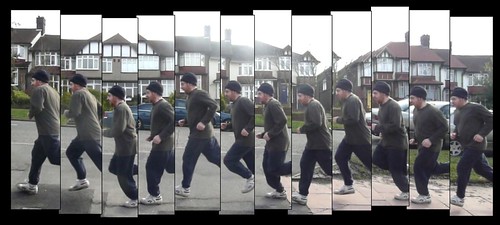
These days with a digital camera, it is quite easy to replicate this technique. I got my daughter to film me in motion and this is the sequence that it produces. It reveals that even with my leaden step, there is one instant at which both feet are off the ground:

Stephen runs - panels1

Muybridge went on to apply his technique to other animals, and to men and women, mostly scantily clad (his interests were prurient as well as scientific). But although his technique captures the elements of motion, it loses the dynamic. The movement is broken apart and his images are strangely static. The eye does a poor job of re-creating the motion in the mind.

A different approach and one that is more visually appealing was developed by the French photographer Etienne Jules Marey who worked out how to capture a sequence of stills on a single image. He did this using cameras with high speed shutters. Marey’s images retain a sense of dynamism and are immediately more… arresting. He photographed runners and jumpers and even birds in flight. The latter impressed him so much he commissioned an artist to render the bird in a statute that is on show at the gallery.

In later work – some of it funded by the French military in the hope that the analysis of motion might help to devise better training regimes for their troops – Marey sought to abstract the movement into its elements. He would dress his subjects in black but affix bright white strips to their arms and legs. There resulting images have faded somewhat but retain an mathematical beauty, swathed in curves that connect the swinging lines; they are like spirographs partly unwound.

Marey's lines
Marey’s ‘lineograph’?

Marey’s chronophotographs, as he dubbed them, were artistic in themselves but clearly inspired artists such as Giancomo Balla to try to capture the dynamism of motion in paintings, as here below in The Hand of the Violinist. I have to say, I prefer Marey’s photos.

Violinist by Balla
The hand of the violinist (Balla)

In the 1920s the baton was passed back to the US where an MIT engineer, Harold Eugene Edgerton, improved on Marey’s technique by incorporating multiflash or strobe lighting. The regular bright pulses of light gave much better illumination of the subject and, along with faster emulsions, yielded crisper images. Edgerton also worked on high speed photography and was responsible for iconic images of splashing milk drops and bullets smashing through fruit that many of you will already know (though none are represented in the exhibition).

Though an avowed engineer (“I am after the facts. Only the facts.”), Edgerton collaborated with the Italian photographic artist Gjon Mili whose pictures are among the most memorable of the exhibition. Using a creative combination of lights attached to his subject and bright flashes, Mili conjured some brilliant images. A particular favourite of mine was his picture of a violinist in action. To me this is more evocative of the music and the musician’s artistry than Bella’s painting.

Violinist by Mili
Mili’s violonist

I’ll say little more – this is only meant to be a taster. It’s not a very large exhibition but I found it absolutely fascinating; there is an eclectic collection of images and objects. Miller, for all his bombast, was not too stuffy to include cartoons images of Billy Whizz from The Beano, arms multiplied as he threw snowballs, that made me smile in recollection. But more eloquent and more moving was a sculpture of fluid beauty inspired by the wing-beats of a dove taking to the air:

Dove in flight
Poetry in motion.

Stirred by the exhibition I made my own homage to Marey and Mili. I will leave it to the reader to judge whether this constitutes any kind of poetry in motion. I fear not.

Stephen running - panel2
Prose in motion?

Which brings me back to running. The images from the exhibition each sought to extract an instant of stillness from the moving subject, whether runner or musician or horse. In my own running I am also seeking a kind of stillness – a moment of peace, an escape from turmoil.

Curiously, as I headed out the door on Saturday to take the train up to London I grabbed my old copy of John Updike’s Rabbit, Run. I suppose this blogpost on running was on my mind and triggered a memory of the title. The book is the poignant and painful story – written in Updike’s trademark exquisite prose – of Harry ‘Rabbit’ Angstrom for whom the American dream is not working, though he can’t figure out why. His solution is to keep running away, but he can never seem to outrun his misery.

Updike book

The cover refers to the book’s opening which has Angstrom dallying in a side-street on his way home from work, watching some kids playing basketball. He is reminded of his own youthful prowess at the sport; he tries to join in, to recapture something he knows he has lost.

I don’t want to overload this piece with symbolic weight. I am not the tragic figure of Rabbit Angstrom, though my own recourse to running is a kind of escape. I thought I might be able to use the book to make a connection. There was one, but it turned out to be astonishingly coincidental.

As I mulled and turned the book over in my hand I read that the photograph on the front cover of young Americans playing basketball had been taken by Gjon Mili.

Posted in Fun, Scientific Life | 62 Comments

Science and Politics Mix

Tonight I attended a science policy debate organised by CaSE at the Institution of Engineering and Technology on London’s Embankment. Chaired by Roger Highfield, the editor of New Scientist, the debate featured the science spokesmen from the three main UK political parties, Lord Paul Drayson (Lab), the currrent Minister of State for Science, Adam Afriyie (Con) and Dr Evan Harris (Lib Dem).

Science Policy Debate
Ready for action

As in Question Time, the audience had been invited to submit questions for the three panelists and these were used to drive the discussion. The debate, which you can watch online, ranged over a variety of topics with the overall aim of teasing out the positions that are likely to be adopted by the different parties in the upcoming general election. These included science funding, the impact of ‘impact’, science education policy, the role of charitable and private funding of science, the role of scientific advisers and last, but by no means least (and well done to Sile Lane of Sense about Science who raised the question), the partys’ plans for libel reform.

The answers of all three contained no great surprises. Roger Highfield did a pretty good job of keeping the minister and the MPs on topic but there was only one point at which the audience was offered the chance to ask follow-up questions. This meant that some rather slippery statements were made without much of a challenge and I’m glad Evan Harris was there because he did a good job of taking the other two to task when this happened. He managed to get Drayson to concede that ‘efficiency savings’ were synonymous with cuts (the minister had stunningly opened his remarks with the contention that there had been no cuts – contrary to reports in the press or the recent experience of anyone funded by the STFC). He also pulled Afriye up on his rather gelatinous point that David Cameron’s ‘zeitgeist’ would suffice to stimulate stronger social cohesion and thereby induce private individuals to donate more to medical research charities!

I was particularly interested to hear what the panelists had to say about the government’s recent preoccupation with the economic ‘impact’ of the science that it funds. Drayson was fairly unequivocal about the role that science has to play in helping to generate the new businesses and industries needed to help drag the country out of a global recession inflicted by the systemic failure of the financial system. This is certainly an important point, but I fear that the focus is too much on immediate short-term returns and didn’t hear anything from him to allay that perception. Harris was unequivocal on the point that economic impact should have no play in the decisions to determine which grant applications get funded. Amazingly, Afriyie echoed this point quite strongly. But he then went on to say that it was not unreasonable for Research Councils to ask scientists to outline the likely impact of their work in grant applications; not for the purpose of deciding funding but to enable the RC’s to assess impact ‘retrospectively’. I’m not at all clear on what he meant by this or how that would work. You can make a retrospective assessment (no bad thing in itself) without burdening scientists with the additional pen-pushing at the grant-writing stage.

Having said all that, it was certainly a good thing that the debate was held at all. The three participants have already had one debate in Cambridge last year and are due to hold another one in the House of Commons in March, so there is still a chance to go along (assuming there isn’t a snap election in the next 4 weeks). Let’s not kid ourselves that science is at the top of any political agenda but I can’t remember it being higher.

To add to the good cheer, there was some indication of emerging clarity on the standards that need to be applied in the treatment by government of its independent scientific advisers. Afriyie was a tad erratic on this, claiming ministers should have the right to sack them for any reason, but was immediately rounded on by Drayson and Harris. The consultation on the principles that should be applied to scientific advisers (now being re-drafted in the wake of the sacking of Prof David Nutt) is still ongoing; you can register your view here.

Finally, there was unanimity from the panel on the absolute requirement for scientific debates to be unfettered by the libel laws and clear backing from all three for the reform campaign. Harris’s record on this issue speaks for itself but it was heartening to hear strong support from the Labour and Conservative representatives. With luck, that is a program for change that should be independent of the political colour of the next UK government.

Posted in Uncategorized | 14 Comments

I have discovered Jupiter

I am 46 years of age and I have just discovered Jupiter.

This is a surprising revelation, even to me. I have strong memories of being a child besotted with things astronomical. Looking back now, however, I have to wonder at the superficiality of my interests.

I was certainly a devotee of space and space rockets. Though too young to properly comprehend the significance of the Apollo 11 moon landing, I soon caught up with later missions and have since kept at least one eye on our forays into space. I remember scouring the library for titbits on the planets of our solar system and the stars and galaxies beyond. But my familiarity was almost entirely bookish. Perhaps it was effect of the near permanent grey skies of my youth in Northern Ireland, but I never really thought to look up.

The trajectory of my childhood interests carried me to Imperial to study for a degree in physics. There I learned the maths of Kepler’s laws governing the motion of the planets and of the gravity that slings them around the sun, once even measuring G, the gravitational constant, in a laboratory practical using apparatus that conformed closely to Cavendish’s original design. I also delved into the nuclear reactions that power the stars. But despite increasing my comprehension of celestial mechanics, the planets and stars remained distant, not just in space but also in my imagination. It’s a puzzle to me that this separation was not bridged sooner: I could see things in fantastic detail on the page but was still not connecting with reality.

Later I found myself lecturing at the same physics department but by then had hitched my star to the life sciences and ended up teaching molecular biophysics in a timetable slot shared with cosmology. I used to start my lectures by congratulating my students on the tremendous sagacity of their choice. Cosmology was all very well, I declared, but it was a subject concerned with the investigation of a universe that was largely invisible, being mostly composed of dark matter. Even those parts that could be perceived were too far away to see in any detail. Far better, I opined, to focus our attention on the one corner of the universe where something really interesting was actually going on — by which I meant the superabundance of life on planet Earth. The media frenzy whipped up by NASA at the discovery of the tiniest particle of water on some distant planet or satellite, I noted, was an inadvertent admission that life–or even the merest possibility of life–was the topic that excited humankind’s most passionate interests.

Although I was only practising my jaundiced cosmological eye as a piece of rhetorical trickery, I suppose it may have had the effect of distracting me still further from my latent interest in astronomy. (Perhaps I was also partly motivated by envy: cosmology was always a more popular course among the physics students.)

Blue Moon - 31-Dec-2009

And then in the past several months an unusual conjunction of events conspired to reignite my enthusiasm. In September astronomer Alyssa Gilbert popped up on Nature Network, clearly determined to tell the world about the wonders of her subject. At about the same time my daughter joined an astronomy after-school club led by one of her more enthusiastic science teachers so the topic started to come up at home. I realised then that, despite my own long-standing interests, I had never in my life peered at the heavens through a telescope. That was something I wanted to change.

Thanks to Alyssa and NN’s very own Londonista, Matt Brown, I found out about the public observing evenings held at the Greenwich Royal Observatory and promptly booked tickets for myself and my son and daughter for a moon viewing in late October.

But alas, an evening that I was almost surprised to find myself looking forward to with bubbling excitement turned to sour disappointment when the cloudy skies stubbornly refused to break for the entirety of our session. At the observatory they didn’t even bother to remove the lens cap from their magnificent 28-inch refractor telescope. I was forced to swallow a second bolus of dismay when one of their resident astronomers (@Skyponderer) posted a beautiful picture of the moon on Twitter, taken by just holding his iPhone to the telescope eyepiece the following evening!

I was gutted.

And faced with a dilemma. I could try to book for another night hoping for clearer skies; but the tickets weren’t exactly cheap and the risk of another disappointment was palpable. This fear, and the remark by one of the Observatory’s speakers that a modern amateur telescope would produce images almost as good as their huge but elderly refractor, triggered a thought about buying a telescope of my own.

And so it came to pass that on Christmas night I was out on the patio fiddling with the optics of a Sky-Watcher Explorer-130P SupaTrak Auto, a motorised Newtonian reflector with a 130mm diameter mirror. It was a clear night and bitingly cold. For a first session I set my sights on looking at the moon which hung luminously, three-quarters full, in the night sky. But the practicalities of setting my sights proved a little tricky since the spot-finder, an accessory fixed to the barrel of the reflector that conveniently places a red dot wherever the telescope is pointed, had yet to be properly aligned. I swung the telescope around to put the red dot in the centre of the moon and squinted into the eyepiece.

All I could see was a blurry glow which leapt and wobbled as my numbing fingers twisted the focus knob. But no amount of adjustment seemed to sharpen the image. I then realised that since the spot-finder had yet to be calibrated, the telescope was not actually pointed at the moon, though it must have been close. Grabbing the controller I nudged the telescope barrel towards the glow and was immediately rewarded as the bright disk of the lunar surface slid into view. For the first time in my life I gazed at the cratered, pitted surface of our silent satellite, thrown into sharp relief along its shadowed edge. No amount of reading or studying, I suddenly discovered, had prepared me for the amazing intimacy of that encounter. I called my children to come outside and share in the lunar glory.

A couple of nights later I was out again – just looking. I haven’t yet made much effort to read up on the ins and outs of star-gazing, to navigate my way across the night sky. It was my brother-in-law who reminded me that the ecliptic–the plane that, give or take the odd deviation, contains the orbits of the moon and planets–would be defined by the path of the sun (well, duh). For now, I am content just to explore.

Spotting a bright star low in the sky over towards the west I marked it with the red-dot–now correctly aligned–and was pleased to see this, a pale disk flanked by points of light:

Jupiter Sketch 1

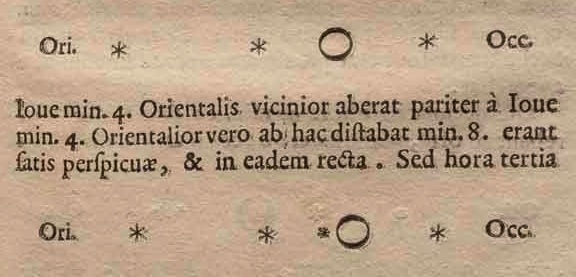
Keen eyed readers will have noticed the similarity between my drawing (I hadn’t yet acquired a bracket for my camera at that point) and one produced some centuries earlier by Galileo Galilei:


From Galileo’s book, ‘The Starry Messenger’; image hosted at www.lettherebenight.com

Galileo’s observation of Jupiter, and what he correctly interpreted to be its moons, were a vital part of the observational evidence that not everything in the visible universe orbited the Earth. It was these observations that initiated his collision course with the Catholic church.

I claim no affiliation with Senor Galilei, a far greater scientist than I will ever be, but as I gazed with my own eyes at Jupiter aligned with its satellites that night, I could nevertheless sense something of the transformative power of seeing things for the first time. What an incredible moment that must have been for him, as the carapace of stars was punctured by the moons of Jupiter.

Tonight I was out again and, turning my view towards Jupiter once more, was thrilled to see that in the four days since I’d last looked the moons had changed position:

Jupiter Sketch 2

There is nothing original or new in this. But for me, it means that the universe has come alive and I am attuning to its rhythms. There is something wonderfully fresh and vital about the night sky that I had simply–shamefully–been ignoring.

Last night, though the cloud cover prevented me from sighting Jupiter, I managed to catch the glorious “blue” moon, the second full moon of the month of December. I was able to try out the camera attachment that I purchased hastily this week and took the photograph above, that hovers serenely, anciently, over the mess of text.

It’s by no means a great picture of the moon — it could be sharper and there is a rim of chromatic aberration along the top edge. But I am utterly delighted with it.

Posted in Astronomy, History of Science | 35 Comments