And then just drizzle some liquid nitrogen…

At the Diamond synchrotron last week, Jamie Oliver would have been proud of us.

Amar and I pitched up last Thursday afternoon at the great gleaming doughnut in the Oxfordshire countryside with the latest batch of Amar’s crystals, packed carefully into a dry nitrogen dewar to keep the little jewels frozen at a chilly 80K. Because we were sharing the beamtime with other users from Imperial our slot didn’t start until about 8.30 in the evening. Amar had plenty of time to transfer the crystals — under liquid nitrogen — to the pucks that would eventually be loaded into the mounting robot. There was even time to stroll over to the cafeteria for a leisurely dinner.

But as soon as we got going with our experiments it was clear that something was not quite right with the samples. Each crystal was mounted in a tiny nylon loop stuck on the end of a thin metal pin. Plucked from liquid nitrogen by the robotic arm, they were kept frozen on the X-ray camera by a steady stream of nitrogen gas at about 100K. But rather than glinting in the fluorescent lights, the crystals looked opaque and rather ragged in outline.

That could mean only one thing: ice.

The diagnosis was confirmed as soon as the crystal was exposed to just half a second of the intense X-ray beam:

Diffraction with ice

The concentric circular rings on the diffraction pattern, partially and annoyingly obscuring the lattice of spots that we needed to measure, were due to the presence of randomly oriented ice crystals, either within or on the surface of our protein crystal. Before freezing, protein crystals are usually soaked in a solution containing a cryo-protectant — or anti-freeze — such as glycerol. The cryo-protectant prevents the water within the solvent channels of the protein crystal from turning into crystalline ice. Instead it should form a glassy solid that only scatters X-rays diffusely and doesn’t seriously interfere with the diffraction pattern.

When you see ice rings it sometimes helps to “re-anneal” the crystal. You do this by blocking the cooling nitrogen stream for a few seconds, usually with a handy credit card, to allow the liquid surrounding the crystal to thaw and then quickly re-freeze it again.

Well we tried that. It didn’t work.

And then Jeremy, a colleague from Imperial, popped into the station and mentioned that Juan, the Diamond beamline scientist, had suggested ‘washing’ crystals with liquid nitrogen to get rid of ice.

By this time we’d been through several samples and were certainly open to suggestions. So with a long 25 mL plastic pipette dipped briefly into liquid nitrogen we quickly drizzled a few drops of the slick colourless fluid over the crystal mounted on the camera.

The effect was immediate. Already on the video screen the appearance of the crystal changed considerably. Gone were the ragged edges and out of the obscurity emerged a gleam of shining light.

Better still, when the crystal was exposed to X-rays the rings were gone. Completely.

Diffraction without ice

And we could see that the crystals diffracted to about 1.5 Å. I’ve mentioned before what a rich treasure-tove of structural detail such data can reveal. Thanks to that timely tip-off from Jeremy and Juan, we were able to get stuck into several hours of solid, rewarding work. We were cooking, if you’ll pardon the pun.

When I got back to Imperial there was the usual round of inquiries as to how the trip had gone. It’s always good to be able to report that you got some data. But this time I was more interested in recounting the impressive effect of the liquid nitrogen wash – to spread the good news, so to speak. And I found plenty of eager ears.

And that’s what I’m doing here I guess. The title of this blog is Reciprocal Space, after all. Every so often I feel duty-bound to make some mention of X-ray crystallography and the joy it can bring.

Posted in Uncategorized | 28 Comments

Virus Illusion Confusion

Thanks to the very good offices of Matt Brown, who knows everything about everything happening in London, I found myself at the Smithfield Gallery last night. Jenny, Richard and myself joined Matt there to gaze at Luke Jerram’s artful glassy virus sculptures.

Matt has already blogged about the evening so I will leave it to him to tell you more about the exhibition (which may also get a mention on Lablit before too long). I want to go in a slightly different direction.

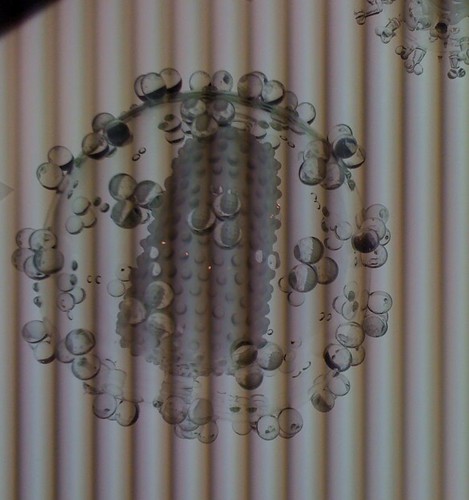
You will also see some beautiful photos on Matt’s post, but when I dug out my iPhone to snap a picture of one of the sculptures displayed on a light table, this is what I got:

Virus on a light box
Strip-lit sculpture?

Jenny asked me why the background was ribbed in the photo since no stripes were evident to our eyes – or in Matt’s or Richard’s pictures, taken on ‘real’ cameras. I had to confess that, despite being in possession of a degree in physics, I was stumped.

However, I guess the question must have been gnawing away at me in the background because this afternoon, whilst traipsing back-and-forth between my office and the laser printer, I stumbled across a solution. Or, at least, I think I did.

But before we get to that – would anyone else care to puzzle it out?

Posted in Uncategorized | 28 Comments

Flags of our Daughters

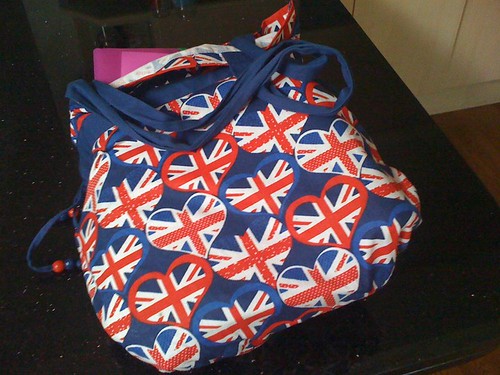
Flags are potent and emotive symbols for many people but when my daughter plonked her new school-bag on the kitchen counter at the beginning of this week I cracked a wry smile.

Brit-BagLove that Union flag?

My reaction to the garish decoration of her bag made me realise what a long way I had travelled from my own childhood, a journey that has been at least partly influenced by science.

The details are a bit fuzzy but one summer when I was about five or six years of age, the colours and curious geometric arrangements of little Union Jacks on sale in my local sweet-shop must have caught my eye because I sacrificed my sweet money to buy one — no more than a bit of plastic glued to a stick — and taped it to the handlebars of my bike. But when my father came home from work and saw me doing laps of the yard, there was no wry smile.

“Where did you get that?”

I was immediately banned from parading my purchase in the street.

It’s not that my father was angry. Rather, he was concerned for my safety because, as a Catholic growing up Northern Ireland in the Trouble-wracked sixties and seventies, the decoration of my bike was likely to attract dangerous interest from both sides of that divided community. Other Catholics (our republican friends, so to speak) would wonder what the hell I was doing, whereas Protestants (unionists – God Save the Queen and all that) would have unmasked me with a couple of questions (“What’s your name?”, “What school do you go to?”) and soon divined that my affinity for the flag was not nearly as thick as blood.

As I got older I learned there was more to a flag than the pretty patterns. Though it was by no means universal, many of the streets and housing estates in Northern Ireland were branded with Union Jacks or Irish tricolours, to signal the affiliation of the local residents. One lot would tolerate you, the other was ‘the enemy’. So despite my initial infatuation with the red, white and blue, the British flag became an intimidating stranger.

My aversion to the Union Jack wasn’t sufficient to prevent me heading to university in London to study physics. This was a big change of scene for a lad from Ballymena. London was a lot to cope with but I revelled in the refreshing new mix of people, none of whom seemed too preoccupied with religious or community affiliation. But there were still odd effects of my upbringing. Every so often I would trip over my Northern Irish roots.

I settled in England, having met my wife at university. Admirable assimilation you might think, but although she is English — her Essex origins had not escaped me during our courting — when she was expecting our first child I started to fret about what it would be like to have a son who spoke with an English accent. Estuary English, to be precise. I was worried that his linking R’s and dropped H’s might be a barrier between us*.

Of course, in the event nothing could have been further from the truth. My son speaks the way he speaks and that is part of who he is. It’s the same with my two daughters. But it took the experience to teach me the lesson. Nowdays we just laugh about our different accents. By which I mean, they laugh at mine.

“Say ‘fruit’ Dad”
“Frute.”
“Go on, say ‘eight’.”
“Eee-it.”

The move to England was good for my education in diversity, but the lesson was solidly reinforced by forging a career in science. Life in a modern lab is fantastically enriched by international contacts. As a postdoc I was lucky to do stints in France and the USA (our second child is American, but didn’t stay long enough to pick up a Boston accent). And a whole string of foreign students and postdocs have passed through my lab at Imperial, from as far afield as Argentina, Russia, Israel, Greece, Hungary, France, Ireland, Indonesia, and China.

These observations will be familiar to most people who work in science. The internationalism of the profession may even have come to seem ordinary, but our daily immersion in the world-wide ebb and flow of people is an extraordinary pleasure and privilege. And of course it is hugely beneficial to our shared scientific enterprise.

But international engagement is not such a commonplace for everyone. When my daughter’s bag landed on the worktop, the bright array of red, white and blue also brought to mind the British National Party (BNP), who have blended the union flag into their logo, smearing it with their stunted, whites-only mindset and making it for many a symbol to be feared. There has been a bit of a to-do recently (as we say in England) about the BBC’s plan to allow BNP members to appear on Question Time, a long-running TV show where the studio audience gets to quiz politicians of the day. In my opinion the BNP are an excremental bunch of little Englanders, who espouse loathsomely violent methods of immigration control, but I think the BBC would be right to put them on the show. The exposure to the diversity of the British public might just do them some good (or, at least, some electoral harm). There’s nothing like mixing it with strangers to teach you something new about the world.

Pomp, in the right circumstances (from the BBC)

However, that battle can wait for another day. This evening on BBC-TV there are no politicians because the Last Night of the Proms is being broadcast, the last of a series of summer concerts (held in the Royal Albert Hall) that is famed for the standing-room-only promenade in front of the orchestra. As is traditional, at the end of tonight’s concert there will be Elgar’s rousing Pomp and Circumstance and there will be much joyous waving of the Union Jack. I’m quite partial to a bit of Elgar and, even if I still can’t connect with the flag-waving, I’m completely relaxed about others enjoying it.

I’ve got my roots, you know, but I’m branching out.


*I realised my son’s accented fate was sealed one Friday morning when he was about three years old. We were living in Essex and he was starting to learn the days of the week.
“What day is it today,” I asked.
“Um, Monday?”
“No. I’ll give you a clue – tomorrow’s Saturday. So what is it today?”
“Um, Wednesday?”
“No, that was two days ago. Tomorrow is Saturday,” I prompted, “so today is Fffff… Fffff…”
His eyes lit up with the delight of recognition.
“Fursday!”


Posted in Science & Politics, Scientific Life | 126 Comments

Beachbooks 3: Uncommon science and danger

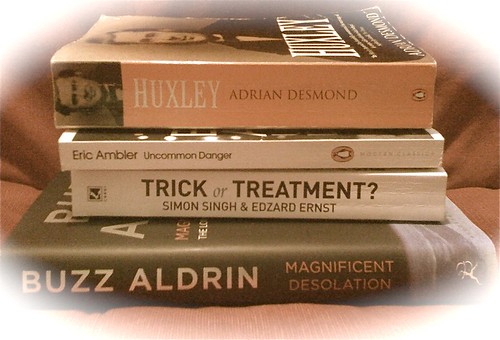
I am determined to finish the third and final installment of the posts about my vacation reading before the holiday season comes to an end — which I think is tonight. I want to tell you about the biography of Huxley and Eric Ambler’s Uncommon Danger.

Truth be told I have been struggling with this post. Like an over-stimulated tourist, I have bought too many shiny souvenirs and am having trouble stuffing them all into my little suitcase. As with all packing, the problem is basically one of size.

The first two books of my holiday selection were quick and easy reads; even a dullard such as myself managed to polish them off in two days apiece. But Adrian Desmond’s Huxley, weighing in at about 640 pages of a miniscule, close-packed font, was truly monumental.

Or perhaps mountainous is the word because the ascent up the story of Thomas Henry Huxley’s life is fairly demanding. By the time I reached the teary end, watching as the scientific giants of the late 19th Century gathered sorrowfully around his grave, I was exhausted, wrung out. But the view was spectacular and my head was dizzy with new facts and connections and questions.

Last two books

Born into a modest family in 1825, the bright young Huxley initially trained as a medic, spending much of his time developing his skills as an anatomist. At the age of 21 he sailed as the Assistant Surgeon on HMS Rattlesnake‘s four-year surveying voyage of the waters around north-eastern Australia. Trawling the seas as they sailed, Huxley dissected the invertebrates of the southern oceans and his original observations on their unusual anatomy helped to make his name back in England. Though his career stuttered for a few years on his return to London — Huxley lacked the finances that lubricated Darwin’s rise — he eventually established himself not just as a formidable scientist, but as one of the foremost men of his age.

Today Huxley is chiefly remembered as ‘Darwin’s Bulldog’, the man who carried the battle for evolution to Ecclesiastical England. Huxley would have acknowledged that moniker but Desmond delves into the complex strata underneath. Not only does he paint the broader, richer canvas of Huxley’s combative role in Victorian society, but he also picks apart Huxley’s surprisingly complex attitude to Darwin’s famous theory.

Although there are evident parallels between the lives of Darwin and Huxley, who were to become such close friends, they were very different characters, and Desmond does an excellent job of delineating the distinctions between them. Each was gifted academically and undertook a career-defining sea voyage in his formative early twenties, but the reaction of these elements produced very different results in the two men. Whereas Darwin had spent much of his education combing the shorelines of Scotland, beetling in Cambridgeshire or learning geology in Wales, Huxley was the more assiduous student at medical school, devoting all his spare time to reading and microscopic dissections. He had even published his first paper before sailing on HMS Rattlesnake — on the discovery of a new membrane in hair cells. Darwin’s equivalent claim at the same age was to have found a new species of beetle.

The difference in the nature of the discoveries is telling and may go some way to explaining the fact that Huxley returned from his voyage in 1850 with no notion pertaining to the speciation of life on earth, even though he had been absorbed in efforts to group and classify the morphologies of the invertebrates he netted from the sea. Desmond makes a convincing case that Huxley’s medical fixation on anatomy and structure, coupled with the lack of exposure to the flora and fauna of the countryside in his metropolitain youth, may have limited his vision of the processes that formed the natural world.

But it is a disservice to Huxley to speak of him only in relation to Darwin. Desmond brings the man fully to life, in all his dimensions (though I fear I can only sketch a monochrome outline here). Established as a celebrated anatomist, Huxley then taught himself paleontology and was the first to identify the link between dinosaurs and birds. His fossil interests brought him into direct conflict with Richard Owen with whom he had a long and bitter feud about the links between primate and human skulls and brains. The implications of the similarities that Huxley demonstrated horrified Owen, who chose to see the natural world as the ongoing work of the divine author who had fixed a special place for man. Huxley would have none of it and delighted in the battle. His most famous book Man’s Place in Nature (1863) underscored the evolutionary links between man and primates in a way that Darwin, famously, had not dared to do.

But such courage and fire were the mark of Huxley. His lasting legacy is to have imprinted science on Victorian Britain. Not only did he excite the working men of the day — 600 at a time — with his public lectures on the latest developments in the emerging science of biology (Huxley was to become that subject’s first professor), but his tireless campaigning for science to be taught in schools and universities, where the bible and the classics had long prevailed, changed education forever. Indeed I was surprised to learn that the emergence of London as a vibrant centre for science — in large part due to Huxley’s stimulus — eventually prodded the ancient Anglican giants of Oxford and Cambridge to make space for the subject on their curricula.

These educational gains were just one of the fruits of Huxley’s wider fight to establish a place in society for science and its secular outlook. His gospel message was clear: the learned ‘seek for truth not among words but among things’, he declared. Huxley preached the ‘sin of faith’; for him science showed ‘that the ultimate court of appeal is observation and experiment, and not authority’.

Huxley lived and breathed science and nowhere was this better demonstrated than in his willingness to swallow errors when proved wrong. There are two delightful episodes of this recounted in the book, the first when reports from the survey ship HMS Challenge fail to find a single Bathybius, an enucleate jelly that he considered to be a very primitive form of life. Huxley had to concede that his own specimen was a laboratory artefact (a precipitate in alcohol?) and took responsibility for shepherding the negative result into Nature, the journal that he helped to found. ‘I shall eat my leek handsomely’, he told Wyille Thomson, the naturalist who had conveyed the disappointing report.

The second incident occurred when Patrick Geddes, student dissecting a whelk under Huxley’s tutelage, showed a detail of the tongue that was different to his earlier description. ‘Pon my word, you’re right! You’ve got me!” Huxley told him “I was wrong! Capital! I must publish this for you.’

With such excitement at a new finding, even when it is in contradiction to his own observations, you can’t help but warm to the man. His belief in observation and experiment drove him repeatedly into argument with the bishops (it wasn’t just Wilberforce who felt the lash of his tongue) and those scientists such as Owen who clung to the divine hand when simpler mechanisms were in evidence. On one memorable occasion Huxley castigated Owen for his elliptical enunciation of a divinely-controlled evolution: ‘the first duty of a hypothesis [is] to be intelligible,… this may be read backwards, or forwards, or sideways, with exactly the same amount of signification.’ One can only imagine what he would have made of the unscientific nonsense spouted by many of today’s alternative medicine community.

But Huxley’s gift with words, evident even in the letters from his youth, was not just deployed in battle. During the arduous voyage on the cramped HMS Rattlesnake there were numerous deaths among the crew who were soon dispatched overboard. ‘There is hardly room for the living on board a ship, so that no wonder that the dead find no resting place in it.’ And later, when he is pining for his long-awaited fiancée, Netty, he writes of imagining her ‘bright smile — a kiss — one of the thousand nothings that make life something’.

Desmond’s book, in its turn, feels like the sum of a thousand somethings. In contrast to my disappointment at Buzz Aldrin remaining caged and distant within the pages of Magnificent Desolation, I was delighted to see TH Huxley leap, full of colour and complexity from this wonderful biography. There is a curious parallel between the two men since both suffered breakdowns through depression, but even here Huxley’s plight is more vivid. Alarmed by the havoc wrought on his health by his enormous workload, a large chunk of it unpaid, his wealthy friends club together to make him a gift of £2100. They are concerned that his pride may prevent him from accepting such a large sum, but he does so graciously, honestly and revealingly. His letter of acknowledgement to Darwin is full of pathos.

‘I accept this splendid gift… for the first time in my life I have been fairly beaten. I mean morally beaten. Through all sorts of troubles & difficulties poverty illness, bedevilments of all sorts have I steered these thirty years, and never lost heart or failed to buffer the waves as stoutly as they buffeted me… [But] I have for months been without energy & without hope and haunted by the constant presence of hypochondriacal apprehensions which my reason told me were absurd but which I could not get rid of — for I was breaking down; sliding into the meanest of difficulties, the would be climber of heights, mired in a mere bog…
Have I said a word of appreciation for your own letter? I shall keep it for my children that their children may know what manner of a man their father’s friend was & why he loved him.’

If I have a gripe it is mainly that I was too thrilled to read the book more slowly so as to absorb a greater part of the detail. But one of the remaining puzzles for me is that, despite Huxley’s vigorous defence of Darwin and his theory (at least in his popular lectures and writing), evolution did not become more closely enmeshed in his own research work beyond 1860. Desmond contends that Huxley’s reticence on the details of evolution, which sometimes frustrated Darwin himself, was due to the tenuous and fragmentary nature of the evidence supporting the phylogenetic trees. But I cannot yet square this with Huxley’s honest and sophisticated appreciation of the sometimes erratic development of scientific hypotheses. I guess I will just have to read some more, no great hardship since I been here before and will probably willingly return to the subject.

By the end of the book I was stuffed, replete as after a huge but hugely satisfying meal. The switch, finally, to Eric Ambler’s Uncommon Danger with its taut, lean prose came as a welcome digestif. This slim thriller provided a lively jaunt through pre-war Austria and Czechoslovakia as Soviet and Romanian agents — the former aided by a hapless English journalist and the latter in the pay of a brutish British oil company — manoeuvre and out-manoeuvre one another on the trail of stolen military plans. It was breezy, quick, barely plausible and wonderfully absorbing.

I’m done now.

Posted in Book Review, Uncategorized | 13 Comments

What a difference a year makes

I attended last year’s Science Blogging conference very much as an outsider. I’d signed on at Nature Network and passed a few comments, but was not a blogger. However, the event was a turning point for me and in the warm flush of excitement that emanated from the conference, I finally decided to jump into the strange reality known as the blogosphere.

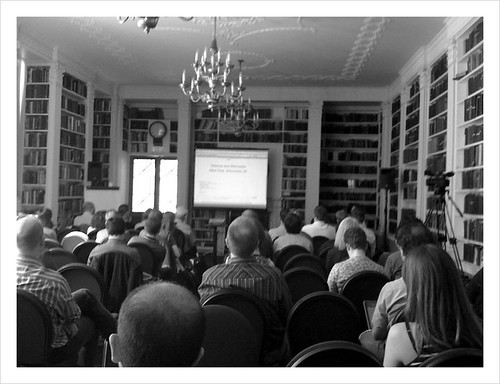
This year I came back to Science Online London 2009 (which took place yesterday) from a rather different position. For me the conference actually kicked of at the Friday evening bash organised largely by Jenny, Richard and Matt and hosted by Mendeley. This loosely-run event was held on a roof-top terrace somewhere in the Farringdon area and attracted forty-odd interested souls. The first session, led by Jenny and myself, gave me a chance to offer a few basic observations on the value of online media, blogs in particular, for getting across the narrative that is so often lost from textbook and journalistic presentations of science.

FF #solo09 on Twitpic
Spouting on the rooftop (Richard’s pic)

There followed a very interesting discussion, with vigorous participation from many members of the audience, as was the case in the subsequent sessions on Blogging as a tool for persuasion (led by Richard and Cameron) and the two more spontaneous sessions on blogging genres (Eva Amsen’s suggestion) and on PR, the latter generating some trenchant remarks from the redoubtable David Colquhoun. Suffice to say he’s not a fan.

But more than anything the event was about getting together — lubricated by free drink — and making more of a connection with people that many of us only knew ‘online’. Whatever kind of knowing that is.

The late night on Friday was not too much of an impediment to the early start at the Royal Institution on Saturday. The conference was launched with great verve and intelligence by Petra Boynton and David Allen Green (Jack of Kent) who laid out the proper ethical and legal framework for bloggers. It’s all so very clear now. “Ahem.”:http://network.nature.com/people/scurry/blog/2009/05/30/i-don’t-know-what-to-say

We then moved on to cover topics as diverse as Blogging for Impact, Citizen Science, Online communication for institutions, real time metrics for assessing scientific contributions and Google wave, which is apparently about to crest.

Citizen Science

There were some great contributions, from the panellists and the floor, though I was somehow content to sit back and let it flow over me. Much of the material seemed a bit diffuse or perhaps too specialist for an ordinary scientist such as myself. I have yet to be touched by any of the excitement swirling around Google wave, for example; it still seems too much like a geek toy. Some tidbits did nevertheless end up lodged in my head. I very much liked the sound of the Ask a biologist site that Paolo Viscardi talked about and it was good to hear that the editing tools at Wikipedia are to become simpler.

But more than anything and, as I had discovered last year, the greatest joy of this event is meeting the people who are the reality behind the virtual world that we inhabit online. Not only did I manage to put faces to people that I already knew (delighted to have finally met you Steffi, Eva and Maria, to name but a few), but I also met people I hadn’t known before in any medium.

Over lunch I enjoyed debating the merits of electronic lab notebook with Rory Macneil of Axiope. I’m going to need some more convincing on that one, but I’ll certainly be investigating.

I bumped into Northern Doctor on the balcony at the end of the lunch break. Down in the street we could see the smokers clustered around the front door of the institution. What’s the collective noun for smokers standing outside a building, I wondered. “A carcinoma,” he suggested, “or a wheeze?”

It is agreeably ironic that the richest experience for me was meeting these online folk in the flesh. It was a particular thrill to come across many of the community (bloggers including Jack of Kent , Dr Aust, Gimpy, Zeno and the Quackometer), who have been doing such fine work both in supporting Simon Singh and in taking rationality to the alternative medicine community.

Meeting these guys and all the other people I chatted to during the conference, and in the pub afterwards, brought home just how much joining in online has enriched my life with new connections. But it still strange to realise that these connections are best savoured in the real world.

Or maybe it was the effect of the drink.

Posted in Uncategorized | 43 Comments

Music in a nutshell

I once read in a physics textbook that if an atom were to be magnified to the size of London’s Wembley Stadium, the nucleus at the centre would be about as big as a hazelnut.

Well screw that, because I can think of much better uses for Wembley Stadium. Besides the obvious — football — it is of course an ideal venue for rock concerts and last Friday night U2 showed exactly how it should be done. From my high and distant vantage point they stood like stick-men on the stage, but still managed to amplify themselves to fill the stadium. And I’m not just talking about the sound level.

It’s over 20 years since I last saw the band but, spurred by the blog post I wrote when their new album came out in March, I bought tickets for last Friday’s concert. Recklessly, I got tickets for myself and my children, whom I’d exposed — not altogether unwillingly — to some of U2’s back catalogue. I’d not been to a rock concert of any kind since the children came along, so I knew this was going to be different.

Elbow Wembley
Elbow filling Wembley

But I needn’t have worried. For us the show kicked off with the support act, Elbow, whose enchanting, pained melodies from ‘The Seldom Seen Kid’ I admire very much. They put in a great performance, all the more impressive since it was to a half-filled stadium on a light summer evening. Suddenly I remembered: there is something different about having the music pounding through your whole body.

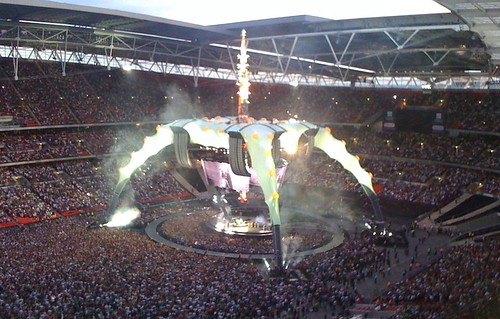
And then, with the light dimming and smoke starting to emanate from the gigantic spiderous stage in the middle of the stadium, a thunderous roar greeted U2 who launched straight into the pulsating, clanging ‘Breathe’ from the new album.

U2 Wembely - start
U2 take over

The years fell away – at least episodically. I was repeatedly reminded of my parental status as my youngest, who’s not so familiar with the band (and initially confused them with Elbow), kept asking — by bellowing in my ear at the top of her voice — “What’s this song called?”

In front of us was another father with his two children. He was clearly much more ‘into it’ than me because he kept jumping to his feet and punching the air. Then he would try to get his kids to do the same. Part of me was thinking ‘Good on you, mate’, but I could also hear a voice in my head congratulating me on not being such a dreadful embarrassment.

But there were moments. Bono has more or less given up his sermonizing so there were almost no gaps between tracks. The show was incredibly slick and technically stunning. U2 turned the stadium into a dazzling cauldron of sound that thrummed in your rib-cage and swept you away.

I’ve said it before — I love the music — but I’d forgotten how special it was to hear it live.

U2 Wembly - for Iran
Tribute to the Iranian demonstrators

At times, the show was moving in other ways. ‘Sunday Bloody Sunday’, written for the Troubles in Northern Ireland was given new meaning as the stage was flooded with green and the video screen filled with images from the recent demonstrations in Iran. The band then dedicated ‘Walk on’ to Aung San Suu Kyi, sentenced to a further 18 months house arrest in Burma only this week.

And at the end, just before the first encore, there was the face of Desmond Tutu talking from the giant video screen, reminding us of the lives that had been saved by the nurses, doctors and scientists who had worked so hard to relieve the misery of AIDS and malaria in Africa.

Science and music – it doesn’t get much better than that. Even for an aged has-been like myself.

U2 Wembley - late
U2 lighting up the stadium

Postscript: It has emerged from subsequent discussions that my kids were, shall we say, somewhat amused by my asynchronous clapping along. Fortunately, they couldn’t hear my singing.

Postscript 2: I haven’t forgotten my review of Huxley – it’s still gestating!

Posted in Music, Science, Uncategorized | Tagged , , , | 39 Comments

Beachbooks 2: Dagnificent Messolation

For my second holiday read I gave in to the excitement surrounding the 40th anniversary of the Apollo 11 moon landing and splashed out on Buzz Aldrin’s Magnificent Desolation. The book (co-written with Ken Abraham) tells of the aftermath of his visit to our dusty satellite.

I have long been a fan of the moon landings, having been just about old enough to realise what was happening in the later lunar missions in the early seventies. It confirmed me as a space-nut. Though the enthusiasm of childhood has waned a little, I “loved”:http://network.nature.com/people/scurry/blog/2008/12/28/imagine-there’s-no-earth the recent and enthralling In the Shadow of the Moon documentary, which was built around detailed interviews with most of the Apollo astronauts, all of whom spoke candidly and came across as thoughtful and charming. Each seemed the sort of bloke you’d be happy to bump into in a pub. But I’d read that Aldrin had succumbed to alcoholism on his return to earth and was intrigued to know more. I thought it would be interesting to explore the dark side of the moon, as a counterpoint to all the froth of the anniversary.


Colonel Buzz Aldrin (from Wikipedia)

The story starts promisingly, with a brief, breezy account of the Apollo 11 mission, but then disater strikes and it breaks into pieces like a capsule with a faulty heat-shield. You are left gazing quizzically at a bunch of smoking fragments, with little hope of re-assembling them into the original unit. I was bitterly disappointed, the bad taste accentuated by the sense that there was a great story lurking behind the shambolic tale told by Aldrin and his co-author.

That story clearly has some fantastic elements – the astronauts’ amazing journey, the world-wide adulation on their return, the undercurrent of rivalry with Armstrong, Aldrin’s struggle with normalisation after leaving NASA, his descent into depression and alcoholism, the marital infidelities and break-up, his brief experience as a Cadillac salesman (a bad one) and the long, slow climb back to a sense of equilibrium and happiness in his third marriage. But from this silk purse of riches Aldrin and Abraham somehow only manage to turn out a sow’s ear.

I think the problem is with the writing – it is far too bland. I don’t know how the book was put together but I couldn’t escape the impression that the co-writer Abraham was putting words in Aldrin’s mouth and thoughts in his head. It didn’t feel real, and that was a huge problem for me. Aldrin’s tale is told candidly enough – he admits his infidelity and recognises the terrible pain that he inflicted on his first wife and their children. And he is pretty frank about facing up to depression and alcoholism; on this score he was well ahead of his peer group back in the early ’70s and took considerable risks with his reputation. But the episodes that plot the path of dreadful decline are too cliché-ridden to pack much punch. There’s simply not enough brutality to the honesty.

And there’s a lack of telling detail. The ups and downs of Aldrin’s ten-year battle with drink and depression, helped by various partners and therapists, is recounted at length but the narrative doesn’t bear close analysis. The heart of the story is missing — the events are there but there’s no real access to his thoughts and feelings. I still can’t fathom why in 1978 he finally decided to give up the bottle and has been able — happily — to stay the course.

I managed to finish Magnificent Desolation, but only thanks to my long-standing devotion to the Apollo missions. The last third of the book was a rather dull grind through Aldrin’s wooing of his third wife, Lois, and his attempts to re-vitalise NASA’s interest in missions to the moon and Mars.

Buzz Aldrin remains a hero for me. I know I’d love to meet him in a bar and shoot the breeze — over a mineral water. But I’m afraid I don’t think I’ll be reading any more of his books.

And this brings me finally to Thomas Henry Huxley who, though he lived a century before Aldrin, leapt off the page full of vibrant life in Adrian Desmond’s truly magnificent biography…

(to be continued)

Posted in Book Review, Uncategorized | 4 Comments

Beachbooks 1: Trick or Treatment

Just before heading off on holiday I gave notice of my intended reading matter. Pedalo-duty permitting, I hoped to get through all four books.

Holiday read

The wind and currents of the French Atlantic coast precluded any pedalo action so the kids had to settle for surfing lessons instead, and were placed in the capable hands of an instructor. And so I turned first of all to Singh’s and Edzard’s Trick or Treatment, an analysis of complementary or alternative medicine.

The book is clearly and meticulously written – I found it an easy read. The authors are at pains to explain the necessity for an evidence-based approach when evaluating any proposed treatment of human ailments. Acupuncture, homeopathy, chiropractic and herbal medicine are covered in the greatest depth, each getting a chapter to themselves. All the remaining known ‘alternative’ therapies are given much briefer treatment in the appendix.

Singh and Ernst lack the irreverent humour of Ben Goldacre, whose excellent Bad Science covers some of the same territory, and their tone may be a bit too didactic for some. But I appreciated the attention to detail. The authors drilled carefully into the core of alternative medicine and, almost invariably, came up with… snake oil. They found that none of the treatments has much to offer beyond the placebo effect or the benefits of more conventional therapies.

Ultimately what struck me most about the book was the sense that emerged of the intellectual poverty of alternative medics. They might tacitly admit the primacy of the scientific approach to the evaluation of treatment efficacy by trying to clothe themselves in science, but they’re like children who can’t dress themselves properly. Trick or Treatment (like Bad Science before it) is very good on explaining the inequalities of different types of evidence. A great recent example of this is the fabulous blogospheric dissection of the evidence that the British Chiropractic Association finally produced in response to the criticism of its libel case against Singh. Much of it, argued the bloggers, was irrelevant or cherry-picked.

The other, more depressing realisation I came away with, is that alternative medics aren’t about to disappear anytime soon. Alas, they’re usually quite happy to get into the ring with science and go a full 15 rounds. Lacking the skill to land much of a punch, their aim appears to be to duck and weave until the scientists are finally exhausted. So I’m afraid it’s up to us to keep trying to knock some scientific sense into the alternative medicine community.

We have to keep on questioning the evidence for alternative medicine. It not a matter of arrogant condescension but of quietly and firmly pointing out how the methodology of science and its resolutely critical culture are so essential for understanding how the world — and good health — works. I don’t want to get all po-faced about this but more of us need to stand up to counter the seepage of fanciful medical practices into modern life. With Trick or Treatment now in my back catalogue (and I reckon I’ll be returning to it frequently for points of reference) I’ll be able to do my little bit more confidently.

(Parenthetically, anyone looking for an opportunity to step up to the mark should head over to Improbable Science where David Colquhoun is calling for people to respond to the Department of Health’s consultation on the Pittilo Report. The report has recommended that practitioners of acupuncture, herbal medicine, traditional Chinese medicine should be subject to statutory regulation by the Health Professions Council. All very innoucuous sounding perhaps but, as David explains, it opens the way for untested treatments to acquire an official-looking seal of approval.)

Having finished Trick or Treatment I launched straight into astronaut Buzz Aldrin’s Magnificent Desolation. A confirmed moon-nut, I had been really looking forward to the book but, oh dear me, what a shambles…

(To be continued, soon.)

Posted in Book Review, Uncategorized | 28 Comments

Blog hol

This’ll be brief since it’s been a busy week. I’m aiming to get through my ‘to do’ list before heading off on holiday at the weekend. If past form is anything to go by, it will me take a few days to wind down. I have a plans for a grant application roiling in the back of my mind, still churning, still not quite formed. But eventually, I will come to rest.

We’re going to the seaside. The kids love the sand and the water, and my wife and I are happy to sit on the beach, me in the shade and her in the sun. Every so often, we will argue in the most desultory fashion about whose turn it is to take them out on a pedalo.

I’ll be bringing my laptop, but only so I can finally get around to editing the video of our holiday from last year. I have three hours of footage from Sicily that I want to whittle down to a snappy 30 minutes — or less, if I can hold my nerve. I may spend some time sketching out a few ideas for blog posts. I’ve loaded my iPhone with movies and the entire 3rd series of The Wire.

And I’ll bring some books.

Summer reading

It struck me when I took this picture just how much my reading matter is linked to blogging. What has become of me?.

Buzz Aldrin’s Magnificent Desolation speaks to my “lunatic”:http://network.nature.com/people/scurry/blog/2008/12/28/imagine-there’s-no-earth interests. I bought it to get the frank story of how Aldrin really crashed to earth after landing safely back on the planet at the end of the Apollo 11 mission. It will be a counterpoint to the rampant anniversary celebrations going on around us (which, by the way, I am enjoying enormously!).

Singh’s and Edzard’s Trick or Treatment is the book that inspired the newspaper article that led to Singh being sued for libel. The case was highlighted by the electrifying Skeptics in the Pub meeting that I attended in May. And the fight goes on.

Huxley is a character I have long admired, and not just for his connection with Imperial College. I read a short biography of him “earlier in the year”:http://network.nature.com/people/scurry/blog/2009/02/16/are-you-going-to-this-seminar-huxley’s-speaking, but am looking to getting the complete story from Adrian Desmond’s book.

For ‘light relief’ I have Maxine to thank for stirring a renewed interest in crime fiction. I still haven’t been able to get hold of the first book in the Wallander series. But recent mention of Eric Ambler in The Guardian (not a word, Henry) caught my attention, so I will be giving Uncommon Danger a try.

Mind you, if I get stuck on that bloody pedalo, I probably won’t get very far with these…

Posted in Uncategorized | 25 Comments

Vital Supplements

Those outside science are often surprised to learn that we usually have to pay for the privilege of being published. The charges incurred by authors, argue the journal publishers, reflect the cost of the significant value that added when a raw manuscript is converted into a scientific paper. And, at a pinch, I would tend to agree.

I remember seeing my very first paper appear in Biochemistry back in 1990. It was a magical moment. The bulky double-spaced manuscript of text, references, figure legends, tables and figures had been transformed into a slender, formatted paper. I can recall making my way to the library to seek out the fresh, green-covered issue of Biochemistry that contained my article. I don’t think I would go so far as to describe the paper as an object of beauty, but it was nevertheless for me a thing of wonder and joy. To see my words and graphs laid out pristinely on the page, in two regular columns with each table and figure neatly embedded in the text produced a moment of quiet fulfilment.

Graph
Science (and history), in the making. From Biochemistry

But that wasn’t all.

An extra smack of satisfaction derived from the knowledge that, until that day, papers were things that I read, that I pored over and struggled to absorb. Always they were articles that had been written by other people. But here, for the first time, was something created by me. I had found something out and now it was being presented to the world. A once impossible mountain had been climbed.

And I knew that my work had attained a kind of permanence (inasmuch as we may grant our civilisation that destiny). As part of the published scientific literature, the paper was indexed, catalogued and sent to libraries all over the world.

That sense of magic remains, even 19 years later. I still love to get the galley proofs of each new paper – there is a distinct sweetness to the first glimpse of the transformation of a raw manuscript into a peer-reviewed publication.

These days of course, newly published papers almost immediately appear in PubMed and are available for download across the planet (subscription or open access permitting). The advent of the Internet has also changed the type of information that can be published. No longer are we restricted to the published page or even to a fixed number of printed pages. These days we can add, affix, annex, append and augment. In a word, we can supplement. It is now common for a scientific paper to tow in its wake a great mass of supplementary online information. This provides a rich resource of additional text, images, sounds and video.

Or, at least, it should do.

Usually the added material consists of more text and figures than could be accommodated on the printed page and it’s a boon to be able to include it in the public record. But too often, alas, the magical ‘added value’ of publication is lacking from the presentation of this supplementary information.

What amazes me is that, despite the evident care taken over the paper, no-one seems to have given much thought to the way that the supplementary information is provided to the reader. As a case in point, I was reading a Nature paper last week, in preparation for a review I’m writing and needed to track down the associated supplementary information. It was easy enough to find but the vision that greeted me on the web-site was a crushing disappointment. There were no fewer than nine separate files to download. Nine!

SuppInfo
More or less? You decide.

Six of the files were Word documents and three were pdfs. The information was a benign mix of words and figures but for reasons that are lost to me no-one had thought to combine them into a single unit. Or to integrate the information to make it more accessible — to put the figure legends with the figures, for example.

I don’t mean to pick on the author (or the journal*) in this case, since my experience is that this fragmentation of supplementary information is fairly commonplace. There is presently a degree of chaos that we could do without; it is degrading the reader’s experience. But I am also worried that the random and proliferating set of filetypes being used to store supplementary information is undermining the permanence of the scientific record.

I think we, authors and publishers, can do a lot better. With just a little supplementary effort.

*Update – As Maxine points out in the comments below, the Nature stable of journals have made great strides since 2005 to improve the formattting of supplementary information that they publish.

Posted in Uncategorized | 78 Comments

Picture perfect?

I love pictures. And photographs. Unlike some, I can’t paint or draw with any great skill, but in common with many other people I get immense pleasure from photography. I’m no expert and wouldn’t even consider myself a serious hobbyist, but I have been known to enjoy composing and capturing an image with my little compact camera.

Here’s one I took the weekend before last when we were at Brighton. I now have it as the desktop picture on my computer and it has been making me smile ever since. I like the elemental quality of the scene: earth, water and sky and my children caught in a moment of simple enjoyment.

Brighton beach and children

Pictures are also important in my work. But the pleasure of their creation is sometimes mixed with pain. Lots of pain.

In the past few days I have been working on a new paper which will describe the structure of a protein-peptide complex that we have solved in my lab. It’s been tough enough grinding out the words to describe our results, but coming up with the figures has been about a thousand times harder. Hence the well known epigram, I suppose.

Although I have images of the structure in my mind when I’m writing, I have to lay out the paper in words first to find out what it is I want to say, to identify those parts of the structure that are likely to be the most meaningful for the reader. Once the draft manuscript is complete I can list the figures I’d like to include.

But this is when the trouble starts.

Often the list is quite long and has more images than can be accommodated in the finished manuscript. (Colour figures are not cheap, so cost is a major consideration.) But how to condense all that information, without obscuring the message? The meaning of a good figure should leap off the page; ideally the reader shouldn’t even have to consult the legend to appreciate the central message. For structural biologists the principal difficulty is trying to convey detailed three-dimensional information on a two-dimensional page. It requires real artistry, and perhaps that is the solution?

In the early part of the 20th century Picasso and Braque pioneered cubism, a school of painting that tried to be a way of depicting an object as seen from different viewpoints independently. In other words, the artist depicts the subject from a multitude of viewpoints to represent the subject in a greater context. Here’s an example:

File:Le guitariste.jpg

In the words of the celebrated Australian artist, Rolf Harris, “Can you tell what is it yet?” Fortunately this image does come with a figure legend. It reads, “Le guitariste.”

But of course!

I don’t mean to mock: Picasso was clearly a very considerable artist (though I don’t go for everything that he produced). But clearly the aim of the cubist is different to that of the crystallographer*. We work on very different planes of understanding. The idea of being able to present different perspectives in a single image is appealing, though in my work as a scientist I’m looking for literal—rather than conceptual—representations of reality. I guess my problems are a bit more prosaic, but I do still struggle for my art.

Let me show you what I mean. Here’s an image showing the superposition of the protein structure before (grey) and after (purple) binding of the peptide (orange):

1-CC
_All structural figures made with Warren Delano’s fantastic PyMOL

The image is schematic since, rather than depicting all the atoms of the molecule, you see a winding worm tracing the fold of the polypeptide backbone. But I’ve also shown (in sticks) some of the side-chains of the protein that change their conformations when the peptide binds. The aim here was to show global and local conformational changes that resulted from peptide binding.

The second figure below was an effort to show some of the bonding pattern that locks the peptide and protein together:

2-HB

The green dashed lines show hydrogen bonds formed between the backbones of the peptide and the protein. There are nine of them in total and they help to zip the peptide into place. The trick here was to find a viewpoint that allowed all nine to be seen. Also, I didn’t want to deviate too much from the viewpoint of the previous figure. I didn’t want to lose the viewer.

But I wasn’t happy with these images – something gnawed at me overnight. It struck me that the two views weren’t so dissimilar; perhaps they could be combined into a single figure? I thought about how to do that and came up with this:

3-MC

Here instead of wormy tracery I have depicted the bonds connecting the backbone atoms as sticks. But the zig-zag path of the backbone is untidy – it clutters the view and obscures our perception of the side-chains. This wasn’t the answer.

So finally I thought to simplify still further. I opted to return to the smooth backbone trace, even though it doesn’t show all the atoms involved in hydrogen bonding to the peptide backbone, because, this doesn’t really matter. The key point is to show that the bonds are distributed along almost the entire length of the peptide (and most readers will already know that proteins are capable of these interactions).

4-CC-HB

Sharp-eyed readers may have noticed that I also zoomed in a little – to capture as much detail as possible while still showing enough of the overall structure to preserve the context of the peptide binding site. This is better but I’m still not wholly satisfied with the result. I’m not sure about sticking with the green hydrogen bonds; maybe I should switch to purple or lilac, so that it is clear that the peptide is bound to the purple, rather than to the grey structure?

This tortuous process occurred over a period of three days. And these weren’t the only figures that I have been wrestling with. Each image demanded a similar level of attention, scrutiny, effort and engendered immense frustration. And in every case there was the wretched struggle to twist and turn the viewpoint so that all the important features remain in view. Like Picasso and Braque, what I really needed was to find a way to show different perspectives in the same image. And I think I’ve found an answer, though it can’t yet be implemented on paper, alas.

What I really need are moving pictures.

*Curiously, Picasso was acquainted with at least one crystallographer, JD Bernal, a Professor at Birkbeck College in London. During a party at Bernal’s flat in Torrington Square in 1950 Picasso famously sketched a pair of angels on the wall. The plaster containing the drawing was saved when the building was demolished and later bought by the Wellcome Trust. For £250,000.

Posted in Uncategorized | 33 Comments

Confessions of a Twitter Fritterer: slightly hipper but a little bitter

I’m guessing that pretty much everyone has mixed feelings about the micro-blogging service, Twitter. The ability to rapidly post ‘tweets’ of no more than 140 characters can easily be seen as both a blessing and a curse.

I was certainly in the skeptical camp for a long time and easily resisted the temptation to sign up. Blogging in 140 characters, I scoffed, what a pitiful waste of time! And so I might have remained, had events in May not propelled me into the twittersphere. Though I’ve only been tweeting for a month, that’s eons in the twitterverse and so it’s high time I blogged about the experience.

It all started while I was attending the dramatic Skeptics in the Pub meeting in support of Simon Singh, who is currently being sued for libel by the British Chriopractic Association. Don’t tell me you didn’t know…! Unexpectedly finding myself standing at the very front of the crowd, I was able to snap pictures of the speakers with my iPhone and upload them to facebook, a purely visual form of live-blogging I’d not tried before. That got me thinking.

Dave Gorman at Skeptics in the Pub
 

I blogged about the meeting later that night and during the ensuing discussion became aware that the issue of Singh’s libel case was very much humming on Twitter. With encouragement from Clare, I finally took the plunge. You can now follow me at @Stephen_Curry. If you want to.

Twitter
Poo-tee-weet!
 

The value of Twitter for keeping abreast of hot news was immediately apparent. The introduction of the ‘hashtag’ #singhbca made it easy to stay in touch with the Singh case since those following closely made sure to tag their tweets with this marker. That way I got early alerts about the publication of press releases from the British Chiropractic Association and the resulting analysis of the community who are tracking this issue. And boy are the BCA taking a beating. Having finally in this past week coughed up the list of papers that they claim as the evidence in support of their claim against Singh, the twittering/blogging community is now taking a very close look at the quality of this evidence. Martin Robbins of The Lay Scientist is, among others, at the forefront of this effort. Check out his recent post on this BCA press release (which also includes links to other bloggers who are contributing to the analysis).

I don’t know where these people get the time to do such sterling work (which is subjecting the chiropractic profession to the kind of intense scrutiny that it cannot have experienced before), but it strikes me that what they are doing is a brilliant piece of community service. Already a whole swathe of chiropractic web-sites have been advised to withdraw claims for treatment efficacy that they cannot justify with evidence.

But the impact of Twitter can be much wider. It seems to have played a vital role in allowing Iranians to tell the world about their experiences of the protests that have swept Tehran in this past week – providing an immediate and chaotic and visceral account of the unfolding events (and offering links to pictures and video). The hashtag #iranelection has been one of the hottest on Twitter in recent days. And it works both ways – people from around the world have been retweeting the reports (to their followers) and sending messages of support. For me this has been a totally new type of experience of dramatic events in a far off country. Somehow the BBC news, for all its quality, never provided such a direct connection.

On a lighter, but still democratic note, an online poll by the right-wing Daily Mail which asked the typically loaded question “Should the NHS allow gipsies to jump the queue” prompted the Twitter community to get organised. I saw tweet after tweet urging people to vote ‘Yes’, voted myself and re-tweeted. The poll, which delivered an astounding 93% ‘Yes’ vote was removed from the newspaper’s website. Perhaps because they were astonished by their readers’ liberal views

Other campaigns have worked less well and perhaps show up the limitations of micro-blogging. Last week was official “Homeopathy Awareness Week” and, if you followed the #homeopathy tag, you would have seen comments from both sides of the debate about this unscientific mumbo-jumbo. But there was no real engagement. I found myelf resorting to wise-cracking: “Homeopathy awareness. Careful: risk of drowning“. In retrospect I’m not especially proud of this.

And then of course there is the whole lighter side of Twitter – the endless nonsense and puffery. Some of it is sublime, (some not so). Through Twitter I first heard about Robert Llewelleyn’s wonderful Carpool video podcast. Then there was a heads-up about the man who tried to pay his bills with a drawing of a spider – utterly wacky (this is even wackier). I am now also subscribing to the Nature news @ApolloPlus40 which is aiming to twitter “the Apollo 11 moon mission as it happened — 40 years on”. I’m a sucker for “that kind of thing”:http://network.nature.com/people/scurry/blog/2008/12/28/imagine-there’s-no-earth.

And last week during the tube strike I gave in to one of the more narcissistic aspect of Twitter and micro-blogged my walk from Victoria to South Kensington.


Harvey Nichols in Knightsbridge: Yes, we do have bananas.
 

Not sure if anyone was watching though.

But. And it’s quite a bit but. It may be only micro-blogging, 140 characters at a time, short and sweet, crisp and to the point. But it’s highly addictive and it does suck up a hell of a lot of time.

In the morning before I even get out of bed I find myself checking up on the latest tweets from the people I follow. At work, between tasks, I have caught myself just having a quick look to see what’s going on. And then getting diverted. Often tweets provide links to web-sites that you end up following. Few people can construct an interesting narrative from just the 140 characters so many emissions are simply links to other material.

It’s a rich, rich source of information and interaction. But it’s doing my head in. That’s why Jim Hendler’s blog post last Friday hit home so well. His piece is about finding the time to blog, which itself is an issue for me. But if I add to that the distraction of Twitter, the problem is compounded. I keep thinking back to Richard Hamming’s remarks about sustaining that 10% extra effort in your science so as to reap long-term benefits in progress and productivity. And I wonder if blogging and twittering has soaked up that time from my schedule. I think it might have.

Oh, look – Maxine’s tweeted. Kthxbye.

Posted in Uncategorized | 27 Comments