Freedom of Error

I have been struggling recently to find ways to rehash my post on scientific authority without causing NPG any further distress. This evening, on the train journey home, I think I finally found a way because I read one of the most remarkable scientific papers I have ever come across.

The paper, by Keating et al., brings us directly back to the ongoing saga of the British Chiropractic Association’s libel suit against Simon Singh. It was published in 2005 in the open access journal Chiropractic & Osteopathy and at least three of the six authors have affiliations with Chiropractic colleges. To all six authors I would like to say:

Gentlemen, I salute you.

The title of the paper, Subluxations: Dogma or Science?, is quite telling. Inside the authors fearlessly examine the status of the subluxation syndrome, a founding concept in chiropractic since the introduction of this method of treatment in the 1890s. I have struggled a little to find a definition of subluxations. As quoted in the paper, the Association of Chiropractic Colleges states:

A subluxation is a complex of functional and/or structural and/or pathological articular changes that compromise neural integrity and may influence organ system function and general health.

You see what I mean? If I understand correctly, the idea is that problems with the spine can propagate to the rest of the body via neural pathways. But I am not the only one wrestling with this concept. The whole substance of the paper is a discussion of how the idea of subluxations has come to pervade chiropractic without any experimental verification. It’s a pretty rigorous treatment. The summary is worth quoting in full (I am taking full advantage of the open access!):

Hypothetical constructs involve tentative assertions about physical reality. They serve as essential tools in the development of science, and permit the empirical testing of the non-obvious. However, when the speculative nature of an hypothesis or hypothetical construct is not made obvious, an otherwise acceptable proposition becomes a dogmatic claim. Such is the history of subluxation in chiropractic.

This brief review of the role of subluxation dogma in clinical practice, in marketing, in the legal and political arenas, as a basis for professional identity, and in the rhetoric of leading chiropractic organizations and agencies, is not a statement about subluxation’s validity or lack thereof. Only focused clinical research will enable us to determine whether the traditional chiropractic lesion merits clinicians’ attention. We don’t know whether subluxation is meaningful or not.

The dogma of subluxation is perhaps the greatest single barrier to professional development for chiropractors. It skews the practice of the art in directions that bring ridicule from the scientific community and uncertainty among the public. Failure to challenge subluxation dogma perpetuates a marketing tradition that inevitably prompts charges of quackery. Subluxation dogma leads to legal and political strategies that may amount to a house of cards and warp the profession’s sense of self and of mission. Commitment to this dogma undermines the motivation for scientific investigation of subluxation as hypothesis, and so perpetuates the cycle.

The simple expedient of amending dogmatic assertions to note their tentative, hypothetical character could do much to improve the image of the profession, to re-orient it to the challenge of testing its cherished hypotheses and to establishing the cultural authority of chiropractors in our unique realm of health care. The task of reorienting the profession to a credible science and art belongs to all who understand the scourge of dogma, and who seek a brighter future for the chiropractic profession and its patients.

If that has whet your appetite, I can recommend the rest of the paper. It was certainly a revelation to me who, in common with many others, I suspect, knew very little about chiropractic until a short while ago. The authors’ candour in squaring up to a fundamental problem within their own field is refreshingly scientific.

What a contrast this makes to the rather feeble pronouncements that have come from the BCA in recent weeks in response to the mounting campaign in support of Simon Singh. Their main complaint is that the libel case “has been re-characterised by his supporters as a freedom of speech issue”. Writing in New Scientist today, Richard Brown (chiropractor and vice-president of the BCA) avowed “To stifle scientific debate would clearly be wrong.”

I think they are terribly confused about the necessary connection between free speech and scientific debate.

If Keating and colleagues are correct, the chiropractic profession has spent the past century not engaging in scientific debate. An earlier press release from the BCA mentioned “27 different publicly-available research papers” that Singh should have consulted before writing his contentious article but I haven’t been able to find out which papers they are referring to. Since they are already in the public domain, why can they not be listed, so that a proper scientific debate can commence?

In science we know — from hard-won experience — that the culture of vigorous and ruthless examination is our best prospect for learning about the workings of the world, including the processes of health and disease. It’s how we figure out what authorative statements can be made about the nature of reality. The process isn’t always pretty or efficient. Brilliant ideas are conceived and nurtured but they’re not always right and when the error is found, the idea is eventually discarded and left to die. No-one likes to be proved wrong – we are all human, after all. But as scientists we accept that only through the detection of error can progress be made. Hypotheses are made to be falsified. Science flourishes because it has the freedom to err.

That is why the stifling of scientific criticism through the law courts is so lamentable. The BCA claims it is only defending its reputation but the implications of its actions have spread far wider than that.

Let me leave you with what was for me the most interesting paragraph from the Keating paper:

Chiropractors’ insistence upon defining the profession in terms of a hypothetical (and largely untested) construct is foolish at best: subluxation may or may not be a meaningful notion. This commitment also augurs against the conduct of clinical research to confirm or refute the utility of the subluxation construct, firstly because the presumption of validity undermines the motivation to investigate, and secondly because such research has the potential of undermining this proposed identity (i.e., subluxation doctor). The erosion of reimbursement for chiropractic services is also a possibility if subluxation research fails to measure up to expectations.

I have no further comment, but would welcome your comments and criticism!


ResearchBlogging.org

Keating, J., Charlton, K., Grod, J., Perle, S., Sikorski, D., & Winterstein, J. (2005). Subluxation: dogma or science? Chiropractic & Osteopathy, 13 (1) DOI: 10.1186/1746-1340-13-17

Posted in AltMed, Libel Reform | 24 Comments

Keep the Libel Laws out of Science

Simon Singh is a brave man. He has announced that he is going to apply to appeal in his case with the British Chiropractic Association. He writes about the background to the case here.

Simultaneously, Sense About Science is launching its Keep the Libel Laws out of Science Campaign. It should be widely reported in the UK media today.

Libel Reform Campaign logo

On the website you will find a statement written by Singh and a group of people including Tracey Brown (MD of Sense About Science), Edzard Ernst (Prof. of Complementary Medicine and Singh’s co-author on Trick or Treatment) and David Allen Green (lawyer, blogger and Nature Networker!) on the use of libel to silence scientific debate and calling for a parliamentary review of the libel laws. Around here it is by now, I hope, fairly obvious why this is an important issue.

The statement has already been signed by nearly 150 of the ‘top names’ in science, journalism, comedy, literature and the law including Lord Rees, Stephen Fry, Professor Richard Dawkins (stop twitching, Henry), Derren Brown, Professor Steve Jones and Dara O’Briain. (Interesting debate to be had there about scientific authority, but I digress!)

The statement has now gone live and you can sign to show your support. I’ve already done so.

Oh, and if you can, make sure to blog, twitter or otherwise Web2.0 about this. Please send the link to your friends and ask them to sign too.

The statement has already been sent to the Prime Minister, the Department of Culture, Media and Sport and the Department of Justice and it will be sent again — and again — with every 1000 additional signatures that are received until there is a commitment and a timetable from the parties for the necessary legislation.

This will probably be a long and tortuous journey.


Posted in Uncategorized | 14 Comments

I don’t know what to say

My most recent post, “Respect my Authority!”, which was an attempt to explore the origin of scientific authority, has been removed by Nature Network because their legal advice deemed it to contain some dubious assertions.

The matter was handled with great care in phone conversations with Corie and an email from Timo. I am grateful to them for the consideration they have shown. I have no doubt this was a tortuous decision. I’m relatively new to this game and have no desire to be sued or to cause serious problems for NN. So I decided to take the legal advice on trust and agreed to the removal of the post.

Ironically, the wider intent of the piece was to assert that scientific authority derives largely from the culture of open and robust debate that exists within the scientific community. But that culture is under threat, at least when it seeks to engage with the wider society. That was already clear from what I heard at the Skeptics in the Pub meeting about the Simon Singh case, which has brought to light the powerful reach of English libel law. Following my account of the meeting, Maxine set up a forum topic, Using the law to stifle scientific debate, to foster more discussion. I urge you to take a look and to peruse some of the links to recent newspaper articles on this topic.

It is certainly feels odd that my post is the first on NN to be stifled by this law. I’m going to have to think about what this means for future blogging activity. I don’t yet know exactly what to say – or how to measure my words in future. This development seems to introduce a level of self-censorship that I had not been fully aware of before. If I can find a positive note, it will make us rely even more heavily that we already do on solid evidence.

And I am going to offer enthusiastic moral and material support to the campaign to reform English libel laws.

Posted in Uncategorized | 104 Comments

In my opinion the British Chiropractic Association is being unscientific

I have just come home from a gathering of Skeptics in the Pub in the Penderels Oak in Holborn and I am excited and dismayed.

Simon-Singh

Simon Singh – bloodied but unbowed

This was a special meeting to discuss developments in the court case being brought by the British Chiropractic Association (BCA) against the popular science author, Simon Singh. There was a packed house, a charged atmosphere and rousing, heartfelt speeches by Dave Gorman, Nick Cohen, David Colquhoun, Dr Evan Harris MP and Simon Singh himself. And rightly so: the issue goes to the very heart of our freedom to discuss science.

Science is about measurement of the world. And, perhaps more importantly, about being measured — in the sense of being steady, dignified, thoughtful, considered, deliberate, restrained. The first point about measurement goes without saying. Tonight, the second will bear some re-iteration.

Simon Singh has publicly criticised the BCA for their claim that the curative power of chiropractic extends well beyond the remedy of back pain and, for example, offers relief from childhood asthma.

How have the BCA responded to this critique? With verve and wit?

Alas, no.

With a swathe of peer-reviewed scientific papers that robustly support their claim?

Not as far as I can tell.

They have sued him for libel.

Using the UK’s dangerously lax laws on what you can and cannot write in a supposedly free press, they have brought the heavy weight of their legal muscle to bear. The BCA seems, in my view, to be more interested in their reputation than in setting the facts before the public.

And they are winning — for now — thanks to what may come to be regarded as a dubious interpretation of the word ‘bogus’ in Singh’s article. See Jack of Kent’s superlative blog for more of the back-story.

There are intricacies to this case that I do not yet understand. Ben Goldacre, though very supportive, has criticised Singh on technicalities, suggesting that the evidence in favour of the BCA’s position is weak and partial, rather than non-existent (as was claimed). But if Singh really got it scientifically wrong, are the courts the best place to settle the argument? If the BCA had a mature, serious and scientific outlook, they could have swatted Singh aside with the overwhelming mass of the evidence in their favour.

But where is this evidence? Let’s have it. As scientists, we can willingly share in the common goal to refine and improve health treatments for the population, so let’s scrutinise the data and test its quality. But I have yet to find it. Perhaps the BCA could point me in the right direction. A quick search of my own turned up a Cochrane review from 2005 on the efficacy of manual therapies for asthma (including chiropractic):

The review found there is not enough evidence from trials to show whether any of these therapies can improve asthma symptoms, and more research is needed.

I don’t think libel is any way to proceed if you are serious about science. Why, you have to ask yourself, is the BCA leaning on libel laws that place an undue burden of proof on the defendant?

This cannot stand. If science means anything, it must be strong enough to call into question any and all claims. If what the BCA says is within the power of chiropractic is backed by scientific evidence (I admit I haven’t looked hard enough), then hurrah — it will be a victory for patients and scientists alike. If not, let them withdraw and fall silent on the matter.

If you have a care about science, I would urge you to take an interest in this case. Let us all take a closer look. But let us do so carefully, rationally, rigorously, openly. Let us take a measured approach.

If you want to offer support, start here.

Posted in AltMed, Libel Reform | 46 Comments

Oddly Connect

The germ of this post started with a remark by Kristi, who was struck on a recent visit to the UK by the number of people reading on public transport.

I was reading a piece from this week’s Nature as I rode the underground last Friday night on my way to a recording of the TV show QI, and the name Archibald Vivien Hill suddenly leapt off the page.

The Nature article, an extract from CP Snow’s Science and Government was an entertaining account of how a science-led committee pushed through the development of radar in Britain in the 1930s, a far-sighted planning decision that helped to save the country from invasion in WWII. The committee, chaired by chemist Henry Tizard contained two other eminent scientists, Patrick Blackett and Archibald Hill, both Nobel laureates, for physics and physiology respectively.

I already knew of Blackett’s prominent role in applying scientific principles to Britain’s wartime defence: my lab is located in the Blackett Laboratory, which also houses the Physics department that he used to head. But Hill’s involvement was a revelation.

What caused my wide-eyed double-take was that, just hours before, I had been revising my Protein Science lectures and adjusting the treatment of the Hill equation, a formula that is commonly used to describe the binding of small molecule ligands to cooperating binding sites on proteins. Hill developed the equation back in 1910 while trying to account for the cooperative binding of oxygen to haemoglobin, the iron-containing protein that gives blood its deep red colour. Ninety-nine years later, it is still worth setting in front of biochemistry undergraduates.

Hill-paper
Hill’s famous paper

But this brilliant innovation was not what earned Hill the Nobel prize in 1922. Rather it was his insights into the workings of muscle fibres that were rewarded. As with many people of genius, Hill’s interests and capabilities were broad and deep.

It wasn’t just the range of his knowledge that made him truly impressive. As AC Grayling argued in The Guardian last Saturday, knowledge itself is not enough to make a genius. The marks of true intelligence are being “being creative, thoughtful, quick-witted, humorous and perceptive”. I can’t speak for Hill’s sense of humour but the astute recognition of the value of radar belies all the other attributes.

Knowledge, rather than intelligence, is what quiz shows usually demand from their contestants but QI, for those who don’t know it, is very different. Contestants are awarded points for the most interesting and entertaining answers and are penalized for falling into the oft-laid quizzical traps of the show’s host, the inestimable Mr Stephen Fry. Hence the title: QI stands for Quite Interesting, though I sometimes wonder if it is a deliberate inversion of IQ, a more mechanical and perhaps largely meaningless measure of intelligence.

Mr Fry in his element

The venerable Mr Fry (from the BBC)

What is so wonderful about QI is not just the witty repartee between the host and the guests, most of them comedians of one stripe or another who invariably chime with Grayling’s definition of intelligent and are adept at making imaginative connections between facts and ideas, often hilariously. But even more impressively, QI celebrates learning, not just on a narrowly-defined topic, but about almost everything, including science. Now in its sixth season QI has touched on subjects as various as the triple point of water, the Parisian sewer system, the number of moons that orbit the Earth (ans ≠ 1), the origin of apples, the architecture of the Parthenon, and what English words rhyme with ‘purple’!

Fry is the only imaginable chair of such a show: actor, comedian, novelist, documentary maker, poetry teacher, tech-geek, blogger and podcaster, he is a true modern polymath and has reached the venerable status of ‘National Treasure’ in the UK. Somehow — miraculously — he has bucked the British distaste for erudition. It is truly delightful to see a mainstream TV show that is at once fantastically funny and deeply curious about the world. Snow, with his enthusiasm for cultural breadth, would surely have loved it. For those of you outside the UK, there are plenty of tasters on YouTube.

On Friday night my enthusiasm for QI cooled momentarily because, having queued outside the studios on London’s south bank for over three quarters of an hour, my wife, sister, brother-in-law and I — along with about a hundred others — were turned away as surplus to requirement for that night’s audience. Needless to say we were none too impressed with the show’s organisers.

But we were determined not to let the evening go to waste and shortly repaired to a restaurant in Southark for some fabulous Turkish cuisine. During the meal my brother-in-law, an erstwhile boom-operator who had worked on Stephen Fry’s best-known film, Wilde, regaled us with the story of shooting a scene during which Fry would have to walk out of shot and stand behind him. On each take Fry whispered in mock-salacious tones a developing commentary on the contours of my brother-in-law’s rear end, reducing him on the third go to such a fit of laughter that he dropped the microphone. As the director exploded with anger Fry graciously stepped forward with his mea culpa.

On the train home that night, I finally finished the article about the radar committee. There just isn’t enough time for reading, so you have to take advantage of every chance you get.

Posted in Fun, History of Science, Science & Media, Uncategorized | 27 Comments

Desirous of structures?

There was a very nice piece in yesterday’s Nature by Ananyo Bhattacharya (a former PhD student of mine who now works for the journal). Ananyo discusses the current structural ‘wish list’ with some of the world’s most ambitious protein crystallographers.

Perhaps I’m a little biased but I think it’s beautifully written. Even if you have only a passing interest in the structures of large biological molecules, I recommend you have a look.

Posted in Uncategorized | 2 Comments

Nod to the pod squad

When I was a little boy I remember that my mother would sometimes extract a dull metal implement from the dark recess of a rarely used cupboard and clamp it to the kitchen table. Turning the handle she would feed the device with cubes of beef and it would spew mince onto a cold white plate.

This is what my brain feels like.

I have read fourteen grant applications in the past few days in preparation for an upcoming funding committee meeting. Each of them was densely written, crammed onto the page, and just as densely argued. My brain has turned to mush. Its shredded cortex has left me few resources with which to fashion a blog post but fortunately I have some material that I prepared earlier.

These days it is almost de rigeur for writers of blogs to plug themselves into that other piece of Web2.0 wizardly, the podcast. There have been several recent examples from among our number: stand up Katherine, Brian, Henry and Eva). And it was hearing Jenny Rohn on the Guardian Science Weekly podcast that originally got me into all this. So you know who to blame.

Until recently I had never ventured into audiospace but, like buses, two opportunities have just come along. The first is the inaugural Lablit podcast where, as guest-chair, I led the discussion on Jenny’s highly engaging first novel, Experimental Heart. The recording, nicely edited by Richard, gives a great flavour of the discourse.

And then, thanks to the good offices of NN denizen Sara Fletcher, I was interviewed by Naked Scientist Meera Senthilingam for the Diamond Light Source podcast. Diamond is the UK’s sparkly new synchrotron, a giant X-ray generating doughnut that nestles in the Oxfordshire countryside. Having made use of the facility last December, I got the chance to talk about our work on the foot-and-mouth disease virus protease. Have a listen, if you like—the interview starts at about 12m 30s in and lasts about 7 minutes. If you’ve seen the video, you may recognise the story. T-shirts will be available soon.

I cannot properly judge what it is like but I was at least reasonably impressed by my lack of ums and aahs!

Posted in Uncategorized | 16 Comments

I’m reviewing the situation

I should have done this a long time ago but I was too proud. I think I need to review.

In 2002 Dan Carter published a paper in BBRC describing the crystal structure of the protein, human serum albumin, complexed with hemin. It was a very interesting piece of work, not least because it was the first determination of an albumin structure from crystals that had been cryo-cooled all the way down to -173°C. This was an important advance because the cryo-cooling reduces the awful damage that X-rays mete out to proteins as they rip through the crystals in the experiments used to determine the protein structure. Basically, if you can freeze your crystals, you can get better data.

But the paper had one glaring omission: the methods used to cool the crystals were not described.

I was intrigued. No, truth be told, I was annoyed. Because we were investigating the same protein and, try as we might, we hadn’t got cryo-cooling to work. Instead, we sealed our precious crystals in thin-walled glass capillary tubes at room temperature, using a technique first developed by the ingenious and irrepressably bohemian JD Bernal in the 1930’s. The capillary method works well as long as your crystals are big enough (fortunately, ours usually were) but tends to limit the resolution of the X-ray data. It was largely superceded by cryo-cooling in the mid-1990’s, but the cooling can be tricky to get to work in some cases.

 
Frozen crystal in a cryo-loop
Chill, baby. Cryo-cooled crystal in a nylon loop
 

I wrote to the editor to complain about the omission from Carter’s paper and got short shrift. BBRC was a rapid publication journal, he shrugged, and the referees must have missed it. I should take the matter up with Carter.

But I didn’t. I hesitated. And that hesitation turned into a pause that lasted years. We had tried to get the cryo-cooling method to work ourselves but without success. Albumin is a notoriously flexible protein and the crystals can be very fragile. They weren’t easy to grow in the first place and we were reluctant to keep ruining them in failed cooling attempts; the students needed to get their PhDs after all, and the postdocs their papers. Clearly we should have tried harder but we surmised that the crystals were just too delicate to withstand the shock of rapid cooling. I didn’t want to admit our lack of progress to Carter, who was our main competitor in the field, so we soldiered on with our capillaries.

Even so, we didn’t do too badly. In fact we’ve done rather well (as I’ve mentioned before) and published about 20 papers on the structure of albumin and the various molecules that bind to the protein on its circuitous journeys through the bloodstream. It’s been a very rich seam but we’ve mined heavily and are now moving on.

Other labs are now getting in on the act and I would like to think that–in part–they have been stimulated by our work. So when I was asked recently to put together a review article on the crystallographic analysis of albumin, I decided to add some further impetus by including a lengthy section summarising in detail the techniques that we and others have used to grow albumin crystals and to handle them in X-ray diffraction experiments. This brought me back to the vexed question of cryo-cooling. More recently, a couple of new groups have started to apply this method to albumin, but not all have published details. A lab in China had reported a structure determined from cryo-cooled crystals of albumin but, like Carter, omitted their methods.

So back in February I emailed the Chinese group. And because it was only fair, I gulped down my pride and finally contacted Carter to ask about his 2002 paper.

The Chinese group leader replied quickly and candidly. They had been reluctant to include the method because it was unreliable. That was no great surprise to me, given what I knew about the delicacy of albumin crystals. But, I argued, that very unreliability was a reason to publish, not to withhold the methodology. Reporting it would give someone else the chance to grab the baton and run with it. We discussed back and forth in a few cordial email exchanges. I still don’t know what their methods are, but they have at least agreed to report them in detail in their next paper. I’ll be sure to watch out for it.

From Carter, I’ve heard nothing. I waited a couple of weeks and sent a polite reminder. Still nothing. My guess is that he won’t reply and than his silence may be due to his commercial interests in the protein (though I don’t know for sure – just in case he’s litigious!). I’ve no problem with people wanting to develop their results into valuable new technologies, but if they want to publish papers and play the science game, then I want them to play straight. No funny business.

So the next time you are reviewing a paper and forcing yourself to re-read the lifeless prose for the umpteenth time, please don’t be tempted to fast-forward through the Materials and Methods. Give them all the attention they deserve. And then some. And then some more.

Now, where did I leave that piece of humble pie?

Posted in Uncategorized | 30 Comments

A faking disgrace?

Today I finally made it to the Darwin Big Idea Exhibition at the Natural History Museum in London. I had been concerned that our almost legendary lack of familial organization was going to prevent us from seeing it (Matt caught it back in January). But late last week I summoned the wherewithal to log on and book tickets, just managing to sneak in a visit before the show closes.

The school Easter holidays are still in full swing, so we had to bump our way through packed corridors to get to the entrance. With a cursory glance at our timed ticket (twenty-five quid, thankyouverymuch), the attendant ushered us into the dimly lit exhibition rooms.

The very first item on display (after the ‘No photography’ sign) was a brace of mockingbirds—laid out on their backs—that had been shot and tagged by Darwin on two adjacent Galápagos islands. The perceptible differences in beaks and plumage between these birds, rather than the more celebrated finches (which he didn’t cotton on to until much later), helped to stimulate Darwin’s thoughts on variation. This was the real deal – here were specimens collected by the man himself.

And there were more treats in store. A letter from Captain Fitzroy to Beaufort, giving thanks for his lucky choice of Darwin as a sailing companion. One from Darwin, offering observations on his adjustment to life aboard the Beagle. For the record, Fitzroy’s hand-writing was much neater.

Further on there was a real coup – Darwin’s notebook in which appears the famous diagram of the tree of life, evidently his first conceptualization of descent with modification:

I think.
I think, therefore I am an evolutionary biologist.

I read through the card posted to the side of the display case to glean the background to this famous document and at the bottom spotted an important word. It was very telling, shocking even. It said:

Continue reading

Posted in Uncategorized | 42 Comments

Hellboy oh boy!

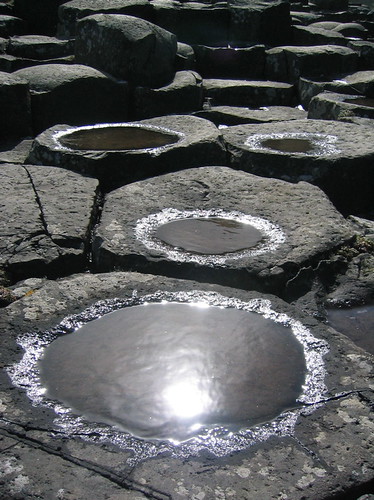
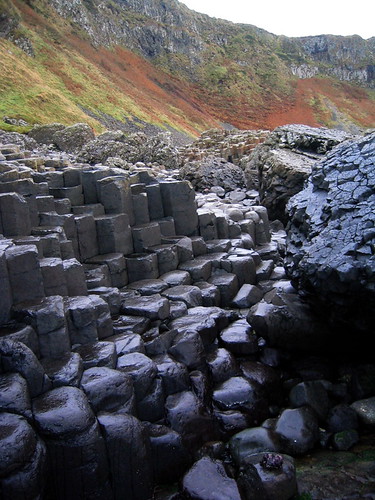
As a crystallographer from County Antrim in Northern Ireland, it should come as no surprise that I am much taken by the Giants’ Causeway, an impressive basalt rock formation on the north coast that boasts some of the largest crystals in the world.

Giant's Causeway reflection
Hexaogal crystals in Co. Antrim – each column is about 60 cm across.

 
Even though London is now my home, I have often visited and made sure that my children have become familiar with the area. When asked his opinion of the Causeway, Samuel Johnson is reputed to have opined, “Worth seeing, yes, but not worth going to see.” But the man was a fool, as far as I can make out. I may be partial but it’s amazing.

Shapes and colours
Care: Slippery when wet.

 
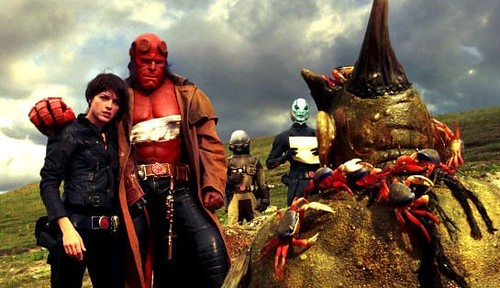
So I was tickled a deep shade of pink the other night when watching Guillermo del Toro’s fabulous Hellboy II: The Golden Army. Because the plotline sent ‘Red’ and his merry band all the way from Manhattan (well-known orifice of the underworld) to the familiar green coastline of North Antrim, on a quest to find said Golden Army.

Strange visitors to the Giants' Causeway
You can tell it’s Northern Ireland from the look of the sky. (From the IMDB)

 
Would you believe it, the army was right there, hidden in a monstrous cavern beneath the cliffs. And so ensued the elaborate, violent and inevitable final battle of the film – great stuff! All the more enjoyable because a little bit of movie-magic touched a place near to where I was born.

Posted in Uncategorized | 19 Comments

Lucky Stan

Attending the spring meeting of the Society for General Microbiology in sunny Harrogate earlier this week I had the chance to hear Stanley Prusiner deliver the SGM Prize Lecture on “Prion biology and diseases”. Not bad as talks go, though he would never win prizes for the design of his slides.

Prusiner won the Nobel Prize for Physiology or Medicine back in 1997 for his work to establish the prion hypothesis. It was ground-breaking stuff: self-replicating proteins that caused neurological disease. He had to fight his way through plenty of adverse, not to say derisive, opinion to get published and funded. In his talk he swept though this early work quite quickly to bring us up to date on more recent progress. Some of the assays they do are staggeringly long, involving as they do monitoring the disease symptoms in infected mice for more than 600 days. And I thought crystallography was slow!


Prusiner (left) receives his prize from the King of Sweden

But the most engaging segment came at the end when he allowed himself to be philosophical about winning his Nobel. For the benefit of the younger members of the audience he offered a few thoughts on what it takes to be a winner (a subject I have touched on before). His contention is that it is better to be lucky than brilliant, since luck has a big role to play in bringing your work to prominence.

He cited his own work on prions as a case in point. He had started out thinking that the disease-causing agent was some kind of tough but slow virus; if it had been, the work would have been interesting but hardly earth-shattering. The prion proteins could have been a bit less abundant in brain tissue; if so, they would have been undetectable using the techniques available to Prusiner at the time. He might have made the discovery 10 years earlier; if he had, it would have been too early to pursue the topic in any depth until molecular biology techniques were better developed. He might have been scooped by another scientist working on the same thing (something that happens all too commonly); if so, that would have been that.

And then in the early ‘90s BSE and vCJD erupted dramatically in the UK, bringing prion diseases to massive but unwelcome prominence, and Prusiner’s work very much into the public eye. The rest, as they say, is mystery history.

So there’s hope for all of us. Well, it may be too late for me (or Jenny?). But before all you young’uns start relaxing and waiting for great good fortune to roll up, let me mention that Robin Weiss, who presented Prusiner with his SGM prize, recalled in his remarks Pasteur’s maxim: chance favours the prepared mind.

Now get back to work!

Posted in Uncategorized | 6 Comments

Eye-opening access

If this paper is the future of open access publishing, then we are in for an interesting ride. And it’s a journey that will reveal a great deal more about the process of science than most outsiders will have seen hitherto.

The article by Kinch and Grishin, published in a recent issue of the very open access journal Biology Direct, provides a great example of the self-correcting nature of science by refuting a finding from Kiriakidou et al. that was reported two years earlier in one of the life science giants, Cell. What adds a particular frisson of excitement to all this is that the reviewers’ comments and the authors’ responses are appended to the end of the Biology Direct paper for all to see. I’ve not come across this level of openness before, but I think it could be a very good thing.

The scientific nub of the matter is of considerable interest since it touches on an exciting topic—translational repression by RNA interference (RNAi)—but the public nature of the dispute is even more gripping.

Kiriakidou and colleagues looked at the amino acid sequence of human Argonaute, a protein crucial to the mechanism of gene silencing by RNA interference. Curiously, they found a segment of Argonaute that resembles another protein, eIF4E, the mRNA cap-binding protein that controls the initiation of protein synthesis. The inference from this observation, that Argonaute might also bind the mRNA cap, appeared to be borne out by experiment and led to the formulation of a plausible mechanism to explain how the synthesis of proteins from mRNAs targeted by Argonaute might be repressed. Here was an important new finding in a hot area of science. No surprise then that it ended up being reported in Cell. The paper was even flagged up by the Faculty of 1000.

But there’s a problem: the Kiriakidou paper is based on an error. Kinch and Grishin looked again at the protein sequences of Argonaute and eIF4E—using more sophisticated methods—and detected no similarity. None.

More compellingly still, they compared their three-dimensional structures of the two proteins (which, curiously, were both available in 2007) and showed that they were not the same. At all. As a result, the title of their paper in Biology Direct reads like an inversion of the earlier work: Argonaute ‘does not contain an eIF4E-like mRNA cap binding motif’. We are a long way here from the linear progression model of scientific development, but somewhat closer to reality.

And what brings us closer still is the publication alongside the paper of the correspondence between the reviewers and the authors, which gives some great insights into the messy and disputatious business of science.

In their comments the authors reveal that the paper was originally submitted to “the high-profile journal that published the Kiriakidou et al paper” (tellingly, Kinch and Grishin can’t even bring themselves to write the name of the journal) but was rejected after a six-month wait “on the basis of lacking experimental evidence”, even though the reviewers for Biology Direct are unanimous in their praise for the thorough-going nature of the work. It does rather look as if Cell has dodged a dose of medicine that might have done the journal and their readers (and authors?) some good.

While the referees are generally very positive in their comments, there is a request to shorten some of the sections describing the methodology of the paper, but Kinch and Grishin defend the inclusion of such details as necessary to convince their peers of the utility of computational analyses of sequence and structure. Again a certain frustration is evident: “Without a certain detailed familiarity with the methods, sequence similarity search results are easy to misinterpret” and go on to complain that many life scientists are simply too ready to discount “computational experiments”. Could they be referring to prejudice? My favourite remark is their parting shot: “Although convincing researchers with pre-formed opinions is particularly difficult, we think our description contains an educational component that could help developing minds.” Ouch.

Not every paper is so controversial but this sort of episode is common enough in science. It’s a business that is messy, incomplete, contradictory and suffused with human feeling. Often things have to be thrashed out in several labs before a consistent and plausible story emerges. Not every experiment is perfectly insightful or free from error. And day-to-day battles may occasionally be won on the strength of feelings about this or that piece of data. But the process is nevertheless a sound one; in the long run, through repeated experiments and thorough discussion, the data will speak and well-founded skepticism will suck out the traces of personal venom. It’s still the best way we have to fight the war of discovery.

And it’s good that this messiness should be made known, so that the public get a much better understanding of what science is really like. This seems to be a growing movement; just recently we have seen Alom Shaha’s brilliant film on the importance of science and, as Ryan and Heather have pointed out, a great new web-site at Berkeley that aims to present the warts’n’all view of what scientists do. The movie mentioned recently by Caryn looks to be in the same vein.

The publication of the reviewers’ comments also strikes me as a good way to make sure that they do a professional job of their critique. Biology Direct even goes one step further in publishing the names of the reviewers (all members of the Editorial Board). As a sometime reviewer myself I would be happy to live with publication of my comments on someone else’s manuscript but I’m not sure I’d want to have my name printed alongside. I guess I would be apprehensive about repercussions on my own manuscripts and grant applications from aggrieved authors, concerns that are shared by others.

Kiriakidou and colleagues will no doubt have been stung by the correction — no-one likes to be proved wrong (I know I don’t). But they’ll get over it. I’m sure they know they made a mistake and will be determined not to repeat it. In any case their experimental observation that Argonaute can bind mRNA caps still stands and may be significant, though it is likely to come under renewed scrutiny. But this is good; it will generate new data and new insights into how the protein works.

That’s the funny, amazing thing about science: it always wins.

ResearchBlogging.org

Kinch, L., & Grishin, N. (2009). The human Ago2 MC region does not contain an eIF4E-like mRNA cap binding motif Biology Direct, 4 (1) DOI: 10.1186/1745-6150-4-2

Posted in Open Access, Uncategorized | 17 Comments