In the past couple of weeks I have been trying to convey to my students something of the glory of thermodynamics. It’s not an easy or popular subject, especially given the mathematical content. But I do love it so!
I know it seems dry: heat, work, entropy, state functions, the second law. The zeroth law for God’s sake. But peel away the yellowing, crackling paper and underneath you will find a vibrant subject that is alive with science and history. What it shows is that concepts we now take almost completely for granted, like work and energy, were actually hard won. I have been telling my students about the origins of the concept of heat and therein hangs quite a tale.
No less a figure than Lavoisier listed heat alongside hydrogen, oxygen and nitrogen in the table of elements from his famous Elements of Chemistry textbook, published in 1789. At that time heat was thought of as a substance, a fluid—igneous fluid or caloric—that pre-existed within matter and could be released in chemical reactions.
But Lavoisier was guillotined five years later during the reign of terror that followed the French revolution and soon after the idea of caloric was also knocked on the head. This latter revolution was not the work of a brutal, faceless committee but due to Benjamin Thompson, an infuriatingly delightful character, also known as Count von Rumford.
American by birth, Rumford sided with the British at the outbreak of the revolutionary war and eventually fled to London. There he proceeded to upset the British authorities and soon found himself working for the Prince-elector of Bavaria, in charge of munitions. In this capacity he could observe closely the manufacture of cannons—which were cast in solid brass and bored out to create the barrel—and “was struck with the very considerable degree of heat which a brass gun acquires, in a short time, in being bored”. These observations stimulated an ingenious series of experiments, which he published in 1798 as a paper entitled “An Inquiry concerning the Source of the Heat which is excited by friction”. Thanks to the good offices of JSTOR you may be able to download the paper as a pdf and it’s a cracking read.
In the manner of the time, Rumford’s article is written rather discursively. Here and there he reflects on how he feels about his experiments and achievements. It’s an insightful style that brings plenty of colour to the usual verbiage of scientific reporting—one that we might do well to re-discover.
From the start it is clear that Rumford is not a man wracked by self-doubt. Addressing the learned fellows of the Royal Society, he advances the view that an ordinary working life affords plenty of opportunities for scientific contemplation and goes so far as to claim that, for him, the happy circumstance of his occupation has more often led to “useful doubts, and sensible schemes for investigation and improvement, than all the more intense meditations of philosophers, in the hours expressly set apart for study.” Way to get an audience on your side.
Switching tack, he tries a little modesty. And fails. Rumford temporarily concedes that his experiments may not warrant such a grand introduction but then avers, “I cannot help flattering myself that that they will be thought curious in several respects, and worthy of the honour of being made known to the Royal Society.”
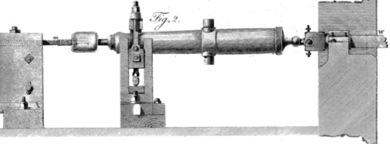
Rumford’s cannon – plug and borer on the left. Water-filled box not shown.
Rumford details his experimental set-up, which uses a cannon cast from solid brass. The Bavarian cannons were cast vertically, muzzle up, as a solid piece about a third longer than the finished product; the additional weight from the extension served to compress the metal that would form the muzzle of the gun, bolstering its strength. Rumford put this extension to the service of science. He worked it into a hefty plug connected to the main barrel by a short neck and then hollowed it out to accommodate the borer, blunted to increase friction while reducing the rate of erosion of the brass. In this way, the borer and plug could be encased in a watertight wooden box.
Then comes the boring bit. By which I mean, of course, the really exciting bit.