Back in the late Nineties, I was interning at the National Institutes of Health in Bethesda, Maryland. During the working week, I threw myself into the lab with all the evangelical fervour of a pilgrim who had finally reached her own personal Santiago de Compostela. But during the long summer evenings and weekends, I was spending a lot of time with new friends, euphoric with the freedom of living far from home.
Hello world
During these times, I got to know Jon, an amiable man who was heavily into amateur radio. I loved watching him work the VHF network with his handheld. It’s striking that when I sat down to write this post, it took some time to remember Jon’s name, but his callsign – KD3FG – was still etched into my memory.
Ever since that summer, I’ve wanted to take up the hobby myself, but life has always got in the way. Last autumn, I decided to start studying for my Foundation License. It was a long, slow process, because facts and figures no longer stick so readily in my mind, and I’ve never had a strong affinity with physics or electronics.
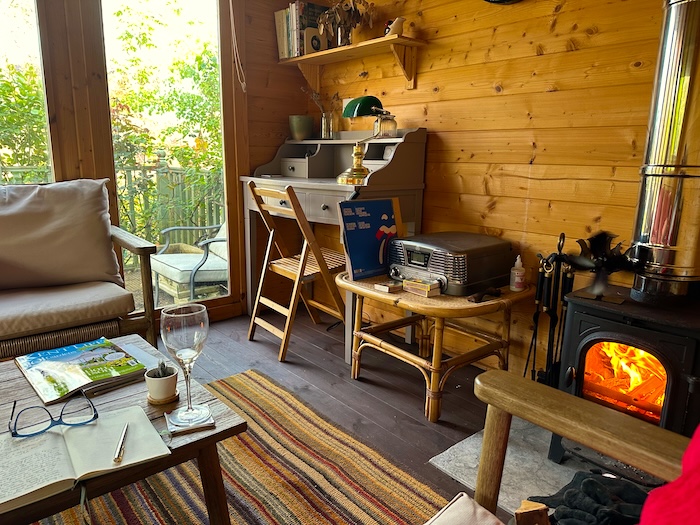
All that season, and into the winter, I’d set aside an hour or two a week to study the curriculum, lying on the sofa in front of the wood stove in the summerhouse. Over and over I’d read the chapters, absorbing the relationship between power, voltage and current, summing up theoretical in-series and in-parallel batteries, learning how signals propagate through the different layers of the atmosphere. I memorised the phonetic alphabet from Alpha to Zulu, and studied the shapes, pins and threads on images of various connectors – PL591, N, SMA, BNC – until I could tell them apart at a glance. I learned what causes interference, and how to avoid it. I marked up the long, densely populated Band Plan which tells you which type of user can use which stretch of the spectrum, alongside the maximum allowable transmission power. (One must steer well clear of other users, such as MI5, who own the 431-432 MHz turf within a 100 mile radius of London’s Charing Cross.)
At the beginning, I didn’t know my Sporadic E from my elbow, and I was continually frustrated. But eventually, all the information started to soak in. In the meantime, for my birthday in 2024, Richard bought me a beautiful Yaesu transceiver and a few bit and bobs to go with it. I started taking mock exams, and early this spring, I was ready to sit my online theory test with the Radio Society of Great Britain. I was stupidly nervous on the day; the invigilator let slip that women very rarely took part. So he seemed particularly pleased to let me know that I had passed (missing only one question). A few days later, I was assigned my unique callsign: Mike Seven Hotel Zulu Tango.
It was at this point that I came face to face with the reality that theoretical knowledge will only get you so far. Ultimately I wanted to “work the world” – that is, use the High Frequency band (3-30 MHz) to contact users other countries, maybe even astronauts on the International Space Station. But I quickly ran aground. I’d need to do a lot more reading even to decide where and how to erect an antenna for my permanent high-frequency shack. To bridge that imposing gap, I bought a cheap VHF/UHF handy (for the more accessibly 30-3,000 MHz frequencies). I was full of hope, but the way my house is situated on the side of a hill, the only thing I could pick up with the tiny in-built antenna was the BBC, and random static on other channels. The space around me seemed utterly sterile; no one answered my calls. It was all very discouraging.
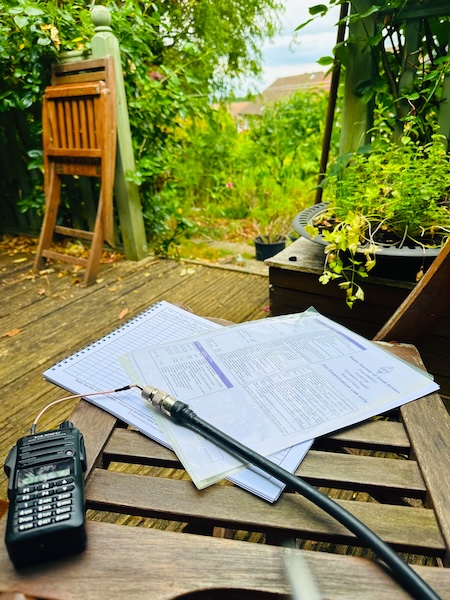
Then a friend put me in touch with the neighbourhood Ham Club – a grand name for two local guys on WhatsApp who turned out to be super friendly and helpful. I don’t understand even a fraction of what they chatter about most days, but they were generous with their time and advice. Ian lent me a massive pneumatic mast which could elevate my “white stick” vertical ground plane antenna nine meters into the air, with plenty of clearance to send and receive over the Thames and even to the airspace west of the massive hill shadow. Meanwhile, Stuart came around to look at our back garden, advising on HF antenna placement and gifting me a coaxial cable with the right attachment to connect my handy to the antenna mast. There was just enough slack for me to sit on the summerhouse porch and have a go.
What if there was no one there; or worse, there was, but no one wanted to reply?
Reader, I felt like the belle of the ball. The airspace around me was not empty, but full of life and chatter. People were queuing up to talk to me in the FM calling zone of 145.500 MHz, establishing contact and then moving up or down the band to find a free frequency. It was like being at a cocktail party, but instead of talking about what you do, you chat about your radios, your antennae, your physical locations, and how good (or bad) the mutual sound quality and signal strength is. Like a geeky cocktail party, except you’re the only woman in the room. Later, Ian and Stu confirmed that most operators were committed to being supportive of “YLs” (Young Ladies), which I found amusing. I signed off my final 73 feeling thoroughly exhilarated.
I still need to hire an aerialist to erect my white stick into a more permanent position on the roof, drill some holes into the house for cable access, and erect my end-fed long wire HF antenna across the back garden to access more far-flung operators. All in all, though, I was happy with my first foray into the airwaves.
I enjoy doing science, and despite all the stress and heartache, I still love being part of the profession. Yet it’s not escaped my notice that most of the ham enthusiasts I’ve encountered are retired. I do sometimes look forward to day when I can spend my time doing other things I love – lifelong hobbies alongside brand-new adventures.


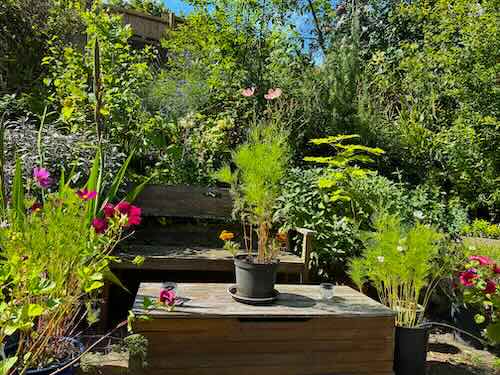
 Greetings from the tail end of a typical British bank holiday, where the big highlight was gardening in the rain.