In which I step out

Six weeks into the big experiment, and I’m surfacing for a brief update.

There is nothing I can say about new motherhood that has not been rehashed a million times, so on the topic of sleepless nights, lunching frantically on handfuls of peanuts while shoving wet clothes into the dryer and slobbing around the house in a milk-stained unbuttoned man-shirt rescued from the charity bag, I shall remain silent. The experiment did get off to a rough start — I will probably blog later about the postpartum neurological complications that nearly killed me. But now, grateful to be alive and compos mentis once again, I am finally getting into a rhythm.

Joshua, my beloved F1, is a big fan of daytime napping, so I’ve been able to resume my intellectual life quite quickly. As he snores in his swing chair, I work on various tasks: three papers that need attention, a bit of grant reviewing for a study section I’m on, co-editing Occam’s Corner, and of course tending to LabLit.com, running as always in the background as it has faithfully for nearly nine years. While I was in hospital the second time, hooked up to drips and a catheter, I was fielding editor requests from The Journal of the Royal Society Interface on my iPhone about our recently accepted manuscript – we actually ended up getting the cover photo, which I’m really proud about. (Not bad for my first senior-author paper).

Jenny's research make the cover!

Back home and recuperating, I heard that a paper at PLoS One was accepted pending minor revisions, so I’ve been penning the rebuttal letter between feeds, and last week I ventured up to the university with the pram to meet with its first author to discuss the final changes. And I’m getting together the first draft of a big paper from my last position, which is exciting enough to find a decent home fairly soon, if all goes well.

I find that academic pursuits sit well in the maternity leave environment. Thinking about science makes for a nice change from the sheer physicality of nonstop childcare – which is also a joy but has its challenges. Not going into the lab every day has brought back echoes of my Amsterdam unemployment phase, when I’d come up for air from constant novel writing to wander the streets and canals, adrift and slightly melancholy as only an unemployed person can be. Now, as I push the pram with its chunky tires through the woods in the weak autumn sunshine on our daily walk, my mind is strangely blank, and I marvel at how the hours stretch when a day’s structure is removed. It’s as if I’ve stepped out of time altogether. But my intellectual life is a reassuring connection to the rest of the world that makes this strange new existence much less scary.

Sometimes I wonder if I am supposed to feel guilty for maintaining my enjoyment — and even my need — of life apart from motherhood. A certain school of thought says this divided focus could be damaging to a child. Comparing the two is an impossible experiment, but I like to think that my son would prefer me to be happy and multidimensional. One day I’ll ask him what he really thinks.

Posted in Domestic bliss, Scientific thinking, The profession of science, Women in science | 14 Comments

In which we make a move

There’s a lot of change going on in my life right now, all at once. In addition to giving birth sometime in the next fortnight and needing to finish up a major piece of work-related writing before that, my lab has just moved across town.

We leave behind us a remote satellite outpost in Archway, its listed buildings sold to developers for purposes unknown. It was never optimal, but it is still filled with good memories for me, being the site of my first independent position. Also, we have now physically split from the clinic, where basic scientists and medics have been working together just a floor apart to understand the deep biology underlying chronic urinary tract infections. Our very close collaboration will continue unabated, but with the clinic moving a few miles north, and us moving a few miles south, it will never be as free and easy. So there is definitely an element of sadness about leaving it all behind.

Untitled
Packing up…

Now, we find ourselves amidst a bewildering array of hundreds of piled-up crates in a building within the university’s main campus – a stone’s throw away from Euston Station. We’ve moved into the abandoned floor of a very old building, nominally refurbished as a place to temporarily “decant” various university departments who are ultimately destined for new, not-yet-completed buildings. Our date with destiny is in two years’ time, when we move again to our (hopefully) final resting place a few blocks further south. So we’ll be here a while, in this strange place with its antique hardwood and glass cases, wooden benches and other charming nostalgic touches, like walls that can’t be drilled because of the asbestos. Still, with a lick of paint and a deep clean (including that alarming space on the lab floor cordoned off with ancient radioactive tape), it’s now looking pretty good.

Of course, while it’s great to be back into the mainstream – with its easy access to collaborators, seminars, proper cafés and, let’s face it, people who actually work with lab reagents I sometimes have an urgent need to borrow on short notice – moving labs is always incredibly disruptive. You really don’t know where to begin. But like true Brits, we said sod the microscope suite, tissue culture and lab benches: let’s start with the tea room.

Untitled

And once I’m allowed to drink again, I’ll be very happy indeed to frequent our new local, one of my favorite pubs, which happens to be just across the street.

So raise a virtual glass to our new home, and all the scientific adventures that will soon be playing out here.

Posted in Nostalgia, The profession of science | 8 Comments

In which I find ‘it’

When I pictured my ‘adult’ life in academic science, it never looked anything like what it actually turned out to be. Trained as we are through the ranks, the neophyte scientist is constantly exposed to her bright future stretching ahead in clearly demarcated steps: PhD, followed by a few postdocs, then slotting into a university job with its own internal steps all the way up to full professor. Every working research institute she inhabits is a core sample through these ranks, with examples of every stage freely available for inspection and wistful admiration.

My own path, clearly, was the complete opposite of orderly. But recently I’ve become aware that, despite the untraditional nature of my advancement in the past few years, I am nevertheless now doing a grown-up scientist’s job in practice, if not in title. My official moniker, ‘Principal Research Associate’, is suitably vague, indicating that I’m a PI without a permanent job. Accordingly, my contract lengths are short and frequently refreshed, fuelled entirely on soft money. In discussions with various funding bodies and prospective alternative employers in the past month or so, it’s clear I’m lodged into a no-man’s land, too senior for most schemes (having passed the dreaded ‘expiration date’ of x years from being awarded a PhD) and too junior for those that require a firm tenure-track commitment from the university.

So what’s a girl to do? A more senior colleague may have accused me of ‘having my head buried in the sand’ recently, but another way of looking at it is that I’ve just getting on with the science. And the results have been a real joy. I’m involved in several amazing collaborations, have brought in small grants and PhD studentships, have been the co-author on a number of papers in the unit, and am supervising a number of junior researchers working on my projects. My H-index and publication record are strong, and I’m being returned in the Research Excellence Framework. At a recent American conference, I met all my major competitors and confirmed that I’m on the right track. The intricacies of the pathogen-host interactions I’ve been studying unfold like a flower of astonishing complexity, facilitated by the vast array of patients we have that kindly consent to being studied. When I open the lab door every morning, there is a spring in my step as I wonder how the previous day’s experiments have gone.

I still feel insecure sometimes, of course. Last week I travelled to meet a fellow academic to see if we had some common ground for a small collaboration. As I was ushered into his office and watched him speak with assurance, I felt like he was the real thing, while I was just an imposter. Looking at it objectively, however, we seemed about the same age, probably on equal footing with regard to experience. When I looked him up in the directory later, though, I found that he was considerably younger than me, having been appointed only this year and having received his PhD a full decade after mine, with a current publication list as short as mine had been in the late 1990s. So what was it that made me feel so inferior? Was it his gender? His confidence? Or was it something about the word “Lecturer” stamped on his door nameplate, making me feel like a junior post-doc all over again? Words are powerful things, and titles do matter.

I’m happy to report, however, that I’ve surmounted a real milestone in the past few days: the submission of my first two last-author papers.

Submit!

By the convention in my field, the last author is the lab head, the one in charge, the source of the ideas. The big cheese. Last authorship is the territory of those that have finally made it, wherever or however ‘it’ may be. Perhaps ‘it’ isn’t something that has to be the top rung of a well-worn ladder of newbie dreams. Perhaps ‘it’ is just the place where you finally land, by whatever means necessary, and where everything just clicks into place.

Posted in Careers, Staring into the abyss, The profession of science, Women in science | 16 Comments

In which a picture’s worth a thousand words – in any language

Sometimes random consecutive events jibe in unexpectedly harmonious ways. When I returned to the lab from a well-earned holiday in Italy yesterday, the first thing I did was have a chat with one of our new summer students, a bright and enthusiastic Italian undergraduate interested in gaining lab experience in a clinical setting.

It turned out her English was fairly rudimentary, and some of my colleagues told me that they’d had a few communication problems when she’d arrived on Monday. Fresh from ten days in Tuscany, where I’d been polishing my own primitive grasp of Italian speaking with the natives (largely about food, coffee, the weather and, of course, the ever-repeating theme of how many months along I am in pregnancy and whether my in utero passenger was a “bimbo o bimba”), I found that the student and I were able to get along just fine in a mixture of English and Italian, supplemented by the excellent Ultralingua iPhone app — and plenty of sketches.

The Grand Experimental Plan

Also, it turns out that a very large number of lab terms can be converted to Italian simply by adding an -o or and -a after the English term, with the appropriate lilt. Who knew?

But all this reminds me of one of my favorite themes – knowing your audience. I am fascinated by the way that some people know instinctively how to pitch their communications, while others seem to give it no thought whatsoever. I’ve watched scientific colleagues at parties being asked “what they do” by a non-scientist guest, and being quietly horrified by the inappropriate responses: jargon and acronyms and a way of presenting things that clearly only an expert in the field would understand. Yet I also understand the opposite tension — not wanting to appear condescending by dumbing things down to childlike levels. It is a fine art, sensing from the information at hand — and real-time reactions — how exactly to phrase things so the correct balance is struck. Your cocktail party audience is unlikely to know what an FPLC is, for example, but you may be able to safely assume knowledge of terms such as genes and DNA. Maybe.

The art of knowing your audience is applicable to all forms of communication, whether it be science writing, explaining your project to your grandmother — or showing the new Italian student how to use the microscope. I overheard one of my colleagues instructing her to “twiddle the fine focus knob” if she couldn’t make out her Gram stains, and was not surprised when this statement drew a blank. Better to use a more common verb, like “move” — or better still, just demonstrate. Having worked in a lab in the Netherlands for four years, I remember that I was always grateful when people used nursery Dutch and gesticulation to show me things. There is nothing worse than a flood of unintelligible language, except perhaps being too embarrassed to ask for clarification and getting things horribly wrong once the person helping you leaves the room.

Posted in The profession of science | 12 Comments

In which we reach the brink – chemists add their voices

As 26 June draws nigh, I’m starting to get a little nervous about the outcome of the UK Treasury’s decision on the 2015-2016 budget, which will decide how much public spending will be allocated to the science budget. Science is Vital has been hard at work trying to sway hearts and minds with our latest campaign – for those of you who were snoozing in the back, you can catch up by reading a piece Richard, Stephen and I wrote back in March that sums it all up in the Guardian.

The Royal Society of Chemistry has been pushing in the same direction, as intrepidly described by Matthew Brown a few weeks ago. Following on from that post, the RSC has just today released the full briefing, which is available for download.

Is it just me or are those formulae reflected in the safety glasses incredibly sexy?

Is it just me or are those formulae reflected in the safety glasses incredibly sexy?

Take a look – it’s a good read. They call for 0.7% of GDP to be spent on science by 2020. Science is Vital has called for an eventual target of 0.8% (the G8 average) – which if the RSC’s call is heeded at a steady, incremental rate, would be achieved by 2025.

Meanwhile, our petition remains open for signatures, and you have until Friday to make your voice heard on our UK scientist funding survey, which will go into a report for Government that we at Science is Vital are currently scrambling to finish off. Last but not least, it’s not to late to write to your MP!

Working together, we really can make a difference.

Note added 7 June 2013 07:23:

Yesterday, Chancellor George Osborne dropped hints that science would be “protected” in the next spending review, although he didn’t go into details. While this is encouraging, the Government has always referred to the 2010 ring-fenced cash freeze as a protection, so I’m not certain this news is any different from what we were expecting based on earlier insider information. I hope to be proved wrong on the 26th, though!

Posted in science funding, Science is Vital | 4 Comments

In which the data get an outing

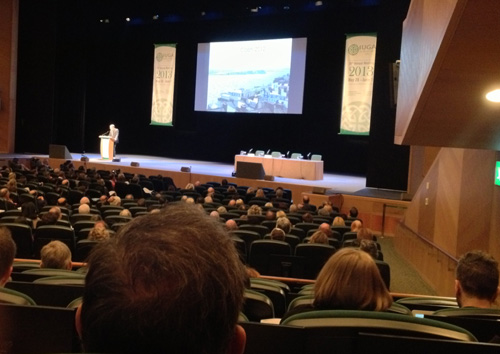
For the past few weeks I’ve been traveling the globe at back-to-back conferences – hence the silence here. The conference universe has its own natural laws, and time flows differently as its strict routines overwrite all of your own normal ones.

ConferenceAuditorium

Instead of thinking about experiments, papers and grants in the familiar environment of your own lab, you are thrust into a throng of many hundreds of people whose scientific interests overlap and diverge in a complex intellectual Venn. Inside the same Venn unit, these people can be friends, or long-standing competitive enemies, or strangers of uncertain provenance who need to be sniffed out and analyzed for their potential to fall into one or the other group in the future. Sometimes, there is a fine line between enemy and friend; you can be on great terms with a scientist but deeply uneasy about telling them anything of substance about your own work, in case they might be given an ill-advised clue. Outside your own particular Venn, passing scientists can be so much white noise, fellow companions on a completely different journey studying topics that have little relevance to your own work.

Instead of experiencing scientific knowledge through the immediacy of test tubes and physical results, or the polished, almost sterile patina of published research on paper, conference-goers are immersed in a grey zone of works in progress, often presented in a manner that makes the results feel more solid than they actually are. It’s very difficult to critique an eight-minute talk or a meter-square piece of paper when you put your preliminary findings up for public scrutiny on the podium or posterboard. You want to advertise how far along your work is, to discourage competitors from trying to beat you to the punchline, but you don’t want to give anything crucial away too soon, either. So the delicate dance plays out a thousand different ways all over the various carpeted, air-conditioned levels of the conference center, in hushed auditoria or over scorched coffees or cheap Merlot – researchers sizing one another up, probing their respective projects, wondering exactly what is being held back or what might be slightly exaggerated for best effect.

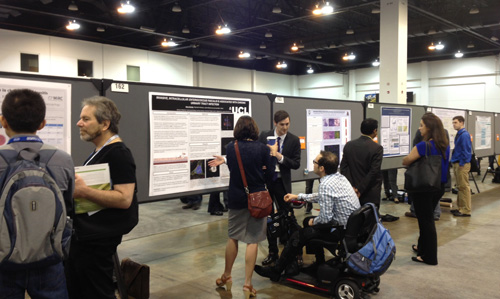
I was terribly proud of my research assistant, Harry, for defending himself admirably against a veritable onslaught of curious (and largely friendly) visitors to our poster from various competitor labs at the American Society for Microbiology – we’ve only recently come onto the scene, so it was good to make a favorable impression. Not least because this poster marks a career milestone in my own career: my first poster as the senior author.

PosterSesh

I feel like I’ve been away from the lab, and home, for years. Traveling and intense mental exertion (to say nothing of sleep deprivation and jet-lag) can be made sweeter by social episodes at the end of the day – like a spontaneous congregation at this friendly pub in Temple Bar, Dublin on a lingering, nearly-summer evening.

GuinnessTime

But I am looking forward to flying home tomorrow, at long last, to restart my real life once again.

Posted in Careers, Scientific method, Scientific thinking, The profession of science | 6 Comments

In which things flow naturally forward

I’ve been pondering the impermanence of things lately.

Maybe it all started with the departure of a well-liked clinical researcher from our lab, an OB/GYN with a sense of the absurd who never failed to make us laugh. Now when we walk by his empty bench, it’s a reminder of the absence in our close-knit team – an absence so strong that it’s almost a presence.

Absence

The itinerant nature of the scientific profession is one of its major downsides. The ‘churn’ in a standard lab ranges from a few months to half a dozen years on average, so it’s very common to show up in a new research position and attend a leaving party not long afterwards. People are always coming and going, and the group composition is forever shifting in dynamics as personalities add themselves to, or depart from, the mix.

As a sociological experiment, it’s interesting to observe, but there is also an undercurrent of sadness to the relentless flux that has always dogged me. Even when a scientist colleague doesn’t leave the country – and that happens a lot – it still is difficult to retain the friendships that once seemed so immediate, forged as they were in the crucible of a relentless rush of experimentation. In my past, there have been late nights in the lab, joking with colleagues, when I thought I could never recapture a social environment that special. But once you leave, it all slides away. For the first few months, you might meet up for drinks with former labmates, but it’s seldom the same, and soon the lab you left behind has churned itself out of existence – there are new people, new dynamics, new shared memories that you are no longer part of. To them, you are just initials on a useful Eppendorf tube, or an author on a paper that came before them. And your new lab becomes your new family, closing ranks to exclude your past.

Experiments, too, are fleeting. It never ceases to amaze me how manipulations that can take on such importance in your mind one day can, by the next, morph into insignificance when their outcome is not good. Freezers and fridges are full of failed experiments that you can’t quite bring yourself to chuck away – for at the time, you invested so much meaning in them, so much hope.

Mess

Even my physical surroundings are not constant. In a few months, my university is selling off the satellite campus that’s been my home for the past year and a half, to be turned into luxury flats. While I welcome the move south to the main campus, it will inevitably cause a lot of disruption. We are being “decanted” (such a dreadful managerial term) into temporary accommodation for eighteen months, into an abandoned building that is currently heaped with junk and – apparently – teeming with asbestos, meaning certain rooms are completely off-limits. When we had the walk-through a few months ago, we were dismayed to find that my future lab space had a huge, ancient radioactive spill on the lino cordoned off with fading yellow tape – with no Geiger counter to hand, and no indication of the isotope in question, we had no idea how hot it still was. It will all be decontaminated and given a lick of paint, so hopefully it will end up perfectly habitable. But then there will be another move, to our final resting place in a newly refurbished building a few blocks away – more disruption, more impermanence.

As I left the lab this evening, the cherry blossoms were fluttering down and accumulating against the curbs like drifts of pink snow.

“Life is a series of natural and spontaneous changes. Don’t resist them; that only creates sorrow. Let reality be reality. Let things flow naturally forward in whatever way they like.”
– Lao Tzu

Posted in Careers, Nostalgia, Staring into the abyss, The profession of science | 9 Comments

In which it all goes a bit Hitchcock

As I approach the door and reach for the knob, I find that my heart rate has accelerated. Behind me, one of our research nurses cowers a few paces back: she needs to get inside, but – quite understandably – doesn’t want to go in first. This, then, is one of the many aspects of being in charge of a lab that isn’t listed in the job description.

I know exactly what to expect, but somehow, that doesn’t make the atmosphere any less tense.


The Terror Within

As I pull open the door and slip inside, all at first seems well: the thrumming of the four massive freezers, ancient but still serviceable, produces its usual white noise, and a faint cool breeze from the open windows ripples my white coat, dispelling the breathy heat of the machinery. I’m just about to turn to my colleague and proclaim the all-clear when suddenly, an explosion of sound like an out-of-control helicopter blasts through the room. My colleague and I emit involuntary shrieks, duck and cover our faces as two grey, blurry objects rocket out from behind the freezers and make a bid for freedom through the open windows. In the shocked silence that ensues, a dozen feathers spiral lazily to the floor, already coated in the weekend’s layer of downy fluff and guano.

Only then do we laugh, and then go about our business retrieving samples.

Forget the spherical cow; dear reader, we have a massive pigeon problem here in the lab. It’s all down to the lack of air conditioning. Having four immense freezers attempting to keep a core inner temperature of minus eighty degrees Centigrade in a room barely larger than a closet, the ambient temperature quickly exceeds the machines’ capacity to do their jobs if there is not sufficient ventilation.

Freezer Room

There were a few weeks over the long, bitter winter when we could actually shut the windows, but those days are long gone. As the warm spring sunshine pours through the Victorian panes of glass, the freezer room quickly overheats unless all five windows are wide open. And with spring also come the roosting pigeons, which seem to particularly like hanging out with a bunch of hot freezers. The fair weather also, of course, happens to correspond with the end of term, when there are no longer any undergraduates around to bribe into being gun dogs to flush out the pests.

Try as I might, I can’t come up with a solution that doesn’t involve a ridiculous amount of effort, such as buying lengths of chicken wire at a home improvement shop and nailing them up as barricades. We could learn to live with the shock factor, but we’re worried about hygiene: the freezer room abuts our main microbiology lab, where we are culturing uropathogens with fastidious care. And for some reason, the pigeons that hang around the Archway Gyratory seem particularly scruffy and insalubrious.

Post-Pigeon Lab Carnage
Post-pigeon carnage

All ideas, serious and otherwise, gratefully received.

Posted in Silliness, The profession of science | 12 Comments

In which I dream of going viral

In a post I wrote over on the Guardian yesterday, I made the comparison between early-career researchers and unknown musicians:

But how does a younger scientist with a shorter track record, whose “excellence” might not yet be apparent, get his first grant? It must be a lot like getting your first break as a popular musician – except unlike a bloke with a guitar, scientists can’t film themselves on YouTube performing experiments in their bedroom to garner a reputation. Instead, they need grant money to produce the results that get turned into papers, which in turn prove their excellence – but without the grant, they’ll never get off the ground in the first place.

But then I got to thinking: wouldn’t it be totally cool if one could go viral being filmed doing an experiment in one’s bedroom? This is the closest I’ve got to it so far:

Plasmid Preps begin at Home

Our satellite campus doesn’t have an ultracentrifuge, so I recently had to gatecrash a friend’s lab in the Royal Veterinary College across town to do a plasmid prep. If you’ve ever perched in someone else’s digs, you know it’s always a little bit awkward – you don’t know where everything is, and inevitably you’re using up precious bench space that belongs to one of the resident students or postdocs. Ultimately, you end up feeling underfoot and in the way.

By the end of the prep, after doing the final spin and seeing that lovely white pellet of DNA at the bottom of my tubes, it was approaching 6 PM and the thought of sticking around for the final pellet-dry and resuspension steps seemed tedious. Worse, I wasn’t even sure I could get out of the building after hours without an escort or a pass.

So I took everything home and finished it off in my living room. (Don’t tell Health and Safety about that G&T on the side.) I was only really nervous when I was riding the Tube, wondering how I would explain the contents of my rucksack if I were stopped and searched by the London Transport Police.

“It’s just Green Fluorescent Protein,” I could imagine myself pleading as I was hustled away in cuffs. “GFP in a mammalian expression vector. To turn cells green. So you can see them.”

“Tell that to the judge, lady.”

But seriously. Could one actually film oneself doing an experiment real-time in one’s bedroom in any way that was meaningful, and would anyone be interested?

What do you think, Dear Readers?

Posted in Health and safety gone mad, science funding, The profession of science | 14 Comments

In which I cling on

Recently I was kindly invited by the University of Southampton’s branch of the University and College Union to give a talk about the casualization of research jobs. ‘Casualization’ refers to the state whereby workers are employed in a disposable fashion instead of being taken on long-term. Most early-career academic researchers in the UK, who are collectively responsible for generating the vast majority of scientific data, are employed on fixed-term contracts (77%, according to a 2011 survey by Vitae, in direct contravention of the 2008 Concordat), or on open-ended contracts which are unstable because they rely on soft money, and as such often end in redundancy.

Although research is a popular and oversubscribed profession because of the excitement and freedom of doing creative work, it is widely acknowledged to have many drawbacks compared to other professions. But in a 2011 survey conducted by Science is Vital on more than 700 UK researchers across all levels of experience, casualization was cited as the very top concern – ahead of pay and other common complaints.

Poll

As an individual, I’d have to agree that short-termism and its affiliated career uncertainty is my biggest problem with the scientific profession too. As an exercise for the talk I was giving, I thought it might be useful to make a flow chart of my professional career in terms of contract length (with relative salary indicated by the yellow stars). Although I know I’ve had a long and tortuous progression, something immediately sprang out at me when I put it all together in one diagram: in the private sector, I’ve been offered a permanent position within a few months of joining a company – every time. In academia, I’ve never been offered one.

Career Path

But at least my immediate future is now secured. From April, I’ve been placed as a named investigator on someone else’s grant, so I can carry on with the same work I’ve been doing. (It’s a mark of how long I’ve been on an open-ended contract, renewed every few months at the last second, that a year can seem like an eternity). With some great papers coming out, and bolstered by an external grant I’ve recently won, I hope to use the coming period to secure one of the few independent fellowships that don’t have age restrictions – fingers crossed.

Posted in Careers, Staring into the abyss, The profession of science | 8 Comments