In which we endure

Baby, it’s cold outside.

And inside too, as it happens.

Over the past month or two, London has been in the grip of some of the coldest weather I ever remember having experienced here. For most London workers, the chill is something you only notice on your commutes. But not so in the aged Victorian building that houses my lab, resplendent in the blonde-colored, ivy-sprawled, pointy-gabled brickwork of this provincial university satellite campus. Neither the lab nor my office has central heating of any kind, and the graceful, single-glazed windows suck out whatever animal heat scientists tend to give off.

All of which rather challenges the idea of doing an experiment at “room temperature”. (It is of little consolation that in the summer, as sun pours through those same beautiful windows, the temperatures will often exceed 40 – there isn’t any air-conditioning either, needless to say.) At the nadir of the big freeze, I measured the lab at 14 degrees Centigrade, and asked everyone to let their reactions run fifteen minutes longer than what the protocols called for, just in case. All the students soldiered onward in overcoats and wooley hats, bopping along to music and seemingly unconcerned. When our health and safety officer scolded them, I sent an email telling her to back off – if uropathogenic bacteria can’t penetrate a lab coat, they certainly won’t get through fur-lined polar fleece.

In my office, I’ve been working with my door shut with an electric space heater on full blast a few inches from my desk. It takes the edge off, but I find it scientifically curious how working in a cold room blunts the intellect. Unlike the music and chatter of the students drifting under the door, or the suspiciously pungent incense floating up from our ground-floor neighbors, the Asanté Academy of Chinese Medicine, the cold is something I cannot screen out. It prickles at the periphery of my senses, telling me that all is not well, that I should be shutting down all but essential functions. (Apparently writing a grant application is not one of them. Funny, that.)

But the cold is not all bad. For the first time in months we’ve been able to shut the windows in the room housing our mammoth, ancient minus-eighty freezers, which overheat at every other time of year. Which means that we don’t have to bribe the undergraduates to chase the pigeons out of the lab. And when the lovely man from BOC arrives with our liquid nitrogen refill, we don’t have to worry about our samples thawing out when we wheel our tank down to the pavement outside the main entrance.

LiquidNitrogen
My research assistant, Harry, keeping an eye out

And there are signs, too, that spring is coming at last:

Snowdrops

Leaves

Hyacinth

DaffsAndViolets

Crocus

I, for one, am ready.

Posted in Health and safety gone mad, Students, The profession of science | 8 Comments

In which we make a mess of things

As a rule, when I’m trying to be creative, I have a hard time focusing if my workspace is not pristine and well-ordered. This holds true whether I’m working on a novel at my desk or performing an experiment on my lab bench.

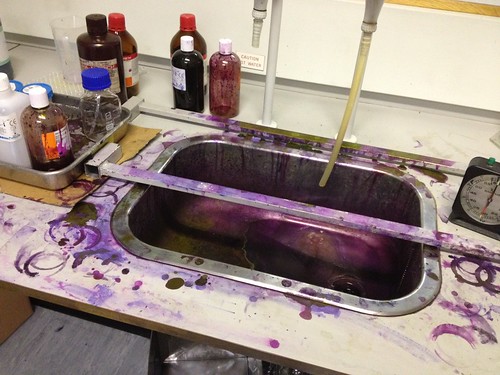
This is why I find a certain area in my lab a little bit distressing:

Gram Stain sink

This is the place where we do our Gram stains. Gram staining is an ancient but still perfectly serviceable microbiology technique whereby a slide of dried bacteria is subjected to a series of dyes and chemicals in order to reveal whether its cell wall is Gram positive (purple) or Gram negative (pink). The purple stain is associated with peptidoglycan, which is found on the surface of a large group of microorganisms. Even though it was invented by the Dane Hans Christian Gram back in 1884, it is still often used as a first step to classify an unknown organism.

I just wish the procedure weren’t so damned messy. There’s no getting around it, though: no matter how careful you are, your dedicated Gram sink is going to end up looking like this. I have a soft spot for this procedure nonetheless, since it was the first microbiology technique I learned as an undergraduate, back when we had to isolate E. coli from our own lower bowels to get full marks.

Those were the days.

Posted in Nostalgia, Scientific method, Silliness | 6 Comments

In which science writer wanna-bes are given a chance at fame and glory

Are you a early-career cell biologist (PhD student or post-doc) in the UK with a flair for the pen? Do you like to communicate about your science using everyday words and sentences structures other than the passive voice? Or maybe you’re passionate about other areas of science outside your own lab, and would like to express them in a creative way?

BSCBgrab1

If so, why not enter the British Society for Cell Biology’s writing prize? The shortlisted entries will be judged by me, and the winner will receive £300 in cash and will be published on the BCSB website as well as on LabLit.com. More detailed rules can be found on the prize page, and the deadline is 15 February.

If you’ve always wanted to try your hand, why not make 2013 the year you give science writing a go? The world needs good science communicators, particularly those who are active at the bench and can give topics their own unique, insider’s perspective. The more we scientists talk about science, the more allies we can gain in wider society. With science funding in constant jeopardy, this is one way you can do your bit to help engender trust and support for your profession.

Good luck, and spread the word!

Posted in science funding, The profession of science, Writing | Comments Off on In which science writer wanna-bes are given a chance at fame and glory

In which we feel the estrogen love

Yesterday was a mixed day for women in science. Bright and early in the morning, I sat plugged into Skype waiting for the BBC World Service to interview me about subconscious bias against female scientists. The news hook was a piece that had appeared in the Guardian a few days earlier from an anonymous female professor talking about the most recent of many studies (which I blogged about here) showing the bias in action. My spot was to be the last, and the program was due to go off air in less than ten minutes.

The live program was being streamed into my headphones as I waited to go on air. After some cheerful cricket news, the guy before me came on: a fish geneticist who answered all the interviewer’s questions in a slow, roundabout and complex manner. It soon became very clear that, despite the interviewer’s best efforts to cut him short, there was going to be no time to talk about women in science that day.

Sure enough: “You’re going to hate me, but we’ve run out of time,” a voice said apologetically into my headphones at precisely 7.59.

“That’s OK,” I replied. “It’s not the first time I’ve been out-talked by a male scientist.”

Never fear, however: this disappointment was very nicely mitigated by subsequent happenings. Last night, after months of plotting and planning by myself and fellow University College London colleagues Uta Frith and Philippa Talmud, UCL Women had its glorious launch event.

UCL_Women
A show of hands: they’re mine, actually!

UCL Women is a grassroots networking group for academic staff in the sciences, engineering and mathematics at UCL, open to staff at the post-doctoral level and above. (We had to restrict the numbers somehow, but if our starting pool proves manageable we may expand our criteria to other categories in future.) A significant expansion of a smaller group founded by Uta Frith called ‘Science and Shopping’, which I’ve been lucky enough to be a part of for a number of years now, UCL Women is informal and aims to provide access to information and advice that might otherwise be hard to come by. The main medium of interaction will be drop-in sessions where people can socialize, but we also plan to have a few formal events too. Research Fortnight had a nice piece on us earlier in the day, which includes some thoughts from Uta about what the group will be like.

We had no idea how much interest there would be when we first dreamt this up, but the hundred free slots to our launch sold out in a few days and 45 people on the waitlist couldn’t get in. So clearly the women at my university feel the need for something like this.

The meeting was chaired by Philippa Talmud (Professor of Cardiovascular Genetics), and the fabulous Vivienne Parry (Writer, Broadcaster, Vice-Chair of UCL Council) moderated a panel of speakers addressing the questions “How did I get here? What am I doing?”. I felt very outclassed on the panel, which also included Sarah-Jayne Blakemore (Professor of Cognitive Neuroscience), Mary Collins (Dean of Life Sciences), Uta Frith (Emeritus Professor of Cognitive Development), Jean McEwan (Dean of Medical Sciences), and Liora Malki-Epshtein (Lecturer, UCL Civil, Environmental & Geomatic Engineering). Afterwards, Vivienne opened up the discussion within the wider audience, which was packed into the room along with one lone, brave male photographer (who held his head high, I’m happy to report).

What impressed me most was how many female professors were in the room. I am quite sure it was the most I’d ever seen together in my life – with only 15% in life sciences overall, they are certainly few and far between. And there was an amazing energy – a sense that passions were running high, that we were a force to be reckoned with – that there was nothing that we couldn’t achieve if we worked together in a positive and collegial way.

As one person tweeted:

If you’re a female academic at UCL and would like to get involved, follow us on Twitter (@UCLWomen) or visit our website for regular updates. It’s all still in the chaotic planning stages, but it’s already shaping up to be something really special.

Posted in Careers, The profession of science, Women in science | 1 Comment

In which I get my mojo back

So 2012 has drawn to a close, a new year is upon us and London’s seemingly endless broodiness gave way to brilliant sunshine today. Out in our local park this morning, strewn with spent fireworks and empty Champagne bottles, unusually large crowds of people roamed around, blinking in the unfamiliar sunshine after a late night of reveling. Up until this point, the city has been pelted with almost nonstop rains, flattened under gusting winds that take down rotting fences and do obscene things to umbrellas. We’ve been blanketed in afternoons of a perpetual twilight gloom, and winds howl through the chinks of our sturdy Sixties-build flat. Home for Christmas this year, Richard and I have burned many candles against the darkness and have tried to do something that goes against our innermost natures: namely, to relax and do nothing without feeling guilty.

I’ve succeeded for the most part, having caught up on my sleep, eaten a lot of food, finished two so-so novels (The Marriage Plot by Jeffrey Eugenides and Death Comes to Pemberley by PD James) and plowed halfway through a third (Strong Motion by Jonathan Franzen). My limbs are languid and my brain is just a little bit mushy.

Despite all this recuperative loafing, I did have a firm goal to attempt at least one task over the long break: to jump-start my fiction writing.

Normally I never suffer from writer’s block with my novels, but when I do, it’s absolute. After penning my first two novels in an almost unbroken streak of furious activity (5000 words a day on average, taking about three months to write a first draft), I stalled halfway through my third for nearly four years. This hiatus was not actually writer’s block per se, though; it was more that with no publication in sight for the first two at that time, it seemed pointless to carry on churning out books into the void. But once I’d published Experimental Heart, it felt right to dust off Number 3 and finish it off. It proved rather difficult to overcome the inertia of four long years of activity, but as I described in a previous post, a writer’s holiday in Whitstable got things moving again. Currently I’m finalizing it for publication, though I am not sure yet exactly what the plan is there – which is another story for another time.

My current writer’s block is of a different quality entirely. Since I wrote those two and half novels so effortlessly, my life has become a lot more complicated — I’ve got LabLit.com to tend, rebellions to foment, various blogs to feed and rather a lot of speaking and writing engagements to discharge. As a consequence, I have less time to write overall. So it’s important then when I do manage to cobble together a few hours here and there, I make good use of the time. Unfortunately, Novel 4 — which is based on an interesting, real-life premise and seemed so promising in outline form — ground to a halt in the middle of chapter five sometime early last year. And try as I might, I have not been able to make headway since.

It is a very peculiar feeling as a writer, liking the idea of one’s novel, but not actually liking what’s emerging onto the page. Writing fiction, for me, has always been like falling in love, or being swept as a reader into a book you don’t ever want to end. The characters come to life and drag you under, and writing in this state is a joy, not a chore. Novel 4, alas, was just not doing it for me. I was not sure whether it was the novel itself, or whether it was the right novel at the wrong time. Eventually, Richard persuaded me to set it aside and try something else. And since he, and several other of the test readers of Novel 3, thought it ripe for a sequel, I decided to try just that. Within about an hour of plotting and thinking, the sequel was off like a rocket, taking on a life of its own after only a few pages.

So it wasn’t me; it was the book. I suspect it was too dark, too close to some real-life events in my past that still sit uncomfortably with me, and that’s not where I want my imagination to dwell heavily right now. Maybe one day in the future I’ll feel more enthusiastic about entering those waters, so I’ll keep the mothballed manuscript waiting. In the meantime, it’s back to a familiar universe where the characters are old friends, and there’s space to invent a few new ones too. And there’s unfinished business that needs to be sorted out, and someone up to no good who has disappeared off the map and needs to reappear, and — well, I don’t want to give anything away!

To celebrate, we hired a car and drove down, appropriately enough, to Whitstable, my place of literary mojo, and then eventually up to the Elmley Marshes on the Isle of Sheppey. Sheppey, a very strange and isolated part of Kent, plays a pivotal role in Novel 3 and its sequel, so it was good to immerse myself in its murky atmosphere as I prepare to dive back down.

I wish you all a very Happy New Year, and leave you with a few photos from Elmley to set the scene…

Richard bird-watching
Richard scoping for birds

Elmley Marshes, Dusk
Extra-heavy rains have just made the marshes more hospitable to the many birds who shelter here

Two bridges onto the Isle
The old and new bridges onto the Isle – which play a pivotal role in the plot

Old and new bridges onto Sheppey
Heading back home to my typewriter over the Old Bridge, eclipsing the New

Posted in LabLit, Nostalgia, Writing | 5 Comments

In which a classic tale of DNA and discovery is recast

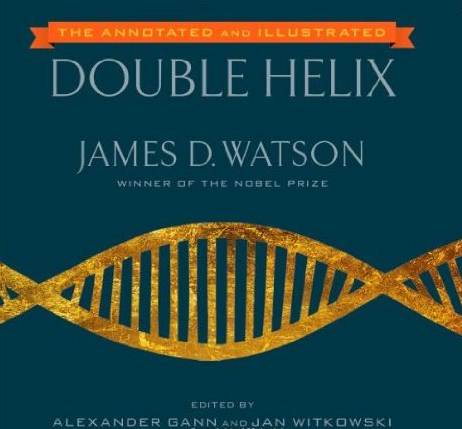
As for many people in the molecular biology profession, my first reading of The Double Helix by James Watson was a revelation. I can’t recall how old I was – probably in my late teens. I had already decided I wanted to be a scientist, and the engaging, first-person account of such a pivotal discovery – nothing less than solving the structure of DNA and revolutionizing biology forever – pretty much sealed the deal for me.

helix

In retrospect, I have mixed feelings about the work now – and I’m sure I’m not alone. Once you know a little more about what Rosalind Franklin was really like, and how certain plot points probably actually panned out, it’s difficult to look at Watson’s book in quite the same way again. Depending on whether you believe the ferocious defense by Franklin’s friend Anne Sayre or the more balanced biography by Brenda Maddox, you find out that Franklin was, at the very least, meanly lampooned as a person she was not, and at the worst, possibly stitched up and deprived for too many years of the scientific credit she deserved.

Nevertheless, the book remains an astonishing work of art: while it’s commonplace today to read fictionalized accounts of real scientists and historical discoveries – to make a novel out of a biography* – back in 1968 it was as far as I know, almost unique. No matter how I feel about Watson now, I recall being enchanted by his young narrator’s voice, rushing towards his destiny with humor, irreverence and a passion that leaps off the page.

To mark the 50th anniversary of the Nobel Prize bestowed upon Watson, Francis Crick and Maurice Wilkins for the discovery of the structure of DNA, Cold Spring Harbor Laboratory Press and Simon & Schuster (Editors, Alexander Gann and Jan Witkowski) have collaborated to produce a gorgeous coffee-table edition packed full of annotations, photos, letters and documents, some never before published, as well as a “lost chapter” from the original manuscript and a fascinating dissection of the controversy surrounding its original publication.

I have not read The Double Helix since that heady first time in my teens, so I look forward to sinking into it over the holidays and seeing whether Watson’s youthful charisma can overcome the darker knowledge of subsequent information.

*If you’re interested in fictionalized scientific tales, you can visit the LabLit List and take a look at anything labelled as “historical”. Personal favorites include The Unfixed Stars (on Clyde Tombaugh, the Kansas farm boy who discovered Pluto), The Sky’s Dark Labyrinth (on Kepler and Galileo) and This Thing of Darkness (on Fitzroy and Darwin).

Posted in LabLit, Nostalgia, The profession of science, Women in science, Writing | 6 Comments

In which lab lit storms New York

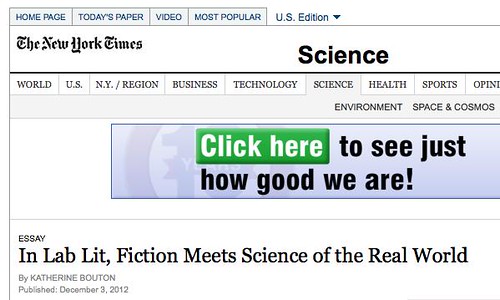
Last night my publisher emailed me in high excitement to tell me that I, and my magazine LabLit.com, had received some positive coverage in The New York Times.

LabLit.com in the NYT!

Do have a read of this (freely available) piece by Katherine Bouton if you’re interested in lab lit fiction and its place in the grand literary scheme of things. It’s certainly wonderful to see fiction about scientists getting the mainstream airing it deserves. The hook for the piece is Barbara Kingsolver’s new science novel Flight Behavior (reviewed on LabLit’s most recent podcast), which I can highly recommend.

The infiltration of science and scientists into popular culture continues. Onward!

Posted in LabLit, Writing | 8 Comments

In which I am not a science cheerleader

There is something seductive about the scientific profession: it exerts a gravity so powerful that it can hoover all of the surrounding universe into its warped perspective. If you have your heart set on being a scientist, you set off on that journey with unwavering focus. Twenty years later you might look up and realize that you still don’t have a proper job, but somehow that’s ok, because there is nothing else in the world that you could possibly do.

Do you recognize this mindset? I certainly do. Until about fifteen years ago, that was me, barreling down a path that had no forks and certainly no exit ramps. At its beginning was a PhD, and at its end, a permanent lab head position in academia – cue fuzzy-focus shot of a bright-white space full of gleaming equipment and happy young people. In the middle of this tableau, an older me, perched on a stool, brow furled intrepidly as I’m presented a perplexing result, like some sacred offering, by one of the younger people. The phone rings, and someone else rushes over, picks up the receiver and chirps, “Rohn lab!”

Well, life does not always work out as expected. In the biological sciences, the vast majority of PhD students cannot ever run their own research group, simply because there are not enough spaces for them. A lab head churns out many dozens of replacements over a long career stretch, but there will be only one position available when he retires – if that position is not made redundant. In the UK, the Royal Society has estimated that, of PhD students produced, only 3.5% will secure some sort of permanent research position in academia and just 0.45% will become full professors.

So what does this mean for the 96% of scientists who leave academia to do other things – research in industry, science-related jobs like patent law or science publishing, or non-science employment altogether? What 96% of a group does can no longer be seen as an aberration: it is actually the norm. And what awaits them outside academia? Often, it is job security, a much higher salary and better work-life balance – frequently, a profession every bit as worthy and complex as the one they left behind. Many find it is only the beginning of an epiphany: the start of a more fulfilling life where effort in equals effort out; where one’s efforts are vastly more respected and valued; where the difference that you can make is gratifyingly quick and tangible.

But in the midst of the vortex that is academic science, such defectors are often viewed as a failure. Because if it’s not academic science, then it’s not the universe, right? These wayward souls have sailed right off the edge of the map into serpent-infested waters.

My second novel, The Honest Look, follows a turbulent few months in life of Claire, a scientist who is torn between science and doing something else. I have found that her story resonates with many people, both in and out of the profession. But there is a peculiar subset of academic scientist who takes a strong objection to the novel’s ending (and if you don’t want to know what it is, the rest of this post discusses a major spoiler). A recent discussion of my novel, which was otherwise very strongly positive, closed with the following remark:

One caveat, however. The protagonist, like the author, is both a scientist and a writer — a poet. In fact, the poet seems more carefully described, with wonderful passages on the process of creating poetry. This is certainly not a problem in itself; except that the poet-protagonist wins out over scientist-protagonist in the end. As such, the message might be taken (especially by young readers inclined both toward the sciences and toward the arts) as an endorsement of the arts over the sciences. Or, to put this another way, you can do poetry and be a “lone genius,” but do science and you may find yourself amidst all of the, well, nasty stuff that the novel portrays so well.

Is this the message we would want our youngsters to take away from the novel?

I find this view utterly fascinating. Leaving aside that fiction is meant to be work of art itself, not a propaganda tool for career advisors, what are we to make of his concern? If I interpret this person’s view correctly, the choice of the arts over the sciences is not only a betrayal, but describing it is also a bad influence on the impressionable young. It is not the first time I’ve heard this criticism of the ending – others, always scientists, have seen Claire’s choice as a disappointing “failure”, as turning away from the “right” path to something that is more lightweight, more flimsy, less worthy of her talent and effort.

Personally, I would turn the question around in two different ways. First, is it correct to suggest that science is superior to the arts, and that to choose the latter makes you somehow a lesser person? Is the universe that brought us miraculous works of music, verse, paint and prose any less aspirational to a civilized society than the scientific one?

And second, in the unlikely event that one were writing a novel as propaganda, would it be ethical to leave our youngsters with the impression that there is a scientific job for even a tiny fraction of every talented person who wants one? Is it right to lure them into a profession that does not want most of them long-term – which leverages them dispassionately as cheap, disposable labor that can be wrung out and thrown aside when they grow too old and expensive? When one of the legion of talented young people decides to, or is forced to, leave the fold, is this an uncomfortable fact that we should try to cover up? Or is saying goodbye actually an integral part of the lore and fabric of the scientific profession, as indispensable to our campfire tales as the eureka moment, or the brilliant theory that got away?

Posted in Careers, LabLit, Scientific thinking, Staring into the abyss, The profession of science, Writing | 28 Comments

In which I prepare to be terminated – again

The afternoons are darkening, the leaves are scattering to the ground — and the usual seasonal missive from HR has arrived in my inbox.

They need my clothes, my boots and my motorcycle

Actually, although I’m on rolling 3-monthly contracts, I haven’t received this kind of notice in writing since I started nearly ten months ago. Each time, they’ve found spare salary behind the sofa cushions at the final hour. The Unit here very much wants to keep me, but despite the fact that I’m REF-returnable, overseeing the production of exciting and clinically-relevant data and have already managed to bring in external funding, the receipt of a formal letter makes me wonder if the game is finally up.

So I have to decide now whether I should start seriously looking for another position. And if so, do I want to find an academic situation, or would I rather leave its uncertainties and instabilities behind me for good?

I’ve been here before, of course. After another redundancy in a small, low country that now seems a world away, I recall writing in my leather notebook all the pros and cons of academic research, industrial research and non-science jobs such as publishing, staring at them for hours as I agonized over what to do. In the end, with the economy in poor shape at that time, the decision to leave research was made for me. But not being in the lab made me fundamentally unhappy, and this memory too is fresh in my mind — as is the joy I experienced when I finally clawed my way back. I have been particularly content in this lab, feeling for the first time as if my talents and experiences are being used to their full potential, as if my efforts really could help patients and make a difference to their lives. Previously, my passion for the vocation had been lost in the details, and rediscovering it once again has been a daily source of intense satisfaction. It would be a personal tragedy if I had to leave it all behind.

Still, I am at heart a pragmatist. I have mortgage payments to keep up and food to put on the table; redundancy pay (less than a month’s salary) would not get me far. I believe myself to be eminently employable in a wide variety of roles, but it can take time to find a decent job. So it seems like the right thing to do is to roll up my sleeves and make a start.

Will leaving research, if it comes to that, become a life’s regret? I’m not so sure. I’ve come a long way since I last faced this decision. Tomorrow, I turn 45. Battling to stay constantly afloat seems increasingly unappealing. Meanwhile, the past few years of my expanded activities in writing, communicating, punditry and policy have revealed interesting career prospects that weren’t even possible for me the last time I was laid off. It seems likely that my love of research could face some stiff competition if I found the right role outside of it.

Having recently been accused by a higher-up in the Division of allowing my head to be “buried in the sand”, it might be time to face the inevitable with good grace and a sense of humor.

Posted in Careers, Staring into the abyss | 16 Comments

In which I powder my nose

It’s rather disconcerting to enter a stall in a public lavatory, sit down – and see your own name staring back at you on the inner door advertising.

Loo

Does this mean I’ve really hit the big-time?

/Ducks in preparation for some really bad loo puns

Posted in LabLit, Silliness, Writing | 5 Comments