In which we excavate the Tubes that Time Forgot

I’ve written before about “the churn”, which is a term established scientists tend to use when they want to make short-term lab contracts sound like a good thing – instead of the relentless waste of talent and reagents and constant reinventing of the wheel that they can actually be in real life. Freezers tend to epitomize this whole concept, harboring dark spaces where samples can accumulate over many years, being slowly buried alive by layers of frost in corners that are just too cold and occluded to spend a lot of time tending to. All it takes is one complete turnover of lab personnel (circa four to six years) to render expensive reagents and irreplaceable samples into so much meaningless junk.

The other day our aged minus-twenty freezer finally packed it in. This came as no surprise – for many months now we’ve had to vigorously kick open the internal plastic doors to gain access. No matter how hard you scraped, these flimsy barriers became coated with a thick patina of ice within minutes of closing the leaky main door and could only be liberated by force and a wild spray of glassy fragments all over the floor. Soon our tubes of chemicals dissolved in water were failing to freeze even after being stored overnight, so we knew it was time to evacuate everything to one of the two minus-eighties hulking nearby.

Except, probably rather predictably, there wasn’t any free space.

So I asked my lab to roll up their sleeves, get out their notebooks and spreadsheets and work out which boxes were important and which were unknown and, by definition, rubbish suitable for disposal. Our lab does clinical trials, so by law we have to store some samples for a very long time. Even taking these well-documented boxes into account, we were all a bit appalled by how much else was in those freezers – hundreds and hundreds of lost boxes, containing thousands of tubes. Boxes with no names, tubes with indecipherable handwriting, initials that no one recognized. Every once in a while we’d hit something familiar (“Oh yeah, that’s H‐‐‐‐‐. Remember him? He’s the medical student who used to fill up the urine samples so full that when you thawed them out you’d get sprayed with piss!”), but in the end, these were the minority.

Lab Freezer Clearout

It is sort of sad, thinking that each row of every one of these boxes was someone’s experiment. Someone thought it was important enough to spend back-breaking hours labelling each tube, filling it with something or other, no doubt with the full expectation that she’d return to them in future, or that someone else in the lab would carry the torch. So many plans, so many dreams – so many expensive tubes and reagents – all destined to end up in the Bucket of Shame.

Tubes that Time Forgot

Posted in The profession of science | 6 Comments

In which numbers lie – except when they flatter us

Bibliometrics have been making me cross recently.

In the past month, I’ve stumbled across two instances where journal impact factors were being used in a grossly inappropriate way to assess the worth and quality of scientist colleagues. This exposure in turn has really hammered home the inanity of our profession’s obsession with measuring the immeasurable.

I don’t want to compromise anyone’s privacy, so let’s call the two people involved Timothy and Anna (not their real names). Timothy is an early-career researcher in another London university who went to speak to the person in charge of marshalling the troops for the upcoming Research Excellence Framework (REF), a national exercise used to assess the quality of a university’s research output. The better the research, the more money the university gets allocated in the future. So it’s an incredibly big deal that has grown into a monstrously complex bureaucratic nightmare spanning years and consuming many man-hours of effort. Timothy had a few great papers under his belt and was eager to make his contribution. The person he went to see, however, took a quick look at CV and said that it didn’t appear that any of his papers were of a high-enough quality. Timothy was surprised to hear this, and asked how she could tell this just by scanning her eyes down a CV for approximately sixty seconds.

“The journals you’ve published these in,” she explained, “aren’t four-star. So I can tell you right now that we won’t be using your papers in our final REF return.”

Timothy was so shocked that he couldn’t think of anything to say to this; he just took his CV back and retreated, flushed with humiliation. Later though, when I ran into him on the street, he was starting to get angry. I offered to buy him a drink, over which he told me the whole story. What, he wanted to know, did “four-star” mean, anyway? Two of his papers were in the most prestigious and well-regarded specialist journal in his field. Was “four-star” really just code for Science, Nature, Cell or one of their high-impact sister journals? Could it really be that only papers published in these journals were worthy of note? I told him that similar assessments had been made about people at my university, and I’d seen on Twitter that such practices were widespread across the UK.

The next day, Timothy fired off an email to someone higher up at the university who was coordinating the REF and asked if there was an official list of journals ranked by “star”, and if so could he have a copy for reference? That person wrote back immediately, saying that there was no ranking list of journals, as HEFCE are “adamant” that journal impact factors or such similar rankings will not be used by the assessment panels in REF.

Curious, I looked at the REF website and easily found the actual clause that makes this clear:

No sub-panel will make any use of journal impact factors, rankings, lists or the perceived standing of publishers in assessing the quality of research outputs. An underpinning principle of the REF is that all types of research and all forms of research outputs across all disciplines shall be assessed on a fair and equal basis.

Clearly an injustice had been done. Timothy didn’t know what to do, so I urged him to speak to an eminent professor in his field and get a second opinion about the quality of his papers. I’m happy to report that this divine intervention did the trick, and some of Timothy’s papers were judged to be excellent and worthy of including in the REF return after all. But I wonder how many others are being unfairly judged, and what will happen to them if they don’t have the courage to complain? Although not being included in the REF looks bad for the individual, rocking the boat is not always something that people feel safe doing – especially early-career researchers whose own positions are not yet secure.

Anna is another friend of mine, an early-career researcher at a different Russell Group university further north in Britain. She’s on an independent fellowship at the moment, but this expires in one year and she’s been on the lookout for a permanent position within the same department. When such a job was advertised, she jumped at the chance to try to win the post in a robust competitive process. She ticked every singe box that the job advert wanted: great papers, both in quality and quantity; experience with intellectual property; evidence of bringing in lots of external funding; and great synergy with the work the rest of the groups were doing. The advert also made a prominent statement that women were particularly encouraged to apply because they were currently under-represented in the department. But she was rather shocked not even to be short-listed. When she made some inquiries, it transpired that the committee had triaged applicants solely on whether they had “big” papers. She was afraid to ask what “big” meant, but assumed that it referred to our old friends, the Cell/Science/Nature trinity. Her application had been packed with amazing achievements, but apparently nobody had even bothered to get beyond the publication list.

Much has been said about how impact factors are not a good judge of the individual paper, let alone of the author who wrote it. Recently my fellow Occam’s Typewriter Stephen Curry posted an excellent piece, from which I’ll extract one salient nugget that nicely summarizes the problem (but do read the whole piece, as it’s wonderful):

Analysis by Per Seglen in 1992 showed that typically only 15% of the papers in a journal account for half the total citations. Therefore only this minority of the articles has more than the average number of citations denoted by the journal impact factor. Take a moment to think about what that means: the vast majority of the journal’s papers — fully 85% — have fewer citations than the average. The impact factor is a statistically indefensible indicator of journal performance; it flatters to deceive, distributing credit that has been earned by only a small fraction of its published papers.

As Stephen’s post goes on to point out, the case for impact factors being useful for judging individuals is even more ludicrous.

None of this stuff is new, but this is perhaps the first time that I’ve seen at close hand the human cost of inane bibliometrics. I don’t think my friends are rare exceptions – this cancer is well and truly entrenched.

But as the nights are drawing in and a damp chill settles down over dark London streets, I don’t want to end this post on a negative note. With all this impact factor context in mind, you can imagine my amusement when I received an email from Amazon this morning, telling me that they had come up with a new metric to rank their authors based on subgenre. So I was tickled to discover the following:

RomanticSuspense

Hot damn, I’m officially a Romantic Suspense novelist! I don’t know about you, but considering how many books are for sale overall on this planet, that number looks pretty damned good to me. I may not have a Nature paper yet, but this will do nicely in the meantime.

Post-script: If you’re a scientist getting ground down by the constant harmful vibes of being measured by inappropriate numbers, why not consider escaping into a little bit of “romantic suspense” yourself? The Honest Look and Experimental Heart, my two novels about scientists, are available on Amazon. The first is more literary, the second more hard-core geeky, but both promise chills, thrills, steaming test tubes… and satisfying lashings of lab skulduggery.

Posted in LabLit, Scientific papers, The profession of science, Writing | 20 Comments

In which they don’t make authorship like they used to

I recently had the pleasure of helping to judge the Max Perutz Science Writing Prize competition, held by the Medical Research Council in collaboration with the London Metro newspaper. The brief for aspiring young writers was to explain why their research mattered – in a manner that could catch the eye of a harried, half-asleep commuter picking up a free paper on the Underground.

Such a task is not easy, but the short-listed authors did a great job of using eye-catching imagery to snare our attention. From gleeful descriptions of “desperate volunteers” helping to implicate norovirus as a disease agent, in true Koch’s Postulate fashion, by drinking diarrhea, to snippets from history or literature, their strategies were diverse and effective. The winner, Andrew Bastawrous, a postdoc at the London School of Hygiene and Tropical Medicine, wowed the judges with a snappy account of an iPhone app to aid blindness research that he was trialling in Africa.

For me, the most interesting fact I gleaned from the experience came not from the official entries, but from a speech at the celebratory drinks reception afterwards. Robin Perutz, son of the eponymous Max and himself a professor of Chemistry at York University, talked passionately about his father’s dedication and talent in communicating science to the public. This much about the man I knew, but a little revelation near the end was entirely surprising.

According to Perutz junior, his father – who won the Nobel Prize for Chemistry in 1962 with John Kendrew for shedding light on the protein structure of haemoglobin – was apparently not a fan of lab heads claiming authorship for work going on under their auspices. Simply being the team leader and bringing in the money and resources should not justify this person being listed on the paper spearheaded by one of his apprentices – if the specific ideas and experiments stemmed from PhD students or postdocs, they ought to get full credit. And in Max’s lab they did: Robin said that many seminal papers from those times simply do not bear his sire’s name.

Nowadays, in my field, such a mindset is unthinkable. Not only is the lab head always on the paper, but it is very rare indeed for this person to relinquish senior authorship. In most cases, the first author is not even allowed to be co-corresponding author, let alone the sole corresponding one. This occurs despite the fact that the lab head might not know exactly how the experiments were performed, in precise detail, or be able to provide such details or data in further correspondence. Sure, there are many cases when the lab head provides crucial intellectual contributions – but they do not always justify an automatic placement in the most prominent position on the list. And of course we’ve all seen cases where the lab head did not even earn a minor authorship, and indeed had little idea of what the paper was about.

It’s not just about the paper itself. In a bibliometric-centric world, such unearned authorship means that the lab head’s reputation grows disproportionately faster than those of his or her trainees. In the worst case, possibly rare but by no means unheard of, such a situation can lead to rather mediocre people amassing vast intellectual empires, simply because the papers produced by their team can attract more great young researchers to contribute to the snowball effect of great data, great grants and great papers.

It’s interesting to think what might happen if authorship in the life sciences one day reverted to a more Perutzian philosophy: credit where credit is truly due.

Posted in Science journalism, Scientific papers, The profession of science, Writing | 25 Comments

In which fantasy informs reality – and saves the planet

The discussion about what fiction can do for science is best encapsulated by the often heard, emblematic plea: Where’s my bloody jetpack, then?

Okay, so the technorati may still be earthbound on Segways while they wait for the price of a Virgin Galactic trip to dip below the stratosphere, but that doesn’t mean that we all don’t secretly hope that science fiction’s most amazing promises will one day come to light. Very recently, I shared a public platform with novelist and futurist Neal Stephenson in a discussion at the Edinburgh Book Festival (adroitly moderated by LabLit regular Pippa Goldschmit), talking about what science can do for fiction.

IMG_3322

It was a jam-packed tent in Charlotte Gardens, and the audience was vocal, passionate and articulate. Stephenson kicked off with an interesting anecdote about how science fiction can almost be like market research – he was once approached by a bunch of engineers interested in one of the technologies he’d invented in a novel. Apparently they were using his premise as a catalyst to brainstorm all sorts of real-life technology. Science fiction, in that way, almost gives you permission to speculate about things that you’d be laughed out of the Senior Common Room for entertaining otherwise. And in fact, in one of the essays in Stephenson’s new book, a collection called Some Remarks, he states that science fiction has functioned as a “loophole” for academics to be able to escape the “strict and cruelly enforced” rules of academic publishing:

And indeed there have been any number of hard science fiction professors who have donned the motley, taken up the pen, and written more or less successful works of hard science fiction as a way of dodging those two terrible strictures against popularization/simplification, and synoptic pulling-together-of-diverse-strands.

The conversation that sunny afternoon ranged far and wide, including a ruthless examination of scientist characters in fiction. One audience member lamented that the boffins in Ridley Scott’s Prometheus were almost too human, in that they were complete emotional wrecks – we’ve come a long way from Mr Spock, essentially, and that wasn’t a good thing. But Stephenson countered: although Spock was a revelation in his day, isn’t it a sort of progress that scientist characters have evolved beyond that paragon of logic and objectivity?

Although my basic position is that true portrayals of the scientific process – the good, the bad and the ugly – can function as a PR tool to humanize scientists and make their message more trustworthy, Stephenson produced a rather surprising view: enough with the dystopia already. As long as science fiction’s most popular modus operandi remains “it can all go horribly wrong”, he contended, we’re never going to get anywhere with rolling up our sleeves and fixing the world’s many problems with science and technology. It’s hard to write an engaging plot without some skulduggery, though, so focusing on the negativity of science – its ethical trespasses, its mistakes, its cover-ups, its ten-foot mutant lab rat escapees – may be a lot easier for a writer of fiction than penning something all sweetness and light. But I think he may have a point.

IMG_8294

Following the event, I had the thrilling experience of sharing a book-signing table with Stephenson. His line was very long – and less demographically diverse – compared with mine, but it was a fascinating insight into the minds of his many hard-core fans (who, in their thirty or so seconds on the spot, rattled off biographies like “Reading Snow Crash inspired me to go into medieval literature”). Afterwards in the Author’s Yurt, Stephenson told me that before that day, he’d never really thought about just how few scientist characters there were in literature – it was ludicrous, he marveled, that we could name almost all of them in one hour-long discussion. The lab lit rarity problem I sketched at the beginning of the event, he said, articulated something that he’d been subconsciously aware of for some time but had never quite surfaced until that moment, and that it was a cause worth fighting for.

I couldn’t have hoped for a more ringing endorsement.

IMG_8338

(All photos by Richard P. Grant)

Posted in LabLit, Science fiction, Writing | 10 Comments

In which we say goodbye

Over the summer, our lab has been invaded by an exotic species with a dynamic life cycle and an all-too-brief half-life.

No, I’m not talking about some new strain of uropathogenic E. coli or other variety of bad-assed bug.

I’m talking about our crop of summer students.

Grown-up and world-weary researchers often have mixed feelings when the summer students descend — boisterous high-school pupils or undergraduates eager to get some lab work experience to facilitate their future debut in higher education. It might initially seem like a great idea to get in an extra pair of hands to work on your project. The problem is, though, that they arrive in a pretty clueless state, probably with little practical experience and only a sketchy theoretical grounding in the work they are meant to be doing. They certainly don’t know where everything is or how the equipment works, and someone has to look after them very closely. Often, this can consume your entire day, especially in the first week or so. Take your eyes off them for five minutes and you might return to a slump-shouldered tragic figure, starting at a broken slide or a reaction spilled all over the bench. And there is nothing more tragic than a disappointed student, crushed by their first (of many) experiences with lab failure.

Just as you are starting to wish you’d never agreed to entertain a student, they suddenly start being useful. They master the technique and don’t have to interrupt you every five minutes to ask you where the antibody is, or whether they have the pipette dialled correctly or whether (a particularly vexing problem for the newbie) they’ve calculated their dilution properly. They can focus on their specimen under the microscope without running for assistance. They just get on with things, and they can do things that you just couldn’t get yourself organized enough to do yourself. When it comes software-driven apparatus, they can often find short-cuts that you didn’t even know existed — making you feel suddenly ancient, like a grandmother being taught to send a text message by an eight-year-old.

But it’s their enthusiasm that really makes it all worthwhile, for me. When the little project you thought up in a sleep-deprived daze on a Monday morning suddenly starts to bear interesting fruit, they light up like a fluorescent bulb. Even negative data doesn’t phase them. (“This will make a great section in my report about how to do things better next time!” one of mine said excitedly this morning, in the face of page after page of Excel graphs showing no significant difference between any of the experimental conditions.) They fill the coffee room with happy laughter, and they leave sweet, poignant little traces all over the lab:

Glove Love

Tomorrow is their last day, and it will seem a little too quiet without them.

Posted in Students, The profession of science | 7 Comments

In which a picture’s worth a thousand words

A significant part of the scientific process is documenting what you observe. This activity is not merely a formality for the record. In some cases, it’s not until we study and analyze our results that the experimental situation can start to clarify.

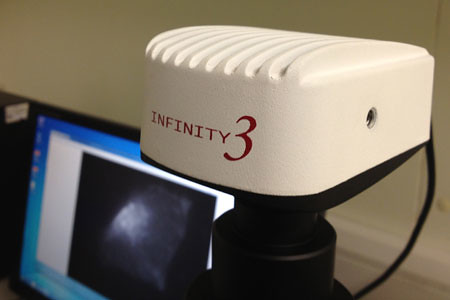
In being charged with setting up a new cell biology lab, one of the first obstacles I hit was the state of our fluorescence microscope. It is a perfectly serviceable old beast, but it was lacking two essential components. First, it didn’t have a filter cube needed to detect red, one of the four major fluorescent color channels that cell biologists have in their palette (the others being blue, green and a wavelength known as “far red” that the human eye can’t see). Second and much more problematically, it lacked a camera to collect all the images. True, one of my young researchers was getting pretty good at aiming an iPhone camera down the ocular (which, if you’ve not tried this, is not dissimilar to playing a very frustrating video game), but this only worked well for white light.

Being cash-poor at the moment, I decided we could live without the red filter cube (which costs about a grand) for the time being. But something really needed to be done about the camera. A proper camera not only documents what you’ve done, but is a lot more sensitive than the human eye. Using its more discerning sensor, you can discover things about your experiment that you couldn’t by peering down the eyepiece. And so it was that we finally scraped together enough dosh — £4,000 including a PC and software to run it — to buy the cheapest decent CCD camera set-up that we could afford.

Behold the Infinity 3 — the most gorgeous piece of kit I’ve laid eyes on in a long time. She’s only about the size of my palm, but she packs a serious wallup. Respect.

Sexy New Camera

Before the camera’s arrival, we’d do an experiment and then wait the week or so required to get a slot on a superior microscope housed on another campus, about thirty minutes away by bus. Normally when you do an experiment, you look down the scope straight away, take some pics, brew yourself an especially strong cup of coffee and process the images back in your office, looking at them with various image analysis tools and squeezing out every iota of information possible. Armed with that new knowledge, you can set up the next experiment – sometimes that very same day. So the research goes really fast when you have instant feedback. But if it takes a week to know if something worked properly, your research crawls along at a glacial pace – which in the current competitive climate, is deadly.

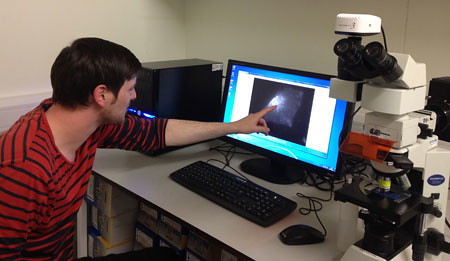
So the new camera is cheap, but pretty darned cheerful. Even Harry, my hard-to-impress MRes student, had to admit it took great pictures.

Harry And The Machine

So now all I need is that red filter cube. You know what to get me for my next birthday.

Posted in Scientific method, The profession of science | 18 Comments

In which we welcome a new friend

There is nothing like the joy of finally getting a piece of lab equipment that you desperately need.

Crate

OK, so it was fun messing around with the Poor Man’s Shaking Incubator (see the exclusive video of the prototype in action here). But ultimately it proved unreliable, and I had to abandon that strategy.

You can’t really hold your head up amongst serious microbiologists, though, if you can’t culture your bad-assed bugs in broth. There are things we do that require exponentially doubling bacteria, and for this application, a Petri dish full of agar just doesn’t cut it.

But we managed to scrape together the cash for this beautiful piece of kit – and isn’t there just something magical about a piece of newly-arrived apparatus peeking out of its packing crate?

Welcome, little guy. I’m sure you’ll fit right in here.

Posted in The profession of science | 4 Comments

In which science policy suits up

What must Britain do to retain its global scientific reputation in a changing world?

This evening at the Royal Society, various men of science, industry and politics gave us their opinion (“UK Research: Building Bridges, Building Prosperity”). These included the Rt Hon Dr Vince Cable MP, the Secretary of State for Business, Innovation and Skills, and the President of the Royal Society, Sir Paul Nurse.

Cable got the pesky idea of science funding out of the way right at the beginning, saying that the 2010 settlement had been relatively generous and he didn’t want money to feature in the ensuing discussion. A ripple went through the audience at this point, so I suppose I was not the only one who thought that this was a strange omission. How can you have a robust science base without robust investment?

His talk was interesting but didn’t cover any new ground. The most notable points included:

– The concept of “brain drain” should be rebranded as “brain circulation” – i.e. a good thing
– His department would be grateful for any feedback about outstanding problems with the visa system for scientists (so if anyone has any gripes, do please email them to his office)
– The UK needs to be more open about data sharing
– The new Defamation Bill in its current form adequately protects scientific freedom of speech (a point some consider debatable)
– Diversity in STEM is needed to make sure we have enough scientists. (I’m not convinced this statement is true – try finding a job in the current climate – but obviously I think there are many solid reasons for this goal, and we have a long way to go.)

I won’t cover the entire wide-ranging discussion that followed (Cable’s speech is available online), but I thought two of the comments from the floor were especially worth noting.

The first was a tweet from Evan Harris:

5 men on panel at Cable science speech at Royal Society & all 5 questions from men, 3 with beards ‪#coulddobetter‬ ‪#rsvince‬ ‪#beardsnotkeyissue

(Plus a man each for the opening and closing remarks. Note, the seven men on stage were also all white and of a certain age.)

It was a little difficult to take all the serious diversity talk from such a vast array of suits with a straight face.

Second, Imran Khan of CaSE asked Cable whether, when our competitors were increasing funding for science, he still felt that the cash cut in real terms and direct cuts for capital spending had been a sound idea. In essence, quite remarkably, Cable replied that the science budget previously had been so generous that it could afford to take a hit. I am sure that most researchers here in the UK would not agree that the tiny proportion of GDP that we currently spend on science is truly that big. But more significantly, I think this gives us a clearer picture of the attitude that scientists will be up against as the next Spending Review looms on the horizon – does the government still think our budget can withstand more trimming?

If so, we have a fight on our hands.

Posted in Policy, Politics, science funding, Science is Vital, The profession of science | 17 Comments

In which I am not worthy

I am still pinching myself.

The good folks from the Edinburgh Book Festival have invited me to get up on stage with one of my favorite authors, Neal Stephenson, to discuss the importance of science fiction on science fact. The event is one of the ‘Science Meets Fiction’ series being sponsored by The Wellcome Trust.

I still recall my 25-year-old self being blown off my lab stool by Snowcrash, Stephenson’s third novel, which I devoured during incubations while slaving away over my one megabase of manual radioactive sequencing in graduate school in Seattle. After being introduced to my first ‘lab lit‘ novel, Cantor’s Dilemma by Carl Djerassi, around the same time, I hunted around and discovered that Stephenson had already written in that genre with Zodiac – a wonderful but little-known story about a pain-in-the-ass ecoterrorist chemist that I adore to this day. Since then I’ve read almost everything he’s written, including what I think might be his most ambitious, Anathem (my Nature review is available here).

The topic of my discussion with Mr Stephenson is an interesting one. I’m most well-known for my views on what science can offer fiction; what fiction can offer science is in some ways a more complex and intriguing proposition, touching as it does on the inspiring and firing of young imaginations. Although I currently champion the realism of the lab lit genre, it’s a little known biographical fact that for my entire childhood and adolescence I read pretty much nothing else but science fiction. I enjoyed all the greats, from Asimov to Zelazny, and my father subscribed to the magazine Fantasy & Science Fiction, which I worshipped from cover to cover. Our family spent many evenings in the Seventies in front of the television watching Star Trek, Space 1999, Battlestar Galactica, Buck Rogers and the like. I once wrote a book review of Have Space Suit – Will travel for a fifth grade English assignment, and the teacher marched me to the school library and made me show him the book, assuming that with a title like that, I must have made it up.

What has science fiction done for science? There are a lot of examples, of course. I still remember reading Robert Heinlein’s Friday, and being entranced by his description of sitting down in front of a computer and being able to search for any piece of knowledge in the universe. I now recognize this plot device as being indistinguishable from the internet and Google, but back then, I was so excited by Heinlein’s idea that, when I took my first computer classes in high school (black screen, glowing green block text, an entirely self-contained experience imprisoned by the few programmes contained within), I was bitterly disappointed with reality. Did Tim Berners-Lee, Larry Page or Sergey Brin read Heinlein? I have no idea. But the corpus of classic science fiction is filled with examples of fictional technology that eventually became fact.

I’d be delighted if you could attend this event in Edinburgh, which takes place during the height of Festival proper. The details are below. But in the meantime, I’d love to hear your favorite examples of science fictional notions that inspired real-life science or scientists of the future.

Jennifer Rohn and Neal Stephenson
Saturday 18 August
5:00pm – 6:00pm
ScottishPower Studio Theatre
Edinburgh, Scotland
£10.00, £8.00 concessions

Posted in LabLit, Nostalgia, Science fiction, Writing | 8 Comments

In which we look to the horizon: science is more vital than ever

When Science Is Vital joined with hundreds of other organizations to successfully fend off threatened cuts to the science budget in 2010, the next Spending Review seemed aeons away. By now, of course, most scientists in Britain have heard the persistent rumor that the next Review will be brought forth to some unspecified date in 2013 – in other words, it could be right around the corner. Meanwhile, our economy continues to flounder, punctuated by gloomy headlines predicting that full recovery could be years away. Not, in other words, the climate you really want to be in when the Government starts casting about for further ways to tighten its belt.

This time around, fortunately, we have a lot more than six weeks to make some noise. Science is Vital plans to step into the fray, and we need your help and ideas to put together a new campaign to remind politicians that science is vital for the UK economy.

What can you do?

Come to our first Annual General Meeting, which will be held in Central London on 13 September (7-10 PM, fine details TBA). In addition to the formal AGM, we will have a line-up of interesting speakers and entertainers, plus food and a cash bar, so it should be a fun evening.

To be able to vote, you will need to have become a member within the last calendar year, which you can do by contributing the paltry sum of £3.14 per year (or a multiple of π if you’re feeling generous). Every penny goes towards the business of SIV: we have no salaries or overheads to cover.

Space will be limited, so RSVP as soon as you can.

Our humongous Facebook presence got badly mangled in the platform’s bizarre Group Archiving exercise a few months back, so please go along to our new page and help restore its former glory. And you can support us on twitter by following @scienceisvital.

To convince the Government that science is vital for the UK economy, we’ll need to support the gathering of evidence and behind-the-scenes conversations with politicians. A great way to do this is to join the Campaign for Science and Engineering to enable their superlative work on our behalf. Closer to the time, we should all drop a letter to our MPs and make our convictions known.

Working together, let’s gear up to keep science safe on the other side of the horizon.

Posted in Policy, Politics, science funding, Science is Vital | 3 Comments