Champagne in plastic cups after a successful PhD viva is still a classic, but you don’t often see labmates getting together to recreate one of your prettiest thesis figures in cake format.
Congratulations, James!
Champagne in plastic cups after a successful PhD viva is still a classic, but you don’t often see labmates getting together to recreate one of your prettiest thesis figures in cake format.
Congratulations, James!
I like to watch eddies that form underneath waterfalls in a cascade, the ones you see in creeks of glacial run-off rushing down the sides of mountains. The milky-green water, and everything trapped in it, seems desperate to get from point A to point B. But sometimes, the turbulence creates a moment of dithering, of pause, of milling around. If a fallen leaf, or bit of moss or bark or twig, gets swept up into the creek, it may end up in a pool, churning around with fitful energy, or sometimes even stalling in a momentarily calm center. But if you watch for a few moments longer, you will usually see the flotsam expelled from its eddy and propelled once again along its way. The forces that govern the formation and dispersal of these whirlpools are beyond me, but I can sense the mathematics flickering just underneath – present even if they are still not completely predictable or understood.
Biomedical research labs, and the departments that house them, are a lot like these pools. There’s a charged sense of purpose and activity swirling around, but for a few years, the researchers within are becalmed within a bubble of intense mental focus and scrutiny. Likewise, people are always coming and going – in any given month you’re likely to both meet a new neighbor and head off for someone else’s leaving drinks. A few colleagues carry on to bigger and better things, most carry on to do more of the same, and others sink without a trace.
I’ve been thinking a lot about lab continuity as my contract nears its completion. I’m one of several people on this corridor who’s recently had their termination meeting ahead of the end of a fellowship, and it’s time for us to start preparing for how we will pass on all the skills, knowledge, data and reagents that we have accumulated over the years. Some of us are more organized than others, needless to say.
Me, I fall somewhere between average and obsessive-compulsive. My notebooks are novelistic in detail, but my freezer space has recently become a bit dishevelled.

I've seen worse
It’s going to be a big job, but I’m determined to do it right. Because it’s no exaggeration to say that most labs harbor a lost treasure-trove of the forgotten. In my travels through the minus-eighty freezers of this world, I’ve seen rack after rack of Eppendorf tubes labelled only with the numbers one through 24; final bleeds from long-dead rabbits who gave their lives to produce an antibody that was never even properly tested; endless seas of constructs that took months to make, their tube markings smudged beyond all recognition. I’ve been bequeathed lab books full of data enough for half a paper, never to be finished by someone else for lack of documentary evidence. I’ve seen kits and arcane equipment gathering dust on shelves because the last person who knew how they worked left the lab years ago.
This untidy archive – the dirty, wasteful secret of most labs – is simply the by-product of human nature. The closer a researcher gets to the end, the less important it all seems in the grand scheme of things – especially if he won’t benefit from the work in his next stint. And the time it takes to hand everything over is often under-appreciated; you might have good intentions, but in the last mad dash to clear your bench, use up your holidays and move on, succession tasks are often deprioritized out of existence. Our lab has recently implemented a checklist for succession, covering reagents, notebooks and skills, with the recommended start time of one month prior to departure. It’s a great idea, but I’m not sure it will work for everyone. Even highly organized lists that thoughtful people leave behind often don’t make as much sense as you’d like when you actually try to use them to locate a key image or bit of DNA. Ring up that person a few months later, and even she will find herself vague about what she meant at the time.
We should all do our best to document our passages, but the reality is that most things will get swept away without a trace. The marks we leave on anything in life are fleeting. In a business where the wheel is reinvented on a daily basis, the things that are most important will probably find a way of floating to the surface eventually, with or without our assistance.
Once again I revisit the question broached by Science is Vital in our recent report Careering Out of Control? A Crisis in UK Science Careers. Last week I participated in a round table discussion about this very issue co-hosted by Paul Nurse, the President of the Royal Society, and David Willetts, the Minister of State for Universities and Science. Also present were about a dozen high-flying stakeholders from industry, education and policy – I was the only academic post-doc present. (The meeting took place under Chatham House Rule, which means I can discuss what was said but not by whom; fellow OT blogger Athene Donald, one of the participants, has also summed up her thoughts here, and we’ve both given a very short précis to the RS blog. I should also stress that although the meeting was about research of all kinds, I’m coming at this from the science point of view.)
I fully expected to have to defend the idea that all isn’t rosy with academic research careers, so I was pleasantly surprised by the fact that its significant structural problems and instabilities seemed accepted by most from the start. In the UK, it’s estimated that 89% would like to stay, but there is only space for about 4%. In fact, there was discussion that we need a “cultural change” and, as no one else in the world has yet tackled this problem, the UK has the opportunity to lead internationally on this complex and important problem. I must admit this was far from the “all talk and no action” scenario I imagined might have resulted from such an exercise.
Yet from this beginning, an obvious division of opinion developed. Some wanted to frame the discussion solely on facilitating the “graceful exit” from the pyramid (in other words, the shape is what it is, and we should try to work around it). But others wanted to probe at the shape itself, and whether it could be altered – for example, the feasibility of “fattening the pyramid” (i.e. creating more mid-level, permanent jobs for highly skilled research staff; at the moment, only 3.5% of researchers hold these positions). I was pleased when the decision was made to discuss this question, but was disappointed at some of the opinions of long-term postdocs aired around the table. Phrases such as “surely if they didn’t make it in a few years they never would” and “most of these postdocs in the holding pattern don’t belong in research anyway”, in all fairness, probably reflect the experiences of the people espousing these views. Equally, in my field I have seen many, many brilliant scientists forced out by bad luck and circumstances, simply because their potential took a little longer to show or they were in the 6th percentile on a fellowship and the cutoff was 5. I have also been honored to know and work with permanent research staff whose skills and talents are awe-inspiring, and who are worth many times over their slightly higher salary in terms of what they give back to the teams and lab heads who house them.
Seeing as how their less encouraging views and my complimentary ones are both anecdotal, I’d favor seeing some hard numbers. Hypothetically speaking, as a thought experiment, if fellowship applications cut off at 5% and the losing 95% have to go, just how “bad” were those in the 6 to 10th percentile? In the 11th to 15th? Was there a steep step-change at 5, or was it just a very gradual continuum? Do all quick-off-the-mark superstars who get independence always do well, and do the few old-timers who managed to start a lab later in life always do poorly? Some researchers would rather leave than not be a lab head, but there are probably a large number who would be well suited to a permanent non-PI research job and who would flourish in that environment. So how big is that latter pool?
The usual opinion that “permanent research staff tend to go stale” was aired, as it always is. To me, this begs the question: will a brilliant researcher passionate enough about science to enter a risky career for little monetary benefit really suddenly go “stale” at the first whiff of job security? To me, this assumption is insulting. But even if this tendency to go stale exists in some cases, what is to stop these positions from being competitive and periodically assessed? The answer at the roundtable – “it doesn’t seem fair to chuck people out after going stale” – seems a bit ridiculous. First, no other profession has a problem excising dead wood, and second, the current system chucks out thousands of older people who haven’t gone stale without even blinking. If a competitive, properly assessed job was on offer, I have no doubt there would be talented researchers who would rise to the occasion.
The rest of the meeting focused mostly on ways to equip researchers to leave academia. Many participants sang the praises of encouraging academic researchers to do a stint in industry to equip them with valuable skills and experience. I couldn’t agree more, as the five years of biotech experience under my belt were invaluable. But industrial stints are not always rewarded in the current system. For example, the Royal Society University Fellowship Scheme does not allow applicants to disqualify time spend in industry from the ticking clock of “time from PhD” eligibility, even though in many cases publication is impossible and your track record will look far worse than someone who has played it safe by staying in the academic fold. Removing disincentives will be as important as adding incentives, in my opinion.
And finally – if we want to encourage leavers to leave early in their career, how can this be enforced? There appeared to be a well-known concept called “seven years and you’re out” which I found rather alarming. This phrase draws a blank on Google, but from context I think they were talking about postdoctoral years. As I mentioned on my Royal Society blog wrap-up, such a concept might not sit well with a profession that knows very well the role of luck and slower-germinating potential in research. Indeed, even the current President of the Royal Society took more than seven years to land his first permanent position (it’s closer to ten years, if I’m reading his biography correctly).
But overall, I left the meeting happy with the congenial and constructive nature of the event, and for the opportunity to have brought up some of the points that emerged strongly from Science Is Vital’s recent consultation. This is not the end of the story by any means, and I sincerely hope that the trend to include academic post-docs in these sorts of discussions will continue.
So, there is life after a high-throughput screen after all.
As the dust settles after publication of my big screen in the Journal of Cell Biology, I’ve been thinking back on the last four years of my lab life and wondering where it all went. I knew when we embarked on the project – a visual survey of cell shape phenotypes across the entire fly genome, and in a targeted subset of 500+ human genes – that it was ambitious. But I’d had a real mental block about envisioning its aftermath.
I remember having particular difficulty in my Wellcome Trust fellowship application, in the section where I had to describe long-term aims and milestones for when the screen was “finished”. It’s really hard to plan experiments when you don’t know what sort of genes will shake out of the tree: you are reduced to banal generalities in the subjunctive mood – if I were to get X as a hit, I’d do Y to follow it up. Fortunately the Wellcome panel of experts were sufficiently convinced that the screen would yield good fruit, no matter how hypothetically, and by and large I am happy with the outcome as well.
But there is a strange feeling when you come to the end of such a long project. The momentum that carried you up to that point suddenly dissipates – you are both lighter, but also newly unstructured. In my case, the sense of being cut loose is exacerbated by the imminent end of my contract at the close of January. I think I have found the means to stay in research afterwards, though until the funding comes through and the contract is signed, I don’t want to go public about it. I’m very optimistic about the appointment, but by its nature, I will probably be leaving behind the work I am doing now.
So what do you do with a few months? What can you do? I’ve turned to a second screen – the product of an EMBO short-term fellowship sabbatical I carried out for a few months at the EMBL a few years back. The dataset comprises two terabytes of timelapse video footage of each and every one of those 500+ human genes manifesting their actin phenotypes in real time. After having failed to find any collaborators who had the time and money to help me analyze this massive dataset computationally, and knowing that I couldn’t physically watch all the movies myself, I came up with a cunning plan: to use my fixed J Cell Biol screen to identify one phenotypic cluster of interest and then visually inspect the movies for all the genes in that set to see if anything looked intriguing.
Dear reader, it worked a treat. I have found one gene that gives an amazing and unique phenotype in dynamic timelapse that wasn’t evident from the fixed screen. Like the best hits, there is a little known about it, but not very much. I’ve also got in touch with the researcher who’s published the sole paper on this gene, and we’ve embarked on a really friendly and stimulating overseas collaboration – I don’t want to reveal any details just yet, but we have high hopes of getting a paper together. It’s been so long since I’ve worked on just one gene that I’d forgotten how good it feels to abandon the general for the highly specific. When you work on one gene, instead of hundreds, you can make and test mutants – you can lavish care and attention onto your approach; you can read the literature in detail and allow yourself the indulgence of entertaining a few crazy ideas.
Will I ever do a screen again? Quite probably. But for now, I’m basking in the glow of reverting to my previous one-gene-sort-of-girl phenotype at long last.
Many of you have probably heard about the Science Careers campaign that we at Science Is Vital are currently running – which is also the reason I have not blogged for a few weeks. I’m a little in shock right now because I appear to have just obtained a full eight hours of sleep: I’d forgotten how that feels. (Since I’d also like to refresh my memory about the concept of a sit-down breakfast, I’ll just give you the brief highlights now.)

Suited and booted outside BIS (photo: S. Curry)
Phase I began back in May with a public discussion at the Royal Institution with a panel including the Science Minister, David Willetts. There, we talked about all the ways that the science career structure might be damaging UK science – and the lives of UK scientists. Mr Willetts asked us to put together a summary. So Phase II – a call for evidence and broader consultation – took place in the month of September. We (and a number of kind volunteers) analyzed the data as quickly as we could, and produced yesterday’s report: Careering Out of Control: A Crisis in the UK Science Profession? I’ve written up an account for the Guardian; there’s some nice coverage in the Times Higher as well; Nature is running something next week, OT’s own Stephen Curry will have a blog in the Times, and Lewis Dartnell is penning something for The New Scientist, so keep an eye out.
Yesterday afternoon, Mr Willetts and his team met with us for thirty minutes to discuss the report, in what was a very productive meeting. As a result, I was invited to meet him again in a roundtable discussion convened by Paul Nurse at the Royal Society on this very issue at the end of the month. We are very pleased with this outcome, because one of our recommendations was that younger scientists, and the voices of researchers with more diverse, and perhaps not as successful, experiences be included in any discussions on career structure. I will do my best to help represent and transmit the ideas, experiences and emotions of the 700+ scientists who passionately spoke out in our various consultations over the past half year.
Yes, it’s an oil tanker, and one running at a decent clip. The way scientific careers are discharged has solidified over many years of custom and practice. The money for science is frozen for the foreseeable future, which means that any changes would require reallocation of current funds. Also, the problem has been going on for some time, and many of these ideas have been discussed before to little apparent effect. Nevertheless, I think it’s never too late to try to change something that seems wrong. Working together, and assuming that change is possible, we may be able to improve the lot of working scientists in the UK – and help protect the underpinnings of our world-class research base. And as Stephen pointed out on Twitter, perhaps an improved model here could inspire other countries to take a harder look at their own situations.
Is there a strong correlation between the number of hours you are physically present in a lab and the pace and success of your project?
The furore over Nature’s 24/7 lab feature, published a few weeks ago, is still sending out the occasional ripple. In case you missed it, the 31 August issue of the journal featured three pieces: a beautifully written account of Alfredo Quiñones-Hinojosa’s high-powered, workaholic lab at Johns Hopkins in Baltimore by journalist Heidi Ledford; the opposing viewpoint for the importance of work/life balance, presented in the first person by Julie Overbaugh, a successful group leader at the Fred Hutchison in Seattle; and an editorial, which seemed, on balance, to come down largely in favor of the turbo-gunner approach. Indeed, it finishes with the rather ominous observation: “As research funding declines in many countries, science will intensify. Anyone lacking the inner intellectual drive and a capacity for relentless focus to get to the heart of the way the world works should stay away.”
All of you have probably known about labs like Quiñones-Hinojosa’s – especially if you’ve spent time in any prestigious research hub in America. And some of you may have lived the 24/7 lab lifestyle yourself at some point in your career.
I, personally, have been there. But rather ironically, my 24/7 epoch – which stretched over the five and half years I was a PhD student in Seattle – happened in the lab of the aforementioned Julie Overbaugh herself. Hers was a relatively new lab at the time, and I ended up being the first PhD student to graduate from her group. My work ethic wasn’t precisely 24/7, but I would routinely work 12-14 hour days on the weekdays, and 8-10 each weekend day: never fewer than 80 hours a week, and sometimes approaching 90 or 100. This was the epoch in which I single-handedly cloned and sequenced more than a megabase of DNA, the old-fashioned manual way, with radioactive sulfur and hand-poured gels, and typed the results in manually at the computer each morning until the G, C, A, and T keys were visibly worn.
You could find me in the lab at six in the morning, or at midnight, or putting in a few hours on Christmas day. I once set off the intruder alert alarm in the Regional Primate Center after coming in from clubbing to check on some cell cultures at 3 AM – the goth clothes I was wearing at the time didn’t seem to reassure the security guard that I was actually an authorized PhD student. I’d ride those long hours on an adrenalin-fuelled buzz that only a 20-something year old kid could carry off for long periods of time, buffered through the failures by sporadic bright sparks of promising data and a constant stream of incredibly loud grunge or indie music.
It is important to stress that all of this behavior was entirely self-imposed. Julie worked normal hours and repeatedly stressed that we – the Overbabes, as we called ourselves back then – could all do as we liked. Some in her lab worked normal hours, and some worked longer. I think we were all a little scared of Julie: someone who applies no pressure is a pressure of its own. But I think the fact that it wasn’t imposed or expected is very important. Nobody has a right to treat a worker like a slave – something I think that some lab heads forget. “That’s how we did it in my day” is no justification.
If you look at my track record, you’ll see that my 24/7 PhD stint bought me four first-author papers, two first-author reviews and two co-authorships. Impressive, perhaps, until you factor in that I didn’t get my first paper out until my fourth year. In many projects, you have to labor for years to get a system up and running; the 24/7 thing isn’t necessarily going to strike gold during your typical post-doctoral short-term contract span. And with age, inevitably, comes the weakness of the flesh. Nowadays, I get tired, I get hungry; I can’t force myself to work the long hours I used to do with such ease. As I approach middle age, and life starts to feel finite, I find that spending time with my loved ones is more important than cranking out so many papers that I never get to see them.
And I think Julie is right about the creativity angle: I get scientific ideas when I’m running in the woods, or swimming laps, or lying sprawled on a sunny blanket in the weekend garden staring at the clouds. Sometimes in the lab or at my computer, I feel a block that won’t ease until I step away from the problem. I abandoned the 24/7 ethic completely from my second post-doc onwards (I’m on only about 50-60 hours now, if you include the time I spend writing papers and reading the literature at home), but my publication record remains as strong as it was at the outset, and some of the work I’m most proud of happened in a 9-to-5 industry culture.
Personally, although I’m glad Nature gave someone like Julie a platform to voice an opinion that many of us feel is obvious, I’m a little bit disappointed that its editorial team decided to side with the sweatshop mentality. Judging by the comment threads on the three pieces, most readers were equally disappointed. Quantity is seldom quality in science, and there are many different styles and diverse approaches in the quest for knowledge. The sleep-in-the-lab scientific stereotype is getting a little stale. As a community, shouldn’t we be moving beyond all that?
With the arrival of September, autumn has arrived in London with a vengeance. The air is crisp and cold, marigolds wither on my back porch, and the campus is full of robed, jubilant undergraduates ready to accept their diplomas and take their place in the world. Summer holidays are already a distant memory, and months of uncertainty lie ahead – will I finish up my second paper before I run out of funding? Will one of the various career possibilities on the horizon pan out for me, preferably with no interruption in salary?
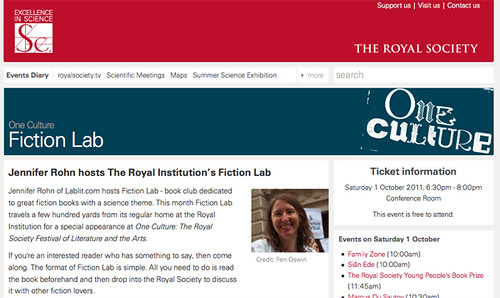
Heck – I don’t know, and right now, frankly, I don’t care. Because there are a whole heap of literary bright spots ahead. First and foremost, I am delighted to report that Fiction Lab – the monthly geeky science novel book group I run at the Royal Institution – has been invited to conduct its October gathering at OneCulture, the Royal Society’s very first literary and arts festival. When we were initially asked to participate, one of our regulars asked, “What’s the deal – are they going to watch us having Fiction Lab and throw buns at us like chimps in the zoo, or are the great British public encouraged to read the book and join in?”
Happily, I can report that the latter condition applies – everyone is invited to read the book in advance and show up on the night to discuss it with me and the Labliterati – our coterie of incisive, amusing, witty and often excoriatingly critical book lovers. The book we have chosen is State of Wonder by Ann Patchett, a beautifully wrought tale of scientific intrigue ranging from the labs of Big Pharma to the Amazonian jungle (more details here).
(If you’re a quick reader, you could also rock up for September’s Fiction Lab in its usual home at the Ri, where we’ll be discussing Einstein’s Dreams by Alan Lightman on 12 September).
For those of you stalwart enough to brave a trip south of the river, I’ll be appearing at the Lewisham Literary Festival on 14 September with Sid Rodrigues, Manjit Kumar and Michael Brooks. We are meant to comprise “a panel of science writers and scientific novelists [talking] about science in popular culture, the weirder aspects of science and anything else you want to ask them.” Interpret that how you will!
I also want to plug an upcoming short story competition sponsored by the Diamond Light Source called “Light Reading”. LabLit.com is a media partner and I’ll be one of the judges! From the website: “The rules are simple: we’re inviting you to submit a story of up to 3,000 words inspired by Diamond – the facility, the science and the people. There’s also a Flash Fiction prize for stories under 300 words. Stories can be in any genre and there is no minimum word limit. Diamond will shortlist the best of these stories, which will then be judged by an expert panel. The top three writers will receive a cash prize, and these, along with those highly commended by the judges, will be published in an anthology of short stories. The competition will open on Monday 5 September 2011.”
(Psst: here’s a plot idea for free: Professor Curry did it in the Synchrotron Hutch with the beamline.)
Finally, I would be woefully remiss if I didn’t suggest the ultimate cure for post-holiday blues: an intrepid scientific romp or two. If you haven’t already indulged, why not cheer yourself up with one or both of my novels, Experimental Heart and The Honest Look?
Geeky satisfaction guaranteed.
—
Thus ends this regularly scheduled blog post. Read on for random puffs of my novels to whet your appetite:
“Science as it is practiced today can be conceptualized as a mystery story, or a love story, or a thriller. In Experimental Heart Rohn has made a brilliant synthesis of these three modes, resulting in a page-turner with depths, exploring the hope and danger of both bio-medicine and lab romance. In short, a true novel. Scientists who gave up reading fiction about science because it’s never right — check this out. Non-scientists wondering what goes on it in that weird culture — find out here. By the end you’ll be reading as fast as you can.” — Kim Stanley Robinson, Hugo- and Nebula-award winning author of Red Mars, Antarctica and Forty Signs of Rain
“Scientific publishers usually work diligently to avoid any allegation of publishing fiction. Cold Spring Harbor Laboratory Press, renowned for its prestigious scientific journals and books, smashes that mold with publication of its first novel…It’s a thriller whose subject is romantic self-discovery, and its milieu is the complex world of basic and applied life science research. It’s a good read, as Rohn makes her characters in the laboratory and the biotech communities come alive. I hope it’s a harbinger of more ‘lablit’ to come…Rohn’s skill in melding the scientific and literary worlds will give you a fresh perspective on life and work.” — Cell
“[Experimental Heart] realistically and humorously portrays the inner workings of a biology research lab, relations between the scientific community and the public, and the highs and lows of research life…Rohn spins a riveting thriller — replete with scientific discovery, fraud, falsified reagents, romantic darkroom encounters, threats, and even abduction — as Andy searches for personal and scientific fulfillment.” — Science
“She’s done it again! Cell biologist and novelist Jennifer L. Rohn has written another taut, suspenseful story about a young scientist’s journey to find oneself [The Honest Look]. … The story is witty, zingy, and fast paced. It is credible and compelling. I cannot say anything more than ‘read this book’ and ‘enjoy the suspenseful thrills.’ You will be gratified that you did.”
– Cell
“Set in the high-stakes world of biomedical research, this fast-paced novel [The Honest Look] is populated by strong characters facing difficult choices, driven by twisty plotting and compelling writing… After you’ve finished, you’ll snap the book closed in satisfaction, realizing that scientists are human, just like everyone else. Whether you are a scientist, a mystery buff or you simply enjoy immersing yourself into a tightly-written story, you will enjoy this thought-provoking thriller.”
– Nature
Cell and molecular biology is a bit of a dark art. The way we perform our experiments has been passed down from generation to generation in sacred texts known as “protocols”. Like any recipe used and abused by generations of creative people, the methods and materials are continually refined as people try slightly different conditions, either in the hopes of improving the result or (let’s be honest) finding a shortcut allowing them to escape to their local pub before closing time.

Protocols used to be on paper (stained, torn, smeared, possibly slightly radioactive) – photocopies of photocopies with layers of marginalia successively enshrined – but are increasingly electronic. Either way, they represent an astonishing living record of scientific processes in action. They also unwittingly betray a little bit about the researcher who first composed them. One of my favorite bits from a protocol about isolating genomic DNA from Drosophila, written originally by a wonderful Chinese PhD student in our lab, starts off like this:
1. Put flies in tube.
2. Kill with stick.
I was thinking about protocols the other day when trying out a new method for culturing cells derived from the human retina. Cultured retinal cells, not surprisingly, don’t have all the characteristics of their tissue of origin, even when you genetically engineer them with some key genes. But someone recently discovered, and published, that if you add a smidgeon of sodium pyruvate in a slightly different formulation of standard culture media, the cells start to transform just a little bit closer to what they should be. Sure enough, a few days after adding the humble salt, my cells began to take on a telltale graininess: dark pigments, expressed by cells fooled into thinking they should prepare to absorb light.
“Look, they’re making eye contact,” quipped one of my colleagues as he peered down the microscope.
I am often astonished by the weirdly arbitrary nature of the procedures that have stood the test of time, and wonder how they came about. For example, when you want to zap DNA into a bacterium to make more copies, you perform a simple but very precise protocol that includes a heat shock of exactly 42 degrees Celsius for exactly 45 seconds. Who was the first person to ever work that out, and how many iterations did this molecular biology pioneer attempt before stumbling onto the perfect formula? And is it too late for me to buy him or her a drink?
I don’t know about you, but sometimes it all seems rather eye-of-newt and tongue-of-bat.
A post I initially wrote about the consequences of putting arbitrary sell-by dates on post-docs seeking fellowships has been rebutted by my esteemed OT colleague Athene Donald. It’s an interesting post and I encourage people to have a look at it along with the many comments (and, since I don’t want you to interpret the below quotes out of context, do go back and read them in their entirety). However, I’d like to extract three assumptions that came up that interested me the most – and I’d love to hear your views on them (paraphrased below):
Assumption 1. People who’ve taken a bit longer to achieve a decent track record and a portable line of independent research are less likely to become world-leading scientists (and are therefore less worthy of funding).
Athene speculated that funding bodies probably see meanderers as a bad risk: “I think the general view (of those on the committees) would be someone who has, apparently happily, taken postdoc after postdoc probably lacks the creative spark to go off and be an independent leader.”
She acknowledges, of course, that appearances are deceptive. But is it a generally sound assumption? There is also an alternative hypothesis: someone with more experience might actually do more for the money than someone with less experience. Athene admits she knows of no evidence one way or the other, and neither do I (aside from an unscientific gut feeling that experience is a good thing, not a detriment) so I’m throwing this out to the crowd: has anyone seen any such studies? If so let me know.
It would be reassuring if the eligibility criteria used by the bodies that fund science turned out to be evidence-based.
Assumption 2: The current fellowship evaluation systems of the major funding bodies is as fair as is humanly possible, and it’s not theoretically possible to remove arbitrary experience cutoffs without crippling the system.
I think this one is a non-starter, personally. As far as I’m concerned, anything that doesn’t violate the laws of physics is not impossible, and I wouldn’t accept this argument as a reason not to take a look at how things are done with a fresh eye. (I heard the word “impossible” quite a bit at the beginning of the Science Is Vital campaign, for example.)
Deevybee noted: “Like Athene, I have sat on committees that evaluate postdoc fellowships and I can only support what she says. When you have a heap of 50 applications in front of you and know that you can recommend 5 of them to go forward to the next stage and only half of those will get funded, the last thing you want to see is broadened criteria.”
The thing is, we’re brainstorming here, so we’re allowed to be creative. Nobody is suggesting that we ought to dump 200 more files of the same length onto poor Dorothy’s desk. How about if those files were shorter in the first round, more manageable? As a nice analogy, do you remember when pre-submission enquiries started becoming increasingly common? Many of the scientists I knew worried that they wouldn’t be able to make the quality of their paper shine through in an abstract format, and a few journal editors in my acquaintance were similarly concerned. A few decades later and, by and large, the humble “pre-sub” has become a genre appreciated by editors and authors alike for the most competitive journals, probably saving years of wasted time on both sides. I’m not suggesting fellowship apps could be dealt with by abstract alone, but the analogy is meant to show that (1) it is theoretically possible for selection criteria of complex science to be successfully streamlined, and (2) it doesn’t necessarily make more work to let in more applicants if your streamlining has been designed with care to compensate for the increase.
As an aside, I’m not convinced that removing the cut-off dates would lead to the magnitude of inundation feared. As Athene mentioned, many postdocs don’t want to be independent. One way to test this is to ask the RS to supply the total numbers they received last year for the URF compared to this year; the difference might be this elusive figure. It wouldn’t be perfect, as numbers can fluctuate year by year, but it would be a start.
Assumption 3: People who are directly affected by an issue cannot think about it dispassionately or objectively.
Although this issue does affect me directly, I am genuinely trying to explore it in a manner that is balanced and that takes into account all the factors. I don’t think my post or any of my comments has been particularly heated. Rather, I’m just enjoying the stimulating discussion – despite the implication that folks in my plights should just suck up and “take the cards they’re dealt” and that we’re too close to the issue to see the other side. I’ve been interested to hear from people who are adversely affected by these issues, and I’ve been interested to hear from others who are on the other side and are helping to allocated the limited resources as fairly as they can. I would also point out that it’s possible to turn this around: those on the other side are also capable of being overly passionate and could be at the risk of not weighing the opposite argument as fairly as they could either.
I’d suggest we think about this as scientists – with curiosity, with a practical bent and with maximum creativity. Is it a good idea to open up fellowship applicants to all mid-career postdocs? If so, what’s the best way to make it happen logistically – how could we consider streamlining the search for great projects and the future PIs to make them happen?
All ideas welcome!
What a difference a few words make.
Compare this:

With this:

A modest difference, you might think. But your average postdoctoral stint in the life sciences is probably something like 3-4 years. So the difference between 8 and 12+ years is significant. Realistically speaking, you wouldn’t expect to do three postdocs in under eight years. Still a modest difference, perhaps, but it’s enough to make me ineligible for the Royal Society University Research Fellowship (URF) scheme – even though under last year’s wordings, I was still within this limit.
But I don’t want this post to be about me. Most people look at my age and career path and assume I’m not a player: would a real player have done a stint in industry, or surrender to a career break in publishing due to personal circumstances, or have outside interests in science communication? This is, of course, debatable. Yet I want to make this post more general, as the new wording has ruled out a number of my colleagues (far younger colleagues with excellent track records) who took a much more traditional path – but still weren’t traditional enough.
I don’t want to invade their privacy, so let’s compare two hypothetical postdocs, A and B, both of whom published two decent first-author papers in their PhDs and were otherwise equivalent in talent and experience at the start.
Postdoc A does his first postdoc in a high-powered lab, stepping neatly into a project, initiated by a departing PhD student, that is just starting to bear fruit. He doesn’t have a family, so is able to work 12-hour days and throughout the weekend. He ends up with two top-tier papers in four years, and is able to secure another high-profile postdoc in an allied field, consolidating his reputation as an up-and-coming star with two more decent papers. Adding those to his 2 publications from his PhD, he has 6 first-author papers after 7 postdoctoral years. Moreover, his boss is happy for his protégé to take the line of research with him, so he’s in a great place to apply and succeed at a fellowship like the URF.
Not so Postdoc B. She does her first postdoc in a small but respected lab, but gives birth to her second child in year 2. The project is disrupted by her one-year break, so by the end of four years, she has only one co-first author paper (shared with the postdoc who took over her project while she was on maternity leave) and one small first-author paper. She has had to leave the lab every day at 5 PM to pick up her kids from daycare, and can’t work weekends. Most funding bodies would disqualify her break, so she’s effectively done a 3-year stint. From this, she secures a second postdoc in another decent lab, but the boss wants her to develop an entirely new system, which takes her three years to perfect: it’s a highly intricate technological advance, clearly innovative and incredibly powerful. In her third year she manages to publish one first-author paper about the system, but her boss doesn’t want her to take the bulk of this desirable prize as seed-corn for an independent fellowship; she attempts arbitration, but the head of department sides with the lab head. So instead she leaves it all behind and does a third postdoc in a high-powered lab on a project that’s quick off the mark: four years later, she has two top-tier papers, one decent one, and a portable line of research. Her track record is now the same as A’s – except that she’s been in the postdoctoral system for 10 years (not counting the break), so is not eligible for the URF.
Incidentally, this is not about gender. The above scenario could easily have been swapped: the hot-shot with no family ties could have been a woman; the maternity scenario could be swapped for that of a man who’s a full-time carer to his kids or his ailing parents, or for that of a spouse who has to follow a higher-paid, non-scientist spouse to a geographical location with no decent labs for several years. But these sorts of problems probably will fall disproportionately on women, because they’re more likely, on average, to be affected by having a family. It’s also not age discrimination per se, although such restrictions will, by their very nature, work against older researchers.
When I wrote to one of the funding bodies about their policies, they replied that “quality was paramount” – then reiterated the eligibility guidelines. Quite frankly, I don’t understand why postdoc A is of higher “quality” than postdoc B. If anything, the fact that B has triumphed over adversity and still come up on top is testimony to the tenacity of her character, which will stand her in good stead against the vicissitudes of an academic career. Who knows how A would react to a prolonged string of bad luck? What does timing have to do with quality? As long as one is between a PhD and an independent position, and is still obviously producing high-quality results, what difference do a few years make? Couldn’t these decisions be made solely on the excellence of the track record and of the proposed project?
I don’t want to pick on the Royal Society specifically – they are not alone; indeed, it seems to be the norm to impose such restrictions. Hats off, therefore, to the MRC which, with its Non-Clinical Fellowship is, to my knowledge, the only funding body available to a biomedical researcher in the UK that does not put an expiry date on postdocs.
Another thing I learned from my URF email enquiry, which wasn’t in the fine print, is that industry research doesn’t count as a career break: in other words, I have seven years of academic research under my belt (which would qualify me), but four years in industry (which scuppers it; under the old rules, it would have been considered as the third postdoc, so I would have squeaked through). This rule is in place despite the fact that it’s very difficult to publish anything decent, if at all, in industry, and impossible to take any research with you. In not letting applicants disqualify this time, it looks to me as if the RS does not want people to explore industry – which is odd, considering the emphasis on translational research, impact and intellectual property to which more and more funders give lip service, and the fact that most university departments find industry savvy desirable.
I’m interested to hear people’s views on these issues. But before I sign off, I should leave you with this thought: some might wonder how my criticism of sell-by dates fits with my views on science careers in general, and on the problem of the postdoctoral glut in particular. On the surface, imposing these restrictions might seem an easy way to shave off aging researchers who haven’t made the cut quickly enough, leaving more jobs and opportunities for the massive legion of younger postdocs coming up. But I don’t like this solution: it doesn’t account for non-traditional paths, for hidden talent, for delayed potential, nor recognize the value of experience. It favors the lucky and the unencumbered, the well-connected and the glib. Besides, making the system fairer now may lead to a bit more healthy competition in the short term, but when those younger postdocs turn into older postdocs, it will work in their favor too.
Because, despite our best intentions, we’ll never know at the start if we’re going to turn into postdoc A or postdoc B.
By day: cell biologist at UCL. By night: novelist, broadcaster, science writer, sci-lit-art pundit, blogger and Editor of LabLit.com. I blog about my life in science, not the facts and figures.