In which I ponder the new Two Cultures

Given the recent trendiness of science/art/lit projects, and the grant money and audience interest they can pull in, CP Snow’s notion of ‘the Two Cultures’ is starting to feel a little bit antiquated. But I do sometimes wonder if a new division hasn’t quietly slipped in to take its place: science vs. journalism. If you squint into the distance, you just might be able to make out the front line now: scientists ranged on one side, bristling with dry ice canisters and sharp pipettors, and the journalists, whose job it is to report on their latest breakthroughs, lined up on the other with veeery sharp pencils, each camp teetering on the edge of the divide and no shortage of suspicious glances and bitchy comments in between.

If the relationship has grown acrimonious, either acutely or chronically, it’s a real shame. After all, the two camps should rightly be commensal: science feeds exciting information to sell papers (or whatever the online/advert equivalent is these days), while journalists help scientists get the word out about their latest findings, thereby fostering public interest in the work (which could inspire everyone else to be happier with their taxes funneling in that general direction). But commentaries in the Guardian over the past year show that there is a lot of disagreement, whether it be for or against scientists being allowed to fact-check their media quotes, or scientists failing to understand the purpose of science journalism. The most recent salvo I’ve seen, already summarized, and defended, by Stephen Curry and Imran Khan, features Nature journalist Ananyo Bhattacharya suggesting that scientists had sold their souls to industry. The comment threads beneath all these and related blogs show that there are a lot of vigorous and diverse opinions out there.

What better time, then, to get together and clear the air in person? There’s nothing I like more than a good live debate, and fortunately Alok Jha of the Guardian – whose science section is shaping up to be the premiere online ring for civilized sparring – is guest-curating the perfect opportunity at London’s Royal Institute on 13 March: Scientists and journalists need different things from science: Discuss. We’ll get to hear from Bhattacharya, one of the chief stirrers (for whom I have a soft spot, ever since we worked out that he’d actually been at one of the grad student parties I lampooned in my first novel Experimental Heart), and Cardiff scientist Chris Chambers, who begs to differ with Bhattacharya’s opinion on fact-checking. Also due to speak are everyone’s favorite science blogger Ed Yong, and Fiona Fox, the head of the Science Media Center, all moderated by Imperial College science communicator Alice Bell.

I have a special interest in this topic because I straddle the divide; although I’m a practicing scientist, I also earn freelance on the side writing science news. It makes for a rather unusual sensation – I can feel and recognize, sometimes, the wariness of my sources down the phone line, but when I’ve got my journalist’s hat on I am going for the kill. On the other hand, when I give quotes to the press, I am sometimes nervous about being taken out of context. Occasionally journalists spontaneously ask me to check my quotes, which I always appreciate – but then, if a source demands to see his quote before publication, after I’ve interviewed him on-the-record, it can get awkward. In short, I can see both sides of the argument, and on a given day I’m not entirely sure who is right or wrong.

A little bird has told me that the organizers are very much hoping to attract a goodly number of media-hostile – or at least, indifferent – scientists, because that would be a lot more interesting than preaching to the converted. And it’s not just going to be a rehashing of old grievances: there will be a genuine attempt to try to improve the understanding between the camps, and possibly effect some sort of change for Good. So if you hate those over-inflated headlines, meddling subs and a cure for cancer in five years’ time, why not come along and have your say – and see what the other side really thinks, and why?

Posted in Science journalism, The profession of science, Writing | 2 Comments

In which they don’t make ’em like they used to

Even though I initially trained as a virologist, it’s a little known factoid that I did my PhD in an old-fashioned Microbiology department – back in the days when “microbiology” really meant “bacteria”. We virologists populated a small unfashionable pocket in an otherwise seriously old-school establishment. From the array of teams working on microbes as diverse as Agrobacterium and Salmonella to the annual Christmas pudding steamed in a 50-liter container in the main autoclave, it was an all-singing, all-dancing floor of no-nonsense bug work.

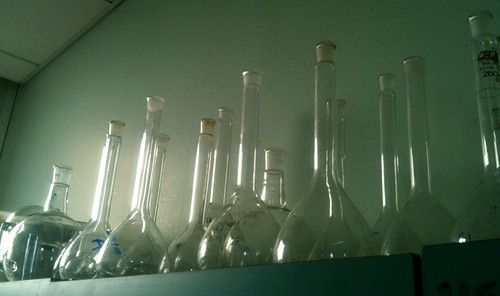
Flasks

To earn my upkeep for the first year, I had to teach large labs of medical students the rudiments of sterile three-zone streaking, Gram stains, blood agar and the IMViC coliform test. (For some inexplicable reason that none of the professors could explain, the E. coli residing in my gut were reproducibly indole-negative, so I couldn’t use my own commensals as a classroom control. Considering how these are traditionally isolated, I considered it a bit of a blessing.) Although my heart belonged to the Retroviridae, I took great pleasure in the rituals and manipulations of classical microbiology and passing these on to my students. Even today, I still use the three-zone streak method and a flamed platinum loop to isolate colonies for cloning, even though most of my colleagues just scribble bugs with a dirty yellow tip and do just fine that way. It may not matter for molecular biology, but it’s more about taking pride in the proper way of doing things.

So, two decades on, it’s good to be back in a Microbiology lab with a capital M. Although I’ll be working on the cell biological aspects of urinary tract infections, there is a significant component of pathogen investigation that we need to do in parallel. Things have definitely moved on since the IMViC test: we now have fancy test strips to assay for indole production and the other metabolic readouts used to distinguish similar bugs from one another – and the most amazing chromogenic agar, onto which you can streak an unknown mix of bugs and separate out strains in a rainbow of different possible colored colonies.

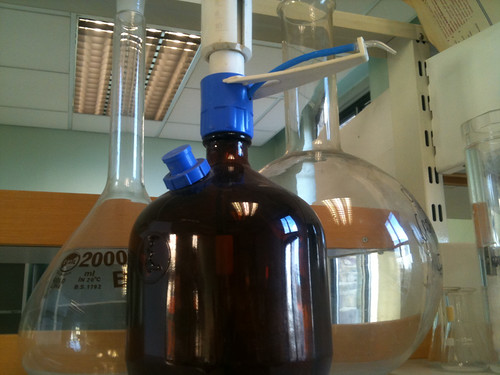
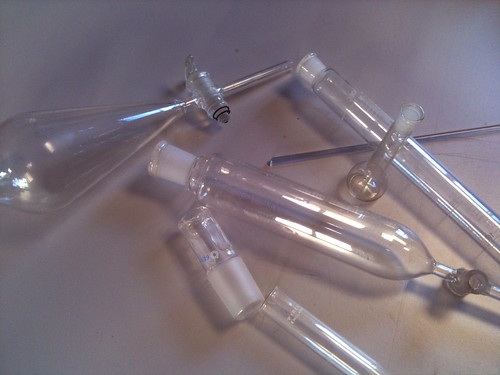
But amongst the high-tech kits, relics of our deep microbiological past lurk high on dusty shelves. I’m sure they’ve never been thrown away simply because they’re too beautiful. And I’m certainly not going to break that tradition. So we’ll keep working in the shadow of a more genteel past, harking back to an era when things were made of glass and tooled to precision specifications by craftspeople who took pride in the aesthetics of their products.

MoreFlasks

BitsAndBobs

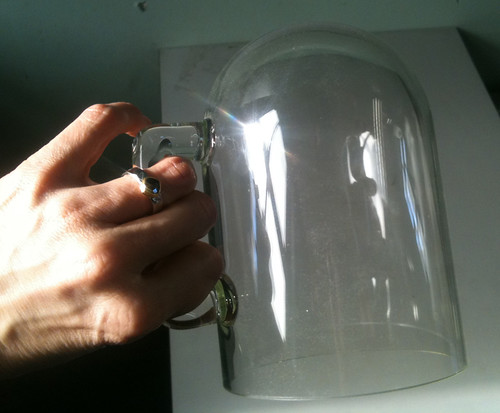
But I’ll close on a mystery: what the heck is this?

Snuffer

It looks like a weird pint glass, but its curvature suggests that the opening is meant to be facing downward. It rather harkens back to the days of Joseph Priestley, who put glass jars over mice to see if they required something in the ether to survive. But I suppose it might also just be an over-engineered Bunsen burner snuffer.

All ideas welcome!

Posted in Nostalgia, The profession of science | 30 Comments

In which I sort it out

All of my professional life, I’ve worked in affluent labs – in academic groups bolstered by multiple sources of grant money, or in a biotech setting flush with investor capital. More recently, I’ve enjoyed a generous personal consumables budget courtesy of my Wellcome Trust Fellowship.

The new lab, alive with potential

The fridges and freezers in these work spaces have been crammed full of reagents accumulated over many years. Old chemicals are often perfectly serviceable, which increases the value of such well-stocked treasure troves. In my previous lab, for example, I inherited a scruffy, foil-wrapped 15 mL Falcon tube of ethidium bromide solution from the previous inhabitants in Alan Hall’s group, circa 2004; I dipped into this tube for my entire 4.5 year stint – it worked beautifully – and left it behind for the next lucky user to enjoy. Another bequeath chez Hall were three full boxes of alphabetically arranged restriction enzymes from Aat1I to ZraI, most with expiry dates in the early- to mid-1990s. Despite this, the majority still managed to cut DNA with some degree of efficiency. In karmaic payback mode, I made sure to leave behind most of the unfinished chemicals that I’d purchased.

The upshot of working in a wealthy lab is that you can often think of an experiment and then start it a few minutes later. If you don’t have a particular reagent, there is usually an entire building of colleagues from which you can borrow – or an entire campus if you can be arsed to brave the cold. In my first novel Experimental Heart, I describe the detailed etiquette of this “scrounge culture”, illustrating the importance of your neighbors – and the contents of their freezers – in keeping the engines of science running.

For the past week and a half, I’ve been settling into my new home here in one of the satellite campuses of the main university. The lab I’m charged with starting up mostly from scratch is enormous – 7 entire bays and five side-rooms – but it is also almost empty (aside from great piles of junk that we’re in the process of clearing out, including some amazing historical glassware that is probably worth a few bob – but that’s another story). As a remote site, the campus is a cobbled-together mixture of orphan disciplines that struck out on their own sometime in the distant past, probably as overspill. As a result, there is plenty of room, but the trade-off is that individual groups are divorced from the rest of their departments. Our building, for example, is an eclectic mix of people who don’t have much in common – and that includes the material we work with. In fact, my lab will be the only biomedical research facility on the entire site.

All this means that there will be no popping across the corridor for a quick scrounge; instead, appointments must be made, journeys on the London Underground undertaken. Yet with give-and-take being so crucial for the scrounge culture, I foresee a problem: I may borrow from colleagues on the main site, but no one is going to travel up here to borrow something from me in turn. Hence, any scrounges will become increasingly one-sided, and therefore psychologically unsustainable. I fear we will have to get used to going it alone – and preparing well in advance for any contingency.

So here I am, getting to grips with things. The lab has tissue culture hoods but no CO2 mains or liquid nitrogen. Historically a clinical microbiology lab, we’re strong on Gram’s iodine, agar plates, haemocytometers and specimen jars, but entirely lacking in basic items like enzymes, the means to assess DNA and protein, and advanced imaging apparati. So we’re busy ringing up companies, getting quotes, sketching floorplans, liaising with the site manager.

It’s exciting to face this blank canvas, roll up my sleeves and start making something vibrant and exciting out of it. In fact, it’s made me realize that throughout my career in both research and publishing, the appointments which have proved most stimulating and successful have been those in which the culture or infrastructure needed sorting out, shaking up, reinvention.

Ladies and gentlemen, the Doctor is In.

She’s only wishing she’d brought along that scruffy Falcon tube.

Posted in Careers, Nostalgia, The profession of science | 24 Comments

In which I move on

I have always been fascinated by microorganisms and the many strategies they use to subvert the host cells that they parasitize. For me, the most interesting aspect of infection is the interface between the invader and its victim – the ways that bugs take opportunistic advantage of features that cells really can’t live without. My PhD project, for example, dealt with how feline leukemia virus uses sloppy replication to spin out a wide range of mutated envelope proteins, thereby tweaking the way virus particles can dock with the host T-cell membrane or do selective damage that facilitate spread. Of course the host can and does retaliate, shifting the goalposts and forcing the viruses to repeatedly up their game in a process that is often called “cat and mouse evolution”.

I’d moved away from pathogen-host interactions in recent years, my research becoming increasingly abstract and biased towards the host cell side. I’ve been gaining valuable insights into how cells maintain and regulate their dynamic shapes and structures – the ruffles, protrusions and pseudopods that cells elaborate in the process of carrying out their day-to-day existence, coordination of which requires a tight and complex communication system close to the plasma membrane. All of this experience is great ammo for microscopic warfare, whether it be against microbes or cancer. In theory, that is. In practice, I was poking and prodding a highly adapted lab strain of cancer cells in Petri dishes. And in so doing, I was straying further and further away from fighting actual diseases, which was the reason I got into science in the first place. I knew it was time for a change, even if my fellowhsip wasn’t about to expire.

Those of you following my blog know about my long struggle to re-enter academic research after a considerable career break, first in biotech and then in science publishing. You’ll have traveled with me though my ups and downs, shared with me the dawning, and disappointing, realization that staying in research might not be possible – as it ceases to be for so many other mature post-docs who haven’t quite found their place in this cutthroat career fray.

After all of this, I never truly expected a happy ending.

It’s not really an ending, since my starting contract is relatively short in the first instance and will require me to raise funds – never a sure bet in the current climate. But it’s a great stepping-stone, and I’m ridiculously thrilled at the prospect of being in the clinic at last.

From the first of February, I’ll be starting up a basic science lab to work closely with my new colleagues in the Division of Medicine who run a busy clinic dealing with urinary tract infections – in particular chronic ones, that come back again and again despite antibiotic treatment. The science is very new and not yet widely studied. I’m simplifying this quite a bit, but what we know is that bacteria physically invade the bladder epithelia and set up infection within the host cell cytoplasm. In principle this is not an easy achievement, given that the engulfed bacteria start out being enclosed in cell membranes, en route for routine disposal. But then, something goes horribly wrong: the bacteria hijack the communication signals between the membranes and the host cell cytoplasm, persuading the prison wardens to let them free. Once released, the bacteria set up a slow-growing, long-term colony inside the cells, in insidious biofilm masses known (in a wonderfully sci-fi way) as “pods”, and in other quiescent reservoirs deeper within the stratified epithelial layers. Safe within, pods can persist for months, completely protected from antibiotics as well as the person’s immune system. At a later date, following completely unknown cues, the pods reactivate, burst out of the bladder and initiate acute infection all over again. My new colleagues have made a lot of inroads with clinical research projects on patients, but what’s been lacking is the basic science line of investigation. And that’s where I come in.

This is a dream project for me. It’s a fantastic biological problem, and I can now use all of my cell biology expertise against a real-life disease, one which causes a lot of misery and economic liability worldwide. It may be possible to extrapolate anything I learn to other occult intracellular infections. And of course, pathogens are often the best way to shed light on our own cellular processes: viruses, for example, revealed the secrets of cancer genes, so I expect to discover new basic cell biology along the way. Best of all, the mentality of this clinic is to translate any basic findings back into treatment as soon as possible. The translational approach (with a proprietary commercialization angle) also opens up an entirely new avenue of funding streams aimed at getting academia and industry working together, which will hopefully bring in the funds I need to grow the lab.

Looking back, I’m shocked that it’s taken me nine whole years to regain my position as a group leader since being knocked off my perch by an ill-timed biotech bankruptcy. But I don’t regret any of the decisions I made along the way, and I am positive that I will be able to stay in academic research where I belong – with a bit of luck and a prevailing wind.

Posted in Careers, The profession of science | 17 Comments

In which I offer one little reason

A certain impending – and exciting – move has left me with no time to blog.

Tomorrow is my last day, and after a week of holiday, I’ll be flying North (but only about 3 km) to start up a new lab. It’s a bit sad, because this will always be the place where I relaunched my scientific research career nearly five years ago. But the overwhelming feeling is of happiness and expectation.

Where am I going and what will I be doing? All will be revealed in due course!

Posted in Careers, The profession of science | 22 Comments

In which not much is left to the imagination

Here’s a sign I snapped during my post-Christmas holiday in Yorkshire. Can you spot what’s wrong with it?

It is a classic example of a violation of a rule that fiction writers refer to as “Show, Not Tell”. What it means is this: if you spell things out unnecessarily to your audience (whether this be a reader, or a person in search of a pint), he will become frustrated in your lack of trust in his intellect or imagination. Whenever I see a pub blackboard extolling the virtues of how old, or charming, or historic it is, I’m very much disinclined to go inside and form my own opinion. In short, any pub that needs to trumpet its greatness probably has to do so for a reason: because its claims are grounded on wishful thinking. The best pubs become known as such through good experiences spread via word of mouth, not by chirpy phrases on a sign.

In fiction, the “Show, Not Tell” rule is notoriously slippery. The whole modus operandi of fiction, you might think, is to paint a picture for the reader and in doing so, lure him into your world. This is true, of course. But if you do so in an obtrusive, didactic way, you’ll only annoy your readers – and risk shattering that all-important suspension of disbelief, a spell that all storytellers needs to maintain.

One of my favorite authors is Neal Stephenson, and I waited three months to read his latest, Reamde, after ordering it off Amazon. Not only did I want unbroken time to enjoy the tale, but its 1.3 kilo bulk was too heavy to schlep around on the Underground during my daily commute, and I feared drowning in the bathtub under its sheer 1044-paged gravitas. So I took it with me to the North York moors just after Boxing Day and read it in several hour stretches between long rambles on the moors, and games of whist with glasses of port near the open fire in the pub under our room.

The Horseshoe Inn, Levisham, Yorks

For the most part, I did lose myself in the plot – it’s a great novel. There was just one niggling problem with the prose: a tendency to over-explain, including a few instances of the above-mentioned violation. Even established writers get this wrong on occasion. Can you spot it here?

He set his bag down on one of the leather-upholstered seats, carefully, suggesting that it contained something valuable and delicate, such as a laptop.

Everything we need to know about the bag’s contents is adequately imparted by the use of the adverb “carefully”. (I say “adequately”, because adverbs are a fairly lazy way of “showing”.) The next clause about being valuable and delicate is overkill, and the third, about the laptop, is bludgeoning the poor reader over the head. We are being told how to interpret what we’re seeing, instead of being allowed to witness it all without explanatory footnotes.

“Show, Not Tell” violations not only insult the reader’s intelligence, but they leave nothing to the imagination. If this particular character – a hulking great bulk of a gangster hacker – was setting down a bag with care, I as the reader would instantly start wondering – what’s in there? Why is he worried about it? Is it a piece of equipment, a weapon? A laptop? Some other delicate item that we can only guess it? The suspense would ramp up in direct proportion to how much time I devoted to wondering. Instead, the author has basically fed it to us on a platter.

Such clumsy constructions are easy for any writer to make, which is where talented editors come in. When I’m working on a novel, the early drafts tend to emerge over-explained, with too many adjectives and adverbs. Revision, for me, is the process of shaving away words until only a glimmer of the sentence’s core essence remains. And after this, external readers tend to point out where I still haven’t gone far enough.

Being in Yorkshire showed me in other ways how difficult the writer’s lot truly is. I tried to describe the following scene, low tide at Whitby, in several emails to friends, and failed completely. So instead of a thousand words, I’ll close with this picture:

Happy new year, all!

Posted in Writing | 16 Comments

In which we are the last man standing

You know it’s the last day before Christmas break when:

1. All of the communal microscopes are free, so you can run lots of parallel experiments.
2. Whenever you enter a room or corridor, the automatic lights flicker on.
3. Plenty of the best cookies are still available in the common room.
4. You hear a lot of weird noises in the empty lab that you never noticed before.
5. The tissue culture incubator is almost completely devoid of dishes.
6. Every work email you send elicits an out-of-office reply.
7. The machine that never normally breaks down packs it in just as the person who knows how to fix it leaves until January.
8. Your boss is the only lab head still in the building, and you’re the only one he has to pester about experiments.
9. Point 8 slightly mitigated by brownie points gained.
10. You wonder whether you have the stamina to attend the last party of a week of parties.

Happy holidays one and all!

Posted in Silliness, The profession of science | 4 Comments

In which we down a few

It seems like only yesterday that Nature Network, in what struck me as a bizarre fit of misplaced paranoia and pettiness, locked some of its most popular bloggers out of their own sites, preventing them from posting their own farewell messages and receiving any final comments of goodwill. Well, I for one have never looked back – and I’ve enjoyed the past year in my new blogging home immensely. What hit me immediately about escaping the NN sphere, with its clunky interface and registration practices, was that I was suddenly hearing comments from all sorts of people who had never interacted with me before. And that’s been really great, so I thank all my readers for stopping by.

What could be more exciting than Occam’s Typewriter’s first birthday? Why, institute cocktails, of course! Once a month, one of the lab groups puts on a much-anticipated Friday night bash for everyone else. Tonight’s theme was not without its controversies, however, causing a mild kerfuffle that ultimately culminated in the following mass email:

Dear All

It has been brought to my attention by an individual in the department that some people may find the images on the posters advertising this Friday’s cocktails offensive. Let me reassure you that this was not my intention to offend Christians or indeed anybody else, and nobody who had seen the posters before I put them up suggested that they may be offensive.

However, if you have been offended by the pictures of George and Toms’ faces photoshopped on to Mary and Joseph, or Jemima and I transposed onto Mary and the donkey, then I apologise. I will endeavour to get around the building and remove the posters in question and replace them with hopefully less offensive ones. Please let me know if I miss any, or feel free to take them down and dispose of them yourselves. If anyone is offended by pictures of mince pies and beer, then I’m sorry about that too.

After spending a few hours on this afternoon’s lab bonding exercise – scrubbing fungus from the inside of the tissue culture incubators and hoods – I’ll be only too happy to exchange my Virkon for a vodka twist. And I don’t care whose face is on the donkey.


Update 15.39 PM: Just some proof that our lab has definitely earned the cocktails!

Fungus Counter-attack (a.k.a. How Many Scientists Can You Fit Into a Small Tissue Culture Suite?)

Posted in Silliness | 14 Comments

In which I long to curl up with a good book

‘Tis the season when colleagues start discreetly disappearing from the lab, only to return a few hours later laden with shopping bags from Oxford Street. There is a run on discarded boxes and packing peanuts in the store room, and colorful envelopes from biological supply companies begin to clutter up the pigeon-holes. Starting from this week, alcohol dehydrogenase levels will slowly build up while last-minute experiments are frantically completed around a complex festive social schedule. The London air will smell like snow, yet will produce only a chill drizzle.

For me, the upcoming Christmas break means time to do all the things I now struggle to make time for – in particular, reading. If you’re like me, you’ll want to sink into a lovely novel or two or twenty. So there is no better time to announce that my lovely publishers, Cold Spring Harbor Laboratory Press, have decided to slash the price of the Kindle versions of my two science novels, Experimental Heart and The Honest Look – to £3.56 (or $5.72, or suitable equivalents in other currencies). Both received great reviews from all the life science journals that have steadfastly refused to publish my finest work over the years, so what’s not to like?

Remember, Cold Spring Harbor Lab Press is a non-profit organization whose income helps fund the great science that goes on nearby. So do consider getting yourself a copy!

I confess to having mixed feelings about ebooks. I tend to buy both print and electronic versions now, depending on price and availability, and while I enjoy using my Sony Reader, the paperback still exerts a bit of a pull on me. For October’s Fiction Lab, I read John Banville’s Kepler on the Reader, but there was something compelling about the look and feel of this month’s selection bought in paperback, John Steinbeck’s Cannery Row, that seemed to draw me in. I don’t like to imagine my once-dynamic bookshelves becoming static museum exhibitions, slowly gathering dust and trapped in time as my purchases tend increasingly towards the electronic.

Will I really one day throw away my books as I recently did my CDs, VHS and audio cassette tapes? I feel the answer must be a vehement ‘no – but I have the sneaking suspicion that I’ll be proven wrong in my lifetime.

Posted in LabLit, Writing | 23 Comments

In which signaling takes the cake

Champagne in plastic cups after a successful PhD viva is still a classic, but you don’t often see labmates getting together to recreate one of your prettiest thesis figures in cake format.

Congratulations, James!

Posted in Silliness, The profession of science | 9 Comments