Touch, Feel

I’m not proud of myself but I have to confess to a lascivious addiction. I know. It’s disgusting. But I can’t help it.

The problem started in 1999. I remember all too clearly my first glimpse of the well-proportioned curves and smooth, smooth skin. After that I was hooked. Oh. God. I couldn’t resist.

The Apple G3 PowerBook, my first ever laptop, was gorgeous.

Image from flickr

It didn’t matter that the machine weighed nearly 3 kilos, was possessed of a rather flimsy keyboard and whined. Lust, like love, is blind.

We were inseparable but the relationship lasted just two years. In 2001 Apple produced a computer that uncoupled me from the G3. To some, the first incarnation of the G4 PowerBook was no looker. Gone were the cool black skin and the sensuous curves. The new machine was all rectilinear functionality: serious straight lines softened by the merest blunting of the corners.

Photo by Scott “Jerry” Lawrence

But to me it was a dream. What sold me on this beautiful metal machine was the 2001 look – it seemed to have dropped to Earth from the slowly rotating space-station in Kubrick’s 2001: A Space Odyssey. And it was lighter, thinner, faster and boasted a massive 20 GB hard-drive. The keyboard felt amazing: firm under my fingertips. This was the future I had been promised in the sixties.

I had to have it. I told you I’m addicted. When, just two weeks into the relationship, the strap on my shoulder-bag failed, dropping the computer to the ground and breaking one of the screen hinges (so much for being made of Titanium), I was almost broken-hearted. But I did not hesitate to pay out for the £600 repair.

We had three years together. But age withers the loveliest of creatures and the titanium coat was eventually disfigured by the touch of my sweaty palms. And the machine started to lag behind newer incarnations that came wrapped in stain-resistant aluminium.

Aluminium G4

Image by Pete Verdon

I was never entirely happy with the all-over silver gleam of the G4 Powerbook I bought in 2004. I preferred the firmer squeeze of the keyboard on the older machine, but speed and power won out. Here was a computer that could be used in all seriousness for the number-crunching and image-rendering required by protein crystallography. It made me feel like a real man.

Three years later, seduced by the switch to Intel processors, I swapped it for a 15″ MacBook Pro. There was no change in the look of the machine or, mores the pity, to the spongy keyboard. The gratification of the purchase seemed diminished so I consoled myself with the boost in performance and a hard-drive that had swollen to 250 GB.

MacBook Pro 13"

My lap. My laptop. Image on flickr

But now, the love is back. I have just got my hands on a slender, sophisticated 13″ MacBook Pro. It’s still more rectangular than rounded but the body of this thing is machined from a single piece of aluminium. The keyboard — firmer again — nestles in a shallow depression that invites you to run your fingers around the curved edge. The large, sensitive trackpad needs your touch. The black is back, in the keys and surrounding the glossy screen. It is only a shade over two kilos and has the power to last all night.

Posted in Technology | 23 Comments

Cosmos and Kapoor

Having delighted in Jacob Bronowski’s The Ascent of Man earlier this year, I sat down to watch Carl Sagan’s Cosmos, which several commenters had recommended to me.

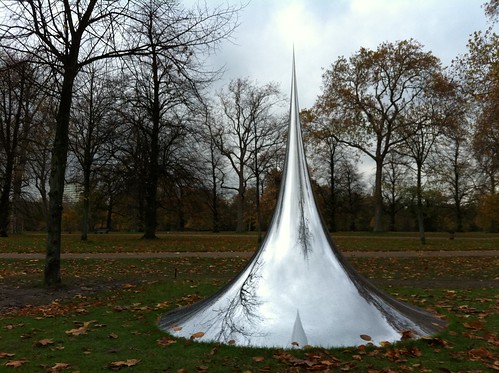
You can read what I thought of it in my guest post at Grrlscientist’s Punctuated Equilibrium blog over at The Guardian. As you will see, it is wrapped up with the recent apparition of shiny sculptures by Anish Kapoor in Kensington Gardens.

See what you think.

Non object (spire)
“Non-object (Spire)” by Anish Kapoor

Posted in Astronomy, Communication, TV review | 2 Comments

Libel Reform: Not There Yet

The British cardiologist Dr Peter Wilmshurst was reported in 2007 to have made remarks critical of a clinical trial involving a medical device made by NMT Medical. He is now being sued for libel.

The case is complex and I have not mastered the detail. I have, however, grasped one essential fact. Dr Wilmshurst’s comments were made in the United States. His words were reported on a US medical website, Heartwire (www.theheart.org). NMT Medical is an American company. But Wilmshurst is not being sued in America, where the right to freedom of expression is robustly enshrined in the constitution. Instead he is being taken to court in England, where the libel laws allow foreign individuals and corporations much freer rein.

And it is to this country’s discredit and the detriment of free discussion of science that the laws are so lax.

I have written several posts on libel reform in the past eighteen months, focusing on the case brought by the British Chiropractic Association (BCA) against the science writer Simon Singh. The BCA sought to use England’s easy legal means to silence a critic, rather than to engage him directly on the key scientific issue: the BCA’s astonishing claims to be able to treat childhood ailments such as asthma by manipulation of the spine.

Simon Singh speaking after his appeal victory

Only Singh’s courageous resolve, and his deep pockets, allowed him to stand his ground, and eventually win the day (though he is still embroiled in legal arguments to recover his costs). Many others — including scientific journals — cave in. Few have the financial muscle to take on large organisations at the libel game in England and Wales. Wilmshurst’s stance is an act of bravery, particularly given the recent intensification of the legal action being taken against him.

On the upside, the Singh vs BCA case highlighted the parlous state of libel law in this country and it helped to accelerate the movement for libel reform.

This week is the first anniversary of the report Free Speech is Not for Sale, which highlighted the oppressive nature of English libel law (and is an excellent and very readable starting point for those wishing to inform themselves of the case for reform). In short, the law is extremely hostile to writers, while being unreasonably friendly towards powerful corporations and individuals who want to silence critics.

The English libel law is particularly dangerous for bloggers, who are generally not backed by publishers, and who can end up being sued in London regardless of where the blog was posted. The internet allows bloggers to reach a global audience, but it also allows the High Court in London to have a global reach.

You can read more about the peculiar and grossly unfair nature of English libel law at the website of the Libel Reform Campaign. You will see that the campaign is not calling for the removal of libel law, but for a libel law that is fair and which would allow writers a reasonable opportunity to express their opinion and then defend it.

The good news is that the British Government has made a commitment to draft a bill that will reform libel, but it is essential that bloggers and their readers send a strong signal to politicians so that they follow through on this promise. You can do this by joining me and over 50,000 others who have already signed the libel reform petition at http://www.libelreform.org/sign

Remember, you can sign the petition whatever your nationality and wherever you live. Indeed, signatories from overseas remind British politicians that the English libel law is out of step with the rest of the free world.

If you have already signed the petition, then please encourage friends, family and colleagues to sign up. Moreover, if you have your own blog, you can join hundreds of other bloggers by posting this blog on your own site. There is a real chance that bloggers could help change the most censorious libel law in the democratic world.

We must speak out to defend free speech. Please sign the petition for libel reform at
http://www.libelreform.org/sign.

Posted in Libel Reform | 1 Comment

Science is Vital: Perturbation Theory and Practice

The firework screamed upwards into the night sky and burst, with an almighty crack, into a vibrant spray of light and colour. Everyone looked up. Some people cheered. And then the murmur of conversation resumed.

Is that what happened with the Science is Vital campaign, which bloomed and boomed in the UK this past September and October? The campaign concentrated the arguments and ire of the science and engineering community on the Government in the run-up to the announcement of the Comprehensive Spending Review (CSR) on 20th October and appears to have had a palpable impact in persuading the Lib-Con administration not to slash the science budget.
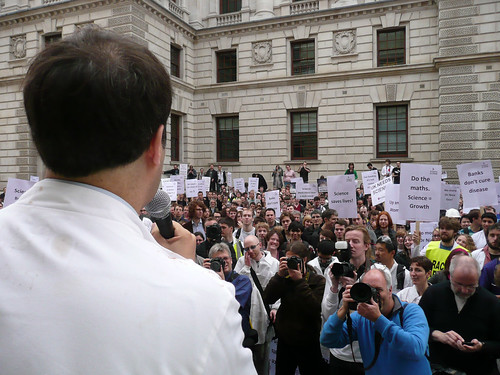
Science is VItal - finale

How did it happen, what did it really achieve and what residue has been left behind? We have had lively first person accounts about setting up the campaign from RIchard Grant and Della Thomas, who were both closely involved in the organising committee, a revealing examination of its online progression from Shane McCracken, and careful analyses of the CSR from Jenny RohnEvan Harris and CaSE director, Imran Khan.

Having waited a few days to reflect on the campaign, I wanted to give my own digest. The assimilation is still incomplete but what follows will have to do. It is very much a personal view — I have not had time to track down links to many of the blogs and articles that I absorbed during and after the campaign, so please feel free to take issue.

Looking back, it is clear that Vince Cable’s first major speech on science, delivered at Queen Mary College on 8th Sept, was the spark that lit the flame. It certainly inflamed me, by coupling an erratic and erroneous assessment of the quality of UK scientific research with ominous warnings that we were going to have to “achieve more with less”. Incensed and taking my cue from other bloggers, I responded with an article for the The Guardian, co-written with Evan Harris (who, I discovered, has a cooler head). We dismantled Cable’s sloppy analysis and reasserted the quality and value of UK science.

But Jenny Rohn’s response to Cable’s speech was more straight-forward and more courageous. It was a call to action:

“Let’s march on London! No more Doctor Nice Guy, no more hiding behind our work, no more just taking things lying down like we take everything else in our profession — poor job prospects, poor funding, low pay, poor life-work balance. If they are going to bleed us dry, we might as well try to do something before it’s too late. I reckon there are thousands of practicing scientists and their allies in the vicinity — let’s make some noise.”

And it struck home with dramatic speed. Within hours, a fledgling committee had signed up via the comments section of Jenny’s blog. A Facebook page appeared that night and the #scienceisvital tag swept all before it on Twitter. Within two weeks the Science is Vital web-site launched to gather petition signatures and announce plans for a rally in Westminster and a lobby of Parliament.

The ease with which we collected and coordinated support online was the key to the impact of a campaign that only had a few short weeks to get its act together: there were precisely 42 days between 8th September and 20th October. The sound of the ticking clock was always audible at our frenetic committee meetings.

It is no coincidence, I think, that the campaign sprang into life less that a week after the Science Online London 2010 conference (SOLO10) on 3-4 September, which was attended by almost all of the people who formed the SiV organising committee. The SOLO conferences are lively affairs even if they are largely unknown in the scientific community since the vast majority of scientists still eschew social media activities. One of the most memorable contributions this year was by Evan Harris, who urged scientists to get more political — on any issue where science informs our understanding of the complex choices facing society — and offered a few pointers on how to do so. Crucially, he emphasised that the purpose of lobbying is to get the attention of policy makers, an activity distinct from engaging the public on science.

His talk made great good sense to me but raised a few yelps of objection among the audience who, quite naturally for such a gathering, were very active on Twitter. Some insisted that lobbying and public engagement should go hand in hand; others protested that many scientists are simply too busy to take on the additional burden of political activity. Both are interesting viewpoints, but I was out of sympathy with them.

I suspect my views had been coloured by spending time in the previous year or so getting involved in the campaign to support Simon Singh in his libel battle with the British Chiropractic Association, demonstrating against valueless alternative medicines, attending debates on science funding organised by CaSE and the Westminster Skeptics and engaging with school-children. These activities had taken me out of the lab as never before. I found them fascinating, worthwhile and energising. I have been confirmed in the view that scientists, some of us at least, need to be more active in the public domain (a view reinforced by a coffee-time conversation at the conference with Alok Jha, who definitely thinks scientists should get out more).

I don’t remember that the Government’s threat to science funding was discussed much at SOLO10, though it had been a constant theme of all my encounters with scientific colleagues since the election. But I think the conference had dried the tinder so that when Cable came along with his ill-judged speech things were ready to catch fire.

The flames spread rapidly following Jenny’s initial call to arms. Jenny herself, and the small committee that nucleated in the response to her blog-post, were taken by surprise by the speed and overwhelmingly positive nature of the online response. Clearly, a nerve had been struck and the reflex of the whole community seemed to be to swing into action.

The use of the internet and social media (especially Twitter) was crucial in spreading the message and keeping supporters abreast of developments and reports of the campaign in blogs and mainstream media. But it was equally valuable in providing a conduit for morale-boosting, positive feedback to the organisers from the community of supporters. This helped to get the committee through many very stressful moments of uncertainty (the details of organising the rally in London proved particularly troublesome). This support came initially through comments on Twitter but later, once the SiV web-site had launched, via the rapid accumulation of signatures on the petition. Each threshold of the count was celebrated on Twitter, helping to build momentum. One thousand, two thousand, five thousand, ten thousand! The campaign was heady, breathless and exhausting. (For the record, making placards is back-breaking work that leaves a heavy deposit of spray-glue on your shoes).

Scattered among the energetic messages of support, there were a few nay-sayers. Many I spoke to in the flesh in those late September days to ask for support responded enthusiastically, but there were sometimes shrugs and murmured doubts that no campaign could deflect the Government from its oft repeated contention that cuts had to be made and the scientific community would have to play its part. Such negative reactions were frustrating but understandable, and perhaps reflects the erosion of self-confidence among scientists due to long years of government neglect.

Online there were other criticisms to contend with. Some felt the campaign should broaden to include the whole Higher Education sector. And that the Arts should be considered as important as the Sciences. There are good arguments for both these viewpoints, but the SiV campaign had a very specific origin in Cable’s barely veiled threat against UK science. We had learned our Harris lesson well and, given the extreme time pressures, felt it necessary to keep the focus on science funding.

Other matters were more trivial but still generated a surprising amount of heat. At the call for protesters who had lab coats to wear them to the demonstration — as an easy signature of the scientific community — the twittersphere took flight in a flutter of indignation. Some voiced concerns that lab-coats would make it too easy for the media to stereotype us as ‘boffins’. Others complained they didn’t wear lab-coats to do their science. Again, both are fair points to make in the long run, but the campaign team felt that the easy visual hook would earn valuable media exposure and, indeed, this proved to be the case.

A deeper concern was that the necessary focus on the economic case for science would make us hostages to fortune — that we were wrapping the constraining cords of ‘impact’ around our own hands and tying ourselves to a common Government view that science should always pay its way with technological advances that can be commercialised in the short-term. There had already been disquiet about the recent introduction of impact statements in grant applications to the Research Councils. Many feared, with good reason, that this would skew funding to more applied research, thereby discounting the value of curiosity-driven work, which retains an  impressive track record of success if only you are prepared to look for it.

Although the campaign was careful to highlight the importance of blue-skies research (and of the wider economic benefits of public investment in the science base), the focus on the economic value of the science spend was necessary in the short time-frame available to us. For sure this economic focus comes at the cost of overlooking the importance of science as an important cultural activity, valuable by its own lights. And again, this is a worthy argument but it is a broad and long-term one. The immediate goal of the campaign was to change the mind of a Government fixated on balancing the books. We felt that arguments embracing all the likely benefits of science ran the risk of losing the attention of those who mattered: the men at the Treasury.

And so we rallyed outside their offices on 9th October where speaker after speaker and placard after placard drove home the message that cutting the science budget would be a counter-productive move for an economy that was struggling to recover from a crippling budget deficit. That was followed by the lobby of Parliament on 12th Oct and delivery of the petition — which then stood at almost 34,000 signatures — to 10 Downing on 14th Oct. Handing in the petition triggered an invitation to a meeting with science minister, David Willetts, who wanted to hear at first hand what had motivated this motley band of scientists and supporters to create so much noise. The message seemed to be getting through. Willetts and Cable had also, I gather privately, been taking readings from a wide spectrum of scientific opinion.
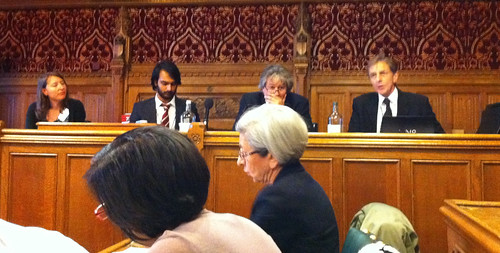
Science is Vital Lobby - Speakers

The news of the campaign’s success — if it can be called such — broke on the eve of the CSR announcement when it became known that the science budget would be frozen in real terms from 2010 to 2014 and ring-fenced within BIS (the Department of Business, Innovation and Skills). This was immediately met with a jubilant sigh of relief — Twitter is, if anything, a rapid-response medium —  followed by a more temperate reception, acknowledging that a freeze in real terms means a slow erosion of the value of the Government’s investment in science over the next four years. We also had to be careful to recognise that many other areas of government spending, especially on welfare, were cut savagely. The news that sick and disabled people will lose benefits and support in order to balance the public spending budget took some of the shine off what appeared to be an unlikely escape for science. But we adhere to our case: spending on science should, over the long term, generate the economic benefits that pay for welfare and support services.

The news of the freeze was also tempered by the realisation that it only affects recurrent expenditure by BIS on research funding. There remain considerable uncertainties about capital expenditure (a concern for the physics community who are particularly dependent on large-scale facilities) and about the Government’s plans for university funding. The effect of the radical shift of funding from Government support to student tuition fees, which will be doubled or tripled, is yet to be determined. The future for Britain’s universities may well be bleak — it is certainly somewhat blank at present.

Science Question Time at the RI

I got a sense of this while listening to David Willetts at the Science Question Time held at the Royal Institution  last week (listen here or read Beck Smith’s report). I suspect the Government, in its haste to put together a spending review to tackle the huge UK deficit, has not had the time to gauge the integrated effect of its changes to the science and university budgets. For example, Willetts claimed that the likely 10% decline in the real value of the science budget could be significantly mitigated by efficiency savings. When I pointed out that university researchers now faced the double whammy of competing for declining research funds (in real terms) while coping with demands for more contact hours from undergraduates paying higher fees and couldn’t see where where those efficiency savings were going to come from, the answer was disappointing. He mentioned only the Government’s intention of reducing the burden of assessment on universities and grant holders.

That said, I still think he was listening. It’s clear from their success in putting their case to the Treasury that Cable and Willetts have taken the arguments for science on board. And though some of his answers at the Royal Institution were unable to fill in the anxious gaps in our view of the future, he did at least say that he would take the concerns of the panel and the audience back to his departmental colleagues.

What effect that has remains to be seen, but scientists should be keeping a close eye on BIS. It is still early days for this new administration. They have yet to be overtaken by events so it is to be hoped that the ministers will have the chance to deliberate a while longer on just how scientifically ambitious the UK wants to be. And into these policy debates (and other relevant areas of government activity), I hope that more scientists will be prepared to cast their views.

We cannot properly tell — since the experiment has only been done once — whether the Science is Vital campaign had a real impact on the Government’s final budgetary decisions. For what it’s worth, I incline to the view that it did. But more importantly, I hope that by raising the flag for science the campaign has caused some of our number to think more deeply about the societal worth of what they do and to recognise the value of stepping into the public domain. It certainly moved me to up my game and examine the economic case for science more closely, widening my reading choices to include Royal Society reports and academic analyses. The arguments are complex and the evidence for the benefits of public spending on science, though cumulatively powerful, lack quantitative precision. But grappling with this information made me better equipped to address these matters with my MP and the wider public. I’m sure the campaign had a similar effect on others.

There are risks associated with ‘going public’. The mantle of lobbyist is not one to be worn lightly since it will attract the suspicion of other interest groups, especially if the topics are controversial — as any climate scientist will tell you. The SiV campaign largely avoided such disputes by sticking resolutely to the single, well-supported argument that investment in science brings economic benefit. Future debates may be more contentious, but our resolve to act should hold.

Conversely, this sort of public engagement reflects back into the scientific domain. It is no bad thing for scientists to be prompted think about how our work connects with the preoccupations of Government and our fellow citizens, about how the research that we do is likely to benefit the people — mostly taxpayers — who fund it. Interactions in the public domain work both ways.

For now we might pause to recover from the intensity of recent weeks, but I am optimistic that those who got involved in supporting the Science is Vital campaign might be willing to come back for more and to help hold this Government’s science policy up for scrutiny. Science is on the political agenda as never before.

And now that we have figured out how to launch a noisy rocket, it should be easier next time around.

Posted in Science & Politics | 44 Comments

Ask

Despite having a physics degree and some notion of the stretchiness of space and time in Einstein’s theory of special relativity, I’ve never felt comfortable with these ideas. In particular, I have never really had a good feel for why — or how — energy and mass might be interchangeable, as dictated by his most famous equation: E = mc2.

Apparently, this is something that I had in common with Brian Cox’s wife, Gia Milinovich.

Which is fortunate because when she asked him “Why does E = mc2?”, Cox’s attempt to answer his wife’s query ultimately resulted in a quite wonderful book, co-written with his University of Manchester colleague, Jeff Forshaw.

The book is an unusual piece of popular science in that it is almost entirely conceptual, going straight to the core of the theories with only the briefest of diversions into pen portraits of some of the figures mentioned along the way. The outlines of Einstein’s own life are not even sketched, such is the authors’ devotion to the task of exposing his space, time and mind-bending theory.

Why does E equal mc squared?

Look at the creases – I really did read it.


Why does E=mc2? is therefore a courageous and ambitious book and one that, for me, succeeded brilliantly. Cox and Forshaw are solicitous and engaging guides through the observations and logic that drove Einstein to his far-reaching conclusions. They are apologetic at times about some of the mathematics encountered along the way but at the same time agreeably enthusiastic about the need to do to in order to appreciate one of the true wonders of twentieth century science.

The book is not long but plots a steady, clear route through the various conundrums that led Einstein forward. It starts with the necessary abandonment of the notion of absolute rest, continues through Maxwell’s uncovering the speed of light, c, as a universal constant and, by leaning primarily on the notion of invariance (the idea that all observers should agree in their measurements of the same objects, events or phenomena), takes us into the inescapable heart of Einstein’s four-dimensional space-time.

It’s a breath-taking, epiphanic journey. In the first stage alone our everyday experience of the world is revealed as a mere shadow of nature’s interweaving of space and time. And we are discovered to all move within space-time at the speed of light. Even when we are sitting down.

But there is more. Beginning from the simple notion that no-one has yet observed a infraction of the law of conservation of momentum (the masses of objects multiplied by their velocities are maintained in all collisions or interactions) and by shifting that law into 4D space-time, the authors inexorably track Einstein’s E = mc2 equation to its source to deliver another instant of sweet revelation.

Mass and energy are found to be equivalent. And not just in the exotic way that sub-atomic particles and energy are interconverted in particle accelerators. It’s happening every day – step into your car and accelerate away from the kerb and your mass inexorably, though almost imperceptibly, increases. The world is not what is seems to be. It is far more _interesting_.

The latter part of the book is perhaps the most challenging. Cox and Forshaw don’t hesitate to throw down the ‘central’ equation that describes all the known interactions between matter and the forces that bind it together (except gravity).  Despite its formidable complexity, they walk the reader with a sure and steady step through its meaning and beauty. You don’t get a complete explanation — the details are simply beyond the reach of a popular science book (that’s why they call it ‘physics’, to paraphrase Mamet) — but there is enough meat for a satisfying feed.

Cox talks science

Brian Cox talks to my daughter and my nose (Photo by Richard Grant)


What I loved about this book was that it re-ignited my love for physics. I found that I ‘got’ relativity for the first time. I had mastered the equations during my degree but not properly absorbed their weight and significance. Perhaps there _is_ something to the old adage that education is wasted on the young? At the Geek Calendar launch last week Alok Jha, another physics graduate (who has reviewed the book for The Guardian), told me he’d had felt a similar sense of discovery. And Brian Cox himself confessed to me the same revelation in the process of writing the book, as the morass of maths yielded up its load of meaning.

This is why questions from the uninitiated are so important for scientists.

What is more, the book made physics seem important again. My degree had left me with the impression that the 20th Century has been one of spectacular progress leaving today’s physicists mostly to fiddle at the edges of our most fundamental theories of how the universe was put together. Perhaps that partly explains my shift into the life sciences, but physics now seems to be back on centre stage. I find myself eagerly awaiting the results from the Large Hadron Collider which is set to deliver the next seismic shift in our universe of understanding.

It is a mark of the success of the book that I am hungry for more. There were glimpses of complexity beyond the reach of the present narrative and I have questions for the authors. What exactly are the rules governing the interconversions between the particles produced in the high-energy collisions within particle accelerators? And how does the Higgs mechanism — which is treated in more detail in Ian Sample’s book, Massive — fit with the idea of the equivalence of mass and energy? There wasn’t the space-time to delve into this sufficiently but perhaps Cox and Forshaw can be persuaded to write a sequel. Maybe once the LHC has pronounced on the matter?

Posted in Book Review | 5 Comments

Science is Vital: Letter to my MP

I am presently attending a conference on Caliciviruses in Chile and am enjoying being immersed in both the warm spring sunshine and the latest research on this important group of pathogens. Any of you who has suffered at the hands of the ‘Winter vomiting bug’ is already closely acquainted with caliciviruses.

Although I am many miles away, my mind keeps reverting to the imminent announcement of the Comprehensive Spending Review, which is likely to have far-reaching consequences for the health of UK science. Despite the fact that the Science is Vital campaign culminated successfully last week in a rally, a lobby, a petition with over 35,000 signatures and and meeting with the Minister for science, David Willetts, it seems unlikely that UK science will escape very significant cuts.

The situation remains grim. Despite some encouraging noises made earlier in the summer by Mr Willetts, I think the government has not properly absorbed the case for science in it’s policy formulations. I got a sense of this at the lobby of Parliament last week where I spoke to my MP, Mr Bob Stewart (Conservative, Beckenham). He asked me to make the case by providing recent examples — in half a page — of how publicly-funded science has made a significant impact on the UK economy in the past 10-15 years. My response is appended below. As you will see, if you have the stamina, the case is not easily accommodated within half a page.

Dear Bob,

I want to thank you again for making the time to meet me at the House of Commons during the Science is Vital lobby on Tuesday last. I appreciate the seriousness with which you are addressing this issue.

You asked me for evidence — summarised in half a page — of scientific research in the UK within the last 10-15 years that had made a significant economic impact. I was happy to accept this challenge since, being a scientist, evidence ought to be my forte.

Immediately below I will present a brief example of scientific impact. However, that will be followed by a more detailed consideration of the issue of how the impact of public spending on scientific research is measured, because a focus on just the tangible outputs (i.e. commercial products) of government investment in science underestimates its true value.

I haven’t had the time to do a rigorous search of the recent high-tech industrials landscape in the UK so please allow me to cite a slightly less recent example taken from the very useful and accessible report The Scientific Century, which was published by the Royal Society earlier this year.

The techniques for isolating and producing large amounts of monoclonal antibodies — molecules generated by the immune system to fight disease-causing bacteria and viruses — were developed by Cesar Milstein at the MRC labs in Cambridge in 1975. Further work by Greg Winter in the same labs in 1986 showed how to modify or ‘humanise’ these molecules so that they could be used to develop new medicines for use in humans. In the course of his work Winter founded two companies, Cambridge Antibody Technology and Domantis, which were sold on to multinational pharmaceutical companies for £702m and £230m respectively. Approximately one third of medicines currently in development are based on this antibody technology (which has been licensed to more than 50 companies worldwide) and the market value of antibody-based pharmaceuticals is estimated to be worth around $32 billion. It is worth nothing that these estimates take no account of the health and societal benefits of improved treatments. I hope you will agree that this is a powerful example of the economic worth of the original public investment in the work of Milstein and Winter.

For a more recent example, can I suggest that you keep an eye on the emerging applications of graphene, the isolation and characterisation of which won the Nobel prize for the Manchester-based physicists Andre Geim and Konstantin Novoselov just over a week ago. This unusual material is formed of sheets of carbon that are only a single atom thick and has many exciting properties, for example, being unusually strong and having diverse electrical conductivity (depending on how the material is prepared). The first applications, most likely in new touch-screen technology, are expected within a couple of years.

But, as I mentioned above, it is misleading to think only in terms of the tangible benefits (i.e. new products and companies) that arise from public investment in science. The evidence that has accrued from studies of the impact of government funding of science invariably shows that the benefits to the economy are complex and multifaceted. An excellent review of this area was published in 2001 by Salter and Martin. I won’t go into it in great detail but the key points are worth highlighting.

In essence they identify six main benefits of public funding of scientific research:

Increasing the stock of knowledge — the research base generates a stream of new insights about the natural and man-made world which are the raw material for new technologies that can be commercialised.

Training skilled graduates — the university sector produces the science and engineering graduates needed to maintain our industrial capacity.

Developing new scientific instruments and methodologies — these benefits are in addition to the generation of the ‘raw material’ of new information (the traditional example cited here is the laser but a good recent example is the discovery of RNAi molecules as a potentially novel class of therapeutics).

Forming networks and social interactions (between academia and industry) — these networks are absolutely vital for ensuring the efficient transmission of results from the publicly-funded research base into the industrial sector. These interactions work both ways by making academic scientists more ‘industry-aware’

Increasing the capacity for scientific and technological problem solving — this includes not only our ability to address urgent national and international problems, such as the threat of global warming, but also societal issues (e.g. drug policy, something that the previous administration arguably handled poorly as a result of not engaging properly with its scientific advisors).

Creating new companies — oddly, though it is presumed to be a primary benefit, this factor is less significant. In part this is due to scientists not being properly prepared for the challenges of working in a commercial environment. This avenue could be bolstered by better training or improving opportunities for licensing new discoveries.

These benefits are overlapping and interlocking and are easy to overlook if the focus of our attention is on new products or companies as the most important direct outputs from spending on science.

Salter’s and Martin’s analysis emphasises the deep reach of a healthy science base into national economies. Some might argue that the UK doesn’t need to do any scientific research itself but should just aim to be good at exploiting new information as it emerges from the worldwide scientific enterprise. After all, the scientific literature is available to all and science is a pre-eminently international enterprise.

But the research has shown that the capacity of an economy to absorb new scientific information depends vitally of the presence of a strong science-base, located in universities and research institutes. This not only produces the graduates recruited by industry who are trained in the scientific method, but it also ensures that there are the academic researchers who, through personal contacts with industry, are able to help turn new information into valuable knowledge.

Let me give an example taken from my own research, which illustrates this point and also shows how the benefits of public funding of science are easily hidden from view. In the late 1990s my group started working on the structural analysis of how drugs interacted with the blood protein, human serum albumin (HSA), which is a frequent bug-bear of the pharmaceutical industry. In many cases promising new drugs have to be abandoned because they stick too tightly to HSA and are therefore not delivered efficiently to the parts of the body where they are needed. Ideally, drug companies would like to examine how each new compound binds to the protein so that they could design variations that would stick less tightly. But to do that, they needed to use the particular crystallographic methods that we had applied successfully.

Our results were published in the scientific literature and therefore easily available to industrial scientists. But we nevertheless got a lot of interest from all the major pharmaceutical companies in the UK, who invited me to give seminars our our work and to discuss in detail how we had got these experiments to work. This is not an isolated example: clearly industry values face-to-face contacts with publicly-funded researchers as a way of obtaining a deep understanding of the science.

The consultation work that I did on HSA is not recorded in any public database and it is therefore difficult for me to give a measure of the true impact of our work in this area. I am confident — anecdotally — that it has been significant. But this example shows how difficult it can be to capture the true economic value of the government’s investment in it’s science base.

Salter and Martin give more information on the particular benefit of contacts between academia and industry and note in particular the success of geographical clusters of universities and industries that have been successful in stimulating economic development in California and Massachusetts in the USA and in Cambridge and Dundee in the UK.

Even where a linear relationship between inputs and outputs seems workable, there can be hidden difficulties that need to be lubricated with public funding. Let me give one further example from my work to show how government funding of R&D work is needed to kick-start scientific and technological developments that industry is reluctant to pick up because the benefits are too uncertain. My group also investigates foot-and-mouth disease virus (FMDV) and has worked out the structure of an important protein from the virus known as 3C. This work has created the opportunity to develop antiviral drugs that could be used to control outbreaks of the virus. I am sure you remember the 2001 UK outbreak which cost the economy somewhere in the region of £6 billion. Even the much more modest outbreak in 2007 inflicted costs of several hundred million pounds.

And yet, despite the likely economic value of new measures to control the disease, I found it impossible to attract industrial support for our efforts to find a chemical that would bind to the FMDV 3C protein and might be developed as a useful antiviral drug (in the same way that drugs have been successfully developed against HIV). The companies I spoke to were reluctant to fund early-stage investigations. I was told to come back and talk to them only after I had identified some initial compounds. Fortunately I was eventually able to source funding for this phase of the research effort through the Dept. for Environment, Food and Rural Affairs (DEFRA), but only with this public funding has this potentially valuable avenue of research been kept open.

This brings me back to Vince Cable’s speech on 8th Sept, which was echoed in your response to my first letter and stated, rather bluntly, “there can be no justification for public money being used for research that is neither commercially useful nor theoretically outstanding.”

The main difficulty I have with this approach is that, as I have tried to show above, it seems predicated on a very narrow view of the outputs that arise from government funding of the UK research base. I think that UK policy should be based on a deeper understanding of the broad impact (and high quality) of the country’s scientific capabilities.

Mr Cable’s statement may seem like a reasonable strategy. But how will it work in practice? We already know that the vast majority of UK science is excellent – over 90% of research funding goes to labs designated as 4* or 3* by the Research Assessment Exercise. The system is working at near maximum efficiency so there is no likelihood of achieving ‘more with less.’

Moreover, how is ‘commercially valuable’ research to be identified, especially when history has taught us time and again that the value of scientific research is impossible to determine a priori?

In view of these difficulties, and if you are still willing, I wonder if you might raise questions in the house about the rigour of the evidence base for the government’s policy on cutting the science spend, particularly since it appears to be on the verge of implementing deep cuts, a policy direction that is the exact opposite of all our major and nascent competitors.

The issue does not easily boil down to pithy sound-bites or simple questions but I would like to know from Mr Cable or Mr Willetts:

Where exactly in the publicly-funded research sector has he identified the capacity to do more with less?
How will the government be able to determine what constitutes ‘commercially valuable’ research (especially within the realm of blue-sky work that is the central source of novel scientific insights that can be enormously valuable)?

I know the financial situation is perilous but I am sure that neither Mr Cable not Mr Willetts wishes to be remembered as ministers responsible for long-term damage to the UK science base — and the UK’s capacity to recover from this downturn — but that does seem to be a real possibility. Please be assured that my colleagues and I in the Science is Vital campaign will be watching developments very closely.

Yours faithfully,

Stephen

P.S. I must apologise for the extreme length of this email. I know you are very busy but this issue is very important to me and, as I hope you appreciate if you have managed to read this far, rather complex. Please also note that — for the benefit of my scientific colleagues — I will publish this letter on my blog at http://blogs.nature.com/scurry/.


I want to thank Kieron Flanagan for helping me get to grips with some of the evidence on the economic value of public funding of research and in particular for directing me to the work of Salter and Martin. All mis-readings and inaccuracies are mine alone.

Posted in Science & Politics, Scientific Life | 12 Comments

Science is Vital – Lobby of Parliament

After the amazing success of the Science is Vital Rally on Saturday (see here for video and Jenny’s report and here for another first-hand account by Prateek Buch), it was off to the House of Commons today. Not quite in my brand new shoes, but they had at least been cleaned following extensive glue coverage in Friday night’s marathon placard-making session.

Lobby pass

The lobby was a chance for us to put the case directly to our MPs, and to hear from representatives of the three main parties, and a statement read out by Vince Cable, who was unable to attend due to the fact that, at the time of the lobby meeting, he was standing at the dispatch box trying to explain why his pre-election pledge not to raise university tuition fees had been torn up.

Science is Vital Lobby - Speakers

Dr Jenny Rohn, Imran Khan (CaSE), Prof Adrian Smith (BIS), Prof. Colin Blakemore

I will leave it to others to write more detailed analyses of the lobby but I did manage to record my first impressions as I headed home from Westminster. It is clear that the situation is clearly still very serious for UK science. Please support the campaign in whatever way you can.

Listen!

Posted in Science & Politics | 2 Comments

Rally to the Cause of Science

The Science is Vital Campaign has caught the grim mood of the scientific community and focused the energy of opposition to light a fire of protest.

The campaign petition was gathering about 1,000 signatures a day just after the launch two weeks ago but that rate has more than doubled in the past couple of days so that — astonishingly — the tally now stands at over 20,700 signatures. Temporarily at least, the law of conservation of momentum has been broken.

Many of the people who have signed up in support will be gathering in King Charles Street opposite Her Majesty’s Treasury at 2 pm on Saturday to register their protest in person. We had our penultimate planning meeting tonight, just across the road in the Red Lion pub. The mood was buoyant — for now. All the pieces seem to be falling into place. We had to finalise the list of speakers, sort out stewards to marshal the crowds and make arrangements to put placards together.

Science is Vital - campaign meeting

Despite the smiles around the table, the purpose remains serious. The risk of substantial damage to the UK science base is palpable, not just from budget cuts, but also from the Government’s immigration cap. The case for science as a solution — not a contributor — to the country’s economic woes has been made again and again.

But words will not be enough. It will take people.

Scientists and engineers, and those who believe in them, need to stand up to mark their opposition to the folly of cuts that can only injure the reputation of the UK as a centre of excellence and reduce our capacity to recover from the economic downturn. We need to show our passion and our commitment to the enterprise of investigation and innovation.

I will be there. Will you?


Many thanks to Della Thomas for the photo.

Posted in Science & Politics | 7 Comments

Science is Vital – The Case for Support

A quick note here for those interested in the details of the case for support behind the Science is Vital Campaign that is fighting against cuts in the UK’s public spending on R&D.
The campaign has posted key points and I have written my own digest of the case on the Naturally Selected blog over at The Scientist.
SiV logo

Posted in Science & Politics | Comments Off on Science is Vital – The Case for Support

Patrick Blackett’s Science was Vital

Please be patient while I experiment with audio to drum up support for the “Science is Vital campaign”:http://scienceisvital.org.uk/. It will only take two minutes and forty-nine seconds.
Listen!

Listen!

Thank you for listening.


Update (Sun 26th Sept): For those of you who prefer to read than to listen to my measured Northern Irish burr, here the text of the audioboo:

”Science is Vital to our society — and often in ways that are quite unexpected. Let me give you an example by telling you about the physicist, Patrick Blackett.

He was very much into blue skies research – almost literally so. At Cambridge in the 1930s Blackett developed the cloud chamber*, a device that could be used to detect cosmic rays — streams of sub-atomic particles that come to Earth from all over the universe and descend from the blue sky.

His work won him a Nobel prize in 1948.

Now particle physics isn’t everyone’s cup of tea, but if you think that Blackett’s science wasn’t so very vital to the UK then consider this:

During World War 2, Blackett turned his scientific mind to the defence of the nation. He worked with the armed forces to improve air defences around Britain’s cities and to find new ways of protecting convoys of navy ships from attack.

But one of his most interesting discoveries shows how unpredictably brilliant science can be.

The Royal Air Force had been inspecting its bomber aircraft for bullet holes after bombing missions and concluded that they needed to add armour-plating to the parts of the planes that had been hit.

But when Blackett looked at the same evidence he said, “No. You should put the armour plating on those areas where there are no bullet holes.”

What Blackett realised was that the RAF’s examination of only those aircraft that returned was biased.  Bullet holes in surviving planes marked positions that were not critical for staying in the air. Blackett reasoned that aircraft that had been shot down had probably been hit in places that were undamaged in the planes that managed to come home.

And he was right: by implementing his suggestions, RAF bombers suffered fewer losses.

Blackett’s aim, he said, was to base strategy not on gusts of emotion, but on numbers — on science.

Britain emerged victorious from WWII but faces fresh challenges today: economic hardship for sure, but also energy crises, global warming and the need to keep an aging population healthy.

To meet these challenges, I am pretty sure that Blackett would say, “Science is Vital”.

To find out how you can support the campaign to prevent cuts in British science, please visit the web-site at: scienceisvital.org.uk


*Strictly speaking the Cloud chamber was invented by Charles Wilson. Blackett — and the Italian physicist G.P.S. Occhialini — developed the counter-controlled cloud chamber, a version of the device that allowed cosmic rays trigger the detector and therefore their own photographs. This made it a much more effective device for studying particles from outer space.

Posted in History of Science, Science & Politics | 14 Comments

The Lady in the Room

She’s here. She’s in the room. I’ve not noticed her before — not in previous years — but every now and then her presence is unmistakable.

I am sitting in a lecture theatre in St Andrews University in Scotland, attending the 16th Meeting of the European Study Group on the Molecular Biology of Picornaviruses, or Europic, as it is more conveniently known. Despite its Euro-centric name, the conference attracts participants from all over the world and about 200 of us have gathered here to tell one another about our research.

Picornaviruses are a large family of viral miscreants that includes poliovirus, human rhinovirus (the major cause of the common cold), hepatitis A virus and my own favourite, foot-and-mouth disease virus. I like viruses and I like Europic — I’ve been coming to the conference since 1991. A large part of its appeal is the conviviality of the participants, many of whom I greet like old friends, even though our only contact is a few days together every other year.

Europic 2010

But I also enjoy the breadth of the science. We come to scrutinise the life cycles of these tiny molecular pathogens, and the sickness and death that ensues when they gain entry to the cells of the body to initiate an infection.

All aspects are covered on a scale that ranges from the atomic to the planetary. We dissect the atomic details of how the virus molecules interact with host cell proteins, review the reorganisation of the cell interior that occurs as the viruses commandeer its protein manufacturing centres, discuss how the sickened host marshals its defences against the invader and debate the merits of ongoing plans to eradicate the scourge of polio from the face of the earth.

Though my own focus is usually fixed at the atomic and molecular end of the spectrum of investigation, over the years I have gradually absorbed the cellular, organismal and epidemiological studies that are helping to flesh out a complete picture of virus infection.

So I try to stay tuned in all the talks. But this year there has been something different about the conference. It hasn’t happened in every talk but from time to time, after the same visual or audible cue, I am suddenly aware that there is someone new at Europic, someone I hadn’t noticed before. Her name is Henrietta Lacks.

The cue is in the mention of her cells, which are known by the four letter diminutive, HeLa — not a name of her choosing. HeLa cells have been growing — multiplying in numbers — in laboratories all over the world since they were taken from Henrietta in Johns Hopkins Hospital in Baltimore back in 1951. She died in great pain shortly afterwards leaving a young family of five children and never knew that she changed the world. She never knew that the biopsy taken from her cervical tumour would establish the first immortal culture of human cells.

Henrietta_Lacks_(1920-1951).jpg

I know this because I read Rebecca Skloot’s The Immortal Life of Henrietta Lacks over the summer. This fascinating book gives a forensic and moving account of the tremendous impact that HeLa cells have had on scientific research and the wretched wound of anguish that science inflicted on her family. I don’t intend to give a detailed review since that ground has been well convered by Mark Henderson and Ed Yong among others, but it’s a fantastic read. Skloot has a firm grip on the research into cancer, virology and cell biology that was so stimulated by the establishment of a human cell-line that could be grown in bottles in the laboratory. But more importantly, the book brings Henrietta to fleshy life again by telling the story of her children’s struggles to come to terms with their mother’s living legacy. They knew nothing of the biopsy and only discovered many years later that her cells were still alive; they never benefitted from the millions that were made by selling HeLa cells to researchers.

The book recovers a story that was nearly erased from history because none of the scientists who worked to establish the HeLa cell line had any contact with Henrietta’s family; and few of those who used her cells in their research considered their origin.

It is a story worth telling — not just because it serves to remind scientists of the value of retaining some sense of the people they use, and the people they might hope to serve. Skloot’s journalistic eye (and tenacious investigation) captures a wealth of detail in uncovering the drama of the Lacks family. Their human story is more gripping than the scientific one, though never more so than when the two intersect. One of the most poignant episodes in the book is when cell biologist Christoph Lengauer, who has been contacted by Skloot, invites two of Henrietta’s children to look into his microscope to see their mother’s cells for the very first time, fifty years after she died.

I’ve seen HeLa cells myself in the microscope but I never thought much about them beyond counting their number to check that my cultures were thriving. I grew HeLa back in the mid-nineties, litres at a time, to infect with poliovirus. This provided milligrams of purified virus particles that I could use to examine how poliovirus shifted and shimmied to trick its way into a susceptible cell. I didn’t know where the cells came from — sorry, who they came from. I was focused on the science, thinking only of how to get my experiments to work. I had quickly swallowed the pseudonym — Helen Lane — that had been put out by the scientists at Johns Hopkins to ‘protect’ Henrietta’s anonymity and never paused to question the circumstances of their origin.

But I have now. And this year at Europic whenever I hear “we infected HeLa cells” or “here you can see the effect in HeLa” or noticed that four-letter label on a slide, the image of Henrietta floats into my mind’s eye. Hands on hips, smiling, she is here, watching us, following the proceedings.

In reality, of course, she’s not here and she’s not aware of our discussions. But in the darkened conference hall I still feel the need to nod acknowledgement and whisper “Thanks.”

Posted in Book Review, Scientific Life | 18 Comments

Monsters in the details

I promise I won’t make a habit of just posting links to stuff on other sites but I am childishly proud of having a piece about macromolecular crystallography in the Guardian Science Blog.

Posted in Protein Crystallography | Tagged | 4 Comments