For the longest time I thought he was French. It’s the name — Joule; it sounds French and in my physics class at school no-one thought to explain otherwise. In fact, Joule was not even introduced as a name — the word was simply handed to us as the SI unit of energy, a replacement for Calorie who, for all I knew, might also have been from France.
Many years later, long after I had completed my schooling and a degree in Physics, I was surprised to discover that James Prescott Joule — to give him his full name — was from Salford, near Manchester. He remains a slightly elusive figure to me since I haven’t yet got hold of a biography, but he is starting to take shape, more so since my latest visit to London’s Science Museum.

JP Joule and apparatus
It’s a shame that histories and biographies are so often omitted from science classes, since the human story of how concepts developed can make them more accessible. This seems especially true of the more abstract ideas of science, which too many assume to have popped, ready-formed, from the mind of some genius. Joule was no genius; if anything, I get the impression that he was a bit of a plodder. But fortunately he was a tenacious, meticulous and insightful plodder.
Joule’s main interest was thermodynamics which as a subject has a reputation for being difficult and boring, even among physics students who have opted to grapple with its abstruse state functions — heat, enthalpy, entropy and such-like — and the seemingly endless differential equations that relate them to one another. But thermodynamics is more important than most of us (and most physics students) realise because it connects our everyday experiences to the underlying atomicity of the world and helps us to make sense of energy, a term much abused by the other-worldly but one which, thanks in part to Joule, has a well-defined meaning in science.
I was reminded of the Salford scientist by a chance encounter at the Science Museum with the apparatus that he used in his most famous experiment. I nearly missed it as I passed through the ground floor gallery at the Science museum a few weeks back, on my way with my daughter to see the fabulous Hubble 3D film in the IMAX cinema, but there, in a floor-level glass cabinet surrounded and dominated by the giant locomotives of the steam age, sat an unprepossessing piece of worked brass that had helped to extract a golden nugget of science from those engineered monsters. With that small canister and those rotating paddles, Joule showed the world that work and heat are equivalent. My daughter gazed patiently at the ceiling as, smiling, I flitted around the cabinet taking pictures.

Joule's apparatus and steam engine
So work and heat are equivalent; it doesn’t sound like much. To most of us perhaps the notion is so obvious that any sense of its achievement has vanished. But eighteenth and nineteenth century science had struggled for a long time to grasp the imponderable quantities that were light and heat and electricity and magnetism. Joule wasn’t the first or the last to think deeply about them but his careful experimentation was crucial to crystallising our modern understanding. In part, he took his cue from Count Rumford, a delightfully colourful figure whom I’ve written about before, and whose cannon boring experiments skewered the caloric theory of heat and pointed to the link between the force of friction and the generation of heat.
Like Rumford, Joule wrote an accessible account of his experiments for the Philosophical Transactions of the Royal Society, but the styles of the two men could not have been more different. Joule’s report, ‘On the Mechanical Equivalent of Heat’, which was published in 1850*, has none of the egotistical exuberance of Rumford’s rollicking tale. It is measured, plain-spoken. But the ordinariness of the prose and the simplicity of the experiment are deceiving. I think Joule’s paper is a gem as lustrous as any worn by the preening Count.
To begin with, Joule is fastidious and gracious in his acknowledgement of those whose work led science out of the blind alley of caloric theory to the point where he could conceive of an experiment to measure the equivalence of heat and work “with exactness”. He mentions not only Rumford, but Davy, Dulong, Grove, Séguin, Faraday and even the luckless Julius von Mayer (who, depressed by the lack of recognition of his work and in dispute with Joule over priority, attempted suicide in 1850)**.
All of these men had been groping their way to a realisation that, in various ways, the application of forces to solid, liquid and gaseous bodies caused them to heat up; and that heat was, in effect, the energy transferred to the body by the efforts of friction or compression or even electrification (which Joule linked to the force of chemical affinity in a battery). He even notes:
“there were many facts, such as, for instance, the warmth of the sea after a few days of stormy weather, which had long been commonly attributed to fluid friction.”
So the idea was there. But it was resisted. Joule notes at the end of his introduction that, despite the accumulating threads of evidence in favour of the relationship between work and heat:
“the scientific world, preoccupied with the hypothesis that heat is a substance, and following the deductions drawn by PICTET from experiments not sufficiently delicate, have almost unanimously denied the possibility of generating heat in that way.”
It was Joule’s singular insight that exact measurements were the necessary foundation to convert the idea into a scientific theory, or better yet, a law of Nature. The experiment he designed for these measurements was elegant in its conception, but required all his imaginative power to execute it with precision.

The paddle wheel and vane assembly
The apparatus was straight-forward: a set of brass paddles immersed in water were linked by two pulleys on either side to heavy weights. As the weights dropped through a measured distance to the floor, the paddles rotated between fixed vanes and agitated the water. The weights were wound back up again and the process repeated.
The temperature of the water was measured at the beginning of the experiment and then again after twenty falls of the weights. The total increase in heat was calculated by multiplying the observed temperature rise — typically about 0.6 °F — by the combined heat capacity of the water and the brass apparatus. The work done was determined by multiplying the combined weight (in pounds – lbs) of the two lead discs by the distance (in feet – ft) that they fell to the floor.
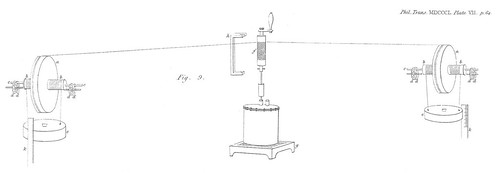
Joule's diagram of his experiment
There is nothing terribly sophisticated about the experiment but the wonder of it is in the heroic care Joule took to control and correct his measurements.
He engineered the apparatus to reduce the friction of any moving parts and fixed it on a wooden mount designed with as few points of contact as possible, so that any loss of heat through conduction would be minimised.
He shielded the apparatus from his own body heat with a large wooden screen but even so, took care to do controls in which he went through the entire motions of performing the experiment but without moving the weights or the paddle, and measured the resulting temperature rise (which averaged at a minuscule 0.012975 °F).
He measured the room temperature at the beginning and end of each experiment so that he could determine how any difference with the apparatus was affecting the results (this required a correction of -0.000832 °F).
He determined the net weight of the leaden discs (406152 grains (grs.) — or 26.318 kg) by subtracting the frictional resistance of the pulley wheels of the apparatus, which he measured to be equivalent to a weight of 2837 grs, an adjustment of 0.7%.
He measured the speed of the falling weights, which dropped at 2.42 inches per second, and subtracted the kinetic energy of their motion from his determination of the total work (weight times height fallen) to find the work that had been expended only on heating. Effectively this entailed reducing the total distance dropped (1260.248 inches) by 0.152 of an inch.
He repeated the experiment and each control run forty times.
And then he did it all again.
But the second time he used mercury as the frictional fluid instead of water. This alteration required an additional step in which the vessel containing the mercury was immersed in water immediately upon completion of the twenty drops of the weights so that the heat accumulated could be measured by its effect on water. The mercury experiment, each time accompanied by a control run, was repeated twenty times.
And then he did it all again.
This last time he mimicked Rumford by having the falling weights turn one disk of cast iron against another, while immersed in mercury. As previously, the whole apparatus was dunked in water at the end of each run to measure the heating effect of the friction. This was repeated, with controls, a sum total of ten times.
By three different experiments, using three different media — water, mercury and iron — Joule found the heating effect of the work done by the falling weights to be the same value to within less than one half of one percent. Consideration of the process and number of repetitions of each experiment persuaded Joule that the trials performed with water had provided the most accurate determination and so he concluded:
“That the quantity of heat capable of increasing the temperature of a pound of water by 1° FAHR., requires for its evolution the expenditure of a mechanical force represented by the fall of 772 lbs. through the space of one foot.”***
The conclusion is prosaic, almost cumbersome. But through imagination, through meticulous care, through long, repetitious hours in the laboratory Joule pulled an idea out of the ether and gave it the substance to overcome the prejudices of men.
Thus did the first law of thermodynamics, which had actually first been enunciated by Mayer in the early 1840’s but then resisted by many in the scientific community, even in the wake of the early reports of Joule’s experiments, make its tortuous entry into the scientific mainstream. Mayer’s rendition — let me give him the last word — is indistinguishable from the modern equivalent: “Energy can neither be created nor destroyed.”
Our scientific understanding, in contrast, most definitely has to be created.
Footnotes and Bibliography:
*The 1850 paper by Joule is in fact a recapitulation of a series of experiments that had started in several years previously; his initial results were first published in the Manchester Courier, which was an unusual destination even at that time.
**Joule’s words on Mayer appear to be especially carefully chosen, probably because his 1850 paper was written after the dispute with the German physician and physicist had erupted. He writes, “The first mention, so far as I am aware, of experiments in which the evolution of heat from fluid friction is asserted, was in 1842 by M. MAYER, who states that he has raised the temperature of water from 12°C to 13°C., by agitating it, without however indicating the quantity of force employed, or the precautions taken to secure a correct result.” I haven’t been able to get hold of Mayer’s paper (published in Comptes Rendus, t. 25, p. 421) but suspect there is some justification for Joule underscoring the point about the need for scientists to report the details of their experiments.
***The result obtained by Joule is within one percent of the modern value.
See also: Science, A History 1543-2001, John Gribbin (Penguin Books), p382-388.