The first is to alert you to a little update of my last poston the Sense about Science demonstration outside the Department of Health to raise awareness about their lax proposals for the regulation of traditional medicine. The protest passed off successfully on Wednesday and there are now photos of the event available on flickr.
The second is to flag up the lovely new banner that I have spread across the top of my blog thanks to the recent implementation of this feature. I put this up on Wednesday and nobody said a thing. I am disappointed in each and every one of you. ;-p
Third, and most importantly, I wanted to direct you to this piece on The Guardian site that I have co-written with Dr Evan Harris. It is our analysis of that now infamous 45% figure of supposedly non-excellent science that Business Secretary Vince Cable bandied about so wantonly in a radio interview on Wednesday morning. We ask Mr Cable to revise his careless estimate of UK science.
I was only able to attend the second day of Science Online London 2010 but was glad to be able to hear Dr Evan Harris’s keynote talk on “Turning online science into real world policy change” and the follow-up break-out session on “The Sci Vote Movement”. Any gathering of the blognoscenti runs the risk of descending into navel-gazing, so it was good to be reminded that the point of much of our online activity as bloggers or scientists should be to have some impact in the real world.
Of course for many people there are robust connections between these two spheres. Indeed, my own experiences of being involved in supporting Simon Singh as he sought to defend himself against the BCA libel suit brought home to me how valuable online access was to propelling real-life activity — and activism.
Singh got into hot water by questioning the evidence base for chiropractic, only one of a plethora of alternative medicine therapies that are on offer to the British public, often accompanied by exaggerated claims of efficacy. His Trick or Treatment book, co-authored with Dr Edzard Ernst, is a good place to find out about the paucity of the evidence for not only chiropractic*, but also acupuncture, homeopathy and reflexology, among many others.
Another thing that these alternative practices have in common is the desire for the veneer of ‘approval’ that may be conferred by the establishment of official regulation. In the UK, unfortunately, the Department of Health is too often happy to play along and is now proposing to set up a professional registration scheme for practitioners of traditional medicine.
You might think that this would involve screening the practitioners for the quality of their treatments.
You might think –as an unsuspecting member of the public — that registration means practitioners are on a par with members of the medical profession.
You might think that the top priority of the Department of Health would be the health and treatment of illness of the UK population.
But you would be wrong because the registration process makes no test of the efficacy of the treatments offered by traditional medicines. It is enough for them to be traditional.
As a practitioner it is enough, therefore, to be an old wife with a tale.
To highlight the lunacy of these proposals (see here [pdf] for more details), the Voice of Young Science (VoYS – @ voiceofyoungsci) is planning to protest outside the Department of Health from 11:30 am on Wednesday of this week (8th Sept). Evan Harris alluded to it briefly in his talk yesterday. If you can, please go along to participate. If you have an old wives’ tale of how to treat blisters or nettle stings, or you know what happens if you don’t eat your potato skins, you will qualify for the award — on the spot — of a prestigious Diploma in Old WIves’ Traditional Medicine. The assessment only takes 2 minutes. Go on: you know you deserve it.
The scheme is targeted at acupuncture, herbal medicine, traditional Chinese medicine and other traditional medicine systems. The ultimate aim of the protest is not to denigrate these traditions, but to hold them to the same standards as modern evidence-based medicine. And to point out to the Department of Health that the British public deserves better than veneer. It deserves substance.
Update: Fri 10th Sept, 08:15 am: The protest event passed off successfully on Wednesday last (though unfortunately I couldn’t make it because of work commitments). Photos are now available on flickr.
*At the time of writing, you can download the chapter on chiropractic for free.
Some of you may not have heard of last week’s launch of a new science blogging site by the Guardian newspaper.
They have a core group of regular bloggers — Jon Butterworth, Dr Evan Harris, Martin Robbins and NN’s own Grrlscientist — who between them will be covering good science, bad science and science policy. It’s yet another bright addition to the rapidly changing firmament that is today’s blogosphere.
As part of a festival to mark the launch of the new site several other bloggers were asked to write pieces and I was delighted to be offered the chance to contribute. I’m a bit late with the notification — a wedding and the #solo10 conference intervened — but on Friday they posted my starry eyed account of my summer telescopery.
Update (3:20 pm): Errant link now fixed!
Posted inAstronomy|Comments Off on Guardian of Science
“I’ve seen things you people wouldn’t believe,” the dying replicant Roy says of his off-world experiences in one of the final scenes of BladeRunner. As a structural biologist I often feel I could say the same thing, all the more so now that I have read David Goodsell’s “The Machinery of Life”.
This is a wonderful book that gives fascinating and wide-ranging insights into the molecular components that work together to give us and other organisms the gift of life. The text is clear, accessible and provides a good lay introduction to biology at the molecular level inside and outside the cell. But what makes this book special are the pictures. They are sumptuous.
Wide and close-up views of molecular crowding within a bacterial cell. The blue molecules are protein enzymes. Water molecules (cyan) appear almost triangular. (No place here for homeopathic ‘memory’).
Goodsell, a structural biologist at the Scripps Research Institute in California, has set himself the task of providing a realistic representation of the molecular landscapes within living organisms, a vista that is beneath our everyday sight because of the extremely small size of the components. He has fused his scientific and artistic abilities to generate the stunning images that are generously scattered throughout his book. In every case he has drawn on the latest research (the 2nd edition that I read was published in 2009 and is a significant update of the 1993 original) and endeavoured to render the molecules of life with the appropriate shape, size and number in the various compartments of living organisms — the nuclear and cytoplasmic environments within cells and the blood and tissue fluids that surround them. He has been careful to use the same scale throughout for these intracellular and extracellular panoramas so that the images in the book can be compared.
When it comes to molecular structure, I’m a pro. I spend my days peering at the byzantine architecture of proteins and RNA. I know my amino acids from my nucleic acids, my main-chains from my side-chains and can tell at a glance if molecular interactions are hydrophobic or hydrogen bonded. But my focus is usually mechanistic and tied to one or two molecules at a time. How does this protease work? How does that fatty acid molecule stick to albumin (shown below). But even if my stated ambition is to take a holistic view of biology, the day job too often reduces me to, well, a reductionist.
Human serum albumin (HSA) with a cargo of fatty acid molecules (yellow). The protein colours indicate the three similar domains within the protein. From the crystal structure.
That is no bad thing when you are trying to figure out a mechanism, to pull apart the nuts and the bolts to see how the molecule actually works. But I have to remind myself every now and then to climb out of the tunnels dug into the details of the handful of molecules that my group investigates to have a look around at the wider picture. With Goodsell’s book on my shelf that will now be a lot easier. The views that he offers are beautiful, amazing and mind-bogglingly complex; they offer the best picture we have of the molecular context of the biochemistry of life.
I spent quite some time just poring over the pictures in this book, absorbing the detail. I am glad that Goodsell decided to label his images only very sparsely, so that the view of the crowded cell is not cluttered with artificial words. The variety is wonderful. I gazed at the innards of cell nuclei, the fibres of muscle cells, the synaptic connections between nerve cells, the seemingly innocuous scene of poliovirus penetrating and killing a cell. Strangely, the detail is almost unnerving. I know I biology works, but how can all those molecules possibly manage to find one another and work together in such fantastically complicated environments!?!
Childishly, the experience reminded me of losing myself in the lovingly detailed illustrations in Richard Scarry’s Busytown books. Remember those? I hope that the charm and richly colourful detail of the Goodsell’s pictures might ensnare the non-specialist reader in the wonders of molecular biology.
A human B cell releases a packet (green) of antibody molecules (tan, Y-shaped) into the blood serum on the right of the image. HSA molecules appear as pale green triangles in the serum.
If I were overly artistic in my pretensions I would say that Goodsell is exploring the space between science and the imagination with his illustrations. But I am plainer speaking and contend that there is no space between them–the overlap is too great. Goodsell’s artistic book is simply a wonderful exemplar of the power of scientific imagination.
Though he has worked hard to root his images in established facts, Goodsell is careful to acknowledge their limitations. The structures of many molecules are still only vaguely known and our knowledge of the concentrations and cellular distributions of others is incomplete. So there is some risk in presenting these images since pictures can have a power beyond words. But I am quite happy to live with that and am grateful to Goodsell for his vision and industry.
Goodsell has generously made his illustrations available for anyone wishing to them in personal presentations. Posters and some funky looking models can be purchased here.
Ian Sample’s _Massive – The Hunt for the God Particle_ is a fast-paced account of the quest for the Higgs boson, an elusive particle that is purported to solve the mystery of mass.
If you were unaware that the question of mass was the least bit mysterious, you are in good company–with about 99.99% of the population of the planet for whom the matter of matter has never arisen. I confess I haven’t considered it myself in any depth, even though I am the proud owner of a degree in Physics. My degree is a bit rusted now, having sat neglected in a far corner of my mind for several years. Even when it was freshly installed back in the mid-1980s I don’t remember being much troubled by the question of mass. I did get an introduction to particle physics, but the field seemed such a jumbled mess of exotic entities hopping in and out of existence that I never quite managed to get a firm grasp.
As a result, my attention wandered elsewhere. But who could have escaped the brouhaha in recent years–both positive and negative–surrounding the inception of Cern’s Large Hadron Collider (LHC), now installed in the 27 km ring that straddles the French-Swiss border at the foot of the white-capped Jura? The papers have been full of it, perhaps surprisingly given the arcane nature of the business of particle physics. Sample’s book is a timely attempt to put the genesis of the LHC and the meaning of its high-profile search for the Higgs boson into context.
It’s an entertaining and breathless read: Sample whizzes through the story, tracking the progress from Higgs’ first inkling of an idea back in the early sixties right up to the present day, which sees the particle physics community poised on the verge of discovery, waiting to see if the Higgs’ boson–the eponymous ‘God particle’–will finally flash into existence as the LHC is ramped up to full power.
The story is a deft mix of particles and personalities and the concoction is highly energetic. Sample weaves in and out of basic explanations of the esoteric Higgs field, covering both the ideas that engendered it and those that have grown up in its wake. He takes the reader into the core of the science, guiding with an assured but necessarily light touch. You won’t come away from the book with a deep understanding of the prosaically named ‘standard model’–physicists’ best theory of the composition of matter, a jigsaw puzzle of particles of which the Higgs’ boson is one of the last pieces–because the topic is too abstruse for mere words and demands mathematical capabilities that are beyond most readers, including this one. But the book nevertheless provides a fascinating glimpse beneath the surface of our ordinary reality to a world where men and women spend their lives unravelling complexities in Nature that are inapparent to most of us, except when we stop to wonder, to ask that most basic of questions: where did all this stuff come from?
_Massive_ is as much about the scientists as their science–whose interactions can seem as complex as those between the particles that they strive to uncover. For example, Higgs is far from being the only major figure in this story. As Sample makes clear, there were five other scientists, working in two teams–Brout and Englert, and Guralnik, Hagen and Kibble*–who came up with very similar theories of mass and have a claim, sometimes indignantly asserted, to the boson that, due to accidents of time and place, was named after Higgs.
These six are only some of the theorists who feature in the story. But just as influential are the experimentalists who drove the construction of the great particle accelerators at Fermilab in the US and Cern in Europe that have competed fiercely in the hunt for the Higgs boson. If anything, tensions between experimental scientists seem to have been more keenly felt down through the years as they fought for advantage and the priority of discovery that might secure a Nobel prize.
Sample’s tale bounces between the personalities and the tremendous technical difficulties involved in bringing these gigantic machines to life or, in the case of the doomed superconducting supercollider, to a much regretted still-birth. One of the strangest but, for me, most enjoyable chapters considers the dangers of smashing particles together at what are, for humans, unprecedented energies. The risks of creating an earth-devouring black hole–already played out vociferously in the media–are treated in thoughtful, if bizarre, detail. It is an odd account of hypothetical stranglets and the chilling prospect of _universe-destroying_ vacuum decay, but one that throws up some fascinating insights into mutual mis-understanding between scientists and the public.
The speed of the story makes for an exhilarating ride, but is sometimes bought at the expense of tantalising detail. Tastes will vary but on occasion I would have liked Sample to dally a while longer among the rivalrous particle physicists. I wanted to hear more about the maverick scientist and welder Robert Wilson, whose star waxed and waned at Fermilab. I wanted more of the dirt on Carlo Rubbia: just how did he get away with casually mis-directing Pierre Darriulat’s team–who were working towards the same goal on a different detector at Cern–and so secure the accolade of being the first to publish on the discovery of the W boson?
But it is the perhaps the mark of a good science story that it awakens so many questions. I am intrigued. And not only by the strange interactions between the cast of theorists, experimentalists and engineers behind the international quest for the most invisible fragments of the universe. The dormant physicist in me has been stirred to life by Sample’s lively, accelerated tale. As far as I am concerned, this certainly isn’t the end of the matter.
*Co-incidentally, Tom Kibble taught me the rudiments of mechanics in my first year of Physics at Imperial College. I had no idea of his research interests in this area.
But having been at the Edinburgh Fringe for a few days now, I’m wondering if he might have had a point. We are here for a week of our holidays, thanks to the demands of our comedy-loving children, who have expertly dictated our program of shows–there’s not a been single dud so far (well, almost*).
However, not wanting to be entirely at the beck and call of my children, I have steered us to a couple of the more science-themed offerings. On Monday we rolled up, at the alarmingly early time of 11:25 am to Your Days are Numbered: the Maths of Death, an entertaining romp through the probability and statistics of mortality by Matt Parker (@standupmaths) and Timandra Harkness. Fact: you are certain to meet death one day but (at least in the UK) this will not involve sharks.
The show was very funny and, in a strange way–by rubbing our noses in the numerology of ephemerality–really quite life-affirming.
The Edinburgh Fringe – not entirely what we were expecting.
I had the same feeling yesterday, at the slightly more respectable time of 12:10 pm, during Robin Ince’s Carl Sagan is still my God. Despite the ironic title and his opening poke at Jenkins’ science-bashing journalism, Ince’s show was very much about imparting a sense of the glory of the very existence of the universe and of the ineffable fact of our evolution to consciousness within it.
He read from works by Feynman and Sagan, clearly and rightly enthralled by the power of their curiosity and the lucidity of their thinking, and very much wanting to share that with the audience. I should add that the readings were linked with plenty of witty banter–this is a comedy festival after all and Ince is a superb comedian (his Laurel and Hardy impressions were particularly impressive)–but there was a certain proselytising energy about the performance.
Which is no bad thing.
Even at Richard Herring’s show, Christ on a Bike, squarely aimed to pull humour out of the contradictions of biblical writing and religious teaching (much of it at the expense of his religious parents), there was an unexpected proselytising twist. Herring had no qualms about shocking his audience with his material (I confess to squirming in my seat beside my kids on one or two occasions) but at the end, after he’d had his fun, his tone became almost reverential. Hilariously and raunchily iconoclastic it may have been, but underlying the performance was a thoughtful, almost respectful, consideration of the charitable precepts of Christianity. Herring’s clearly a bit of a thinker.
Of course there’s nothing in what Jenkins says about science being a religion – his argument was just gratuitous opinion-piece fodder. But science as a way of life, of looking at the world–well, there could be something in that. If our experience of Edinburgh is anything to go by, it seems to be gaining in popularity.
*Sorry to say that Dyslexia, The Musical, while not lacking in energy was a bit too much of a pantomime for my tastes. Other non-scientific hits were Delete the Banjax, The Penny Dreadfuls and the utterly, utterly brilliant Tripod vs The Dragons (warning: extremely nerdy).
Walter Clement Noel was famous in the wrong circles for the wrong reasons. He died in Grenada in 1916 aged just 32.
Over fifty years later, in the first decade of my life, Chitty Chitty Bang Bang was far and away my favourite film. I must have seen it six or seven times, a huge tally in the days before VCRs and DVDs. The magical tale of endangered children rescued with the help of a flying car captivated my boyish mind. I was entranced too by the outlandish inventions of the children’s father, Caractacus Potts–played by Dick van Dyke–and especially by the ingenious contraption of wheels, rails, levers and cords that he devised to cook and serve up sausages and eggs for breakfast.
I remember lying awake at night trying to figure out how to concoct a similar mechanism to hoist the books and toys from the shelves at the far side of my room without having to get out of bed.
Here comes breakfast.
But I never managed to figure out how to do it. Years passed and I grew up. When that happens, you are supposed to put away childish things. But I became a scientist.
I became a scientist because in my final year as a physics undergraduate I attended lectures in biophysics and learned about a device that is stranger and more complex than anything dreamed up by Caractacus Potts: a protein called haemoglobin.
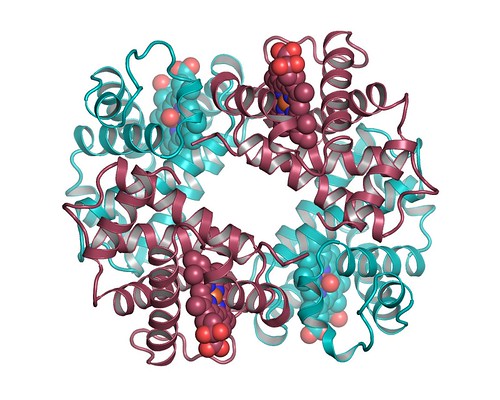
The red blood cells that give your blood its colour do so because they are stuffed with haemoglobin, a molecule made up of four protein chains (two α and two β, shown in red and cyan in my figures)–each of which folds into a sub-unit that grips an iron-bearing haem group. The complex assembly of haemoglobin allows the four haem groups to snag four molecules of oxygen when the blood traverses the capillaries threaded through the lungs. Haemoglobin slowly releases these molecules as the blood circulates through the body, thereby providing every cell with the oxygen needed to burn the fuel that energises life.
Unfortunately for Walter Clement Noel, it was a defect in his haemoglobin molecules that probably took his life away.
To this day the story of haemoglobin is taught in biophysics courses because it was one of the very first proteins to be studied by protein crystallography, a technique in which the scattering of X-rays into myriad beams by crystals made of pure protein is interpreted mathematically to reveal the molecular architecture in exquisite detail. In the case of haemoglobin, which is constructed from over four thousand atoms (1), this architecture is astonishingly complex.
Need oxygen? You’ll want lots of these. A hugely simplified view of haemoglobin. The atoms of the haem groups are shown as spheres.
The structure of haemoglobin was published in 1959, but the effort to determine it had begun more than twenty years earlier in 1936 when Max Perutz, a diminutive Austrian Jew, paid a visit to his cousin’s husband (2).
Perutz had gone to England to escape anti-semitic persecution and to pursue his studies in organic chemistry, and found himself under the supervision of Desmond Bernal, a colourful Irish scientist who was pioneering the development of X-ray crystallography. Guided by Bernal, the young Austrian became interested in using crystallography to elucidate the molecular structures of organic chemicals. He thought could see a gap in the market–no-one had attempted to determine the structure of haem, the organic molecule at the core of haemoglobin–and, excited by this prospect, used his family connection to set up a meeting with Felix Haurowitz, a biochemist who worked on haemoglobin in Prague.
But Haurowitz was unimpressed. Haem had been synthesised some years before, so the chemical formula was known and the structure would not add much new information. Instead he encouraged Perutz to go after the structure of the whole haemoglobin molecule. At the time, this was a monumental proposal–the techniques did not exist to tackle a structure containing a hundred atoms, never mind one composed of several thousand.
That didn’t seem to matter–Perutz was inspired. And fortunately perhaps, he was also young enough and naive enough to think the project feasible. He knew Bernal was keen to work on proteins and had recently developed methods for recording high quality X-ray diffraction patterns from protein crystals, which are much more delicate than the crystals of organic molecules that chemists were used to handling. Haurowitz could also offer immediate encouragement since he himself had grown crystals of haemoglobin, taking his cue from the work of two American chemists, Edward Reichert and Amos Brown.
Haemoglobin had first been crystallised in the nineteenth century but Reichert and Brown, working at a near-industrial scale, published a monograph in 1909 containing over 600 photographs of crystals grown from haemoglobin purified from 109 different species of animal. Though it was too early to know anything of the structure of the protein molecules, since their work predated the X-ray diffraction analysis of crystalline matter, Reichert and Brown noted that variations in the shapes of the crystals of the haemoglobins could be correlated with the apparent relatedness of different animal species. Presciently, they reasoned that the variations in crystal shape probably reflected small differences in the haemoglobin molecules themselves and claimed it as molecular evidence–the first–for Darwin’s theory of evolution. But Reichert and Brown had nowhere to go with their observation since their work preceded by more than thirty years Oswald Avery’s determination that DNA–and not protein–is the material basis of genes and heredity.
At around the same time the Chicago physician James Herrick saw with his microscope the unusual distorted shapes of Walter Clement Noel’s red blood cells that were the cause of his painful anaemia. But he was unable to make any connection with structure of the resident haemoglobin. Like Reichert and Brown, in the absence of structural information, he had nowhere to go.
Back in Cambridge Perutz was not stuck. He soon learned how to grow crystals of haemoglobin but it would take more than twenty years of hard labour–interrupted by the war that saw him first interned as an enemy alien and then diverted to work on Habbakuk, a doomed scheme to build an aircraft carrier out of reinforced ice–before the structure of the protein finally emerged. In large part the difficulty was the one that was obvious from the beginning–the need to develop the methodology for extracting the structure of such a large molecule from crystalline X-ray diffraction patterns. In this endeavour Perutz experienced a moment of glittering genius: he predicted that the addition of heavy metal atoms–in his case, mercury–would produce small but measurable changes in the diffraction that could be used to solve the problem. But when the day came to test his idea there was no sense of a cold, scientific mind at work. Perutz suffered every particle of the excitement and fear that any of us senses when our hopes are pinned on the outcome of a crucial experiment:
”As I developed my first X-ray photograph of mercury haemoglobin, my mood altered between sanguine hopes of immediate success and desperate forebodings of all possible causes of failure. I was jubilant when the diffraction spots appears in exactly the same positions as in the mercury-free protein, but with slightly altered intensity, exactly as I had hoped.”
The structure that was finally published in 1959 was rather crude. It revealed just the outline form of the molecule and was at first something of a disappointment to Perutz. But over the next few years the full atomic structure of haemoglobin emerged from the murk of ignorance and was revealed to be a thing of glorious intricacy.
One could finally see exactly how the atoms of the protein chains curled into helices that wrapped around one another to give haemoglobin a shape that clasped onto each of the four haem groups. But more than that, comparison of structures solved with and without oxygen bound to the protein showed that haemoglobin is a moving molecular machine of great subtlety, one that is finely tuned to its oxygen-transport function.
The looping video above gives an idea of the contortions that haemoglobin undergoes as it binds and releases its life-giving cargo. Below you can have a closer view of the writhing and shifting of the atoms involved (3).
In a lecture theatre back in 1982 the realisation of the complexity contained within a single protein molecule produced a writhe and a shift in my mind and set me on the course that–albeit circuitously–made me a protein crystallographer. It has been boggling my mind ever since. I am still tickled by the intricacy of the mechanism, which is why I so much wanted to share it. I toiled longer than I care to admit to generate these morphing videos and, though I very much hope they show you something of the ‘life’ within just one protein, the motions shown are just an approximation (3) and the mechanical repetition of the looped animation hides the truer, stochastic nature of the molecular contortions. The scientist in me fears that I may be mis-leading you, but I’m taking that risk.
I’m not going to lay out the full explanation of how haemoglobin breathes and flexes as oxygen attaches to the centre of each haem group; this blogpost is already too much like a textbook. But as the oxygen binds to the iron atom in the centre of the haem group, that atom shifts and the whole plane of the haem flexes; the side-chain of a histidine amino acid in the protein that is bonded to the iron atom is pulled toward the haem, a movement that levers the helix containing the histidine to a new position.
In this way, because the helix extends to the interface with the adjacent sub-unit, there is communication from one part of the molecule to another. In this way haemoglobin senses when oxygen levels are high and responds by adjusting the conformation of its sub-units to increase its binding affinity.
Thus can haemoglobin morph into a high-affinity form as the blood cells pass through the oxygen-rich lungs and grab tightly onto four molecules of oxygen, its full complement. As the red cells travel to the extremities of the body the oxygen is slowly released. This in turn relaxes haemoglobin back to the low-affinity form, which enhances the discharge of oxygen, maximising the efficiency of transport.
But oxygen isn’t the only molecule to exert control over haemoglobin. The protein is also sensitive to the local carbon dioxide concentration, which is elevated in very active tissues. Carbon dioxide binds to and modifies the protein to further reduce its affinity for oxygen and induce additional release in those parts of the body where it is most needed. This is the Bohr effect, named for its discoverer Christian Bohr, the father of the more famous Niels, who laid the foundations of atomic theory and quantum mechanics.
And the layers of complexity don’t end there. Diphosphoglycerate (DPG) provides yet another means for our bodies to regulate oxygen binding to haemoglobin. The analysis of the structure shows that DPG binds to the crevice between the two β sub-units of the protein and drives it towards the low affinity state. Paradoxically, by reducing the affinity of haemoglobin for oxygen, DPG allows us to survive better a low oxygen levels, again by enhancing the release of bound oxygen in the deep recesses of the body. Mountaineers pausing to acclimatise to high altitudes are giving their bodies the time boost levels of DPG so that they can function in the thin atmosphere.
The sheer cleverness of the complex mechanism for transporting life-giving oxygen revealed by Perutz’s structural work makes me smile every time I think of it. But lest you should think that I am about to shade into acquiescence to any kind of intelligent design, let me tell you about a darker side to haemoglobin.
For the structure of the protein also explains exactly how a mutation in Walter Clement Noel’s gene for the haemoglobin β-chain that changed just one amino acid–at position 6 in the chain–was sufficient to cause the painful anaemia that plagued his life and very probably led to his early death.
That mutation replaces the water-loving OH side-chain of a Serine amino acid with a somewhat stickier Valine side-chain that prefers to be shielded from water. The structure shows that the Valine side-chain can fit snugly into a sticky pocket on the surface of the β-chain on another haemoglobin molecule that becomes exposed in its deoxygenated form. But because each haemoglobin molecule has two β-chains, this interaction can daisy-chain, leading to the formation of long fibrils of haemoglobin, especially deep within the body where the molecules are more likely to have dumped their oxygen cargo. These fibrils bundle into fibres long enough and strong enough to distend the red blood cells into the unusual crescent or sickle shape that Herrick could see in his microscope.
(The figure at left shows a small section from a haemoglobin fibril. The atoms of the valine side-chains that stabilise the fibril like the teeth of a zip are shown as orange spheres).
Healthy red blood cells have a dimpled discoid shape and slip easily, often in single-file, through the finest capillaries of the body. But sickled cells get stuck, causing painful blockages–especially in active tissues that are depleted of oxygen. The distorted cells are usually eliminated by the spleen, leading to the anaemia that Noel suffered from.
This sickle cell anaemia is most common in people–like the West Indian Noel–who originate from central Africa, where it was better known by different appellations. The incidence is surprisingly high (about 0.2% among African Americans, but probably higher in Africa) for an inherited disease that leads to an early death. Why should a mutation that causes such a debilitating disease persist in the human population?
Bluntly, brutally, Walter Clement Noel suffered debilitating anaemia because it was a price he had to pay so that others could be resistant to the scourge of malaria. Noel was unlucky because both copies of his haemoglobin β-chains carried the sickling mutation, making him particularly vulnerable to the distortion of his red blood cells and the painful symptoms that ensued. In his case unfortunately, the ‘cure’ was worse than risking malarial infection from mosquito bites.
But in individuals with a single copy of the defective haemoglobin chain, the sickling occurs only very rarely–they live essentially disease-free (4)–but it is induced if their red blood cells become infected with the malarial parasite. The infected cells therefore tend to sickle and this aids elimination of the infection, although the mechanism is not properly understood: the parasite may be eliminated along with the distended red cells in the spleen or the haemoglobin fibres may simply make the cell too leaky for it to replicate. Whatever the precise mechanism, the mutation provides an important advantage in populations exposed to the threat of malaria.
But not everyone is protected. The demise of Walter Clement Noel from complications arising from sickle cell anaemia tells us is that evolution is a pitiless force of nature; it looks only to the good of populations and cares nothing for individuals.
Noel’s tragedy is all the more acute because he probably had a perfectly serviceable replacement for the defective β-globin chains within him: the γ-globin chains that he had used as a foetus growing within his mother’s uterus. The foetus doesn’t breathe air but instead must extract oxygen from the maternal blood flowing through the placenta. To do this, the β-globin gene is inactive at the foetal stage and haemoglobin is instead formed by pairing two α and two γ-chains, which gives it the increased affinity needed to compete for oxygen with its mother’s blood. But once the child is born, expression of the γ-chain is turned off just as the gene for the β-chain is activated. A solution for Walter Clement Noel would have been to reverse this transition, but there was no way to do that back in 1910 (5).
The problem of the genetic control of haemoglobin α, β and γ-chains was discussed at the First Global Congress on Sickle Cell Disease, held this year in Ghana to mark the centenary of the publication of Herrick’s famous paper. New insights into the factors that regulate these genes promise to open fresh avenues in the search for therapeutics. But progress is slow–connections between observations are not so readily made–and fully effective treatments have yet to be developed. It was my reading the report of the meeting a couple of weeks ago in Science that triggered the recollections that loop through this blogpost. Unfortunately the report also makes clear that after one hundred years of work on this–the first molecular disease–people are still suffering and dying.
(3) The animations are morphs between the two known structures of haemoglobin with and without oxygen bound (PDB codes 2dn1 and 2dn2 respectively) and were made with eMovie. It is not a physically exact representation of how the conformational change is achieved but it is probably a reasonable estimate. Sharp-eyed readers will see that I have omitted the iron atom in the centre of each haem group. This was necessary because the morphing program–for reasons that I couldn’t fathom–failed to deal with them in a reasonable way.
(4) However, people with a single faulty β-chain are advised not to climb to high altitudes or to otherwise expose themselves to low oxygen levels since this promotes the aggregation of their haemoglobin.
(5) Since 1995 hydroxyurea has been used to offer relief from painful sickle cell crises in some individuals; it appear to work in part by re-activating the foetal γ-chain gene.
I came across this today and found it quite remarkable. I’m not going to say anything more right now but, if you have a minute, test yourself with this short video.
I read an article by Matthew Reisz in Times Higher Education last week about the strained writing style of academic publications and it really got my goat.
Don’t get me wrong — it’s a good piece and makes some valid points, several of which resonated strongly with me. Reisz wonders at the lack of pleasure in academic writing among writers and readers, which leads to the inanimate style of much academic prose. He speculates that this is due to a lack of incentives for people to reach out beyond the walls of the academy — thereby automatically limiting their audience to an expert group — but is cautiously optimistic that the tendency towards inter-disciplinarity and funding agency drives for wider ‘impact’ may help to overcome that. He advocates a focus on good story-telling as an essential tool for drawing in a broader readership and criticises the academic style as needlessly obfuscatory. Reisz quotes approvingly from UEA’s Sarah Churchwell, a senior lecturer in American studies:
The measure of the intelligence of an article is not in the length of the words, but in the complexity of the argument.
Right on, Cowgirl.
But Reisz’s aim is not always so true. He misses the point of referencing, claiming that it too often interrupts the flow of an argument (thought this is the case with some formats) and is mainly done for show. He complains that there are insufficient outlets for academics to practise their non-specialist writing skills. Ironically, the author of an article that was posted online seems not to have heard of the internet — or blogging.
But what got my goat was that his eminently sensible contention that “The frequent costs of ‘academic tightness’ are lost readers and missed opportunities to participate in wider public debates“, was followed by this bombshell:
None of this may matter much in highly technical areas. Few people will care whether a paper on the minutiae of amino acids is written in snappy prose.
Come again? Perhaps you’d like to step outside Mr Reisz?
But I don’t actually want to get into an argument about Mr Reisz’s predilections for history or critical theory or his disregard of the molecular life sciences (which have profoundly affected the human story over the past 100 years). His remark stung, but on reflection it seemed more like a challenge, especially since I whole-heartedly approve of the push to make scientists engage with a wider audience.
I hadn’t considered any audience outside science when I was writing my first papers twenty years ago, in the afterglow of my PhD. But the world has changed a great deal since then. In the past few years there has been great pressure for more accessibility from the Open Access movement. In part this is driven by the consideration that free access for scientists is the most efficient way to use public money given for research. But it is also an acknowledgement of the the right of the public to see the results of the research that they pay for. However, it is no good letting people have access to scientific papers if the dry, technical style makes them unreadable.
I don’t think there is a ready solution to this conundrum since it would involve writing papers for two very different audiences. For sure we scientists could do more to eschew jargon and focus on the narrative structure of our reports from the coalface. But there is a trained tendency for precision and objectivity in scientific language. It is what we know. It is how we carefully describe the world. Added to that, we know that our peers — who will be charged with determining whether our manuscript is fit for publication — want us to cut to the essential details of the experiments and their results and don’t need the jargon explained to them. Little wonder then that any sense of the excitement is often drained from the account. The overuse of the word ‘interestingly’ is but part of the problem.
I had thought that blogging would improve the style of my scientific publications by giving more vigorous exercise to my writing muscle. I like the freedom. There are no prescriptions on format and, although I try to take some care over my sentence construction, I enjoy the relaxed style of the blog.
But in practice it has made little difference. As soon as I sit down to compose a scientific paper I can feel the strait-jacket of precision tightening around me. I know that much of my academic writing is stiff and dry. I tried once to loosen up — in a commentary piece where there is traditionally more freedom of expression — but my nerve failed me and before submission I edited the article to constrain its playfulness.
The difficulty is that careful description of a piece of scientific work requires constructing sentences built from details that, however ornate and fascinating, usually have to be scaffolded with the spars and planks of probability and qualification. There may well be a masterpiece of science underneath the cluttered prose, but like many a hapless tourist, the casual reader rarely gets a glimpse.
I’m sure I can do better and at least improve the reading experience of my scientific peers, but I doubt that my papers would be much more accessible to a more general reader. The gulf between these audiences is simply too wide. An acknowledgement of this can be found in every grant application form where there are separate sections for technical and lay summaries of the science in the proposal. But as a science blogger, I can also make a more effective effort to be heard outside the academy. Even with stories of the minutiae of amino acids.
This question of audiences came up at the Science Blogging Talkfest which was held last week at the Biochemistry Society in London and attended by the bright and the beautiful of the capital’s science bloggers. I went along too. Excellent accounts of the main issues covered (and not covered) in the proceedings have been written by Jon Butterworth, Noodlemaz and the ever-challenging Shane McCracken (one of the organisers of I’m a scientist). There were many points about engagement during the evening but I particularly appreciated Ed Yong’s telling tales from non-scientist readers who had been deeply affected by his science writing.
It would be good if more of us could achieve that sort of reach. I was pleased beyond measure on the night of the #talkfest when several people spoke warmly about my blogging. But gratifying as they were, those comments came from a fairly narrow audience. Of course it’s important to know that you are able to communicate with the scientific and scientifically engaged community, but I’m interested to find ways to do more. The thrill of contact with the wider audience of enthusiastic school students in the recent I’m a Scientist competition is with me still and I think I need another hit.
Or several.
Thousand.
To that end I’ve been thinking of writing more posts aimed at that broader audience. I don’t mean to change the subject matter of this blog — it will stick with the hurly-burly of doing science — but I will try to open the gates a little more.
I already have in mind an idea for a post on the story behind our latest paper on the enzymology of the 2C protein from foot-and-mouth disease virus. The first line reads:
It started with an innocuous question in a bar in the frozen, winter-dark town of Inari, a few points north of the Arctic Circle.
Yesterday morning I was at the Royal Institution to hear David Willetts, the UK Minister for Science, outline the new government’s policy on science.
His speech comes at a time when the government is issuing all sorts of warnings about the parlous state of the British economy. Every minister appears to be under instruction to soften up the populace for the economic pain that has to be inflicted in order to get UK plc back to reasonable health*.
But the Minister for Science has long had a reputation as a man of preternatural intelligence — he is widely, and perhaps even a little fondly, known as David ‘Two Brains’ Willetts — and he did not disappoint. He made some very interesting remarks on science policy. There have been several reports on the speech already, for example in New Scientist and The Guardian, but I wanted to give a scientist’s perspective.
First, of course, there were the ominous warnings about the massive size of the UK debt following the ravages of the credit crunch. Although the US, France and Germany have all recently boosted investment in science as part of a policy to re-ignite their economies, there is little prospect of this in the UK because we are significantly worse off. As Willetts put it:
“I recognise that countries like the US, Canada and France have reacted to recession by spending more on science. But their public finances are in much better shape than ours. The US government’s deficit as a percentage of GDP in 2009 was 10.2 per cent. Canada’s was two per cent, France’s six per cent, Germany’s 1.6 per cent. Ours was 11.1 per cent.”
That argument is not entirely convincing to me since the difference between US and UK deficits seems marginal. Willetts did not directly address the threat of a potential loss of scientific talent to North America.
However, I’m afraid I’m not equipped to tackle that argument in any detail, though it seems to me that we scientists need to take a much greater interest in this area. There is no doubt that governments of all hues are always going to want to see the economic impact of the public money that is spent on science and technology. The real debate is about how that impact is judged. I was at least encouraged that Willetts has a much more informed and sophisticated view of this issue than the erratic Simon Jenkins.
Willetts is quite naturally concerned about the return that the government gets for its spending on research but he seems to have a better understanding than his predecessor, Lord Paul Drayson (himself a very committed minister), of the value of blue-skies research. His commitment is not the least bit sentimental. While acknowledging the international esteem and national pride that derives from the UK’s share of Nobellists and its impressive contribution to influential scientific publications, Willetts denied that these factors were in themselves a sufficiently powerful economic argument for funding.
Impressively, he seemed to me to want to look beneath the superficial layer of headline successes to test the evidence for the real economic impact of a science base that is capable of delivering such scientific prowess.
As far as the economy goes, it may not really matter where scientific discoveries are made. The key for the success of UK plc is to be able to assimilate those discoveries and engineer them into new products and industries. But that is only likely to happen if there is a strong science base (which itself is likely to be contributing to leading-edge research) with good links with industry and business. Willetts acknowledged the success of some universities–including Imperial College–in reaping the harvest from their science through spin-out companies but cautioned that the spin-out model had perhaps been given too much credit as an engine of commercialisation. He suggested that the sausage factory model of university funding — money in, product out — had been oversold. In fact only about 3 percent of university income derives from spin-outs.
Willetts seems keen to explore other avenues. He spoke warmly of ‘clusters’ of universities and industry such as the ones at Dundee that have been successful in the life sciences and video-game software. He also talked of the need to ensure that the country was training sufficient engineers to be able to convert knowledge into technologies that sell.
In addition the Minister has been reading up on his science policy. He cited a discussion paper (pdf) by Jonathan Haskel and Gavin Wallis which reported strong evidence for market benefits from the public R&D spend on research councils (but not from civil or military research). In this context Willetts applauded the public (and charitable) investment in the Diamond Light Source synchrotron, a facility I have used myself and one which provides a valuable but otherwise unaffordable resource for the aerospace and pharmaceutical industries.
How these approving words will be transformed into government action remains to be seen, though Willetts made a good start by announcing the postponement of the Research Excellence Framework, the government’s mechanism for measuring university performance, the philosophy and methodology of which has been heavily criticised. Perhaps I was caught up in the excitement of hearing the speech live, but I am glad to have Willetts on the side science as he prepares to do battle with the Treasury mandarins.
Willetts’ mature and knowledgeable approach to science will hopefully reach into other areas of public policy. While the previous Labour government significantly boosted investment in science, its record on incorporating scientific evidence into policy making was spotty at best. Willetts sounded a more hopeful note in this direction:
“More broadly, as society becomes more diverse and cultural traditions increasingly fractured, I see the scientific way of thinking – empiricism – becoming more and more important for binding us together. Increasingly, we have to abide by John Rawls’s standard for public reason – justifying a particular position by arguments that people from different moral or political backgrounds can accept. And coalition, I believe, is good for government and for science, given the premium now attached to reason and evidence. We have already offered a science induction for new MPs, and ensured that the principles of scientific advice to government are referred to in the new ministerial code. In addition the Government’s Chief Scientific Adviser, Sir John Beddington, has updated his guidelines on the use of scientific and engineering advice in policy making.”
He also spoke of the importance of the social sciences in bringing an evidence-based approach to the understanding of human behaviour which is of course crucial to the formulation of policy in a broad range of areas, including control of drug use, criminal justice, education and welfare.
I was particularly pleased to hear an acknowledgement of the need for reform of the libel laws of England and Wales:
“We cannot… have writers facing libel charges because they offer a scientific critique of other people’s claims. This is an issue which I have raised with Ken Clarke, the Lord Chancellor, and which his department recognizes they must address.”
After the end of the speech I managed to catch up with him to ask precisely what the government’s plans were in that regard and was told, encouragingly if somewhat elliptically, to expect an announcement from the Ministry of Justice ‘very soon’. As it turned out, I didn’t have long to wait because yesterday afternoon the government declared its intention to bring forward a defamation bill next year. This is good news, not least because it is a very positive response to the concerns of the scientific community about the chilling effect of libel law on our freedom to discus and criticise in the public domain any matters relating to science.
So I left the Royal Institution with a smile on my face. Given the circumstances, Willetts had said much that was heartening to a beleaguered scientist.
But the heat from warm words needs to be sustained during the tortuous process of forming detailed policies if it is not to dissipate into a hollow bitterness. Once the glow of my very brief encounter with the minister had faded, I recalled the tenor of the conversations I have been having with my scientific colleagues up and down the country in the past several months. No-one I know is looking forward to the future with much optimism. Funding cuts and redundancies are at the forefront of all our minds — and are already a harsh reality for some. There’s a long, hard winter to be borne before we can taste anything like spring again.
Willetts’ words will only be proved to have any worth if they can survive the freeze and help to nurture the re-growth of a healthy body of UK science.
*If anyone can explain to me how we got sick in the first place, I’d be much obliged.
Many of you will already have seen this because I have been promoting it shamelessly on twitter. But this is the video of the talk I mentioned in a post back in March that my daughter Eleanor gave on a topic she feels passionately about: corduroy.
If you listen, you will hear that Jenkins defends his article by re-writing it in his head. He shifts to the more serious point (not articulated in the written version) that science and scientists need to make their case for funding. As if that were news.
Jenkins also takes a rather narrow view of what he considers to be worthwhile research. Work on Alzheimer’s disease is good but he is less impressed by cancer research for some reason and more dubious still of blue-skies or fundamental work such as that going on at the LHC.
There is a serious debate to be had here. I wonder if Jenkins is really prepared to engage with it properly. There is much to ponder but for now I will state my position with words from Pasteur:
In a dramatic move today, the Government responded to an unprovoked attack on scientists from Guardian writer Simon Jenkins by announcing radical new priorities for UK science.
Revealing the policy shift, science minister David Willetts said*, “We have to re-purpose the scientific effort of the country to address the urgent problem of recovering the missing half of Simon Jenkins’ arse.”
“I will also contribute personally to the project,” continued Willetts, “by devoting one of my two brains to the search.”
Jenkins expressed huge relief at the news. “I simply can’t function without it,” wailed the benighted opinion-dealer*. “I love science and sciency stuff. I really do. I am totally awesomised by the wondrous wonder of it all. But every time I try to write about it, I come out with this half-arsed crap. I mean, look at what I wrote last week. Just look at it. Complete twaddle!”
When asked for comment, Lord Rees, the outgoing President of the Royal Society whose Reith Lectures were viciously and groundlessly attacked in Jenkins’ wayward article, said*, “He was very mean about my lectures. I thought they were quite good actually.”
Mark Walport, Director of the Wellcome Trust, announced that the Trust would be cancelling their investment in the planned UK Centre for Medical Research in order to re-direct funds to tackle the Government’s new scientific priority. “It may seem reckless,” he said*, “but Jenkins’ scientific half-arsedness is like a virulent cancer at the heart of our society. I know the problem may sound straightforward — all we need to do is to locate Jenkins’ left buttock — but it is technically very challenging. Though we suspect the half-arse to be quite big, we know from looking at his newspaper column that it became detached some time ago.”
Physicists speculate that Jenkins’ half arse may be source of anti-Dark Matter. Professor Stephen Hawking explained*, “In it’s absence the dark matter of the other buttock appears to overwhelm his grey matter, leaving the poor man incapable of rational thought.”
Ian Sample, Guardian science correspondent and author of Massive, a new book on particle physics, speculated* that the arse may also be location of a mysterious entity known as the Higgs bozo.
But Mark Henderson, science editor at the Times, sounded a note of caution*: “It may in fact be dangerous to re-unite the two buttocks because that could make Jenkins a complete arsehole.”
Police forces around the country will also be involved in the search for the missing buttock. When asked about Jenkins’ arse, a spokesman for the Metropolitan Police said*, ‘We are looking into it.’
*No he didn’t. (Libel Indemnity Clause: Please support ongoing efforts for reform of the Libel Laws of England and Wales)