Elsevier, the Research Works Act and Open Access: where to now?

If Elsevier calculated that its withdrawal of support for the Research Works Act (RWA) would neutralise the arguments stirred up around academic publishing, I think the company is mistaken. I certainly hope so.

Things may have gone a little quiet on this issue in the blogosphere since the removal of the immediate cause of irritation, but there remain good reasons to keep looking hard at the vexed state of academic publishing, in particular at the issue of open access, and to keep thinking about how things might be improved.

I’m sure I am not the only one who has had his eyes opened by this affair. Though I haven’t written on the topic for a couple of weeks, I have still been engaged with it. As a working scientist, the issue of publishing just keeps cropping up. Having been made aware of the problems — and some of the associated complexities — I want to try to get to the end of my thought processes, however convoluted the journey.

The past

Elsevier abandoned support for the RWA at the end of February but did so rather grudgingly. There was little acknowledgement of the boycott and so the withdrawal struck many commentators as a tactical retreat by a company that had little notion of enacting real change.

Elsevier’s move may have cooled the argument a little but it is by no means dead. For one thing the number of signatories of the Cost of Knowledge petition has continued to rise — at the time of writing it stands at over 8200. I suspect the embers of the argument are being kept warm by discussions in common rooms and offices around the country. The publisher’s support for the RWA has had something of akin to the Streisand effect: I’m sure more people than ever are aware of open access and thinking more clearly about what it means for them.

The present

I find myself thinking differently. It would be an exaggeration to say I had been radicalised but my determination to seek out open access avenues in publishing my work is stronger than ever. To give just one example, I was invited a week or so ago to contribute an article to a special review issue being put together by an Elsevier journal. I was pleased to be asked — such invitations are a nice acknowledgement of your expertise — and normally I would have agreed without hesitation.

But this time I paused for thought. As is common in such situations, I would be expected to write the review without payment but now I asked myself why I should contribute to Elsevier’s very hefty profit margins by writing for free an article that would be held behind a paywall. So I replied to the editor to say I would only accept the invitation if Elsevier agreed to make the resulting review article freely available. I added that I would consider my labour as payment of any ‘author processing charge’. Unfortunately, we were not able to come to terms so I will not be contributing. Three months ago the outcome of this invitation would have been different.

The decision in this case was relatively straight-forward. This would have been a single-author paper since none of my present group is working in the subject area of the review. It would have been a more difficult choice had there been scope to involve other members of the group — I have their careers to consider. Nevertheless, I think that in future I shall always test the open access options before considering invitations to write reviews.

The future

The issue of open access should remain prominent over the coming months. In the UK the topic will get a fresh airing when the government’s Finch committee, set up last year to examine open access, reports later this Spring.

Independently, the UK research councils (RCUK) are reviewing their open access policies and just last week published draft proposals (PDF – have a look, it’s only 6 sides). While these new proposals don’t go as far as the open access policy of the Wellcome Trust, they represent significant movement in the right direction. The key changes from the current stance are:

  • Specifically stating that Open Access includes unrestricted use of manual and automated text and data mining tools; and unrestricted reuse of content with proper attribution.
  • Requiring publication in journals that meet Research Council ‘standards’ for Open Access.
  • No support for publisher embargoes of longer than six months from the date of publication

There’s a nice summary of the draft document on the Nature News blog and an initial critique here.

In the proposals support remains for the hybrid model, allowing either Gold open access, where authors pay ‘author processing charges’ and the publisher makes the final formatted version freely available immediately, or Green open access where an author-formatted version of the paper is provided free via ‘subject-based or institutional repositories’.

There are residual problems with the proposals that I hope can be cleared up in the consultation period before the new RCUK policy is set in stone. Firstly, the draft proposals retain the dual funding model for payment of open access charges — they can be charged directly to the grant if publication is within its lifetime or from indirect costs (overheads) paid to the host institution. As I have written already, this complex system does not work in practice. It will take good will and organisation on the part of universities and funders to enact a system that provides proper support. If this is to involve negotiations with each institution, it would appear to undercut RCUK’s aim to find ‘more efficient and effective mechanisms to support Open Access’.

The second major problem is likely to be agreeing what constitutes an allowable repository for those authors trying to go down the Green open access route (which has the advantage of not incurring any charges). I ran into difficulty on this route with a recent paper (published in Structure, an Elsevier title) because the staff running my institutional repository at first thought that my agreement with Elsevier did not allow me to deposit the full text of the paper. Happily, an email to the publisher resolved the problem within a few days (please have a read), but I was left wondering how many other articles have not appeared in institutional repositories because of similar misunderstandings (to say nothing of institutional or authorial lethargy over deposition).

A subject-based repository would have been a far preferable option since it makes papers easier to find. However, I discovered that my publishing agreement with Elsevier explicitly restricted me to my institution’s repository. I was debarred from sending my version of the paper to UK PubMed Central.

This regulation hinders access to the literature and therefore undermines the whole purpose of open access. PubMed, the first port of call for anyone searching the biomedical literature, frequently links to publisher’s site but never to institutional repositories. An avid reader seeking out my recent paper would easily be directed to the journal site where, without the benefit of a subscription, they would have to pay Elsevier’s $31.50 charge for 24 hours access (not even for a permanent copy!*). Alternatively, the poor reader would have to guess that there might be a copy at Imperial and would then have to try to find our repository.

I hope it is obvious that fragmentation of the literature into institutional repositories cannot be a desirable long-term solution to open access. I would urge RCUK to look closely at this aspect of their draft policy and to push as hard as possible for subject-based repositories.

I’ll stop there. I’m sorry to harp on about this and have already gone on at length. But needs must.


*Thanks to Alicia Wise of Elsevier for pointing out that the 24 hr access allows you to download a permanent PDF. Apologies for any confusion caused.

Update (09:00, 22 Mar 2012): There is a report of the negative reaction of the Publishers’ Association to the RCUK draft proposals in the Times Higher Education today — hat-tip to Prof. Martin Humphries at Manchester University (@HumphriesPrsnl). This is to me a good sign that RCUK is pushing in the right direction.

Posted in Open Access, Scientific Life | Tagged , , , | 37 Comments

Libel Reform: the endgame?

It has been a long and winding road but tonight the journey towards libel reform in England and Wales paused in the historic Great Hall of the Inner Temple to take stock.

The wheels are turning and the machine of government is moving slowly in the right direction. The coalition came to power with a promise of reform. A parliamentary committee has met to consider the case for change and reported their findings last October. At the beginning of this month, the government responded.

Libelreform rally - Inner Temple, London  2012

Clockwise from top left: Lord McNally, David Allen Green, Tracey Brown, Sir Stephen Sedley


While the government’s response represents a significant step forward, it does not yet meet all the demands of the ongoing campaign. The specific remaining weaknesses identified by the campaign are as follows:

  • The current libel laws chill speech on matters of public interest and on expressions of opinion on matters in the public realm. We need a new effective statutory public interest defence. Instead, the Government is only proposing minor changes to an already complex, unwieldy and expensive defence, called “Reynolds Privilege”.
  • Libel laws are used by corporations and associations to squash any criticism and manage their brand. The laws need rebalancing to protect the ordinary individual or responsible publisher, by restricting the ability of such “non-natural persons” to sue for libel or threaten to do so.
  • The law allows trivial and vexatious claims. There should be easier “strike out” of trivial or inappropriate claims at an early stage.

Tonight supporters of the campaign assembled to reflect on how far we have come and to plan the strategy for the endgame.

Although the government appears engaged and Minister of Justice, Lord McNally, spoke encouragingly of the prospects for change, several speakers warned campaigners not to be too complacent. The signs are encouraging that plans for a new defamation bill will be included in the Queen’s speech in May of this year. But there is as yet no guarantee of that. Even if the bill is brought forward, it is not clear that sufficient parliamentary time will be awarded to the legislation to ensure that it gets onto the statute books.

In spite of the notes of caution, the meeting was infused with measured optimism. Lord McNally conceded that in its present form the draft legislation falls short of the reforms that the campaign has been seeking. But in a perceptive speech, David Allen Green saw advantages in this imperfection. If the bill had simply echoed the dream legislation of the campaign, he noted, that would be a signal that the government wasn’t taking it seriously. The residual imperfections can therefore be read as a sign of real intent. McNally also pointed out that the bill could yet be improved in its passage through parliament.

And just in case anyone was starting to think that libel reform was a battle for yesterday, given the successes of Simon Singh, Peter Wilmshurst and Hardeep Singh in challenging recent suits, there were potent reminders of the scale of the problem. Nick Cohen saluted the gathering but warned against group-think by supporters of reform. Pointing out that the libel laws in England and Wales make these countries the enemies of liberty, he also drew attention to the fact that the need for libel reform is not just for journalists because, in this modern age, anyone who writes on the Internet is at risk.

Then, astonishingly, Simon Singh, stepped up to the microphone and revealed that in 2010, as he was battling the suit brought against him by the British Chiropractic association, he received another threat of libel over remarks he had made about climate change. Thankfully in that case a stern rebuttal from his lawyer had seen off the threat.

But the threats remain. Simon Singh may have learned how to cope through bitter experience but the ease with which suits can be slung though the courts is terrifying — as is illustrated by the ongoing case of Vaughan Jones, sued for a book review.

If we are to clear a space in the public domain for proper and robust debate on all matters of real public interest, we urgently need to reform our libel laws. With continued pressure, parliament may soon have a once-in-a-generation chance to enact reform. But the job is not yet done — as Tracey Brown of Sense about Science reminded us in her closing remarks. You may yet be called upon to write to your MP and to play your part in history.

Posted in Libel Reform | Tagged | 5 Comments

The road well trodden

Scientists should do this. Journalists should do that. And eventually we will live in a world where the media reporting of science achieves perfection. At least that is the hypothesis.

The hypothesis was put to the test at the Royal Institution last night in a discussion organised by Alok Jha and chaired by Alice Bell. The speakers included Ananyo Bhattacharya and Chris Chambers, who had fired their opening salvoes on the Guardian’s web-site some weeks ago. Bhattacharya defended the rights of journalists, while Chambers initially countered that science and scientists are different and so should be accorded privileges in their dealings with reporters.

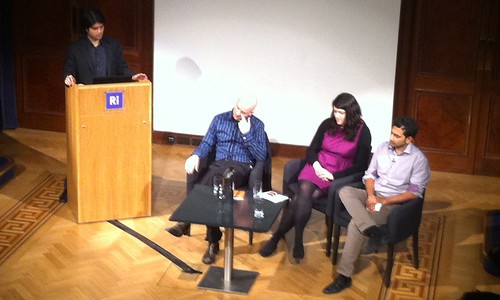
RI Science Media Debate

Chris Chambers wipes away a tear as Alok Jha emotes about science journalism

Before the two parties met last night, there had been some expansion and cooling of these divergent views, which took away much — though not all — of the heat of the debate. Fiona Fox of the Science Media Centre and Ed Yong, freelancer and blogger, injected some fresh thoughts and questions before the discussion was turned over to the audience. The whole proceedings were recorded on video and will, I hope, soon be available on the RI web-site.

I don’t wish to dwell too long on this topic. The interactions of scientists and journalists have been played and replayed too many times already. But I wanted to pick up on a couple of points.

First, science journalism in the UK has many strengths. It is by no means perfect but the very fact that scientists and journalists were prepared — again — to get together to discuss how they could help each other is testament to a certain rudeness of health.

So the gathering was healthy, but there were still a couple of emissions that disturbed my nose. The first came from Chris Chambers who proposed a ‘kite mark’, a quality stamp, for science reporting. I don’t see how such a vetting system is workable. The idea is fleshed out in more detail in Chambers’ submission (PDF) to the Leveson Inquiry. Good quality stories about a piece of research, goes the proposal, would derive from direct communication from the scientists involved, would be fact-checked by those scientists before publication, would provide a link to the original paper and — within a short period following publication — would allow the scientists to comment and respond.

There are some good elements here, in particular the need to link to the original paper (not a new idea), but overall this proposal seemed to have flown straight from cloud-cuckoo land. I agreed with Fiona Fox, who thought that journalists would look upon a kite-mark with all the relish they would have for a ‘cup of cold sick’.

During the ensuing discussion, Nicola Davis, a writer and researcher for the Times’ Eureka magazine, said that any journalist wanting to write up a science story should always read the original paper. There are some situations where this makes sense — a specialist reporter writing an in-depth article, for example — but the proposal seemed disconnected with the realities of journalists facing the pressure to file multiple stories per day. The notion may be workable for more accessible areas of science, evolutionary biology and drug trials perhaps (though see the work of Goldacre, B. on the latter topic), but discounts the conceptual difficulties of many areas of physics, chemistry and biology. Here I would rather see scientists stepping up to take greater charge of the content of press releases — and being ready to talk to journalists about their work.

There are no hard and fast rules governing interactions between scientists and journalists and no need for them. Contact is good; it will breed understanding on both sides and that in itself will enhance the accuracy of science reporting.

At the same time, the relationship should not get too cosy. The primary responsibility of good science reporters is not to science or scientists, but to their readers. Journalists need to challenge the science that they are reporting and, weirdly perhaps, I would go so far as to say that scientists need to help them do that.

And then we all went to the pub.


Posted in Science & Media | Tagged , , , | 13 Comments

Science: the bargain for funding

On the Guardian web-site today you will find a piece by myself and Imran Khan of CaSE which is a response to an attack on scientists for striking a faustian bargain with business.

Guardian Article


The attack was written by Ananyo Bhattacharya, who is the chief online editor for Nature and, funnily enough, a former PhD student of mine. We’re still good friends, by the way! The argument revolves largely around the impact of the impact agenda that the research councils have rolled out, presumably in response to demands from their — and our — political masters.

Ananyo was passionate in his contention that the pendulum has swung too far, that scientists have lost the sense of the deep worth of blue-skies research. Imran and I are circumspect about that. For sure, the impact agenda has perturbed the system. But in a democratic society, we argue that it is reasonable for scientists to take some account of political realities.

I’m unsure as yet how much clarification of the deeper issues has been made here. Our critique has already been criticised. I’m confident there is more common ground than a speed-reading of the two articles would suggest. Maybe this is just another one of those regular eruptions of the tension between public policy and the intrinsic values of science. I don’t know. But if there is a resolution to this debate, I would dearly like to find it.

Posted in Science, Science & Politics | Tagged , , , | 43 Comments

Some progress on Open Access

This morning there have been two very interesting developments on open access.

First, Doug Kell, Chief Executive of the BBSRC, responded on his blog to my open letter. His reply is detailed and goes some way to clarifying progress in the approaches that Research Councils will take to improve uptake of OA publishing options. I would encourage you to read it and respond.

He makes some encouraging noises, although I did not yet see any mention of a commitment to follow Wellcome in affirming “the principle that it is the intrinsic merit of the work, and not the title of the journal in which an author’s work is published, that should be considered in making funding decisions.” This would be an important component of any revised policy (as discussed in the comments beneath my last post).

And secondly, Elsevier have this morning announced they are withdrawing support for the Research Works Act. It remains to be seen what further steps the publisher will make to improve their commitment to open access modes of publishing but this is a positive and welcome step.


Update (21:42): This post was bashed out as a rapid response to this morning’s developments. The news about Elsevier’s abandonment of support for the RWA triggered  plenty of reaction around the blogosphere. It was widely welcomed but also seen largely as a tactical move rather than a change of heart. It is progress surely but, as several commenters have pointed out, does not yet represent a material change on the publisher’s OA policies. That will take sustained pressure.

The blogs on Elsevier’s announcement that caught my eye today were from: Cameron Neylon on Google+Gavia Libraria, the library loon, the irrepressible Mike Taylor and Bjorn Brembs,  and Michael Eisen, who exhorts people to pause briefly to celebrate the news but then to “get back to the trenches”.

Is it ironic to suggest that the very open access that allows such effective sharing of news and information within the blogosphere has been a powerful mechanism for undermining Elsevier’s opposition to the growth of open access in academic publishing? Perhaps there’s a lesson there.


Posted in Open Access, Science | Tagged , , , | 3 Comments

An Open Letter on Open Access to UK Research Councils

Short Version

Please read the Wellcome Trust’s policy on open access. And then adopt it. Thank you.


Long Version

Please read the Wellcome Trust’s policy on open access. It’s short so I’ve pasted it below. The policy states (with my emphases in purple):

The mission of the Wellcome Trust is to support the brightest minds* in biomedical research and the medical humanities.

The main output of this research is new ideas and knowledge, which the Trust expects its researchers to publish in high-quality, peer-reviewed journals.

The Wellcome Trust believes that maximising the distribution of these papers – by providing free, online access – is the most effective way of ensuring that the research we fund can be accessed, read and built upon. In turn, this will foster a richer research culture.

The Wellcome Trust therefore supports unrestricted access to the published output of research as a fundamental part of its charitable mission and a public benefit to be encouraged wherever possible.

Specifically, the Wellcome Trust:

  • expects authors of research papers to maximise the opportunities to make their results available for free
  • requires electronic copies of any research papers that have been accepted for publication in a peer-reviewed journal, and are supported in whole or in part by Wellcome Trust funding, to be made available through PubMed Central (PMC) and UK PubMed Central (UKPMC) as soon as possible and in any event within six months of the journal publisher’s official date of final publication
  • will provide grant holders with additional funding, through their institutions, to cover open access charges, where appropriate, in order to meet the Trust’s requirements
  • encourages – and where it pays an open access fee, requires – authors and publishers to license research papers such that they may be freely copied and re-used (for example for text and data-mining purposes), provided that such uses are fully attributed
  • affirms the principle that it is the intrinsic merit of the work, and not the title of the journal in which an author’s work is published, that should be considered in making funding decisions.

As a policy it is clear and purposeful. It is built upon the principle that OA is good for science and good for the public. The policy is backed by funding that is available to Trust-funded researchers even after their grant support has finished. And, most pleasingly of all, although there is an expectation that the scientists it funds should publish in ‘high-quality’ journals, at the same time the Trust makes it clear that chasing after impact factors is not the point — there is a commitment in its funding decisions to judge work on its merit. If this goal can be realised, it will break one of the heaviest chains tying scientists to the status quo.

Now contrast the Wellcome Trust’s statement with a typical open access policy, say the one from the BBSRC (the funder that I am most familiar with – but the MRC policy looks rather similar). If you click on the link you will be taken to a web-page that contains two small PDFs. Each contains just a few paragraphs of text. The first is an initial statement from June 2006 of their OA policy and the second is an update that was published in late 2008. The organisation of these texts is a bit haphazard — and so are the declared aims.

In my view neither document has the drive or focus of the Wellcome Trust’s policy. The aim is to ‘encourage’, rather than oblige. The financial support on offer is more limited and more difficult to access (no pun intended but it is ironic). As outlined in the notes for BBSRC applicants (PDF), OA charges expected within the term of the grant should be put down as direct costs. Those expected after the end of the grant term should be charged to the overheads paid to the university holding the grant. Good luck with forecasting your need for OA funding accurately. This system is complex and it doesn’t work.

As a case in point, consider my most recent paper, submitted to the Elsevier journal Structure. Since the work had been funded by the BBSRC, that meant I had to pay Structure’s $5000 OA fee. Yes, $5000. I know. But the grant had finished between submission and acceptance so the BBSRC told me funds to cover that charge should be provided by my institution from the fEC payment (the overhead). My institution informed me this money was spent and when I relayed this to the BBSRC, I was instructed to take the green OA option — self-archive my version of the revised, peer-reviewed manuscript (not the Structure reprint). This is very much a second best option. I have put the PDF on my personal web-site and in my institution’s depository (Spiral) but am not allowed by Elsevier’s terms and conditions to upload my paper to UKPMC, where it would be much easier for the user community to find.

This was, in my view, an avoidable shambles, brought on by the combination of Elsevier’s high OA charge (at least for its Cell Press titles) and the Research Council’s lack of a proper funding mechanism.

But change is afoot, albeit slowly. In May last year, Science Minister David Willetts announced a renewed commitment to OA, to be implemented by Research Councils UK (RCUK) and the Higher Education Funding Council for England (HEFCE). This intention was reaffirmed in December upon publication of the government’s “Innovation and Research Strategy for Growth” document (PDF). This states:

“The Government, in line with our overarching commitment to transparency and open data, is committed to ensuring that publicly-funded research should be accessible free of charge. Free and open access to taxpayer-funded research offers significant social and economic benefits by spreading knowledge, raising the prestige of UK research and encouraging technology transfer.”

Well that’s good. However, the document also revealed plans to establish “an independent working group chaired by Janet Finch to consider how to improve access to research publications, including publicly-funded research.”

It’s not clear to me why this is necessary. In a 2009 report (PDF) RCUK had already identified the main obstacles to the wider adoption of OA:

  • a perception amongst many disciplines that OA journals lack impact
  • limited awareness amongst researchers of funding sources for pay-to-publish models
  • non-compliance with institutional policies which mandate self-archiving in institutional repositories.

The first of these points would be addressed by adoption of a statement identical to that in the Wellcome Trust policy,  providing proper funding to show that OA matters and, crucially, emphasising that the Research Councils would base funding decisions on quality, not impact factors (though this would have to be backed by similar expressions by promotion panels in universities). The two remaining difficulties could be dealt with by stipulating that researchers who did not comply would soon find themselves ineligible for grant funding. Such a position would increase the awareness and compliance of scientists. I guarantee it.

The RCUK report even made the point that the push for Gold OA — publication in OA journals that do not charge subscription fees — could still permit commercial publishers to make a decent living, though perhaps not an exorbitant one, as is the case at present for the major publishing companies. The drive for OA engendered by a proper policy, seems likely to stimulate greater interest among scientists in OA enterprises like PLoS and could even enhance the marketplace by creating some real competition and so driving down costs.

So please adopt the Wellcome trust policy on Open Access. Thank you.


*Brightest minds – alas the Wellcome Trust doesn’t get everything right. Their funding policy means concentrating their resources in fewer hands, choking off a mixed economy of research funding that has worked well and is better able to sustain university-based research (as I have written elsewhere).

Posted in Open Access, Science, Scientific Life | Tagged , , , , , | 60 Comments

Elsevier Break Dance

Lately, it’s all been getting a bit intense. Not tetchy, as at the Scholarly Kitchen in recent days, but still pretty focused.

Four of the last five posts here have all been about the arguments surrounding the Elsevier boycott and the future of academic publishing. I noticed that a similar flurry of activity on Mike Taylor’s blog, which is normally devoted to sauropods, drew a complaint from a regular reader about the deviation of the subject matter from their regular fare: stories about lizard-hipped dinosaurs.

I wondered if the same might be happening here too. Although I am still exercised (and thinking) about this issue, I could do with a break myself. I don’t have anything particular to say on another topic right now but, as an antidote to all the seriousness (and because I’ve been toying with the idea of including regular photo-blogs), I thought I would share a photograph of one of my daughters, taken a few years ago at the Guggenheim Museum in New York.

Dancing in the Guggenheim lights

She is lost in her enjoyment. And so am I every time I look at this picture.


Posted in Fun, Scientific Life | Tagged , | 6 Comments

An Open Letter to Elsevier

Since the beginning of the argument with Elsevier over their support of the Research Works Act (RWA) in the US and the announcement of the boycott of the publisher, I have been keen to stimulate dialogue. Elsevier seems to be interested in the same thing and their response to the research community, hesitant at first, is now being relayed by open letters from the organisation and comments (e.g. herehere and here) from various employees on blogposts and on Twitter.

This is good.

To continue the dialogue I’d like to pick up on a couple of points in the recent open letter from the publisher.

“Being criticized by even one researcher, let alone all the signatories of the petition, is difficult for a company whose reason for being is to serve the research community.”

This rather skips over the fact that Elsevier has a duty to make profits for its shareholders, which is another important reason for its being.

Then there is the question of their service to the research community. The publisher likes to see itself as working ‘for’ the researchers. They go on, in describing their activities:

“It’s work that is both complex and investment-intensive, performed by Elsevier employees working for a vast global community of more than 7,000 journal editors, 70,000 editorial board members, 300,000 reviewers and 600,000 authors. We are proud of the way we have been able to work in partnership with the research community to make real and sustainable contributions to science.”

That’s a touching reference to ‘partnership’ but it is important to be clear about the nature of that relationship. Most successful partnerships are either equal or agreed by mutual consent to be fair. Where does the balance of equality or fairness lie in our partnership with Elsevier?

There seem to be problems — witness the flare-up over the RWA. Even in a response that is supposed to address the concerns of their research partners, Elsevier cannot quite help making a slip of the pen:

“We have invested heavily in making our content more discoverable and more accessible to end-users and to enable the research community to develop innovative research applications.”

“Our content”? There they go again. How easily the publisher seems to forget where that content comes from. On Twitter Elsevier employee Liz Smith explained to me “‘Our’ content means the article we’ve invested in. It’s not our work and we know that.” I’d like to suggest that our partner tries harder to find a form of words that more clearly acknowledges the shared nature of the content. To be fair to them, however, perhaps the publisher is simply relying on the fact that most authors sign over to them the copyright of their journal articles.

The letter ends with an undertaking:

(to redouble) “our substantial efforts to make our contributions to that community better, more transparent, and more valuable to all our partners and friends in the research community.”

Partners and friends? There is truth in that. I am sure that many who work for Elsevier have come from scientific backgrounds (to focus on my own area) and are committed to the industry because they see it as a valuable contribution to the research enterprise. This was expressed to me by Liz Smith on Twitter, “I can honestly say we feel privileged to help get the awesome work scientists do out to as many people as possible.” I believe her.

But this is not the whole story. There seems to be a disconnect between many who work for the publisher and the ultimate aims of the business. The open letter is at least in part a PR exercise and so glosses over some of the more uncomfortable aspects of our friendship with the multi-billion dollar publisher.

Elsevier might like to think of itself as the friend of the research community but it doesn’t always treat it that way, as shown by the recently concluded negotiations on journal subscriptions with JISC Collections, the body that deals with publishers on behalf of UK Higher Education institutions. Having had to swallow above-inflation subscription prices rises for several years (in part driven by the demands of researchers who are largely ignorant of the cost implications), the UK HE sector now spends nearly £200m per year on access to journals and databases. That is about 10% of the QR budget paid to universities by HEFCE.

However, since the credit crunch, shrinking university budgets have obliged Research Libraries UK (RLUK), the organisation that speaks for the major research intensive universities and played a leading part in the negotiations, to take a firmer stand. Indeed they felt compelled late in 2010 to threaten the cancellation of the big deals (bundled subscriptions of numerous titles) with publishers like Elsevier and Wiley-Blackwell as part of their negotiating strategy.

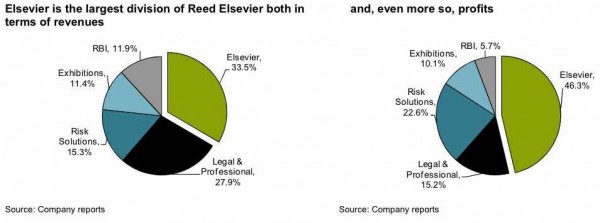
Perhaps such tactics should not seem surprising — they are part of the rough and tumble of commercial deal-making. But it’s not the sort of stance you expect to have to take with partners and friends. Especially when the customer ultimately seeking to negotiate prices is also the author who provides journal content for free, the editorial board member, also working without payment, and the peer-reviewer, again working at no charge to the publisher whose journals, in the case of Elsevier, are the most profitable arm of its business.

Breakdown of Reed Elsevier revenues and profits (2010)

Reed Elsevier revenues and profits (2010). Elsevier is the STM publishing arm. Source: Bernstein Research (1)

Moreover, if Elsevier truly desires to encourage greater transparency with its partners in the academic community, they could start by releasing RLUK from the confidentiality clauses that they imposed on the deal that was reached at the end of last year. Debby Shorley, the head librarian at Imperial College who was active in the negotiation process, cannot tell me how much she pays for Elsevier journals. We therefore cannot have an informed conversation about decisions on journal subscriptions. That’s not helpful.

I’m afraid it is difficult at times to remember that many who work for the publisher are on the side of science.

But let’s continue to talk. Discussion, even if it is argument, is good. It brings things out into the open. Before all this business over the RWA and the Elsevier boycott I had not given sufficient attention to the interplay between the scientist and the publisher. I am now. And I’m not happy with what I see. I want better value for money and more open access.

Elsevier is correct to claim that it offers a range of open access options to authors but I think publishers are increasingly aware that the scientific community wants more. According to a briefing note I obtained from Bernstein Research (2), a publisher’s-only workshop was held in the spring of 2011 to address the questions, “Can we learn not just to live with open access, but to love it as well? Has the time come to turn the threat into an opportunity?”. That’s certainly a telling title and the invitation to that workshop outlined publisher thinking in more detail (with my emphases in bold):

“Open access is here to stay, and has the support of our key partners. Funders see it as the way to maximise access and impact for the research they fund, policy makers are under pressure to make it happen. Publishers know it is much more complicated and threatening to make it work than is apparent to the advocates and the fund holders. But we would benefit from having a compelling, coherent and above all positive story to tell about the role we can play in achieving these objectives“.

I say to my friends in the scientific community, let’s help our friends in the publishing industry to realise that opportunity.

(1) Reed Elsevier: The inevitable crunch point – downgrading to under perform because of growing concerns on Elsevier, Bernstein Research, 10 March 2011

(2) Reed Elsevier, Bringing down the house – Why Elsevier is vulnerable in its upcoming Big Deal negotiations, Bernstein Research, 29 March 2011

My thanks to Claudio Aspesi for making these documents available. A more recent briefing note that analyses the possible impact of the publicity surrounding the boycott is also an interesting read.

Update – 13-02-2012: Thanks to Debby Shorley for correcting me on the roles of the JISC collections and RLUK in dealing with publisher negotiations. Text amended accordingly.

Posted in Open Access, Scientific Life | Tagged , , , | 28 Comments

How to access Open Access?

My train of thought is still running.

Last week, taken aback by the revelation of Elsevier’s deep support for the Research Works Act, an anti open-access piece of US legislation, I declined to review a manuscript for the publisher and wrote about my reasons for doing so. My blogpost received an unusual amount of traffic. It seemed to have caught a wave – started elsewhere – that is sweeping through the scientific blogosphere. Mentioned in Research Fortnight, the post even drew comment from Elsevier. In a follow-up piece Benoit Bruneau explored the impact on scientific societies of a radical shift to OA models of scholarly publishing.

Light at Mykenes

The brouhaha has many complex facets, which are being explored in some detail in the blogosphere (and occasionally in the regular press). What a wonderful resource it is; in the past several days I have profited from the writings of many contributors. Michael Eisen, a long-time proponent of OA, clearly thinks the time for action has come. Bjorn Brembs, himself no stranger to this topic, provides a useful breakdown of the large profits made the large publishing groups. Though some have argued that it is unfair to single out one publisher as the target of the boycott, the Library Loon makes the case for concentrating fire on Elsevier. Cameron Neylon, also very much in the OA vanguard, thinks the current set-up will soon be seen as a temporary aberration as more scientists seek to gain more control of the publication of their research. He argues, persuasively in my view, that funders may well hold the key to seeing through a shift in the publishing landscape (of which more below). And Tim Gowers, the fire-starter, is thinking through new models of community-led publishing and peer review.

Elsevier’s support for the RWA is backfiring badly. Discussions on open access have been rumbling on for more than a decade but suddenly there is a feeling of movement.

But is it real? The blogosphere is a tricky place to calibrate. How much of the indignation over the RWA is being transmitted to the larger scientific community? Everyone has heard of OA and is more or less aware of tensions with publishers. But I emailed my department last week to take a poll of views on the Elsevier debate and from a staff of nearly a hundred received just a handful of replies. Most readily support the principle of OA but there is residual hesitation. The lustre of the impact factor still shines brightly.

And yet, as Michael Eisen writes so passionately, escape from the impact factor trap is entirely in our own hands – and the community should “stop using it as an excuse“. That idea is propagated in more detail by Michael Nielsen in his recent book “Reinventing Discovery“, which coincidentally I have just finished (it is very good). Nielsen discusses OA as part of a broader analysis of the opportunities created by the internet for the grander plan of Open Science and suggests that it is a matter of offering the right incentives to scientists.

Nielsen is right. It will not suffice for a few labs to strike out on their own by committing to fully open access publishing. Rather, we need concerted action to change ingrained practices. The UK government has signalled its support for OA in principle but we shall have to hope that aspiration converts to practical action.

Maybe there are ways for the scientific community to help out with that? In the UK I would like to see the Royal Society pick up the government’s message and start to spread it. That may be over-optimistic since its initial deliberations on OA were rather cautious. But perhaps the Royal Society fellows, each picked for their scientific success and so secure in their position, could lead the way by committing to fully OA publishing? Fellows and other senior scientists could also help to break the tyranny of impact factors by publicly eschewing their use when serving on grant and promotion committees and focusing instead on the science. They would win warm plaudits from Peter Lawrence for doing so.

The funding agencies also have a role, as Cameron Neylon has pointed out. At present, the UK Research Council policies on OA are relatively ineffective – in large part because they are not properly funded: their support terminates with the end of the grant, which is often well before publication of the results of the research has been completed. The Wellcome Trust, by contrast, has created a mechanism that works much better by providing funding so authors can pay open access charges even when grants have finished .

But Wellcome’s approach still fails to address the problem of cost (which may in part account for its plans to become a publisher). I haven’t yet absorbed the data on pricing (although that is something I am investigating), so can’t address that point substantively. Nevertheless the 30-40% profit margins of Elsevier and other major scientific publishers do seem extraordinarily generous and suggest that there is plenty of room for efficiency savings.

At the moment those profit margins are generated from subscription charges and hefty OA fees for those authors who opt to pay publishers to deposit a final peer-reviewed, formatted version of their paper in PubMed Central. This mixed economy is inefficient since in each journal issue only a selection of the papers will be free to readers. Yet university libraries still have to pay the full subscription costs for journals, even when they contain OA articles, so universities face excess costs during this transitional period. Would it not be better to get the transition over and done with?

The question is how to propel it forward. The petition is still growing, with over 4500 signatures tonight, but on its own the blogosphere is unlikely to sustain the momentum for change. Attention drifts. We need to push the discussion out into seminar and coffee rooms, into the plush accommodation of the Royal Society and into the offices of research funders up and down the land. We need to open up the discussion on open access — so please keep talking about it.

Posted in Open Access, Scientific Life | Tagged , , , | 23 Comments

Important Bus Business

This is going to add minutes to my life – every time I take the bus. And I have Guardian columnist Tim Dowling’s truculent teenage kids to thank for it.


Disdaining the sorry business of relying on a published timetable and standing frigidly at the bus-stop, Dowling’s offspring, with preternatural anticipation of how the world is supposed to work, informed his father (and this reader) about the Next Bus London app he had on his smartphone.

The what?

A quick Google search later and I realised there is an abundance of these apps (for the iPhone at any rate). Cheapskate that I am I demurred on the £1.99 price tag for Next Bus London and opted instead for BusMapper, which is free. Much more my price range.

And two days later we are very happy together. The app knows where I am, knows where the nearest bus stops are and, best of all, knows when the buses are going to show up. I don’t know how it works, GPS or some such nonsense. I don’t care.

But I do care that it works. My morning coffee can be ever so slightly more leisurely because there is less uncertainty in my life. This is a good thing.

Posted in Fun, Scientific Life | Tagged , , | 17 Comments

Guest post: Society Journals and the Research Works Act

My previous post on Elsevier and the Research Works Act (RWA) stimulated a conversation on Twitter with Benoit Bruneau about the possible impact on the journals of scientific societies of moves to open access publishing.  This is an aspect of the debate that has not been discussed in much detail of late. Benoit, who researches cardiovascular disease at UCSF, kindly offered to write a guest post discussing the dilemmas posed to scientific societies by the RWA. 

Much has been said about the RWA, and the involvement of big name publishers. Less discussed, but very important for many scientists, is the role that scientific societies and their journals have, and the impact of current or future publishing practices. Some societies, such as the American Association of Immunologists (AAI), the American Society of Nephrology (ASN), the American Heart Association (AHA), and the American Society for Clinical Investigation (ASCI), publish their own journals. Of these, very few (in this list only the ASCI), have an open access policy. Other societies, such as the Society for Developmental Biology (SDB), publish in journals operated by big publishers, such as Elsevier (in the case of SDB’s journal, Developmental Biology). So where do these societies and their journals stand on RWA?

Well in some cases it’s crystal clear. In letters that responded to a “Request for Information” (RFI) by the Office of Science and Technology Policy, Executive Office of the President, regarding “Public Access to Peer- Reviewed Scholarly Publications Resulting from Federally Funded Research””, the AAI wrote:

“…working in partnership with professional societies and other scholarly publishers offers the federal government the most cost-effective and efficient way of ensuring that private sector, scholarly journals survive, preserving their crucially important service of providing independent, expert peer review (accomplished at publishers’ expense) of government-funded scientific research.”

This refers to their perceived duplication of efforts in having PubMedCentral duplicating published manuscripts. The statement might make sense, if the journals were to offer free access after 12 months. But they continue with:

“…want to express our clear opposition to government mandates which require private sector publishers to make their legally-owned property (i.e., journal manuscripts, published articles and associated data) available online on sites other than our own, or to comply with a government-determined embargo period. These mandates allow the government to take private property without owner authorization or compensation, and threaten the sustainability of our nation’s premier peer-review publishing system.”

So, not so happy about providing free access. They also claim that PMC is an inferior means of disseminating and archiving published material. This is highly debatable, especially the permanence of published work. Finally, they answer many questions posed by the RFI, and include this delightful gem, which we’ve heard from Congresswoman Maloney:

“…increased “free” access is likely to benefit scientists in other nations, whether allies or enemies. In some instances, this will enhance international cooperation in the sciences, but it is not necessarily beneficial to the U.S. economy as even our friendly competitors will gladly take our research findings for free….. Neither publishers, nor the U.S. scientific enterprise, nor the U.S. taxpayer benefits from the “giving away” of our peer-reviewed publications.”

Oh dear. The point really is, these societies make most of their money from their publications, and of course feel threatened.

But then how does ASCI do it, publishing all papers in JCI for free? I don’t have the answer, but perhaps these societies should talk to each other…

In the case of the SDB, it’s a bit more complicated. They too make most of their revenue from their journal. But in this case, they fall under Elsevier’s control, and only receive a fraction of the journal’s revenues (around 10%). What can they do, stuck between a rock and a hard place? Currently they are debating what to do, so the jury is out. The SDB does provide an OA option for HHMI and Wellcome Trust-funded researchers, reasoning that they can afford the $3,000, but that many other researchers can’t. Then why not have a hybrid model such as the Company of Biologists, who publish Development, and offer OA for a fee?

Then the final question is for those of us who are members of these societies. Do we boycott our own society journals? Do we engage the leadership to try to convey our views? There is no clear answer, but it should be something. The editors of the journals are scientists, just like us. They understand, and they will listen. The societies have existed for a long time, and are an important part of science, in assembling scientists with shared interests in the form of conferences and journals, promoting scientific education, amongst other laudable goals. But many have their survival inextricably linked with their closed access journals.

As scientists we must ask ourselves how to help our scientific societies, while promoting open access.

I’m sure Benoit will be happy to respond to any comments that you might want to make.

Posted in Open Access, Science, Scientific Life | Tagged , , , , , | 27 Comments

Why I chose to decline an invitation to review by Elsevier

All relationships suffer tensions from time to time, especially those based on love-hate.

Scientists have a complex relationship with their publishers — they love to get published in high-impact journals (most of which are run by major publishing companies) but hate the abuses of impact factors made by their own community in promotion and funding committees. They applaud the ethos of peer review as a valuable quality-control mechanism and a cornerstone of the amateur ethos of science that has persisted despite the global professionalisation of research, but grumble that publishers get this arduous service for free. They love to see their work in published form — a particular thrill the first time it happens — but complain that they often have to pay to do so, both as authors who have to meet page and colour figure charges, and as readers whose universities must pay subscription charges that place increasing strains on library budgets.

It’s complicated: my sketch does not cover all the nuances and dimensions of the problems. But partly in response to these tensions, and to advance access to publicly funded research, there has been a move over the past decade towards an open access (OA) model of publishing, in which the author pays the costs of publishing and the papers are made freely available to readers: there is no subscription charge. The OA model takes many forms, including new community-sponsored publishers like the Public Library of Science and funding mechanisms that enable cooperating private publishers to offer open access. Not all publishers have warmly embraced the OA movement, seeing it as a threat to subscription model that worked well for a long time, at least before the advent of the internet.

The troubled love-hate liaison between scientists and their publishers is going through a particularly dangerous turn at the moment because of the Research Works Act (RWA), a piece of legislation introduced to the US Congress in December. I read about it last week on Michael Eisen’s blog and was surprised to learn that the act would undermine the OA policy of the NIH, the major US government agency that funds biomedical science. That policy requires

that all investigators funded by the NIH submit or have submitted for them to the National Library of Medicine’s PubMed Central an electronic version of their final, peer-reviewed manuscripts upon acceptance for publication, to be made publicly available no later than 12 months after the official date of publication.

But the Act demands (with my emphasis) that:

No Federal agency may adopt, implement, maintain, continue, or otherwise engage in any policy, program, or other activity that:

(1) causes, permits, or authorizes network dissemination of any private-sector research work without the prior consent of the publisher of such work; or

(2) requires that any actual or prospective author, or the employer of such an actual or prospective author, assent to network dissemination of a private-sector research work.

The insidious aspect of the act, apart from its threat to open access, is the use of a kind of double-speak that converts work that is almost entirely publicly funded into the private property of a publisher. It is this claim — an apparent land-grab — that has incensed scientists.

But what has further stoked the fires of this argument is the revelation that one of the sponsors of the bill, NY Congresswoman Carolyn Maloney, has received substantial campaign contributions from executives at Elsevier, one of the largest academic publishers in the world.

Eisen, an evolutionary biologist at Berkeley and a co-founder of PLoS, laid out the details clearly on his blog and drew comment from Tom Reller, Vice President for Global Corporate Relations at Elsevier. To his credit, Reller tried to make the case for the publisher. But to my mind that argument incorporates excessive claims about the value that publishers add to final published peer-reviewed papers that report publicly-funded research. Reller was right to point out that management of the peer review process is a non-trivial exercise and incurs real costs, even if the peer reviewers themselves are mostly publicly funded scientists. But he still struck a bum note:

…of course we know peer reviewers aren’t paid. And we know that we, and our journals need them. If you ever reviewed for one of our journals, thank you, and we truly hope you continue to do so. I know all about the issues related to how difficult it is to find quality peer reviewers. You’re often paid by the government, and it is time consuming, we get it.

“We get it”? Perhaps it was a moment of exasperation on the part of Mr Reller, but his gratitude for peer-review was starting to sound like ingratitude. It was not a winning pitch to a community on which you rely. It was a slip of the mask that revealed the hard-edge of a serious business. That same hard edge drives the decisions to fund sponsors of legislation that aims to curb open access. One wonders if the authors of the legislation have had other support from Elsevier?

These are emotive issues — see, for example, this argument and response — but I wanted to look at them coolly. As Eisen points out, it should come as no surprise that a large successful company should lobby and support legislation that is in their commercial interests. This has been happening since parliaments were first formed. But scientists and publishers have to interact — they have shared interests. And that interaction will be healthiest if the discussion of respective interests is held in the open, which is why I was glad to learn of Elsevier’s latest activities.

I started to seriously think about my attitude to scientific publishing and to open access in particular last September when I wrote on the topic in response to a piece by George Monbiot in the Guardian. My blog post led to an extended and informative comment thread — with contributions from scientists and journal editors — that I found very helpful.

This latest episode caused me to think further. On reflection, after the first pulse of anger had passed, I found that I was still angry at Elsevier’s actions. And so, when a request to review a manuscript for an Elsevier journal appeared in my inbox, I opted to decline. I gave as the reason for my refusal the revelations about how the publisher was providing support for the Research Works Act.

This triggered an email from Elsevier which, in the interests of further discussion, I reproduce in part below (again with my emphasis). They make their case:

Fully acknowledging your right to decline reviews wherever you feel appropriate, I am taking the liberty of providing you with some background information on the Research Works Act, hoping of course that you might change your mind.

Our support for the Research Works Act comes down to a question of preferring voluntary partnership with government agencies and other funders to promote access to research works, rather than being subjected to inflexible government mandates like the NIH policy, which do not take into account the needs of different journals.

One of Elsevier’s primary missions is to work towards providing universal access to high-quality scientific information in sustainable ways. We support the bipartisan bill, which seeks to prevent US government policies, like the one imposed by the NIH, that mandate the dissemination of journal articles published and funded by the private sector.  Elsevier and other publishers have embraced and nurtured a whole range of access options to ensure broad dissemination – author pays journals, delayed access, manuscript posting, and patient access, to name a few.  We’ve worked constructively with a number of government agencies to develop new ways to expand access to journal articles reporting on, analyzing and interpreting agency-funded research. But like other publishers and societies we have always opposed the adoption or extension of the NIH policy, which restricts the author’s freedom to choose where to publish and undermines the sustainability of journals published by the private sector. The legislation is an effort to prevent such unsustainable policies.

Congresswoman Maloney of New York City co-sponsored this legislation quite simply because New York is one of the country’s leading publishing states. There are more than 300 publishers that employ more than 12,000 New Yorkers, many who live or work in or around New York City. Elsevier and many other publishers have offices located in Congresswoman Maloney’s district. We support her because she has been a strong supporter of this important industry, our employees and good public policy. And we believe the Research Works Act is good public policy.

There is nothing in the Research Works Act that prevents an author from publishing in an open access journal. Furthermore, Elsevier works proactively to achieve universal access to all its products and services, publishes eight open access journals, offers authors the option to sponsor open access to their article in over 1100 titles, and has a flexible green open access policy. While we support measures to curb open access mandates for government funded research, we have consistently supported the NIH research posting policy since its inception in 2005 as a voluntary provision. In other words, our basic position has remained unchanged.

I hope this provides you with some background regarding our standpoint in this issue.

If you have any questions, I would be more than willing to answer them.

While acknowledging the work and added value that publishers certainly bring, this position does not properly address the fact that for most papers the research work and the effort of peer review is funded publicly. Nor am I convinced by Elsevier’s contention that the NIH policy undermines the sustainability of private sector journals. A study commissioned by the Wellcome Trust in 2004 (PDF) compared the costs of subscription and OA models of publishing and concluded that OA was sustainable and likely to be marginally cheaper. Perhaps those conclusions need to be updated for 2012. I would be grateful if anyone could point me to a relevant analysis.

Elsevier’s assertion that the RWA does not prevent authors for publishing in OA journals is certainly true. I have to say the current fracas is propelling me further in that direction (and I am by no means alone in this – see here and here). There are concerns about the possible impact of committing to OA-only journals — loss of prestige, threat to the careers of junior colleagues, loss of grant income (as I mentioned towards the end of this post), so this is not a decision to be taken lightly.

But if scientists believe, as I do, that the fruits of their publicly-funded work should be available to the widest possible audience, we have to think about the most cost-effective ways of doing that. Of course, many have already done so; I am playing catch-up here but so are many of my colleagues, which is why I wanted to think through these issues in the open.

Scientists — and the public — are the major players in this arena and so have the scope to influence events. I am not looking for a shouting match but we need more dialogue between all parties to move the relationship forward, even if that sometimes involves difficult arguments or refusals to co-operate.


Update (29-1-12): For anyone looking for a handy background briefing on Open Access Publishing, this POST Note from the UK Parliament is very useful.

Posted in Open Access, Science, Scientific Life | Tagged , , , | 58 Comments