Numb or Numbered?

It just doesn’t add up: why do so many people, including scientists, get stuck on the maths problem?

The subject is on my mind because it was raised at a departmental meeting last week where I tried to argue that A level mathematics (the qualification obtained at age 18 in the UK) should be an entry requirement for our degree programmes in biochemistry and biology. Given the increasingly quantitative nature of these subjects, I ventured, we need to be taking on students who are comfortable with maths.

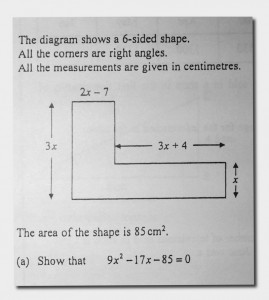
The GCSE maths qualification obtained at age 16 is adequate for general arithmetic skills and a grasp of elementary algebra but does not cover many concepts that are useful in the life sciences, such as exponentials, logarithms, simple calculus (first order differentiation and integration), trigonometric functions or — a particular favourite of this X-ray crystallographer — the use of complex exponentials to represent waves. I know this because my daughter is preparing for her GCSE Maths exam next month and I have seen the practice papers.

Maths problem

My view is that we cannot rely on GCSE qualifications in maths to equip our students for a 21st Century university curriculum in the life sciences (or indeed any science). Biology and biochemistry may once have been largely descriptive disciplines but those days are gone. For more and more areas in the life sciences — enzyme kinetics, molecular interactions, bioinformatics, genetic inheritance, population dynamics to name just a few — a proper understanding requires maths skills significantly beyond GCSE level. (To say nothing of providing aesthetic appreciation of the mathematical foundation of so many living curves and curls.)

Unfortunately I did not prevail. In part I think there is reluctance to impose A level maths as an entry requirement because it would restrict the pool of applicants. Many students who do biology or chemistry at A level don’t take maths. In fact, of those students who study for A levels in the UK, only about 25% do maths. Worryingly for our science and engineering base, this is one of the lowest figures among developed nations.

That figure is probably not surprising to many people: the aversion to maths is commonplace and the refrain “I’m no good at maths” is heard up and down the land. But what has surprised me recently is the realisation that the aversion is so often also shared by scientists, a discovery that underscores the extent of the problem while at the same time pointing to a solution.

I have been interviewing life scientists for an upcoming video project and, though the sample is too small to be statistically significant, almost all have confessed to finding maths difficult or even distasteful, at least at the outset in their careers. Even TV’s favourite physicist Brian Cox was no friend of mathematics at school — by his own admission he only scraped a D at A level.

Nevertheless, each of these people faced down their mathematical demons on the way to becoming scientists; some of them now do daily battle with serious numbers and formulae. Why is that? Are these scientists the exceptions, the ones who persevered despite a lack of affinity for maths? How many others fell by the wayside?

I don’t know the answer to these questions though the testimony of the scientists reveals that motivation is the key. You have to be able to see the relevance of maths before you can rouse yourself to get stuck in. I experienced this in my physics degree during a maths lecture on Fourier Theory, which shows that any mathematical function can be represented as a sum of sines and cosines. Neat, I thought, but so what? Perversely, the lecturer omitted to make any connection with physical reality, even though Fourier himself only developed this mathematical tool to solve the problem of understanding heat conduction along an iron bar. Only later when I learned the relevance of Fourier Theory to my beloved X-ray diffraction did I really get to grips with the maths.

The abstractive power of maths is its greatest strength but can also be its undoing: the subject is too easily seen as alienating and therefore provides a ready excuse for students to give up. Is the apparent unreality of the subject also the source of the feeling that it is difficult? Perhaps so, but Cox suggested a useful remedy for that mindset, comparing the ability to do maths with the ability to play the piano. No-one expects to be able to sit down at the piano and just play. You have to practise.

And so it is with maths. But for some reason many people don’t realise the bit about needing to practise. Cox only cottoned on to it at university (and went on to get a first class degree in physics) so perhaps we shouldn’t be too hard on school students. But I do think we need to find a way to learn the lesson earlier, so that a greater number of our students might embrace the subject, and be more fearless in the face of science and engineering.

Posted in Maths, Science | Tagged , , , | 137 Comments

Movement and Music

What the hell is Stanley Kubrick’s 2001: A Space Odyssey about? I’m sure I don’t know.

I’m really, really sure I don’t know. At least, I think I am. I’ve seen the film three times now, and I’ve read Arthur C. Clarke’s book — albeit a long time ago — but I still can’t get my head round it.

However, that won’t stop me trying and I had another go on Thursday night, attending what was the most exciting performance of the film that I have ever experienced. I hadn’t exactly set myself a high threshold since previous viewings were on an old TV set with a 4:3 aspect ratio and, more recently, on my iPhone, the viewing divided over several commutes.

I know that’s not giving a cinematic masterpiece a fair chance and am relieved I never had to account for myself to Mr Kubrick. Now I have finally managed to make amends. I had long wanted to see the film on a big screen but the showing on Thursday went even further since it was accompanied by an orchestra and choir. That lent a thrilling live dimension to Kubrick’s on-screen artistry.

A memorable experience

Many who have seen 2001:A Space Odyssey contend that nothing happens. It’s certainly true that, on one level, not much happens. Some prehistoric primates encounter a smooth black monolith and are taught to use bones as weapons. Fast forward 4 million years and humans re-discover the monolith on the moon. It directs a signal to Jupiter and a mission is sent to investigate. On the way the spaceship’s computer the HAL9000 — malfunctions and turns against the crew, killing four of them before being de-activated by the surviving commander, Dr Dave Bowman, just as the spaceship arrives at its destination. Bowman leaves the ship and is taken through a mysterious portal to another planet where he lives out his days in a room furnished in the 18th century French style. On what seems to be his death-bed, he transforms into a foetal star-child who returns to Earth and, in the film’s final frames, is seen gazing at the planet in contemplation. And that’s it.

How on Earth does this simple plot take 141 minutes? That’s probably the wrong question because, apart from the prehistoric opening, none of the action takes place on Earth. Or perhaps I should say the inaction since large passages of the movie are taken up by the slow, balletic movements of various space-craft accompanied by classical music, most famously Johann Strauss’s Blue Danube Waltz and Richard Strauss’s Also Sprach Zarathustra, richly and deliberately layered onto the moving images, on this occasion by the members of the Philharmonia Orchestra and Choir. A shuttle manoeuvres towards a slowly rotating space-station in Earth orbit, gradually twisting its motion to match the steady turn of the docking bay; another makes the long transit to the moon, landing sedately in a sunken base; a third transports an investigative team over the surface of the moon to the site where the monolith has been re-discovered; the gigantic Discovery One space-ship taking Bowman and his crew to Jupiter to find the source of the mysterious black slab glides with glacial momentum past the camera; and then there is the slow, slow manoeuvring of the EVA pod to repair the ship’s antenna.

These sequences of pure, banal movement are interspersed by small snatches of dialogue, almost all of it lacking any strong emotion. The greatest feeling is expressed paradoxically with minimal intonation — by HAL in a gripping scene where Bowman, addressed throughout using his first name by the computer (“Stop Dave. Stop, will you? Stop Dave. I’m afraid. I’m afraid, Dave. Dave, my mind is going.”), determinedly, slowly and methodically disables the computer that has killed his crew and sabotaged the mission.

The overall lack of emotion expressed seems strange, given the immensity of the themes in the film — nothing less than the origin and evolution of humankind and the discovery of alien intelligence in the universe — but the film is still a powerful experience. Against the backdrop of ultimate meaning human life is rendered as a series of simple actions. The images and scenes are almost hypnotic; human life is kept in the foreground, but abstracted so as not to be too… distracting. It is left to the viewer to reflect on what it is all about.

Survival of the fittest? Is that it? Is that all that matters? Since seeing the film this week I have read that the computer may have been in competition with the crew, seeing itself — machine intelligence — as the more worthy recipient of the attentions of the creators of the monolith. I must admit this possibility had never occurred to me. Kubrick was always reticent on the question of meaning in the film, deliberately whittling away the dialogue, to leave room for the imagination. And for questions. What do the aliens know? What is in the mind of the star-child at the end of the film?

I still don’t know what to make of 2001 but I enjoy trying. Why does it have such fascinating force? It’s partly the space-ships, which were created with such loving detail (Kubrick hired NASA engineers to help with their design): the drama of this science fiction is grounded in reality. But the music and the movement and the stripping of the story to its barest elements gives the piece a meditative, mysterious grandeur that somehow satisfies without providing answers.

I think I’m going to watch it again.

Posted in Cinema, Music | Tagged | 26 Comments

Winging It

A short film about flying. And about the wing on the plane that I was in. Yes – the wing.

I flew this morning and enjoyed a little bit of engineering magic.


Posted in Fun, Technology | Tagged , , , , | 19 Comments

Moon Boon

It cannot have escaped your attention this past weekend that the Earth was treated to a supermoon. The correct terminology for this felicitous event is a perigee syzygy, but the reasons for the interesting nomenclature need not detain us.

The point is that Saturday night was clear in London and gave those of us who live there a magnificent view:

Supermoon over Kent (2)

Which, just like a lunar orbit, brings me to a place I’ve been before. I photographed the full moon back at the turn of 2010 with what was then a brand new telescope. I wrote a blogpost about the excitement of my first fantastically detailed views of the moon — and the planets — and am preternaturally pleased that it has been included in the Open Laboratory 2010 collection, which is published today.

You should really think about buying a copy. It only costs money and has forty-nine wonderful examples of the best science writing on blogs.

Open Laboratory 2010 - Cover

And a piece by me. 😉


My thanks to this year’s editor Jason Goldman, and series editor Bora Zivkovic for all their hard work.

Posted in Astronomy, Blogging, History of Science, Science | Tagged , | 15 Comments

Don’t submit. Submit.

We came. We chanted. We lobbied. We petitioned.

And in the end, thanks to the Science is Vital Campaign and the persuasive efforts of CaSE and the learned societies and captains of high-tech industry, the UK science budget was protected from deep cuts in the Governments Comprehensive Spending Review last autumn.

The settlement came as a huge relief to a community of scientists and engineers who had fought hard to make the case that science and technology are crucial engines of innovation and growth, one that the UK — facing growing competition from overseas — would neglect at its peril.

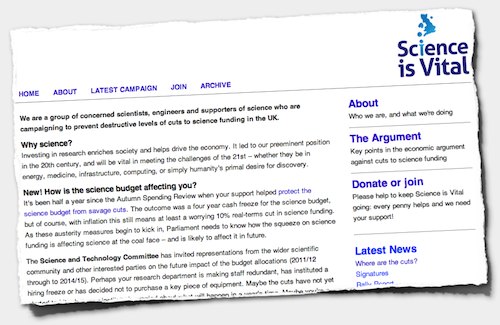
Science is Vital Website

However, the four-year freeze in the recurrent budget for publicly funded research represents a steady decline in real terms of somewhere in the region of 10-15%, depending on the rate of inflation. This is exacerbated by the cuts of around 40% that were made in capital spending, money largely devoted to large-scale infrastructure.

There is little doubt in the scientific community that Science Minister David Willetts battled well with the Treasury on our behalf. But the harsh reality is that the reduced spend on science – coupled with the uncertainty imposed on the university sector by the ongoing overhaul of student funding – makes for extremely challenging times ahead.

To face that challenge as positively and as productively as we can, the fight needs to go on. As a community we need to keep reminding the government of the importance of investment in science, and to gather the evidence of its deep economic and cultural value.

We also have to maintain a close scrutiny of the Coalition’s science policy. The government is very keen on assessing the impact of the scientific research that it funds. So no doubt it will welcome a determination of the impact of its own spending decisions in this area. As I noted a few weeks ago, Parliament is now offering us an excellent opportunity to do just that.

The parliamentary Science and Technology committee has issued a call to the scientific community for submissions that will give a ground-level view of the effects of the spending decisions that were announced last year. The Science is Vital Campaign thinks that this is a very good thing — and we hope that you agree. These submissions will provide valuable insights to the committee and are, we hope, a useful way to harness some more of the tremendous passion and energy that flared up among scientists and engineers around the country in September and October last year.

Times are tough but we must not submit to resignation or defeatism.

Instead, please head over to the Science is Vital web-site where we have explained the background to the call for evidence and set out clearly how you can help by preparing a brief report of the impact of constrained spending on your research for the Science and Technology Committee.

This will allow you to submit in a very positive way.


Use the hashtags #scienceisvital and #CSRimpact to follow and support the campaign on Twitter

Posted in Science, Science & Politics | Tagged , | 2 Comments

You may not be interested in this but this is interested in you

I was banging on last week about how scientists should use words rather than guns during public engagement. Words are safer — and often more effective.

But they are not completely safe. In fact, they can sometimes be rather dangerous, especially when used without due care and attention in England and Wales, where the libel laws take a keen interest in the words of any unsuspecting author. At the end of the long arm of the law here is a cold hand that places a legal chill on our freedom to criticise individuals or companies — even when offering an opinion grounded in fact. Our libel law is unbalanced: it puts too much power in the hands of those who can afford expensive lawyers. And it reaches well beyond our national borders, potentially affecting anyone whose writing appears within them.

Libel Reform Lobby Montage - March 2011

The constricting effect of the law is felt even within the scientific community, especially in the area of public health. Its consequences may sometimes seem absurd, but the recent libel suit brought by the British Chiropractic Association against science writer Simon Singh and the ongoing pursuit through the courts of British cardiologist Dr Peter Wilmshurst by medical company NMT have highlighted the very real dangers of our current legislation.

I was surprised to experience the law’s cooling touch myself back in 2009, after publishing a blogpost on Nature Network. The post was written in good faith but in complete ignorance of the legislation and was taken down on the advice of Nature’s nervous libel lawyers. Please don’t ask me what I wrote — I’m afraid I can’t tell you.

The libel laws in this country have a deadening effect on discourse in many other areas of public interest — banking, human rights, consumer rights — and affect anyone in the business of publishing. These days that includes anyone with a Facebook page, a Twitter account or a blog. It probably includes you.

But pressure is now building for a change, thanks in no small part to the Libel Reform Campaign, a combined effort by Index on Censorship, English Pen, and Sense about Science. In the run-up to the UK general election last year there was all-party support for a change in the law. Next week, thanks to initial prompting by Lord Lester, the Government is expected to publish draft legislation as a basis for wide consultation; a final bill should then be prepared and enacted in 2012 — we hope.

But the libel reform campaign is not taking anything for granted and, in a nicely calculated attempt to maintain the initiative, has published a short pamphlet (pdf) that outlines the short-comings of existing legislation and sets out the provisions a reformed defamation bill should contain. It is well worth reading.

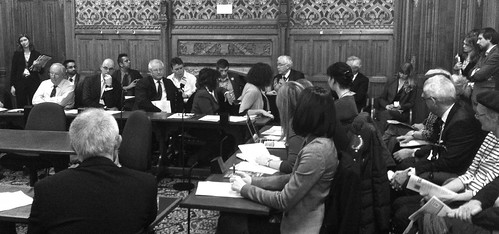
Libel Reform Lobby - March 2011

Lord Willis speaking

Yesterday supporters of the campaign gathered in Committee Room 5 in the Houses of Parliament for the launch of this important document. The meeting, chaired by Dr Evan Harris, heard brief submissions from representatives of many different organisations — Nature, the British Medical Journal, Facebook, Which, Mumsnet, Justice and Amnesty International among others. It was sobering to hear condensed into half an hour so many examples of the nefarious impact of the current libel law, but heartening at the same time to witness the democratic resolve to seize this opportunity to get improved legislation onto the statute book.

Though there was a strong sense of a shared mission at the meeting, several speakers, including Lord Willis (pictured above), warned that there would be opposition, not least from libel lawyers fearful of being out of pocket as a result of reforms that, in the interests of free speech, would more reasonably restrict the ability to claim defamation on behalf of wealthy clients. In the New Statesman, David Allen Green cautioned against complacency:

“The Libel Reform Campaign has worked hard for over a year to nudge the government into publishing the draft bill. They are to be congratulated for getting possible reform this far. However, more general participation in the debate following publication of the draft bill will help determine what will happen next. The need for libel reform has not gone away, and the campaign for libel reform needs active and engaged support now more than ever.”

Wise words. If you are a scientist and think scientific issues should be debated freely in the public domain, I urge you to take an interest in libel reform. Even if your work is unlikely to rub up against powerful vested interests and you think you are not at risk, remember that you are also a citizen and the stifling impact of libel could well be bad for your health.


Posted in Science & Politics | Tagged , , , | 10 Comments

Here is a Man Who Stood Up

In many ways Travis Bickle, the disturbed taxi driver in Scorsese’s famous film, is a model of public engagement.

For one thing, he really thinks about his audience. He rehearses in front of a mirror so that he will be fully prepared for his encounters with the people he wants to reach. Legs apart, arms folded, his stance is confident — his body language is really very good.

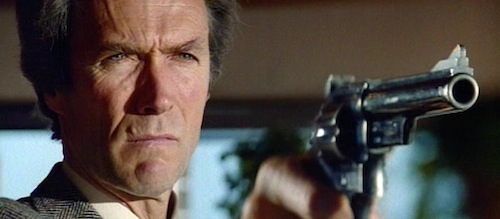
Then, with the merest tilt of the head: “You talkin’ to me? You talkin’ to me?”

Travis rehearses in the mirror

Travis rehearses in the mirror

You see how Travis secures the complete attention of his audience before putting his message across? Textbook.

And not only that, he is also careful to use the tools best suited to his method, which is to change the minds of his conversants by rearranging their brains. So he takes guns. Just the job.

There’s no doubt Travis is an effective communicator. Scientists and science writers might sometimes be tempted to resort to such extreme measures, especially when trying to resist the relentless assaults from the wackier screw-heads of pseudoscience. Not with guns or knives of course — use your words — but with a similarly aggressive attitude to redress. How good it would feel. They are so very, very wearisome these science frauds, the dreary homeopaths, the fact-shy opinionists, the star-struck-dumb astrologers and any of the other numberless trolls lurking on the Internet. And now the government’s own chief scientific officer, Professor Sir John Beddington, has called on scientists to be ‘grossly intolerant’ of the mis-use of science. Maybe it’s time to tool up?

Go on — it would make your day. Wouldn’t it? Well, wouldn’t it… punk?

Do you feel lucky?

Of course it wouldn’t. That’s not how we do things in science, or at least not how we’re supposed to do them. Even Beddington — caught off-guard at the time of his original statement — has cooled and explained his position in more measured terms: scientists have to expect to face skepticism and criticism, but they should do so willingly, proactively and with careful explanation of the evidence (and its limitations) as their only weapon.

In taking the time to account for his initial outburst, Beddington is walking in the large footsteps of Carl Sagan who preceded him by fifteen years in the sagacity (how well the astronomer was named) of his advice. Sagan’s book, The Demon Haunted World — Science as a Candle in the Dark, is a handbook for our times. More particularly, this collection of writings is a reassuring touchstone amid the noisy, chaotic growth of the scientific blogosphere.

Famed for his landmark television series, Cosmos, it is no surprise to discover that Sagan is a gifted writer. But more than that, as a communicator he is so admirably thoughtful — in both senses of the word. The book starts in the back of a taxi cab where Sagan deftly but politely dismisses the driver’s assertions about extra-terrestrials, the prophecies of Nostradamus and the shroud of Turin.

From there the book takes the reader on extended excursions in and out of the illusory Martian canals, through the tortuous narratives of alien abductions and UFOs and back in time to a world populated by demons where women were routinely put to death as witches. He also muses on the problems of how to turn people on to science and how to convince governments to take the long view of the value that can come from scientific research (the chapter on “Maxwell and the Nerds” is especially good on this topic).

Sagan’s approach might not be for everyone. The tone is calm, the slow turning-over of the evidence is meticulous. He is so God-damned reasonable. The curiosity is endless — Sagan is genuinely interested to know how people can become so absorbed in the improbable. He is resolutely skeptical but — and this is the mark of the man — ever respectful. Mostly.

“Have I ever heard a skeptic wax superior and contemptuous? Certainly. I’ve even sometimes heard, to my retrospective dismay, that unpleasant tone in my own voice.

But he has learned his lesson and drills insightfully into the core of the problem.

“There are human imperfections on both sides… Even when it’s applied sensitively, scientific skepticism may come across as arrogant, dogmatic, heartless and dismissive of the feelings and deeply held beliefs of others. And, it must be said, some scientists and dedicated skeptics apply this tool as a blunt instrument, with little finesse… All of us cherish our beliefs. They are, to a degree, self-defining. When someone comes along who challenges our belief system as insufficiently well-based — or who, like Socrates, merely asks embarrassing questions that we haven’t thought of, or demonstrates that we’ve swept key underlying assumptions under the rug — it becomes much more than a search for knowledge. It feels like a personal insult.”

And so, when asked by a fellow astronomer to sign a scientific manifesto called “Objections to Astrology”, Sagan refused — not because he had any truck with the pseudoscience of predicting human character or destiny from the stars — but because the statement struck the wrong tone. It was authoritarian.

Sagan died in 1996, well before the science blogosphere took off, but there can be little doubt that he would have been an enthusiastic proponent and participant. He wrote for Parade magazine — a popular Sunday newspaper supplement — and received many letters from readers (some of which are quoted in the book). He was engaged and engaging. At a time when too few scientists unbent themselves from their experiments, here was a man who stood up.

Posted in Blogging, Communication, Science | Tagged , , , , | 41 Comments

The Perutz Effect

I have Jim Franks of Newton TV to thank for the opportunity to sit around a table with some of the current scientists at the world-famous MRC Laboratory of Molecular Biology to talk about the legacy of its founder, Max Perutz.

Guardian website: NewtonTV video on Max Perutz

The discussion was part of a video that you can see at The Guardian web-site and is intercut with previously unseen interview footage of Pertuz himself looking back on his scientific life. I know I’m biased, but it’s a fascinating film.

I hope you’ve heard of Perutz. He’s a scientific hero of mine — it was his patient, tenacious pursuit of the structure of the oxygen-carryng blood protein haemoglobin that inspired my own move into structural biology.

But he wasn’t just a great scientist; he was also a wonderful mentor and a canny science administrator. His legacy is very much alive, as I discovered in the course of a delightful conversation with present and former MRC-LMB directors Hugh Pelham and Richard Henderson, and other current members of staff — Kiyoshi Nagai, Lori Passmore and Andrew Carter. I think Max Perutz still has a lot to teach us about how to do science properly. I hope you’ll watch.

NewtwonTV video screenshot


Posted in History of Science, Protein Crystallography, Science, Science & Media | Tagged , , | 1 Comment

Prize Your Imagination

On Wednesday last I was fortunate to find myself an outlier among the great and the good at the Wellcome Trust Image Awards for 2011, where hefty glass slabs were being handed out by Adam Rutherford as prizes to imaginative individuals who had conjured a captivating image from their scientific work. The picture below of a blood clot forming underneath a sticking plaster was one of my favourite prize winners (perhaps because of my long-standing interest in blood):

Clotting blood on sticking plaster

Clotting blood on sticking plaster (Anne Weston, LRI, CRUK)

I was struck by the fact that most of twenty or so awards were for micrographs of one sort or another. Microscopy offers high-resolution access to a unseen world, one that is — in most cases — at the very edge of our perception and so benefits from the excitement of revealing familiar objects in unfamiliar but spectacular detail. It’s a thrill that is as old as the microscope, as Robert Hooke so ably demonstated with his 17th Century bestseller, Micrographia.

Now I don’t wish to bang on about the wonders of molecules again, but I was left feeling a little disappointed that no structural biologists working at the atomic level were to be found among the award winners. I don’t even know if there were any molecular submissions.

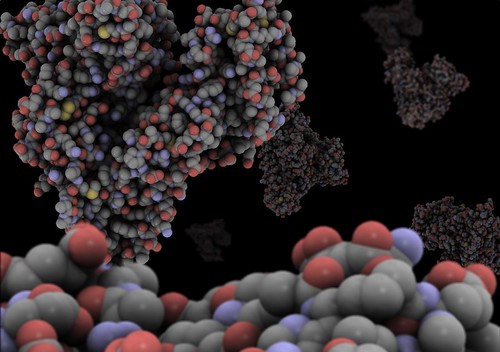
But I now see this as a challenge for next year and call upon the protein crystallographers, NMR spectroscopists and cryo-electron microscopists (those engaged in three-dimensional reconstructions) to fire up their computers and their imaginations for the competition in 2012. I’ve made a start — you can see below something rough and ready that I knocked together this evening using a photo editor to assemble molecular images of albumin made with Qutemol (a somewhat limited program that is nonetheless quite, um, cute):

Albumin molecules - here and there

Albumin molecules - here and there

Not too shabby but plenty of room for improvement. I reckon I’ve got almost a year to perfect my technique.

Posted in Protein Crystallography, Science | Tagged , | 8 Comments

An Inconsistent Truth?

The Science Museum in London is a national shrine to human ingenuity. Its existence is a testament to the value that our society places on inquiry and innovation, its worth paradoxically underscored by the fact that, even in these impecuious times, entry is still free.

The museum sits grandly on Exhibition Road, just around the corner from my laboratory at Imperial College. Some lunchtimes I like to drop in, just to sit among the leviathans in the steam hall or to take a quick peek at some of the brassy instruments. There is a solidity and a magnificence to many of the exhibitions. It is a favourite place.

I was therefore surprised last week to come across a dispute about an exhibition on alternative medicine at the museum. A guest post by Alex Davenport on Marianne Baker’s blog criticised the Living Medical Traditions exhibition for its presentation of practices such as homeopathy and acupuncture without any accompanying evaluation of their worth. Prompted by his critique, the science museum responded on their own blog, defending the exhibition as one that provided “anthropological and sociological perspective on medical practices”. The redoubtable David Colquhoun was also critical of the low level of the scientific content in the exhibition and Marianne and Alex re-visited the argument in The Guardian.

On all these blogs quite a discussion ensued — some of it cantankerous (a ‘firestorm’ according to one participant) — about the proper manner for the science museum to present scientific information to the public. Prominent in support of the museum was Rebekah Higgitt at the Whewell’s Ghost history of science blog, who wrote to defend the anthropological, sociological and historical approach they had taken. She took to task those commenters who claimed the only way for the museum to improve the public understanding of science “is to tell them some science”.

This narrow view of the role of science museums has already been satirised — such is the fearsome speed of the blogosphere — and rightly so, but this response doesn’t address the argument put forward by Davenport,  Baker, and Colquhoun or what is for me the most interesting substance of the discussion. The sometimes testy blog conversation had echoes of an earlier exchange on the skeptical approach to astrology. Since I have just read Carl Sagan’s The Demon Haunted World, a wonderful and wise book on the collision of science and non-science, and been wondering about modes of scientific communication, I thought I’d take a closer look.

So yesterday I went to the museum.

Anatomical Man

Anatomical Man

The Living Medical Traditions exhibition is just one part of the much larger Science and Art of Medicine Gallery on the 5th floor of the museum. The gallery is a packed maze of glass cabinets — the exhibition relies almost wholly on an amazing and often wonderfully gruesome array of artefacts: scalpels, microscopes, eviscerated models and prosthetics. Starting with Egyptian, Mesopotamian, Greek and Roman practices, the gallery traces the development of modern medicine through the middle ages, into the Enlightenment and right up to the present day. There is a clear narrative about how the development of a scientific and experimental approach to physiology and disease has brought us — not always linearly — to our present understanding. The room may be frustratingly dim but many, many of the exhibits are brilliant. You should go and see it.

In the middle of the gallery, and clearly demarcated from the rest, you will find the Living Medical Traditions exhibition. There are notices at the entrance to explain its purpose. Since this purpose is at the root of the dispute, I will quote them in full. At one entrance there is:

Living Medical Traditions

Medical traditions have developed in all parts of the world. Here we describe different medical traditions. In contrast to scientifically based biomedicine, which is a relatively new approach to medical practice, some of these traditions stretch back over thousands of years.

In this section of the gallery, we have chosen to present four medical traditions: Ayurvdea, Unani Tibb, Traditional Chinese Medicine (TCM) and African medical traditions

Across the world, millions of people use these traditions. For example, 40% of people in China, a country home to nearly a quarter of the world’s population, use TCM clinics as their first choice.

The point is made that this part of the exhibition presents material that is different from “scientifically based biomedicine”.  However, that boundary is blurred by the way in which some of the material is presented. For example, part of the display on Traditional Chinese Medicine describes the work of Professor Shi Zaixiang who combines traditional approaches with “cutting edge” biomedicine. How that combination works is not explained. The display on African traditional medicine also describes — but does not explain — joint approaches to treatment by traditional healers and biomedical workers.

Also at the entrance is the following introduction:

Living Medical Traditions

When people fall ill the type of treatment they seek often depends on where they live.

This area of the gallery illustrates healing practices from around the world using objects collected by businessman Henry Wellcome, who died in 1936, and more recent material collected by the Science Museum.

Ayurveda, Unani Tibb, Traditional Chinese Medicine and African medical traditions are all explored. The area also features a number of personal stories from around the world that show how individuals choose medical treatments from different traditions.

A valid strategy in my opinion, but in what sense are these practices being explored?As a further notice explains, the exhibition is structured around the accounts of a small number of individual patients and practitioners:

Personal Stories

Around the world, medical traditions coexist, interact, compete and combine.

Here we describe local cases where individuals have chosen treatments from more than one medical tradition. Some visit practitioners who mix knowledge and techniques from different sources.

Individuals choose a practitioner for many reasons. Their choices may be guided by their personal belief systems or limited by geography or cost.

This is a potentially fascinating approach to the subject of traditional medical practices and one that is by no means out of place in a science museum. There is an acknowledgement that traditions intersect in complex ways that depend on local culture with more modern approaches to healthcare. But the material on display is too superficial to do the subject much justice. There are testimonies from individuals — some of them extremely interesting — but that is about all. In my mind each account raised intriguing but unanswered questions. There was no exploration of the individual experiences.

One story from Nepal recounted the case of Pasang, a woman who was injured in a fall and was treated at a nearby hospital. But she also sought out the ministration of a local shaman because she feared the fall may have been caused by a angry deity who needed to be appeased. Why did she choose both treatments rather than one or the other? Did she recover quicker because of the attentions of the priest? On these matters she is silent.

Professor Shi Zaixiang of Beijing University, whom I mentioned above, treated a group of patients who were all suffering nausea, vomiting, hearing problems and bouts of vertigo. Though his modern training suggested they had Ménière’s Disease, his traditional understanding suggested that “their qi energy wasn’t circulating correctly” and so also informed his selection of herbal remedies. But there is no comment from the Professor as to how he melds his modern and traditional outlooks. How, I wondered, does he reconcile the modern understanding of energy with the ancient? How, for him, does qi energy relate to the concept of energy that developed — in a fascinating way — from the studies of physiology and thermodynamics that were done in the 19th Century (explained in some my favourite exhibits elsewhere at the museum)?

These are just two examples but they give the flavour of material on display. What is particularly strange to me is the lack of interaction between the Living Medical Traditions exhibition and the rest of the gallery. Strangely, the approach to the scientific content is deliberately hands-off. In response to Alex Davenport’s blog post, the museum issued a statement explaining its approach (my emphasis in colour):

In our ‘Living Medical Traditions’ section of the Science and Art of Medicine Gallery we take an anthropological and sociological perspective on medical practices. We reflect patient experience in a global setting. We do not evaluate different medical systems, but demonstrate the diversity of medical practices and theoretical frameworks currently thriving across the world.

Our message in this display is that these traditions are not ‘alternative’ systems in most parts of the world. Instead they currently offer the majority of the global population their predominant, sometimes only, choice of medical care. We do not make any claims for the validity of the traditions we present. For example, we include the use of acupuncture but do not say that acupuncture ‘works’. We consider that these ‘alternative’ medical practices are of considerable cultural significance. We also recognise that some may consider the inclusion of these practices in the Science Museum controversial.

As with all Science Museum galleries independent experts were consulted when developing this gallery. In this instance advice was sought from leading academics in the history of non-western medical traditions as well as practitioners and users of these traditions. We maintained editorial control throughout and resisted equating local medical practices with the western medical tradition.

This statement provides a clearer explanation of the aims and limitations of the exhibition than is offered to the public visiting the museum (and might usefully be placed at the entrance to the display).  In contrast to some of the commenters who have weighed in on this debate, I agree with the museum — and Rebekah Higgitt — that an anthropological and sociological perspective is a perfectly valid way to look at scientific matters such as the development and practice of medicine in different parts of the world. But why emasculate it by refusing to consider the extant scientific analyses of these practices, particularly when to do so undermines the anthropological and sociological approaches?

The exploration is oddly blinkered.

Why not evaluate the scientific underpinnings of these practices? Wouldn’t that be germane to an understanding of their anthropological and sociological meaning? Why is there no statement anywhere of the known controversial nature of homeopathy or acupuncture? Isn’t that a valid part of the sociology of these methods? Did the patient in the display choose acupuncture because of the weight of the phrase ‘traditional’ or because he had looked at the evidence? How exactly do practitioners combine modern and traditional approaches? That’s an interesting psychological and sociological question; is it a genuine fusion or an approach calculated to seed modern methods in cultures with long-standing traditions?

None of these fairly obvious questions is addressed. Strangely, given the subject matter of the exhibit, the museum has refused to take a holistic approach. And that’s a shame because the end result comes across as intellectually shallow.

The superficiality of the display is all the more  surprising because there are healthy doses of a combined scientific, anthropological and sociological approach elsewhere in the Gallery. Anthropological aspects are evident from the historical narrative, which outlines the increasingly mechanistic view of the human body and the causes of its malfunction. And many sociological aspects of healthcare are considered: the pros and cons of abortion are debated; the question of attitudes to vaccination is discussed; the practice of phrenology as a means of assessing mental faculties is described — in this case the museum is not afraid to report that it was ultimately “discredited and became a ‘quack’ subject”. The museum does a good job in places* of critiquing the science: the advantages of X-rays as a diagnostic tool are tempered by the revelation that the penetrating rays also cause cancer; prosthetics for those who suffered the scourge of thalidomide are also on display.

Vaccination Warnings

Vaccination Warnings

Why the inconsistency? Given the range and robustness of much of the main part of the gallery, the light touch in the Living Medicines Exhibition is puzzling. The museum claims it retained editorial control over the material gathered from practitioners for the display but how much control or judgement did it exercise? Not much it seems to me and as a result it has failed to make much sense — scientific, anthropological or sociological — of traditional medicine. I think the Science Museum could and should do this important topic much greater justice. At a time when public attitudes to medicine remain in such flux, even in the West where scientific approaches are perhaps most deeply embedded, the Living Medical Traditions exhibition is a missed opportunity.

I suspect that despite the ‘firestorm’ there is plenty of common ground between many of the people in the blogosphere who have recently written and commented on this exhibit. Now that the Museum has also joined the discussion, wouldn’t it be interesting to explore whether something positive might emerge?


*In other places it does not — the section in the main part of the Gallery on drugs being a case in point. The introduction contains a panel titled Homeopathic, Allopathic and Herbal Drugs. It begins “During the 20th century, allopathic or scientific drugs have come to dominate medicine in Western countries…” and ends “These cases (S.3-12) show only the development of allopathic drugs and the drug industry.” This is a bizarre take on modern drug development. The museum seems not to know that ‘allopathic’ is a term coined by Samuel Hahnemann, the founding father of homeopathy, and is used almost exclusively by homeopaths to disparage medicines that do not conform to homeopathic ‘principles’. On any objective assessment, the museum should revisit this display. There is little case for presenting the development of homeopathic medicines over the past 200 years since there hasn’t been any. But why is there nowhere to be found a clear explanation of the principles by which homeopathic preparations are prepared and formulated? The Gallery has a sections on biochemistry and drug molecules but nowhere is there an attempt to site homeopathy in relation to science.

Posted in AltMed, History of Science, Science | Tagged , | 45 Comments

Small and Very Far Away

As Father Ted might have explained it to Dougal, this one is very small:

Atom

Atom


but that one is far away.

Mars

Mars (NASA)

And yet it is the distant planet and not the nearby atom that seems to excite the greatest interest in the public mind. I blame Carl Sagan. And bloody Brian Cox. And a dozen other popularisers of science (that git Simon Singh springs to mind) who have done such a fantastic job of bringing the solar system and the rest of the glimmering cosmos into our homes and into our heads. How come the same attention isn’t lavished on atoms and the wondrous things that can be made from them — molecules. I spend my life on molecules but I’m not sure other people are interested.

I was struck by the criminal inattention paid to molecules as I tried out Cmol, a nifty program that allows interactive display of their structures on the iPad (and the iPhone). As a professional structural biologist I make my living by figuring out what protein molecules look like and spend a lot of time looking at them. It seemed to me a no-brainer that someone clever would come up with a decent app to let me view my precious molecules on a glossy Apple tablet.

Well Helen Ginn is someone clever and her Cmol app is pretty damn good. It might need a couple of developmental tweaks (which she’s told me are in the works) but the program is already relatively powerful. I’d say it’s on the verge of being a serious professional tool. It certainly beats the only other contender, Molecules, into a cocked and poorly rendered hat.

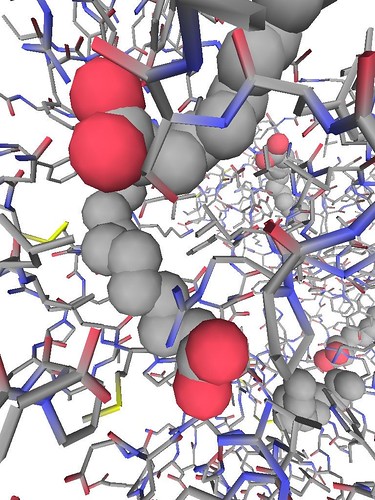
In Cmol I can view structures that I’m currently working on or download any molecule that is available from the Protein DataBank (PDB), the free public depository of biomolecular structures (proteins, DNA and RNA). There are then a variety of ways that I can select and represent different portions of the structure. In the example below — a picture of the albumin protein found in your blood serum — I am showing the bonds between protein atoms as sticks coloured by atom-type: oxygens are red, nitrogens blue, carbons grey and sulphurs yellow; the atoms of the fatty acid molecules that albumin carts around your body are represented as coloured spheres using the same colour code. It’s a complex image but I hope you can get some sense of how it might be deciphered.

Human serum albumin on Cmol

The real success of Cmol is the way the program levers the interactive capabilities of the iPad. With one finger you can rotate the molecule, with two you can move it across the screen or zoom in. The view may be two-dimensional but the interaction — the hand-eye coordination — makes the encounter truly immersive. It is almost as good as using 3D goggles, which we wear in the lab for heavy-duty structural work.

Now that’s all very well for me and for other structural biologists but few outside our monkish, molecular discipline can access this lovely experience. For many biologists and biochemists, never mind the public at large, the idea of downloading and displaying a PDB file — the structure of a protein molecule, say — is about as conceivable as parsnips on Pluto. Despite some laudable efforts, such as the PDBwiki, the complexity of these structures and the abstruse coding of PDB files hides them from view.

For the general public, apart from the iconic image of the DNA double-helix, I suspect there is little grasp of the molecular intricacy that sustains life, and therefore no feel for the subject. The molecular question simply doesn’t arise and that is a disappointment to me. The starry universe out there is familiar to many people, but there is a whole universe inside every living thing on Earth that, sadly unknown to most, seethes with as much variety and wonder as the contents of the night sky.

Paradoxically, the big stuff that is so far away is much more familiar than the small stuff — the molecules — of which we are made.

But there’s no paradox. Sagan, Cox, Singh and their ilk have helped us to befriend the universe by revealing our connection to it. That supernova might be light years away but it was just such an explosion that created the elements that made us and our home planet. The fascination with the possibility of life on other worlds is fuelled by the dreadful excitement of how that would change our conception of ourselves.

And so it should be with molecules. Is it intrinsically more difficult to tell the story of the multitudinous building blocks of the living cells of our bodies? I don’t believe it; or don’t want to. After all, the connection is obvious, even if it is too often blindingly so. But I know from experience that making the connection to the reader is not easy. To tell a gripping molecular tale, you probably have to work at least as hard as Father Ted.

Posted in Astronomy, Protein Crystallography, Science | Tagged , , , | 54 Comments

Interesting Times

“May you live in interesting times”, goes the Chinese curse. Chinese scientists are certainly living in interesting times (as reported today in Nature) but they are unlikely to see it as a curse. The budget of the Chinese Academy of Science (CAS) has increased sevenfold since 1998 and is set — as part of bold plans — to rise 70% in the coming year. There may be a new-found emphasis on applied research in the Chinese Innovation 2020 plan but it is difficult to argue with budget increases of that scale.

Today we also saw something of the interesting times that are affecting UK science, but the outlook is not so rosy. Pfizer announced the closure of its research and development facility at Sandwich in Kent which employs 2400 people, many of them scientists. The government’s Business Secretary Vince Cable refused to interpret the decision as a vote of no confidence in the UK as a place to do high-tech research. That rings a little hollow given reports of Pfizer’s recent investments in — you guessed it — China.

The government produced further evidence today of its lack of strategic scientific thinking when Education Secretary Michael Gove announced the termination of ‘golden hello’ payments to new maths and science teachers. As the Campaign for Science and Engineering (CaSE) makes clear, the scheme is to be axed even though the country is still desperately short of teachers in these key areas. Disappointingly, the evidence base for the decision remains a mystery.

All very interesting, but rather than standing around shrugging at our misfortune, scientists in the UK need to speak up. Thanks to Parliament, there is the opportunity to do so.

Imran Khan, Director of CaSE, has provided a very useful survey of the science funding landscape in the UK now that the government has laid out its spending plans in detail. The initial settlement was greeted with a general sigh of relief back in October 2010 — we all know it could have been worse — but now we also know that the flat cash budget for the next four years has been melded with deep cuts in capital expenditure.

It’s not yet clear how that will play out, but Parliament is taking a keen interest. In the words of Andrew Miller MP, Chair of the Parliamentary Science and Technology Committee:

“Difficult funding and implementation decisions in many areas will now have to be made by the Government and key budget holders. As the dust settles over the coming months, it will begin to become clear where the key pressure points will be, and how decision will impact on the UK scientific and research community and our world-renowned science base.”

In evidence given to the Committee last November science minister David Willetts has, understandably, defended the government’s position. The Committee has also taken the views of the chief executives of the Research Councils.

But now the MPs are also asking for submission from scientists themselves; commendably the Committee wants to have the view from ground level where the bite of reality is most keenly felt. So it is down to us — the working scientists — to give it to them. If you still think that science is vital, I urge you to consider making a submission by April 27th.

Regrettably, I think you’re likely to have something interesting to say.


Update (2-2-11): This was written in haste last night and I forgot to mention the other piece of the UK science jigsaw puzzle that the government seems unable to fit together – the impact on universities of visa restrictions that will limit the number of overseas students coming to the UK. As reported in the THE yesterday, it was the turn of the Home Affairs Committee to take evidence. Let’s hope they talk to the Sci Tech Committee, so that at least Parliament is joined up (though of course visa restrictions will affect all subjects).

Posted in Science, Science & Politics | Tagged , | 26 Comments