It is the day after the day after the fortnight before. I had hoped to write sooner about the relentless work and tremendous fun I had participating in I’m a Scientist, Get me Out of Here over the past two weeks. But such was the nervous energy expended in the last week that it has taken me till now to recover my bearings.
Exhausted and distracted with anxiety, I was massively relieved to see posted on Twitter at 3:30 pm last Friday the news that I had emerged finally as the winner of the Imaging zone! My head was spinning – how did that happen?

It had all started back in mid-April. That’s long enough ago for me to have forgotten precisely how I first heard of the competition but I think it may also have been from a tweet on Twitter. I made some tentative initial enquiries about the likely time commitment and was told it should be about 2-3 hours per day for the duration of the event. I’d say that proved to be an underestimate, but I’m not complaining.
One hundred scientists took part in the event, which aimed to connect them with 5000 school students from around the UK. The scientists were divided into twenty teams of five and competed against one another to impress and engage the students. I was assigned to the Imaging Zone with four other scientists–Pete, Steve, Marieke and Tom–since, in various ways, we look at things in our research.
For the first week we were all involved in answering questions posed by the students the schools assigned to our zone. This happened either offline–we would get emails notifying us that questions were waiting to be answered on the Imascientist web-site–or online in real time during a live-chat.
The live-chats were shockingly intense. The students in their classroom would fire question after question into the chat window on the left-hand side of my web-broswer window. In the panel on the right the scientists would be hammering away at the keyboard trying to keep up with the flow of the conversation and the stream of new queries.
These sessions were insanely good fun. There was an entertaining mixture of serious and not-so-serious Q&A and plenty of banter back and forth. “Xbox or PS3?” “Do you believe in God?” “What infectious disease would you like to cure?” “What is the most important thing you have done in science?” “Why is a rainbow curved?” Gaaah! – even recalling these rapid-fire demands is setting my heart racing again.
But these forty-minute bursts of contact were vital in establishing a lively contact with the students. I was glad that I’d been on Twitter for about a year and had some practice at bashing out a pithy statement in as few words as possible. That way I could at least try to keep up with the flow of interrogation. But it was all so fast. Sometimes a student would come back from your answer with a follow-up question but by that time I’d answered two more and lost the thread! To counter-balance my woeful memory I tried to keep things light and humorous with the kids, though always had something serious to say to a serious question.
Through speedy typing (achieved by relaxing my spelling) allowed me to answer as many different students as possible and, by keeping up a sense of fun, I think I was able to garner support during the live-chats. It was harder to know if the more considered answers given to offline questoins were getting through to the audience since there was little feedback on these. In total over 400 questions were posed and answered in the Imaging Zone during the two weeks. The answers varied in length from a one liner (Will pigs ever fly? Yes, on the day I am awarded the Nobel Prize), to much longer, researched responses to much tougher queries: How do magnets work? Why is an orange called an orange but a banana is not called a yellow? How do you know your experiments are right? Will we ever cure cancer?
Dealing with these questions took hours and hours, some snatched during the working day, but mainly in the evenings and weekends during those two relentless weeks. I tried to keep on top of them, answering within 24 hours but this wasn’t always possible. One of the difficulties in pitching the answer was not knowing how old the student was who’d posed it. They could have been any age between 11 and 17 – quite a range. But the questions provided an amazing insight into the minds of these young people: interested, zany, imaginative, committed to their world. They think large in a way that I have too often lost sight of.
By the end of the first week I thought I was doing OK, but a browse through the students’ profiles showed that most of those who had indicated a preference had opted for one of the other scientists. I wondered whether this might be because my research on the structure of proteins and RNA was not something they could easily connect with. I was up against cosmology, particle physics and brain scanning – all very sexy topics.
That thought impelled me to make what seems to have been my master-stroke. The winner of the competition is awarded £500 to spend on a science communication project and each of us had been asked to write in their profile what they were planning to do with the dosh. My aim was to make a video to show something of the reality of science. Oddly perhaps, I wanted to expose the ordinary side of being a scientist and to offer the reassurance that you didn’t have to be a genius to do it.
And so last Sunday I got up with the germ of an idea in my mind and a few sketched notes. I wrote out a script, linked each line to ideas for camera shots and headed to the Imperial College campus in South Kensington with my family/film-crew to shoot the trailer to my film. It was a frenetic day but just after the stroke midnight, having nervously watched my wife’s reaction as she previewed the film, I upoaded it to YouTube.
On Monday morning I was ready to roll and launched my tactical strike. My blogpost was ready, I had also added the film to my Imperial College website (knowing that many schools would block YouTube), I’d updated my Imascientist profile with the relevant links and tweeted like mad to whip up a bit of interest.
Pretty soon it became clear that some of the kids had seen the trailer. A couple mentioned it in offline questions and others did during the first live-chat of that week. More importantly, thanks to the input and involvement of my own teenage children, I think it was pitched at the right level.
Tom Hartley, who became my toughest opponent, kindly tweeted his admiration of the video and my all-black ‘ninja’ attire. Soon thereafter I somehow (?) became dubbed the “Ginger Ninja“, a moniker that stuck for the rest of the week. I can’t say I was altogether displeased. 😉
Things hotted up considerably in the second week because from Tuesday the kids started to vote for their favourites and the least popular scientist was evicted. Pete went, and then Steve, leaving myself, Marieke and Tom to battle it out. But though each one of us was determined to win, we shared lots of supportive banter on Twitter and in the pre-amble to the live-chats. During the chats themselves, I had no time at all to even look at what the other two were writing, never mind try to get involved in their conversations.
By Thursday night only Tom and myself were left standing. Tom went into over-drive and amazingly, in a single night, pulled together a video of his own to explain his science and his inspired plan to scan the brain of a class teacher should he win.
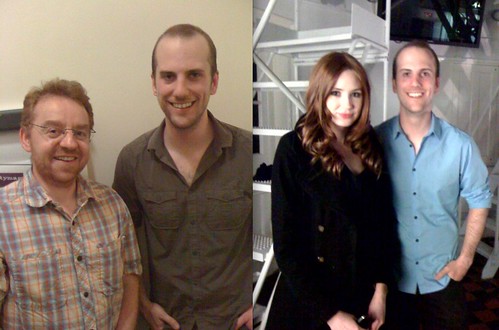
I headed to the pub that evening but still wasn’t leaving anything to chance. I had no delusions whatsoever about being home and dry. Luckily for me I bumped into Colin Stuart, a freelance science writer and broadcaster who works at the Royal Observatory in Grenwich (whom I’d first come to know through a bizarre coincidence). I knew from Twitter that he’d been present when a recent episode of Dr Who was recorded at the observatory and had been lucky enough to meet and be photographed beside the very lovely and — more importantly — the very ginger Ms Karen Gillan, who plays Amy Pond, the Doctor’s feisty assistant. The ginger theme had cropped up several times by then (one student evern directing me to the entry on ginger at Uncyclopedia – funny, but ouch!) so the opportunity seemed too good to miss.
On the spur of the moment I asked Tom Whyntie to take a picture of me standing beside Colin so that the Ginger Ninja was able to make one final strike and offer the students a last-minute Dr Who Spot-the-Difference puzzle on Friday morning. (I think I’m in the picture on the left.)
For the rest of that day it was hard to focus on my work. We had no live-chat scheduled for that morning, so Tom and I were left to while away the day as best we could. By 3 pm I could no longer bear to be in my office and headed out into the sunshine to try to distract myself for half-an-hour.
The announcement, when it came, was a massive relief. I’m really not sure how I’d have reacted if I been beaten at the last. Probably badly. I felt awful for Tom who had fought so valiantly and worked so hard to fire the students’ interests; my guess is that he wrote the most detailed answers to the offline questions. He conceded defeat with enormous grace and for that I honour him.
The immediate aftermath was a whirl of congratulations on Twitter and the slow-dawning realisation that I really am going to have to make that film…!
But I don’t want the buzz of Friday to obscure the more important point. We all wanted to win but what we all wanted far more was for the students to be engaged. In that I have no doubt that we succeeded. The level of engagement was really quite astounding. There was no bull-shitting from the scientists. Though there were plenty of injections of humour — on all sides — all questions were handled with seriousness and modesty by the scientists. Sometimes we had to look things up (I made extensive use of Wikipedia – and said as much) or we simply acknowledged that we didn’t know. I hope that will bury any false impression of scientific infallibility. Above all we wanted the students to see that real scientists are real people–interested and interesting but flawed and finite, just like themselves.
Compared to the fireworks that sometimes flare up on twitter or in blog comments, it was certainly noticeable that the tone of the conversations was invariably positive and good natured (even if some students did try it on by cutting an pasting esoteric scientific tracts during the live-chats. But I guess that is to be expected from lively teenagers!).
I have a few quibbles with the layout of the Imascientist web-site and would like to see more of a discussion developing from the off-line questions but now is not the time for that sort of feedback. The two weeks were surperb, intense, anxious, fantastic and fretful. I’m glad it’s over and can now turn my mind back to some pressing research matters. But I’m so proud of myself that I stepped up to take part.
If any scientist reading this is now thinking about signing up for Imascientist 2011, I urge you to stop thinking and DO IT!