This is not good enough

In a letter that I received this week from the Wellcome Trust about my grant application I read: “The Committee commended your engaging lay summary, which was deemed to be one of the most entertaining ever presented.” That was very good of them to say so. But it was not good enough.

That’s because the statement was preceded by the news that “whilst the Committee agreed your application had merit, the competition was strong, and as a result, we are unable to support it.” In other words, “this is not good enough.”

The comments from the referees, which were attached to the letter, universally praised the value, content and design of the proposed program of investigation. There were some niggles about particular priorities, but these were offered constructively. One referee made a better argument for the project than I had made myself in the application. But this was not good enough.

We have worked hard on this project over the past several years, generated new protein structures, new results, new insights. And published papers. By many measures our investigations have been very successful. But this is not good enough.

I have written elsewhere about the thrill of science, trying to explain why I love being a scientist. There is great joy in discovery, in living by your wits. I have fantastic memories of the good days, some very recent. I know there will be more. But today, this is not good enough.

I knew when I set out on this journey that I was casting loose on uncertain seas. I rejected safe passage through a career in the National Health Service. I knew that as a scientist I would always have to operate at the very limit of my abilities. Anything less would not be a life. But today, this does not feel good enough.

There is nothing special or unusual in what has happened. This eviscerating experience of rejection is by no means unique. It is shared by all scientists. It is the life we choose. But today, the comfort derived from knowing this is somehow not quite good enough.

However, tomorrow is another day.

Posted in Uncategorized | 36 Comments

I confess

There is something inherently confessional in a blog, even in a science blog. There is an urge to reveal—do you feel it?—that is normally kept safely in check. Mine is pretty well locked down. And yet I admire those who, on occasion, have cast off their reins and opened their hearts with great honesty. I think particularly of Richard’s pieces on “depression” and, more recently, faith. The opening lines are enough impart a tingling, cliff-jumping sense of danger. I’ve never really felt moved to take the plunge – until now.

So here goes my confession. It will be rather shocking to some, perhaps to many of you.

Hup.

Continue reading

Posted in Music, Scientific Life, Uncategorized | Tagged , | 72 Comments

Are you being served?

Working at home last Thursday, trying to get some quiet time to focus on a review article, I caught the lunchtime news and heard of the untimely death of the actress Wendy Richard. She was best known as Pauline Fowler from long-running BBC soap Eastenders. But those of an—ahem—older generation may remember her more fondly as the ditzy Miss Brahms, one of the bizarre cast of characters from Are you being served?, a 1970s sitcom about the staff of Grace Brothers Department store. Despite the title, service seemed to be the least of the their preoccupations.


Wendy Richards as Miss Brahms

Which is a bit like Open Access sometimes, a topic that crops up frequently, most recently on Caryn Schectman’s blog. It’s supposed to be about serving information more freely to the scientific community (and anyone else who’s interested) but sometimes, although the data are now public (_The truth is out there!_), they’re not always so accessible. I’m not talking about papers—download, print (or perhaps not), read—but all the raw data that are now accumulating at sites around the world. As Heather has mentioned, getting your hands on it is not always that easy.

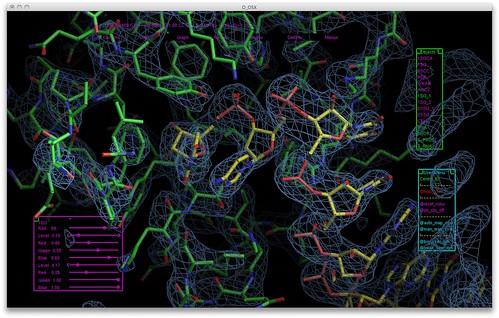
But returning to my desk last Thursday, I found a very nice example of Open Access working well—for me at least. I wanted to check out a detail in a figure of a protein-RNA complex in one of the papers I was reading. Was that hydroxyl group really in that position I asked myself. I wanted to to have a look at the electron density map that the model had been built into for myself.

And I could, using the Electron Density Server (EDS). Let me explain very briefly: when protein crystallographers publish a new structure these days, they are required to deposit not only the coordinates of the macromolecule with the PDB, the Protein Data Bank, so that anyone can have a look at it on their computer*, but they must also send in the structure factors, colloquially known as F’s. The F’s are basically the raw data and allow you to reconstruct the electron density map that was used to guide construction of the atomic model. But only a seasoned crystallographer would know what to do with them; and even then, there is a bit of an activation barrier between grabbing the F’s and running the programs needed to generate the maps.

Thanks to the Electron Density Server, it took me all of 30 seconds to go from “Hmm, I’d like to check that out” to “Oh, I see what they mean.” On the EDS web-page you simply enter the PDB identifier for the structure (taken from the paper) and it immediately serves up a package of files that, once unzipped, lets you fire up the molecular graphics program O. You can then get straight to work: in the O session the structure coordinates and maps are already loaded. The EDS is a fantastic piece of work.

Protein-RNA complex and electron density
Check out the atoms on that!

Now, it’s still not for everyone. In part that’s because of the nature of the data, since you need to have some understanding of the crystallographic method to be able to interpret the maps. And O does have a bit of a learning curve (though if you can find a friendly local crystallographer, I reckon they could take you through the basics in 10-20 minutes). So, if you’re a neophyte, you would probably want pretty badly to have a look before you had a go. But for the crystallographic community the EDS is a great resource – it serves up the data with a smile.

Now I’m still not ready to run with the radicals of the Open Science movement who want to lay every single pipette action before the public in real time, but—if a result is published—I do want to be able to see the data. The EDS is, I hope, part of a growing movement that is affecting all fields of science. So I look forward to easier access, in all areas.

 
*Though it’s also an interesting question of how easy it is for non-structural biologists to grapple with pdb files and molecular graphics programs, even when they don’t care about the electron density. Perhaps a topic for another day.

ResearchBlogging.org

Gerard J. Kleywegt, Mark R. Harris, Jin yu Zou, Thomas C. Taylor, Anders Wählby, T. Alwyn Jones (2004). The Uppsala Electron-Density Server Acta Crystallographica Section D Biological Crystallography, 60 (12), 2240-2249 DOI: 10.1107/S0907444904013253

Posted in Protein Crystallography | 19 Comments

So last week

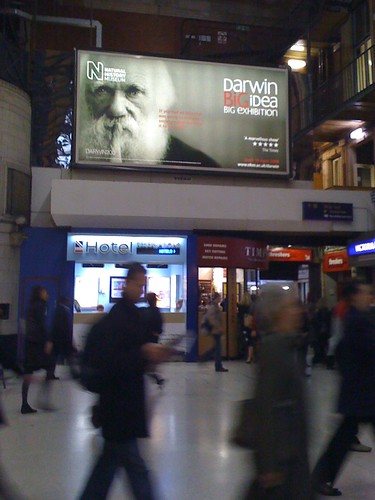
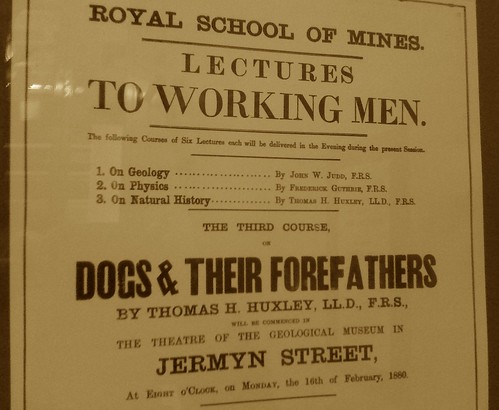
I know, I know. He’s been done to death, but I realised this morning that I have been walking past this poster for some weeks now and it’s always pleased me. I think, somehow, it still seems a little… subversive.

Darwin, ssshhh!

Posted in Uncategorized | Comments Off on So last week

Are you going to this seminar? Huxley’s speaking.

Oh wait, I’ve just checked the poster and we’re 129 years too late. Damn.

But if you had been in the Piccadilly area at 8 pm on Monday 16th Feb 1880, you could have attended his talk on ‘The characters by which dogs resemble and differ from other animals’, the first of a series of six lectures on ‘Dogs and their forefathers’. The whole series would have set you back a mere sixpence. Sorry, I’m afraid it was for working men only: Huxley was ahead of his time in many different ways, but not in all.
Huxley's Lecture Poster
Huxley’s poster, sadly somewhat hidden on the backstairs of the Imperial College Library

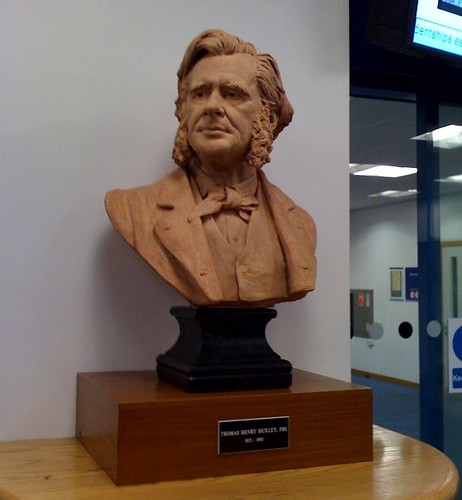
Thomas Henry Huxley is perhaps chiefly remembered as Darwin’s bulldog, the man who famously jousted on evolution with Bishop Wilberforce at Oxford in 1860 in the aftermath of the publication of On the Origin of Species. But his contributions to 19th Century science were far wider and deeper than his stout defence of Darwin’s work. I am reminded of this every day because my office at Imperial is in the Huxley building. Alas, this is not one of Imperial’s finest architectural statements (1), but once through the rather anonymous entrance on Queens Gate, you are greeted by the bust of Huxley, overseeing proceedings with an affable eye and checking that his legacy is in good shape.
TH_Huxley
Our patron, keeping a watchful eye

Huxley studied medicine for considerably longer than Darwin. But though he served as an assistant surgeon—and amateur naturalist—on the five-year voyage of HMS Rattlesnake (1846-50) to explore the north-eastern waters of Australia, he never completed his medical education. Instead, on his return to London he threw himself into scientific pursuits, principally anatomy, physiology and palaeontology. By chance in 1854 he secured a temporary lectureship at the Royal School of Mines (now part of Imperial College), a post that he held on to for thirty years.

No shrinking violet, Huxley was always eager for a public forum to promote science, and not just to the genteel classes who supped it with glasses of champagne at the Royal Institution on a Friday evening. Huxley’s lectures to working men were an integral part of a broader program to raise the status and impact of science in 19th Century society. Huxley also served tirelessly on the first London School Board in 1870, just as primary school education was being made compulsory for all children in Britain. In this role he strove to establish a place for science alongside the classics in the school curriculum. He was also instrumental in pioneering formal training in science at university.

Huxley’s skill as a sharp-witted writer and public speaker soon brought him to prominence. He clashed early on with Richard Owen—then England’s finest anatomist—being rankled as much by Owen’s selfish character as by his conservative approach to palaeontology. Though Owen was highly regarded by many and often compared to Cuvier, the French master of this field, Huxley’s view was dimmer:

What a capital title that is they give him of the British Cuvier. He stands in exactly the same relation to the French as British brandy to cognac.

That sharpness of tongue was never to leave him. It was deployed masterfully in his debate with Wilberforce and many times later in his published exchanges with defenders of the biblical account of creation, among them Prime Minister Gladstone. A correspondent from Devon who wrote to the Pall Mall Gazette to complain about an article by Huxley received the reply:

A Devonshire man is good enough to say of me that ‘cutting up monkeys is his forte, and cutting up men is his foible.’ With your permission I propose to cut up a Devonshire Man; but I leave it to the public to judge whether, when so employed, my occupation is to be referred to the former or latter category.

His combative spirit could sometimes get the better of him—there’s little doubt in my mind that he would have made an enthusiastic and engaging blogger on Nature Network. His taste for debate, especially on religious matters, earned him the sobriquet Pope Huxley from some quarters, and arguably deflected his intellect from scientific matters where it might have been more gainfully employed. It might even be said that Huxley wove the mantle later picked up by Richard Dawkins, though he was always less militant, coining the term agnostic and adhering to that position till the end of his life.

But Huxley was not simply out to antagonise religious types. His wider agenda was to clear a space for science, free from ecclesiastical interference. He fought and campaigned not just to have Darwins’s ideas heard but for science itself to be regarded as part of the core of our culture. In that he succeeded admirably and it’s a shame we missed that lecture.

Notes
(1) The present Huxley Building is a rather gruesome concrete monstrosity. The original edifice—now the Henry Cole Wing at the V&A Museum—is much more impressive.

For more on Huxley (I fear I have done him a disservice in this very brief sketch), check out Albert Ashforth’s Thomas Henry Huxley (Twayne Publisher’s Inc, New York, 1969). It’s an easy read at only 162 pages. However, having tasted the aperitif, I am definitely tempted by Adrian Desmond’s Huxley: From Devil’s Disciple to Evolution’s High Priest (available from Amazon), based solely on my enjoyment of his biography of Darwin (co-authored with James Moore).

Posted in Uncategorized | 11 Comments

Chance can be a fine thing

There was an old man from Downe, Kent
Who found man arose by descent
He said, “This may grate:
But my friends we’re primate,
Give thanks for life’s great accident!”


I’m having fun with this (hey, it’s the weekend and half-term), though I think the affectation affliction will end soon…

Posted in Uncategorized | 6 Comments

Ode dear

Charles Darwin
Was a star in
Eighteen fifty-nine

His theory
Caused a fury
Among lovers of design

“No Adam?
Far too random –
That’s never a solution!”

But Charlie smiled –
He was not riled:
“Sorry, that’s evolution.”


It’s catching on, this Darwin thing.

Posted in Uncategorized | 8 Comments

Back to the road not travelled

Last week I took the train through a snowy landscape to Warwick University to give a seminar at the Department of Chemistry. I arrived a little early to catch up with a couple of virologist friends; in the coffee bar we chewed over funding politics and hot topics in viral replication. I met my hosts for lunch and a pleasant chat about common interests in serum albumin. That was followed by an intense couple of hours talking to several of the chemists in the department about drug synthesis, catalytic mechanisms, analytical tools for studying membrane proteins and the intriguing transport properties of albumin. My head was buzzing with information by the time I stood up at 4 o’clock to present my talk on the structure of the 3C protease from foot-and-mouth disease virus (FMDV). Sociable to the last, we repaired to the bar for a drink before I got a cab back to the station.

A very good day all-in-all. I do enjoy getting out and about to give seminars. There’s great stimulation in meeting the demands of explaining your work to the wider scientific community (a good time to start thinking about what the results really mean!) and in engaging with new people and new ideas. It’s the very stuff of science.

But it could all have been so different. My visit reminded me that twenty years ago, as a fresh-faced graduate trainee with the National Health Service (NHS), I attended management training courses at the Warwick University Business School. Having completed my PhD, the roads ahead diverged: I was at a loss as to what to do next in science and so decided to take a completely different route. I thought running a hospital might be a worthy and challenging alternative.

I was right. But at the same time, completely wrong. The management courses at Warwick were fantastic—hugely stimulating—but hospital management was not for me. Too much wheeling and dealing with people to get even relatively simple things done. I was no good at it and, for the first time in my life, hated going to work. The job was certainly worthy and challenging, but that was not enough—nowhere near.

So after a few months I started applying for postdoctoral positions and eventually found myself at the Institute for Animal Health where I made my first acquaintance with FMDV. I was home again and have not looked back. Until today.

I think if I had joined he NHS after my first degree, I might well have stuck with it and made my career in hospital management. But doing the PhD spoiled me, in both senses of the word: although I didn’t fully realise it at the time, I was infected by science and that has made all the difference.

Posted in Uncategorized | 22 Comments

Abandoned post

Abandoned

Posted in Uncategorized | 12 Comments

X marks the spot

X.

Posted in Uncategorized | 8 Comments

Snow stopper

This post is completely justified since crystals are a central topic at Reciprocal Space and I awoke this morning to a landscape covered with them:

WW-winter

Snow has the wonderful property of making the world look fresh and new. Even the disaster area known locally as ‘our back garden’ manages to look appealing under its cold white blanket.

The schools are closed so the kids are delighted and, as I type, champing at the bit to get outside. There’s only about 6 inches, which is nothing in Finnish, Torontoan or Bostonian terms, but round here life has ground to a halt. There are no trains into London. The weather even seems to have crashed the web-site of Southeastern Trains:

SE-trains

Looks like I’ll be working from home.

Posted in Uncategorized | 64 Comments

You can call him Al. Again

It’s over. And over a week ago at that. But I only finally caught up with the third and last episode of Prof Jim Al-Khalili’s BBC4 series Science and Islam last night.

I flagged it up just before the series started and had been quite excited, having enjoyed Atom, Al-Khalili’s earlier documentary about the hey-day of physics in the early 20th century. It didn’t quite deliver at the outset, although things improved with each episode. The final program was easily the best of the bunch and unearthed some telling detail about the influence of Arabic/Islamic astronomy on Copernicus.

Overall I think it was a worthy effort, though you really can’t get through much material in three hours of telly. I’m tempted by the book (actually written by someone else – Eshan Masood), since it is an important period in history, especially given the current parlous state of relations between the west and the middle east. You can hear more about the Abbasid Caliphs who started of the Islamic Empire on In Our Time.

I would go on but there’s a more considered review of the series on Andreas Forster’s blog. Andreas is a postdoc at Imperial who tells me he is “thinking about” getting started on Nature Network. So how about heading over there to read his piece, leave a comment and encourage him with some of that world-famous NN lovin’?

Posted in Astronomy | 12 Comments