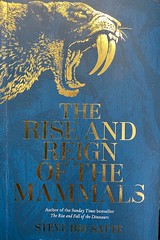
 Steve Brusatte: The Rise and Reign of the Mammals The ink hardly dry on his bestselling The Rise and Fall of the Dinosaurs (which I reviewed here) palaeontologist Steve Brusatte returns with what can only be the natural successor. It’s an odd thing, that compared with dinosaurs, fossil mammals seem strange and remote to us, when we are ourselves mammals, and mammals outshine dinosaurs in every way. Mammals evolved at around the same time as dinosaurs, and, after a slow start, diversified into forms both smaller than the smallest dinosaur and larger than the largest. Blue whales are mammals: the largest have a mass of 110 tons and can exceed 30 metres in length, making them the biggest animals that have ever lived, bigger than the whoppingest dinosaurs, and unlike dinosaurs they are alive now. ‘How glorious is it that we breathe the same air as a blue whale, swim in the same waters, and gaze at the same stars?’ says Brusatte. Whales rule the waves, which dinosaurs never did: bats, in contrast, have conquered the air, which dinosaurs only did when they became birds. And mammals have produced humans, the only animals which, as far as we know, are capable of reflecting on their own existence. And yet Brusatte has a mountain to climb, acquainting readers with a welter of unfamiliar extinct animals, the ancient cousins of mammals. It says something about the popularity of dinosaurs that one of these, Dimetrodon, is regularly grouped in the popular imagination with dinosaurs, a case of palaeo-cultural misappropriation if ever there was one. And there is rather a lot about teeth. Yet Brusatte’s enthusiasm surmounts these challenges, interspersing anatomy lessons with evocative you-were-there descriptions of life at various key stages in mammalian history — and a lot of anecdotes from the life of a field worker. My favourite was the tale of when, after an exhausting and mostly fruitless day prospecting in the backwoods of Poland, filthy and sunburned, Brusatte calls in on the veteran palaeontologist Zofia Kielan-Jaworowska — and is greeted by her ferocious Pomeranian, which fastens its efficiently mammalian teeth into his leg. I should say at this point that other books on the evolution of mammals are out there. Beasts Before Us by Elsa Pancirolli covers the same ground (according to the blurb – I have not read it). And Brusatte’s comprehensive notes don’t mention a wonderful recent book on Ice-Age mammals, Vanished Giants by Anthony J. Stuart. DISCLAIMER: This review is based on advance uncorrected proofs sent by the publisher.
 Alastair Bonnett: Off The Map Here on the Norfolk coast I am always searching for new beaches to explore. Norfolk is a big county, and has lots of beaches, and there are still beaches which one can have more or less to oneself, even at the height of the summer. It had always occurred to me that there seemed to be no access to the beach on the fairly long stretch of coast between the villages of Overstrand and Mundesley, so I went looking for it — on Google Earth. Near Trimingham I saw, as if from space, a collection of cars parked neatly just next to a wide sandy beach. How had I missed this? Tracking back, I saw that it was accessible via a dirt road, so I set out in the car to find it at ground level. A turn-off from the main road led to the potholed dirt track, and I could immediately see why I’d have missed it before: the turn-off was headed with a large sign that said (now, I might be paraphrasing slightly)
TRESPASSERS WILL BE SHOT
with the subheading
SURVIVORS WILL BE SHOT AGAIN.
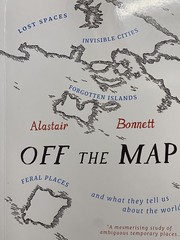
Naturally I decided to explore further, and at the end of the track found a car park maintained by the local council, and meant for public use, for all that the car park was free (a novelty), with easy access to a wide, sandy beach. Ever since then it’s been our favourite beach for walking the dogs. Although — it must be said — quite a lot of other people know about it (it is adjacent to a modest caravan site) part of the charm of this beach is that it’s in some way a secret, and belongs to us. This creates a camaraderie between the users of the beach, no matter how transient they may be, that is absent from beaches that are more generally accessible and which have better facilities (no ice-cream van has, in my recollection, braved the potholes down to the beach, which is also sans beach huts, sans caff, sans shop, sans public loo, sans nearly everything). By being slightly off the beaten track, it has become just that little bit special. No, I am not giving you the co-ordinates. That a sense of place has meaning to human beings is the theme of this charming book, which, in its collection of 47 cartographic oddities, is an appeal to the importance of topophilia – a love of place. Failure to recognise this leads to consequences that vary from the amusing to the tragic. Among the motley collection of locales is Leningrad, a kind of alter ego to St Petersburg; the two fractally intertwined villages of Baarle-Nassau and Baale-Hertog, one in Belgium and the other in the Netherlands, each no more than a doorpost away; and the multiple enclaves-within-enclaves of the Chitmahals between India and Bangladesh whose inhabitants suffered discrimination from both states (a situation resolved in 2015, after this book was first published). One is reminded of China Miéville’s urban fantasy The City and the City, in which two entirely different cities share the same space (indeed, the author mentions this book). There is the urban landscape of Bonnett’s native Newcastle known only to foxes; the lay-bys known only to doggers; and Sandy Island, a sandbar in the South Pacific known only to cartographers, but which doesn’t actually exist at all. Through it all is a sense of regret that our sense of place has been replaced by a preoccupation with the journey. Old Mecca, for example, has largely been demolished, consisting mainly of the Grand Mosque where pilgrims gather, and the hectares of parking lots and hotels required to accommodate them. And there’s a parking lot at Los Angeles International Airport (LAX) that is a shanty village of campers that house the often transient airline staff, but with no power or running water. At the opposite extreme are the luxury cruise ships that have become a home from home for the super rich. Everywhere — but nowhere. A poignant read.
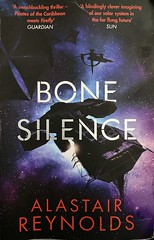 Alastair Reynolds: Bone Silence The astute reader will note that I reviewed a Reynolds last month. That one, Inhibitor Phase, from his Revelation Space universe. Bone Silence, though could hardly be more different. It is the final part of a trilogy (the first two are Revenger and Shadow Captain) and although it stands alone, it does so only just. I had read the first two and although I only had vague memories of them, I wonder if I’d have struggled without having done so. The scene is our Solar System but as you’ve never imagined it. Ten million years in the future, all the planets have been broken up into a ‘congregation’ of twenty thousand worldlets. This is a brilliant conceit, for it means that the spaceships that ply the worlds can be powered by solar sails, passage can take weeks or months, and Reynolds can make the destinations as exotic as you like. A kind of steampunk humanity bustles in the busy worlds along with a welter of exotic aliens. Piracy thrives, so the atmosphere is very much Pirates of the Caribbean in space. The entire economy is based on ‘quoins’, mysterious artefacts of alien manufacture not originally meant to be used as currency, that must be ‘mined’ from other small worldlets or ‘baubles’, often booby-trapped. Only the bravest crews get to go bauble-hopping. Another piece of background — we find this Universe during the ‘Thirteenth Occupation’ , the thirteenth time civilisation has risen from a previous dark age. Enter Adrana and Arafura Ness, two spoiled little rich girls from the worldlet of Mazarile, who in Revenger get a thirst for adventure and, trying to slake it, get more than they bargained for. In Shadow Captain they subdue Bosa Sennen, a formidable Pirate Queen, and Arafura especially takes on some of her personality. At the end of Shadow Captain the pair, through some mishap, trigger a change in the quoins such that they depreciate in value, precipitating an economic crisis. Bone Silence finds them having to take a mysterious alien to the remote and moderately lawless world of Trevenza Reach (a wonderfully piratical-sounding faux-Cornish name, for all that it’s more like 1930s New York) pursued all the while by a ruthless fleet of Revenue cutters. The space battles that ensue are terrific and the Pirates-Of-The-Caribbean parts of the book are hugely enjoyable. But as the action unwinds the preoccupations grow more and more existential, as the sisters wonder what quoins really are; why there have been thirteen occupations, and much else. The closing section turns from Pirates of the Caribbean to Rendezvous with Rama, and although the Clarkeian confrontation with vast, ancient artefacts is well handled, the contrast and change of pace seem jarring. Another fault is that after a long build-up the ending seems far too hurried, as if Reynolds were struggling with a deadline, or just wanted out. ‘I am, for the time being, done with the Ness sisters’, he admits in an afterword, though ‘[w]hether they are done with me remains to be seen’. In some ways I am not surprised, for his characters do like to talk. And talk. And talk. Perhaps Reynolds craved some of the silence the title promises.
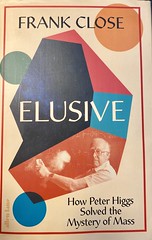 Frank Close: Elusive I love maths. My problem is that my adoration is unrequited. It took two goes for me to get an A-level grade sufficiently adequate to permit me to attend university. Since when I have been on an endless quest for enlightenment that relies on science writers such as Simon Singh (Fermat’s Last Theorem), John Gribbin (In Search of Schrodinger’s Cat), Brian Clegg (The Quantum Age) and Ian Stewart (Calculating the Cosmos), to name but
 seven four three, the result of which is to increase my ardour though not necessarily my understanding, which is of course not the fault of any of these stellar writers, and I have to say this as some of them are my friends. It was John Gribbin who alerted me to the tome currently the focus of our attention, as he’d reviewed it in the Literary Review, the only periodical to which I subscribe (and my subscriptions in the past having been eclectic – from Interzone to The Spectator to Classic Rock, all now lapsed) and I was so enamoured that I decided to buy a copy. But I digress. Elusive is an account of the shy, retiring theoretical physicist Peter Higgs and his invention (I use the word advisedly) of the fundamental particle that, by a curious set of circumstances, one of which depended on an editorial mis-citation in the references of another paper, bears his name. It is by Frank Close, a physicist who knows the subject personally, as well as being conversant with all the technical details, so this is as close to the equine anterior orifice as one is likely to get (see Brian Clegg’s interview with Frank Close here). And it’s a gravitationally attractive read. Peter Higgs (born 1929) is, or was, just a regular working theoretical physicist who happened to have a remarkable insight. Building on work he knew about elsewhere — he had rubbed up against a smattering of other work from molecular biophysics to superconductivity, showing that it pays to read widely outside one’s field — he posited the existence of a quantum field which, through the agency of its associated particle, conferred on all other particles the property we know as mass. In a long professional life in which he published rarely, he formulated his idea and published it in a rush during the summer of 1964. Close reprints Higgs’ two main papers at the end of the book, and it is fair to say that they will be incomprehensible to those of us who never got around to Lagrangians and Fourier transforms and other whatnots of advanced mathematics and so leave us mere mortals gasping at the extreme cleverness of those who have. Close then takes up the story of the massive engineering marvel that is the Large Hadron Collider, whose work finally revealed that Higgs’ boson wasn’t just a mathematical trick, but a real thing — testament again to the wonderful fact that natural phenomena completely outside our range of experience can be expressed in mathematical terms, no matter how abstruse. (It’s amazing to think that the discovery was made ten years ago. I could have sworn it wasn’t as long ago as that, perhaps my impression has been distorted by relativistic time dilation). The particle was elusive as the man, who, a stranger to email and mobile telephony as giraffes are to unicycles, contrived to be out of town when the Nobel Committee announced he was a winner. I wonder if anyone has noticed that the cover photo shows Higgs not writing on the blackboard with chalk (the way that twentieth-century theoretical physicists used to get their exercise) but rubbing things out with an eraser. The confirmation that the Higgs boson exists was the capstone of an era, as it completed physicists’ collection of fundamental particles in what is known as the Standard Model. The problem is what physicists will do next. It took half a century of effort for experimental physicists to confirm the existence of the Higgs particle, and even then they had a good idea where to look. Now that it has been found, it raises many questions that remain unanswered, and may remain so, for to shed any light on, say, why the Higgs boson confers precisely the masses it does on particles (I mean, why is the muon 207 times the mass of its lighter sibling, the electron, and not some other value?) and whether the Higgs boson might have any bearing on other abiding mysteries, such as the nature of dark matter; the proposed Inflationary Era early in cosmic history; or the existence that defies all logic of the Republican Party, would require machinery of a power that would defy current engineering prowess, not to mention budgets, even if physicists could draw up a blueprint for a machine that had any target in view whatsoever. No wonder that theoretical physicists are now in the doldrums, at least according to Sabine Hossenfelder in her book Lost In Math (one of my hits from last year). With no experiments in view, or even possible, they resort to a kind of doodling in which to create equations that are aesthetically pleasing is seen as an end in itself.
 James White: Star Surgeon This is one I picked up secondhand after fond memories of reading James White’s work many, many years ago. It was very enjoyable, but really hasn’t aged well. James White was an SF author, originally from Northern Ireland, best known for his novels and stories set in a gigantic space hospital called Sector General, and starring a Doctor Conway – a human physician in a medical environment that includes a dazzling array of wonderful extraterrestrials, all living in a milieu that’s peaceful and cooperative. Conway’s special friend is a Dr Prilicla, a grasshopper-like creature from a low-gravity world constructed so delicately that it might be crushed by a pithily-worded comment — which is unfortunate as Dr Prilicla is strongly empathic. Star Surgeon, first published in 1963, is the second such adventure, after Hospital Station, but each can be read alone. In this story the hospital comes under attack from a vengeful power due to a series of misunderstandings, and the ever-resourceful Conway has to solve the various problems that come up. It’s a ripping yarn, but it is strange that in a setting in which the riotously diverse extraterrestrials are treated as human beings rather than as monsters, the same enlightened attitude isn’t extended to the other members of the human contingent. All the humans are white (as far as one can tell), and all the important ones are male. The human doctors are all male — the human nurses all female, and are referred to as ‘girls’ who shouldn’t ‘worry their pretty little heads’ about anything consequential. To be sure, one could dismiss this as typical of the times. But darn it, it kept tripping me up and spoiled what might have been a stellar reading experience.
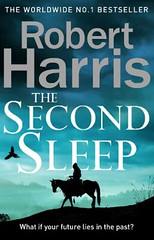 Robert Harris: The Second Sleep Imagine that you are the novelist Robert Harris, who, having lately returned to your home turf of historical fiction closely based on World War II (Munich) has your previous novel Conclave fresh in your mind (a novel I reviewed here). Christian iconography ripples through your subconscious. It’s then that you look at the back of your iPhone and what do you see? An apple with a bite taken out of it – as symbolic of Man’s First Disobedience as anything could be. Being Robert Harris, you plan your next novel, and the result is The Second Sleep. This is one of Harris’ rare excursions into SF. Whereas Fatherland was alt.history (set in 1960s Berlin in a world where Hitler had won), The Second Sleep takes place in a rustic, cleric-dominated England eight hundred years after an Apocalypse of unknown nature. The Apocalypse, it seems, took place when as a result of some unspecified problem, the world’s computer systems all crashed, taking the world’s financial systems with them. The ancients, you see, back in 2025, had long since traded the rustic solidity of stone and bullion for rusting steel, breakable glass, and money as evanescent as electrons. They were paid in electrons for doing jobs as vaporous as smoke – programmers, marketing executives, web designers. And what with the population of London reliant on just-in-time food supplies — dependent on those same electrons — and yet completely unable to fend for themselves, catastrophe is swift and savage. In our bucolic future England, though, pulled up by its bootstraps by the Church (country churches having been among the few buildings that survive from age to age) and in which inquiry into the ancients is a sin, we find Christopher Fairfax, an impressionable young churchman sent to bury the vicar of a remote village who has died in suspicious circumstances. It seems that the vicar had had tastes towards the antiquarian, and the young Fairfax gets sucked in, with dreadful consequences. The Second Sleep therefore joins the shelves of the post-apocalypse novel, especially popular during the Cold War, examples being such titles as Earth Abides, and — the apotheosis of their zenith — A Canticle For Leibowitz. But where the peerless Fatherland, an alternative history, is firmly grounded in Harris’ deep knowledge of the Third Reich, The Second Sleep, while still a cracking read (which one expects from Harris as a bare minimum) is somehow rootless, lacking the mythic depth of Canticle and others of the genre. It also winds up far too quickly. Perhaps Harris felt a deadline looming. Not one of his best, I fear.
 Edward Gibbon: The History of the Decline and Fall of the Roman Empire: Vol I, The Turn of the Tide. Edward Gibbon was born in 1737, the eldest child of seven. He was very sickly, but healthier than his other siblings, all of whom, along with his mother, had died before he was ten. Nurtured by an indulgent father, he went on to make history. Literally so, for Decline and Fall represents the model that all other histories were to follow. This is Volume One of a handsome eight-volume Folio Society set I picked up cheaply on eBay. Gibbon originally published the work in six volumes, so my Volume One isn’t quite as extensive as his Volume One. (It also leaves out almost all his footnotes – which is understandable as there were more than 8,000 of them, apparently). Gibbon’s first volume was published in 1776, the year that the U. S. declared itself independent, and covered the Roman Empire from its height under Trajan (98-117CE) to Constantine; my Volume One only gets as far as the accession of Diocletian (284CE). Although a quarter of a millennium old, and probably less useful as history than it once was, it excels as literature, and is as worth reading today for enjoyment as, say, Bede’s Ecclesiastical History of the English People — which is, of course, very much older than that. Gibbon’s hero and main source, for the earlier parts, is Tacitus, though for much of the rest the sources are French. Gibbon was educated in Lausanne and imbibed the best that the French enlightenment had to offer, from Montesquieu to Voltaire. Gibbon actually preferred to write in French, and it is probably thanks to the advice of his friend Hume that Decline and Fall was written in English instead. And what glorious English it is – as elegant, as well-proportioned, as satisfying to look at, as a Georgian rectory. His prose is so lucent, in fact, that one critic (and I agree) said that one is likely to be carried away on its rolling cadences such that one has to go back to discover its sense. Everywhere Gibbon shows his gentle and humane irony, his understated humour, such as here:
Artaxerxes had served with great reputation in the armies of Artaban, the last king of the Parthians, and it appears that he was driven into exile and rebellion by royal ingratitude, the customary reward for superior merit. (p188)
and here:
The revolt of Saturninus was scarcely extinguished in the East before new troubles were excited in the West by the rebellion of Bonosus and Proculus in Gaul. The most distinguished merit of these two officers was their respective prowess, of the one in the combats of Bacchus, the other in those of Venus… (p297)
and here, describing the talents of the younger Gordian:
Twenty-two acknowledged concubines, and a library of sixty-two thousand volumes, attested to the variety of his inclinations, and from the productions which he left behind him, it appears that the former as well as the latter were designed for use rather than ostentation. [in a footnote he adds] By each of his concubines, the younger Gordian left three or four children. His literary productions were by no means contemptible. (p171)
The prose seems so fluid to the modern reader, his politics so contemporary (an old-fashioned Liberal, or Whig, he found beneficient despotism preferable to what he called ‘wild democracy’, what we would call ‘populism’), his religion so sceptical (he finds much to praise in the tolerant polytheism of the Romans, contrasting it with the intolerance of the Christianity which he sees as one of the causes of Rome’s downfall) — that one is brought up with a start by the general ignorance of the times in scientific knowledge. In a footnote on a passage on the litany of animals killed by Commodus in the arena:
Commodus killed a camelopardalis or giraffe, the tallest, most gentle, and the most useless of the large quadrupeds. This singular animal, a native only of the interior parts of Africa, has not been seen in Europe since the revival of letters, and though M. de Buffon (Histoire naturelle) has endeavoured to describe, he has not ventured to delineate, the giraffe. (p106)
From this one infers that Gibbon had never seen a giraffe – something that we take for granted. Although giraffes were present at the court of the Medicis in the 15th century (Gibbon seems ignorant of this), the arrival of a giraffe in France in 1827 — long after Gibbon’s time — caused a sensation. And in the 18th Century, nobody knew anything about climate change, or Ice Ages:
Some ingenious writers have suspected that Europe was much colder formerly than it is at present; the most ancient descriptions of the climate of Germany tend exceedingly to confirm their theory. (p202).
As to the reasons for the decline, they are various. Gibbon goes back to the foundation of the Empire under Augustus, in whose person combined the offices of tribune and consul – hitherto kept separate so the former could act as a check on the latter. Absolute power led all too often to tyranny. This did not sit well with the fact (mostly honoured in the breach) that the position of Emperor was still nominally a post conferred by the Senate — a solid hereditary foundation might have allowed for a measure of stability. As time went on, Emperors tended to be imposed on the Senate by a fractious and divided military. Here, on a rare instance of agreement between the Senate and the army:
… nor, indeed, was it possible that the armies and the provinces should long obey the luxurious and unwarlike nobles of Rome. On the slightest touch the unsupported fabric of their pride and power fell to the ground. The expiring senate displayed a sudden lustre, blazed for a moment, and was extinguished for ever (p288)
Those who found themselves Empurpled dreaded the inevitably gory death that awaited them an a year or two, but found themselves powerless to resist the mob:
If the dangerous favour of the army had imprudently declared them deserving of the purple, they were marked for sure destruction; and even prudence would counsel them to secure a short enjoyment of empire, and rather to try the fortune of war than to expect the hand of an executioner. (p.251)
Another reason for the decline was the decision by Caracalla (198-217) to make everyone in the Empire a Citizen of Rome. Although this sounds an estimable plan, the motives were governed more by the need to raise taxes than by an urge for equity. But if everyone’s a somebody, then no-one’s anybody, and any Thomasus, Dickus or Harrius could find themselves on the throne regardless of merit, and just as soon deposed. And before one thinks that Gibbon’s condemnation of Caracalla’s move was that of an elitist snob, our thoroughly modern Mary Beard decided to end SPQR, her history of the Roman Empire, at that point.
Reading Decline and Fall is like indulging in a particularly rich and delicious chocolate cake. A slice is nice. Two slices are nicer. But being force-fed the whole cake will make one sick. Therefore I shall leaven my reading of the subsequent seven volumes with literature of a quality that is, if not lesser, at least different.
 The Rev. Richard Coles: Murder Before Evensong Old-fashioned whodunits seem to be de rigeur among the celebrati, and hot on the heels of The Man Who Died Twice by Richard Osman, you know, the Man on the Telly (reviewed here), comes this from Britain’s best-known celebrity cleric. The first rule of writing is Write What You Know, so it’s no surprise that the protagonist, like the author, is a somewhat high-church and deeply learned vicar who keeps dachshunds. This (the churchy part, not necessarily the dachshunds) allows the author to tap into the rich tradition of clerical sleuthery from Father Brown to The Canon in Residence, notwithstanding inasmuch as which the Stephen Capel mysteries by my friend B. C. of Swindon, and, through that, into the well-worn tradition of traditional English whodunits. For this one has everything: the gossipy country village setting; the manor house; the relics of the class system; a large cast of stock characters from the shifty gamekeeper to the battleaxe who runs the Flower Guild; the flinty old spinsters who were in service at the Big House as young women, and so on. It also cleaves very much to the formula — a welter of seemingly unrelated events compost in the protagonist’s mind until he has that blinding flash of inspiration when everything comes together, swiftly followed by a dramatic denouement, and a coda in which several of the main characters get together to sum things up. It’s also a period piece, set in 1988, when home computers and mobile phones (the scourge of modern crime stories) were expensive novelties – but it also allows for people who were young in World War Two to be still alive and kicking. And, not to spoil things, but events that happened in that late unpleasantness bear strongly on the course of this story. It’s not as much of a page-turner as Richard Osman’s whodunits, but what it lacks in zip it more than makes up for in richness, depth and darkness [now you’re sounding like an advert for coffee — Ed]. DISCLAIMER: Although I have had the pleasure of the acquaintance of the author on several occasions, I bought my own copy.
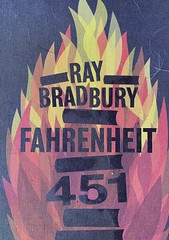 Ray Bradbury: Fahrenheit 451 I found this lovely 50th-anniversary hardback on the shelves of Offspring#1. (The link takes you to a different edition). Neither of us could remember how it got there. Offspring#1 suggests I bought it for them many years ago. I’m amazed I’d never read the book before, though I have very, vague memories of a movie version starring Julie Christie. Now, that takes me back. Written in 1953, it’s a dystopian near-future USA in which books are banned, and the job of firemen such as the protagonist Guy Montag is to find any books that are found and to burn them. The population is kept happy with a constant onslaught of stimulation so loud, colourful and immersive that it leaves them too exhausted to think. Most people (here represented by Montag’s wife Millie) have music piped into their ears constantly by ‘thimbles’ and spend their time watching TV shows, more real to the viewers than real life, in which people talk a lot but never actually say anything. Young people get their thrills by joyriding, killing passers-by and one another for sport. Books are banned not necessarily because they are physical objects but for the ideas they contain. Because they are likely to contain actual opinions, they stir up discord and discontent that might be offensive to somebody – so they must be removed. All modern life is there — reality TV, social media, earbuds, instant gratification, cancel culture, endemic casual violence. The blurb calls it ‘terrifyingly prophetic’. Anyway, when Montag is lured by the magic of books, his life unravels, and, hey, I’m telling you the plot. Don’t read this blog! Read the actual book! And did I say the writing is absolutely beautiful? Lyrical, almost musical, but perfectly balanced with the genre pacing and plot. No wonder it’s one of the classics of science fiction.

 Although we arrived in a somewhat wilted state after eight hours on the road, as attested by the architecturally wayward state of the awning when I erected it (see picture) the Bongo scarcely broke a sweat during the journey.
 We never worked out how to use the inbuilt gas burner, which was OK as we much preferred to brew outside on a camping gaz stove. I also couldn’t work out how to get the water pump to work — the one that pumps water from the jerry can stowed in a rear compartment into the tap in the sink next to the (unused) gas burner. I discovered why — a plug had come loose. I fixed it… neglecting to check that the tap inside was off, and pointing into the sink. Neither was true, and we had a minor flood in which one of the internal lights got fritzed. Oh well.
 We had a lovely break, during which we caught up with our relations and met some very friendly indigenes (see picture) but the time came to depart. By Monday the weather had broken somewhat, and keen to avoid the horrendous roadworks on the M5 motorway, we decided to try the scenic route, driving through mid-Wales until we popped out in the West Midlands in the general direction of Herefordshire. The charming and domesticated hills and valleys of Carmarthenshire slowly gave way to the altogether more wild and rugged terrain of Powys. The road between Llandovery and Builth Wells climbed up and up into the kind of landscape one usually only sees in TV commercials for performance cars. It was only here that the 2.5-litre diesel engine of the Bongo met a challenge, but mainly because I was unused to the gear-changing characteristics of the automatic gearbox.


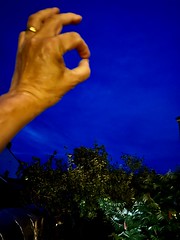 Take a grain of sand and hold it up at the sky at arm’s length. That grain of sand covers a patch of sky equivalent to that captured by