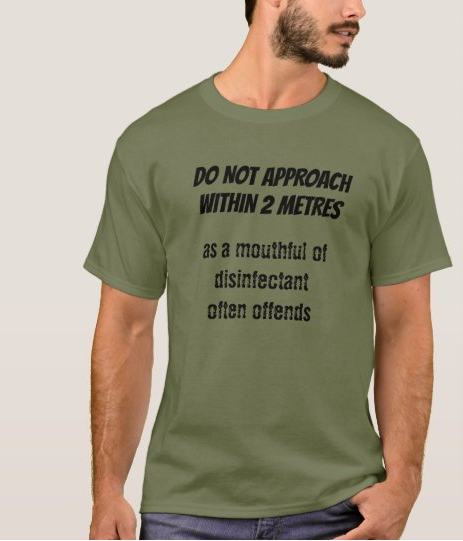
Why Are People So F***ing Stupid?

We are shielding, chez Gee, as one of us has pre-existing health complaints, and another is about to have a surgical procedure. The only person who leaves the house is me, and only to walk the dogs, which I do in quiet woods and lanes to minimize human contact.

So there I was on this morning’s walk in a country lane when I sense a cyclist hovering behind me. I turn round, and there’s a cyclist, who said she didn’t want to startle me. Which was kind. So I pull the dogs to the roadside to let her pass.

She starts to pass but then stops next to me so she could coo over the dogs. I tell her that we are shielding, so she says ‘be safe’ and cycles off.

What do people have to do to drum the seriousness of this emergency into their heads?

Next time I shall wear my mask… except that these numpties will only stop to ask why I am wearing a mask.

Honestly, if this is the human race, extinction can’t come soon enough.

In fact, I am so incensed I have designed a T-shirt. You can see the design in the picture. You can order one here. You’re welcome.

Posted in Uncategorized | Leave a comment

A Soft Landing

People often talk about starting books.

People often talk about keeping up the momentum, once one have started.

What people talk less about is how to finish a book.

I have written 11 of the 12 chapters of Sex and Chocolate, but chapter 12, being the conclusion, will need special handling, in terms of pace and voice. I have a bad habit of rushing to reach the conclusion, at least on the first draft, so desirous am I of getting to THE END. This time I am creeping up on it very stealthily, so it doesn’t notice.

Therefore, I have distracted myself by going through Chapters 1 to 11, making sure they flow properly. As I wrote them out of order, I am conscious that there will be repetitions, and what movie people call ‘continuity errors’. It would be embarrassing if Gandalf appeared in a wizardly cape in chapters 5 and 7, but for some reason wears a green lurex boob tube and a grass skirt in chapter 6.  One recoils in horror at the filming of The Bonfire of the Vanities, in which, midway through filming, the Leading Lady had a breast enhancement.

Even though I have now gone through said chapters, there are still many errors. But I feel that the time is fast approaching coming up to the top of the hour, such that I shall have to start drafting.

I think I now know what to write. I have been spending the time on my dog walks for the past week rehearsing it in my head. But as someone once said, the best laid plans rarely survive first contact with the enemy.

I’m going in.

Cover me.

Posted in Uncategorized | Leave a comment

Chronicles of Pupperino – In Print!

I’ve been posting my Golden Retriever pup’s diary on Facebook for a while. As a result I have been have been deluged with requests for a book version, from, oh, I don’t know, maybe two people.

Well, here it is.

It’s the first six months of the life of Posy the Pupperino (the first four months are documented here). If you want, you can retrieve it [I see what you did there — Ed.] from this print-on-demand-site. The cost is for printing, plus postage and packing. I am making no profit on this.

Posted in Uncategorized | Leave a comment

Dick Jefferies (1932-2020) – a Personal Reminiscence

Dick Jefferies, and friend

Sad to say I have reached an age where my old friends, colleagues and mentors seem to be passing on. I had hardly come to terms with the loss of Jenny Clack — if I ever shall — when I received news, from his son Bill, that my old friend Dick Jefferies had died, on 23 June, after a long illness, aged 88. I wrote a public obituary, with Bill’s help, and you can find it here. What follows is more of a personal reminiscence.

I first met Dr Richard Peter Spencer Jefferies, known to everyone as Dick, in the summer of 1983. I was lucky enough to have been awarded  a summer vacation studentship at the Natural History Museum in London, between my second and third years as an undergraduate at the University of Leeds.

My project involved working in the Fossil Fish section of the Department of Palaeontology. I didn’t know it at the time, but the palaeontologists there were radicals, seeking to reform the world of the classification of life using a new method called ‘phylogenetic systematics’, or to its detractors, ‘cladistics’. They included Colin Patterson (1933-1998); his former student Peter Forey (1945-2016), and their longtime associate Brian Gardiner (b. 1934), three of the four authors of a notorious paper that had been published two years earlier and which was seen as somewhat subversive. All I knew was that to most other scientists in the Museum, these people were Mad, Bad and Dangerous to Know. To an impressionable 21-year-old, they exerted a magnetic attraction (I wrote about this experience in my book Deep Time). They used to meet in a small coffee room-cum-library (that is, when they weren’t at a pub called the Cranley in the Old Brompton Road, don’t look for it, it’s not there any more).

In the regular coffee-room crowd was a tweedy gentleman who didn’t work on fish at all, but whose influence on the others was profound. This was Dick Jefferies, whose fluency in German allowed him to translate key texts on systematics into English. One was Die Ordnung des Lebendigen by Rupert Riedel (Order in living organisms: a systems analysis of evolution, John Wiley & Sons, 1978). He also attempted translations of some of Willi Hennig’s work, but not (as I had previously thought) Phylogenetische Systematik: this was published in English as Phylogenetic Systematics, translated by Dwight Davis and Rainer Zangerl. These works were the foundation of cladistics. Over time, cladistics became the accepted way of doing things.

Geologist and polymath, fluent in six languages but absolutely English in every way, even down to his devotion to the Times crossword, I came to see Dick as the Last Victorian Scientist. He was one of those people who really did know everything.

Dick was born in Croydon, Surrey, on 15 January, 1932. Like many of his generation, he perhaps owed his subsequent career to the circumstances of war. He was evacuated to Steyning in Sussex, where rambles in the South Downs nurtured a love of natural history — and, possibly, the chalk on which it rested. He was educated at Selhurst Grammar School and Gonville and Caius College Cambridge. There he became a geologist, specialising on the chalk over which he had roamed as a boy. His treatise on the Plenus Marls, a component of the Cretaceous chalk, became a standard work.

He met his first wife Beryl at a meeting of the Fabian Society, and, after a stint at British Iranian Petroleum he joined the staff of what was then (and to some of us always will be) the British Museum (Natural History). It was 1963. He was to stay there for the rest of his professional life.

The chalk contains many fossils of sea urchins, members of the group of animals called the echinoderms, and it was his interest in these animals that would shape his career. Besides sea urchins, echinoderms include possibly familiar creatures as sea stars, feather stars, brittle stars and sea cucumbers. All of them have distinctive skeletons made of calcite crystals, and a radial symmetry based on the number five. These are the ones alive today. Fifteen, maybe twenty other major kinds of echinoderms have evolved in the past, starting in the Cambrian Period (541-485 million years ago), and have since become extinct.

Although most had a five-way symmetry, some had a three-way symmetry, some were bilaterally symmetrical — and a few had no symmetry at all. The lure of these very irregular creatures, the stylophora, or carpoids, drew Dick in. A favourite was Cothurnocystis elizae. Dick is holding a model of one of these in the picture above. The real fossils are very much smaller.

In fact, Dick’s love of really strange fossils, as well as his towering erudition and total command of a voluminous literature in five languages besides English, made him the Museum’s expert on ‘Problematica’. That is, fossils so strange that nobody else could work out what they were.

The body of Cothurnocystis sports a series of openings on one side of its body. An earlier researcher had wondered whether these were gill slits, like those of fish (T. Gislén, ‘Affinities between the Echinodermata, Enteropneusta and Chordonia’, Zoologiska Bidrag från Uppsala 12, 199-304, 1930). Dick was transfixed. He took this idea much further, and in a long series of papers, from 1967 right up to his retirement in 1992, he argued, in immense detail, that Cothurnocystis and the other stylophora were not echinoderms at all, but chordates (the group of animals that includes ourselves). His idea, which came to be called the ‘Calcichordate’ hypothesis, was that chordates originated from echinoderm-like animals that had lost their distinctive calcite skeletons. Although it attracted virtually no adherents, critics were at a loss to know how to address it, so formidable were Dick’s arguments, so immense his knowledge.

I returned to the Natural History Museum regularly, later in the 1980s, when I was working on my Ph.D. Although I had initially been signed up to do a Ph.D. on fossil fishes, in London, a series of unlikely events led me to a Ph.D. on fossil cows, in Cambridge. Being the good cladist that I was, I saw that fossil cows were just highly derived fish adapted for living in water of negative depth, sighed, and got on with it. Nevertheless I kept up contacts with my friends in the Fossil Fish section — and also with Dick.

At Cambridge, I was enjoined — as all graduate students are — to teach small groups of undergraduates, and my task was to tutor them in the origins of vertebrates, a subject that had become of great interest to me, partly under Dick’s influence. In those days (it was 1985 or so) very little was known, and the literature was scattered, antique and obscure. There being no consensus, I felt that Dick’s ideas — outré though they were — were as good as anyone else’s, and had the merit of being based on actual fossil evidence. Dick summarised his ideas, together with a truly masterly primer on vertebrate and echinoderm embryology and anatomy in a book in 1986.

I vowed to write a book on the subject that students could use. I embarked on it as soon as I had done with the fossil cows. After one paper on these, I set to work, with great enthusiasm, and the book came out in 1996. I devoted an entire chapter to Dick’s work; not because I subscribed to it (I tried and tried, but could never really convince myself) but because I thought that in a field in which nobody really knew anything, all ideas deserved an airing, and Dick’s was far better argued than most.

Colin Patterson wrote of Dick’s ideas:

Jefferies’ work is original, gives careful attention to method, and has hardly yet been tested by criticism. Good tests will be molecular sequence data and parsimony analysis (e.g. of Jefferies’ invocation of multiple loss of the calcite skeleton, and nonhomology of chordate and hemichordate right gill slits). If it passes these tests, the work may set a model for the future in its synthesis of neontology, paleontology, and method. (‘page 216 in ‘Significance of fossils in determining evolutionary relationships’, Ann. Rev. Ecol. Syst. 12, 195-223, 1981)

Indeed, as Patterson had predicted, the calcichordate idea remained on the table until molecular biology caught up with anatomy,  showing that there was absolutely no trace in any vertebrate of the molecular genetic mechanisms required to create an echinoderm-like skeleton. Twenty years after my first essay on the topic, there is now a wealth of literature on vertebrate origins, which I reviewed in a book that appeared in 2018.

Dick was correct about three things, though: that many aspects of the internal structure of carpoids worked as he said they did, irrespective of their affinities, showing that they did have a very chordate-like internal anatomy; that sea-squirts are more closely related to vertebrates than the superficially more fish-like amphioxus; and that echinoderms really did have fish-like gill slits, but lost them early in their evolution. Indeed, genes for forming gill slits seem to be a unique feature in deuterostomes — the group of animals that includes echinoderms, chordates and marine worms called enteropneusts.

Dick was a fixture at academic meetings on a wide variety of subjects for several decades, and would often ask incisive questions from the floor. He was always keen to learn new things. Once, while on my way to work at the Submerged Log Company, I bumped into him on the Underground – he was on his way, he said, to the Science Reference Library, to read up on developmental biology. ‘It’s a different language’, he said. And this from an adept translator, who knew how to navigate the many subtleties of technical papers in German.

In later life Dick suffered from absent-mindedness, and it became clear that he was slowly going down with dementia. Dick’s was among the finest minds it has been my privilege to have known, making dementia especially cruel.  However, his son Bill told me that even in his last days he had a quality of life — reading about palaeontology, and listening to Beethoven.

After Beryl died in 1989, Dick married Audrey Millar, who died in 2018. His third son, Robert, died in a cycling accident in 2011. He is survived by his two other sons Thomas (b. 1963) and William (b. 1965); three grandchildren, Theo, Alex, Eve and Louise; and an academic legacy far more profound than he realised.

Written with invaluable help from Bill Jefferies. Revised 11 July 2020, with additional material and incorporating corrections from Dr David Williams, with thanks.

Posted in Uncategorized | Leave a comment

Oh What A Lovely Lockdown

I have rather enjoyed the lockdown. I am fortunate in that my job for the Submerged Log Company allows me to work completely from home. As I was working almost completely from home anyway, the only difference, initially, was the removal of the word ‘almost’ from the initial clause of this sentence. My colleagues and I have discovered how to use video conferencing. This has saved an immense amount of time and energy.
I am additionally fortunate in that I live in a charming part of the country where it is relatively easy to get away from other people.

I also have a garden.

Fortune smiles on me further in that my children are no longer small, or even of school age, so don’t require home-schooling. Home from college, they can fetch small objects unattended; willingly do household chores when asked; and even make delicious meals. 

I do, however, have a puppy, which does make a toddler-like mess; occasionally pees on the floor; and whose presence has necessitated my putting up stair gates for the first time in >20 years. But she’s adorable so she can get away with it. 

Adorable pup. Some weeks ago. When she was even more adorable than she is now. OK, she’s still adorable, only bigger.


 Lock-down has had its benefits.

— For an antisocial curmudgeon, such as I am, it absolves me from having to come up with any excuse to interact with people. 

— It’s been so very, very quiet that we have been able to enjoy the wildlife.

— I have learned to make bread, and now do almost all the family baking. 

— I’ve made good progress writing my next book.

— Mrs Gee has long-term health complaints, so we have been shielding, and she is a stickler for COVID-19 hygiene. 

Anything that comes through the postbox is quarantined for three days. 

We shop for food online (actually, we shop for everything online), and when the delivery comes, we store dry goods in the shed for three days, and anything to be used immediately has to be washed down with disinfectant. This is such a chore that we shop for groceries only once a fortnight, and make do with what we have. We use leftovers. There are no top-up shops. 

This means that I have lost weight for the first time in years. My trousers are as loose as the pantaloons in a clown costume, and would fall down were it not for my belt, which is now on the tightest setting. You could say I have dropped a dress size.

— Because we no longer dine out, or go to the pub, or stop at a café for apres-plage, this loss of weight means that I have gained pounds, of the sterling variety. What with not having to commute, or pay hotel bills when I visit the London office of the Submerged Log Company, or having to buy much in the way of fuel for the car, my bank account is healthier than it has been for a while.

Now, I understand that many are not so lucky. They might be without a job, or be cooped up in a tower block with screaming kids, abusive partners and so on. The easing of the lockdown will be a welcome relief for many. Not least the economy, on which everyone’s livelihood depends (mine included).

For me, on the other hand, I meet it with a certain amount of fear and trepidation. I have gotten used to the peace and quiet. I tremble that it is now being disturbed. I feel rather like Pa Ingalls, that rugged pioneer and Patron Saint of the Curmudgeon, who said that a neighbourhood was getting too crowded if he could hear the sound of another man’s axe.

Posted in Uncategorized | Leave a comment

Leeds Alumni Quiz – the Action Replay

I’m sure you’ll both recall that I had the privilege and pleasure to be part of the team of alumni from the University of Leeds that triumphed in the Christmas University Challenge competition earlier this year.

Partly as a result of that, the Leeds Alumni association put together an online pub quiz, raising much-needed funds for supporting students in this time of crisis.

It went out live on 31 May, to an online audience which, if put together simultaneously, all together, at once, and at the same time, would have packed out a fairly large pub.

If you missed it, don’t worry: you can watch the action replay here. Think of this as the ‘+1’ channel.

Why not give it a go?

Posted in Uncategorized | Leave a comment

Cliche In A Time of COVID

In these unprecedented times, shouldn’t we be having a conversation about how the use of cliche is on the rise?

As a thought leader, I am shocked and appalled – fed up to the back teeth, even. I’m passionate about pushing back against such poverty of expression. It’s no longer fit for purpose and should have gone out with the dinosaur.

We should reach out to our halo groups and give them a heads-up, incentivising them to leverage cutting-edge pedagogy and ramp up language from the Shakespearean playbook, even though it might be out of their comfort zone, so we need to show them that it’s on the table.

Whatever we do, we should tick all the boxes and touch base to ensure that we are all singing from the same hymn sheet. We need to deep dive into the issues until we can get it over the line. People will need to pivot to avoid getting thrown under the bus. Let’s cascade this, roll it out, and drill it down.

This wake-up call could be a game-changer, going forward.

Remember: the clock is ticking.

Posted in Uncategorized | Leave a comment

That Book Announcement In Full

Picador press release, as published in The Bookseller:
‘Picador has landed A (Very) Short History of Life on Earth by senior Nature editor Henry Gee.
Ravi Mirchandani, editor-in-chief, acquired UK and Commonwealth plus translation rights from Jill Grinberg at Jill Grinberg Literary Management. A (Very) Short History of Life on Earth: 4.6 Billion Years in 12 Pithy Chapters will be released in spring 2022.
The book draws on the latest scientific understanding, much of it first published in Nature, for “a tale of survival and persistence, illuminating the delicate balance within which life exists”.
Its synopsis explains: “For billions of years, Earth was an inhospitably alien place—covered with churning seas, slowly crafting its landscape by way of incessant volcanic eruptions, its atmosphere in a constant state of chemical flux. And yet, despite facing literally every conceivable setback that living organisms could encounter, life on Earth has learned and adapted and continued for over four billion years. From the earliest humble slime that filled the atmosphere with oxygen; to the sponges that cleansed the oceans for other animals to live in; to the venturesome fishes with legs that sought life beyond the sea—and, by way of amazing amphibians, dramatic dinosaurs, to the thrilling and unlikely story of ourselves.”
Gee is senior editor at Nature, and a former Regents Professor at the University of California. His journalism has been published in the Guardian, Times, Le Monde, El País and the Hindu.
Mirchandani said: “I have admired Henry Gee and his writing literally for decades, so it is an enormous pleasure to be publishing his new book. Reading Henry’s telling of the story of life on Earth is as gripping and fascinating as watching a time-lapse film of our planet, as continents move, icecaps grow and contract and, throughout, as species emerge and fade into extinction, life adapts and thrives and continues, despite everything, undaunted.”’
Posted in Uncategorized | Leave a comment

Advice to Authors – Get An Agent

I expect you’ll both recall that I have been busily writing a book, and have been doing so for some time. I had, in fact, finished it, and the manuscript got well into Version 2.0, which is when my wonderful agent Jill Grinberg gave it a good working-over.

Jill has represented me for more than twenty years. She signed me on the strength of my one academic book, and a very rough synopsis called Thirty Ghosts, and worked with me to get it into a saleable proposition. The result was Deep Time.

She has worked her magic yet again, and following a lot of late-night conversations, email exchanges and a great deal of thought, the draft turned from a long and rambling grimoire into A (Very) Short History of Life On Earth, in which I tell our planet’s history as a narrative, with heroes, and villains, anters vast and deserts idle, and, notwithstanding inasmuch as which, hair-breadth ‘scapes i’ th’ imminent deadly breach, and so on, and so forth, in like fashion. Under Jill’s guidance I boiled down the concept into a killer synopsis.

And, what do you know? We’ve found a publisher who likes it as much as we do. I am thrilled to say that the UK and Commonwealth rights  have been taken up by Picador – an excellent fit, as A (Very) Short History fits their mission statement, that ‘we believe the way a story is told is just as important as the story itself’. And, as the editor of Deep Time told me, what you must do, above all else, is tell the story. Good advice to say, and to hear, but harder to achieve.

Quite a lot of the story had been written, in the sense that I had a large pile of words, not all of which were in the right order. While I was putting the synopsis together under Jill’s direction, I was pulling these words apart, rejecting many of them, recycling others, but mostly casting the whole thing anew, and editing it, and editing it again. And then editing it a bit more. 

I am now more than half done. The book is due by the end of September, and, with luck and a following wind, will be published in the Spring of 2022, which, as coincidence would have it, is when I turn 60. 

Now, I’ve been writing books since my twenties, but take heart from the fact that The Lord Of The Rings wasn’t published until its author was over 60, so I’ll be in good company. But I wouldn’t have gotten far as an author without my agent to offer a sympathetic but critical eye; offer good advice on what will sell; and, let us not forget, fight my corner in the business department.

It has worked out well for me. People sometimes ask me for advice on writing books. My first advice is to get an agent. That’s also my last advice. And, indeed, all the advice in the middle.

Posted in Uncategorized | Leave a comment

How The Light will be Zooming In

As I expect you both know, I have been invited to take part in a festival called How The Light Gets In, which takes place in Hay-on-Wye between 22 and 25 May. This festival, which is distinct from the better known Hay Festival, is a grand conglomeration of music, comedy and ideas. This year’s festival theme is Uncharted Territories, which is very much my kind of thing. Now, I was to have attended physically and in person, but, well, I can’t, and neither can anyone else.

But don’t worry! The programme has moved into cyberspace, and you can catch a lot of very important people and me by registering at the Festival Website and buying the appropriate tickets.

Here are the events at which I shall be making an appearance:

The Key To Progress (Friday 22nd at 8:30pm; discussion at 9:20pm) It was the vehicle of progress and the solution to the world’s ills. The core philosophy of the West and our time. But the halo has slipped. Science is now seen by some as a potentially malevolent force. A key element of the industrial military complex, challenging the environment and supporting a damaging raid on world resources. While many doubt the idea that science is the single objective version of the truth. Should we welcome this shift in our perception of science as the end of an unquestioned belief in a false god? Or is it a dangerous and potentially disastrous slide into prejudice and superstition, that will leave us poorer, less safe, and less in control of our lives? Senior editor of Nature Henry Gee; Scientist Gunes Taylor and philosopher and author of Galileo’s Error Philip Goff evaluate the scientific establishment.

After the debate come and join the speakers and chat.

Extinction and Renewal (Saturday 23rd at 13:00) Citing evidence that species are becoming extinct at a thousand times faster than the background rate, many argue the Sixth Great Mass Extinction is already upon us. And for the first time caused by a single species, humankind. Others contend that at current rates – 100 species a year – it would take a 1000 years to lose just 1% of current species. In the meantime the number of new species is continuing to grow – exceeding the number of species lost. Are we facing a profound crisis? Do we need to radically change our behaviour and way of life to save the planet’s animal life? Or are our conservation efforts proving effective and nature stronger than we suppose and capable of creating entirely new life forms without our help? Green Party Peer Natalie Bennett;  senior editor of Nature Henry Gee and co-founder of the World Transhumanist Association David Pearce get to the bottom of the apparent extinction crisis.

On Sunday 24th at 3pm I’ll be giving a solo talk entitled The Limits of Knowledge:

The more we discover, the more we realise we have yet to learn. So says Nature editor, Henry Gee, as he explores the limits of knowledge, and dares us to look over the edge.

Just after that, at 4.45pm, I’ll be taking part in a more intimate Inner Circle seminar:

What makes humans special? According to senior editor of Nature and author of The Accidental Species Henry Gee: absolutely nothing. Join him to discuss humankind’s place in the world.

So now you know.

The Festival website has all the details and is constantly being updated, so visit it often. You can also follow it on Twitter at @HTLGIFestival, just as you can follow me at @EndOfThePier.

Posted in How The Light Gets In | Leave a comment