-

Henry Gee
is an award-winning author, editor and recovering palaeontologist who lives in Cromer, Norfolk, England, with his family and numerous pets. His latest books are The Decline and Fall of the Human Empire and The Wonder of Life on Earth. His recreations include writing, making music, beachcombing, supporting Norwich City FC, and falling asleep. Click here for a full bio. For all bookish inquiries please contact Jill Grinberg Literary Management.
Instagram: @henrygee22
Disclaimer
This is a personal weblog. The views and opinions expressed here and in the comments do not necessarily reflect those of my employer and should not be read as such.
Amazon Author Page
Inquire Within…
-
Recent Posts
Croxosphere
- Blogging The PhD
- Books, Inq
- City Limits
- Confessions of a (former) Lab Rat
- Deep Thoughts and Silliness
- Dreams and Hopes of a Former Postdoc
- Evolving Thoughts
- Girl, Interrupting
- Mind The Gap
- No Comment
- Not Ranting, Honestly
- Now Appearing
- Punctuated Equilibrium
- Reciprocal Space
- Ricardipus
- Science Behind The Scenes
- The Occam's Typewriter Irregulars
- Trading Knowledge
- VWXYnot?
- Zygoma
Recent Comments
- My Top Reads of 2025 | The End Of The Pier Show on What I Read In January
- What I Read In November | The End Of The Pier Show on What I Read In October
- What I Read In October | The End Of The Pier Show on Who’s Afraid of Artificial Intelligence?
- Henry Gee on Of the Rings of Power
- Tim Beardsley on Of the Rings of Power
Tags
- alastair reynolds
- anjana ahuja
- a very short history of life on earth
- climate change
- conclave
- COVID-19
- depression
- dirtyfilthysexy
- dracula
- edward gibbon
- Erebus
- flabbey road
- frans de waal
- gardening
- gil-galad
- Hay-on-Wye
- Isaac Asimov
- james joyce
- jared diamond
- Jeremy farrar
- J R R Tolkien
- Leeds University
- Linnean Society of London
- Literary Review
- mazda bongo
- Monty Python and the Holy Grail
- music
- neil gaiman
- nick davidson
- pandemic
- Peter Stott
- revelation space
- Richard Osman
- robert harris
- rose Anne Kenny
- SARS-CoV2
- space opera
- spike
- the decline and fall of the roman empire
- the greywacke
- the lord of the rings
- the rings of power
- tolkien
- venlafaxine
- vortioxetine
Categories
Archives
- July 2026 (3)
- May 2026 (2)
- April 2026 (1)
- March 2026 (2)
- February 2026 (1)
- January 2026 (6)
- December 2025 (1)
- November 2025 (2)
- September 2025 (1)
- August 2025 (2)
- July 2025 (1)
- June 2025 (2)
- May 2025 (1)
- April 2025 (2)
- March 2025 (1)
- January 2025 (2)
- December 2024 (2)
- November 2024 (6)
- October 2024 (3)
- September 2024 (6)
- August 2024 (1)
- July 2024 (3)
- June 2024 (1)
- May 2024 (3)
- April 2024 (2)
- March 2024 (1)
- February 2024 (2)
- January 2024 (3)
- December 2023 (2)
- November 2023 (2)
- October 2023 (1)
- September 2023 (2)
- August 2023 (1)
- July 2023 (1)
- June 2023 (2)
- May 2023 (2)
- April 2023 (2)
- February 2023 (2)
- January 2023 (4)
- December 2022 (2)
- November 2022 (4)
- October 2022 (4)
- September 2022 (5)
- August 2022 (4)
- July 2022 (4)
- June 2022 (4)
- May 2022 (2)
- April 2022 (3)
- March 2022 (4)
- February 2022 (1)
- January 2022 (2)
- December 2021 (2)
- November 2021 (1)
- October 2021 (2)
- September 2021 (1)
- August 2021 (2)
- July 2021 (2)
- June 2021 (1)
- May 2021 (3)
- March 2021 (3)
- February 2021 (4)
- January 2021 (9)
- December 2020 (7)
- November 2020 (7)
- September 2020 (1)
- August 2020 (4)
- July 2020 (6)
- June 2020 (1)
- May 2020 (6)
- April 2020 (1)
- March 2020 (1)
- February 2020 (3)
- January 2020 (3)
- December 2019 (1)
- May 2014 (1)
That Book Announcement In Full
Picador press release, as published in The Bookseller:
‘Picador has landed A (Very) Short History of Life on Earth by senior Nature editor Henry Gee.
Ravi Mirchandani, editor-in-chief, acquired UK and Commonwealth plus translation rights from Jill Grinberg at Jill Grinberg Literary Management. A (Very) Short History of Life on Earth: 4.6 Billion Years in 12 Pithy Chapters will be released in spring 2022.
The book draws on the latest scientific understanding, much of it first published in Nature, for “a tale of survival and persistence, illuminating the delicate balance within which life exists”.
Its synopsis explains: “For billions of years, Earth was an inhospitably alien place—covered with churning seas, slowly crafting its landscape by way of incessant volcanic eruptions, its atmosphere in a constant state of chemical flux. And yet, despite facing literally every conceivable setback that living organisms could encounter, life on Earth has learned and adapted and continued for over four billion years. From the earliest humble slime that filled the atmosphere with oxygen; to the sponges that cleansed the oceans for other animals to live in; to the venturesome fishes with legs that sought life beyond the sea—and, by way of amazing amphibians, dramatic dinosaurs, to the thrilling and unlikely story of ourselves.”
Gee is senior editor at Nature, and a former Regents Professor at the University of California. His journalism has been published in the Guardian, Times, Le Monde, El País and the Hindu.
Mirchandani said: “I have admired Henry Gee and his writing literally for decades, so it is an enormous pleasure to be publishing his new book. Reading Henry’s telling of the story of life on Earth is as gripping and fascinating as watching a time-lapse film of our planet, as continents move, icecaps grow and contract and, throughout, as species emerge and fade into extinction, life adapts and thrives and continues, despite everything, undaunted.”’
Posted in Uncategorized
Leave a comment
Advice to Authors – Get An Agent
I expect you’ll both recall that I have been busily writing a book, and have been doing so for some time. I had, in fact, finished it, and the manuscript got well into Version 2.0, which is when my wonderful agent Jill Grinberg gave it a good working-over.
Jill has represented me for more than twenty years. She signed me on the strength of my one academic book, and a very rough synopsis called Thirty Ghosts, and worked with me to get it into a saleable proposition. The result was Deep Time.
She has worked her magic yet again, and following a lot of late-night conversations, email exchanges and a great deal of thought, the draft turned from a long and rambling grimoire into A (Very) Short History of Life On Earth, in which I tell our planet’s history as a narrative, with heroes, and villains, anters vast and deserts idle, and, notwithstanding inasmuch as which, hair-breadth ‘scapes i’ th’ imminent deadly breach, and so on, and so forth, in like fashion. Under Jill’s guidance I boiled down the concept into a killer synopsis.
And, what do you know? We’ve found a publisher who likes it as much as we do. I am thrilled to say that the UK and Commonwealth rights have been taken up by Picador – an excellent fit, as A (Very) Short History fits their mission statement, that ‘we believe the way a story is told is just as important as the story itself’. And, as the editor of Deep Time told me, what you must do, above all else, is tell the story. Good advice to say, and to hear, but harder to achieve.
Quite a lot of the story had been written, in the sense that I had a large pile of words, not all of which were in the right order. While I was putting the synopsis together under Jill’s direction, I was pulling these words apart, rejecting many of them, recycling others, but mostly casting the whole thing anew, and editing it, and editing it again. And then editing it a bit more.
I am now more than half done. The book is due by the end of September, and, with luck and a following wind, will be published in the Spring of 2022, which, as coincidence would have it, is when I turn 60.
Now, I’ve been writing books since my twenties, but take heart from the fact that The Lord Of The Rings wasn’t published until its author was over 60, so I’ll be in good company. But I wouldn’t have gotten far as an author without my agent to offer a sympathetic but critical eye; offer good advice on what will sell; and, let us not forget, fight my corner in the business department.
It has worked out well for me. People sometimes ask me for advice on writing books. My first advice is to get an agent. That’s also my last advice. And, indeed, all the advice in the middle.
Posted in Uncategorized
Leave a comment
How The Light will be Zooming In
As I expect you both know, I have been invited to take part in a festival called How The Light Gets In, which takes place in Hay-on-Wye between 22 and 25 May. This festival, which is distinct from the better known Hay Festival, is a grand conglomeration of music, comedy and ideas. This year’s festival theme is Uncharted Territories, which is very much my kind of thing. Now, I was to have attended physically and in person, but, well, I can’t, and neither can anyone else.
But don’t worry! The programme has moved into cyberspace, and you can catch a lot of very important people and me by registering at the Festival Website and buying the appropriate tickets.
Here are the events at which I shall be making an appearance:
The Key To Progress (Friday 22nd at 8:30pm; discussion at 9:20pm) It was the vehicle of progress and the solution to the world’s ills. The core philosophy of the West and our time. But the halo has slipped. Science is now seen by some as a potentially malevolent force. A key element of the industrial military complex, challenging the environment and supporting a damaging raid on world resources. While many doubt the idea that science is the single objective version of the truth. Should we welcome this shift in our perception of science as the end of an unquestioned belief in a false god? Or is it a dangerous and potentially disastrous slide into prejudice and superstition, that will leave us poorer, less safe, and less in control of our lives? Senior editor of Nature Henry Gee; Scientist Gunes Taylor and philosopher and author of Galileo’s Error Philip Goff evaluate the scientific establishment.
After the debate come and join the speakers and chat.
Extinction and Renewal (Saturday 23rd at 13:00) Citing evidence that species are becoming extinct at a thousand times faster than the background rate, many argue the Sixth Great Mass Extinction is already upon us. And for the first time caused by a single species, humankind. Others contend that at current rates – 100 species a year – it would take a 1000 years to lose just 1% of current species. In the meantime the number of new species is continuing to grow – exceeding the number of species lost. Are we facing a profound crisis? Do we need to radically change our behaviour and way of life to save the planet’s animal life? Or are our conservation efforts proving effective and nature stronger than we suppose and capable of creating entirely new life forms without our help? Green Party Peer Natalie Bennett; senior editor of Nature Henry Gee and co-founder of the World Transhumanist Association David Pearce get to the bottom of the apparent extinction crisis.
On Sunday 24th at 3pm I’ll be giving a solo talk entitled The Limits of Knowledge:
The more we discover, the more we realise we have yet to learn. So says Nature editor, Henry Gee, as he explores the limits of knowledge, and dares us to look over the edge.
Just after that, at 4.45pm, I’ll be taking part in a more intimate Inner Circle seminar:
What makes humans special? According to senior editor of Nature and author of The Accidental Species Henry Gee: absolutely nothing. Join him to discuss humankind’s place in the world.
So now you know.
The Festival website has all the details and is constantly being updated, so visit it often. You can also follow it on Twitter at @HTLGIFestival, just as you can follow me at @EndOfThePier.
Posted in How The Light Gets In
Leave a comment
Things That Go Crunch In The Night
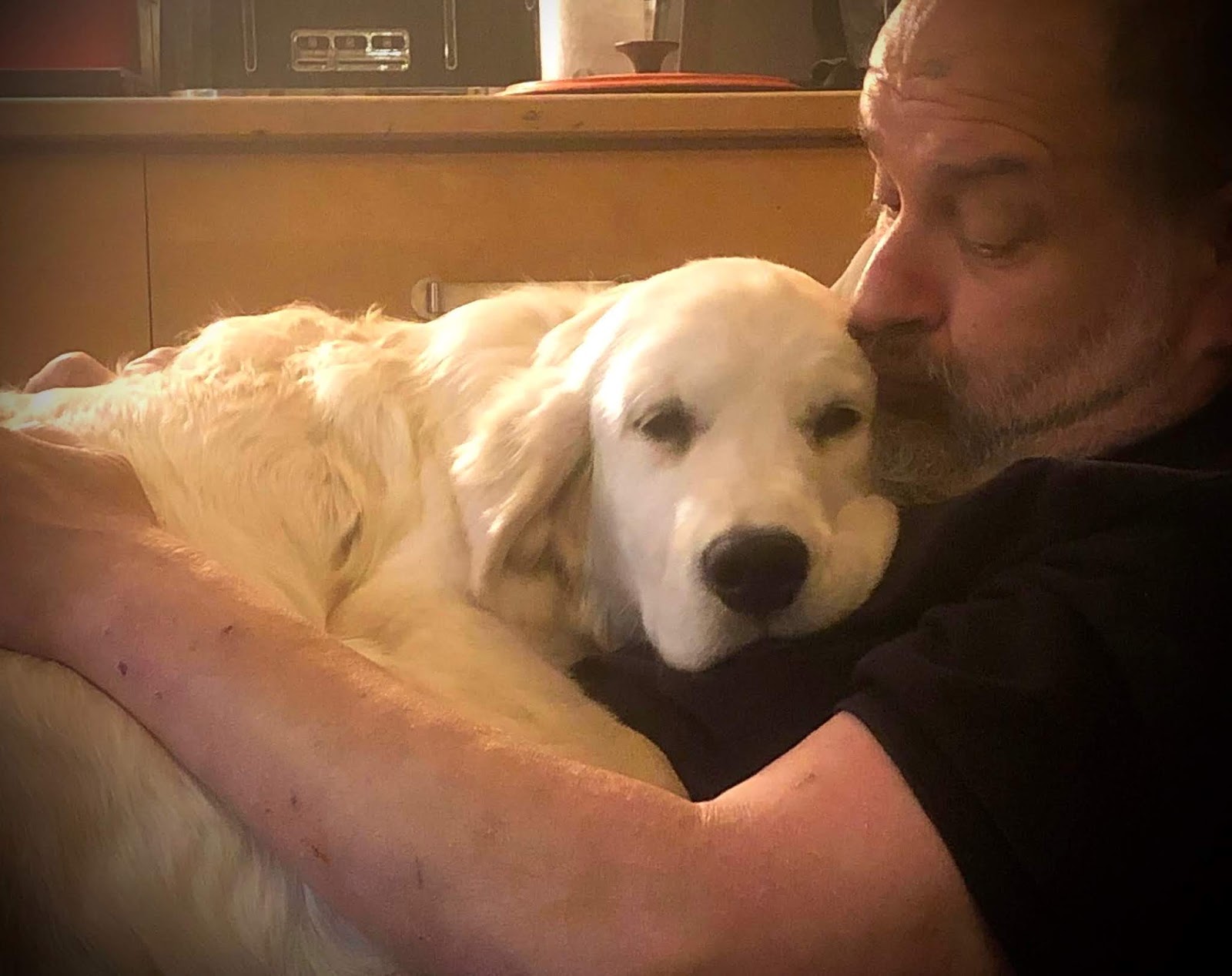
This is Miss Posy Fossil, she of the Chronicles of Pupperino, who is a little over 5 months old, and a cross between a loveable teddy bear and a waste disposal unit.
A few nights ago, at around midnight, she sicked up a pile of vomit the size of a loaf and with a smell that one struggles to describe.
Luckily she cleared it all up herself. She is helpful, like that.
At 4am Posy and her friend Lulu woke up and asked to be let out.
When they came back in we all kipped on the sofa. Posy lay down with her muzzle close to my ear.
Crunch crunch crunch.
As one never knows what she has in her mouth and whether it might precipitate an emergency trip to the vet, I woke up, plunged fist down throat and pulled out a piece of foil from a sweet wrapper. Washed hands. Kipped down. Posy lay down with her muzzle close to my ear.
Crunch crunch crunch.
Oh no – what is it this time? Plunged fist down throat and pulled out piece of fabric with button attached. Where on Earth…? Washed hands. Kipped down.
Crunch crunch crunch.
Not AGAIN?
Plunged fist down throat and pulled out a coat button in a small plastic bag. Washed hands.
That’s when I spotted it.
Posy’s friend Elvis the cat had knocked over and smashed an earthenware pot in which had accumulated all sorts of bits and pieces, and this was where Posy was getting her choice morsels.
Swept up mess. Washed hands. Kipped down.
This time Posy slept with her bottom in my face.
And farted.
It was a long night. Golden Retrievers. Don’t you just love ’em?
Posted in Uncategorized
Leave a comment
Do Writers Keep Regular Hours?
As you both know, I am busily engaged writing my next book. I had actually written the entire manuscript, but in consultation with my agent I decided to take a different tack, and the project moved in a new (but related) direction. Thanks to a new and improved synopsis – providing a secure roadmap – I am now well on the way to completing the new text. More on this at another time.
However, in the meantime, I have found that regular working hours really drive things along – and they don’t have to be too arduous.
As I am not a full-time writer (by day I work for the Submerged Log Company) the time I have to write is limited. I spend no more than 12 hours a week at the book – between 7pm and 9pm each day, except Friday, when Gardeners’ World is on the TV. This is quite enough to rough out 1000 words or so, which is as much as I can do in one go without losing focus. So, at 7pm sharp, I shut myself away in the home orifice, shut the door, pipe some loud instrumental rock music into my headphones, and write.
I find it essential to have a place where one can work undisturbed. Having a home office is great, especially one in which you can shut yourself away – but it’s not essential.
![]() |
| The Home Orifice. Recently. |
More important is the cooperation of one’s family or housemates, with whom you can agree that these hours are sacred. That’s why relatively short, intense bursts work. It might be too much to ask one’s family for one to absent oneself for too long. This is also why I’ve found that regular long-distance commuting by train is a gift: when I regularly traveled between Norwich and London, a journey of two hours, this was enough for me to draft, in two-hour bursts, an entire novel.
Blasts of loud noise into my headphones is also helpful, to minimise distraction from outside sauces tzores sources. I have invested in recording-studio-quality, over-the-ear headphones, and play instrumental rock – loud and noisy to get the adrenaline pumping, but with no distracting vocals. My playlist includes lots of Steve Vai, Joe Satriani, Focus and Jeff Beck, and more obscure and jazzier artists such as Scott Henderson and Shaun Baxter.
I expect that most professional writers, of which I am not one, will keep regular office hours, and will sit down and write, whether they feel the muse is with them or not. At times, when I have a lot of writing to do, I have taken two weeks off, commuted to an office or library, and worked from 9:30 to 5:30 with an hour for lunch. But it is hard to justify this when one has familial responsibilities. Even less suitable is taking oneself off to write, as a vacation – I tried this once and it was a disaster.
Equally important is that one does not work on one’s book outside these hours. The time must be strictly circumscribed. One should avoid the temptation to go into the office and scribble a few lines whenever the fancy takes you, apart from, perhaps, making the odd note. This makes the time spent writing more important, and helps minimise feelings of guilt at not writing, outside these hours, and also allows one to spend more time within the family circle and doing other important things such as walking the dogs, doing the garden and being sociable.
![]() |
| It’s important to spend time with members of your family. |
But whatever works, works. Each writer will have a different way of working. I’ve found that two-hour bursts in the evening, after dinner, but before the good stuff on TV, works best for me.
What works best for you?
Posted in Uncategorized
Leave a comment
The Chronicles of Pupperino: The First Four Months
Hello. My name is Miss Posy Fossil. I am a Golden Retriever. I was born under a wandering star / in a trunk in the Princess Theater in Pocatello Idaho on 2 December 2019. On 26 January I said goodbye to my mother, brother and sisters and moved to my new home. Here is what happened next.
Day 3. Dad works at home. I’ve worked out that I should lie across one of his feet, in case he has to get up — to feed me.
Day 5. Today I visited this great place. It’s called the ‘vet’. I got a lot of cuddles. Here is my new fren Louise.
Day 6. At the end of a busy day spent running around, playing, and eating, all one can do is wrap oneself in a scarf and go flomp. It’s exhausting being this adorable.
Day 7. I think the natives are beginning to accept me as one of their own.
Day 7 (continued). Today I am two months old. My plan for world domination is taking shape. One day soon any object placed on this coffee table will fall victim to my swishy tail.
Day 8. Already I have proven my worth. Today I saved the house from invasion by large pink aliens.
Day 9. Tried to launch myself onto Dad’s lap but bounced off. I have however managed to climb six steps up the staircase, which is more than the Daleks achieved. Galactic domination can only be days away.
Day 14. Mid-morning. After running around madly for the past four hours, it’s all finally caught up with me.
Day 15. These tiny golden retriever puppy teeth are the sharpest teeth in the world. They could rip the strap of this croc clean off. So I have just one question. Do you feel lucky?
Day 16. I’m now big enough to climb onto the sofa and therefore onto Dad’s tummy while he’s having a shluf. No corner of the house will be spared my adorableness! Except that Dad’s put a gate in the hall so I can’t go upstairs. I’m too tiny, they say. TOO TINY. Harumph. We’ll soon see about that.
Day 17. I can has my Mummy where I want her.
Day 21. It is a fact universally acknowledged that all human footwear must be chewed/gnawed/thrown around/hidden/combinations of the above. But sometimes one has to admit de feet.
Day 22. I found this spoon. I feel strangely stirred.
Day 24. I have a new fren! OffSpring#1 is visiting. He obviously needs a cuddle.
Day 31. Celebrity Personal Appearance at the Vet, which I enjoyed. Here I am again with my fren Louise. Also, first day on a leash – not so much.
Day 32. Elvis says I’m not allowed to put my paws on the table. Er… hang on…
Day 35. I’m three months old today! Where has the time gone? Time for a comfy snooze.
Day 38. A big day today. I went to the beach. I had never been to the beach before. If you’ve never been to the beach, you should go. It’s AMAZING. At first it seemed awfully big. But then I met some new frens and ran around and paddled in a tide pool. Then I went to Henry’s Cafe and was very spoiled . Then I went to sleep. Zzz. I hope I go to the beach again, it was GREAT.
Day 40. Here I am at Henry’s café, my favourite place to be for aprés-plage. If I’m especially good I get treats and some of Dad’s sausage roll.
Day 41. Playing on the beach with my new fren Spud.
Day 44. This is me having a well-earned snooze at 8:30 this morning after chasing Dad around for 3 hours. Honestly. He was terrible. Stopping me doing things I wanted like going outdoors, coming in again, going outdoors five minutes later, coming in again, snarfling the cat food, barking a lot, disemboweling the sofa and stealing Mum’s shoes.
Day 45. Here I am with my good fren Elvis. He’s a very chilled doggo. He doesn’t mind it if I chew his ears or suck his head.
Day 46. So, we’re on the beach, and Dad throws this blue thing called a ‘ball’. ‘Fetch!’ he says. I chase it, because, you know, that’s what I do. I’m a dog. But when I get there I don’t know what to do with it. Do I pick it up? Do I bury it? What? Dad picks it up again and throws it into the sea. Does he think I’m going in there? I don’t mind the water — but the sea is just so big. You know, noisy, with waves, and everything. ‘Call yourself a Retriever?’ says Dad. ‘I want my money back!’ But he doesn’t mean it because I’m so adorable, and, anyway, we went to Henry’s Cafe for treats.
Day 51 (or thereabouts. What do you expect? I’m a dog). I love going to the beach. The best thing about the beach is finding new frens to play with. The other best thing is digging holes. As you see I now have this very fashionable harness that Mum and Dad bought me in Coastal Pets in Cromer. A nice lady at the shop gave me a special fitting. Mum and Dad are staying at home a lot and looking worried. I cheer them up by inventing new games for them to play. The best one is Find-The-Footwear. I am very good at hiding Mum’s new expensive shoes. I hid Dad’s nice boots. He has found one of them but has no idea where I have hidden the other. Now he has to go around in his hiking boots. The laces are a bit chewed. I can’t imagine how that happened.
Day 54. Went to Trimingham Beach with my frens Lulu and Ronnie. Lulu is teaching me how to play ball, but she won’t always let me have a go. But I don’t mind cos I’m a Golden Retriever Pup running around in the sunshine and that’s the BEST.
Day 55. Mum and Dad went to the shops to get some new engraved pet collar tags for me and my frens. And probably loo rolls. They came back with this brand new secondhand sofa from Sue Ryder specially for me. If I stay very still I just merge into the background.
Day 56. Here I am relaxing with my fren Elvis who is also a very good doggo. I don’t know what sort of doggo he is. I have asked him but he won’t say. He just purrs.
Day 57. I found this spoon. It’s my spoon. It’s the best spoon. Okay, so now it’s just a very chewed piece of wood. But it’s still my spoon. I love my spoon.
Day 58. I think I might have overdosed on shoes.
Day 59. Gosh I have been busy. I have spent all morning in the garden chewing sticks, and helping Dad plant potatoes. Now I am helping my Mum doing some baking, and hoping she’ll drop nice things on the floor. Edible or not, it’s all the same to me, as long as I can get it down the bone chute.
Day 60. Mum has been trying to do her degree course at home. She says I am a ‘pickle’. So Dad has just taken me for a long walk (‘my ration of one daily exercise’, he calls it.) We went with my frens Ronnie and Lulu. Dad wouldn’t let us talk to the other dogs because ‘social distancing’. But now I am pooped.
Day 62. Phew. What a day. I helped Mum take an online Nursing Practice exam. This involved a lot of running around barking. After that I helped Mum sort out her revision notes. I might have eaten some of them. I can’t remember. It’s all a blur.
Day 63. The family has been spending lots of time watching box sets. First we had The Lord of the Rings. Now we are well in to The Hobbit. I’m not really interested in these so Mum gave me this wooden spatula. It’s mine. My own. My precioussss…
Day 64. I am on the sofa cleaning one of Dad’s shoes. My special fren Elvis, the purring doggo, has come to see what I am doing. I might let him help clean Dad’s shoe with me. Jobs like this are much more fun with two.
Day 66. Dad is working from home – I love to help. He lets me do useful things like shred envelopes and bank statements.
Day 67. Today I am 4 months old. As I am now a big grown up doggo Mum and Dad let me stay up to watch the News at Ten. So many people are isolated and on their own. I wish I could go visit them and be their fren. I’d cheer them up with entertaining games like ‘hide-the-shoe’ and ‘guess-what-disgusting-thing-I-have-in-my-mouth’.
Posted in Uncategorized
Leave a comment
Jenny Clack Remembered
Sad to report the death of Professor Jenny Clack, FRS, after a long illness, on March 26th.
Jenny was a leading palaeontologist who specialised in the earliest tetrapods (land vertebrates), and made many important and lasting contributions to her field (see this documentary here) . Perhaps the most famous was her discovery in Greenland of many fossils of the early tetrapod Acanthostega gunnari, reporting that the creature had no fewer than eight not five not six not seven but eight yes eight count ‘em eight digits on its forelimbs.
Quiet and reserved, she bore her last illness with characteristic stoicism. She was, however, not above a sly sense of humour such as when she sent a paper to Nature describing a tetrapod from the Carboniferous of what is now Central Scotland. Back then the region was dark, swampy, volcanic and very smelly, probably much as it is today. Jenny insisted on naming the creature (against my advice) Eucritta melanolimnetes – the Creature from the Black Lagoon.
I shall remember Jenny from when I knew her best, when I was a graduate student at Cambridge, where she was very kind to me during a sticky patch in my life (I used to be a fly) — and when, clad in figure-hugging leathers, she would roar into the quad astride a powerful motorcycle.
Despite being a biker she was profoundly averse to rock music, so when her student Per Erik Ahlberg and I (graduates together) were going to see a Motörhead concert, Per described the group to her as ‘a chamber ensemble playing contemporary music’. She is survived by her husband Rob and no doubt a number of cats and motorbikes.
We shall miss you Jenny.
Posted in Uncategorized
Leave a comment
Heathrow: My Part In Its Downfall
There has been much fuss and brouhaha about a judicial decision to rule out the further expansion of Heathrow, the large aerodrome to the west of London.
And quite right too.
As you both know I work for the Submerged Log Company, whose orifice is in Central London. I’ve worked there for more than 30 years. At first, when there was no internet, one perforce had to commute to where the work was, and live within an easy distance from the orifice. Nowadays, though, I work increasingly from home, at Cromer, in Norfolk. The family moved to Cromer in 2006, not long after the arrival of broadband.
At first, connectivity was achieved by small pieces of damp bailer twine loosely knotted together, but now it’s a respectable 37 furlongs per fortnight.Easily enough to work seamlessly even when the family is looking at youtube videos, catching up with TV on the iPlayer and so on and so forth in like fashion.
When I made the move, my London-centric colleagues were aghast. We are required to do some air travel for work, and how was I going to do that once I’d cut the apron-strings to Heathrow? My reply was simple – Norwich International Airport.
They laughed – lots of unfunny and patronising metropolitan jokes about Sale-of-the-Century and Normal-for-Norfolk. But no longer.
Norwich has no queues. Sometimes, the person who gives you your boarding pass is the same as the one who checks it as you get on the plane.
Norwich airport has no pre-Heathrow traffic gridlock.
What’s more, Norwich airport is less than an hour’s flight to Amsterdam Schiphol, and from there, the world. Schiphol is a much nicer airport than Heathrow. Everything is all in one terminal, and perhaps because it’s in Holland, everyone speaks perfect English.
And there is a gate at Schiphol (D6, for those interested) which is like a bus waiting room for KLM City Hopper planes to take you to just about any UK regional airport you can think of, from Bournemouth to Newcastle to Humberside to Exeter to Bristol, and, of course, Norwich.
The flight home, from Schiphol to Norwich, is so short, that, given the time difference between Britain and Europe, the ticket shows you landing five minutes before you take off.
In the past 13 years, I’ve had to travel from Heathrow no more than once or twice. If we want to build airport capacity, there are plenty of UK regional airports with much more space and fewer environmental concerns than Heathrow.
Honestly – Heathrow – who needs it?
Posted in Uncategorized
Leave a comment
How The Light Gets In
I know you’ll both be agog to learn that I have been enticed roped in corralled invited to take part in a festival called How The Light Gets In, which takes place in Hay-on-Wye between 22 and 25 May. This festival, which is distinct from the better known Hay Festival, is a grand conglomeration of music, comedy and ideas. This year’s festival theme is Uncharted Territories, which is very much my kind of thing.
I’ll be giving a solo talk entitled The Limits of Knowledge:
The more we discover, the more we realise we have yet to learn. So says Nature editor, Henry Gee, as he explores the limits of knowledge, and dares us to look over the edge.
I’ll also taking part in a more intimate Inner Circle seminar:
What makes humans special? According to senior editor of Nature and author of The Accidental Species Henry Gee: absolutely nothing. Join him to discuss humankind’s place in the world.
… and featuring in three debates as follows:
The Key To Progress (Saturday 23rd at 12:00) It was the vehicle of progress and the solution to the world’s ills. The core philosophy of the West and our time. But the halo has slipped. Science is now seen by some as a potentially malevolent force. A key element of the industrial military complex, challenging the environment and supporting a damaging raid on world resources. While many doubt the idea that science is the single objective version of the truth. Should we welcome this shift in our perception of science as the end of an unquestioned belief in a false god? Or is it a dangerous and potentially disastrous slide into prejudice and superstition, that will leave us poorer, less safe, and less in control of our lives? Senior editor of Nature Henry Gee; Professor of Cosmology at Manchester Sarah Bridle and philosopher and author of Galileo’s Error Philip Goff evaluate the scientific establishment.
Extinction and Renewal (Saturday 23rd at 13:15) Citing evidence that species are becoming extinct at a thousand times faster than the background rate, many argue the Sixth Great Mass Extinction is already upon us. And for the first time caused by a single species, humankind. Others contend that at current rates – 100 species a year – it would take a 1000 years to lose just 1% of current species. In the meantime the number of new species is continuing to grow – exceeding the number of species lost. Are we facing a profound crisis? Do we need to radically change our behaviour and way of life to save the planet’s animal life? Or are our conservation efforts proving effective and nature stronger than we suppose and capable of creating entirely new life forms without our help? Producer and director of Blue Planet 2, Frozen Planet and Planet Earth Kathryn Jeffs; director of the International Centre for Birds of Prey Jemima Parry-Jones; senior editor of Nature Henry Gee and co-founder of the World Transhumanist Association David Pearce get to the bottom of the apparent extinction crisis.
Language, Animals and Us (Monday 25th at 10:30) Many think language makes us uniquely human. Yet bees communicate precisely how to reach a source of pollen from the hive. Birds warn of a predator. Dogs call to each other with their barks and understand our verbal commands. And new studies show that baboons’ grunts align with human speech patterns and even plants send signals to each other through their roots. Is language just one type of communication, and have we wildly overestimated its importance? Are humans no different in principle from other animals and plants? Or is language profoundly different from all other forms of communication and the enabler of consciousness itself?
The Festival website has all the details and is constantly being updated, so visit it often. You can also follow it on Twitter at @HTLGIFestival, just as you can follow me at @EndOfThePier.
Posted in Uncategorized
Leave a comment
Desert Island Discs
I am unlikely ever to be invited to be a guest on Desert Island Discs, the BBC’s long-running radiophonic emission, though I did take part in BBC Radio Norfolk’s version once. The pain of being overlooked, week after week, is lessened, as one can do much the same on social media: a facility denied the late Cabinet Minister Herbert Morrison, who kept a list of his favorite gramophone records in his pocketbook in case he was ever asked. (He wasn’t). Notwithstanding inasmuch as which I was tagged by a friend on Facebook (but only because I begged him) to list ten records that had shaped my character, such as it is, on ten consecutive days, and tag another friend to take up the baton. And so, here they are, collected all together, at once, simultaneously, and at the same time, although (as they say on all the best game shows), in no particular order.
Queen A Night At The Opera.
This is the album that contained ‘Bohemian Rhapsody’, of course. One of the very few 45s I ever bought, and I played it until it wore out. As Dr Johnson never said – when a man is tired of ‘Bohemian Rhapsody’, he is tired of life: for there is in ‘Bohemian Rhapsody’ all that life can afford.
I still remember when, as a schoolboy, I bought the album, in a record store in Sevenoaks, Kent. Thanks to Queen featuring a lot in ‘Good Omens’ on TV, it’s now on heavy rotation in the car. Nothing matches it for musicality, sheer ambition of orchestration, clever songwriting — and fun. When you are feeling low, just fling in a few more Galileos. darling, and get Scaramouche to do the fandango.
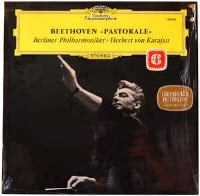
Beethoven, Symphony No. 6, the ‘Pastoral’So it was that the Infant Gee was placed in a playpen within earshot (but out of reach) of the Gramophone, where a classical music disc had been placed, the idea being that music would soothe the Savage Beast. The Pastoral was a favourite. I don’t know the precise recording, though I suspect it wasn’t Happy Herbert and the Sunshine Band, as here. Even today, it’s one of my favourites. The thanksgiving theme that comes in after the storm sequence can still move me to tears. If I should die and have a postmortem, you shall find it inscribed on my soul.
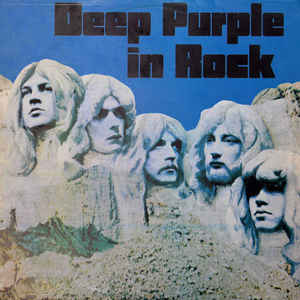
Deep Purple, Deep Purple in Rock‘Listen to this,’ said my pal Zak Chaudhury, placing the disc on the School Gramophone. It was 1976. We were 14. The explosive sound of ‘Speed King’ astonished my ears. I had heard nothing like it, the mixture of classical sensibility, supercharged blues, and hard rock ferocity. What I remember most is track 3, ‘Child In Time’ – an ethereal sound, drenched in reverb, of what I later learned was the Hammond organ of Deep Purple’s founding maestro, the late, great Jon Lord. That was Day Zero, Year Zero, of my love of all things Hammond — and the moment when I discovered the blues.Deep Purple In Rock came out in 1970. It was the group’s fourth album. Before that they had been a very 1960s pop group, more popular in the US than their native Britain, fronted by an old-style 1960s crooner. Their repertoire of pop cover versions sat uneasily with the moody stylings of guitarist Ritchie Blackmore and Lord’s classical ambitions. So after they staged Lord’s ‘Concerto for Group and Orchestra’ at the Albert Hall, Blackmore demanded and got his part of the bargain — a record of all-out hard rock. It was visionary, as hard rock had hardly been invented.And they had a new ingredient. Out went the crooning — and in came the screaming. Of a young man called Ian Gillan, who’d lately starred in the West End in the lead role in ‘Jesus Christ Superstar’. Deep Purple had found its voice, and for a while, could walk on water.
J. S. Bach, The Art of Fugue I was a graduate student in Cambridge in 1985, which happened to be the 300th birthday of J. S. Bach. I got rather caught up in the tercentenary celebrations. I went to Bach concerts, and read Douglas Hofstadter’s masterpiece of nerdery, Goedel Escher Bach, the Eternal Golden Braid. I went to organ concerts at the Royal Festival Hall, which had all the ambience of a bike shed. It was only much later when I happened to visit St Thomas’ Church in Leipzig, where Bach spent much of his career as choirmaster and composer-in-residence, and the organist struck up what sounded like a Bach chorale just as I walked in, that I could experience the full Majesty of Johann, the Mystery of Sebastian. For me the zenith and apotheosis of Bach was his final work, The Art of Fugue. This is a long and yet incomplete exposition of the height of counterpoint, of which Bach was the greatest exponent. Bach invented the rules of fugue — and broke all of them — to create a masterpiece. Austere and yet sportive, The Art of Fugue is, superficially, as undemanding as elevator muzak. But listen closely, and you get drawn into its web. Just when you think you’ve understood it at a deeper level, you find more depths to explore. The Art of Fugue is ‘pure’ music, not created for any particular instrument. I first heard it arranged for solo organ, in a record in my father’s collection, but as such it tends to blur into one long dirgy smurge. You really need to be able to follow each part individually. That’s why in later life I bought it arranged for a string quartet, as here, by the jewel-like Juillard. Were I on Desert Island Discs this would be the one disc I’d rescue, for The Art Of Fugue isn’t one piece of music — it’s a collection of all the music that ever was, is, or ever will be.
The Limeliters, 14 14K FolksongsEveryone’s musical tastes are first shaped by their parents’ record collections. As well as the classics, my parents clearly had had a brush with the US folk revival of the early 1960s. There was a Pete Seeger ’45 in there, along with three albums by the Kingston Trio, and two from this group, the Limeliters: this one, 14 14K Folksongs, and the gospel-tinged Making a Joyful Noise. This disc has both sorts of music – Country and Western — from an age as yet uncorrupted by glam and rhinestones, when traditional American music still looked back to its pioneering days. It was this disc that gave me my first taste of how folk music could evoke America’s wide-open spaces. There’s blues in here (‘Betty and Dupree’, ‘Gambler’s Blues’) but also convict songs (‘No More Cane’); songs about building the railway (‘Drill Ye Tarriers Drill’); genuine old-fashioned westerns from the days when cowboys actually chased cows rather than shot one another (‘Whoopee-Ti-Yi-Yo’); the hardships of going west (‘Sweet Betsy from Pike’); and much, much more. I expect a lot of the atmosphere came from the lush reverb (oh, those old plate reverbs have a lot to answer for) but this is a record that resonates with me to the present day. 
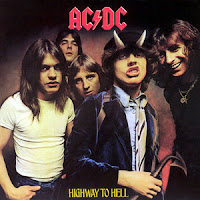
AC/DC, Highway to Hell
I was introduced to the rough-hewn pleasures of AC/DC at school by my friend Nipper, a cheeky chappie who probably identified with Angus Young, AC/DC’s lead guitarist who inevitably appeared as a naughty schoolboy in shorts, cap and satchel. He did this well into his sixties, when the effect was more, well, Krankies than Kerrangg, but one can excuse it all because he was (and is) one of the finest rock guitarists who ever lived — and his band, one of the purest, clearest and most disciplined combos to tread the boards. And the finest record by AC/DC is this one, their sixth, and the final featuring, on lead vocals, the drunken swagger of Ronald ‘Bon’ Scott, who died not long afterwards from rock-star excess. But don’t be fooled by the blather and braggadocio — Highway to Hell is a perfect record. Every note is pin sharp. Producer Robert John ‘Mutt’ Lange took an already well-honed rock’n’roll band and pared it down to its minimalist essentials. The result is less a brawling sucker punch than a stiletto of catchy numbers (‘Touch Too Much’, ‘Shot Down In Flames’, ‘Girl’s Got Rhythm’, ‘If You Want Blood’, and of course the title track) that drills directly into your brain. I have so many rock albums, so why this one? Partly because, at the age of 19, I drove from leafy Sussex to see AC/DC headline at the Monsters of Rock festival at Castle Donington in 1981. Sharing my Mini Clubman on this epic trek were Nipper and our mutual friend Ratty. AC/DC (by then fronted by their new singer Brian Johnson, who grew up in Newcastle where he gargled gravel washed down with liquid helium) were magnificent. The band was to go on to even greater heights – the first album with Johnson, Back in Black, is a classic – but Highway to Hell is more accessible, less knowing, less monolithic, and dare I say, more loveable, the last time AC/DC really lived the Dennis-the-Menace personae of a gloriously mis-spent youth that we teenagers all longed (and feared) to emulate.
Howard Shore, The Fellowship of the Ring, Original Motion Picture Soundtrack
I’d been captivated by the works of Tolkien as a child, but I’d put them aside in my late teens. The advent of Peter Jackson’s movie trilogy of The Lord Of The Rings in the early 2000s rekindled my interest, and fanned the flame into a firestorm. I read just about everything Tolkien had written on his fictional Middle-earth; I became a member of the Tolkien Society, editing its scholarly journal Mallorn for eight years; became the science correspondent for TheOneRing.net, and even wrote a book about Tolkien’s works. As everyone knows, the best bit about the movie trilogy is the score, written by Howard Shore. When the CD for the first film, The Fellowship of the Ring, came out, I played virtually nothing else for a year. Shore’s music, for me, became the very essence of Middle-earth, from the rustic playfulness of the hobbits to the chilling deeps of the dwarves (my favourite part of the soundtrack is ‘A Journey in the Dark’ when, at about 2’35” Gandalf lights up his wand to reveal the magnificent vastness of the Mines of Moria.) The key ingredient, to me, is the frequent addition of a choir which, especially in the lower registers, adds a chill that emphasizes the whole mythic mystery of the tree-tangled landscape.
Michael Flanders & Donald Swann, At The Drop Of A HatFlanders and Swann was a musical comedy duo popular in the late 1950s. This record is a live performance recorded at the Fortune Theatre in London during their successful run in 1957. My mother, a student at the time, saw them, and this record is a souvenir, in my mother’s collection. It was part of the soundtrack of my childhood. Flanders and Swann, who described themselves as ‘a drawing-room farrago’, were probably the very last expression of highbrow Edwardian home entertainment. They are best remembered today for their songs about animals, especially ‘The Hippopotamus Song’ (‘Mud, mud, glorious mud’, and all that). They represent comedy in its pre-satiric innocence, when humor could be intellectual simply for the sake of it. Audiences of today would probably require footnotes:
1546 was a very bad year for the theatre. Gorboduc was doing very poor business at the Globe. Gammer Gurton was still giving everyone the Needle. … Shakespeare hadn’t hadn’t even started, of course. Beaumont had quarreled with Fletcher – joint tenants…’ (‘Greensleeves’)
Those too impatient or insufficiently educated would no doubt dismiss this as elitist. Some of it would probably be dismissed as sexist:
And the girl in my arms is Mabel Figworthy, and if she says “oooh reeely” once more, I shall break her neck’ (‘A Song For Our Time’)
… elitist and racist …
And to think, he used to be a regular anthropopha-guy (‘The Reluctant Cannibal’)
… sexist and racist …
Oh it’s hard to say “holimakitilukacheecheechee”,
But in Tonga that means “no”;
And if I ever had the money, ‘
Tis to Tonga I shall go;
For every lovely Tongan maiden there
Will gladly make a date;
For by the time she’s said “holimakitilukacheecheechee”
It is usually too late. (‘A Song For Our Time’)
… or elitist and sexist …
And he said, as he hasn’t to put out the cat, the wine, his cigar and the lamps,”Have some M’deira, M’dear” (‘M’deira, M’dear?’)
Back in those days, before offense and sexual intercourse had been invented, F&S were as charming and witty as could be, and probably more so than anything that has happened in the subsequent sixty years. Of course, the Offensariat will probably drone on about the ‘privilege’ of two privately educated white men, never mind that Flanders was in a wheelchair, having contracted polio, not that he ever drew attention to it — identity politics hadn’t been invented then, either. F&S did react, in later years, to the then modish stream of infantile profanity masquerading as intellectual sophistication:
Ma’s Out! Pa’s Out! Let’s talk Rude!
Pee Po Belly Bum Drawers!…
At Oxford and Cambridge, and Yale and all,
and at Berkeley, they really have a ball,
‘Cos the higher the brow, the harder they fall,
For Belly Belly Bum Bum Belly Belly Bum Bum Pee Po Belly Belly Bum Bum, Pee Po Belly Bum Drawers. (‘P** P* B**** B** D******’)
No prizes for guessing which tendency won out, and the world is far poorer for it, in my opinion.
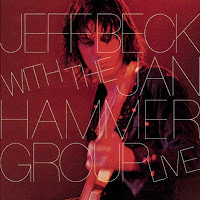
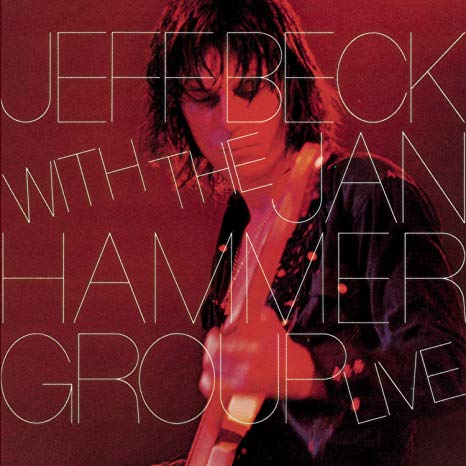
Jeff Beck, Jeff Beck with the Jan Hammer Group, LiveI can’t remember when I first heard this, or when, or who switched me on to this. I think it was at university, and it was a crummy copy of a copy on cassette. Much later Mr S. W. of Berkshire gave me the CD. I seem to have had a yen for guitarists who break the mould. First it was John McLoughlin and the Mahavishnu Orchestra. I since became keen on Scott Henderson. But most of all it was and still is Jeff Beck. Alone among rock guitarists he is still breaking new ground, squeezing sounds out of six strings that seem unimaginable. This album, recorded somewhere in the US in the mid-1970s, is a double whammy, as it is with one of my favourite keyboardists — Jan Hammer. Most people associate Hammer only with the theme to a televisual emission called Miami Vice: a mere bagatelle. For you will never hear a Moog synthesizer played with such flair, such fluidity and such style as under the dext’rous digits of Jan Hammer. Jon Lord of Deep Purple, long an admirer, said that Hammer ‘can make a synthesizer talk’. And with Beck, on this record, it’s very hard, and sometimes impossible, to tell where guitar stops and synthesizer begins. Believe me, I have tried. I confess to be rather fond of jazz-rock-funk fusion noodling, but there is noodling, and then there is noodling, and what stands out from this record is its infectious sense of fun. You can’t help get carried away with it. This record always leaves me with a smile. This is a live album I always come back to, and it always leaves me wanting more. If there was a concert in the past I’d like to have witnessed at first hand, this is the one.
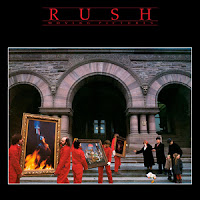
Rush, Moving Pictures
‘Little Red Corvette’. ‘No Particular Place To Go’. ‘She Loves My Automobile’. ‘Wish I Had A Grey Cortina’. ‘Crazy ‘Bout A Mercury’. ‘Fast Car’. ‘I’m In Love With My Car’. ‘Drive’ (by the Cars). The love affair between rock’n’roll and cars goes back to its earliest days. Just like rock’n’roll itself, cars represent youthful liberation and rebellion. A wag once noted that the history of popular music would have been very different had Bruce Springsteen never met a girl called Wendy nor learned to drive. But for me the ultimate rock’n’roll song about cars has to be ‘Red Barchetta’, the second track on Moving Pictures, the eighth album by Rush, the ever-quirky power trio — and, in my opinion, their best, and vindication of the adage that three blokes from Toronto can make a helluva racket. ‘Red Barchetta’ is more than about rebellion against one’s parents, or convention in general, or a metaphor for sex. It’s about rebellion itself. The song is set in a sci-fi dystopia about cars in a stifling future world in which cars had been banned ever since the ‘Motor Law’, in which a Sunday drive by a young man is a ‘weekly crime’ against the all-powerful state. The lyrics of the late Neil Peart, the virtuoso drummer for the band, often touched on science fiction and libertarian themes. They were also far more literate than one generally expects from rock music. Here’s the heady rush of speed — the sounds, the sights, even the smells, of driving as though your life depended on it:
Well-weathered leather, hot metal and oil,
The scented country air;
Sunlight on chrome, the blur of the landscape;
Every nerve aware.
All put together with the thrawn, sinewy and muscular music by bassist and singer Geddy Lee and guitarist Alex Lifeson, complete with an amazing variety of serpentine riffs and changes in time signature. It’s a whole album in one six-minute song. And that’s just one song out of seven, each one a feast.
Posted in Uncategorized
Leave a comment