
When I applied for a blog here on Nature Network, I promised M@ that I would use my space to flag up research that caught my eye. Last week I spotted the title of a Letter in Nature that warranted further exploration. Having spent my summer immersed in Synthetic Biology in practise it seemed fitting to take a closer look at Stricker et al‘s Fast, robust and tunable synthetic gene oscillator.
Any Synthetic Biologist will be familiar with Elowitz and Leibler’s repressilator. One of the first examples of the application of engineering principles to biology, the repressilator is a synthetic network of three transcriptional regulators which mutually repress each other’s expression. By incorporating both the repressilator and a reporter construct into Escherichia coli cells and carefully adjusting the molecular properties of the interacting species, the repressilator was shown to exhibit stable oscillations of GFP expression, independent of cell division time.
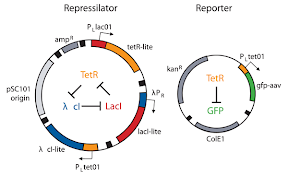
Figure 1: Repressilator genetic circuit
Stricker et al use a different genetic circuit design, based on positive and negative feedback loops.
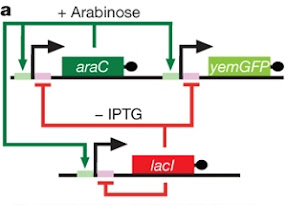
Figure 2: Stricker et al‘s genetic circuit based on positive and negative feedback loops
Both Elowitz’s repressilator and Stricker’s genetic circuit produce stable oscillatory cycles, with the phase of the cycle heritable between daughter cells. However, in contrast to the repressilator, the model and experimental work described by Stricker explicitly considers the tunability of the genetic circuit. The length of each oscillatory cycle could be affected by three external stimuli – arabinose, temperature and the media source. By fixing two stimuli, the oscillatory period could be tuned as a function of the third.
The engineering cycle is a much-loved paradigm of Synthetic Biology, outlining the iterative relationship between design specification, mathematical descriptions and experimental work.
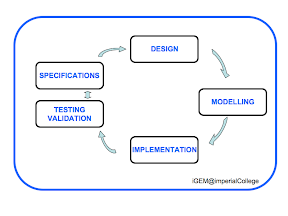
Figure 2: The engineering cycle
This paper is an elegant illustration of the engineering cycle in practise. The authors initially based their model on previous theoretical work, but this model failed to describe the tunability and robustness of their oscillating circuit. They therefore re-visited the model in light of experimental findings and incorporated new features, explicitly modelling the molecular processes in more detail. They attribute this need to the significance of the timescales involved in biochemical processes such as translation and protein folding, and the strictly sequential nature of the steps involved in expression and degradation of the reporter protein.
Neatly, when exploring the behaviour of this improved model, the team “identified another region of parameter space that would support oscillatory behaviour” – using their computer simulations they realised that a modified genetic circuit that could also oscillate. By constructing this new circuit in vivo, the authors confirmed their model’s predictions.
Such an intimate relationship between modlling and wet-lab work, so central to the application of engineering principles to biology, is fiendishly difficult to implement, as we found this summer. This team used meaningful mathematical predictions to direct their wet-lab work, and showed that biology can be harnessed, or at least helped, by engineers.
Jesse Stricker, Scott Cookson, Matthew R. Bennett, William H. Mather, Lev S. Tsimring, Jeff Hasty (2008). A fast, robust and tunable synthetic gene oscillator Nature, 456 (7221), 516-519 DOI: 10.1038/nature07389

