More on Willetts’ Speech

In the days following Willetts’ big science policy speech, there had been a piece in Nature by Daniel Sarewitz and letters from disgruntled physical scientists to the EPSRC that in different ways highlighted the role of scientists in directing research funding. I was therefore asked by the Guardian higher education network to offer some further thoughts on who should decide how science is supported by public money.

Which I did, in a piece cobbled together last week and published yesterday. Please have a look.

In the meantime, there has appeared a superb analysis of Willetts’ speech by Richard Jones (a physicist and Pro-Vice-Chancellor for Research and Innovation at the University of Sheffield). William Cullern-Bown at Research Fortnight has also written a very perceptive blow-by-blow account.

I recommend both — each makes the point that the Willetts was signalling a more fundamental shift of industrial and scientific policy than I had realised.


Posted in Science, Science & Politics | Tagged | Comments Off on More on Willetts’ Speech

Moving Molecules

Regular readers will know that molecules are my thing, that my scientific endeavours are devoted to revealing the intricate architecture of proteins — the molecular machines that sustain life.

They will also know that I have at times struggled with the problem of how to write about molecules in a way that might grab the attention of those who rarely think about them. I have tried variously reporting on our own results, or telling stories that link molecules to history or to some of the bizarre claims of alternative medicine.

In each case I have used words and pictures — and, very occasionally, video. But none of my attempts at video come anywhere close to the films made by Drew Berry.

Berry, a legend in the world of animation, has pioneered the use of 3D animation to try to give a real feeling for the molecular action hidden inside ourselves. To get a sense of what he has achieved, please take a look this recent TED talk in which he showcased some of his work.

Inspired by the molecular artistry of David Goodsell (about whom I have written before), Berry has not only added the dimension of time to our view of our cellular machinery, but brought a truly cinematic vision to it as well. Even those of us who are immersed daily in the world of the atom and the molecule struggled to imagine how they all work together. Berry’s work relieves us of that burden and is a compelling revelation.

P.S. For more examples of Berry’s work (and that of other animators), check out MolecularMovies.Org

Posted in Protein Crystallography, Science | Tagged , , , | 13 Comments

From the pedestal – take 3

Earlier this week I had an interesting email from Jesse Shore, President of Australian Science Communicators, about a blog post I wrote back in 2010. Jesse has kindly agreed to let me post our brief correspondence so I’ll let him take up the story.

Dear Professor Stephen Curry,

Although I am belatedly sending you this message (I got side-tracked after I started a draft in 2010), the topic is still very valid.

This regards your article in the Guardian, ‘We’re not on a pedestal: peer review keeps scientists firmly grounded’ (11 Feb 2010), which I appreciated reading. I agree that the peer-review process is powerful and I certainly support it in my dealings with various science sceptics.

Some of these sceptics assert that peer review is a closed shop which excludes the views of scientists which differ from the orthodoxy. This allows them to dismiss the function and value of peer review, especially when it comes to information that is counter to their opinion.

To support their argument they use examples of work requiring a shift of paradigm, where the new interpretation or theory has insufficient evidence to be compelling to convince those holding to the old way of thinking. Sometimes they invoke the story of Barry Marshall and Robin Warren who spent a few years fighting the conventional wisdom that no bacterium could survive the in the human stomach before their work was accepted. I don’t recall how long it took before other research groups repeated their experiments to verify their work and I don’t know whether Marshall and Warren had difficulty in getting published.

This example may involve more than just peer review but there seems to be a link to it. And for the sceptics the rare exception totally undermines the edifice of peer review. Perhaps one can’t easily argue with someone who takes this stance but do you have any good counter arguments for such people?

Cheers,

Jesse

To which I replied:

Dear Jesse

Many thanks for your email.

No-one seriously contends that peer review is flawless but, while it rightfully has its critics, I think the process still serves a very valuable function. It is a means of quality control and its very existence is a testament to the in-built scepticism that is a quintessential part of the scientific enterprise.

Is it a closed shop? I guess it can be seen that way, since only scientific ‘professionals’ are every likely to be asked to participate. Entry can be gained with a PhD but that sort of restriction is no bad thing. In fact it is necessary given the highly specialised nature of most publications these days.

Is the process biased against mavericks and geniuses? Perhaps there’s some risk of that but the stance that ‘extraordinary claims require extraordinary evidence’ is a worthwhile one. For the specific example of Barry Marshall that you quote, although I think there was skepticism of their initial hypothesis, the publication of the clinching experiment (Marshall’s bold self-infection) did not seem to me to be delayed – the experiment was done in 1984 and published in 1985, which seems a pretty standard timeframe. Moreover, it is possible to think of other instances of ground-breaking work where there was little resistance — in large part due to the quality of the accompanying evidence — for example the discovery of RNA interference or the development of PCR.

That’s not to say that there aren’t controversial issues and climate change is a big one. In that case, part of the difficulty lies in the complexity of the data gathering and interpretation. Modelling climate is just really, really difficult so it will be hard for anyone to come up with definitive work. That sort of problem creates space for sceptics who are out to pick holes without properly understanding the scientific process. Don’t know what to do about them apart from keep plugging away and being open about the business of science.

Very best,

Stephen

To which Jesse came back:

Dear Stephen,

Thank you for your considered reply. It is helpful and motivating.

I agree we all have to keep plugging away. One of the challenges is to express the underpinnings of the scientific process and peer review in simple terms. One of my sci-comm colleagues encapsulates them nicely as ‘where’s the evidence?’ and ‘who’s the source?’. Maybe that’s something to build on.

Cheers,

Jesse

I very much agree with him: something to build on for sure.

(Parenthetically – I was also pleased to see that there is life in old blog posts!)

Posted in Communication, Science, Scientific Life | Tagged , | 3 Comments

The Case for Support

If you are a scientist and you want some money to spend on research, as part of the grant application you have to write a case for support. It has to be good. You need to describe why the problem you are working on is important and to explain, in considerable detail, what you hope to do and how you will go about achieving it. To maximise your chances of funding, you need to link your work to the existing literature in the field of enquiry and to describe the preliminary experiments you have already done as evidence that you can deliver on your promises. Actually, forget about good. These days, the case for support has to be brilliant. It has to be water-tight.

If you are in politics, things work a bit differently.

David Willetts (Jan 2012)

I went along to the Policy Exchange Centre in Westminster this morning to listen to David Willetts, Minister of State for Universities and Science, make a speech about new science policies that aim to ensure the UK has a future in high tech that will boost economic growth.

In some ways it was a good speech but, as a working scientist, it also struck me as odd. Willetts made several bold proposals but failed to accompany them with a case for support.

The centrepiece was the announcement that, to stimulate growth and innovation in the university sector, the government is inviting proposals for “new types of university with a focus on science and on postgraduates”. However, it is not offering any new funding for the consortia of cities, regions, universities and businesses that, it is imagined, might put together a bid, so the incentives for these consortia are not clear. In questions following the speech the minister was not able to offer much further clarification. The government will wait and see what sorts of proposals come forward. In scientific grant applications, this sort of speculative approach is known as a ‘fishing exercise’ and is almost never funded.

Willetts made two further announcements, first of the ambition to have more UK universities in the world’s top 100 institutions and then of a second ambition to increase university knowledge exchange income from external sources — industrial investment in university research — by 10%. Both ambitions are entirely laudable but how are they to be realised? No case was made.

This lack of substance, coupled with repeated reminders throughout the speech that times are tough, gave the impression that the only ideas we can afford at the moment are those that don’t cost any money.

That may well be the truth of the matter.

But I don’t want to focus just on the negatives. Sniping is easy and so, generally, unproductive. It is probably unfair to compare the scientist’s lot with the politician’s and there’s no doubt that science policy is difficult. That’s worth conceding. Willetts may have been given little to work with in terms of new resources but I did sense a genuine determination to acknowledge the value of science and to tackle the knotty problem of how to exploit the UK’s known scientific strengths to infuse new vitality into the economy.

Maybe I am guilty to being too sanguine but the government gets some credit for declaring the intent to maintain Britain as a centre of world-class research. They will get more credit for this intention when it is backed by a greater percentage GDP spend on R&D — to take us more in line with our major competitors — (and, parenthetically, by more consistent policies on university funding and immigration) but that is an argument for better economic times.

For now we may have to content ourselves with measures that are cheap and effective. Despite my reservations about the announcements discussed above, there were other elements of policy mentioned in the speech that appear to have more substance. I appreciated Willetts’ frankness about the role of government in directing research. He was clear about preserving the Haldane principle, that funding decisions should be made by peer review, but nevertheless recognised that the government cannot avoid making spending choices about technology investment that necessarily affect strategies for scientific funding (for example, which types of energy production to support).

Such choices are not easy and Willetts was at least honest enough to concede that the government might not always get them right. More of that type of candour in political life would be no bad thing. The coalition may even do better than previous administrations on such decisions thanks to the commitment to get science advisers into every government department.

In the same vein, Willetts’ description of ‘leadership councils’, ad hoc groupings of science and technology experts charged with advising on particular technology sectors — new councils on e-infrastructure and synthetic biology were announced today — seemed to me a sensible move, provided that, as Willetts was at pains to point out, the latitude for blue skies research is not seriously impaired by the identification of more strategic goals.

Finally, the minister also addressed the long-standing issue of Britain’s relatively poor performance at converting its scientific excellence into industrial and commercial prowess, especially when compared to Germany and the US. In contrast to the case made for some of his earlier pronouncements, Willetts went into considerable depth in trying to analyse possible reasons for this discrepancy and mentioned proposals for birding the gap, including the Bio-medical Catalyst Fund (announced in December 2011) and the re-introduction of Smart awards under the control of the Technology Strategy Board (to provide proof of concept and proof of market funding for businesses). I won’t attempt to critique his analysis at this late hour (notwithstanding the fact that the cultural and economic issues are strangers to me) but hope that others might do so because it is an interesting problem and I would like to know if the case for support stands up.


Posted in Science, Science & Politics | Tagged , | 18 Comments

Work and Energy

It has been a quiet week in lab woebegone*. Though we have been working to pack up everything for a move across campus in mid-January, Christmas has intervened to scatter us to our homes, where traditionally we have the time to reflect on the year just past and galvanise ourselves for the one to come.

Lab Woebegone

Except that this year I haven’t had the time. 2011 was for me a year of two halves — before and after taking on the role of director of undergraduate studies within our department of life sciences. Before, I remember very little of what happened. After has been a blur of meetings, emails, phone calls, spreadsheets as I laboured to master my new brief. Most of the time, however, it has mastered me and time for research and blogging has been squeezed. Or crushed, more like.

The Christmas break afforded a couple of days away from these cares in the mellow mix of family life — my lot are pretty easy-going thank goodness — but there is another grant to be wrestled from frustration to submission by early January and that has kept me half-nelsoned to my desk for most of the past few days.

But I am not here to carp, even though there are things I would rather have done with my holiday. Time may be shorter but I wanted to try, however briefly, to turn a sanguine eye towards the new year.

Physical Energy

The photograph above is of GF Watts’ Physical Energy in Kensington Gardens near where I work. I’m a sucker for the sciencey title (energy is a favourite theme) and it is a pivot point for many of my walks or runs in the park. Even on the grayest days, I love its power and the sense of capability, of optimism.

My new responsibilities may have absorbed too much of my life of late but they have also caused me to think anew about the rights and responsibilities of scientists as investigators and teachers, a subject I would like to turn to next year. There is plenty more blogging to be done and I will make the time.

Happy new year to all for 2012!


*Apologies to Garrison Keillor.


Posted in Science, Scientific Life | Tagged , , | 17 Comments

Jam Yesterday

On a grey day back in October I made my way along Albemarle Street to the Royal Institution for the filming of DemoJam, a lively and light-hearted program of science produced by Jonathan Sanderson and the rest of the gang at StoryCog for the new RI channel.

After a heavy morning at Imperial, it was a blessed relief to walk into the organised chaos in the Conversation Room on the ground floor of the RI and know that none of it was my responsibility. The room was festooned with lights and cameras, and buzzed with people pinging back and forth between different groups trying to sort things out, all under Jonathan’s distracted but watchful eye. I guess I should have known but I was surprised to see just how many people it takes to make twenty minutes of video.

DemoJam 2

A small sample of the people who worked on the video

My only task — very light duties indeed — was to work through my material with Matt Parker, DemoJam’s affable host, to see how we could shoe-horn our conversation on the X-ray crystallography of viruses into three or four minutes. Piece of cake. No, really. Cake. Like a jam sponge.

And then suddenly it was lights, camera, action, inaction, action, inaction, action, inaction and so on — all in front of a live audience and steered with genial humour by Matt. Suzy Sheehy showed off a particle acceleration made with a salad bowl, Ben Craven proved that your eyes are lying to you pretty much the whole time and then it was my turn to spin a tale in conversation with Matt of viruses, crystals and the maths of heat travel along a hot poker. I’m pleased to say we managed it in a single take.

To round off proceedings, Jonny Berliner gave us a song he had written during the afternoon’s rehearsals that was a witty fusion of our three quanta of science. Take my word for it — the song alone makes the video worth watching.

OK, don’t take my word for it — see for yourself.

http://vimeo.com/33343848?title=0&byline=0&portrait=0

The video was released earlier this week as part of the launch of the new RI Channel. The idea is to show off “the very best science videos from the RI and around the web.”

And it does. The site is slick, clean, well-organised and already stocked with some gems from the past — David Attenborough’s 1973 Christmas Lectures for one — as well as more current offerings. Flying Gravity 2 (presented by Ben Craven), is particularly sweet.

Posted in Communication, Protein Crystallography, Science | Tagged , , | 12 Comments

First Anniversary

A year ago today Occam’s Typewriter made its debut on the blogosphere and I published my first post at the new home of Reciprocal Space. It’s been a good twelve months. OT has established itself as a home thoughtful and lively writing with a great range of different voices.

I have relished the new-found freedom of being on a network that may be in orbit around science but is not rigidly tied to it. The new platform has brought a larger and broader readership, and encouraged me to widen my range of topics. My thanks to everyone who stopped by to read — and my special gratitude to all the commenters. Really. It’s the conversation that makes all the difference.

There have been some truly excellent discussions here in the past year. I think particularly of the ones triggered by posts on science funding, communication and publishing and those on maths, plagiarism and — an old favourite of mine — Bono.

Over the year, I have reported on the encouraging progress on libel reform, a campaign that hopefully will come to fruition in 2012.

And who could forget my relentless promotion of that movie? Ahem.

My publishing rate may have dropped off a tad in the past few months, in large part because of new responsibilities at work, but the appetite is undiminished. I have been spurred on again this week by the news that my post on James Joule has been selected for Open Laboratory 2011, an anthology of some of the best science writing on blogs from the past year (congrats also to OT Irregular Richard Wintle, whose posts on genome sequencing have also been included). This makes it four years in a row for me — an achievement of which I am inordinately and indecorously proud. Apologies.

Structure Paper 2011

On the same day that I found out about the Open Lab selection, I was also proud to see the publication in Structure of the latest paper from my group which reported the determination of the first crystal structure of the polypyrimidine tract binding protein. I started this project seventeen years ago. Seventeen. I guess I should try to tell that story some time soon…

Posted in Science, Scientific Life | Tagged , | 21 Comments

Real and False Economy

Last week I went to Germany to talk to a pharmaceutical company about my work on the blood protein, human serum albumin. It set me thinking. But first I need to tell you about albumin.

Albumin is a surprisingly abundant protein in the human body; you have about 200g of the stuff coursing through your veins and more still in the fluid that lubricates your organs. Though it normally works as a transporter for fatty acids and other greasy molecules that are poorly soluble in water, albumin can also absorb many types of drug molecule. This can be problematic: if drugs bind too tightly to albumin, they get trapped in the bloodstream and are less effective. If this happens with a promising new compound, drug companies have to try to modify it to reduce the affinity for the protein. But how do you know what changes to make?

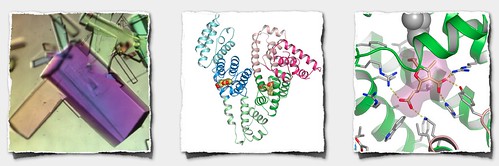
My group, with funding from the BBSRC, MRC and the Wellcome Trust, has spent many years studying the structure of the protein and shown how fatty acids and different drug molecules stick to it. We have done this using X-ray crystallography — shooting X-rays at albumin crystals — to reveal the three-dimensional structure in fine detail; we get to see exactly how the atoms are arranged.

HSA TriptychCrystals of albumin, the structure of the protein and a close-up of a drug binding site

Though albumin has a (well-deserved) reputation for being difficult to work with, we have solved nearly 50 different structures of the protein bound to different molecules so we know quite a bit about what makes a molecule stick to it. Though I’m not very comfortable with the term, you could say that I’m a bit of an expert on the topic of drug binding to albumin. So from time to time I get asked by pharmaceutical companies to talk about our work.

I enjoy these industrial excursions. It amazes me that some people have so much confidence in the ability of science to generate products sold for profit that they will invest millions in the process. As an academic I still tend to see myself as something of an amateur, and industrial scientists as the professionals. I realise that’s a false distinction — one that does myself and my co-workers a disservice — but the industrial interest makes me feel I’m being taken seriously.

I know the pharmaceutical business is a flawed industry. I know about the dodgy marketing, the manipulation of clinical trials, the ghost author abuses, the fake journals. These things are unacceptable but, even so, there is a rigour, an exactitude to the business of making that seems to me as impressive as anything served up by pure research.

It is sometimes said or presumed that scientists look down their noses at engineers but I don’t know who these scientists are. I’ve not met any. For sure there are those who insist on the primacy of curiosity-driven research (no bad thing) or who bridle at the suggestion that they might have to contemplate the impact, economic or otherwise, of their work. But I suspect that even these ‘purists’ share my appreciation of the creative power of engineering — the conduit through which science changes the material world. For that reason I was pleased with last week’s news reports of a new £1m engineering prize.

I was also pleased to have the chance to see how our research on albumin is seeping into industry. There was strong interest in my talk in Germany and there were keen questions in the discussions that followed. For me these visits are sporadic. Other scientists will have more contact with industry but plenty of others will have less. I’m not sure how to foster increased contacts but I think this could be a good thing. It is likely to be important in bolstering knowledge transfer, which is one way to key into the economic value of science (a topic that has been treated with some interest by Jack Stilgoe and Colin Macilwain in the past day or two). I get the impression that there are big differences here between Germany and the UK.

At lunch my hosts and I compared education systems. I learned that it costs just a few hundred Euro each term to attend university in Germany and felt a pang of jealousy: next year UK students will be facing annual tuition fees of up to £9,000. The consequences for UK education have yet to be determined. Somehow, the Germans seem to have closed the virtuous circle — their education system supports a strong manufacturing base, which in turn earns enough to pay for an accessible education system. The German science budget is heading for a 10% boost, while in the UK science funding stagnates.

I know it’s a bit more complicated than that, and that better contacts with industry is only part of the solution. But how does the UK get to Germany from here?

Posted in Protein Crystallography, Science, Scientific Life | Tagged , | 18 Comments

Incoming

I gave a talk a couple of weeks ago at a Biochemical Society meeting on the subject of the Research Excellence Framework, the process that will assess UK academic research quality for the purpose of determining how a large tranche of public funding will be distributed between universities. I dealt in particular with the impact component, which will count for 20% of the assessment and has caused a degree of consternation.

I have written up my thoughts for the Times Higher Education magazine. Please take a look and let me know what you think, either here or there.

Posted in Science, Scientific Life | Tagged , | 1 Comment

Alive to the prospects for libel reform

The campaign for libel reform has been grinding away for several years now but there was still a buzz of expectation as we gathered in Committee Room 10 in the House of Commons last Wednesday evening. By 6 pm the room was packed. All seats had been taken and people parked themselves on window sills or stood in expectant clusters at both doors to the room.

Packed Committee Room 10

This is what democracy looks like

Chaired by Evan Harris, the meeting was an opportunity to hear from people and organisations who have had their freedom of expression curtailed due to the easy threats that powerful vested interests can fashion from our current libel laws. More importantly it was a chance to take stock at an important juncture in the campaign and galvanise ourselves for the final push.

Acting on manifesto commitments for libel reform made in the run-up to last year’s general election, the coalition government has brought forward a draft defamation bill which has in the past six months been scrutinised by a Parliamentary select committee of MPs. In the report published on 19th October the committee reviewed the oral and written evidence presented during its deliberations and made recommendations for improvements to the bill before it is finally presented to parliament.

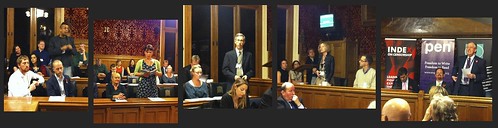
At the meeting speaker after speaker stood up to explain the inhibition, fear and, in some cases, personal torment they had suffered from libel suits or even from the threat of one. Each spoke briefly, but with urgency and purpose. The audience paid keen attention, asked questions and raised further points. This was democracy at its best. We heard from Richard Dunstan of Citizens Advice, from David Marshall of Which? magazine, from Rowan Davies of Mumsnet, from Richard Allan of Facebook, Lisa Fitzgerald of AOL, Sophie Farthing of Liberty and Charmian Gooch of Global Witness. All spoke of cases where libel actions had been used to silence legitimate criticism. The present libel law over-reaches into every corner of our supposedly free society.

Libel Reform Meeting Nov11

From left: Simon Singh, Rowan Davies, Tim Appenzeller, Tracey Brown, Lord McNally

It has a huge impact on science and research. Tim Appenzeller from Nature and Victoria Lustigman from the Publishers Association both spoke of the threats that stifled their freedom to report on science and scientists (Nature is in court this week). The legal advantages given to claimants in England and Wales means that all publishers, academic journals included, regularly censor their own output for fear of the exorbitant costs of fighting a libel action.

The meeting also heard from two individuals who had shrugged off that fear and defended their right of scientific criticism in court — Simon Singh, who faced down the British Chiropractic Association (BCA), and cardiologist Dr Peter Wilsmhurst, who had to fight off a suit from medical equipment manufacturer NMT. In these cases there was a clear public interest in the criticism that was levelled protection from the harm of inappropriate medical treatment — but both men had to take enormous personal risks to stand by their words. Though both eventually won their cases, Singh pointed out that libel remains a threat. This week Vaughan Jones, a 28-year old father of three, found himself in the High Court having to defend a book review he had written on Amazon. Please read that sentence again. It may sound unbelievable but it is true and shows how out of kilter the current legislation is with common sense.

The draft legislation goes a long way to dragging the libel law into the twenty-first century and enshrining a stronger public interest defence for authors, journalists, bloggers and fathers-of-three. But we are not there yet. Lord McNally, the Minister of State for Justice who will have a hand in preparing the legislation, warned the meeting that a final push is needed to make sure that the bill is included in the Queen’s speech next Spring, so that it will be put before parliament and hopefully find its way into the statute book.

Give or take the odd partisan jibe, there was clearly a consensus among the three major parties that the reformed legislation will be a good thing. But Tracey Brown of Sense about Science and LibDem MP Julian Huppert both echoed McNally in urging the meeting to keep the pressure on parliament to deliver. The campaign has come a long way in the past couple of years (especially when you think back to 2009), but one more heave is needed to win the freedom from libel chill that our society deserves.

If you can, please sign and promote the petition and make a donation.

And to keep up that all important pressure, please write to your MP to tell them how important libel reform is to you.

Posted in Libel Reform, Science & Politics | Tagged | 13 Comments

Let’s democratise the bejesus out of libel reform

This week the Guardian made the astonishing revelation that a man who is heir to the throne by an accident of birth and who is the representative on Earth of precisely no-one has been enjoying the right of veto over government legislation. I think this might be a good time to strap on our democratic boots and make our way to Parliament.

Don’t be disheartened by the news of Prince Charles’s dubious interventions in the democratic process. Don’t give in to the apathetic feeling that you can’t do anything. You can and you should.

A public meeting on libel law reform next week presents a good opportunity for us to reassert the power of the people.

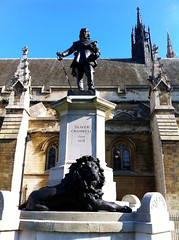
Cromwell at Parliament

Oliver ‘Kingsolver’ Cromwell

If you are a scientist, you have a particular interest in helping to ensure that scientific matters can be robustly debated in the public domain without fear of the threat of a financially disastrous libel suit.

The law in England and Wales at present makes it too easy for powerful vested interests to silence critics, whatever the evidence. But thanks to persistent work by the Libel Reform Campaign over the past couple of years, Parliament and the Government are on the brink of considering serious and fundamental changes to strengthen freedom of speech.

Draft defamation legislation drawn up by the Government has been scrutinised by a select committee of MPs, who recently reported on changes that are needed. These changes, if implemented, will move things in the right direction but do not yet go far enough.

It is imperative that we keep the pressure on Parliament to remind them that the demand for reform is deep and wide. We must not miss this opportunity. To show your support, please come to a lobby meeting in Committee Room 10 in the House of Commons on Wednesday 9th November at 6 pm (see here for details).

Come. If you’ve never been to Parliament before, you’ll be fascinated.

Come. Make sure to add your voice to the demand for fairer libel law.

Come. Show the king in waiting how democracy is supposed to work.


Posted in Libel Reform, Science & Politics | Tagged , , , | 32 Comments

Libel Reform: steps forward

Today sees the publication of a very important report on libel reform.

The report is from the Parliamentary Joint Scrutiny Committee, which has been considering the government’s draft defamation bill in the light of oral and written evidence from interested parties. It outlines proposals for refinement of the draft legislation before it passes through Parliament and, hopefully, into law.

The new legislation will be the first wholesale reform of the libel laws of England and Wales since 1843. This is a big deal because of the excessive power that the present law gifts to the wealthy to muzzle free speech. Our libel law is so bad that President Obama has enacted legislation to prevent US citizens being ensnared by it. I’m writing about this issue here, as I have done several times before, because libel is a serious matter for many people including scientists and science bloggers. Please see this post for background information.

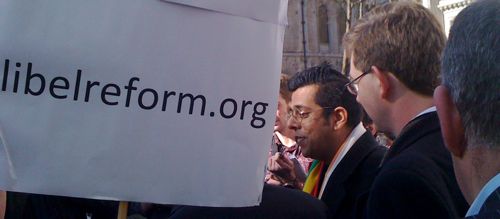
Simon Singh speaking after his appeal victory

I haven’t had time to digest the report but did get a preview of the press release that has been issued today by the Libel Reform Campaign. Here are the key points:

The Joint Scrutiny Committee’s report published today urges the government to strengthen the draft defamation bill in line with proposals from the Libel Reform Campaign.

The Libel Reform Campaign… calls for the government to legislate now and welcomed the Joint Committee’s recognition that the laws need “rebalancing”… The committee is the latest body to support reform. Over 50,000 people have signed the Libel Reform Campaign’s call for a government bill to reform English libel law, at the last election all three main parties made manifesto pledges to change the law and in May 2010 a commitment to reform became part of the coalition agreement.

The committee has made a number of recommendations in line with the Libel Reform Campaign’s proposals namely:

Corporations The committee accepted the Libel Reform Campaign’s concerns over the imbalance of resources between individuals and well-resourced corporations in libel and the “chilling effect” on free speech of libel claims from companies. Their proposals aim to introduce a new hurdle to make it more difficult for companies to use their financial muscle and the threat of court action to silence critics, which may reduce the problem.

Serious and substantial harm The campaign argued that clause 1 of the government’s draft defamation bill should be strengthened to strike out claims for damage that is neither serious nor substantial and does not offer any real prospect of vindication. The committee accepted this stating that a revised clause 1 would: “ensure that trivial cases are weeded out at an early stage by introducing a stricter test for determining whether a case is serious enough to go to court.”

Public interest defence The committee recognised problems with the current public interest defence and noted there was “universal support” for a dedicated defence. Whilst the committee made proposals to strengthen the public interest defence in the government’s draft defamation bill, the campaign believes more should be done to ensure that the defence is robust and accessible.

Internet Our campaign developed proposals for a court-based take-down procedure to prevent extra-judicial censorship by threats to ISPs and web hosts:  a variant of this scheme has been proposed by the committee.

Reducing the cost of libel cases Libel cases in England and Wales have been estimated to cost 140 times the European average. The committee has been explicit in its criticism of the government for not doing enough to reduce costs. In line with our Alternative Libel Project, the committee has told the government to ensure disputes are resolved rapidly by mediation or arbitration such as Early Neutral Evaluation.

There are some very good reforms in these proposals but Sense About Science (SAS), a member of the Libel Reform Campaign, still has reservations. In particular, SAS campaign manager Síle Lane writes (my emphasis in bold):

…while there is a recognition of the problems with the current formulation of the public interest defence, and some good observations about the need for context, the proposals from the committee haven’t resolved the need for a robust public interest defence. Politicians need to address this urgently in taking the bill forward.

This is a key issue for scientists, and in particular for medical researchers and publishers, who may otherwise find it difficult to challenge claims made my drug or medical technology companies about the efficacy of their products. Criticism of such claims is often clearly in the public interest. Celebrated cases in this area have involved Ben Goldacre, Simon Singh and Peter Wilmshurst, all of whom have suffered the stress of libel actions against them. None of these actions were successful but they nevertheless exacted fearsome financial and emotional penalties.

A sturdy public interest defence is vital so that the favour the law currently shows to wealthy individuals or corporations, who can silence critics merely with the threat of a libel action, is replaced by a legal perspective that takes proper account of the weight and process of scientific argument. It is necessary to ensure  access to information that the public has every right to know.

This means that the campaign goes on. And there is still time to sign the petition.


Update (19 Oct; 00:50) – Recommendations that the peer reviewed scientific literature be given the protection of ‘qualified privilege’ are discussed on pages 32-34 of the report. (Link to PDF is in first line of the post).

Posted in Libel Reform, Science & Politics | Tagged , , , , | 5 Comments