The past, The future and The Guardian

This week I got to visit a part of London that is for me a hallowed place – the offices of The Guardian newspaper. I was participating in a workshop for the people who had been short-listed for the Wellcome Science Writing Prize, which is sponsored by the Guardian, and so made my way to its large glass headquarters behind Kings Cross.

Offices of The Guardian

I noted the personal significance of the occasion at the beginning of my remarks to the workshop participants. Alok Jha told me later he thought I had been joking. My sense of humour gets the better of me sometimes, but this time I was not speaking lightly. I have read The Guardian for as long as I have been reading newspapers because it was one of the papers that my father bought every day of his working life.

The Guardian isn’t everyone’s favourite read but it is mine and it was a real privilege for me to be part of it, if only for an afternoon. My remit in the workshop was to speak from the perspective of a scientist about science blogging. I told the assembled young writers how I approached it — extremely gingerly at first but with growing confidence — and then explained a little of the technical details of getting starting and staying in the game.

The other speakers at the workshop were Michael Reigner of the Wellcome Trust, who gave useful pointers on good writing, and James Randerson, The Guardian’s science editor, who outlined what he looks for when a freelancer pitches a story.

I’d like to wish anyone aiming to freelance as a science writer the very best of luck. James Randerson was up front about the tough times facing the newspaper industry, though he took care to offer some hope. He referred us to the Cudlipp lecture given by Guardian editor Alan Rusbridger in January of last year, which dissected the challenges facing journalism in the digital age. Though already 18 months old — the talk predated the iPad by a few weeks — Rusbridger’s analysis still seems on the money, even if the money is an increasingly uncertain quantity (a useful reminder that the scientific careers are not the only ones troubled by a doubtful future). His examination of the problem is clear-sighted but, despite the steady decline in newspaper sales, retains a sanguine eye on the future. The survival of journalism is important because, as we have been reminded in recent days, weeks and months with Liam Fox’s resignation, the exposure of phone hacking at the News of the World and of MP’s mis-use of expense claims, it serves a vital investigative function in an open society. The survival of journalism is something we should all be thinking about.

The lecture is long, but well worth reading. On a technical level it struck me that some of the difficulties — and opportunities — that the rise of the internet poses to traditional print journalism parallel those in academic publishing, a subject I have discussed recently and hope to return to. Randerson seems to have picked up on Rusbridger’s optimism and tweeted on Friday night:

@Stephen_Curry Sounds cheesy, but it has been and continues to be genuinely exciting. Feels like we are reinventing how to do news

The reinvention is due to the acceleration of news gathering and dissemination that is enabled by new technologies, but specifically involves the ability to link to sources, to engage other media — audio and video as well as the written word — and to involve the reader in reporting and commentary. The latter is something of a mixed blessing, as anyone who has perused a Guardian comment thread will know, but it is a feature that readers have come to expect.

The re-working of news also involves new ways of providing content. You can already get The Guardian on your iPhone but an app for the iPad was released earlier this week. It’s on free trial at the moment but will eventually cost you £9.99 a month. I tried it out today instead of buying the Saturday edition.
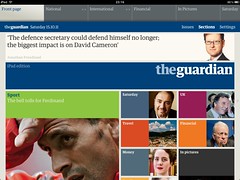
Guardian on the iPad

It’s too early to pass sound judgement on whether this is the future of newspapers. The interface is pretty slick and easy to use. The organisation of sections is similar to the newspaper though I’m not sure if it maps exactly to the printed edition; I couldn’t find the magazine section and so missed Tim Dowling’s funny column on family life. The layout of the front pages of each section seems a little picture-heavy to me, which limits the number of items on a single screen, a feature that slows down navigation through the content. I hate to say it but the Times iPad edition, which has gone for a more newspaper-like motif and has a denser layout of article thumbnails, feels better. But perhaps that is because the layout is more traditional so there is less of a rupture from my habitual reading experience. As a further sign of this problem of transition, I also missed the paper — the rustle and foldability — in using these screen-based versions, but that’s probably just nostalgia and will fade.

Coincidentally, parenthetically and finally, I came across another new publication for the iPad this week, a science magazine called Guru, which is produced by a team containing Stuart Farrimond, one of the short-listed science writers attending the workshop on Wednesday. This slickly designed science and lifestyle magazine is published only in electronic form every two months.
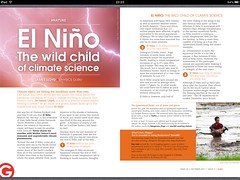
Guru on the iPad

Guru is an impressive example of the power of digital technology. The magazine is created entirely by the voluntary efforts of a band of enthusiasts and is provided free. It may be an amateur effort but these days amateur efforts can easily look very professional. It made me think again about the plight of the academic author — and reader. As Research Libraries UK seek to face down journal price hikes from Elsevier and Wiley, it seems more and more like the right time to reinvent academic publishing.

Posted in Communication, Science & Media | Tagged , , , | 31 Comments

Careering out of control

As Jenny mentioned this morning, I have a post on the Science is Vital campaign on science careers on the Times Eureka blog today. For those of you without a subscription, the text is reproduced here:

The business of science is essentially one of creative problem solving. But there is a problem within science that has long resisted resolution: how to forge a satisfying career that is rewarded in proportion to the long years of professional training.

The traditional career path consists of a science degree followed by a PhD (the first real taste of independent research), and then further training through a couple of stints as a postdoctoral researcher before a scientist can become established as a fully independent investigator.

Most people only start out on that track because they are passionate about science. Because of that commitment they endure relatively low pay, long hours in the lab and the uncertainty that comes with working on fixed-term contracts. Some will ‘make it’ by landing a permanent position as a research group leader in academia or industry. But for too many young scientists, the dream of a career in science breaks apart when, after a series of short-term postdoctoral contracts, they are unable to secure a permanent job. In some of these cases, the departure from science is a necessary part of the competitive winnowing that keeps the UK scientific stock strong. But for others, as they grow older and become more expensive to hire on short-term, cash-limited grants, they suffer the frustration of seeing their research experience work against them as they are priced out of the workplace by the fresh influx of new PhDs. This forcible ejection of highly-trained and productive talent is a shocking waste.

The downsides of the traditional science career model have long been recognised — and were identified by the Roberts Report back in 2002. But little has been done to address these difficulties and the present slow decay of the science budget, which is shrinking job opportunities, means that they are being felt more intensely. The system is reaching breaking point.

To renew the search for solutions and, in particular to bring to the fore the voice of those most affected — early career scientists — the campaigning group Science is Vital organised an open meeting at the Royal Institution in London in May of this year that allowed young scientists to put their views directly to Mr David Willetts, Minister of State for Science and Universities. The audience had plenty to say and, to his credit, Mr Willetts participated with palpable interest. He asked Science is Vital to prepare a report summarizing the issues raised.

We were happy to do so but, as a quintessentially grass-roots organization, we recognised that the RI event had only really been open to Londoners, and so issued a nationwide call for people to share their experiences of working in science and to suggest solutions.

The response was staggering: we gathered submissions — nearly 700 in all — from scientists at all career stages from all corners of the UK, detailing a host of problems. We captured stories of highly trained and motivated people who live every day with job insecurity, who are unable to get mortgages or proper access to maternity benefits, of people driven abroad because of lack of opportunities, of women and men hurting because the career that they love exacts such high costs from their partners and spouses.

Some of that raw feeling is captured in anonymised comments quoted in the summary report, “Careering out of Control: A Crisis in the UK Science Profession”, that was published yesterday. That short document cannot properly do justice to the scale of the problem, but hopefully contains the seeds of a solution.

The career frustrations in science are increasingly recognised by senior scientists — who are only too aware of the inefficiencies engrained in a system that relentlessly demands new talent but does a poor job of enabling experienced people to remain productive throughout their careers. Several respondents at this level felt they could no longer recommend science as a viable career to younger people. And that message is now being picked up by PhD students, who will hesitate more and more before launching on a career. For some, that pause for thought will be no bad thing, allowing them to weigh their options more carefully and perhaps choose an alternative path to exploit their scientific training. But there is also a real risk that if too many are put off by poor career prospects, the life-blood of UK science will drain away.

These problems require urgent attention.  Yesterday, members of the Science is Vital executive had the opportunity to present the report directly to Mr Willetts and to relay the most important concerns. However, we recognize that this is not a problem that can be solved by ministerial writ. It will require participation of all interested parties: government, funding agencies, universities, industry and the scientific community. Thanks to our meeting yesterday Science is Vital has secured a seat at a round table discussion on science careers that will be hosted by Sir Paul Nurse at the Royal Society in October, which Mr Willetts will attend. That will only be a beginning — or more accurately a re-start — of the process of solving the careers crisis in science. But we aim make sure that the voices and ideas of young scientists are heard at that table.

Posted in Science, Science & Politics | Tagged , | Comments Off on Careering out of control

Meet me on a Monday

This is shameless, shameless self-promotion but I was interviewed back in May by Carl Carruthers for his Meet a Scientist Monday podcast, which has gone live today.

The interview was long enough ago for me — being of advanced years — to have forgotten what I’d said, so I’ve just had a listen. We had a nice, meandering conversation. Carl asked me about my research, how protein crystallography works (we have common interests in structural biology), how I’d got into science, about the twists and turns in my career that had brought me to my present position at Imperial and about my favourite scientists, real and fictional. Sound familiar? I guess, Carl and I also have a shared interest in showing the human side of science.

No-one is obliged to listen, of course — the choice is yours. The theme music, at least, is great.

Posted in Communication, Fun, Protein Crystallography, Science | Tagged , | 2 Comments

Perusing the Papers

Last night, having rounded off a busy week with a day of manual labour helping to repair my mother-in-law’s kitchen floor, I retired to bed early with the newspaper. Saturday’s Guardian, if you want to know. It was delightful. I hadn’t taken the time to read the paper for ages and was pleased to rediscover that singular pleasure.

Unfortunately, it’s a pleasure that is unlikely to endure. The newspaper industry — at least as a producer of pages printed on paper — is in terminal decline. The Guardian’s Ian Jack wrote an eloquent lament last Friday which, ironically, I read online this morning.

There is nothing to be done. However much I might share his anticipation of the loss, I am part of the problem. I simply don’t buy or read or the papers as often as I used to. In part it is due to lack of time: my progress through the ranks of academia seems to have inexorably eroded the free time available to me each day. I’m still not sure how that happened.

When I was growing up my father bought three newspapers a day — and often four on a Sunday. On his way to work he would pick up the Irish Times and The Guardian (hence my predilection — these choices are engrained) and read them in his lunch break. Then in the evening the Belfast Telegraph would be delivered to the door. We were never short of news in our house and I suppose the sheer number of papers lying around provided the mass action to get me reading. I can’t remember precisely when I took up the habit but I think I must have been in my early teens.

How times have changed. These days I will fairly regularly buy the Guardian on a Saturday or, if I’ve missed it, the Observer on a Sunday. Even if I do, I often find that the weekend has come to a close and I have not had the time to open the paper — so it gets incorporated into my commute. But if I can carve out some time on a Saturday or a Sunday morning, there is nothing I like better than to sit at leisure at the breakfast table working my way through the different sections.

It is a very particular kind of physical and intellectual pleasure. I like the Berliner format that the Guardian introduced a few years back — compact enough to read as a double-spread but leaving enough room for a plate of toast at the side. And, as Ian Jack noted, the paper takes you to places that you might never otherwise have gone, just in the turn of a page. There’s a randomness to your reading that all the connectivity of the web doesn’t yet attain.

But with sales declining by about 10% a year, how long can this last? It is partly my fault since I am not a regular reader but I don’t think that will reverse. And when they are gone, I don’t yet see the iPad replacing the tactile and explorative nature of perusing the printed page, however touchy-feely it becomes. The impact is already being felt on the next generation — my children only rarely pick up the paper to have a look if they see it lying around. It’s just not something they think of. I feel that I have let them down.

Perhaps it’s just change and my sense of loss is merely a reflection of my age. Clearly, newspapers are looking hard at their web-based futures and it is to be hoped that they can find ways to replace the income lost from declining print sales. There is no shortage of news and it has never been more visually stimulating or interactive. I know I should try to be open to the coming change, optimistic even that the experience will be better. But I will be sorry to see the printed papers go.

Posted in Communication, Scientific Life | Tagged | 12 Comments

I’m a Scientist – making the film

Today sees the release of my new film: I’m a Scientist. It’s about scientists. Please take a look either here, or on the web-site that I have created specially for it*.

The film was a long time coming. I had promised to make it if I won in the June 2010 round of the I’m a Scientist, Get me out of here competition — a great online public engagement event that, over two weeks, enables school-children to put questions directly to groups of working scientists.

I made a trailer during the competition to show the kids what a film from me might be like. It was in fact my secret weapon: a bold move to curry favour with the children, who decided by their votes who would remain in the contest. I think it proved to be effective since I was fortunate — despite very stiff competition — to emerge victorious as the last scientist standing in our group. Of course, as I then realised, that meant I was going to have to spend my £500 winnings on making the film.

Uh-oh.

I had left the trailer hanging with the words “Coming in 2011”, thinking that would give me plenty of lee-way. As it turns out I have managed to release the completed film well before year’s end but it did take quite a while to get going.

I chose the format early on — a series of interviews with junior and senior scientists and settled on the plan to ask them the same set of questions, reflecting many of the enquiries that the children made during the competition.

And then work intervened — the whole business of teaching, grant-writing, conferences, running a research group that occupies most of the waking hours of scientists these days. Spring came around and I found I hadn’t done much more work on the project, even though I kept telling people ‘it’s coming along nicely, thanks’. I realised it was time to pull my finger out.

And so, pretty much on the spur of the moment one sunny day back in March, I rang Jenny Rohn and arranged for my first interview to be held in her garden that afternoon. After the inteview, and with my daughter Eleanor in tow — she was my volunteer camera operator for the day — I went to the Institution for Engineering and Technology to film the Farady statue and then to the British Library to get the Newton statue and do some pieces to camera. A busy day all in all but it was a good start, though not one of my pieces to camera made it to the final cut (don’t tell Eleanor).

Over the next two months I filmed the rest of the interviews and then set about the laborious task of transcribing them. This was unbelievably tedious work, largely because I’m a poor typist. I used a program called Express Scribe to replay the audio at a slower speed that matched my rate of typing. However, there’s nothing ‘express’ about my typing and the slow playback speed had the unfortunate effect of making the speakers sound extraordinarily boring. My interviewees droned on and on for hours as I tapped and tapped at the keyboard.

In the end I cracked. Tim Hunt, who was filmed last, gave me a great interview but it was quite a bit longer than the others (he’s a great talker and much of it was fascinating). I couldn’t face the hours of typing it would take and, fearing a delay that might stretch into summer, sent the audio files off to Casting Words in the US who transcribed it in a couple of days for $1.50 a minute. I even paid the supplement to get the time stamps on each paragraph, which proved very useful for finding the bits of video that I needed for the edit.

In total I had thirty-nine pages of interview transcript — single-spaced — corresponding to several hours of video. While on holiday in Crete I read through the whole lot several times and used colour-coded highlighting to group responses on the themes I wanted to focus on in the edited film. This was a tough, almost heart-breaking process because there was so much good stuff that I couldn’t accommodate in the half-hour I was aiming for. However, the winnowing did at least allow me to do a relatively quick cut-and-paste job to assemble an initial plan for the film and start on a rough cut — pulling together the different video clips into a coherent time-line. For the video editing, I turned to Apple’s Final Cut Pro X, a recent release that has polarised the professional community. However, I’m not a professional and quite enjoyed getting to grips with the program, despite the odd bug and the discovery that my relatively new 13″ MacBook Pro is a shade underpowered for high-definition video editing. I have watched an awful lot of spinning beach-ball in the past few weeks.

Script

At that stage I was also able to start writing the script needed to introduce the interviews, link the themes together and then wrap up at the end — and to plan how and where I was going to shoot these segments.

The links were shot in the latter half of August. The very last day of filming was on Saturday 27th Aug — my son Dominic and I turned up at opening time at the Natural History Museum in London only to find that there was already a large queue of people waiting to get in. Popular place. Once inside, we then discovered that you are supposed to have permission to film within the museum. Oops. Happily, permission was granted after a quick phone-call: “The name’s Curry, Professor Curry. From Imperial.”

The rest was editing, editing, editing — for hours and hours it seemed. Inserting the linking sequences, playing with the order, re-timing, tweaking the audio levels, adjusting the exposure. I made the mistake of filming Tim Hunt in front of a large window; although variations in the light were not noticeable to the eye, they certainly were to the camera, as is evident in the final cut. That’s a mistake I shall to learn from. I hope.

Getting the tone right was also trickier that I had anticipated. I had always wanted to have a light, humorous approach to the film but found that my initial attempts at linking shots were too jokey. They seemed almost disrespectful to the contributions made by my interviewees so I had to re-shoot some portions to rein in the silliness. I hope the final version remains light but does not undercut the weight of what the scientists in the film are saying.

Towards the end there was the matter of working out the opening and closing credits and finding royalty-free music that I could use in the soundtrack, to keep things legitimate. That was also rather difficult since it involved listening to large swathes of original clips described variously as “calm’ or ‘bright’ or ‘relaxed’ and so on. I’m pretty happy with the final selections by Kevin MacLeod that I got from Incompetech. I particularly like the light, inquisitive tone of Sneaky Snitch, which I used for the main theme.

I would rather not dwell on the troubles I had with compression, a rather technical subject that I have yet to master but which is needed to get the video file to a size that can be uploaded to YouTube. Suffice to say that it took several goes to iron out a good solution, and to track down the final bugs in the edit. I’ll be glad if you watch the film once but I have watched it through several times to check for flaws and have begun to understand why Woody Allen says he never looks at his own films once they are finished. That’s not to say that every flaw was caught — there are several remaining in the finished product and I won’t draw your attention to them unnecessarily — but I think I found and repaired all the dropped or blank frames.

The process was thoroughly absorbing and, on the whole, a great deal of fun. It took far longer than I imagined possible; I simply hadn’t realised how much work it would take to record and process six interviews. I don’t think I’ll be able to do a similar sized project on my own again.

I have been so immersed in it these past few weeks that I find the finished film impossible to gauge — my judgements oscillate. But I do hope that it will please some people.


*Thanks to Alom Shaha for suggesting this, to Richard Grant for help with technical details on registering a domain name and to Shane McCracken for hosting and helping me get imascientist-film.org.uk set-up.

Posted in Communication, Fun, Science, Science & Media, Scientific Life | Tagged , , | 45 Comments

Is Massively Collaborative Scientific Publishing Possible?

The job of a newspaper columnist is to agitate and George Monbiot did exactly that last week with a furious rant in The Guardian about academic publishers. It may have been an odd choice for most of his readers but Monbiot seemed to be actually shaking with rage as he laid into the companies that gather and disseminate the academic literature, flogging them repeatedly for charging scientists to publish, for demanding that they provide peer review services for free and, damn them all, for stashing journals behind paywalls that impoverish universities and prevent the public from accessing the fruits of research that their taxes have probably funded.

Personally, I find it difficult to think straight when I’m very angry. I get too caught up in the emotion of defending my position to see clearly and I suspect Monbiot is the same. That may explain some of his wayward swipes; he declared at one point that the academic publishing racket might even be an infringement of the universal declaration of human rights. Come on, George, calm down — you know it’s a bit more complicated than that.

And where did the fury lead? Perhaps for Monbiot it is sufficient to have stirred up the issue, but that’s not enough for those of us at the sharp end — the academics and the public.

The question of action needs to be addressed because behind the incandescent invective Monbiot actually has a point and drew sympathetic support from several knowledgeable commentators, including Jon Butterworth, Ben Goldacre, David Colquhoun and Martin Robbins. The problems are real: academic publishing is expensive for authors and readers. The scientific enterprise — and the scientific society — will work better if results are disseminated more widely, which necessitates reducing costs.

Defenders of the publishers had their work cut out in the wake of Monbiot’s article. Noah Gray made some interesting counter points from the industry perspective (he works for Nature Publishing Group), though not even he could defend charging over $30 for 24 hour access to a single article. Kent Anderson at Scholarly Kitchen tried to argue for the added value that publishers bring to the academic literature but I can’t say I found his case compelling. Part of the difficulty with economic arguments is that publishing companies are private businesses with many different products, not just journals, so it is difficult to dissect operating costs, negotiating positions and profit margins.

I don’t have the head for that kind of debate but as an active scientist I am interested in taking the matter forward. The problem of publishing is a long-standing one — Monbiot’s piece echoed arguments laid out by academic blogger Peter Coles in 2009 (though the complaints go even further back)— which means of course that it is difficult. I’m not sure I have much new to say on the subject but I was struck by how the backwash from Monbiot’s article caught on remarks made by Michael Nielsen at Imperial College this week, and I want to take the opportunity to think out loud.

Nielsen pointed out that academic publishing wasn’t perceived as much of a problem prior to about 1990. In fact, until that point it seemed a very effective way of disseminating scientific (and other) findings. But the incredible growth of the world wide web has completely changed the way we give and receive information. The primary transformation is that the web makes publishing appear so much quicker, easier and cheaper. Why therefore is scientific publishing still such an expensive business, for authors and readers alike?

For some the response to this question is that authors should take charge of the process — the do-it-yourself route. Dorothy Bishop has made some practical suggestions about self-publishing; it’s pretty easy these days to format your manuscript to look like the real thing. She and Jon Butterworth both also pointed to the arXiv database, an online pre-print repository that is popular with physicists, as a worthy model. It provides information for free (prior to peer review), establishes priority — an important concern for competitive scientists — but does not compromise the ability to publish in the peer-reviewed literature (though I have heard of some exceptions to this).

If low-cost publication and access is feasible, why is it not more popular among scientists? I was surprised to learn that arXiv is not even used by all branches of physics. In other disciplines such as my own field, the biosciences, there is no notion of an equivalent repository for research. For me part of the reason is the fear that releasing pre-prints of my work prior to publication in a ‘proper’ journal would simply give ammunition to my competitors. But high-energy physicists who use arXiv are mystified by this attitude since deposition in arXiv establishes who got there first. What are the origins of this cultural gulf and how can it be spanned?

There appears to be a clear demand for an easier publishing model (e.g. see Bjorn Brembs’ thoughtful slide-show). How else to explain the super-charged growth of PLoS One, an online open access bioscience journal that is free to readers and publishes peer-reviewed work as long as it is has been competently done — there is no threshold of interest or significance barring publication.

The growth of PLoS ONE may have been stellar but it still accounts for only tiny percentage of the total scientific output. It has changed the culture, but by how much? If cost, speed of publication and ease of access were really the primary concerns of working scientists, surely other publishers would have jumped into the market? This is happening to an extent — have a look at Nature Publishing Group’s latest title, Scientific Reports — but these new open access journals still charge a hefty fee to authors for the privilege of publication. Shouldn’t the free market be driving down costs?

The problem is that the market is not really free because the costs of publication and subscription are not the only factors in play: the key sticking point is that scientists remain in thrall to journal impact factors. Monbiot can rail against the publishers all he wants, but as long as we scientists are determined to fling ourselves repeatedly at top-tier journals — like moths to a burning lamp — we will never escape a trap that, bizarrely, is of our own devising. For who controls access to journals? Scientists. Who controls access to grants, fellowships and career progression, all of which are largely dependent on a record of publication in journals? Scientists. We know and celebrate this gate-keeping as peer review — it is a proud, though somewhat tarnished, emblem of our credibility. But are we really acting in our own best interests, both as a community and as servants of the public?

And so I turn finally to the example that Michael Nielsen mentioned in his talk, of the mathematician Timothy Gowers who, in this internet age, dared to ask on his blog “Is massively collaborative maths possible?“.

Apparently, it is.

Which of course begs the question in my borrowed title: can the scientific community work together online to improve the dissemination of its research?

We have made a few faltering steps — arXiv, PLoS ONE — but these have yet to embrace the whole scientific community. There is seepage but not yet a cultural shift, not yet sufficient resolve to break the cycle of dependency on impact factors. What will it take? A blog post certainly isn’t going to do it. I suspect we need concerted support from funders and universities, and bold leadership from a few high-profile champions — Nobel Laureates? — to take us towards a solution. It may also require the scientific blogosphere, where this issue is vigorously aired, to reach out more effectively to our disconnected colleagues.

It is easy to see difficulties — hence the durability of the problem. I thought that once I attained the rank of professor I would be free to publish where I wanted and damn the consequences. Of course that was naive; it would be unfair on junior co-workers trying to establish their own careers and would probably kill my chances of maintaining funding. Moreover, science is an international operation — the solution, when it comes, will have to be coordinated on the same scale.

However, ‘international’ is precisely the scale of the internet. The mathematicians have shown that we can use the web to amplify problem-solving intelligence. If we are too concussed by impact to do anything about our publishing woes, then we deserve every single flaw in the current model.

Posted in Communication, Open Access, Science, Scientific Life | Tagged , | 113 Comments

Coming Soon

Today sees the release of the new trailer of my latest and most ambitious film project. In doing so I am following the sound advice of Richard Hamming and forcing my own hand. With the trailer now on public view, I will definitely have to finish the film.

The video started life in the midst of bloody battle — when I was a participant in the online competition I’m a scientist, Get me out of here back in June last year. Turning to desperate measures in my efforts to connect with the school-children whose questions we had to answer and so persuade them to vote to keep me in the competition, I made an initial trailer and promised that, if victorious, I would use the prize money to make a film about what it is really like to be a scientist.

As history has recorded, I emerged a winner at the end of the intense but very gratifying competition. I am now almost ready to deliver on my promise. After months and months of rumination, filming began back in March, when I held the first of six interviews with different scientists. Once the interviews were transcribed, I could construct a storyline, write links between the different segments and assemble a rough cut, all of which occupied large chunks of my summer holiday. The links were shot in the past couple of weeks and the final day of shooting was, I hope (!), last Saturday. So the project is now ‘in post’, as we like to say in the movie business.

The final editing shouldn’t take too long. Watch this space. But first, please watch the trailer:


Posted in Communication, Fun, Scientific Life | Tagged , , | 18 Comments

Science, it’s a bloody marvel

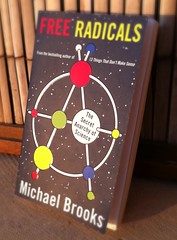
Michael Brooks has scratched beneath the glossy surface of science to write a revealing and thoroughly entertaining book about its practitioners. By cutting so close to the scientific bone that it spills blood, his “Free Radicals” departs violently from the textbook image of white-coated professionalism.

In eight gritty and gripping chapters Brooks uncovers the anarchy at the heart of many of the most famous advances made by scientists. Not content with bending rules to breaking point, they are happy to do the same with the truth if it will advance their glorious hypothesis, and with it, their career. They lie and they cheat, they slander their rivals and puff up their own importance, they gang up on outsiders, they take drugs to fire the imagination. Dear me, how have they been getting away with it for so long?

Free-Radicals

Not every scientist, of course, as Brooks is careful to point out, but the roll-call of the accused is impressively long and studded with celebrated names: Einstein, Galileo and Newton, among many others, are called to account. The author has dug up a treasure trove of stories from all branches science to illustrate the anarchy at its core. As well as the usual suspects, there is a good smattering of names that were new to this reader: Alfvén, Ovshinsky or Margulis, for example, or the improbably named Landrum Shettles, an early pioneer of in vitro fertilisation.

But having cut to the core, Brooks has no intention of pronouncing it rotten. Human it may be — and disastrously erroneous at times — but the message here is that science remains our most powerful way of knowing the world. It’s just that the process is more messy, viscerally so, than is often pretended, even by scientists themselves.

The recurrent theme of anarchy and anarchists is a clever trope, though at times it strains under the weight of the thesis placed upon it. In part this is because most of the examples given are of the celebrated elite — the famous names and Nobel laureates — who are of course only a minority of scientists. All is not anarchy, or infamy, in every laboratory of the world.

Nevertheless, there is plenty of substance here to stimulate the reader. I was struck by the parallel with Kuhn’s notion of scientists clinging possessively, often against the odds and by means fair or foul, to their ideas as an essential part of the process of science. It comes naturally since, to a significant extent, our ideas define us. Most scientists, myself included, will have felt the stab of pain when a cherished theory — it doesn’t have to be an especially momentous one — is felled by a belligerent fact. It’s bad enough if the troublesome data emerges from our own experiments, worse still if it is unearthed by a rival.

This may be an all too human frailty, but it is one that seems to be unavoidable for the process of science: only through the battling of champions can the better ideas win through. What Brooks’ “Free Radicals” illustrates with rich and sympathetic colour is that the fight can be surprisingly bloody and may not even be won on the first round. In some cases, the thwarted protagonist may never taste the sweetness of victory: Subrahmanyan Chandrasekar’s abysmal treatment at the hands of Eddington and the rest of the British astronomical establishment is perhaps the most painful story in the book.

All of which is not to excuse bad or unethical behaviour in the name of science but only to recognise the humanity of the business. Brooks has done a wonderful job of pointing to scientists’ feet of clay. At times, perhaps, his enthusiasm gets the better of him. He tries a bit too hard, I felt, to convince himself that Crick may have used LSD. Elsewhere I wanted to know more: if Einstein had failed repeatedly to prove his most famous equation linking energy and mass, what exactly had he missed, and what did his contemporaries think of the error? But those inevitable questions are perhaps the stuff of another book.

“Free Radicals” should be read by anyone seeking to think clearly about what science is really like. And it’s not just for public consumption. Brooks is also keen to call scientists to their wider responsibilities — to take science to the people and to politicians. He chides them, justifiably in many cases, for hiding behind the veil of professionalism to avoid any taint of politicking; the account of the relatively slow response to the ozone hole, due in part to hesitation by the scientists involved even though their data were solid, is a telling example of over-caution. But society needs more than technical expertise delivered from a laboratory bunker. It needs scientists to come out to play. But guys: play nice.

Posted in History of Science, Science & Politics, Scientific Life | Tagged , | 1 Comment

Rhythms of Life

Some say April is the cruellest month but I found July to be more punishing.

You might think that, for university staff like myself, July would bring respite from the tiresome enslavement of exam and project marking that fills all of June. At the end of that gruelling month the students are granted their grades and degrees and finally quit the campus.

But as July hoved into view all I could see were deadlines piling up on one another: courses for next year to be organised and meetings to be had, a grant application to be written, a paper to be submitted, results to be chewed over with my research group in what never seemed like enough time. Weeks and weekends of work followed one another in a continuum of demand that wound up and ground down. I knew my holiday was coming but did not have the energy to look forward to it.

Crete: daytime

But less than 24 hours after slinking home dead-faced from work, I am in Crete, under the sun and by the sea and determined to do nothing. The cares of work have not yet washed away but they are being eroded as the waves swish and thump against the shore. The house we have rented backs right onto the beach.

The air is warm here and the sky endlessly blue. The water invites and rolls you in its warm, salty embrace. The sand and stones are hot underfoot. My horizon is miles away, a perfect line where the sea and the sky meet before disappearing. On either side are two mountainous arms that reach northwards to enclose the lagoon. They bear almost no human trace – just a single dusty track scored along the base of the western slopes. Moving perpetually in from the dark blue of the horizon, the waves swish and thump against the shore.

As the sun descends at the end of the day, it blazes a dazzling trail across the water. Eventually the shining disc dips behind the mountains to the west, bathing the shadowed land in a coloured glow. As the sky darkens stars and planets wink into being. I see Saturn hanging beneath bright Arcturus. Soon the whole black canopy of night is alive with glittering light. The plough, with majesty, commands centre stage. Over to the east Cassiopeia lays out her careless ‘W’.

Crete: evening

Tomorrow the sun will come up and throw a fresh cover of flawless blue across the sky. The pattern of light and sound and warmth and dark will recur. It is an ancient rhythm that I had forgotten.

The waves swish and thump against the shore.

Posted in Scientific Life | Tagged , | 15 Comments

Plague-arism

Plagiarism is pernicious and pervasive. You can’t seem to get away from it because so many people are getting away with it. As a university teacher I have long been aware of so-called essay-writing services that tout their wares to students who think that by purchasing essays written by someone else and passing them off as their own they can buy their way to learning.

Fools. That’s what universities are for.

I was reminded about the plagiarism business a few weeks back when @mileymithsu started following me on Twitter. Naturally, I checked out her profile and found she was linked (literally) to the web-site of an outfit called ‘Custom Essay Services‘. She has a couple of ‘friends’ who go by @kellydenicolas and @alicetenison, both of whom have similar links to Custom Essay Services. Oddly, this curious threesome often seem to pop up synchronously on Twitter making fairly random tweets, most of which link to the — you guessed it — Custom Essay Services site.

Strange that.

Custom Essay Services presents itself as a company that has nothing but the interests of students at heart. They are passionate about enabling students to achieve their best. They feel the pain that poor students have to endure in the process of learning and are keen to alleviate their suffering. Obstenisbly, their mission is to offer ‘guidance’.

But that guidance is offered in the form of custom-written essays that students can purchase via a pricing scheme that depends on the requisite grade, word limit and deadline. Need 1000 words within 5 days to meet a 2:1 standard? Sixty quid, thankyouverymuch.

Their service is ethical, they say. To buy an essay is not cheating, they say. Essay services are so concerned about the standard of their product that each essay is carefully vetted against plagiarism software. “We do not tolerate plagiarism”, they say.

It is all so… beautiful. Sniff.

However, given their intolerance of plagiarism, I was surprised to find on the Custom Essay Services web-site an icon that is the spitting image of one used by Apple for their Pages word processor and which, I presume, belongs to the American computer company. But perhaps Apple approves of a company that, through its products, facilitates plagiarism? I’ve written to their legal department to find out.

Iconic and Ironic

Iconic and Ironic?

But I digress.

Of course, it is easy to see how unscrupulous students could abuse the products offered by Custom Essay Services and cheat. The company’s vetting of essays by plagiarism software has the effect of re-assuring their valued customers that they won’t be found out. This is explained, albeit implicitly, on the company’s web-site. I’m guessing their customers derive a great deal of solace from these reassurances.

Any student who passes off the work of another as their own is a cheat and a fraud deluding not only their teachers, but themselves as well. It is difficult to know the scale of the problem. My colleague Alice Bell has come across these ‘services’ leafleting outside the doors of my own university, Imperial College. She pointed me to a blog post by a pseudonymous essay writer — Ed Dante — who gave an eye-opening insight into the sordid business of helping students to cheat. Dante sought to justify his work by laying blame at the doors of academia and criticising our inability to properly assess students. There may be a kernel of truth in that, but it by no means exonerates students from the responsibility for their own learning. And Dante, I suspect, will eventually discover that he has made his bed in hell. What kind of life is that — helping the helpless to cheat their way through an ‘education’?

Yesterday Twitter was aflare with the experiences of another academic, Panos Ipeirotis, who had apparently thrown up his hands in despair after discovering that about a fifth of his students were cheating in some way. “Why I will never pursue cheating again” read the title of his disappointed post (which, strangely, is no longer available on Dr Ipeirotis’s blog, but can be found in Google’s cache). The scale of deception was astonishing but, despite his title, Ipeirotis had learned from his bitter experience and sought to develop strategies to reduce the likelihood of plagiarism — and got some astonishingly good work from his students in the process.

So there is hope, but we will have to fight a continuous war of attrition. As academics, it is our duty to have robust procedures for assessment (and to take companies like Custom Essay Services to task). But equally, students must have the integrity and the wit to realise that, in the long run, learning demands commitment, not cash.

Posted in Teaching | Tagged , | 79 Comments

Bono a hypocrite? Good.

Last Friday night as I watched U2 play Glastonbury on TV, the stream of hatred on Twitter was relentless. A torrent of unforgettable ire. I’ve long known that Bono and his band excite very mixed reactions, but this seemed to take things higher. Their music is not to everyone’s taste but on this occasion the bilious flood stemmed from the band’s attitude to taxation, or rather to tax avoidance.

U2’s presence at Glastonbury inspired a small demonstration from Art Uncut, which was quickly smothered by the concert organisers. But of course the organisers could not suppress the outpouring of righteous anger on the internet. How dare Saint Bono preach his anti-poverty rhetoric while greedily and irresponsibly avoiding the very taxes needed to fund international aid? There are no crumbs for the poor from the U2 table, they blogged. It’s so cruel, people tweeted.

Bono’s hypopcrisy is a very obviously a bad thing. Except that it is, in fact, a good thing.

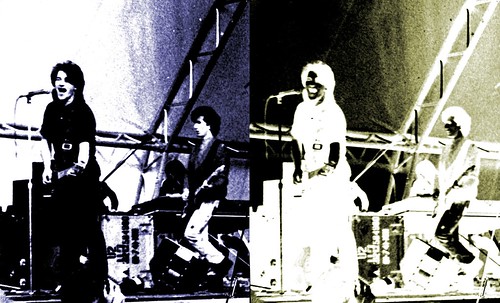
U2 1981 - in black and white

It’s easy to get confused on this because so much of the discourse on Twitter is deeply superficial. Layer upon layer of triteness is laid down in such quick 140-character strokes that the real issues can get buried.

But at the same time, not all of the exchanges mis-lead and I’m grateful to @gimpyblog, @giagia, @nettycox and @aoifemcl among others for the debate I ended up having on Twitter, which spurred me to find out more about U2’s tax position and the wider question of the intersection between tax laws and international development. I hope this blogpost might continue my education.

Since the band’s formation over thirty years ago they have benefitted from a tax regime in Ireland that looked favourably on artists because it did not tax royalties on their work. The primary aim of the legislation was to encourage the arts by providing relief for struggling artists. But the law was a relatively crude instrument since it also benefitted artists who had struggled all the way to globe-conquering success.

U2 have always had a head for business and did particularly well under this tax regime because —unusually in the music industry — they retain the rights to all their music. But they weren’t the only beneficiaries: many British artists including Sting, Frederick Forsyth, and the BBC’s John Simpson moved to Ireland to take advantage of the lighter taxes.

In 2006 the Irish government decided to limit tax-free earnings on artistic royalties to €250,000. With this cap the tax benefit was better targeted to needy artists, though it was still relatively generous*. But the move would have taken a big bite out of U2’s millions so they upped sticks and moved their business to the Netherlands, where the tax regime for royalties is now one of the most favourable in the world: the rate is reckoned to be about 1.5%. It is no coincidence that The Netherlands is now also home to the royalties of the Rolling Stones. If you want delve into the details of Dutch tax law and rock’n’roll profits, I can recommend this thorough article from The New York Times.

It is U2’s ruthless drive for tax efficiency that has attracted the attention of Art Uncut and other commentators, who see it as totally at odds with Bono’s anti-poverty campaigning.

And they are right. Aren’t they? Well, sort of, but the issue isn’t black and white.

For a start, Bono and his band mates have done nothing illegal. U2’s actions certainly deprive the Irish government of tax revenues that they could use for international aid, but the band are acting entirely within their rights as a business that operates within the EU.

Moreover, U2’s and Bono’s financial affairs are private and we don’t have the right to know what they are. Nor to we know much about how Bono spends his earnings. He may or may not donate generously from his own income to charitable causes, but he doesn’t say, so we don’t know and it’s a bit pointless to speculate.

There can be little doubt, however, that Bono’s work to campaign against poverty and disease is effective, whether it be via the RED label or the campaigning group ONE or by his endless badgering of presidents and prime ministers. As in science, the impact of his efforts are hard to assess in detail and some people scoff. But those who have seen him operate are impressed.

None of the above eliminates the stinging charge of hypocrisy, however much the band might argue back. There is a case to answer, though it is not one that should be solely centred on Bono and U2. We need to take a hard look at the tax regimes of countries that allow rich businesses equipped with smart accountants to avoid their duty.

But thanks at least in part to U2, perhaps all that is about to change.

I may be mistaken but I don’t remember any outcry when U2 were based in Ireland and benefitting from lighter taxes than they now pay in the Netherlands. It was only when they jumped ship from Ireland that the cries of hypocrisy went up. And those cries only went up because Bono’s tireless campaigning against poverty has been so effective at drawing attention to the plight of developing nations. Were there howls of protest when the Rolling Stones moved their money to the Netherlands, depriving the British government of tax revenues that could be used for development? I didn’t hear any. Curiously, it takes a hypocrite to get people excited.

But to what end? It’s now a week since Glastonbury and the anger has faded away. The passionate intensity so quickly whipped up on Twitter has dissipated just as speedily. And what is the point of passion if it doesn’t lead to action?

If only more people had Bono’s ability to stick with an issue and work at it, the world would probably be a better place.


*Since Jan 2011, the cap has been reduced to €40,000, presumably as a result of the troubled state of the Irish economy.

Postscript: I have dithered a while over this post. My views on these issues are coloured by my experience so I’m not sure how clearly I am seeing things. I grew up in Northern Ireland and got into U2 and their music almost as soon as they appeared on the Irish music scene, as I’ve written in another post. I could well be biased. Also, I’m no economist and don’t really understand the full implications of how the tax games that EU countries play affect the broader landscape of international development. So all insights on that topic will be gratefully received.

Posted in Music | Tagged , , , , | 67 Comments

Numb or Numbered? Part 2.

Back in April — it seems so long ago now — I wrote about the problems created in university life science courses by the relatively low uptake of maths by the student intake.

It provoked a very long and thoughtful discussion, both beneath the blog post and in email exchanges that I had with many of my colleagues. I am extremely grateful to everyone who took part. That debate about how we should go about inculcating a profitable acquaintance with other mathematical tools among students really helped to inform my views, which I have now updated in a piece published in today’s Times Higher Education.

The publication date now looks very timely, since it comes just the day after Michael Gove, Secretary of State for Education, made an important speech about the government’s plans for mathematics education. From a quick first read, there’s much good sense in Gove’s remarks. Or at least there are decent aspirations. But it’s one thing to make a speech or write an article on a blog or in a newspaper. Making change happen on the ground is where the real hard work has to start.


Posted in Maths, Science, Science & Politics | Tagged , , | 22 Comments