What I Read In February

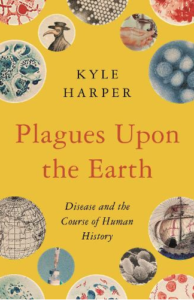
Kyle Harper: Plagues Upon The Earth. Kyle Harper is an historian, specialising in the history of disease. He is specifically interested in the pandemics that swept through the Roman Empire – events that might have changed the course of history. While thinking about that he reasoned that the entirety of human history, not just the Roman Empire, might have been shaped by contagion. Considered as apes, humans, as it turns out, are uncommonly prone to pestilence. Chimpanzees, for example, are strangers to bodily hygiene (they even like to snack on their own poo) and yet have fewer kinds of germs than humans. Harper’s history is divided into several eras. First came our prehistoric past, when we were mostly plagued by worms. After that came agriculture — an unmitigated disaster for human health – in which humans began to live in close proximity to their domestic animals, one another, and the excrement of all. Diseases sprang up that exploited the fecal-oral route, and the possibilities of vector-borne transmission. The Iron Age saw a greater concentration of people in cities, adding respiratory diseases to the mix. Oh yes, and cholera. The Iron Age ended with the Columbian Interchange between Africa, Eurasia and the Americas, with dreadful consequences for all concerned. After that, modernity lurched into view with a greater realisation of the importance of hygiene, followed by the germ theory. For the first time, cities were places where people could safely be born, rather than sinks of mortality that required constant immigration to keep their populations from collapse. Today, people are more likely to die from accidents or genetic disorders than the infectious diseases that exerted such a grievous toll. Depending on who’s counting, there are around 200 viral, bacterial, protist, fungal or parasitic diseases that affect infect humans, including (in no particular order, as they say in all the game shows) malaria (lots of this), bubonic plague, smallpox, polio, tuberculosis, typhoid, typhus, tetanus, diphtheria, chikungunya, whooping cough. filariasis, schistosomiasis, AIDS, influenza, amoebic dysentery (other causes of life-threatening diarrhea are available),  SARS, MERS, Lyme disease, leishmaniasis, syphilis, sleeping sickness, Chagas disease, bubonic plague (did I mention bubonic plague?), measles, leprosy, West Nile Virus, Zika, Ebola, Giardia, guinea worm, threadworm, roundworm, tapeworm, scarlet fever, lice (both sorts), ticks, mites, fleas … the list goes on and on. There used to be more, but diseases come and go. Nobody knows, for example, the agent of the sweating sickness that afflicted people in England in Tudor times. Therefore, every age has its characteristic diseases. One disease of modernity Harper uncharacteristically omits is Legionnaire’s disease, a symptom of that acme of modern life – air conditioning. Harper hadn’t meant to write this book during the COVID pandemic. That he has done underlines the importance of this book, which one can only feel guilty about for finding racily readable, given the subject. Humans, for all our control of the natural world (and perhaps because of it) are ever at the mercy of diseases.
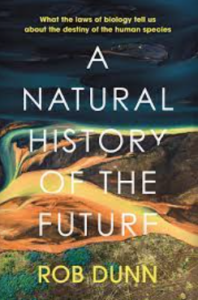
Rob Dunn: A Natural History of the Future. This doesn’t really do what it says on the tin, or, at least, what I expected, which was a prognostication on what life on Earth might be like when we humans are gone (an event which I think will happen sooner rather than later, but, hey, nobody cares what I think). What it does instead is show that despite our imagined mastery of the world in which we live, or, if you are Paul McCartney, the world in which we live in, life has a way of challenging us and adapting to the circumstances offered to it. Human beings are evolving – and so are the animals and plants unfortunate enough to be sharing it with us. To be sure, many of the latter are disappearing, but a few are adapting to our presence. Just as it is the human lot to be burdened by an uncommonly large number of diseases (see above), an enormous number of animals and plants depend on us for their existence — even exploit it. Did you know that there is a species of mosquito adapted to life in the London Underground? I still remember my first ever tutorial at University. It was with an ecologist. I remember little about the tutorial except that the tutor had, on his wall, a poster of fish eating ever-smaller versions of themselves, with the caption THE FIRST RULE OF ECOLOGY: THERE IS NO SUCH THING AS A FREE LUNCH. The modern human world mightn’t look much like a savannah or a rainforest. But the laws of evolution and ecology apply in cities and parks just the same.
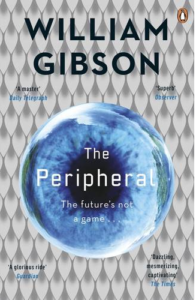
William Gibson: The Peripheral. And now for something completely different.  In a mildly dystopian near-future rural America — think of The Dukes of Hazzard with 3-D printers —  Burton Fisher is an ex-combat vet who makes money playing in immersive multiplayer games on behalf of rich sponsors. One day he subcontracts his role to his little sister Flynne (she’s Daisy Duke: please do at least try to keep up) who witnesses, in the game, a brutal and somewhat bizarre murder. It turns out, however, that it’s not a game. The murder really was (or would be) committed, in a slightly-further-in-the-future version of London, post-apocalypse (an event known as ‘The Jackpot’). Pre- and Post-apocalypse worlds join up through a fortuitous wormhole opened by super-rich ‘continuum enthusiasts’ to try and find the identity of the murderer and why it might have been committed. The Peripheral is a fun farrago of cyberpunk tropes from the inventor of the genre. It suffers a bit, early on, from sacrifice of expository writing to sheer style. When wearing mirrorshades, it seems, it not always easy to see where you are going.

Posted in Uncategorized | Tagged , , , , , , | 1 Comment

What I Read In January

This year’s pile of books got off to a promising start, and the ones I’ve read this month will set a high standard for the year. So, here they are, in order of reading.

J. R. R. Tolkien (ed. Carl Hostetter) – The Nature of Middle-earth. The postmortem publication of J. R. R. Tolkien’s work now far exceeds his output in life (he died in 1972). This is partly due to the fact that Tolkien never threw anything away, but mostly due to the tireless efforts of his son and literary executor Christopher, whose monumental efforts of literary excavation included the 12-volume History of Middle-earth, a collection of drafts, notes and other unpublished marginalia connected with his father’s vast and ever-growing legendarium. Christopher died in 2020, and the seemingly endless task has moved to leading Tolkienist Carl Hostetter, whose Nature of Middle-earth can be seen as Volume 13. In the late 1950s, after The Lord of the Rings was published, Tolkien (sensu J. R. R.) decided to revise fundamental aspects of his invented Universe. By that time the stories that became to be known as The Silmarillion had been revised at least three times and existed in a fairly advanced state. But still he did not rest. He decided to recast essential aspects of the life histories of humans and elves, which would have had important ramifications for the stories at the heart of the legendarium as it then existed. He also decided to re-make the invented world to accord with what we now know of the Universe. So, rather than having the Sun and Moon remade from the final fruits of the Two Trees of Valinor (as they had been hitherto), they would have existed from the beginning as astronomical objects. To my mind this would have been a great shame, and The Silmarillion as published by Tolkien (sensu Christopher) in 1977 adheres to the older (and, by now, canonical) scheme. The Nature of Middle-earth only includes preliminary notes for the reshaping, a lot of which come only as hints or digressions in extensive notes on the etymology of various words in the elvish languages. Language was always the primary driver for Tolkien’s creativity – he was, first, last, and always, a professional philologist, and created languages in the way that other people write music. Some of the material for The Nature of Middle-earth is republished from scholarly articles on Tolkien’s invented languages, which is in itself a terrific resource as some of these will be hard to obtain for most people. It is not clear, however, whether Tolkien actually undertook the necessary revisions. That is, whether he re-wrote parts of The Silmarillion to take them into account. Perhaps there is more Tolkien gold yet to be mined. As for The Nature of Middle-earth, it has to be said it could never be anything other than a hard read, and will appeal only to Tolkien obsessives. I count myself as one, so I found it repaid the effort. Fans who come from, say, the Peter Jackson movies, will be either disappointed or, frankly, baffled. There are some fragments of Tolkien’s beautiful writing in here, but as someone once said in another context, one has to kiss an awful lot of toads before one meets one’s handsome prince.
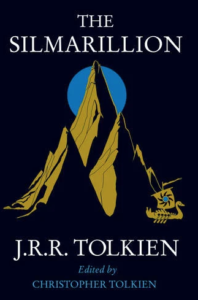
J. R. R. Tolkien (ed. Christoper Tolkien) – The Silmarillion. Having ploughed through the often stony ground of The Nature of Middle-earth my appetite was whetted for revisit to The Silmarillion, which, in its 1977 form as edited by Tolkien (sensu Christopher) can be seen as an abstract of J. R. R.’s invented mythology, in the same way that Darwin regarded The Origin of Species as the abstract for a longer work. In a sentence, The Silmarillion is the story of the Elder Days, the canvas against which The Lord of the Rings is set, and in which some of its characters, such as Galadriel, Elrond, Sauron and Gandalf, played more or less tangential parts. Having read all of the alternatives, reworkings, recastings and various published drafts since published in The History of Middle-earth, I have to say that the work of Tolkien fils in producing a coherent text from his father’s stories is nothing short of a masterpiece. And whatever you might say about Tolkien père, he was a truly wonderful writer. His prose is rich, yet spare: perfectly balanced, with not a word out of place. Just what you’d expect from a philologist who knew the meaning and history of each and every word he used, and that words have power.
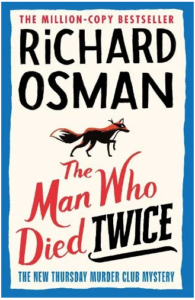
Richard Osman – The Man Who Died Twice. This continues where Osman’s first novel, the Thursday Night Murder Club, left off. If you haven’t read that (and why haven’t you?) it doesn’t really matter. The Thursday Night Murder Club is a group of four seemingly ill-matched pensioners living in an upmarket retirement village set somewhere in the Home Counties. They meet each Thursday to solve murders. And sometimes the murders come to them. For what is basically a sitcom involving a cast largely made of septuagenarians, the body count is high, and the action sometimes gruesome. It’s also pin-sharp, heart-warming, and laugh-out-loud funny. And, yes, Richard Osman is That Man on the Telly.


Francesca Stavrakopoulou – God: An Anatomy. The God of the Bible is a musclebound, physical, jealous street-fighting brawler. He has feet, and hands, and legs, and arms, and a head, and viscera, and dangly bits. This physicality is hard to see, as it has been progressively airbrushed out in successive reworkings of the canonical texts that eventually became the Bible, largely as a result of Christianity which, with its constant worrying about the nature of the Holy Trinity has to pour the corporeal essence of God into Christ, leaving God as no more than some indefinable essence or pneuma, the smile of an ever disappearing Cheshire Cat. The author digs into the original Hebrew of the Bible texts and interprets them as products of the politically turbulent times in which they were written – the closing centuries of the last millennium BCE, when the tiny Yahweh-worshipping kingdoms of Israel and Judah were progressively despoiled, reorganised, destroyed, reorganised again and finally destroyed by waves of Assyrians, Babylonians, Persians, Hellenic Greeks and Romans. She also traces Yahweh back to his roots among a wider Levantine pantheon, as a storm god and son of the High God El, and who eventually took over El’s consort for his own — and shows how Yahweh fits in to the patterns of religion and worship characteristic of the region back to the earliest times. It should be a deeply scholarly work — and it is — but it’s also racy and engaging, and will give pause for thought to anyone who takes the King James Bible literally. Yes, the Bible should be interpreted literally. But in its original Hebrew, which I know from experience, is a very slippery fish, the translation of which will depend a great deal on the moral stance of the translator. If this doesn’t make my Top Ten at the end of the year I should be most surprised.

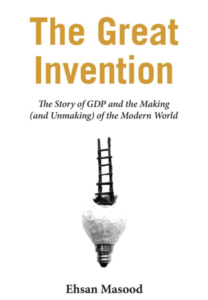
Ehsan Masood: The Greatest Invention – the economic health of a nation is measured using a simple formula called Gross Domestic Product (GDP), which summarises how much producers produce, and consumers consume, and in economic and political circles it’s seen as a Good Thing that GDP is always going up. Indeed, when GDP goes down for more than a certain length of time, there is an economic recession, which is seen as a Bad Thing. The flaw in this argument is that on a finite planet, GDP cannot keep going up without limit. In this small but engaging book, Ehsan Masood suggests that GDP was one of those temporary measures that seems to have become ingrained in the psyche of political economics — invented to measure the recovery of European nations after the trauma of World War II. But GDP doesn’t measure many things that are increasingly seen as essential to life, such as volunteering, or work-life balance. Should be not be more contented with less? In answer to this, Masood discusses two alternative measures in particular. One is Gross National Happiness, a metric peculiar to the Himalayan state of Bhutan. Another is the Human Development Index (HDI) which has achieved a measure of traction. But — for the moment — GDP reigns supreme. But for how much longer?

Posted in Writing & Reading | Tagged , , , , , , , , , , , | Leave a comment

Opinions

Never a truer word was spoke than when Abraham Lincoln said that you can’t please all of the people all of the time. At least, I think it was Abraham Lincoln. Anyway, the same fellow who said that 95% of what you read on the internet is wrong.

But I digress.

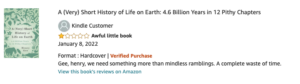
I was mildly bemused to see this review on Amazon of my latest book A (Very) Short &c &c  (if you’ve not heard of this, you are invited to discover more here).

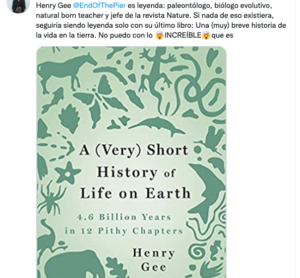
This should be a salutary corrective to this praise seen on Twitter:

I don’t think you need to understand Spanish to see that the reader liked my book a lot. This is especially pleasing in that I do not know the sender. I thanked the person and reminded the world that the book will soon be available in Spanish.

Funny old world!

Posted in Uncategorized | Tagged , , , , | 4 Comments

My Reads of 2021

Yes, the time is coming up to the top of rapidly fast approaching when I list my favourite reads of the past year.  I’m amazed I’ve managed 54 books this year given that I have been very busy elsewhere. Going back through this list I discover titles that I remember enjoying hugely at the time but had since forgotten about completely. To qualify for inclusion on this list a book has to have been both country and western enjoyable and memorable. Competition for the ten spots on this year’s list has been fierce. So fierce that I have snuck in a few as ‘honourable mentions’ (hey, I make the rules, so I am allowed to do this).

A note on links – wherever possible, I have linked the books to pages where they might be bought on Bookshop, an aggregator for UK independent bookstores. If the book can’t be found there, I link to the publisher’s website directly. I have no particular preference for Bookshop, other than a wish to support independent bookstores. Amazon continues to be a godsend chez Gee for household items, such as if one happens to run out of acrostic spline defibrillators last thing on a Sunday night, but I am resolved forthwith fifthwith to shop for books such that independent bookstores might get the benefit. Ironic, really, given that Amazon started as an online bookstore, that I use it for just about everything except books. None of this need affect you: I shall assume that if you both can read this then you are capable of making your own purchasing decisions.

And so, as they say on all the game shows, in no particular order…

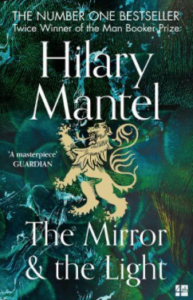
The Mirror and the Light by Hilary Mantel – The concluding chapter of Mantel’s epic trilogy based on the life of Thomas Cromwell (the first two were Wolf Hall and Bring Up the Bodies). That it all ends badly for Cromwell won’t be a spoiler (things usually ended badly for anyone connected with Henry VIII). Cromwell’s reflections as he heads for his inevitable demise are tragic and wonderful. There are those that cannot get on with Mantel’s peculiar style, in which she writes from Cromwell’s point of view but in a curious mix of what seems to be second and third person. But for me, The Mirror and the Light is a capstone to what will prove an enduring literary achievement.


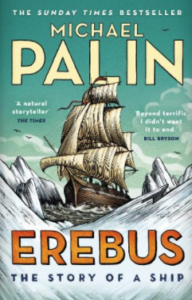
Erebus by Michael Palin – Comedian, explorer and all round Nice Chap Palin tells the history of the Erebus, one of the two ships which (with the Terror) ended its long and storied life wrecked in the remote North American Arctic, as part of Franklin’s failed expedition to find the Northwest Passage. Amazingly, the Erebus represented the peak of technical achievement of the mid-nineteenth century – today’s equivalent would be something like sending an expedition to the Moon. Erebus had sails and a steam engine. Also, tinned food. But the steam engine was underpowered, and the tinned food spoiled, and, having been sealed with lead, poisoned the crew. There’s a lesson here somewhere.


Jews Don’t Count by David Baddiel – Diversity and Inclusion are everywhere, and quite right too. Or it would be, if it included perhaps the most persecuted minority in history — Jews. This extended pamphlet (it’s only 28,000 words long) conceals an iron fist in a velvet glove. Though deftly written (Baddiel is after all a comedian) it hits hard at the hypocrisy of progressives who espouse diversity and inclusion but ignore Jews, and who even tolerate antisemitism – witness that just over a year ago, Britain could have had a government in which antisemitic attitudes had become mainstream. This should be required reading for self-appointed thought leaders in academia and HR departments everywhere. They won’t read it, of course, because in their own minds they are always right. And even if they did, they wouldn’t get the jokes.


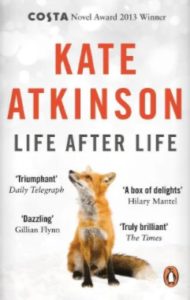
Life after Life by Kate Atkinson – A girl is born on a snowy night in 1910 and immediately dies. A girl is born on a snowy night in 1910, survives for a bit, and then dies. A girl is born on a snowy night in 1910, grows up, and changes history. Possibly. If like me you have wondered what life would have been like had you chosen a road not taken, this is for you. Atmospheric, and, it has to be said, a bit spooky. An honourable mention goes to The Midnight Library by Matt Haig, which explores a very similar theme, and which I also read this year.


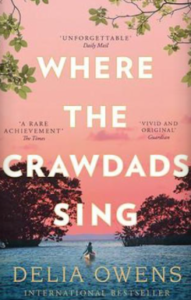
Where the Crawdads Sing by Delia Owens – a tale of a girl who, alone from the age of eight, grows up in a shack in the coastal back-country of the Carolinas and becomes something of an expert of the local wildlife. Not surprisingly so, because she is as much a part of the wildlife as the animals and plants she describes. Explores issues of parenthood, childhood, race, sexual abuse, misogyny and entitlement, but with a refreshingly light touch.


The Accidental by Ali Smith – a very curious one, this, written in what I’d call an ‘experimental’ style. I am not a great fan of literary fiction, suspecting that a lot of it might well be too far up its own fundament for its own good. This one, however, was worth the effort. It concerns a family that’s relocated to a holiday home in Norfolk and welcomes into its orbit a strange young woman of unknown history – a cuckoo that could have a variety of effects on the family’s equilibrium. Stephen King wrote much the same thing in Needful Things, but at three times the length and with far less elan.


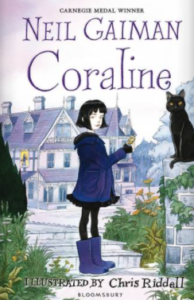
Coraline by Neil Gaiman – rarely a year goes by without the inclusion in my roster of a book by Neil Gaiman, whose books are (in my opinion) consistently first-rate. Coraline, the child heroine, lives with her family in a large crumbling pile long since divided into flats, and so also inhabited by a number of other residents. Well, one day, she opens a door that shouldn’t be opened, and … well, suffice it to say that this is the most frightening book for children (or adults) I have ever read, alongside Struwwelpeter and Peter Rabbit.


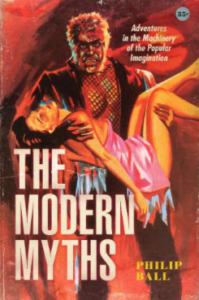
The Modern Myths by Philip Ball – we tend to associate myths with the far past. The doings of Zeus, or Achilles, or Gilgamesh, or Thor. Ball argues that myths are continuously created, and offers some modern examples of tales that started in popular culture but which have transcended their often humble or tawdry beginnings to become mythic tropes. Frankenstein. Dracula. Batman. Jekyll and Hyde. The key to myths is that the originals are often so badly done that they offer scope for others to adopt the tales and run with them. Great literature, it seems, rarely works as myth. I enjoyed this book enormously but found I didn’t agree with all of it. This is the mark of a good book – it leaves plenty of space left for debate and discussion. It made me think.


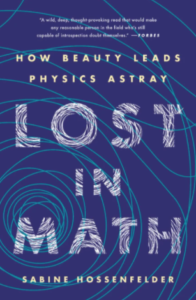
Lost in Math by Sabine Hossenfelder – Theoretical physicists love to sound off grandly about everything, under the impression that such theorising explains just that. Everything, that is. The fact that theoretical physics is broken seems to be a side-issue. Quantum mechanics and gravity can’t be friends. The Standard Model of particle physics, in which everything is made of so many mysterons, schleptons, croutons &c. &c., only works if you pencil in arbitrary values plucked from nowhere that don’t fall out naturally from all the equations. The experiments required to test new hypotheses require equipment far too huge and costly to build. Thus becalmed, physicists have resorted to a kind of scholasticism in which equations have validity as long as they look pretty. It’s not too great a stretch to say it’s become a kind of religion. I’m reminded of the episode of The Big Bang Theory in which theoretical physicist Leonard’s girlfriend, also a theoretical physicist, breaks up with him as they have irreconcilable views. If one believes in loop quantum gravity, and the other in string theory, how would they bring up the children? Sabine Hossenfelder — a theoretical physicist who has seemingly had Doubts — dissects the current crisis in theoretical physics with waspish glee.

And the winner is…

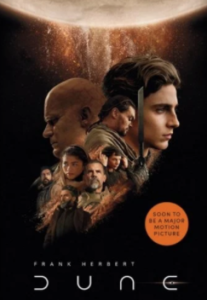
Dune by Frank Herbert, which, with its sequelae Dune Messiah and Children of Dune, constitute just one long novel. I read Dune (but not the sequelae) when I was a teenager and thought it poor. I was subsequently unimpressed by the 1984 Magic Lantern production by David Lynch. I only came back to it following the announcement of the new Magic Lantern Production by Denis Villeneuve (which I have yet to see), and think a great deal better of it. I re-read the first novel and immediately plunged in to Dune Messiah, which I think is better, and then Children Of Dune, which is okay. I haven’t yet read God Emperor of Dune, Antimacassars of Dune, Gloucestershire Grummet-Tinkers’ Scrodes of Dune, Cash-In of Dune, or Jejune Swoon Spitoon of Dune. Just to make that clear.

So, without wishing to tell you the entire plot, here is the entire plot. Human beings have colonised the Galaxy, but at a cost. Thanks to a kind of luddite revolution some thousands of years before the story opens, all thinking machines are banned, so spaceships are piloted by crew addicted a drug called Spice, or Melange, which is only found on a single planet, Arrakis — or Dune, on account of the fact that the entire planet is a desert. Spice has mind-expanding properties that allow the pilots to access hyperspace and thus direct their spacecraft. Spice is a natural product, the effluvia of sandworms, burrowing creatures so gigantic that they make tube trains look like small pieces of wet string loosely tied together.

Dune is governed as a fiefdom awarded by the Galactic Emperor to one or other of the several Noble Families. As the novel opens, the horrible Harkonnen family is to step down to make way for the heroic Atreides family, formerly of the pleasant planet Caladan. But it’s all a wicked plot by the Emperor and the Harkonnens to dispose of the Atreides as the result of a decades-long ritual feud. But the wicked plot of those naughty Harkonnens is foiled by Paul, the Atreides heir, who turns out to have Special Powers, being as he is the culmination of a generations-long breeding program set up by the Bene Gesserit Sisterhood (imagine the Shaolin Monks, but as nuns). Notwithstanding inasmuch as which Paul falls in with the Fremen, the spice-addicted Bedouin-like human inhabitants of Dune; gets himself addicted to Spice, which supercharges his Special Powers (did I mention his Special Powers?);  foils the Horrendous Harkonnens; and, well, you can take it from there.

An over-wrought combination of Space Opera and Sword-and-Sorcery Epic, this could so easily have fallen flat on its face. But the density of plotting, the high adventure, the exploration of exotic philosophies, and the sheer sensawunda keeps it in a state of never quite collapsing. Dune was published around sixty years ago, in the Golden Age of pulp SF that gave us Asimov, Heinlein, Clarke and so on, and has that same vitality, for all that some of it seems dated.  In hindsight you can see how much Star Wars owes Dune. The Jedi owe a great deal to the Bene Gesserit — especially the use of tones of voice to influence others. That, and the connection between bloodlines and the Force. Sandworms are the Sarlacc; Dune is Tatooine; Paul is Luke; Duncan Idaho is Han Solo; the Harkonnens are … well, you can work that one out for yourself.

Posted in Uncategorized | Tagged , , , , , , , , , , , , , , , , , , , , , , , , , , , , , , , , , , , , , , , , , , , | 5 Comments

PR

First, I’d like to wish you (both) a happy holiday.

Second, I’d like to share with you my recent experiences promoting my latest book. My agent advised spending a chunk of advance on hiring a PR company for the US market. Which I did. To the tune of $$$$$ a month. For 5 months.

My PR person worked tirelessly – and I mean tirelessly – opening doors for me to write op-ed pieces in print; fixing it so that high-profile print and online media could publish excerpts; getting me on radio shows with large audiences (such as Coast-to-Coast AM, which goes out on 640 US radio stations and reaches 2 million people); organising ‘virtual’ speaking events in the US; and also guesting on podcasts (eight broadcast so far, including Guy Kawasaki’s Remarkable People, with another recorded and two more scheduled).

PR costs a LOT of money, and is a lot of work, too. My PR person had me doing my homework — writing op-ed articles; recording audio segments; organising web resources and generally being more organised than I usually am.

Although some PR is organised by one’s publisher (and some media comes to one directly) a publisher’s in-house PR people have to spread their resources over the authors they think will sell. When you pay extra for your own PR, they tailor a campaign specifically for you, do much more and go deeper.

And the PR trail requires some stamina. Last night, for example, I was recording a program for radio New Zealand, where it was this morning; and this morning I guested live on a US radio talk show, where it was last night, so right now I don’t know if I am coming or going.

Is it worth it? Time will tell. But, these days, there are so many books, and so many authors, that like the Red Queen you have to run as fast as you can just to stay in the same place. Consider – just about every person you see or hear interviewed on radio and TV talk shows is there because they have a book to sell. And unless you’re already a celeb, you have to work much harder to get airtime. These guests are there because they have PR people forever pitching on their behalf to broadcast producers and bookers.

Would I do it again? In a heartbeat.

Posted in Writing & Reading | Leave a comment

Launch

My latest book A (Very) Short History of Life on Earth has now come out in the US and Canada. Actually, it came out 17 days ago, and it’s available from St Martin’s Press and the proverbial All Good Bookstores, but I haven’t had a moment to carve a word on this until now. It was pipped at the post by versions in Dutch and German; a Spanish edition is now available for preorder; and of course the UK edition, from Picador, has been out for a while.

In thirty years of writing books, this is the first to have made any impact at all. For some years I have subscribed (through Amazon) to a service called NPD Bookscan. This gives me weekly sales of all my print books (so, excluding Kindle and audio) sold either by Amazon or in more than 10,000 US bookstores – some 85% of the bookstores in America. Most weeks I sell one or two. I have never sold more than six in any given week in the past two years. Last week, I sold 536 – this week it’s down to 284. Almost all were of the new book. And this is in the near absence of US print reviews of the book (so far … though the Wall Street Journal did recommend it as a gift book, which can’t have done any harm).

OK, so hardly Harry Potter, I know, but it means a lot to me. My UK publisher tells me that the UK editions has shifted 7,500 copies in all formats and it’s gone into a second printing. They say you have to toil in obscurity for years before you get to be an overnight sensation.

One reason for the visibility is that the book really is available in stores. My previous books have generally be confined to more academic outlets, and this tends to restrict availability. Another is that I have a whole team of people working for me. Not just my marvellous agent, but the publicity people at both US and UK publishers, and, crucially, a PR firm. Through them I’ve got excerpts of the book out in variously visible places, bookings on US radio shows, appearances by Zoom at various events and quite a few podcasts. I’ve been keeping a list here, if you’re interested … but it’s not over yet. There’ll be quite a few more things happening as we slide down towards the festive season. Suffice it to say that rectangular gifts are easiest to wrap. Although I’ve heard that although cylindrical gifts are easier to consume, one shouldn’t let the rectangularity of a gift put you off. Just start nibbling away at the corners.

Posted in Writing & Reading | Tagged | Leave a comment

Week

What an ericacious exhausting sackbut amazing week.

It started last Saturday morning when I discovered that I was being followed by the Literary Editor of the Times.  Followed, in the sense of Twitter. At least, I don’t think the Literary Editor of the Times really was following me, you know, in person, with a raincoat and binoculars, notwithstanding inasmuch as which the Present Emergency and so on and so forth, though of course he might have been, but if he was, he was very good at it, because I didn’t notice.

Perhaps, though, this was a signal. So alerted, Mrs Gee and I bought a copy of the Times on our regular weekend supermarket trip, just in case we were approached by a stranger who sat down next to us on a park bench and said something innocuous like ‘the tulips bloom early in Vienna this spring’. Actually, it’s only Mrs Gee who ventures into the supermarket. I sit in the car, in the car park. After all, someone has to do the stake-out.

Mrs Gee came out, with the usual groceries — atonal apples, amplified heat,  and so on — and a copy of the Times. When we got home we found that my latest book had attracted not just a book review, but the lead book review, noch, and a splendid one it was too. You can read it here.

The effect had a salutary effect on sales. The book had been published in the UK in September. Reviews were sparse but  generally good. There was a lovely one in the Literary Review, a magazine for which I have a particular fondness, though its appeal is, as you’d expect, limited to people like me who simply can’t get enough of books.  Following that, the Amazon UK ranking crept up to the low thousands. Although my publisher tells me that the algorithms Amazon uses are mysterious, this had to count for something.

The Times review gave sales a huge boost. Amazon rankings shot up well into the top 200 of all books – up with colouring books, celebrity autobiographies, books for children, and editions of novels by Sally Rooney in Hebrew. At one stage, I was told, the rank was in the 120s, though the highest I saw was 134.
In specific categories, such as ‘palaeontology’ and ‘dinosaurs’, it reached number one and stayed there for some days (see the picture). The hardcover edition was most popular, but the audiobook and kindle versions came up to approached got close.

And, quite unlike any other book I have ever written, it really was available in the canonical All Good Bookshops.

The Amazon rankings subsided over the following days, although very slowly, and as I write it’s still in the top 1000. By the end of the week normal service should be resumed and I shall return to the comforting obscurity to which I have long been accustomed.

People ask me about the paperback. (Well, one person did, take a bow, Mr. G. O. of Norfolk). There is what’s known as a ‘trade’ paperback, available from foreign markets that are less receptive to hardbacks. The UK ‘mass market’ paperback should be out in autumn 2022.

Meanwhile, editions are already out in German and Dutch, and on 9 November it’ll be published in the US & Canada.

In preparation I’ve been a guest on a lot of podcasts that’ll be broadcast nearer the time (I already have a podcast series of my own that you can hear now). I have a feeling that the hoopla has hardly begun.

Posted in Writing & Reading | Tagged , , , | Leave a comment

Office

Small spaces at home, hitherto neglected nooks and crannies, have begun to assume a far greater importance in our lives than they once did. These are those closets, spare bedrooms, cupboards under the stairs, corners of bedrooms, edges of dining tables or breakfast bars and so on where many people now do their work, when once they would commute to somewhere perhaps more suitably equipped.

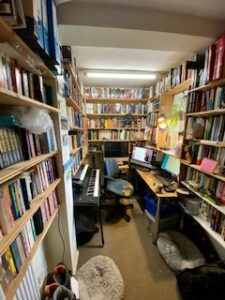
I’m lucky in that even before the Present Unpleasantness I have worked at home for most of the time. When the Gees first moved to Cromer, in 2006, I really did work in a cupboard under the stairs, though back then I commuted more. In 2011 we remodeled the house, adding a kitchen diner at the back, so I moved into (most of) the old galley kitchen. And that’s been my office/ studio/ man cave/ dojo/ fun palace/ library ever since. This is what it looked like a couple of weeks ago.

I did most of the working (and music-making) at the far end. Although it’s a long narrow room, it seems much longer because I used a wide-angle lens to get it all in. In actual fact the total floor area is less than six square metres.

After working hard all summer at the Submerged Log Company, as well as finishing my latest book — and recording the audiobook version thereof — I felt that it was high time for a refurb. I spend quite a lot of time in the home office, whether for the day job; writing on my own account; writing and recording music; or just relaxing; and after ten years of occupation it had begun to look a bit scruffy. There were some ugly stains on the ceiling (a result of minor flooding from the bathroom above), and I realized that behind the bookshelves there was still some raw plaster and even a few holes from when the room had once been a kitchen. Even the wire that had powered the cooker still protruded from the wall. So I decided to take some time off to gut the place.

It took four days — FOUR DAYS — to remove the hundreds of books, sound equipment, sundry gewgaws, bibelots, unicycles, girrafes, and other stuff. Luckily we have a capacious garden summerhouse.

It took another three days to prep the place for repainting. I pulled up the scuzzy floor tiles. I filled up all the holes. I vacuumed. I threw out trash. I vacuumed again. I sugar-soaped the walls. I did more vacuuming. The dust, my dears, the DUST.

The time came at last to apply, you know, actual paint.


And here it is after the first coat of Homebase Pure Brilliant White. One thing I discovered while doing this job is that, like Michelangelo, I don’t like painting ceilings very much. A friend suggested I send the bill to the Pope. So His Holiness might soon be getting a receipt for a large tub of the aforementioned Homebase Pure Brilliant White. and a paint roller.

After two coats — and two days — Offspring 2, who has far greater attention to detail than I, came in to touch up the bits I’d missed.


Then the time came to install a large shelf with legs, which has pretensions to being a desk.

The next task was to attach fourteen vertical runners to the walls, for the shelves. This meant drilling a lot of holes, with a power drill. Another thing I discovered while doing this job was that I am not fond of power tools, especially in a confined space. The NOISE. You might ask why I didn’t use the same holes as before. Well, that would have been too easy. Besides, I wanted some of the shelves in different places.

This took two days. Or, rather, four hours, spread over two days. I could only take so much of the noise (and the vibration), and I wanted to spare the neighbours. After that I could put up the shelves.  Quietly.


After a lot more vacuuming it was time to install new carpet tiles. Last time I did this I glued them down with special tile adhesive, and after some time in this confined space I felt that I was being cheered enthusiastically on by Harvey the Giant Pink Octopus and his All-Star Orchestra featuring the Crustacean Choristers, with, towards the end, Agama Gekko and the Iguana Brass. This time the tiles were thicker and backed with bitumen, so could simply be laid flat on the ex-council lino, without adhesive of any kind, not even hallucinogenic, although I still had to cut a few to fit. This only took an evening, but took longer than it might have done because the dog felt she had to come and ‘help’. This meant that short bursts with a sharp knife and straight-edge were interspersed with longer intervals of rolling around on the floor admiring whichever soft toy was the dog’s favorite that day.
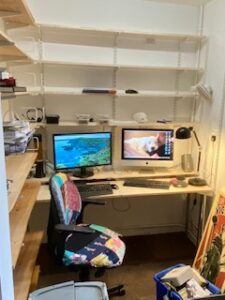


Only then could I install the computers and associated electrical equipment – much easier to do before the books come back.
In the meantime, comments had been made on Social Media about the scruffiness of my chair. Well, I have had that chair for at least a quarter of a century. I have written many books while seated in that chair, notwithstanding inasmuch as which processed many thousands of submerged logs. That chair was good enough for me. But Mrs Gee very kindly re-covered the chair with the fabric from some very colorful but worn-out trousers she once wore, giving the chair a fetching and funky new appearance.


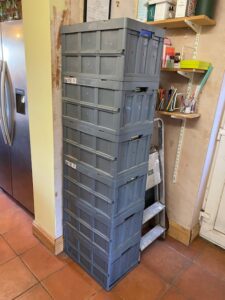
And now, the books. The refurbishment was an excellent opportunity to have a cull. I really don’t like getting rid of books, but as I am fast coming up to rapidly approaching my seventh decade, I made one of two executive decisions – that if I have read a book and am unlikely to read it again, then I should donate it to a charity shop so someone else can have a go. This picture shows a huge pile of crates filled with books destined for our favourite secondhand bookstore, which is at Blickling Hall, a local National Trust property. Almost all of these books are from the Office, though Mrs Gee and I have been thinning out drifts of books that have accumulated elsewhere chez Gee. Working at a publishing company, as I do, I tend to accrete books without knowing it. I also had a large pile of generic thrillers, acquired in two episodes. The first was when a elderly neighbour was in hospital for some weeks trying to shake off pneumonia. He was a voracious reader, and before each visit I’d trawl charity shops for airport-lounge-style thrillers and whodunits. Sadly his pneumonia won in the end, and after his death, his widow returned the books. The second episode was when I broke an ankle in August 2018 and was confined to bed for a couple of months, and neighbours and friends kindly gave me lots of entertaining reading. Much of it now read – the rest, I’m unlikely to – so off they go.



The remaining books re-shelved, the last task was to reinstall Flabbey Road, my home studio. Which I did. The second executive decision I made was that my days of live playing are over. I really don’t much like wiring things up, taking all the wires out again, schlepping huge boxes around in the middle of the night, wiring them up again, playing for a few bored punters wildly enthusiastic crowds, and doing it all in reverse when I could be comfily at home watching Strictly with the family. Besides, lockdown has taught me that I can record whole albums at home, as well as audiobooks.
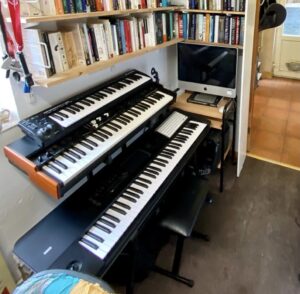


Here is what it looks like from the other end.

And that’s it. It took the full fourteen days, or even a fortnight. And it was exhausting. Some days all I could do of an evening was flake out in front of the TV while I felt the blood pounding in my arms and legs. All that moving of books and equipment, all that stretching and bending, toting barges, lifting bales, while wielding a paint roller/ vacuum cleaner/ carpet knife/ etcetera.

But I’m very glad it’s done. I must say I couldn’t have done it without the support of the family, who had to tolerate the mess and dust and fumes and general chaos. Should be good for at least another ten years. Next stop – tidy the toolshed.


Posted in Domesticrox | Tagged , | 2 Comments

Spayed

It’s been a funny old day. It started in a celebratory mood as my book finally got to be published in the UK. And also, in Dutch, in Holland. I have been basking in congratulatory messages, which has been lovely, and if you want to know what the fuss is all about, you may visit the book’s very own website, which is here.

But the day was also deviant in its routine as I had to get my faithful dog Lulu to the vet to be spayed.  This is an appointment of long standing, and calculated from the end of her last being in season. She is now back from having been spayed, surprisingly perky withal, and modelling a very smart babygro. But I’ll be nursing her this evening.

And it also happens to be Yom Kippur, a day in which publishing books and nursing spayed dogs should really be very far from one’s mind. Real life, eh?

Posted in Domesticrox | Leave a comment

Failure

I’ve seen a lot of emissions on social media lately consoling those who might not have achieved the grades they wanted in order to go to their preferred job or institute of higher learning. Therefore I thought I should contribute to the now-customary general outpouring and effusion of platitudes by people saying that there are more things in life than exams, that things happen for a reason, and so on, and so forth, notwithstanding inasmuch as which I invite you to consider, therefore, my so-far stellar career…

— I failed my Eleven-Plus.

— I failed my Common Entrance for public school. I did however make the subs’ bench and was asked for an interview. I took my fossil collection to show the headmaster and didn’t let him get a word in edgeways. I got in.

— I failed A-level maths. That is, I got an ‘E’, which wasn’t good enough. I had to re-take a year. In the end I got a ‘C’, which was honestly the best I could manage, and enough (just) to get into University.

— I failed my entrance exam to be an undergraduate at Cambridge. ‘Don’t worry’, my Mum said, ‘you’ll get there as a graduate student’. Which I did. I did my undergraduate degree at Leeds, which I loved, and was much more fun than Cambridge would have been. I got a 1st and went to Cambridge to do a PhD.

I failed my PhD viva. They offered me an MSc as a consolation prize. No, I said, I’d rewrite my thesis. Which I did. I got my PhD.

— While I was writing up (the second time) I was invited to join the staff of the Submerged Log Company. That was more than 33 years ago. So despite the three six five failures listed,  I haven’t done too badly. For more advice on the sometimes circuitous route one can take to career success, I refer you to this recent eructation from my colleague Professor Rohn.

Posted in Research, Science Is Vital | Tagged , , , | 2 Comments