Goldacre-esque

Perhaps once he has had enough of complaining about advertising-equivalent exposure and Britney Spears’ breasts, Ben Goldacre could take a look at this article.

The lengthly title, Discrepancies in sample size calculations and data analyses reported in randomised trials: comparison of publications with protocols belies the simple and slightly alarming findings.

This “research about research” considered seventy published randomised controlled trials, comparing the protocols and the corresponding publications of results. The authors considered the proportion of protocols that did not provide information about sample size calculations and statistical methods, and the proportion of trials with discrepancies between information presented in the protocol and the publication.

The authors find numerous such discrepancies in the protocols and resultant publications, from the framework of the study to the methods of statistical analysis chosen.

Does this matter? Well, yes – different statistical methods explore the raw results in different ways, and can give different impressions of the outcomes. If these statistical methods are not specified in advance, choosing which tests to include could potentially be influenced by explaratory analyses of the data. The authors end their piece with a call for documentation of sample size calculations and full plans for data analysis before a trial gets underway, and faithful adherence to this published protocol, or necessary amendments to be explicitly described.

Only with fully transparent reporting of trial methods and public access to protocols can the results be properly appraised, interpreted and applied to care of patients.

Just as Richard wonders if anyone takes that junk seriously, we can question whether clinicians (and researchers, journalists and the public) read, or will begin to read, reports of randomised controlled trials with the scrutiny that this article suggests is warranted.

A.-W. Chan, A. Hrobjartsson, K. J Jorgensen, P. C Gotzsche, D. G Altman (2008). Discrepancies in sample size calculations and data analyses reported in randomised trials: comparison of publications with protocols BMJ, 337 (dec04 1) DOI: 10.1136/bmj.a2299


Posted in Blogging the PhD, Nature Network | Comments Off on Goldacre-esque

Me and my DNA

Journalist Ben Hammersley tries out 23andMe ‘s services.

The test has added, apart from curiosity, nothing meaningful.

I believe that the download will be available for a week; after that, you’ll have to listen again by finding the program in the Analysis archive

Continue reading

Posted in Blogging the PhD, Nature Network | Comments Off on Me and my DNA

Bananas and Slugs – the long tail of science

Here on Nature Network, several bloggers have lamented the difficulty in keeping up with the literature in their field.

BananaSLUG adds even more of a challenge!

By throwing a random word into your Google search string, BananaSlug will return hits that would otherwise be buried several pages into the results.

BananaSlug “was designed to promote serendipitous surfing”. I am not sure it does that – surely serendipity is not found by looking for it – but this is a fun gadget.

Posted in Blogging the PhD, Nature Network | Comments Off on Bananas and Slugs – the long tail of science

meme scheme

1. What is your blog about?

Bioinformatics, theoretical systems biology, synthetic biology, and my experiences being a graduate student in a multidisciplinary field.

It’s my chance to see something, think “hey, that’s neat” and then write about it.

2. What will you never write about?

pass

3. Have you ever considered leaving science?

Yes, last week.

4. What would you do instead?

Become a yoga instructor.

5. What do you think will science blogging be like in 5 years?

The division between blogging and open notebook science will be less clear.

6. What is the most extraordinary thing that happened to you because of blogging?

I was stalked on openwetware.
And, I booked a trip to Cromer.

7. Did you write a blog post or comment you later regretted?

Many times.

8. When did you first learn about science blogging?

On NN last year.

9. What do your colleagues at work say about your blogging?

I asked my supervisor, before I started the blog, whether he minded, as the blog is not anonymous.
He said “by all means go ahead, but don’t name names.”

10. How the heck do you have time to blog and do research at the same time? & 11. Extra credit: are you able to write an entry to your blog that takes the form of a poem about your research?

A student who was at Imperial
Found that blogging made her such a weary girl
She stayed up all night
Getting her blog posts right
And then fell asleep over her cereal

Posted in Blogging the PhD, Meta, Nature Network | Tagged | 4 Comments

Nature Networking

Whilst in Boston, in between sightseeing excursions…

…I took the opportunity to sneak into a real, live, Nature Office, to catch up with Anna whom I met at SciBlog08, and Corrie (who was there too!).

We would like to say we headed for our local friendly coffee place, but we succombed to mall culture…

One of the many only great things about Nature Network is, well, the Networking – meeting bloggers (and non-bloggers) from all sorts of backgrounds, and engaging in discussion with scientists whom I would never otherwise have come into contact with. It’s even better if we can network in real life.

So thanks, Anna and Corrie, for the hospitality – I’m sure we can find a Starbucks next time you are in London!

Posted in Blogging the PhD, Nature Network | 3 Comments

iGEM 2008

Boston-dwelling NN blogger: “So what’s it like then?”

Me: “Well, put it this way, I don’t think I’ve ever see 800 such enthusiastic science undergraduates in one place…”

BDNNB: “That sounds horrible!”

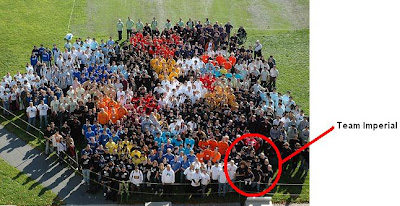
Not horrible, but electric, exhilerating and exciting, the spirit of the iGEM Jamboree is absolutely perfectly captured by iGEM HQ’s Flikr photostream – also check out the iconic iGEM from above picture:

iGEM from above

Continue reading

Posted in Blogging the PhD, Nature Network | 2 Comments

Rapid Response Blogging

I spotted a flyer on campus just now from these people

It seems that oxbridge essays have branched out into a number of areas where they can make money help students with their studies.

Oxbridge Essays have been chastised for distributing their promotional material here previously. I wonder if any students will take them up on this offer?

Posted in Blogging the PhD, Nature Network | 2 Comments

What’s up, down, fast, robust and tunable?

When I applied for a blog here on Nature Network, I promised M@ that I would use my space to flag up research that caught my eye. Last week I spotted the title of a Letter in Nature that warranted further exploration. Having spent my summer immersed in Synthetic Biology in practise it seemed fitting to take a closer look at Stricker et al‘s Fast, robust and tunable synthetic gene oscillator.

Continue reading

Posted in Blogging the PhD, Nature Network | Comments Off on What’s up, down, fast, robust and tunable?

The USB key to your future?

An article in the Guardian Weekend magazine last Saturday documented American novelist Richard Powers’ experience of having his own genome sequenced and his genes examined.

This is not the first journalistic piece to explore the implications of genetic analysis prompted by curiosity as opposed to immediate clinical need. Mark Henderson, science editor of The Times, submitted his cheek swabs to deCODEme and reported his reaction to their assessment of his risk for 20 diseases. And indeed, Anna blogged about Powers’ story as reported in GQ – it has been rewritten here for a different audience.

However, with the exception of the publication of Jim Watson’s sequence this is the first article I have read describing the sequencing of an individual’s genome together with his response.

This is also the first time my attention has been drawn to the work of Knome, a self-styled “personal genomics” company. Knome was founded only last year by George Church, also known for initiating the personal genome project in his capacity as Professor of Genetics at Harvard Medical School.

Knome claim to offer “the most complete and comprehensive analysis of trait and disease associations available on the market today,” and their rosewood-boxed product is certainly seductive. At a price of a third of a million dollars, the client’s sequence is presented on a USB thumb drive. The thumb drive is pre-loaded with software such that the sequence can be viewed, and that the analysis can be updated as new research is released.

Powers reports with raw honesty his apprehension as he waits for his annotated sequence to be returned. Having felt in the past that I would fearlessly jump at the chance to have my own genome sequenced, this piece prompted me to re-evaluate my erstwhile brazen enthusiasm. I used to envisage browsing my own string of bases in the same manner in which I marvelled at a printed copy of the reference sequence, which is presented in pairs of bound volumes at the Wellcome Collection here in London. With the cost of sequencing falling with dizzying rapidity, and the tools for analysis largely in the public domain, I am confident that within my lifetime the price of sequencing and assembling a genome of choice will be within reach of an individual.

When that happens, will you place an order?

Posted in Blogging the PhD, Nature Network | Comments Off on The USB key to your future?

Confusion around the corner

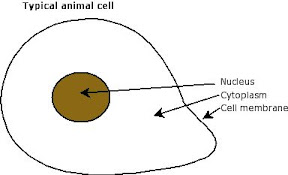
At GCSE level (that’s Freshman/Sophomore at High School to American students) a cell might look like this:

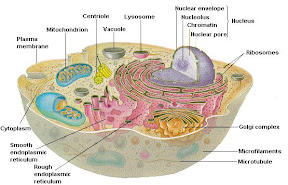
By the time you reach A-level/Senior High, you are presented with something more like this:

At degree-level, your understanding of the workings of the cell expands in scope:

Continue reading

Posted in Blogging the PhD, Nature Network | 3 Comments