The future of Imperial Science Blogging

On Wednesday I witnessed the future of Science Blogging at Imperial College, when I ran a Science Blogging Workshop for Graduate Students. I have blogged before about Imperial College Graduate SchoolsTransferable Skills Training Programme. The Graduate Schools offer a range of courses, so I was surprised that there was not a course on Science Blogging already on the programme. The Graduate Schools issued a call for proposals for new courses:
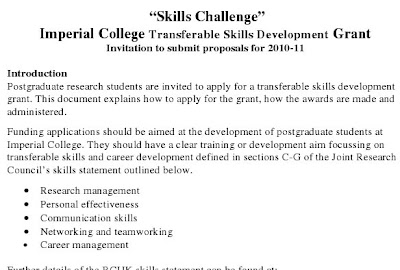
A call for proposals

A call for proposals

I recruited some of the best bloggers in the business and put my idea forward.

To my surprise, the proposal was accepted, and my course duly added to the calender. We did not know how much blogging experience our students would have, so we decided to keep the workshop general and centre it loosly around the why, what, who and how of science blogging.

What is a blog

We started with the basics.

It seemed important to me to make the workshop interactive. My first idea was to have the students draft a post, perhaps publishing the best one, but it was Dr B O’H of Helsinki Frankfurt [corrected 14/3/2010] who suggested that we have the students blog during the session. Fearful as I was of a Zukenberg moment, I agreed, and cast around for a starting point – what should the students blog about? They would not have long to write the post, maybe half an hour or so.

It was actually on the Guardian website that I first saw the winning images from the Wellcome Trust Image Awards. Other bloggers have used these images not far from here. There are twenty-one images and we had twenty registrants. Perfect, I thought, one for me.

What we covered in the workshop is described here, and my slides on why graduate students should blog are at the bottom of this post. After I and Jenny had spoken about why and how to blog respectively, it was time for out students to have a go. We assigned each student an image from the Wellcome Trust Image Awards winners and gave them half an hour. After a couple of hiccups with the wi-fi and wordpress accounts, we were up and blogging. Appropriately fuelled by coffee and biscuits, the student bloggers got to work.
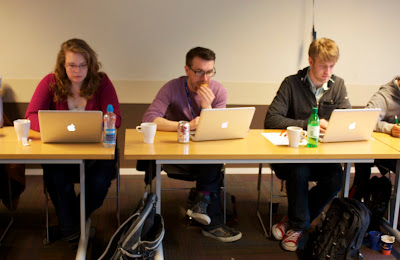
Bloggers hard at work

Bloggers hard at work

We seasoned bloggers (Occam’s typers?) answered questions and helped students to insert links and of course the eye-catching images. As the half an hour mark came and went, one by one the students hit “publish” – for most of the workshop attendees this was their very first blog post.
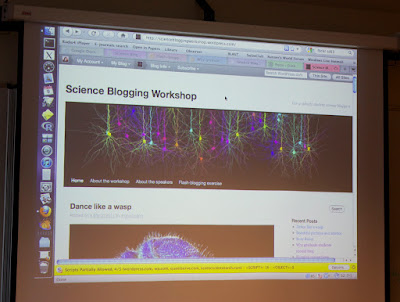
At least when I publish posts on this blog, they don't get projected on the wall in front of my colleagues

At least when I publish posts on this blog, they don

You can see their posts on the website. I have a couple of favourites – Don’t forget the mosquito repellent (in part because this image is my favourite among the Wellcome Image Awards winners*) and The future made flesh because the blogger put the image in a broader context.

We continued the workshop with Stephen explaining blogging from his perspective – that of a Professor and lab head.
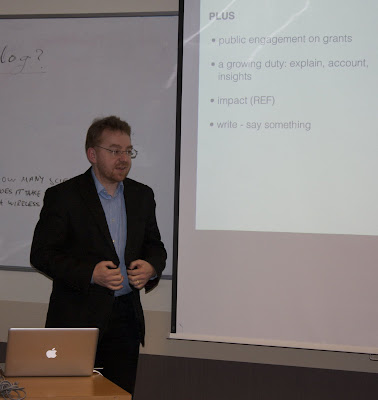
Stephen considers the pros of blogging

Stephen considers the pros of blogging

Richard covered the technical aspects – should you host your blog yourself or get your blogging friend to do it host it at wordpress or blogger? We discussed handling commenters and spam and how to customise and promote your blog.

As we drew to a close, the students posed interesting questions and raised concerns many of us have, about online identity and about finding sufficient material to write about. We encouraged them to make a start at blogging. You never know where it might take you.

This post comes with special thanks: to Richard (who took the pictures), Stephen (who formally supported the workshop proposal) and to Jenny, all three of whom gave their time and support to the workshop; to the Graduate Schools for facilitating the workshop, and the Wellcome Trust Image Collection for permission to use the winning images from the Wellcome Image Awards.

*The genus of the mosquito is Culex. Geddit?

Posted in Blogging the PhD, Meta | Tagged , , | 10 Comments

How to throw a pancake party

Tuesday night is not traditionally a great night for a party. Your invitees have recovered from the weekend, and who wants to go out on a school night?

It is not my fault, though, that Shrove Tuesday falls midweek. Known in the UK as Pancake Day, and around the world variously as Mardi Gras or Carnival, Shrove Tuesday marks the day before the start of Lent. In the Christian tradition, it is an occasion for using up luxuries in preparation for the self-denial of Lent.

Anyway, pancakes are tasty, so here is a plan for how to organise a midweek pancake party with minimal hassle.

Order your ingredients from your favourite online supplier, to prevent grappling over the last remaining box of eggs in the local supermarket on the way home on Tuesday evening.

Ingredients for pancakes

Product placement? On this blog?

I rely on Delia Smith for my pancake recipe.

Delia's pancake recipe, quantities amended

Delia

Fortunately, I held a pancake party last year and already know how to cook pancakes, as one of my invitees suggested this instructional video:

Pancakes, Swedish style

An hour before your guests arrive, start making the batter. Or, persuade a friend to make the batter, whilst you panic clean the flat hide the detritus of daily living behind closed doors and push the vacuum round.

Making pancakes

Getting started making the pancakes

Instruct your guests to bring toppings. Offer then some guidelines, so you do not end up, as we did, with four jars of jam and half a dozen jars of Nutella.

Nutella-fest

Toppings

Making pancakes is fun! So get your guests to make their own. I encouraged my guests to toss their pancakes

Tossing a pancake

Tossing a pancake

but they seemed more interested in flambeing them.

A pancake being flambed

I glanced nervously at the fire alarm...

No-one drinks much alcohol at a pancake party. Partly because they have to get up for work the next day, and partly, I am told, because after three banana-and-Nutella crepes, any food or beverage looses its appeal. This means that your guests are sober enough to help you with the washing up, pack up the leftover Nutella in their bags, and roll home, replete.

See you next year.

We love pancakes, we do.

We love pancakes, we do.

Posted in Blogging the PhD, Fun | Tagged , | 10 Comments

Harder, harder

One careers seminar offered to undergraduates during my degree discussed the pros and cons of pursuing postgraduate study. After the seminar, I spoke to the Careers Tutor responsible for undergraduates in our department. I told him that I was finding the degree course really difficult, and I was not sure if it was worth applying for PhDs as I did not feel certain I wanted to do one.

To the “finding it really difficult” comment, he smiled

We like you to be challenged.

In a similar vein, one lecturer covering a challenging topic during the course found his lectures met with complaints about how incomprehensible the material was. After explaining the concept for the second or third time and pointing us towards some reading material, he seemed exasperated

These things don’t come for free, you know.

I am reminded of these two conversations, and particularly the latter one, when I am grappling with my research. For some students, the biggest challenges to their degrees are practical ones, such as access to data, or not getting on with their supervisor. Others face disruptions ranging from problems with equipment to their supervisor being made redundant.

For me, the single biggest challenge of my PhD so far has been learning the new techniques and material I need to do the research in the first place. Figuring out what I need to know, and how to find the information, and which bits I are going to be useful to me and which avenues are actually dead ends, seem to take me a lot of time. In contrast to the

Here’s a set of Gilsons and a labcoat, now GO!

experience Cath documents, my PhD feels a bit more like “Here’s Google…make a start…”.

This contrasts with the undergraduate degree where in hindsight the biggest challenge was exam technique. It took me the best part of three years to figure out that the way to get through the exams was not to tackle the entire contents of (your preferred edition of) Stryer, more to study about one-third of the course material in detail.

I am coming up halfway through my PhD and I wonder if the challenges will shift as I progress. I am curious to know what the biggest challenge was for other people. Is writing-up universally the biggest stumbling block, is it getting started, or do the real challenges only arise post-PhD?

Posted in Blogging the PhD, PhD | 7 Comments

Octogenarian

People your age, they often find old people…boring

My great-aunt made this assertion, when I described the volunteer befriending role mentioned in my previous post. I am not absolutely sure that “boring” is the reason many young people avoid spending time with the elderly. I have the impression that the young are a little bit afraid. The generation or two between the young and the elderly seems like, well, a lifetime, and seems like a chasm that cannot be crossed.

My work with the elderly has been surprising, rewarding, and entertaining. From the lady who insisted that, back when she was at school, they took gin on their cornflakes, to the centenarian who was still taking the bus to the bingo in the next village several times a week. The people I met would show me photos of times past – particularly memorable was a black-and-white snapshot of one lady driving a motorbike, Wallace-and-Gromit style, complete with side car.

Wallace. With Gromit, in a side car.

Wallace. With Gromit, in a side car.

It took a bit of patience to get them talking, but I didn’t find them boring. They had interests of their own. One eightysomething lady was keen on musical theatre and developed a somewhat improbable crush on Lee Mead.

Lee Mead

Lee Mead was the winner of BBC reality show "Any Dream Will Do"

The population of Britain is aging. Life expectancy at birth for me is somewhere around 77, and for a girl born now it is over eighty. In the coming years, the section of the population that will grow fastest is the “oldest old”.

We are all aware of the cuts in public spending that have taken place or will take place. You do not have to look far to find the treatment of the elderly making headlines. I don’t have easy answers to how we fund the increasing health and social care needs of our aging population. But the octogenarians I have known have taught me that the elderly deserve our time and our patience, our care and our respect.

This post is in memory of RDS, 01-08-1928 to 30-12-2010.

Posted in Blogging the PhD, Life | Tagged , , | 11 Comments

Goodwill to all men

Teaching and research are not the only areas of Imperial College’s activity affected by spending cuts. Earlier this autumn, Imperial Volunteer Centre announced that

due to reduced funding from a specific scheme administered by the Higher Education Funding Council for England, the Imperial Volunteer Centre has…been forced to review its activities.

On its website, IVC used to host a searchable directory of volunteering opportunities. Organizations needing volunteers could submit their opportunities to the database, and students (and staff) could search for opportunities, filtering by category, length of commetment and location. IVC facilitated contact between the volunteer and the organization, and served as a port of call if there were any problems with the volunteer placement. It is this brokerage service that has been withdrawn.

It is a shame that this service cannot continue. As IVC list on their website, similar services are offered by national as well as local organizations.

So, why should students be interested in volunteering?

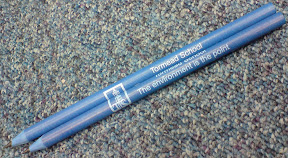
I confess, I have always been somewhat community minded. When I was an idealistic teenager school pupil, one of my proudest achievements was press-ganging convincing the whole school to collect their plastic cups for recycling. We completed the recycling circle by buying pencils made from said cups, and selling them in the School Shop.

A pencil. Made from one recycled plastic vending cup

No, it was not me who came up with the slogan.

In light of the withdrawing of IVC’s brokerage service, here are some anecdotal reasons why students should volunteer.

  • Time

As a student, and particularly as an undergraduate, your time is your own in a way it has not been before, and probably won’t be for a while afterwards. If you are taking a course which is heavy on contact-time, or you have to balance studies with other responsibilities, then maybe volunteering is not for you right now. Your lecturers are not going to appreciate it if you cut class to go out doing good. But if your schedule is a bit flexible, then now is a good time in your life to consider volunteering.

When I was looking for volunteering opportunities, I deliberately picked one with a time commitment I felt I could manage – about two hours, twice per month – making my volunteering efforts more likely to be sustainable. My placement is also flexible enough – I stopped volunteering in the run-up to exams, and picked up again afterwards. I know one student who spent one night per month answering the telephone for Nightline whilst studying to be a vet. (Not actually at the same time!).

You could consider one-off opportunities too. I often spot IC students helping at Exhibition Road Festival, and I know of one student who went for a week to the Centre for Alternative Technology in Wales – volunteering and a holiday rolled into one.

  • CV points

When I turned to volunteering as an undergraduate, I was less concerned about the future of the planet than the future of my career – I wanted to plug a specific gap on my CV. In the event, my career took a different path to the one I was thinking of when I started volunteering. But, two and a half years on, I am still volunteering.

CV-building is a common motivator for volunteers, and some opportunities have an obvious match with career plans. For scientists, outreach is one area to consider. Imperial will continue to operate its own outreach activities, coordinating a range of opportunities which would be particularly appropriate for someone considering teaching or science communication after they graduate.

My volunteering placement has developed my soft skills in some unexpected ways, from communication (explaining Facebook to someone who has never used the internet…or teaching a computer novice how to use a mouse) to crisis management (when a housebound pensioner expecting your visit does not answer the door nor the telephone).

  • Do something different

Being a student (and particularly being a PhD student) is immersive. Students are expected to work hard, and I am not advocating volunteering as an excuse not to be working, but being a desk-bound student I find that taking a little time to do something different to the day-to-day helps to give me some a fresh perspective. I am a befriender (similar to this) – I visit a housebound local resident in their own home, for nothing more complicated than a nice cup of tea and some company (for them(!)).

For IC students, the withdrawal of IVC’s brokerage service might make volunteering opportunities less of a doddle to find. If you feel inspired to give volunteering a go, starting points might include do-it or your own university’s RAG society or outreach service.

Posted in Blogging the PhD, Fun, PhD | Tagged | 7 Comments

PhDs around the world

Prompted by a couple of comments on my previous post, I started wondering about different PhD procedures around the world. Thanks in no small part to tez intech00bs, I have scientist friends in many countries, but most of the PhD students I am in touch with regularly are students here in England. In this country alone, procedures for obtaining the degree vary from institution to institution, and from discipline to discipline. (I have one friend who earned her PhD in fine art by submitting a website.)

So, in a biomedical PhD in the UK, the period of study is normally three or four years full time (or six to eight years part time). At the end of the PhD, the student submits a written thesis which is examined by two examiners. The student has an oral assessment (‘the viva’) after which the examiners decide whether or not to award the degree, subject to major, minor or (more rarely) no corrections of the thesis.

Unlike in some other countries, in the UK there is no requirement for the student to have submitted work for publication in peer-reviewed journals in order to be awarded the PhD. And, unlike in Finland and Sweeden, here in the UK the viva is a private and not a public affair.

I am aware, for example, that in the US the period of registration in grad school is typically longer than the three to four year limit here in the UK. In Finland, I understand, a PhD is normally “by publication” – the student must have had sufficient publications accepted in peer-reviewed journals. (I also understand that in some European countries a PhD candidate is employed as staff by their institution, which is not typically the case here in the UK.)

So, how are things where you are? Wikipedia has a partial list but it is somewhat incomplete, focusing mainly on the criteria for admission to a PhD program. I am happy to update my ideas above, wiki-style, if they are not correct. I am particularly interested in what doing a PhD is like in countries outside Europe and the US as I don’t know how things differ there, if at all.

Posted in Blogging the PhD, PhD | Tagged | 24 Comments

Milestones

I was given a handy sheet of paper when I started my PhD. Entitled Milestones – Cule, it sets out the dates by which I must complete a number of administrative steps. After agreeing on a supervisor, subsequent milestones included submitting a proposal. My examination in order to upgrade my initial registration as an MPhil student to PhD student status took place yesterday.

A milestone. On Kensington Gore.

A milestone. On Kensington Gore.

Each milestone presents its own challenges, and there is that odd phenomenon by which each seems to loom more important than the last. Whilst preparing for my upgrade examination (which consists of a presentation followed by a mini-viva) I was anxious. I was not so worried that I would not pass, but more concerned that my examiners were going to see all too easily the gaps in my knowledge and that I would look a fool.

I sought advice from the blogosphere, which you can read here. My peers in First Life were supportive too, empathising

Oh, I think I made a big drama out of [the upgrade] at the time, but with hindsight it was fine.

On seeing how nervous I was at the first rehersal of my presentation, it was suggested that I

have a shot of vodka before you give the presentation,

an idea which I filed alongside the suggestion that I wear a bowtie. Instead of vodka I went for practise, practise, practise and received helpful feedback on the structure of my talk and the slides. My upgrade was the first presentation I have written consisting, for the most part, of mathematical and statistical concepts. I discovered that equations are much more difficult than figures to make visually interesting,

After giving the presentation, the student has a mini-viva conducted by two examiners. Once I had the presentation down pat, I was most nervous about this. In the event, the mini-viva was more useful than terrifying. One of my examiners pointed out some notational errors in my expression of mathematics, but remarked that he was not surprised to find these given that I do not have a mathematics background. There were some points in my written report that require clarification and others that could be expanded. The examiners did find some gaps in my knowledge, but instead of listing these as failures they suggested references I should read and concepts I should look into.

I passed (phew!) but, as Bob tweeted, this could be something of a mixed blessing. I am not so worried about slaving away for a couple more years, but it dawned on me during the weeks before my upgrade that this is the last exam I have before, well, before the viva after I have submitted my thesis.

Before I started the PhD, an experienced supervisor advised me that one of the challenges of a doctoral thesis is knowing when to finish. A PhD student might struggle to know whether what they have done will be “enough” in the eyes of their examiners. Imperial College does keep an eye on its students’ progress during the years of PhD study, but I am not due any further formal assessment until Submission and The Viva two or more years from now. The prospect of being left to my own devices seems almost more daunting than the treadmill of examinations that featured heavily in my first years at University. Now, it seems all the more important to look for other places my work can be assessed, at a conference or in publication. That way, alongside the rest of the scientific community, I can expect to receive the feedback that, as I learnt from my upgrade mini-viva, can be so useful in suggesting improvements to work completed and further ideas to explore.

The image of a milestone came from amandabnslater on Flickr.

Posted in Blogging the PhD, PhD | Tagged , | 21 Comments

Cliffhanger 2

If you have landed at OT via my old blog, you will be aware that I left you there on the edge of your seat. This is an eventful week for me. The launch of the Sharpest Blogging Network in the Box notwithstanding, I have mostly been occupied with preparing for my MPhil to PhD transfer viva.

If all goes well, I will be updating again next week with both the outcome of the viva, and a review of my post-viva-pre-Christmas celebrations.

Posted in Blogging the PhD, PhD | Tagged | 6 Comments

Cliffhanger 1

Today there are some changes for Blogging the PhD. I am proud to be part of the launch of Occam’s Typewriter, the sharpest blogging network in the box.

To find out the outcome of my previous post, head over there. Whilst you’re waiting a few days for my viva result, check out the other excellent bloggers and immerse yourself in launch fever.

A big thank you to everyone who has read, shared, and commented on my posts here at Nature Network over the past two years. I especially appreciate the helpful practical advice that I have taken from you all during this PhD journey.

Posted in Blogging the PhD, Nature Network | Comments Off on Cliffhanger 1

Launch

Occam’s Typewriter, the sharpest blogging network in the box, is now live!

Posted in Blogging the PhD, Meta, Nature Network | 7 Comments