PhD Comics Movie Review

Piled Higher and Deeper – the popular PhD comic – has been made into a movie. The movie is touring campuses around the world. Find a screening near you, or watch the trailer:

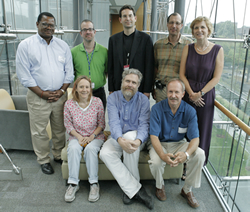
Imperial College Union‘s Graduate Student Association hosted a screening on Wednesday last week. In true Graduate School fashion, free food was provided…
…and this incentive, combined with an two-for-a-bargain ticket pricing structure (“buy one, bring a friend for free”), meant that the movie played to a sold-out (lecture) theatre.

You can read about the genesis of the movie here in the THES. Jorge Cham (PhD comics’ creator) describes how both casting and filming took place on location at Caltech:

Almost everyone else in the cast and crew is either a real doctoral student or somehow connected to one.

The closing credits charmingly detail each of the cast and crew’s real-life roles as well as their cinematic contributions.

The film draws heavily on the comic strip, from the physical resemblance of the cast to their comic counterparts to the scenes with recreate strips from the comic verbatim. Cham mentions in his interview that he used the comic strip archives as elements of the plot, and there is a sense in which this is to the detriment of this piece of work as a movie. The characters’ actions, hopes and dreams take the form of set pieces and one-liners, and I was a little distracted by playing “spot the comic strip” among the jokes.

Perhaps intentionally, the film itself has something of the feel of a student production. However, in the same way you don’t look at xkcd for the artistry, or follow buttersafe for the engrossing plotlines (although either may contain elements of both), the real value in this movie comes from the shared experience of viewing it with about 200 likeminded souls. When the nameless grad student (and star of the movie) laments

I’m not working on a problem, I’m working on a subproblem of a subproblem of a subproblem

and the entire auditorium erupts with laughter, as a graduate student, you feel a little less alone.
(Another blogger agrees.)

Whilst someone who has not endured experienced grad school will be able to laugh at the slapstick, smile at the thwarted romance, and hark back to the idealism of youth, it is PhD students themselves who will be touched most deeply by the exasperation, frustration, triumph and mention of a diet of caffine and ramen noodles.

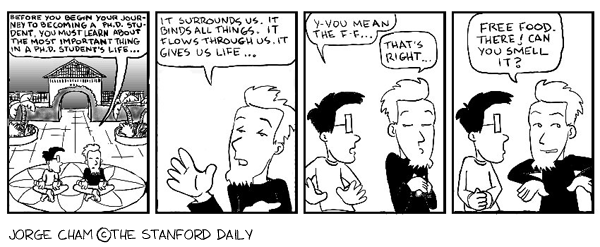
The screening was also chance to catch up with fellow PhD students from across the campus (for example, those whom we worked with during the Research Development Course and had not seen since). Our conversations over free food and drinks resulted in essentially a re-enactment of the below comic (which also features in the movie). Those of you who are thinking of attending a screening would be wise to be wary of what topic of conversation you choose for your post-movie chat.

Posted in Blogging the PhD, Fun, Life, PhD | Tagged | 15 Comments

Perspectives from Big Pharma

I came to research in statistical genetics from an undergraduate degree in biochemistry. I learnt statistics as applied to genetics; perhaps a student who studied statistics of itself would have a perspective that is broader than my own.

I was prompted to think about more diverse applications of statistical methods in the life sciences (and beyond) when I had the privileged of attending an internal conference organised by GlaxoSmithKline‘s Quantitative Sciences Division. PhD students were invited to apply to attend the conference via a mailing list. With a tight deadline I submitted a poster abstract which was accepted.

In common with the other PhD students who attended the conference, I did not know what to expect. My only inkling came from having encountered the work of John Whittaker. Professor Whittaker is Vice President (Statistical Platforms and Technologies) at GSK and also holds an appointment at LSHTM. If I was expecting anything from the conference, it was to come across at least some of the work with which I am familiar – I was not anticipating the broad range of applications that were discussed. GSK’s conference brought together statisticians from every stage of both the drug development pipeline and the manufacturing process. It was eye-opening to see the topics I have studied in one context applied to a problem from another area.

Aware of current anxiety surrounding the potential for individuals with academic training to continue into a permenant post in academia, I felt it was useful to identify some industrial careers that I had not previously realised existed! I would encourage other PhD students in my position to pursue opportunities such as this one, whether or not they are contemplating a career in industry. I would also encourage employers to actively promote the opportunities within their organisations to PhD students who may not be aware of the range of job roles out there.

Posted in Blogging the PhD, PhD | Tagged | 3 Comments

Bafflement and effort

From Robbins to McKinsey – The Dismantling of the Universities by Professor Stefan Collini (Faculty of English, University of Cambridge) is a thoughtful, articulate and damming critique of the Browne report (pdf) and subsequent Higher Education White Paper (pdf).

Cover image of the London Review of Books Volume 33 Issue 16

© LRB Ltd

It is published online and in print in the London Review of Books (volume 33, number 16). There is (sadly) no space to comment on the article on the LBC’s website. The piece is long (>8,000 words), and perhaps itself effortful, especially compared to many online articles, so make yourself a cup of tea first! Whilst you, like me, may not agree with every point Collini makes, this article is worth reading and discussing.

HT WJ who brought this article to my attention via the following quotation:

The really vital aspects of the experience of studying something …are bafflement and effort.


Posted in Blogging the PhD | Tagged , , , , , , , | 1 Comment

What does a PhD mean beyond academia?

If a PhD graduate decides to pursue an alternative career apply for a job outside of academia, in some fields, recruiters will understand what is meant by the PhD on their CV. For a research career in industry a PhD can be an asset if not a prerequisite. Other fields specifically recruit PhDs – some management consultancies recognise the value of a doctorate, academic publishers will be familiar with the qualification, and when applying for a career in finance a numerate PhD can stand you apart from the crowd.

But, how do you explain a three or four year stint of postgraduate study, and more specifically its value, if a potential employer is dismissive of the doctorate? This question was prompted by the article Careers for PhDs beyond academia in the Work section of yesterday’s Guardian.

The comment that leapt out at me (and that comes from a careers adviser at UoL) was

many employers question the commitment of those who have spent seven or more years in academia

There are attributes that it might be reasonable to question about a PhD graduate. If their project was a solitary exercise you might wonder about their team-working or leadership skills. If they were applying for a sales or customer-facing role you might not make the connection between marketing ones ideas in an academic environment and commercial goals. But commitment seems an odd characteristic to question. If you were not committed you would struggle to achieve your PhD.

The article goes on to emphasise that PhD graduates should sell the skills they gained from their degree. With its humanities and social sciences focus, the article suggests skills such as

writing ability [and] foreign languages.

Writing ability should be evident whatever the discipline, from pubilcations and the thesis. In science, skills such as numeracy, data analysis and project management will be at the fore. Beyond highlighting specific skills, is there a way to explain the nature of PhD research? Such an explanation seems necessary, to counter the perception of PhD students as

verbose, individualistic and lacking emotional intelligence.

This would also be useful when answering the What do you do? question, and would hopefully provide a feasible alternative to the not unheard of practise of removing the PhD from a CV (replacing it with “research” or similar) when applying for non-academic jobs.

Posted in Blogging the PhD, Life, PhD | Tagged , , , | 16 Comments

Book Review – Misha Angrist Here is a Human Being

I was reading this book on a train. My friend and fellow passenger asked me what I was reading, and then, whether it was for work or for pleasure. I was momentarily flummoxed. There’s meant to be a difference?

Here is a Human Being

Given that genotype is (more-or-less) fixed at birth and does not change as we grow, it is striking that Angrist opens his book Here is a Human Being by commenting on his age. He considers how someone of his generation relates to the “exhibitionism on YouTube, Facebook, Twitter and MySpace” (although he has since succumbed to the penultimate of these). Then again, whilst its subtitle tells us that this book comes from “the dawn of personal genomics”, in fact it is about more than Misha’s genes.

Misha Angrist is Assistant Professor of the Practice at the Duke University Institute for Genome Sciences & Policy. You might know him as GenomeBoy, the name of his blog at PLoS Blogs. In 2007, Angrist became the fourth participant in the Personal Genome Project (PGP). Here is a Human Being is about how he got involved in the PGP and why he decided to take part.

Eight early participants in the Personal Genomes Project

Eight of the PGP-10: James Sherley, Misha Angrist, John Halamka, Keith Batchelder, Rosalynn Gill, Esther Dyson, George Church, Kirk Maxey. Not shown: Stan Lapidus and Steven Pinker. Image from personalgenomes.org


The overarching aims of the PGP – highlighted on its website – centre on the development of both the technology and the protocols for making personal genomics useful for the public. For the first ten participants in the PGP (the PGP-10, pictured), this meant volunteering to have their genome sequenced and to put their genetic data, together with medical and personal information, in the public domain. With the cost of obtaining genetic data falling and a growing interest in personal genetics, as PGP #2 John Halmka put it

somebody has to do these experiments

Both the title of this book and the publisher’s blurb emphasise Angrist’s participation in the PGP and the questions that are raised by placing ones DNA sequence on the web for all to see. However, the book is not limited to this topic. It tells (at least) three intertwining stories, with Angrist’s DNA-related dilemmas forming only one part.

That is not to say that Angrist glosses over his genotype and related concerns. He is well-qualified to participate in the PGP (he has a PhD in genetics and an MS in genetic counselling); nonetheless he goes through understandable uncertainties about the possible effects of having his genome sequenced and making his genotype and phenotype information publicly available. To do so has implications for himself – the PGP consent form includes the warning that

anyone with sufficient knowledge could take your genome…and use [it] to…make synthetic DNA and plant it at a crime scene

Participating in the PGP also has implications for Angrist’s family, because information revealed by his genome also reveals probabilistic information about the genomes of his two daughters. No genetically tested father is an island – perhaps a more apt title might have been Here is a human being – and one-half of his daughters – but we don’t know which half.

In parallel to the development of the PGP, personal genomics was going mainstream. Angrist introduces us to the colourful cast of entrepreneurs starting up personal genomics companies. 2007 saw the launch of  23andme and the deCODEme service from deCODE genetics. For a few hundred dollars (and falling) these companies (among others) will type several hundred thousand variable positions on your genome and use this information to report your risk of diseases and traits back to you. Angrist describes the launch of these companies (“hark[ing] back to the dot-com era”), their tussles with the law and with medical experts. Further interesting personalities pop up in academic settings – Jim Watson is cornered at a conference, and their exchange attracts a crowd of eavesdroppers waiting to hear “what outrageous thing Watson might say next”. Naturally, George Church (the founder of the PGP) plays a central role, along with his own wife and daughter.

But the most personal aspect of this book is not Angrist’s genome. Indeed, as this review in the Lancet points out, on the subject of predicting phenotype from genotype, the story leaves off just as things are beginning to get interesting. Alongside exploring his genetics, Angrist takes this opportunity to delve into his own psyche. He writes with humour and a self-deprecation that contrasts with the eccentric egos he encounters in industry and in academia. As Angrist flits from lab to computer to conference, he discusses his anxieties from a genetic and a personal point of view. I imagine that the issues he considers – such as the nature of determinism, and personal responsibility – would come to mind when anyone started looking into their genome. Angrist is generous enough to share his experiences here in a very personal account of personal genomics.

Posted in Blogging the PhD, Book Reviews, Fun | Tagged , , , , , , | 1 Comment

Expressive behaviour

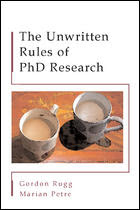
I first came across the term “Expressive behaviour” in my latest self-help book, The Unwritten Rules of PhD Research.

The Unwritten Rules of PhD Research

There is a review of this book here. The authors, Dr Marian Petre and Dr Gordon Rugg, introduce expressive behaviour and its counterpart, instrumental behaviour:

Instrumental behaviour consists of actions leading towards a stated goal…Expressive behaviour, on the other hand, consists of actions demonstrating to other people what sort of person you are…both [are] important

An example of instrumental behaviour might be having the goal of learning a new programming language so registering for a course on the topic or getting a relevant book out of the library. The example of expressive behaviour that the authors give is

sitting in the front of the lecture theatre and taking copious notes in a very visible manner to show that you take your studies very seriously

although I can think of a number of reasons why you might want to sit in the front of the lecture theatre and take copious notes that do not involve the need to show anything. An example of expressive behaviour among PhD students might be staying very long hours in the office to demonstrate that you are a dedicated student, rather than because that is the most productive or efficient way for you to work. (Again, sometimes it might actually be the most useful way for you to work.)

In the authors’ experience,

students are normally good at some types of instrumental behaviour and woefully bad at the sensible sorts of expressive behaviour, usually because nobody has explained to them which signals they need to send out.

It is easy to see how this situation could arise. In academia, certain conventions baffle those who are not familiar with them. (The concept of preparing a poster to take to a conference has been referred to as “quaint” by one non-academic acquaintance.) Indeed throughout this book, guidelines regarding expressive behaviour are implicit in the chapters discussing, for example, attending a conference, giving a talk and handling the viva.

Raising awareness of the concept of expressive behaviour is helpful to PhD students for two reasons:

One is simply that (as the authors suggest) may people are susceptible to some unhelpful types of this expressive behaviour. Being self-aware about this means that if someone finds themself caught in this way, they are in a position to (try to) decipher the signal that I am really trying to send out. They are more likely to be able to do this than anyone else, most of all the person they want to communicate with. The student could then work out how to act more constructively to achieve their goal.

Another reason is that appropriate expressive behaviour seems to be particularly critical when negotiating the academic path. As someone who does not find it easy to dissemble, thinking of my actions in terms of the messages that they send out might help me to find my way more easily.

Posted in Blogging the PhD, PhD | Tagged , | 14 Comments

Dilemma

As well as a dilemma, we have the potentially useful term trilemma and even tetralemma (the choice between two, three or four options respectively). But a lemma, in mathematics anyway, is a stepping-stone in a proof, and does not mean “half of a dilemma”, which is what I thought when I first came across the word.

As every person who takes starts a full-time course of study (or a job with a fixed-term contract) has to do, I am thinking about what to do after I have finished my PhD. I still have an lot of work to do for the thesis. However, there is some flexibility in which direction I take for the last year of my PhD, and how I make my decision depends on what I want to do afterwards.

In common with many a bright-eyed beginning graduate student, when I was offered the PhD studentship, I was quite convinced that I wanted to work in research in an academic setting. But now, two years into my PhD and thinking about what to do next, the decision does not seem so easy any more. I am well aware of the challenges of the next step on the academic career path.

Beware the Profzi scheme

With thanks to PhD Comics

If this next step would be to do a postdoc, then it is difficult not to feel discouraged by the commentaries here and here on Occam’s Typewriter as well as the discussions elsewhere. See also Anthony Fejes trying to figure out the purpose of a postdoc and the advantages and disadvantages of an academic career.

I am instinctively following Athene’s suggestion here and taking some responsibility for my own career path.

Much has been written on so-called alternative careers for academics, including the helpful suggestion (which I have come across more than once) to stop using the term “alternative” given that the academic route is not the only option for PhD graduates. Cath’s practical post suggests figuring out what you enjoy and finding out a way to do it more (more on that later). The Node (“the community site for developmental biologists”) has a series of altcareers blog posts. These stories are useful for scientists with backgrounds other than Developmental Biology.

My immediate dilemma is not whether or not to stay in academia, but how to tackle the final year of my PhD. As I said, I have some options. It essentially boils down to whether I tackle a safer (not sure I would say easier, as I have not found being a PhD student easy up to now) project or a more ambitious one.

I am leaning towards the more ambitious project for several reasons. To do so seems to match my aptitudes, based on feedback from my supervisor. I think I would enjoy the work more, which is why I smiled when I read Cath’s post:

If you enjoy a specific part of your current position, find a way to incorporate more of it into your remaining time in academia.

The more ambitious option is more flexible in the long term, as it opens more avenues if I want to stay in research (I could come back to the “safer” topic after my PhD, but it would be more difficult to go the other way). It also opens more avenues in industry, where there is demand for the skills I would develop, particularly if I keep the needs of industry in mind when I plan the details of what to do (although I would be wary of this being to the detriment of the research).

A more ambitious project has one major drawback. It will likely take several months longer to complete the thesis. I am at a stage in my life where, whilst I have some commitments, I am reasonably confident they would survive some extra months in grad school. But I have found being a PhD student challenging in a number of ways that I did not see coming, and some of the advice I have been given suggested that doing everything possible to complete in three years is a good idea, as well as looking good on your CV in that you can complete a task to a deadline.

I have talked this over with anyone who will listen a lot of people and whilst I have not had any advice on what to do per se, one consistent message I get is that the career decisions you make do not set your future in stone. When you look at the range of career paths other people have taken, a lot of individuals have taken all sorts of circuitous routes to get where they are. Thinking about what to do PhD-and-beyond seems like an enormous decision – a dilemma – but maybe in the bigger picture my PhD is more akin to a lemma stepping-stone.

Helpful links I came across when thinking about the subject of this post include

Posted in Blogging the PhD, Life, PhD | Tagged , , , | 17 Comments

What are you worried about?

If you are naturally someone who worries, then being a PhD student gives you plenty of opportunities to exercise your habit. You will have research-specific concerns about experiments working and deciding which approach to take. Inherent uncertainty comes with the submission of an abstract or paper, or presenting your work for scrutiny, when you may well face unexpected questions or criticism.

These sorts of worries are part of doing research and do become easier to deal with over time. I have developed strategies for dealing with certain setbacks and knowing that I have worked through problems in the past makes me more calm when I am the next sticking point.

But there are concerns that play on the minds of PhD students, beyond the research-specific challenges. Back in 2009, the Graduate Schools at Imperial College researched the wellbeing of PhD students. 1202 students responded to an online survey, and the Graduate Schools put together the conclusions of the research. The top three “most troublesome items” were perhaps not surprising:

  • Feeling frustrated / demotivated by your results and apparent lack of progress
  • Experiencing high levels of stress because of your research
  • Being unclear about the next stage of your career after your PhD

If you take a look at the full list (pdf) of the top ten most troublesome items, many students would nod along with at least some of them. The Graduate Schools also produced some guidelines for supervisors (pdf) suggesting how supervisors can help their students with these difficulties. The guidelines for supervisors centre on giving students realistic information about the nature of research and what is expected of them, as well as pointers towards sources of support.

If, as a PhD student, these sorts of anxieties are getting to you, there are things you can do. As well as looking to your supervisor for a realistic assessment of where you are at, seek support from your fellow PhD students. The results (ppt) of the wellbeing survey suggest that these concerns are common, and if you discuss your anxiety with other students you will probably find empathy if not immediate solutions!

If you are an anxious person, then to some extent, accept that you are going to worry about your progress, and that the anxiety might be there whatever you did. With research, whilst you can plan your experiments and develop a strategy, you will face difficulties and unexpected problems.

One of the attendees at our Science Blogging Workshop spoke of their plans to start a blog. They expressed a lot of anxiety about not knowing what they would write about beyond the first few posts. My suggestion was that not knowing where blogging would take you should not stop you from starting. My blogging has certainly brought me some surprises. In blogging, as in research, learning to sit with uncertainty is a useful skill to have.

Posted in Blogging the PhD, Life, PhD | Tagged , | Comments Off on What are you worried about?

Book Review – Lewis Wolpert on aging

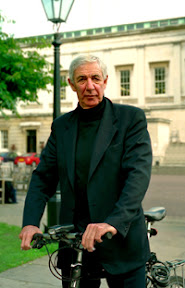
I first came across Lewis Wolpert via his textbook Principles of Development which, to my mind, struck the right balance between seriousness and humour. “Principles of Development” captured the sense of wonder Wolpert feels for his research area, developmental biology. Wolpert is now in his eighties and is Emeritus Professor of Biology as Applied to Medicine at University College London.

Lewis Wolpert

Lewis Wolpert

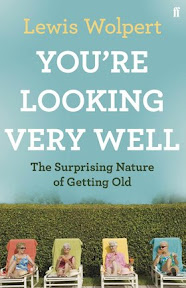
A book on aging might seem an odd choice for a graduate student. This is not the first popular science book by Wolpert I have read. Aside from the aforementioned textbook, How We Live and Why We Die: The Secret Life of Cells is an introduction to cellular biology for a lay audience. I read Malignant Sadness: An Anatomy of Depression and found Wolpert’s analytical perspective on the illness reassuring. When I saw You’re Looking Very Well: The Surprising Nature of Getting Old mentioned in your favourite weekly science journal beginning with N, I was interested to read what Wolpert had to say about a topic familiar to me through my volunteering exploits.

You're Looking Very Well: The Surprising Nature of Getting Old

Wolpert's latest book

Unsurprisingly giving his age, Wolpert draws on his own experiences in his writing, but this book is far from a memoir. Getting old is approached from diverse perspectives, including religion, fiction, drama, myth and legend. More conventionally, sociological, cultural and even commercial issues are addressed.

Naturally in a book on aging, issues of health and wellbeing are considered at length. Wolpert explores what is known about the biology and genetics of aging and its related diseases. Evolution has a surprising role to play in the aging process, as is discussed. What can be done to address the health and care needs of the elderly as the proportion of the population that is old continues to increase is discussed, but no easy conclusions can be drawn. In common with Heather’s comment on an earlier blog post, Wolpert hopes for a societal shift as life expectancy continues to increase.

“You’re looking…” is written with the characteristic clarity that drew me to Wolpert’s writing when I studied using his textbook. The simplicity of the sentences, even when explaining more complicated topics, could be a useful model for many would-be science writers. This is an easy-to-read book – I read it whilst on my Easter break – but the nature of its subject matter means that it is thought-provoking. That the text is occasionally repetitive – Wolpert stresses that “we are essentially a society of cells” more than once – gives the probably unintentional but nonetheless endearing impression of the book being a story told by a forgetful elderly acquaintance.

Wolpert seems to have found peace in his own advancing years. He confesses that

Most of my time is spent writing books, like this one. I do it lying on my bed with the computer on my lap.

which does sound to me like a retirement to look forward to!

In common with “Malignant Sadness”, Wolpert’s matter-of-fact approach to his subject matter in this book makes the intimidating concept something interesting. Whilst the book is thought-provoking, I finished it feeling more comforted than terrified about what the future could hold for an aging society.

Posted in Blogging the PhD, Fun, Life | Tagged , , , | 9 Comments

What is the alternative?

Next month, a referendum will ask voters in the UK

At present, the UK uses the “first past the post” system to elect MPs to the House of Commons. Should the “alternative vote” system be used instead?

Official Poll Card

Official Poll Card

When our Official Poll Cards dropped through the letterbox last week, I realised I did not have much knowledge about the question I was about to be asked. Which way should I vote? I cannot say I have a passion for politics, but I do have a sense that I “ought” to vote. I decided to do my homework.

The BBC’s Q and A on the topic seem straightforward enough, and are certainly easier to wade through than the garish colours of the yes and no campaigns. (It occurred to me that these colours are probably used to avoid the red, blue or yellow of the main political parties in the UK.)

YesNo

Yes or No?

Critics of the current (FPTP) system point out what they see as its key weakness – that a candidate can be elected having won less than 50% of the votes. This happened to two thirds of the MPs in the current parliament. An AV system forces candidates to appeal to a broader section of the electorate, in the hope of winning their second or third choice slots.

The No campaign, on the other hand, argue that AV is complicated and costly to implement. I do think that AV is more confusing. Whilst the concept of ranking candidates is intuitive, it is more complicated under AV to think about the details of the vote you cast – is it better to rank a candidate you are neutral about, third choice or not at all? This pair of blog posts discuss tactical voting under AV in some detail.

Should I follow the campaign of the political party I voted for in the general election? It seems that each party is supporting the Yes or No campaign based on which would result in the best outcome for them at a subsequent General Election, not that one would expect them to behave otherwise.

My PhD research involves conducting simulation studies, albeit not on voting theory. Would be possible to simulate the results of the general election under AV, to see how much difference it would make if we were to change the voting system?

Take the most recent General Election in the UK, in May 2010. Using the vote counts from the 2010 election, would it be possible to conduct a simulation study? One could make some assumptions about how voters might rank subsequent candidates based on the first choices that they indicated on their ballot papers, and see how the outcome would change if voters ranked one, two, three or more candidates in addition to their first choice. The assumptions would be crude and would not represent the results of candidates’ campaigning with the AV system in mind.

The closest thing I found to this suggestion was a paper published in Parliamentary Affairs. Simulating the Effects of the Alternative Vote in the 2010 UK General Election. This study, by David Sanders and colleagues from the University of Essex and the University of Texas at Dallas, is somewhat more sophisticated than my idea.

Surveys conducted around the time of the General Election campaign asked voters how they voted, and further, asked voters to complete an electronic ballot form that mimicked an actual AV ballot. In comparing the two sets of votes, the authors report that not all voters voted for their first preference as expressed on the AV ballot paper, in the FPTP survey. This is to be expected, as some voters will vote tactically in the FPTP system.

The survey data used in this study is sizeable. However, there are not sufficient respondents in each constituency to evaluate what the outcome might be constituency by constituency. Working with the data they do have, the authors simulate the behaviour of voters in different constituencies. Their simulations suggest that AV would leave the Conservatives as the strongest party in England; however the Conservatives would be somewhat worse off than under FPTP. This has implications for the structure of the subsequent coalition. According to the simulation, under AV the Liberal Democrats would have won sufficient seats to be in a position to form a majority coalition with either the Conservatives or Labour, something that was not possible in May 2010 when further parties would have had to join a potential Labour-Lib Dem coalition to form a majority.

This simulation study is an interesting exercise, but it is still some way from representing how voters might have behaved had they witnessed an election campaign which was conducted with the AV system in mind. So I throw this question to the floor.

Should I align my vote in the referendum with my politics? Is there a way to decide how to vote based on logic? There was some debate about whether to impose a minimum turnout on the referendum – which was decided against. Will sufficient people vote in the referendum to represent what the British public wants? If I am not passionate about politics, is it worth my time to vote at all?

Posted in Blogging the PhD, Life | Tagged , , , , | 13 Comments