The Captured Thought

Nicky Clayton and Clive Wilkins

Do you know what happens when a behavioural scientist interested in how humans and animals think gets together with an artist whose prime interest is in the nature of imagination and consciousness? Are you interested?

Nicky Clayton and Clive Wilkins have had a lifetime’s experience in their respective disciplines. Society supposes they would be poles apart but in actual fact they are closer than one might imagine, as the audience at their Royal Institution Discourse discovered recently. In “Imagination: The Door To Identity” Nicky and Clive explored some of the many areas of their interests, which have evolved out of their analysis of the subjective experience of thinking[1]. The ability to imagine future scenarios and relive our past experiences lies at the heart of humanity; it is what we all do for a living and it is integral to our identity, to who we are and how we think.

They argued that human beings have a fundamental interest in navigation, which is used not just externally to explore the planet but internally too. Within us there is a hidden compass that orientates us in space and time. Ask virtually anybody which of these two compasses is the most important, and they will probably tell you it is the external one, for that is where movement can be seen and measured. However there is a counter argument suggesting that we have an imagined internal compass describing a bigger landscape which contains past, present and future, all of which can be accessed at the same moment, allowing for a unique orientation of points. This throws any landscape thus seen into sharp relief ~ were 4D specs available this might be the world they described! Using past, present and future as sign posts, and triangulating their points, we develop, or allow ourselves to find, some of the most interesting places possible.  By virtue of our imagination, we can create new scenarios and anticipate potential realities, ones that may or may not come to pass. This process of imagination is both disadvantageous and opportunistic in equal measure. For imagination impedes and disorientates memories, whilst also creating multiple realities that can coexist side by side. Nicky and Clive went on to discuss what it is like not to have imagination at all, and to ask whether we are unique among the animal kingdom in having the ability to travel mentally in time.

In becoming expert within a specific discipline (in the arts or sciences), one might argue that it is all too easy to lose sight of the bigger picture. We know how it works. In terms of navigation many of us take the same routes through the cities that we devise for ourselves, both literally and metaphorically. We forget there may be alternative routes that we may know of, never question that there may be other routes that we have not yet thought of and modes of transport that we do not consider or are too lazy or scared to invent. It is easy to forget that we all share remarkably similar mechanisms for seeing our worlds. No matter what our discipline may be, do we not all share the same maps to see and distinguish the reality around us? These facets are fundamental features of the human brain. The opportunity to share these realities with alien minds is fascinating. Even amidst the safe jurisdiction of an artist talking to a scientist there are so many new things to discover, as Nicky and Clive are realising.

In essence they are fascinated by the fundamental features of the thinking mind and have formulated a series of six talks, which explore the cognitive abilities of humans and animals. They use a variety of techniques to provide insight into how thinking works and has evolved. The lectures include: the self, the altered self, the social self, perspective-taking and metacognition. By integrating the sciences and the arts Nicky and Clive are exploring new ways of thinking and methods of analysis, in search of a better understanding of the cognitive and conscious processes that encapsulate our humanity ~ in the hope of illuminating The Captured Thought.

________________________________________________________________

Nicky Clayton is Professor of Comparative Cognition in the Department of Psychology at Cambridge University and Scientist in Residence at Rambert Dance Company. Clive Wilkins is a creative writer, fine artist, performer and teacher living in the UK. They share a passion for Argentine Tango.


[1] You can hear the Royal Institution podcast at

http://www.rigb.org/contentControl?action=displayEvent&id=1379


Posted in Art, Guest posts | 2 Comments

Crowdfunding research not yet a crowd pleaser

Academic researchers are one of the few professionals who have to spend a large amount of time throughout their entire career begging for money just to keep their job.

It’s hard to get grants. It’s a lot of work to apply for them, and many are not awarded. Researchers that don’t get the funding they apply for may have to switch projects, or even close down their lab. Even when there is money to keep the lab afloat, money is tight, and many side projects fall by the wayside. For these projects, crowdfunding may be an alternative.

Crowdfunding recently became a popular method of funding new tech or entertainment products or artistic projects. It allows people to ask for many small donations from individuals who support the proposed work, rather than a large amount from a single source.

The most popular crowdfunding platform is Kickstarter, which launched in 2009. It was the initial source of funding for the Cards Against Humanities card game, Julia Nunes’ latest CD, and the Pebble watch.

With the popularity of Kickstarter, a number of other crowdfunding platforms were launched, each with a slightly different angle or method. Indiegogo allows projects from across the world (unlike Kickstarter, which is limited to very few countries due to middle-man Amazon’s payment regulations). Pledgemusic specializes in music projects. RocketHub was one of the first of the broadly themed crowdfunding sites to encourage scientists to crowdsource funding for their research projects.

At this moment, there are six projects in the “science” category at RocketHub, of which two directly go toward research: Chris Thomas has, in the past two weeks, raised $10 toward a $10,000 goal to fund the research of Magnus Essand. Ethan Perlstein is doing a lot better, and has raised over $8000 in the same amount of time, toward a $25,000 goal.

A few times per year, there are far more than six science projects on RocketHub. They’ve partnered with the SciFund Challenge, an organisation that helps scientists develop crowdfunding proposals. They’re currently training the third round of SciFund applicants, whose projects will go live on RocketHub in November. SciFund helps researchers build a crowdfunding campaign, and explains the importance of marketing and language, but still, most of their projects don’t reach their full funding goal. However, unlike some of the other crowdfunding platforms, RocketHub projects that don’t meet their full funding goal do get to keep the money they raised, and spend that on part of the project as they see fit.

While some popular Kickstarter projects raise ten times or more of their target goal (the Pebble watch even raised over a hundred times the $100,000 they asked for), scientific research projects are nowhere near this level of fundraising.

But why does this work at all? Why are a quarter of SciFund Challenge projects fully funded? Why would you contribute to someone else’s research project?

Many of the research projects that have successfully used crowdfunding have been directly appealing. They’re easy to understand, and relatable. Even when the work itself is highly technical, the description has focused on the bigger picture.

But what happens with your money? Funding a research project does not give a direct return on investments. In the non-research Kickstarter examples I gave above, contributors got a chance to pre-order the final product. They effectively prepaid for their Cards Against Humanities game, their Julia Nunes CD, or their Pebble watch, and the creators used those funds to finalize production. This can be an appealing incentive to fund a project, but it obviously doesn’t apply to academic research.

Research can’t guarantee any outcomes. You can’t promise funders that you’re going to cure a disease or find the last animal of a nearly-extinct species. You can only promise that you’ll work on it.

In that regard, it’s not that different from the technology or artistic products that are funded via Kickstarter. Sometimes, they don’t materialize. If a company raises money to develop a product, they can’t guarantee that they’ll definitely be able to create and mass-produce it. Last month, Kickstarter updated their guidelines for hardware and product design projects, to make it more clear to funders that the product is not yet ready, and that Kickstarter is not a store. They want to discourage people from offering the finished product as reward, and emphasize that funding should be a way to support the work of a person or company you care about.

Still, even when the rewards are purely as a thank-you gift – as they will always be for scientific research projects – people who back a project may want to know where their money is going. If a project reaches more than its intended goal (which a number of them have done) what are the researchers planning to spend the additional money on? So far there haven’t been any questions about scientific projects, but in a scenario that can easily be extended to research, Kickstarter backers of Amanda Palmer’s CD and tour raised questions about her expenses – especially when she asked for volunteer backup musicians after already having raised over a million dollars. Be prepared to account for everything you do with money raised through crowdfunding!

Scientific crowdfunding is not raking in millions, though. Even with cute pictures and clear descriptions, some of the most interesting research projects have not even reached half of their goal. Why not? It could be because people don’t care about the research of people they don’t know.

Successful crowdfunding relies on getting your name out there – the same way musicians get their projects funded through Kickstarter. Ethan Perlstein has been doing just that, by promoting his project everywhere, being accessible online via social media and his lab website, and even holding a launch party. If that sounds like a lot of work, remember how much work goes into grant-writing.

Is it worth it?

As a researcher, you can’t run a lab on crowdfunding alone, but you can use it to try to fund a project that you can’t afford otherwise.

For the backers of a crowdfunded project, it’s also a way to get closer to the research, and feel a part of it. They may get a thank-you email, a mention on the website, a photo of the work, or maybe a lab visit. That might not be as much incentive as receiving a special edition of their favourite musician’s CD, but the most direct output of academic research is knowledge, and that’s not something you can pre-order in limited special editions.

Still, backing one project directly may be appealing to people who want to get their knowledge directly from the researchers. Where tax-funded research leads to a broad general output of knowledge in the form of documentaries, newspaper articles, and books, crowdfunding may get you personal email updates from the one lab you funded. It’s a chance to get a glimpse into the process of research.

Crowdfunding is unlikely to bring in enough money to support entire labs. If you lose your main research grant, you can’t replace it by creating a RocketHub project. I don’t say this because I don’t believe that it will catch on, but because even the most popular and obnoxiously self-promoting musicians who use crowdfunding are not bringing in the kind of money that would support an average lab for more than a few years. Research is ridiculously expensive.

So don’t use crowdfunding as a life-saver, but as a source of funding for your pet projects. Other than SciFund and RocketHub, there are a few other crowdfunding platforms for researchers such as Petridish.org and Microryza.

(P.S. I’d been sitting on this idea for a post for months, and just as I thought “This weekend I’ll have time to write!” the Economist covered the exact same topic. Great timing.

My own idea originally started as “how to be an indie researcher” – a post in which I’d list a few alternatives to the way research is done. But there was way too much to be said about crowdfunding alone, so this post happened. Let me know in the comments if you want me to do the “indie scientist” post after all! It will include drop-in community labs, citizen science, open access/science, DIY Bio, “science hostels” and other ideas. No, I will not teach you how to set up a meth lab.)

Posted in Funding | Tagged , , , | 17 Comments

The moonshot power of Google’s new ‘Solve for X’

With ‘Solve for X’ Google is half way to becoming as evil as the bankers.

Solve for X is being touted as a kind of techno-think tank, like TED but done cloud style. It advertises itself at its launch today as “a place where the curious can go to hear and discuss radical technology ideas for solving global problems” and the aura of glamour around it is already impressing influential commentators.

But while Solve for X wants to fix the planet, it has all the intellectual depth of puddle. This might not matter if it were merely another weapon in Google’s growing armoury of lobbying weapons. But the closer you look at it, the more sinister it becomes.

The blurb for Google’s latest baby makes a lot of a moonshot metaphor, saying, “This combination of things – a huge problem to solve, a radical solution for solving it, and the breakthrough technology to make it happen – is the essence of a moonshot.” But only an American, Russian or Chinese drunk on imperial patriotism could make such a claim.

Even kids like me who dream of being an astronaut grow up to see that there is more to moon races (both 60s-70s vintage and the current generation) than simply an intrepid blend of technology and courage. Super power rivalry. Demonstrating the superiority of a particular political system. Prestige and influence around the world. Nation building. Developing dual use technology that the military wants under the PR-friendly guise of human endeavour. Consolidating the political power of the national leader (ie presidential re-election in the US). Delivering pork for regions with big space bases. Enabling powerful technology institutions and their engineers to rise. Stimulating lucrative contracts for aerospace firms.

To make technology the “essence” of a moonshot is to close your eyes to all these social, financial, military and political drivers, every bit as essential as the technology. The whole metaphor collapses into idiocy as soon as you ask, ‘What problem do moonshots solve?’

But this is not just inept history, it’s a wilful rejection of the true complexity of the world. Solve for X tells us the world is an algebra of precise curves that can be processed by Google’s corporate leitmotif, an algorithm. But as Kant said, “Out of the crooked timber of humanity no straight thing was ever made”. As in Anna Karenina, this narrowing of the eyes is bound to prove fatal, in this case to any attempts to truly better the world. A house built on fantasies rather than reality will always fall down, and it’s the poor and powerless who get crushed by the debris (while the firms paid to build the edifice may still, as in Iraq, walk away rich).

But look closer. What exactly is it in the moonshots that Google is choosing not to look at? The role of technology in strengthening the power of both the US itself and of powerful vested interests within the US. This includes the technologists themselves, some of the most influential of whom are now holed up in Google, and from whose elite ranks are drawn many of the speakers for Solve for X. The first four in the website’s list are identified as the McMorrow Associate Professor of Innovation at the University of Washington, the VP of R&D at MC10, the Co-Founder and Chief Technical Officer of Oasys and CEO and Chairman of InCube Labs, a life sciences research lab.

Turning a blind eye to power is what makes Solve for X genuinely sinister. It gives carte blanche to these same powerful vested interests to try and bend the world to their will through the medium of technology.

This is the Masters of the Universe mentality of the Wall Street elite transplanted to supercool and equally superrich Seattle. It has served the bankers well for decades. In the hands of the people who make today’s intoxicating and blinding gadgets it may be even more potent. The aspiring Masters of Terra have arrived.

Posted in Politics | Comments Off on The moonshot power of Google’s new ‘Solve for X’

Response to RFI on Public Access to Peer-Reviewed Scholarly Publications Resulting From Federally Funded Research

Mollyali's photo http://www.flickr.com/photos/mollyali/

What a mouthful!

Well, happy new year to everyone. I thought I’d make it a matter of public record that I support the continuation of public access to peer-reviewed scientific productions where it already exists, and the implementation of better access where it doesn’t.

Some components of relative accessibility are currently under attack in the United States. I would encourage anyone to whom this is of concern to also read Dr. Michael Eisen’s beautifully expressed opinion on his blog or directly in today’s New York Times. He also did an excellent job of exposing who was behind the proposed bill and developing plausible hypotheses as to why.

Below the fold, you can read my response. Even though Dr. Cameron Neylon’s was even longer, and I thought I was cutting down to the essentials, it’s still long. And probably quite boring if you don’t care that much about the issue.

I do, as it has a direct effect both on me and my idea of my mission, and on the people I serve in the small patient associations in different countries who fund my work in part. I know for a fact that many of them find access to the biomedical literature difficult, and they ask me for reprints. Which I am glad to provide. I also provide commentary and interpretation in addition, in general, to help place things into context. But personal physicians could do as much.

As a matter of public record, I also participate in the probably slightly subversive References Wanted room and the rather less effective for organizational reasons #icanhaspdf movement on Twitter. (But probably longer-lived, as Friendfeed.com is destined to … no one really knows what.) Everyone puts in a little, and those who put in feel qualified to make an occasional request, and it so far all seems to work out. Until I get made an example of by some publisher.

Echoes of an early ’90s Internet ethos. I like that.

Continue reading

Posted in Uncategorized | 9 Comments

FINALLY! (Hockey Pool Update, weeks 12 and 13)

FINALLY… I’m winning!

Unfortunately, so is Cath.

We’ve been in lockstep for both weeks 12 and 13, despite not having a great deal of overlap in our picks. So much so, I’ve had to make my line dashed so that you can see hers, which Excel has coloured an attractive shade of muddy green.

Cath and Ricardipus dominate.

It’s pretty tight these days, with the top four contenders within 1.5% of the joint leaders, and the top seven within 10%. Bob is a mere 0.3 points outside that margin in eighth place, and Beth and Mr. E Man are well behind. Fifth/sixth and seventh/eighth are beginning to look like bimodal scraps between ScientistMother and Chall, and Gerty and Bob, respectively. But nothing is certain – the points are so tight that people have been swapping places week over week. Cath, for example, seemed mired in the middle until just a few weeks ago, when she mounted a charge for the top.

The lack of trends defies explanation.


Looking at the weekly totals, I’m struck by the lack of trends. I did really well, but that’s not so obvious. Cath and ScientistMother were the clear winners in week 12, and Mr. E Man had a decent showing. Sorted as they are by the week 13 results (maroon bars, highest to lowest), it all looks a bit of a mess.

Which is also how my picks for the upcoming week look, to be honest. I’m relying on the holidays to trip up some competitors and make them forget to make picks, which I admit isn’t much of a strategy. I don’t think I’ve once been on top of the points for any week, but I’m hoping consistency will win out in the end. Crappy weeks notwithstanding, of course.

Roll on 2012!


Posted in Fun, Hobbies, Politics | Tagged , , , , , | 1 Comment

Don’t look now, but…

I won something!

Clearly those allegedly inherited behavioural traits that lead to my questionable sense of humour have paid off.

By way of celebration, here’s a picture of a grinny alien, who looks almost as happy as I am.

grinny alien

That is all.

Posted in Fun | Tagged , , , , | 4 Comments

Comfort Zone

Sometimes, it pays to step out of your comfort zone a little.

I have a camera, and I like to use it. It’s employed for family events, weekends at the cottage, trips to the zoo, and the occasional conference. I haul it with me whenever it’s reasonable and practical. I’ll use it to shoot flowers, frogs, amusement parks, and yes, even race cars. I’m not averse to a bit of street shooting, and would be happy to photograph a rock concert, if I went to rock concerts any more, and if I didn’t think my camera would be taken off me by security. And I always like a new photographic challenge.

So what’s this about comfort zones?

Well, a couple of weekends ago, I found myself smack-dab in the middle of a convention hosted by a Christian men’s organization, as an official event photographer. Let me tell you: these men are righteous in their belief, strong in their faith, and and clear on what they feel is important. Now, I’m not interested in turning this into a debate about belief or faith, nor about presenting or defending my own opinions on the topic. Without getting into detail, let’s just say that a hockey arena full of three thousand or so Christian men is not usually where you’d find me.

Stage setup, Built for Battle 2011
The stage setup, just before doors open.

But, as you might imagine, there are connections and connections and connections behind this. One of the organizers, an evangelical Christian minister who does marketing for the convention’s organizers, is a friend of mine, and (you guessed it) a motorsports fan. He’s run the volunteer photo corps for the Honda Indy Toronto race weekend for years. It was John who recruited me to the Indy team in 2010, in part on the strength of my 2009 photos. It was John who invited me back for 2011, and barring any unusual circumstances, 2012 and beyond. And it was John who asked me if I would mind shooting last year’s Legacy convention… and this year’s Built for Battle. I’m not averse to doing a favour for a friend, and if it involves wielding a camera – well, why not?

Steve Farrar - onstage
Speaker Steve Farrar, delivering a college football anecdote.

So this year wasn’t quite as far outside my comfort zone as last year, but it was still a far cry from the racetrack. For one thing, the experience of being surrounded by an audience completely comprised of men again felt a bit unusual. And then there were the speakers. To a man, they were tremendous, combining different degrees of evangelism, quotations from scripture, easy conversational tone, and here and there little licks of good old southern U.S. baptist fire. I’ll tell you this – anybody could learn a thing or two about public speaking from these gentlemen. No Powerpoint here, folks – these men are captivating in and of themselves. And again, although heavily slanted towards traditional definitions of family, home, faith and morality, these talks were full of broadly-applicable life lessons. There was a lot to be learned about trust in oneself and one’s peers, looking out for your neighbours, and guarding against all manner of, for the want of a better term, evils.

Built for Battle, Hershey Centre, Mississauga 2011
Shot from a location that was still in bounds (just).

And then there was the music. A full-on rock band on stage, headed by Promise Keepers’ National Worship Leader Andrew Thompson, with Irish Christian musician Robin Mark as a guest. Once again, not exactly what you’d find on my iPod, but these guys can absolutely cook, and with an enthusiastic audience that’s ready and willing to participate – well, the results were certainly uplifting, if not shiveringly magical at times. Music to empower faith, indeed.

Percussionist in blue - Seppo Salminen
The always popular “behind the percussionist” point of view.

As for the photography – well, I mentioned that I’d shot this event last year, so I had some idea of what to expect. Dim lighting, viewpoints that varied from interesting to just plain difficult, on-stage performers in constant motion, and a requirement to shoot without flash so as to avoid being distracting. All of this meant using very wide apertures, high ISO sensitivity, and as slow a shutter speed as possible. Translated, that meant pushing the camera to get as much light into it as possible, while increasing the chance of blurred motion and grainy, gritty image quality. The day became a protracted balancing act, keeping one eye on the shutter speed and the other on the subject, waiting for the lights to transiently flicker up and the speakers to pause for dramatic effect. Wait, wait, wait – click. Fortunately, my life was easier this year, as John had brought along another of our racing comrades, Patrick, who was working from the same shot list as I was. Two bullets in the gun, so to speak, and we were able to tag-team when there were multiple things going on that needed attention.

On Stage, Hershey Centre, November 2011
There was on-stage access at a few times – which is always fun.

In all, the day turned out well and Patrick, John and I managed to re-live a little of our fun racing times in the summer. We nailed a lot of photos. The ones I missed, Patrick got, and vice versa. Done and dusted. And the event was, once again, a nice reminder to me that there are an awful lot of different ways of looking at the world, either through the lens, or not.

[The full Built for Battle 2011 photo set is here.]

Posted in Fun, Hobbies, Uncategorized | Tagged , , | 7 Comments

Week 7, in which we discover that Ricardipus perhaps isn’t quite as good at this hockey pool malarkey as he’s always claimed, but doesn’t quite learn to get over it yet.

That was, and I believe this is the correct way to put it, The Week of TEH SUCKAGE™.

Looking over the weekly stats, it seems that Beth smoked everyone, even the reliably excellent Lavaland. Mr. E Man (cleverly disguised here as “arkmennis”) is doing a bit better than usual, Cath’s in the middle, and the rest of you are here, there, and everywhere.

Week 7 Results

Week 7 Results

With a couple of obvious exceptions, of course. Bob, often near the top of the standings despite his tendency to pick only players with excessive numbers of i’s and u’s in their surnames, had a pretty dismal week. And then there’s me. I have no idea what happened, especially considering that I actually led the whole shebang for half a day or so last week.

If nothing else, this highlights how variable things are this early in the season – single weeks can bounce people all around the standings, and this week I’m back near the top again.

Here are the overall standings for the past two weeks, in glorious Excel ugliness. Please ignore the flabby slope representing my results.

Posted in Fun, Guest posts | Tagged , , , , , | 12 Comments

Motorsport, Astrophysics, and a Nobel Laureate (peripherally)

One nice aspect of living (virtually) at Occam’s Typewriter is the diversity of authors. Though many (most? all?) have backgrounds present employment in science, the variety of topics in any given week provides for some fun reading. But there are certainly some common threads, not least because everyone here reads everyone else’s posts. The cross-pollination of discussions and topics is, at times, astounding in its energy.

One hot topic, as many of you know, is career paths, particularly given uncertain times for science funding in many (most? all?) of the jurisdictions in which we (physically) live. Erika, for example, just wrote a nice piece as a reminder that industry is an alternative to academia. Sylvia’s recent discussion of career options for post-docs is a good read too, as are any number of Athene’s posts, often focusing on gender inequality. And then there are the rest of the Occam’s Typewriter crew, often writing about careers, the interplay with “real” life, and future options. Try Jenny, or Richard, or Steve for a start. And when you’re done there, toddle on over to Stephen’s blog and watch his excellent film, I’m a Scientist. There’s lots more discussion of career paths, and the inevitable roots and rocks that you can trip over, in the other Occam’s Typewriter blogs too.

All of which is a roundabout way of getting to this, an example of a science career that is absolutely tailor-made for me to shoehorn together three of my favourite things into one gloriously amalgamated homonculous homonculus conglomeration of a post:  motorsports, photography, and science. Via Twitter, I was alerted to a nice article in the New York Times’ Wheels blog,  beautifully titled Johns Hopkins Student Applies Dark Energy to the Black Art of Racing.

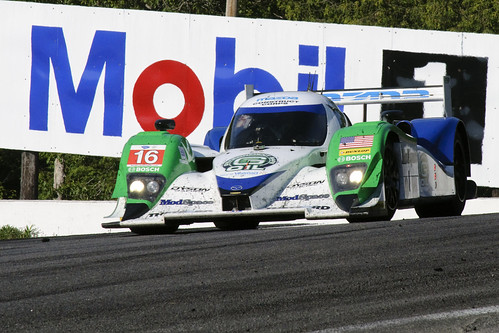
Dyson Racing Lola Mazda, Mosport 2011
Finally, an excuse to post a photo of a race car.

It seems that an enterprising Johns Hopkins student, one Dillon Brout, has spent the last season employed by one of my favourite endurance racing teams, Dyson Racing of the American Le Mans Series. Mr. Brout, the article goes on to state, joined his skills in analysis of complex data sets with a love of motorsport, helping the Dyson crew to secure the top-level Le Mans Prototype 1 (LMP1) series championship for 2011. Now, you could perhaps argue unfair advantage, since Brout’s training came from arguably one of the best possible places for making sense of disparate and complicated streams of data:  the lab of Dr. Adam Riess, who just recently picked up a Nobel Prizefor the discovery of the accelerating expansion of the Universe through observations of distant supernovae”.

So how does this relate to racing? Well, race cars undergo all kinds of forces and stresses, and the best teams collect reams of real-time data from sensors all over the car – in the engine, measuring stresses on suspension components, monitoring tire temperature and pressure, fluid levels, electrical systems, fuel consumption – dozens of potentially important indicators of performance. Track position and adherence to the racing “line” around the track are logged. In some forms of racing, driver biometrics (heart rate, for example) are also carefully examined. These data and many more are collected on the fly, and are also written to memory cards that in long endurance races are swapped out during pit stops, so that the race engineer and other team members can get busy with analysis as the car heads back out on to the track. Clearly, it’s not all about throwing some fuel in, banging some new tires on, and driving like the wind. Racing these days is incredibly high-tech, particularly in the LMP1 class, where cars contain almost voodoo levels of proprietary technology. The Dyson Lola coupe pictured above, for example, runs a custom-built 2.0 litre turbocharged Mazda engine, running on isobutanol – a fuel that has some promise as a more environmentally friendly alternative to corn-distilled ethanol and petroleum products. Building such a thing isn’t easy, and getting it to run at full bore for two, three, six, twelve, or even twenty-four hours is distinctly non-trivial.

Oryx Dyson Racing, morning warm-up, Mosport 2011
Even worse, he had to deal with the second team car as well.

So that’s where a smart cookie like Dillon Brout comes in, bringing some serious data-bashing acumen to the table. It’s about as alternative a career for an astrophysics researcher as I can think of, but I can imagine that should he wish to pursue it, the big players in the racing world may be very interested indeed in this young man.

Posted in Careers, Hobbies | Tagged , , , , , , , | 10 Comments

I am proud to be one of them.

On futzing around, looking for something else, I came across a letter to the editor of The Times, written by the redoubtable Lt. Colonel Alfred Daniel Wintle in 1946. Wintle, a fabulously eccentric yet quintessentially English gentleman (and yes, I recognize that those two things are not necessarily mutually exclusive) had a colourful life. Among his exploits were “enlisting” at the age of 16 and fighting in the First World War (although it is unclear whether he actually officially signed on or not), resulting in the award of the Military Cross. He spent a stint in the Secret Service, serving in occupied France in the Second World War. On being captured, he promptly escaped, apparently convincing the entire Vichy French garrison to join the resistance in the process.

But by far his most famous episode was being thrown in the Tower of London (then a military prison), for threatening an RAF officer with his revolver, ostensibly to try and secure an airplane with which to join the French Air Force in attacking German troops occupying France. The ensuing story, in which he wrote and signed his own arrest warrant, apparently lived like a king in the Tower, and ultimately was acquitted of (almost) all charges, in part through producing a list of people he felt should be shot for the betterment of Britain (including some senior politicians), is fabulous. Some of Wintle’s escapades are documented in the excellent Most Secret War, and in the TV movie “The Last Englishman”.

All this, though, pales by comparison with this absolute gem of a letter, which falls squarely in the “I wish I’d written that” category. It’s practically Oscar Wilde in its brevity. It reads:

Sir,
I have just written you a long letter.
On reading it over, I have thrown it into the waste paper basket.
Hoping this will meet with your approval,

I am
Sir
Your obedient Servant

Sheer brilliance. And it’s so much like something I might have written that it’s scary. I’m very hazy on the relationship of Lt. Col. Wintle to myself, but if behaviour has anything to do with genetics, I’d say that the phenotype is very, very familiar.

[The original document, should you wish to see it, has been photographed and is online at Letters of Note.]

Posted in Guest posts | Tagged , , , , | 4 Comments