International Congress of Human Genetics – day 1

Palais des Congrès, Montréal
This is where it will all happen… tomorrow.

Well, day “minus one” really, since the thing doesn’t start until tomorrow.

Nevertheless, I have braved the Canadian Nationalized Train Service, and am now, after a long and interesting discussion with a mathematician from Dalhousie University, who (a) happened to be sitting next to me, and (b) knew what C. elegans is, in La Belle Province, specifically the city of Montréal.

Yes, I took the train, for a variety of reasons including convenience, lack of irritating security checks, and delivery to within walking distance of my supposedly very swishy, but really very ordinary, hotel.

Nevertheless, arriving nearly a full day early afforded me the opportunity to exercise my usual hobby of painting pictures with pixels. So here you are:

Rural Western Quebec
This is what rural western Quebec looks like, at speed.

And here is a tractor, panned at a stupidly slow shutter speed with a lens that doesn’t compensate for poor technique:

Tractor and trailers, rural Quebec, October 2011

Tomorrow, I am in a project meeting all morning, followed by an afternoon of the ICHG and a dinner meeting for said project. The rest of the week is a free-for-all of talks, posters, vendor-sponsored events, and all the rest of it. Wish me luck. I’ll be posting updates and photos and whatnot as I can.

Posted in Conferences, Guest posts | Tagged , , , , , , , , , , , , | 7 Comments

Eye Candy Fractal Post

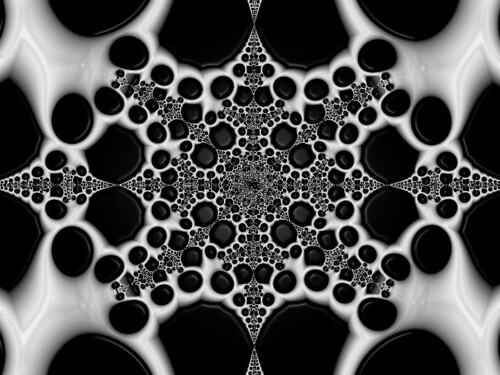
alien honeycomb
“Alien Honeycomb”

Henry’s recent post about music had the quite unexpected (I expect) result of spurring me to think again about a couple of old hobbies I’ve neglected for a while. One, the creation of super-excellent* electronic music, is something I’ve largely left behind since the arrival of a couple of Junior Ricardipi, lo these nearly 11 years since. Although I hung on for a while, the gear eventually was mothballed some time in late 2008. Henry’s post (and comment by Benoit) resulted in me thinking about doing some more, mainly as useful soundtrack material for movies created by one of the aforementioned Junior Ricardipi, and also in me posting some of it to SoundCloud for your listening pleasure.** I even hacked together a new piece, using only archived sound clips and a tiny little bit of newly-recorded sound, provided by a digital piano more frequently used by the other Junior Ricardipus.

But this post isn’t really about that – it’s about another old hobby that I serendipitously started thinking about again – the creation of digital artwork using fractals, occasionally beaten and battered after the fact with good old Photoshop. I haven’t done much of that recently, either, as I’ve been concentrating instead on photographing large quantities of high-speed automobiles, a pursuit you can read about in a bunch of blogposts at my other haunt, including this one, for example.

One nice thing about fractals is that they’re tantalizingly abstract, and you can pretend they’re all kinds of things – plants, lighting, clouds, whatever tickles your fancy. This one, for example, looks like neurons to me:

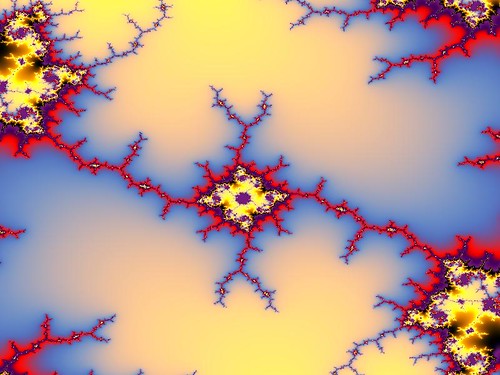
synaptic transmission
“Synaptic Transmission”

This one, on the other hand, makes me think of fish scales:

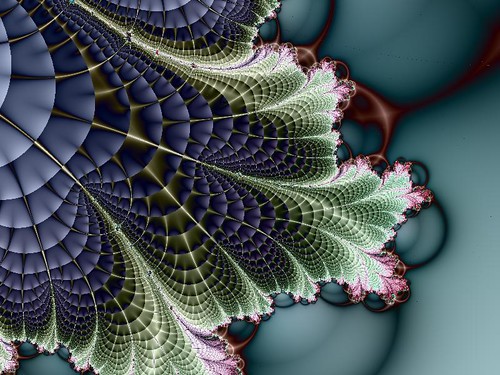
scales
“Scales”

Whereas this, after some pummeling with Photoshop and a few associated plugins, could be just about anything you want it to be:

arthropod parts
“Arthropod Parts”

Yes, I know this is basically just eye candy (or maybe you can come up with a less flattering description, if you try), but it was fun to do, and some of the resulting images may actually end up as backgrounds in a PowerPoint presentation or two that I need to do for work. That’s a pretty flimsy justification for spending (my own) time on this, but hey, it’s a hobby. Or it was, but now that Henry’s indirectly reminded me of it, maybe, just maybe, it will be again.

Many more, if you can bear it, in this Flickr set.


*with very small values for “super” and “excellent”

** with correspondingly small values for “pleasure”

Posted in Art, Hobbies | Tagged , , , , | 4 Comments

Essential Reading, August 2011.

Canadian flag, Royal York Hotel

I didn’t agree with many of his political views, but nevertheless with all good will I direct you to this:

A letter to Canadians from the Honourable Jack Layton

If you, or anyone you know, is battling cancer, you might like to read the section headed A Few Additional Thoughts. And anyone can take inspiration from the last paragraph.

State Funeral and live coverage Saturday, August 27, 2011, on the CBC of course.

Posted in Uncategorized | Tagged , , , | 4 Comments

Science, fashion and the best stem cell dress you’ll (n)ever wear.

A shameless cross-post from a topic I started at the Lablit forum.

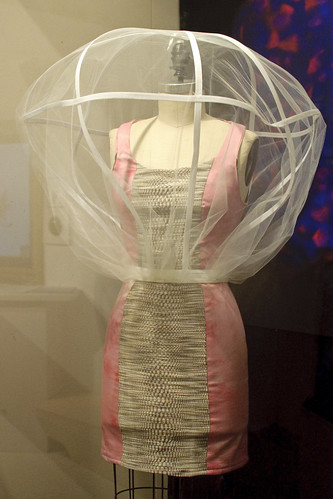
Stem Cell Fashion

This wonderful dress is part of an exhibit at the Ontario Science Centre, entitled The Beauty of Stem Cells – Fashion Inspired by Stem Cell Research. Unfortunately, I completely failed to photograph much else of it (or to be accurate, took a few other photos that can be charitably described as “crap”), but there were several other unusual pieces of clothing, and a series of rather nice photomicrographs by Craig Aarts and Radha Chaddah of the Stem Cell Network.

I also completely neglected to record who designed this elegant gown, but it was one of the following students of the fashion program at Toronto’s RCC Institute of Technology.

Muhammad Alamgir / Gulmairam Amankogoeva / Hilary Birkenshaw / Elissa Contino / Liliane Fotso / Julie Hodge / Lena Meier / Sveta Shvedenkova

I’m going to have to get back to this, I think, especially since there are many other educational and public engagement activities and exhibits along with it. There’s plenty more information at the Stem Cell Network itself, or the relevant page at the Science Centre. For those in the area, it’s on until October the first, 2011.

Posted in Education | Tagged , , , , , , , , | 12 Comments

Science Policy and the Canadian Election – or maybe not.

Tomorrow we vote.

So we’re down to it – only one day left until the Canadian Federal Election, although many who are more organized than I am have already voted in the advance polls. As usual, our beloved national broadcaster has aggregated a lot of content on a dedicated set of webpages, so if you’re really interested in following this, that’s the best place to start that I know of.

Most of the rhetoric so far seems to have centred around the integrity of the existing Conservative government, and about broadly-painted statements about families, taxes, and jobs – no surprises there. Despite some assertions I’ve heard, science funding has been a complete non-issue. Concerns over funding for Geome Canada, for example, which were a big deal following being shut out of the 2009 budget, seem to have largely disappeared. Unsurprising really, in an environment where this election is more about the existing government positioning itself to transition from minority to majority rule, and the two second-runners (the Liberal and confusingly-named New Democratic parties) jockeying for that important “Official Opposition” designation, and maybe, just maybe, sneaking in to power.

Still, I’d thought I’d look at the major parties and see if there were any hints as to their positions on science funding, especially given all the recent activity around this topic on the other side of the Atlantic. This is what I found out… or, as you’ll see, for the most part, didn’t find out.

First off – we have lots of political parties in Canada. Some are reasonable, some less so. I can’t be bothered worrying about most of them, but if you’re interested, the official list is here. The major players, in no particular order, are these five:

1. Bloc Québécois. Their policy document makes only vague allusions to being supportive of research, in particular industrial research. No mention is made of science or basic research per se. Not surprising, really, since separation from Canada and self-rule is their major raison d’être.

2. Green Party. You can debate all you like about whether this is a party worth worrying about. Their platform‘s only references to science and research are in the budget portion, and involve proposals to cancel research by Atomic Energy Canada, and stop federally funded GMO research.

3. Conservative Party of Canada. The incumbents’ platform has the most detail – not surprisingly, since they were able to propose a detailed federal budget recently. There are rather modest budget allocations, of $44 million per year, going forward. The recent budget, which is now tabled pending the election, included lines for the government-funded research councils, Genome Canada, and some other initiatives – nothing earth-shattering, but at least something defined. All indications suggest that if elected, the budget will stand as previously presented.

4. Liberal Party. Until very recently, the major threat to the incumbents. Their platform, which you can find in summary here or in much greater detail here, essentially says nothing about science and research funding, but namechecks similar target areas to the Conservatives, including environmental concerns and neuroscience.

5. New Democratic Party. Don’t be fooled by the name, they’re socialists, and depending which poll you believe, may be ahead of the Liberals. A “costing document”, in essence a mini-budget-proposal, makes no mention of science or research at all. The expanded platform document uses the term “science-based” for monitoring of oil sands mining impact, and of medical “formularies”, mentions a “Green Bond Fund” for green research, “moving towards more publicly funded research and development” for medicines, and research into the Status of Women (their capitals, not mine). None of this is mentioned in the costing document, however.

So there you have it – vague in the extreme. Of course, science and research funding isn’t any kind of platform issue in this election, so we shouldn’t really be surprised by this lack of detail. And arguably, Canadians have many more important things to worry about at the moment. But at least I’ve established one thing for myself – looking for guidance on which way to vote based on science policy is pretty hopeless at the moment, at least in this country.

For more whimsy about the last time Canadians had to go to the polls, by all means read my previous post.

Posted in Funding, Guest posts, Politics, Uncategorized | Tagged , , , , , | 12 Comments

Whupping photos in shape for biology journals

The last time I purchased a piece of software to edit photographs, it was Photoshop 6 for PC. I had tried version 7, which did the job well, on others’ computers, but version 6 did the job, and did it for years on end and many computers.

However, I can’t install it anymore. Perfectly normal for software that came out ten years ago.

I have tried pretty hard to get GIMP to do what I want to do, but I don’t know how. I don’t want to invest in a version of Photoshop nowadays and find out that it doesn’t either, and that my hard-won reflexes are no longer current anyhow, which is the only reason I would upgrade.

Anyone know of a resource that would tell me how to do the following in either a modern version of PS that I could buy, or in GIMP?

This is sort of my workflow when I put together figures for papers:

  • I open up all my photos that I want in the final figure. Usually TIFF but sometimes JPEG format
  • Design a transparent base document with the final pixels-per-inch (or more) resolution
  • Drag guidelines over from the rulers and place them where I want to frame each part of the figure (they’re usually multipart, lettered a, b, c etc.) and leaving an equal measurement of white space around them
  • Note that these parts are not necessarily a reproducible size. They will take into account the shape of the object I want to show, so may be squares or rectangles.
  • Paste in each photograph as its own layer, onto that base document
  • Arrange them in position by dragging them around
  • Perform a homotethic transformation – I don’t know what it is in normal English – but fit the part of the photo I want by enlarging or shrinking, to scale, the original photograph so that what I want to showcase appears in the guidelines I consecrate to that particular subfigure part. Know what the scale factor was, because most of my photos do not have automatic scale bars written in and I often have to calculate them and add later.
  • Be able to rotate the photos at any angle so as to best adapt my axes to the frame.
  • Be able to rename the layers by the letter of the part of the figure to which it corresponds.
  • Adjust contrast and color so that the backgrounds of comparable photographs are similar, if they were not all taken at once under identical conditions (usually the case)
  • Be able to clone-stamp out bits of dust in the background or if they are in a non-essential edge of the photo. I believe that much clean-up is permitted, and I’ve always done that out of respect for the visual message.
  • Be able to annotate with Arial text in any color, as a separate layer (or more).
  • Be able to add any color curved or straight lines, solid or dashed, and arrows and arrowheads, as a separate layer (or more). Be able to duplicate these additional forms.
  • Save the entire figure with its layers.
  • Save the entire figure with all layers fused into one TIFF file.

Suggestions, please! Links also welcome.

Posted in Guest posts | 22 Comments

Expat scientists, Rare Disease Day 2011 and stupid politics

I received notification through Facebook (who says LinkedIn is only for professional conversations, and Facebook only for silly pet antics?) from a Portuguese former colleague from my French Ph.D. lab, who has since gone to live in Germany, England, and now the U.S., that the Howard Hughes Medical Institute launched a new fellowship program on December 1st last year. This program supports U.S.-educated biomedical scientists who have gone back to their own countries – eighteen of them – to start a new group within the last seven years.

The deadline is in THREE DAYS so you may not want to get your hopes up. But if you don’t sleep, it is borderline possible to recycle your ERC Starting Independent Researcher application or your EMBO Young Investigator application (even though it’s not due until April, so you probably would do it the other way around) or your Human Frontiers Young Investigator grant application.

Of course, if you are in Italy, Turkey, Portugal, Czech Republic, Hungary, or Spain you might have applied for the above, whereas if you are in Argentina, Brazil, Chile, China, Egypt, India, Mexico, Poland, Russia, South Africa, South Korea, Taiwan, you most likely didn’t. I hope but suspect there are not equivalently endowed possibilities to support startup labs in those countries. Although maybe, I hope, I don’t know about them. (Edited to include the example of http://twas.ictp.it/prog/prizes, though individuals can’t ask for anything). See below.

And who says that writing blog posts is a waste of professional time? It was when I went to look for the link to the HFYI program that I saw they fund international collaborations without an age limit, and I will look into that shortly, since I recently submitted a request for funds to a rare disease funding mechanism that itself is painfully underendowed, given the estimated 8,000 rare diseases out there *. In preparation for the international Rare Disease Day, this time next week, the French Alliance Maladies Rares (representing 200 rare disease associations) has launched a public campaign all over the national train system this week to increase awareness among the general public – each disease may affect fewer than 1 in 2000 people, but one in twenty of us are affected by a rare disease or another. No point in remaining isolated – health difficulties are common, and we can only combat them by joining forces and exchanging information.

Well, so, funding difficulties, especially for unproved or unhired yet worthy early-career scientists, are also common, and we can only combat them by joining forces and exchanging information.

I’d love to hear about other funding possibilities, and possibilities for non-biologists, for people who are starting up new groups with new subjects, no matter what their prior (Ph.D., postdoc, public or private sector) experience. There is grantsnet.org, thank goodness, but despite the International Funding Index, it naturally has a pretty U.S.-centric slant. I say naturally but it’s a shame that world-wide scientific funding mechanisms don’t make better use of this AND OTHER clearinghouses to publicize.

Of course, ventures like the following don’t help matters, even in the wealthy U.S. – it sounds like something our not-so-strategic English counterparts might have dreamt up, though I hadn’t heard of anything quite yet equalling the demagogic and infamous “fruit fly research” scorn a former vice-presidential hopeful once blathered, from any equivalentally influent politico in England. Until today.

Apparently, a similarly misguided and possibly more dangerous way of riling the public has been launched by the (conservative) majority leader of the House of Representatives, Eric Cantor. I regret that Science Magazine finds it necessary to place its Letters to the Editor behind a paywall, but I’ll paraphrase and quote, and you’ll get the idea from the excellent missive addressed by Dr. Alexandra Gade from Austin, Texas:

…he encourages people to search through NSF awards and report “questionable” research. From those grants deemed questionable, the House will vote on which grants deserve to have their funding revoked.

The research that receives funding from the NSF has been evaluated by those who are qualified to judge the scientific merit of the research. […] Even if the entire NSF were eliminated, 99.5% of the discretionary budget is ignored in such a cutback program.

It is clear that the primary goal of YouCut is to reduce funding for science. The U.S. scientific community needs to take a stand and let the House know that YouCut is both unwarranted and a waste of resources.

I have indeed written a Citizen Review – a scathingly critical one of the whole principle. If I get any human response, which I doubt, I will keep you posted.

This is the most misguided and demagogic attack on peer-reviewed research I have seen in a very long time. I notice you didn’t cite “fruit fly research” as among the grants worthy of your scorn. Good. If certain projects may be questionable, and pointing the public toward the NSF website is fine and well, wasting your resources by building this website, rabble-rousing and finally, producing a report (not to mention pushing to take some action to cut these previously approved science grants, which would never work since they have clearly been found to have merit and payback for the public by people who actually know what they are reviewing) is an enormous waste of taxpayer dollars right there. If you got rid of the ENTIRE NSF budget, you would still have to try to oversee the wasteful spending of the 99.5% of the remaining discretionary budget. Why don’t you sic your ignorant and uncritical electorate on the many measures designed to keep them in said ignorance and lack of skepticism, such as Congressional obfuscation of this sort?

Update: Pharyngula got to this more than two months ago. Couldn’t we harness the forces of good and make our citizen voices heard like this on the citizen review thingy? I.e. don’t let just the wingnuts comment?

Speaking of wingnuts, I have attracted a call-to-arms from one of the Tea Party watchdogs on Twitter, for daring to alert the Congressman to my disapproval. I suspect I’ll fall under the radar but the tactics are interesting, and the immediate reaction. I can’t wait for my first comments.

[* and given the time and effort involved in putting together one of these applications.]

Posted in Guest posts | 2 Comments

On becoming (naturalised, half) British

I am undertaking ‘a journey to citizenship’ and happily (thankfully) I just passed the test and can apply for citizenship soon.
Fortunately I can be a US/UK citizen; the UK isn’t particularly concerned with dual citizenships and the US wants to keep us:

In order to lose U.S. citizenship, the law requires that the person must apply for foreign citizenship voluntarily, by free choice, and with the intention to give up U.S. citizenship.

Broadly meaning that unless you actually denounce your U.S. citizenship, or become a citizen of certain (mostly communist) countries – having dual citizenship is ok as was decided by the US Supreme Court in 1952 (Kawakita vs. the US)

My mother, like I assume many Americans, didn’t know this- she sent me an email:

Are you applying for British Citizenship? I am surprised but understand if that is what you want to do.

As if I was telling her I was joining a fascist regime.

I reassured her that if I had to choose I wouldn’t do it – I would stay American. Why?
Because I am from “GREATEST COUNTRY IN THE WORLD”!

Ok, I am actually kidding about that (yes, really) but this sure is what you learn growing up in the US- We are great Great GREAT and everyone wants to be like us. As embarrassing as it sounds now, I definitely grew up believing this. If the US is good at nothing else it is damn good at indoctrination. Its like Disney, its easy to make fun of Disney when you are old and wizened but as a child it was magical – the wonderful world of Disney with singing birds and dreams that came true.

I wouldn’t say I am particularly patriotic but I am rather attached to my country – its a visceral thing – and I am proud of the idea and indeed ideals of the USA (even though I think we don’t often live up them) – the Constitution is an amazing document. I am also pretty attached to the UK and in particularly to England – I have lived here for a while and plan to stay. I wouldn’t describe myself as an Anglophile, I don’t have a particular love of all things English but I am fond of England and there is alot I like about it.
For example:

1 – Tolerance – England is an incredibly tolerant society
2 – Gentleness – the Police here are amazingly gentle; the Doctors and Nurses at A&E’s here are wonderful – and they have a certain gentleness about them in a way that just doesn’t happen in the US from either public service (in my experience)
3 – the availability of books – books galore, cheap books, good books… everywhere everywhere –
4 – Newspapers – Newspapers in this country are great, relatively
5 – the BBC – which has REAL documentaries – REAL
6 – Cheap food, in grocery stores here you can get decent veg for a decent price even in places like Tesco’s
7 – Trains
8 – you can have a pint in the pub and read a book and people leave you alone.
9 – Manners and moderation – if you don’t appreciate the scrum queue at a pub, go to the US in a crowded college bar on a weekend

The Quiet Pint

There are so many more things I could list. But what I find curious, from an outsider’s point of view, is that most of the English people I know are quite shy about telling me what is good about England – in fact many of them have nothing good to say at all, its like a negative patriotism and wonder why on earth I would want to move here
My butcher summed it up the best:

“You paid over a £1000 to live HERE?!?!?!”

And I am aware that to any point on my list a negative example can be provided- like ‘Yes but the bloody trains are never on time’ and ‘we aren’t that tolerant, look at the BNP’.

Why does patriotism have to be a bad thing? Just like you can be a patriotic American and not be Sarah Palin, can you not be a patriotic English man or woman and not be a member of the BNP? I think you can. There ARE some exceptional things about England and I think alot to be proud of if you are English. And it doesn’t mean you have to turn into someone who is worried about
“the immigration invasion of our country’ or ‘the threat to our security posed by Islamism”

You really don’t. Being an American, which is hardly the nationality du jour if you live just about anywhere in the rest of the world , I am attached to the idea of ‘take back the patriotism’. Why not? It seems reasonable to me that you can love your country and hate some of the things it does.

I am really excited to (hopefully) be becoming a UK citizen, though I doubt I will ever refer to myself as British (though it might be fun for the irony as I have a definite Southern US accent), or go out waving a flag at the upcoming Royal wedding – I am very proud of becoming a part of this country, a country which, in my opinion, has alot to be proud of.

Posted in Guest posts | Tagged | 44 Comments

The Age of Fulfilment

In which the author exhibits his cheap and lazy nature by faffling around a bit, eventually buying Jenny Rohn’s latest novel “The Honest Look” via several geographically separate countries.

Not The Honest Look. Honest.

Another book by Jenny Rohn. One that I actually own already.


Ever one to be up to date [Ed. Note – false], I’ve finally gotten around to ordering a new novel. Having temporarily shelved tomes by James Watson and Craig Venter, polished off Michael Freeman’s Top Digital Photography Tips, dabbled in a rather excellent Ansel Adams book, and decided against re-visiting Hemingway’s Turgid A Farewell To Arms, I was looking for something engaging, something zingy, something like – the shiny and exciting The Honest Look, by none other than Occam’s Typewriter blogger, cell biology researcher extraordinaire, and self-confessed Rock Chick (her words, not mine), Jenny Rohn. Yes, that Jenny – the one with the blog, and the website, and the other website. Not to mention this website. Ok, I mentioned it. Go on, sue me, see where it gets ya.

Quite by coincidence, The Honest Look was the subject of debate at last night’s FictionLab, and Grrlscientist reviewed the book yesterday on her Punctuated Equilibrium blog. Accuse me of jumping on a bandwagon, I don’t care, I can take it.

Anyway, because, according to Ricardipus Rule of Life #1, Nothing Is Ever Easy, I couldn’t order the book initially from Amazon Canada. Because they claimed it didn’t exist. Just like they claim that approximately 10,000,000 other things stocked by Amazon outlets in slightly larger and/or wetter countries don’t exist. Why not? Probably because of our socialized healthcare system, or our gosh-darned generic drugs, or the British North America Act, or something.

Fine. Instead, I decided to order it Direct From The Publisher. Why not?

I’ll tell you why not. Because Cold Spring Harbor Laboratory Press, bless their pointy little propellor-hatted heads, would happily ship me the book as long as I paid them roughly the price of the book, plus the price of the same book again to put it in a box and mail it. Now, I suppose I could have added some more books to my order, to minimize the overall shipping cost as a percentage of the total, but honestly, do I really need a $300 textbook on the size and shape of cellular appendages, or a monograph on the X-ray crystal structure of some fancy protein or other (Stephen and Richard, no comments from you lot please)? Have I mentioned the North American Free Trade agreement yet? It’s supposed to make things flutter joyfully across the US-Canada border, with no impediments – operational, monetary or likewise. Unless it’s softwood lumber, that is. Or fresh water. Or automobiles. Or books. Or just about anything else, although sometimes it seems that guns and marijuana might be exempt.

Right. Off to Amazon UK… or wait, maybe not. That’s in the UK, right? That’s a powerful long way away and I bet the shipping will be expensive. Time for a re-think.

[At this point in the tale, the Christmas holidays and two enormous grant proposals intervened. But wait! All is not lost, because, when I re-surfaced:]

Aha! Amazon Canada now acknowledged the existence of Jenny’s novel. Yes, the shipping wasn’t free (believe it or not, I couldn’t think of a single thing I wanted to add to the order to kick it over the magic “free shipping” threshold), but it was almost reasonable, and, since I was in possession of a very fine gift certificate, the spoils of filling out some market survey or other, I wasn’t too bothered. So, clickety-click, order done, and…

…it’s shipping to me from…

…wait for it…

…would you care to guess?

A book written by an American living in England. Published by an American company. Ordered from the Canadian arm of an American distributor. That in turn arranged delivery via the American subsidiary of an English company. Who are shipping it to me right here in Canada, from England, via Royal Mail, of all things.

Astonishing. It all seems so twenty-first-century somehow – although truth be told, all of this could have just as easily been arranged by good old-fashioned paper mail, probably. Nevertheless, it’s now on its way, and I’m looking forward to it. Honest.

Posted in Guest posts, Uncategorized | Tagged , , , , | 10 Comments

Letting go of mysteries


Thanks to Cath, for inviting me to play! I’ve followed a circuitous path through science–college major in biology, grad school, postdoc. . . and then a stint as a stay-at-home mother, followed by a year as a scientific writer/editor at non-profit research institution.  I am now back at the laboratory bench as a postdoctoral fellow.  I hope to stay in the research lab, but one never knows where one’s path will lead. . .

I’ve crossposted this from my personal blog at The Bean Chronicles.  I think it describes a near-universal experience for scientists.  Perhaps some of you will share your own experiences ? 


In this business, I have begun to learn to let go of mysteries.

In graduate school, my lab studied a large family of signaling proteins. We were particularly focused upon one particular subunit of a heterotrimeric signaling complex. The “gamma” subunit comes in many flavors or isoforms—twelve different isoforms, the last time I checked. Why? This was the burning preoccupation of my PI. Why so many isoforms? These subunit variants have little amino acid sequence similarity (between 15-30%) and are all exquisitely conserved across mammalian evolution. That suggests that there are important functional differences between these isoforms. But what the hell are those differences? What are these protein subunits really doing in the cell? Why, my PI would frequently say with exaggerated frustration, are there so many of them? It’s been over ten years since I left that lab, and the answer is still unknown. My old lab has made important progress on the function of some of these proteins, but my old PI’s question is essentially unanswered. It was a question that preoccupied me for a while, but I long ago left that field. The answers will not come from me.

                                                      *********************************************

During my first postdoc, I became absorbed by a different set of questions. And in the year before I left that lab, I made some interesting observations. Overexpression of a certain gene in a certain cell line led to striking changes in cell morphogenesis: the cells were suddenly able to form long branching tubules that could invade through extracellular matrix. Why? How the hell did they do that? Interesting, my PI at the time commented, and then remarked that he had no clue what it meant or how to pursue the finding. My time in that lab was limited; my fellowship funding had just run out, and I would be out the door in a few months. There was simply no time to follow up on my discovery. It was a mystery that would be left unpublished, unanswered.

                                                      *****************************************************

The image of those branching tubules from my first postdoc has stayed with me. When I joined my current lab, I decided to make use of the cell system I had learned during my first postdoc. And I realized that some of the cell lines I had made during that first postdoc would be perfect controls for experiments I was planning for my second postdoc. I further realized that this was a chance to solve old mysteries: the assays I had planned for my new project could also be applied for that old project I had abandoned. I would crank all my cell lines (old and new) through the assays together; I’d get two papers for the price of one! I told my new PI my idea, and he gave me his enthusiastic support. I wrote my old postdoc PI a long e-mail, catching him up on my career transitions, asking him for my old cell lines, and outlining a collaboration and project proposal.   His response was characteristically brief and to the point:  “Great to hear from you. Happy to send the cells.”

Well, you may have guessed how this ends. In theory it sounds easy to process multiple cell lines together through complicated assays; it sounds easy to balance different projects. It is, most of us find, not that easy. Especially when my primary project began taking on intriguing new dimensions. The work from my first postdoc did indeed serve as useful controls, but they have not served for anything more.

“We need to look over your goals,” my current PI said shortly after the new year. He’s big on making goals in writing and revisiting them regularly. We looked over the list of goals I’d written in the fall. One of the first was to complete that project from my first postdoc lab, and get out a minor publication on it. “I think we’re going to have to drop this one,” I said regretfully.

“You don’t want to do it anymore?” he asked.

“I would LOVE to do it,” I answered. “But I just don’t think we can.”

“It would benefit you more than me,” he said honestly. “I think you’re right. I don’t like having my people drop their goals, but you’re right.”

I don’t like it either, but my primary project, the R01-funded project that funds me and this lab, is the one of primary importance. It’s the project that will help determine, in a few year’s time, whether or not this assistant professor gets his R01 renewed and this lab survives. And that primary project has taken off. It’s soaring. And it’s in a wide open field—I have no competitors (that I know of). That side project I dreamed of, an old observation of branching cells? It’s in a competitive area, and the work involved to bring it to publication would be a risky commitment, and far more than I can afford.

So I find myself again saying goodbye to a past mystery, even while the mysteries of my current project deepen. I wonder if anyone will follow up on that long-ago observation I made in my first postdoc? Nothing has been published on it. Perhaps no one has yet noticed the effect?

That old mystery may someday be solved. But—like the mysteries of my grad school lab–it will not be by me.

Posted in Uncategorized | 6 Comments