
One of my enduring memories of Oxford is sitting in the Chemistry School lecture theatre while a long-haired, leather-jacketed lecturer covered the blackboards in chalky organic reactions (the first time ever I heard about S~N~2 reactions; and a whole heap other stuff I have since forgotten) non-stop for an hour. One of the advantages of taking Biochemistry, instead of something less hardcore, say, is that I got to learn real science instead of just squishy biological stuff, which might surprise Henry ‘cell biologists are stronger than they look’ Gee.
I’ve also maintained contact with chemists of one flavour or another for several years subsequently, including some very clever people working at a drug discovery company based just outside Cambridge. And two of these chaps have written a rather splendid review on chemistry for the non-chemist (one of them was at my party a couple of weeks ago).

Derived from an in-house workshop The review explains nomenclature and concepts that even the squishiest biologist should be able to understand. The naming conventions for oxygen- and nitrogen- (and everything else-) containing compounds are explained, as well as stuff like solid support chemistry and a little bit on how medicinal chemists actually go about making new compounds for testing. And I learned something too. For example, I didn’t know — or had forgotten — ring numbering conventions. Aromatic rings are numbered to ensure heteroatoms (i.e. non-carbons in rings) bear the lowest possible number.
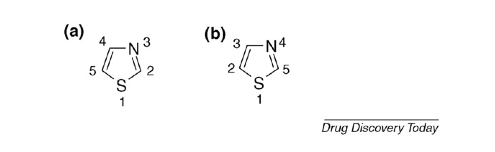
Ring numbering
In the figure above, (a) is correct but (b) wouldn’t be because the nitrogen atom would end up with a higher than possible number.
There are some silly errors in the paper. Figure 5 is captioned as if it were Figure 4. The heterocyclic animation, I mean amination, in figure 7 isn’t.
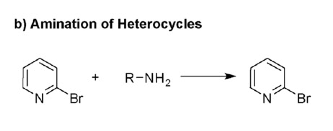
spot the difference
Figure 9 comes before figure 7 and figure 8 is missing. The authors refer to “Laboratoy Equipment” (as if they don’t didn’t have access to a spill chequer).
But anyway. I want to see more of this sort of thing. I want to see a guide to physics for biology, and I’d quite like to co-write something the other way round: NMR or crystallography or squishy stuff, even genetics, for non-biologists.
Jordan, A., & Roughley, S. (2009). Drug discovery chemistry: a primer for the non-specialist Drug Discovery Today DOI: 10.1016/j.drudis.2009.04.005


Embrace your inner squishiness.
When did you take Biochemistry at Oxford (secret handshake expected)? And just go for it- you should write something the other way round.
John Wilkins has collated a pile of blog posts on basic concepts in science, which is more or less what you want to do. It looks like he hasn’t found the box he put them in when he left ScienceBlogs.
Thanks for flagging this up Richard – looks v. useful to someone like me (O level Chem, 1980)! Shame about the errors – have you caught them all?
Apologies for mis-using your thread, but:
@Sarbjit – thanks for your PM. Would have replied directly but seems to be no way to message you via NN…(unlike other contacts)?
I matriculated in ’87, Sarbjit.
waggles fingers
Ooh. Thanks Bob. I’ll have a look.
Oops, crossed comments.
have you caught them all?
Well, that’d be hard to know, wouldn’t it? To be honest I was watching Princess Bride (great movie, book’s even better) as I wrote this post so I’ve probably missed something. I hope it is useful, anyway — and I have a PDF.
Feel free to hijack the thread — I do it all the time. cough.
Ah, that’s a pity. DDT used to have a team of dedicated editors and subs. They got cut from a team of 5 or 6 down to 2, and now all copyediting is done by non-specialists overseas. Guess you get what you pay for.
So, people you need “editors”:http://network.nature.com/people/UE19877E8/blog/2009/05/11/in-which-i-defend-the-editorial-profession-–-belatedly.
Tracking comments throughout the internet… one for Science Online perhaps (again) — this post also on Friendfeed.
The author speaks…….
Richard, thanks for your comments. Just to clarify a little on the errors you spotted:
Fig 8 does still exist, it’s in box 1 and fig 9 is in box 2; the odd out-of-place-ness of these schemes is due to the arrangement of the boxes within the manuscript and the resultant re-arranging of the figures. This is also why fig 5 is captioned as fig 4, as it got re-numbered.
Spelling mistakes and the error in fig 7; In the words of James May, “Permission to say “cock” very loudly?”
Fig 7, as you’ll probably have worked out, should be:
I’m a tad miffed about this one; the figure was correct at submission but had errors in the proof; the revised scheme was correct at the time of submission but appears to have gone awry somewhere….think a quick e-mail to the editors is in order regarding this one…..
Regardless of the comments about copy-editing, and despite best efforts of our proof-readers, as main author, I’ll take the criticism for these slipping though the net. However, I hope these issues don’t detract too much and the article still serves it’s intended purpose…….
Hi Allan
thanks for commenting. It’s always good to get an editorial/authorial perspective. Even if it is limited to saying ‘cock’ very loudly.
The article is good: it’s a valuable exercise. Thanks.
Very nice… I may have to
subvert the systemdownload it legitimately from the local University library system. It would have been very useful about four years ago, when I also worked in a company interested in this kind of thing.Regarding Figure 7, it would be really handy if you’d worked out the chemistry to simply swap the N and Br atoms around. I imagine that would make lots of things easier.
Oh, and @RPG – I also have fond memories of organic chemistry, although a lot of my classmates hated it. Grignard reagents, as I recall, were a particular highlight (although I’ll be darned if I can remember what they’re good for).
Absolutely, Wintle. These chemists eh, don’t they know nothing?
I loved the Dyson Perrins lab at Oxford.
Did You Spill My Pint???
Yes.
OUTSIDE…..
I’ve taken you once, Henry. Don’t make me embarrass you again.
Update: figure 7 has now been corrected on-line by Elsevier. They didn’t coreect the figure 5 caption as requested at the same time, however……
Thaks for drawing it to our attention.
All part of the service, ma’am.