Echoes

At the pub the other night, I was asking how a friend was doing. He was particularly busy, it appears, because he had to attend students’ exhibitions, located inexplicably at inconvenient and distant locations the length and breadth of town. Tiring work, crossing London in the slivers of time between overlapping appointments. At least, I opined, he was getting to see lots of new art. That must have been exciting.

Well, no, as it happens. The artwork he was seeing was invariably, to use a technical phrase, crap. Apparently objects, and the placing thereof, are in this season. And my friend (an art consultant, by the way. He makes his living brokering deals between artists and law firms with too much money) was pretty heartily sick of it. Just objects, random things that could have been (and probably were) picked up off the street, arranged according to the artist’s and displayed. You know it’s art, see, because each exhibit has a little white card that says so.

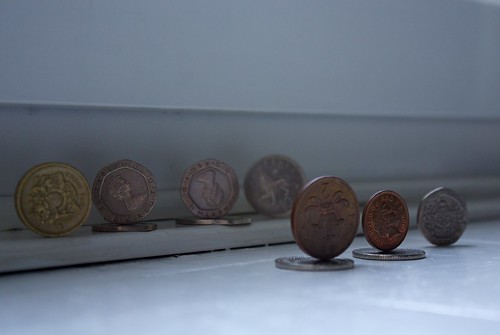
Now curiously enough, I had my camera with me—I was fresh from the Royal Society’s Summer Science Exhibition where I’d been gathering material for a piece in The Scientist. Oh ho, I said, you should take a look at this, and pulled out my camera to show him a photograph.

Pennies

Now you see, he said, that’s actually quite good. At least there’s two rows of things, and the objects are interesting. Maybe even worth showing it to someone.

Funny, I said, because I took that photograph this morning. It’s my bedroom windowsill and I arranged the coins like that when I was talking to my mum on the phone last night.

Art has this problem, doesn’t it?

Ever since the first not-quite-an-ape-not-quite-yet-a-man smeared soot on the wall of a cave, we’ve argued and quibbled about the definition of art. How do we tell what’s art, and what’s the work of some loon having a laugh? I’ve heard that art can be defined in the same way as pornography: you might not be able to describe it but you know it when you see it. Art—let’s say something is art if I, the artist, say it is and at least one of you agrees with me.

Science tends to have it easy, when it comes to definitions. At least, among those who can see homeopathy for what it really is (to take a random example). There are methods and protocols and skill-sets and—well, those exist in art too. You’ve got to be bloody good at representing the true human shape to be a Picasso. You have to understand colour and form to be a Pollock. You might say that your seven year-old could do that, but he didn’t, and, really, I bet he couldn’t.

None of this touches on whether real art—or real science—is actually any good, even if we admit it is real science or real art. That’s what the market does: in art, it’s down to whether anyone will buy it; in science, it’s how many people cite it or how much profit the drug company can make from it. A sunset may be beautiful, but it only becomes art when you paint it, or write a sonnet about it. And you could do a lousy job at that—but it would still be art.

Similarly, you can do science with an infinitely varying level of skill, but it’s still science. It might not be very good, and you might draw the wrong conclusions, and you might not be able to run a straight western blot—but it’s still science.

I think.

But does it matter? Does any of it matter? Does it matter if we can’t define art, yet we can define science? Would it make any difference if we couldn’t define science, as long as we got our medicines and iPhones and vacations on Europa? Would art be any the poorer, or richer, if it were definable?

Does it matter that these are just some half-structured random thoughts jotted down at the end of a tiring day; does it matter that it’s not writing; does it matter that it’s not art at all?

Except… I might claim it is.

Posted in Art, Photography, Science | Tagged , , , | 8 Comments

Mata Penguin

You just know this isn’t going to turn out well.

Posted in Penguins | Tagged , | 5 Comments

On the Journal with No Name

There was a little bit of kerfuffle a week or two ago. Apparently some rather well-respected institutions (and the Max Planck Institute) decided to announce they were thinking of launching a journal. Maybe. In a year’s time. With no editor-in-chief and no business plan.

But! This is going to be the best journal ever! And you won’t need to pay to submit! Or read it! And you’ll never have to do a reviewer’s experiment again! and did we say it is going to be top tier?!

Anyway, thanks to a conversation at the day job today with one of my cow-orkers, I think I see where this is heading. Mark Walport, head honcho at the Wellcome Trust (about whom I have only good things to say, by the way), hath decreed that the aforementioned WT shall fund only the best research.

And obviously this new Journal with No Name will publish only the best research.

Which means that Wellcome-funded researchers will publish in this journal, and this journal only—obviously, because this is the best journal, and they are the best researchers.

In this way, the Wellcome stops paying researchers to publish in lesser open impact journals (which it does as a matter of course, and must cost an absolute stink), and instead saves that money by allowing, nay encouraging these excellent researchers to publish in the Wellcome’s own journal, for free. Because they are doing the best science, and this is going to be the best journal. And of course, not needing to do extra pesky experiments means they have time to publish even more papers, making the Journal with No Name even better!

What could possibly go wrong?

Posted in Literature | Tagged , , , | 24 Comments

Big angry macrophage

Those of you who know anything about British popular culture will no doubt be familiar with Benny Hill. The Benny Hill Show was long-running and immensely popular—although it was often accused of being sexist, it was the men who were usually shown up to be idiots (admittedly in the presence of scantily clad females). Very intelligent and witty, the show’s trademark finish was a chase scene, to the tune “Yakety Sax”.

David Rogers, who died two years after Benny Hill, was a scientist and physician, interested in infectious diseases and medical education. He made a famous video of a big angry macrophage neutrophil chasing down and engulfing a Staph aureus bacterium.

Here, in honour of them both and all things Friday (and because I’m going on holiday now), is something that I hope amuses you. Watch out for the twist.

Posted in Science, Video | Tagged , , , , | 3 Comments

On the hairy nature of light—redux

A while ago I reported on an experiment. Using my laser beam I demonstrated the wave nature of light, by measuring its diffraction. One of the referees, for reasons of poetry, wanted to see the experiment repeated with a different wavelength laser.

So, like a good little peer-reviewed scientist I toddled off and repeated the experiment with a red laser beam that very evening. And here, finally, are the results. No surprises: the red laser was refracted more than the green one. About 20% more, which is what I’d have predicted given the difference in rated wavelengths.

But here are the pictures, and the maths. The working for the green laser is given in my earlier post.

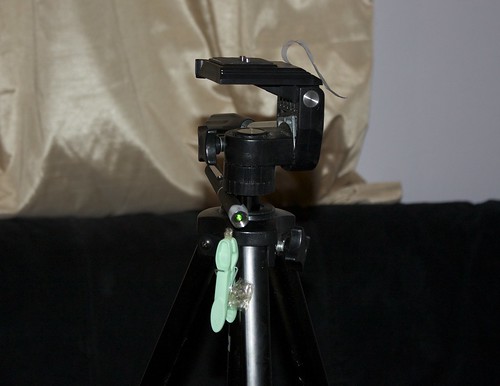
First, here’s the experimental set up:

Laser with flash

Note the high-tech use of a peg and Scotch Tape to hold the hair (human, brunette) in place. There’s also a slightly fuzzy photo, taken under ambient light (one of those dreadful energy-saving bulbs) in which you can see the beam itself thanks to Rayleigh scattering and the dust in the spare room.

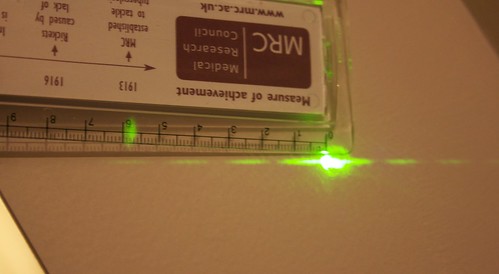
Green laser, ruler
Measuring the green laser

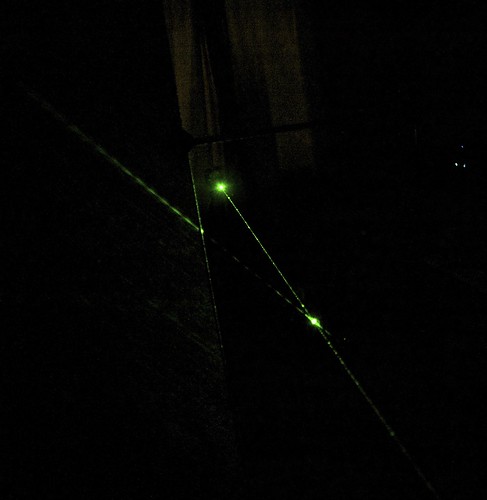
For the red laser, I had to turn off the lights (it only being rated at 1 mW); I also bounced it off a mirror to give me a longer path length and therefore a better node measurement.

Red laser, wall

Using this method, I measured the third maximum at 13 cm from the central spot. I measured the path length at 6.75 m. Given

nλ = xd/L
where

n = # of maximum
x = distance of maximum
d = slit distance (i.e. the hair width–approximately 100 microns)
L = length of beam

then

nλ = (0.13 m 100 x 10-6 m) / 6.75 m

so

λ = (1.9259 x 10⁻⁶ m) / 3

therefore the wavelength is 642 nm.

QE, as they say, D.

Green laser, mirror & path

Posted in Science | Tagged , , | 6 Comments

Another one

Moth

This is a classic.

Posted in Science-less Sunday | Tagged | 3 Comments

Flutterby

Identify this.

Flutterby

Posted in Science-less Sunday | Tagged | 6 Comments

Apocalypse Penguin

Number five.

Apocalypse Penguin

Posted in Penguins | Tagged , , , | 4 Comments

The Chain

Listen to the wind blow, watch the sun rise

At this time of night, if the lights on the Addenbrookes roundabout are kind to me—and they usually are, because the sensors pick me up as I approach—three minutes and two seconds after putting the car into first gear I’m turning off the Babraham Road.

It was the last full week before Christmas. I’d come back to the lab after dinner—cycling home in the dark, and then coming back in the car. We’d had the referee reports back, and I had to do some more NMR titrations, this time on the 800 MHz machine. This meant getting a sample to Ji-Chun in the morning, which meant desalting it overnight, which in turn meant picking the right tubes from off the S-100 column and getting them all into the Centriprep before I went to bed.

Listen to the wind blow, down comes the night

I change down from fourth to second, easing the clutch back in and letting the engine brake into the turn, half an empty mile of straight country lane rising gently in front of me.

Blinking back the itch behind my eyeballs I emptied the last 8 ml aliquot into the Centriprep. I’d been concentrating the protein, ten millilitres at a time, for the last couple of hours. One more fifteen minute spin, and I could fill it to the brim with deionized water; in the morning I’d have a protein that was so concentrated it was almost solid. I’d then be able to dilute it in phosphate buffer at pH 6, and add heavy water for field frequency lock.

Damn the dark, damn the light

It’s best doing this at night, as I can see headlights a mile off, well beyond the rapidly approaching horizon. Even cyclists and pedestrians show up as I flip on the main beam. I plant my right foot to the floor as the bass line kicks in.

I closed the lid of the refrigerated centrifuge, set the speed to 500 rpm and pressed start. I washed my hands in the tiny sink, dried them and turned the lights off as I closed the door to the lab behind me. Downstairs in the harshly lit loading bay car park, I turned the ignition, looked over my shoulder and—

Crunch.

Swinging out, my front nearside bumper had scraped the wing of the sporty yellow Toyota parked next to me. There were still some lights on upstairs, but I had no idea whose car it was. I parked the car and went back into the building to find a pen and paper. This is what insurance is for, after all.

Run into the shadows

On a clear night like this I’m doing a good 80 as I approach the bend at the top of Granham’s Road, Lindsey Buckingham’s guitar screaming to the redline. I slip into neutral and crest the ridge, the wheel going slack in my hands as the tyres lose their grip. Then I coast down to the level crossing, only touching the brakes as I approach the 30 limit, safe on the other side of the hill.

Posted in Lab ratting, War stories | Tagged , , , , , | 4 Comments

I won’t apologize

But I have every sympathy with John Rennie.

Read it, please. And forgive me.

Posted in meta | Tagged | 7 Comments