Science is Vital meets David Willetts

Cross-posted from Science is Vital.


Following the publication of our report on science careers in the UK, which drew on nearly 700 responses to a call for evidence, members of the Science is Vital team met with Minister of State for Universities and Science, the Rt Hon David Willetts, MP, on Thursday 6th October to discuss matters arising and explore how careers in science can be made more secure and more productive.

Mr Willetts began by commending Science is Vital for raising the issue of careers in science in the panel discussion he took part in earlier this year, and for the report itself, which he said was of great value. He said that he expected only a summary of the issues arising on the evening itself, and that the wider consultation came as a (pleasant) surprise. He then invited Dr Jenny Rohn, Chair of Science is Vital and postdoctoral researcher at UCL, to summarize the issues. Jenny said that the breadth and variety of problems identified in the report indicated a systemic problem with careers in science that needed addressing if British science was to remain internationally competitive.

Jenny also observed that at such a time of austerity with a funding freeze in publicly funded research, such structural problems were being felt more acutely than before—a point reinforced by Dr Richard Grant, who said that the funding increases in recent years had masked the instability in science careers that had existed for nearly forty years.

Mr Willetts acknowledged that the insecurity and high staff turnover that short-term contracts lead to are problematic, and that both funding and links to other career paths need to be strengthened. Professor Stephen Curry (Imperial College) pointed out that more funding was not necessarily the answer, and that the issues raised by the consultation were more to do with the way that funding was allocated and the lack of long-term or permanent research positions.

Mr Willetts contended, at this point, that given spending constraints there would be a trade-off between having more secure positions for postdoctoral scientists and the intake of fresh blood in the form of young scientists with new ideas and energy, something that the Royal Society’s Martyn Poliakoff has identified as being central to a successful research sector. Dr Prateek Buch (UCL) made the counter point that this infusion of new talent shouldn’t come at the expense of continuity and institutional memory within research groups, also crucial to generating good outcomes, and that the balance between the two was currently too far in favour of the former. Richard highlighted another difficulty inherent in short-term contracts: high-risk, ‘difficult’ projects cannot be contemplated. The current system rewards low-risk projects that are guaranteed a large number of papers—the ‘low-hanging fruit’ approach to science. This is not necessarily good for science, or Britain, in the long term.

Mr Willetts agreed with the Science is Vital team that more needed to be done for and by the research community to promote stable careers whilst retaining the competitive drive that makes UK science so successful. He appreciated the analogy made by one of the contributors to the report, which pointed out that it would be ludicrous for the teaching profession to have a career structure whereby all teachers were expected to make it to head teacher by the age of 40—at which point they would do no teaching—or leave the profession.

The team also raised the issue of the somewhat chaotic transfer between a career in science and other professions or jobs—suggesting that greater emphasis should be placed early on in scientists’ careers on training for the eventuality of leaving academic science for industry, teaching or other allied employment. Richard stressed that the Government did have a role to play in encouraging industry to contribute more to the training of students and early postdocs, and in preparing them for a career in industry. There was a brief discussion about how this might be achieved.

The Minister also agreed that science careers were ‘atomistic and not family friendly,’ indicating that a great deal of work needs to be done to support women and families through the scientific career structure—something that Jenny emphasized was of real concern according to the consultation and report. Mr Willetts said that this was an area that the Government could take more action on under an equality agenda.

Mr Willetts also acknowledged how the current imbalance in science careers is reflected in our report, and that this was a matter for the research community to raise with funding bodies, research councils and learned societies. To this end he invited Jenny to attend a roundtable discussion between the relevant bodies, at which the issues raised in our report will be discussed. This enables grassroots scientists to express their concerns, but crucially it will also be the beginning of a vital dialogue between Government, funding bodies and scientists as we aim to reshape science careers to support investigators and keep British science at the top of its game.

Science is Vital was glad of the opportunity to present the report to the Minister, and we wish to extend profound thanks to all our respondents and supporters for providing us with such high quality evidence.

—Prateek Buch & Richard P. Grant

Posted in Politics, Science | Tagged , , , , | 2 Comments

So long, Steve, and thanks…

Without further comment.

Steve Jobs

Posted in People | Tagged , | 4 Comments

I predict a riot

I’ve just been checking the OT stats and I think the killer post to end all posts would be a massively cooperative film, made by working mothers, about animated dinosaurs.

That is all.

Posted in Nonsense | Tagged , , , , , | 14 Comments

On taking notes

Cath’s post on whether it’s good manners to take some means of taking notes to a seminar, when you’ve been specifically asked for feedback, reminds me of a seminar I had the dubious pleasure to attend at a certain University department a long, long way from here.

This particular department had a seminar series, given by completed or completing PhD students. Now, in this particular country, PhDs weren’t defended. The thesis would be submitted, examined, and… that was it. You got told whether you’d passed or not. No public defence, no chance to go head-to-head with examiners or committees, no real feedback on the last 3 or (more commonly) 5 years’ work.

So the departmental final PhD seminar was a pretty big deal.

Also in this department we had some groups that I can only describe as being of a medical persuasion. Nothing wrong with that as such, except they tended to attract people who (a) weren’t very good scientists and (b) were only interested in alphabet soup. That is, they wanted as many letters after their name as possible. To be fair, this isn’t the only department in the world that suffers from such people, but it helps to understand what was going on.

So the departmental final PhD seminars given by these people were, to be frank, a bit crap.

Which meant we (the scientists) tended not to go along, feeling that we had nothing to learn and—perhaps more importantly—nothing to contribute. These coves were going to go away and set up in practice somewhere and make loads of money regardless of the quality of the science they had performed in their effort to attain those extra three letters. Nothing we could have said would have improved the science coming out of those particular groups. And lest anyone accuses me of being bitter or unfair, yes, we did see pour souls doomed to repeat the same worthless study as their predecessors year after year after year. Data, see?

Anyway.

The instructions came down from on high that it would be a Very Good Thing if we (as in the postdoc scientists) were to make an effort to attend these medics’ final PhD seminars, for reasons of respect if nothing else. The instructions were passed on by the PIs, with various annotations ranging from “don’t waste your time” to “actually, the Head has a point.”

I used to make a point of attending the scientists’ seminars anyway, if only because there was free canapés and wine, and to show willing, I went along to a couple of the medical final PhD seminars. After all, I thought, how bad can it really be if there’s free food and booze at the end?

The second—and as it turns out, the last—medical final PhD seminar I attended soon put paid to that bright-eyed optimism. I knew things weren’t going to end well when the besuited cove giving the seminar slouched in a chair by the bench at the front of the seminar room. He turned on the laptop, fiddled with it. The first slide had the project’s title, with “Dr” and “PhD” flanking his name. He fiddled with his mobile phone. Started, somewhat smugly, talking about his research. Fiddled with his mobile phone again. Droned (smugly) through a few more slides. Sent a text message. Showed something that was meant to be data. Answered a new text message.

By this time, I’d put my pen down—I’d been taking notes, see, because I actually understood what he was saying and had realized there were some dodgy assumptions in the experiments he’d been doing: I had a couple of questions I wanted to ask. But I’d realized he didn’t care.

Then I realized his supervisor didn’t care either.

I was sat just behind and to the right of his supervisor. Who, while he’d been talking, had been fixated on her laptop. I wondered if she was taking notes, but peering closer I realized that she was reading and responding to emails—the entire time he was talking.

At the end of the seminar, I really couldn’t be bothered asking my questions. He wouldn’t care, his supervisor certainly wouldn’t, and the examiners had already awarded him the PhD.

I didn’t even stick around for the booze.

Posted in wank, War stories | Tagged | 10 Comments

On keeping a good notebook

(Lazy cross-post time: also at Naturally Selected)


One of the first and most important things a neophyte scientist learns–or at least, is taught–is the importance of keeping a comprehensive and accurate record. We all know it’s a good thing, and yet I’d wager most of us struggle with it. Who hasn’t scribbled a calculation or a measurement on a handy paper towel, with all the intentions of taping it in or copying it to our notebook, only for it to go missing somewhere twixt lab and office? Or for it to turn up, months later, made illegible by a mix of coffee rings and Coomassie stains?

Everything should be recorded. The practicalities of this, however, together with the effort involved in keeping a proper index, often mean that some things, often things that seem of only minor consequence, go unrecorded. And this is a real pain when you come to write the paper and realize you can’t remember whether you cloned your fragment using NotI or KpnI; or both; or perhaps it was EcoRV…

Electronic notebooks and other wild ideas might help, but there’s nothing quite like having to trawl through random pieces of scribbled-on tissue while writing up Materials and Methods to bring home the importance of a well-kept notebook.

Unless it’s a Nature retraction.

In my trawl through the F1000 database for retracted papers, I stumbled across this comment:

Unfortunately, however, a proper data notebook is not available as evidence to support our findings, which constitutes non-adherence to ethical standards in scientific research.

Note there is no suggestion of fraud or other shenanigans, and indeed, “There are several independent papers supporting” the findings (also see this one and here.) But,

In accordance with the recommendations from the National Institute of Advanced Industrial Science and Technology, K.T. therefore wishes to retract this paper.

A harsh lesson. Supervisors and students should learn it well.

Posted in Science | Tagged | 6 Comments

Who are you?

I asked someone to send me a brief CV in relation to something I was doing for the day job. They took me at my word, and sent this haiku:

I sit on my butt
Hiding from controversy
Dispensing wisdom

So this perp is evidently some kind of administrator. But some of you have much more exciting jobs, and now it’s your turn–please, let me have your job description in haiku, limerick form or rhyming couplets. And to make it interesting, I’ll buy a pint or two–or another, equally appetizing prize–for what I deem to be the best.

Go to it!

[UPDATE 13082011] I’ve decided to raise the stakes. A signed copy of Jenny’s book (either/or) is now on offer for the very best, and there may be runners-up prizes too.

Posted in Friday afternoon, you | Tagged , , , | 43 Comments

London’s burning

It’s been a strange couple of days. We’re sitting at our laptops, trying to work but keeping an eye on the Telegraph‘s live feed and another eye on Twitter. There are sirens in the middle distance. Tits and sparrows are pecking at the bird feeder.

I worked at home today. About half past one, just after I’d returned from a lunchtime jaunt to Canary Wharf, I heard a load of sirens, quite close. Twitter and the live feed were talking about Lower Road and Surrey Quays shopping centre being next in line. I discovered that the sports store, Curry’s and T-Mobile had been robbed last night, although there were no reports of rioting that close to us. Someone on twitter said it was quiet, but ‘tense’. I decided I should check it out myself.

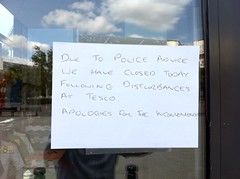
Surrey Quays: Decathlon closed. Some windows boarded up. Tesco business as usual.

So about an hour later I took what I called an “unarmed reconnaissance” trip on my bike—although I did carry my heavy D-lock with me. Quite a few people—shoppers, by the looks of things—seemed to be heading towards Tesco. There wasn’t a hoodie in sight. I rode round the car park and looked towards Lower Road: not as busy as usual, but people around, doing normal people-y things. A few shops were shuttered up, but there was no sign of trouble.

In Surrey Quays itself, one of the doors was closed to people going in, although people were coming out. Workmen were starting to repair some damage. The other door was open, and although Tesco seemed to be as busy as usual the shutters were down further in. I even met my neighbour, pushing her pram.

I went to look at Decathlon, noting that a couple of windows were boarded up and it was dark inside. I took a photo of the sign on the door—and three black men walked towards me. “What did you do that for?” one asked. “So I can let people know what’s going on,” I replied.

One of them looked at my big, heavy, D-lock. I smiled and nodded towards the library. “I live round the corner,” I said. This seemed to calm them down. “Are you keeping on eye on things here, making sure it’s all right?” They said they were—I thanked them, and rode home.

I can’t imagine the landlord and patrons of the local pub standing for any nonsense, either.

Sir Hugh Orde, head of the Association of Chief Police Officers, has said in the Guardian,

What is happening in London is not an insurgency that is going to topple the country. There are 8 million people in London and it is a tiny proportion doing this. They are gangs of looters and criminals and although it is concerning it has to be kept in proportion.

Now, and strangely for this time of evening on a Tuesday, St Mary’s Church is ringing its bells. It’s a little bit crazy out there, but we’ve had worse. Everything’s going to be all right. But that’s no reason not to enjoy some Clash…

Posted in London | Tagged , | 9 Comments

For we all, like sheep

Here the UK we have an “e-petition” website, where you can get get a bunch of like-minded people to sign up to your latest crazy idea and if you can find another 99,999 crazies then the Government has said it might consider debating your proposal. There was a lot of fuss yesterday, on twitter and in the news, about a petition to bring back capital punishment. Less fuss was made of the fact that there were twice as many petitioners for the contra motion.

A meme I saw repeated on twitter was that those who were campaigning for the return of the death penalty were those who also oppose abortion, as if this was both illogical and morally repugnant. (There is in fact an argument to be made that the innocent should be given a chance, while those who are clearly guilty have blown it—but that’s besides the point here.)

It’s equally logical to assert that those who are against capital punishment are also those who are in favour of killing unborn children—phrased like that, equally illogical and morally suspect.

The problem here is that, especially on twitter and in blogs and other forms of social media, subtleties and caveats and nuance are lost as we seek to beat the other side into submission—or at least to make them look foolish. There are, I think, few questions that resolve neatly into yes/no camps; and saying ‘yes’ to one never necessarily means an automatic ‘no’ to another. Look: the question “Have you stopped beating your wife yet? Answer yes or no” does not admit to an answer from a reasonable person. Equally, “Are you against abortion/Do you support the death penalty” in all cases is not a simple yes or no matter.

We could actually get somewhere if we stopped painting ‘the opposition’ in such simple terms. It would be even better if we realized how much our perceptions of someone who disagrees with us on one matter are shaped by either a few media-hogging loons, or the media itself, or both. But it’s far easier, far more satisfying, and far more effective in bolstering your own particular prejudices and gaining support, to demonize those you love to hate, and ascribe to them logically improbable positions to shore up your own prejudices and stop you engaging with the issue to hand. You’re white; I’m black: we must fight until one of us is dead.

Posted in Rants, wibbling, you | Tagged , | 10 Comments

A momentary lapse of reason

A long time ago, in a galaxy far, far away…

Before Experimental Heart was published, a discussion at the LabLit fora centered on whether it was possible to write an exciting story that remained true to real lab life. I maintained that it could, and in the best traditions of empiricism set out to prove it by experiment.
Freesia
This led to a collaborative writing project: I set the scene, we gathered some characters and people to write them, laid some ground rules and the Experimental ‘Lab Lit’ Fiction Corner was born.

And for a while, the experiment was a success. Characters and plot developed, dark goings-on were revealed, mysteries deepened and pulses quickened. Unfortunately, time and trouble got in the way—I suffered from depression, people were busy, I moved back to the UK; the momentum was lost.

The story was never finished.

I’ve toyed with the idea of finishing the story myself—after all, I know the plot and how I want it to resolve—and producing it as a radio play, or something like that. But the other night, Jenny and I came up with a better idea: let’s finish the damn thing the way we started. But what we’ll do is apply a bit of pressure, and complete the experiment in full view of the internets.

Here’s the plan.

I’m going to edit what we’ve got already, and serialize it here at Confessions over the coming couple of months. That will give me impetus to get it into shape. I’m getting in contact with the other writers, and it will encourage them to produce something. I’ll give them more guidance as to where they should be taking it, which means they can concentrate on writing rather than plotting (or understanding just what the blazes is going on).

The story will develop over at the LabLit fora, and I’ll post edited versions here a few days after they appear there. And I encourage you to add comments in the forum thread created for the purpose. You can also read what we’ve got so far in that forum, but you might like to pace yourself and wait for the serialization here—it’s completely up to you.

Oh, and I’m trying to trace all the writers we had before. Some of them might not be able to commit, so if you want to volunteer to take over a character, please let me know!

Wish us luck.

(And we can still produce it for radio—or podcast, at least—at the end of it all.)

Posted in A momentary lapse of reason | Tagged | 5 Comments

On tits and sparrows

Opposite the advertisement for the Grant Arms Hotel, Grantown-on-Spey (“The Wildlife Hotel”) in Autumn 2011’s Birds magazine from the RSPB, Caroline Nash tells us she’s helping to save sparrows. As you might know, sparrows—which for some of us are the epitome of garden birds—are declining in numbers across the UK. Nash is working on a project to find suitable habitats for the insects sparrows feed on, and is monitoring how sparrows use the different habitats the RSPB has set up in London parks.

Since last summer we’ve had two bird feeders hanging off the balcony above us. One contains peanuts, and is frequented by great tits, blue tits and various finches (mainly greenfinches, but I’ve seen a goldfinch too). Oh, and a squirrel who had the grace to look guilty when I drew back the bedroom curtains one Sunday morning. The other feeder contains bird seed (which does not, to my disappointment, grow into baby birds).

Mrs Great Tit

Anyway, this feeder has been empty for a few months. The reason for this is the dirty pigeons that infest London. When I installed the feeder, I used the smaller perches, because “Pigeons and other large birds” weren’t supposed to be able to stand on them. These pigeons found a way. So I then cut off the crossbar of the perches. The tits and finches could just about stand on them; the pigeons figured that they could hit the feeder and make the seed fall out, whence they could eat it (and crap all over my porch to boot). All my efforts at pest control failed. No amount of intense green laser beams in their eyes would make them stay away for long. I seriously considered investing in an air rifle but using it to best effect would involve some serious remodelling of the back door.

Great tit, Sparrow

The time came for me to troop into Robert Dyas and buy some more peanuts for the first feeder. As I was there, considering giving up on seeds and getting a second peanut dispenser, I saw they had seed feeders that were supposedly squirrel- “and other large birds”-proof. Score.

I bought it, and a new bag of seed, and installed it on the porch. The result has been some very pissed off-looking pigeons, and—finally!—house sparrows in my garden.

House sparrow

I call that a win.

Posted in Personal, Photography | Tagged , , , | 29 Comments