On Me

Just in case you read here and not Martin ‘s excellent blog (why not? For shame!), you should check out what I’m doing at F1000. If that makes any sense.

Posted in Uncategorized | Comments Off on On Me

On UFOs

I saw a UFO on Saturday.

Let me explain: it was an object (four of us saw it) so not a product of my fevered imagination (a mass hallucination can not, however, be ruled out at this stage); it was in the sky (therefore ‘flying’, for some value thereof); and I couldn’t tell what it is (yet).

It was possibly slightly east of due north, about thirty to forty degrees off the zenith, and gave the impression of being a long, long way away. The time was 11.35 UTC and we were stood about half a mile north east of Canada Water tube station. It shone brightly — like the sun glinting off a cruising airliner — and my first thought was that it could be an iridium flare but it did not perceptibly move, and did not fade. I then thought it might be a weather balloon. The brightness seemed to vary irregularly, although that was possibly an effect of our eyes trying to focus. We walked about fifty yards to the station and we couldn’t see it any more.

Then yesterday (Sunday) I was walking by Redriff Primary school, about half a mile I guess NE of where we had stood the day before, and looked to the north. There it was again. No flare, then; and probably no weather balloon either. It was 12.30 UTC, and as far as I could tell the object was in the same place.

My other hypothesis, that of geostationary satellite, does not hold because the object was polar rather than equatorial (and could one even see a geostationary from twenty five thousand miles away?).

So. Over to you. What the hell was it?

Posted in Uncategorized | 28 Comments

You have no idea what you are doing, do you?

As it’s a random Friday afternoon in April, a guest post from my mole in the pharma publishing industry.

———
_Herbert Van Der Hibernator
University of Life_

There is a famous scene in The Life Of Brian where Brian is forced to hide from some Roman soldiers and finds himself standing on a rickety platform inexpertly nailed to the outside of Matthias’s house. The platform eventually collapses and Brian finds himself standing on a speakers’ platform with an expectant audience in front of him. Looking around for inspiration, he realizes that he is supposed to philosophize and begins with “Don’t pass judgment on other people, or else you might get judged, too.” The crowd respond with a mixture of rapture and bewilderment. What follows is a typically Python interchange as the hassled Brian is forced by an ignorant audience to clarify every point he makes. He inevitably makes a string of mistakes until the immortal line is cried: “He’s making it up as he goes along!”

It is probably a feeling familiar to us all. We are making our way in the world without a clear set of rules and no matter how closely we observe the successes and failures of others, no clear pattern of causality is evident and we remain in the position of making it up as we go along.

It has always been thus.

I was inspired to comment on this by this week’s press coverage of Armando Iannucci’s big screen adaptation of his successful television series In The Thick Of It. The film, entitled The Loop, depicts the comedic working life of British politicians in the run-up to the invasion of a middle-eastern country. Iannucci was quoted as deriving his inspiration from government reports regarding the invasion of Iraq and the particularly frightening discovery that a 22-year old graduate had been packed off “with his iPod” to draft the Iraqi constitution simply because he had a fresh degree in constitutional studies. Iannucci realized that the business of serious government, while fronted by grizzled old statesmen like Gordon Brown et al, is actually being conducted by a bunch of kids with no idea what they are doing and who are making it up as they go along.

We love to laugh at the government and its incredible incompetencies, and we probably enjoy the idea that the whole affair is a modestly formalized, reactionary college party with nuclear weapons. However, we should take care in adopting such a superior attitude. If we look closer to home, there are parallels that will at least cause us to blush and look at our shoes, and possibly lead us to pity and empathize with the constitutional studies graduate listening to Babyshambles as he considers whether or not Iraq should have a senate, a congress or both.

My chosen field is pharmaceuticals. I work with a range of drug companies from the very big and Swiss to the very small and Czech, and no matter how big and serious a pharma company is, it is still apt to make mistakes. People outside the business looking in may find this pretty alarming. Pharma companies are in the business of making drugs that are given to sick people to make them better, or at least make them feel no sicker than they felt the day before. The whole enterprise of medicine is so inherently risky that the industry has found itself regulated up to its eyeballs to ensure patient safety through brutally rigorous application of processes for the design, delivery and reporting of clinical trials. And rightly so. The medical profession and the public needs to be certain that the experiments conducted to determine the efficacy and safety of a new drug have been conducted to the very highest standards by people who are properly trained and highly experienced in the field.

The problem with this is that almost all of the people I work with are about the same age as me. We, the professionals running and reporting clinical trials, are about 30–45 years old. We can still remember our graduation night. We like to watch reruns of Top Gear because Clarkson is cool, we laughed at Jackass, and we are most definitely making it up as we go along.

The result of leaving my generation in charge of things is a series of truly gargantuan errors of judgment and a catalogue of mistakes that is too long to list. Some of the most notable examples come from the design and running of these supposedly flawless clinical trials. I have seen an instance where a company decided to do an unplanned interim analysis of the primary endpoint of a phase III trial without understanding that doing so altered the statistical power of the study. The result was that they missed significance of the primary endpoint in the planned analyses by 1% and their thousand-plus patient trial was a worthless, million-pound wreck. Another company designed a study with so many endpoints in it that statistical chance would make one of them positive. The investigators got very excited that they had a positive result until it was pointed out that a random number generator would have got the same result or better. There was also the painfully embarrassing tale of a team who drafted a dummy abstract for a major clinical congress to see how the abstract submission system worked. They must have done a good job because the abstract was submitted in error and accepted by the congress for an oral presentation. The author, Dr John Smith of the University of Orkney, however, did not exist.

I am going to go back to my desk now and wing it in the name of medical progress. As I do so, no matter what disasters befall me or those I work with, I will remember that off-the-cuff advice from Brian of Nazareth: “Don’t pass judgment on other people, or else you might get judged, too.”

Posted in Uncategorized | 3 Comments

On Differences

“It’s too bright,” Sophie said. “The sun won’t set!”

I thought we had some sleep masks from the flight over (when, on a four-fifths empty 777, we had a row each and those of us who weren’t so excited that we photographed Iran in nauseating detail could actually lie down), but by the time I got around to looking for them she was asleep.

One of the things that struck me about living in Sydney was the length of the days. Being closer, much closer, to the equator than we are in the UK, the days were of a more uniform length, and it never stays light long enough to keep children awake much past their bedtimes. I missed the drawn-out crepusculum; twilight in Australia being almost non-existent. (Incidentally, next time someone complains about the weather in the UK, point out to them the difference in rainfall between Sydney and London, and then—especially if they complain how cold it is—compare London’s latitude with, say, Nova Scotia.)

I don’t ever recall seeing anyone famous in Australia either—by which I mean someone who would be recognized by an average person on the street (Peter Doherty doesn’t count; and if you want a real chuckle at the desperation of Australian science read this attempt to re-define ‘Australian Nobel Prize winners’). I heard U2 play from a couple of miles away, but that’s about it.

On the other hand, within three days of arriving in London to live, this conversation took place as a certain shock-haired gentleman was herded, surrounded by television cameras, towards the Tube:

Kate: “Who’s that, Rachel?”
Rachel (12): “It’s the Mayor of London, Boris Johnson.”
Kate: “How do you know that?”
Rachel: “I saw him on Top Gear!”

I’m so proud of her.

Sophie, too, is settling in. It was her first day at school yesterday, and she was mobbed by her new classmates. They’re doing a project on Natural Disasters this half-term: this week it’s ‘Earthquakes’ but after that it’s ‘Volcanoes’.

“Oh,” Sophie said, “I stood on a volcano in Auckland.”

“Cool!” chorussed the class. “Impossible!” according to one smart-arse.

“It was dead, duh,” Sophie said.

“Cool!” chorussed the class.

Also yesterday I had coffee with Ishta’s wife, and talked about schools and how her son loves science (his science teacher is apparently amazing if somewhat unconventional), and how it might be possible to get him or his class to see a real lab. In the afternoon I met up with a TV producer (thanks to Matt Brown), and talked about doing green-screen interviews for a graphics-heavy science TV show.

My feet haven’t touched the ground. The only down-side is Vista’s propensity to lock me out because the ‘security log is full’ and to randomly reboot at least once a day. I really wish they’d let me connect my MBP to the network at work.

And a final difference. It does my cynical heart good to see this:
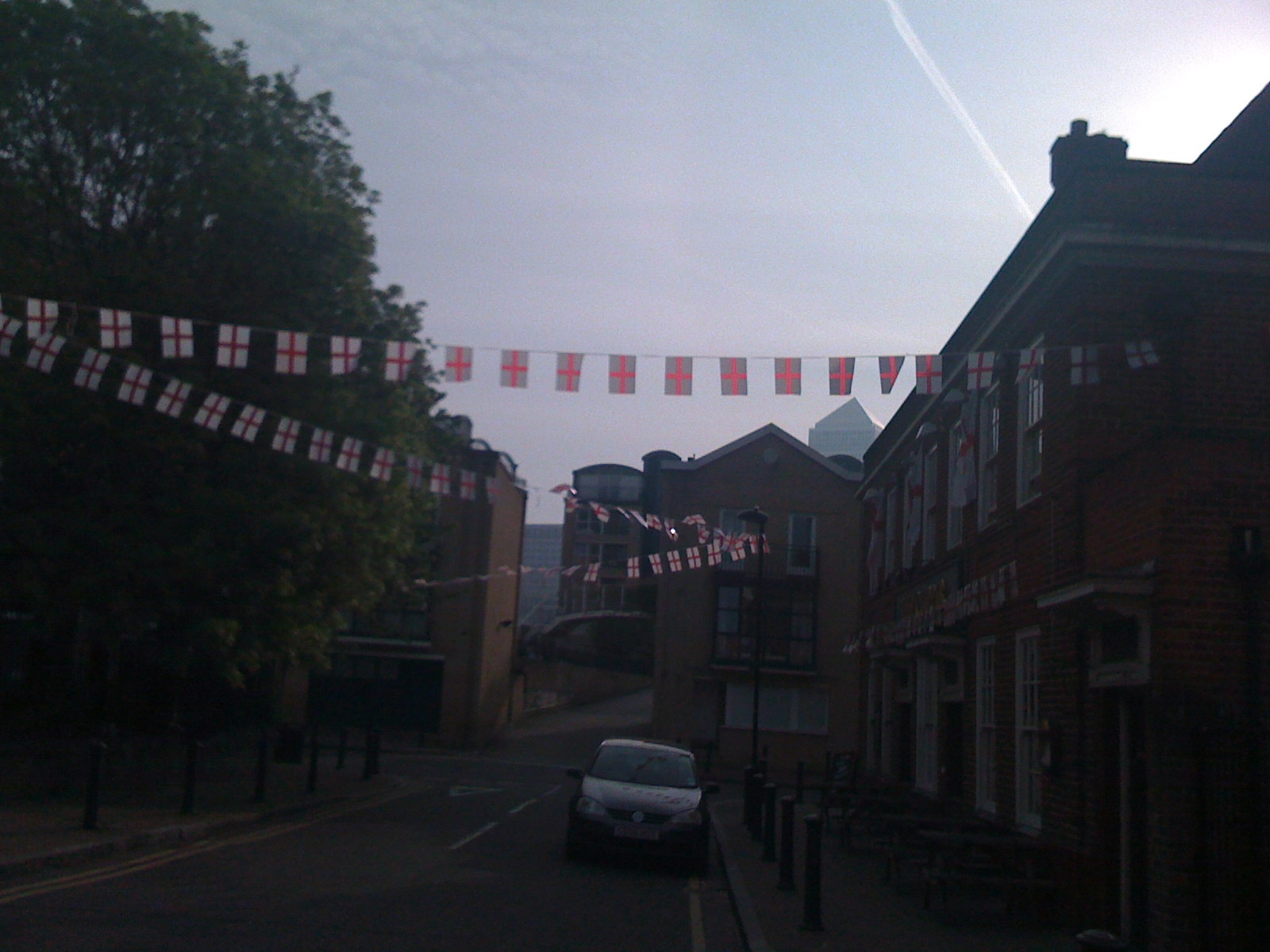
Happy St George
Cry ‘God for Harry, England, and St George!’

Posted in Uncategorized | 28 Comments

On the ride

After about six weeks on the road, living out of a suitcase and depending on the kindness of strangers friends I moved into a house in Rotherhithe on Saturday. It’s going to be a further week or two until the housebox arrives with all my gear, and goodness knows how long until BT connect the phone line and I can get internetted at home.

‘Home’. There’s a nice word. I feel like I haven’t had one for quite a while. Sydney was never intended to be a final destination, an ‘endpoint’ of our travels—the intention had always been to continue on to New Zealand after a couple of years—but with time ticking and grants looking ever less likely I was getting frustrated and somewhat unrooted. Then the new job landed in my lap and we all came back. Home.

Don’t get me wrong: I don’t regret any of it. It’s been fantastic, with highs and lows; a complete blast.

Since coming back, work-wise, it’s been just as breathtaking. I thought my role at F1000 was reasonably clear, even if how I actually did it was going to be a little fuzzy around the edges. But then, on my first day, the chairman sat me down and told me he’d dreamt up a new, different job title for me, and gave me a project that left me gasping for breath.

After two weeks (either side of Easter, so both of them a bit shorter than normal) I’ve clawed my way to the surface and am beating everything into shape. It’s going to be a lot of work, and it’s all rather new and exciting—and in a little while Martin, strangely, is going to tell you all about it.

This morning I left home and got to work nice and early, to find that I couldn’t log on to my PC because the ‘security log’ was full, and had to wait for one of the IT people to get in to fix it. Then, after I was in, I turned to a colleague behind me to talk about the weekend (and chickens and hiring cows—long story); and Windows crashed.

Bah. Thank goodness I’d brought in my new and could write this.

Posted in Uncategorized | 35 Comments

On the ‘phone

Friday afternoon bloglet.

Promega have released their Protocols and Applications Guide for the iPhone. This is so damned cool I might have to run off and download it.

Sounds perfect for the busy, gloved scientist —almost a shame I’m not one anymore.

Posted in Uncategorized | 57 Comments

On paying for Open Access

My ego was stroked earlier this week when I received an email from Branwen inviting me to speak at the Research Information Network ‘s Consultative Group meeting in May. (Branwen and I met last year at the Open Science workshop run by Cameron Neylon. Very good it was, too.) I then had a very informative half hour or so trolling around the RIN website.

The RIN is a publicly-funded organization that exists to research information and data issues that affect researchers (yes, that sounds a bit meta, I know) with the aim of developing policy and advocacy. Through surveys and reports the ultimate goal is to develop ‘a national framework to meet the information needs of researchers’.

I found a very interesting report on the use and impact of e-journals —no great surprises to me as I completed a market report on this very subject last year: however, there are some interesting statistical analyses in there and in what is probably the ultimate stroke of irony, I’ve ordered the hard copy to read through later (on the Tube, maybe).

But the thing that quite a few people here might be interested in is the report on paying for Open Access (OA) charges:

The Research Information Network and Universities UK have produced a guide (March 2009) to provide advice on paying open access publication charges: that is, fees levied by some journals for the publication of scholarly articles so that they can be made available free of charge to readers, immediately upon publication. The guide also sets out recommendations for universities and other research institutions, publishers, research funders, and authors.

http://www.rin.ac.uk/openaccess-payment-fees

I haven’t had chance yet to read the report in full (the new job is taking up most of my intellectual capacity at the moment and I’m still living out of a suitcase) but there are some intriguing findings:

  • Nearly three quarters of responding authors have published in a fully OA journal in the last five years
  • Fewer than half of the respondents said their Higher Education Institute has an OA policy
  • About a third said their institute encouraged OA publishing
  • the University of Nottingham has established a central OA page charge fund
  • perhaps somewhat obviously, Before they submit articles for open access publication, corresponding authors should ensure that they have access to the funds necessary to meet
  • the publication fee._

I’d be interested in reading what people think of this. You can download a glossy PDF to find out more.

Posted in Uncategorized | 20 Comments

On and on

I was thinking earlier this week, mostly thanks to various happening things (and the answer to the question posed therein, by the way, is only in physics but not often in biology—evolution for example is often deeply misunderstood by SF writers) how much of what we have in our hands was science fiction only ten, maybe 15 years ago and yet we still haven’t got a moonbase, and how my MacBook Pro was still sitting at Jenny’s place unloved, which is a real shame because it is a very lovely thing (and I’ve called her ‘Guinevere’, by the way, for reasons that don’t concern us) and how utterly cool it is that I am able to edit and produce a podcast using the software that comes with it for LabLit and who I could get to voice the intro (I have a candidate but need to ask her at my birthday party on Tuesday) and then I started, this afternoon that is, not last week because in the meantime I’ve gone up to Lincoln to say hello to my girls and then while I was thinking about the podcast Eva gChatted me and we talked about how she guessed I’d be be going to SciFoo ’09 (which I am, if I can save enough geld for the airfare); and then I was charging the first cool gadget I got on returning to the UK (within 24 hours of landing, in fact), and suddenly was moved to ask the entire world

Why is bluetooth on the iPhone so shit?

Continue reading

Posted in Uncategorized | 12 Comments

On the payroll

Hello London!

As you may have gathered, I’m finally back in the UK, and more to the point, working in London. Sort of living here, sort of itinerant: but at least I’ve been in the office this week.

The doyenne of all things LabLiteral has been putting up with me for the past week (and foolishly has agreed to next week too — and host a birthday party for me) while I get to grips with the rather interesting creature known as the Faculty of 1000.

Mug shot
Essential stationery

My job title is ‘Information Architect’ (which is more appropriate and less, well, businessy than ‘Business Development Manager). Essentially, that means I have been given responsibility for the F1000 product, in particular the website. And for the things that we have planned for it.

I’ve had a tiring but stimulating week and am finding my feet, gathering information and getting to know the team. They’re a good bunch at F1000 and I’m still rather excited, and am not missing the bench at all (which is, perhaps, a little bit surprising).

Ideas. We have lots of them. And I’m the proverbial new broom. Watch, as they say, this space.

Posted in Uncategorized | 37 Comments

On the train

I’m on my way to London. Two reasons: to brave the leeches (estate agents) and to start my new job on Monday.

For those of you who don’t know/haven’t been listening, the new gig is at the Faculty of 1000, which can be described as a biomedical literature fitering service. If you want to quickly get at the important and exciting papers in the biological hegemony F1000 should be your first port of call. I’ve been tweeting some of the reviews we’ve published, and hopefully I’ll soon be keeping a shiny new weblog to keep you informed of what we’re doing to make the world a better place.

Enough advertising. I’ll still be here, and yes Cath, it’ll still be called ‘The Scientist’. I did toy briefly with the idea of calling this bar ‘The New Scientist’ — and both ‘The Publisher’ and ‘The Web 2.0 Maven’ lightninged across my tortured cerebellum — but I decided to stick with elegant minimalism. Quiet in the cheap seats, Henry.

I feel that although I did wander into science almost by accident, I have always been a scientist and always will be, even if I don’t actually work at the bench any longer. This new vocation is one I’m choosing, but that doesn’t change who I am; just as I know I’m a writer and a poet, despite hordes of angry LabLitters baying for my blood –or at least my ink.

So. New challenges, new opportunities; and yes, I’m very excited. Apparently, because all the staff that were related to BioMed Central have now left, my desk is in an otherwise empty bay, facing the window. I’m looking forward to it, and I’ll tell anyone who cares to listen all about it on Monday evening after we’ve goggled at Experimental Heart at Fiction Lab (you are all coming, aren’t you?).

Now, about that house…

Continue reading

Posted in Uncategorized | 20 Comments